Should You Pay Off Your Mortgage Before You Retire?

Paying off your mortgage before retirement can reduce monthly expenses and provide greater peace of mind, but it may require using a significant portion of your investment portfolio or cash reserves. Whether it makes sense depends heavily on your mortgage rate, where the payoff money will come from, the tax consequences, and how much liquidity you want to maintain. At Greenbush Financial Group, we typically evaluate the mortgage decision as part of the household's broader retirement income and tax strategy rather than looking at the mortgage in isolation.
Should You Pay Off Your Mortgage Before You Retire?
For many people approaching retirement, the idea of entering retirement without a mortgage is appealing.
No mortgage payment means fewer monthly expenses, less debt, and potentially less pressure on your investment portfolio.
But there is another side to the decision.
If you have a $250,000 mortgage and pay it off before retirement, that $250,000 has to come from somewhere. It may come from cash, a taxable investment account, an IRA, or some combination of accounts. Once the money is used to pay down the mortgage, you also have less liquidity and fewer assets available to invest.
That creates the central tradeoff:
Do you want to retire with less debt, or retire with more money invested and available to you?
There is no universal answer. The right decision depends on your mortgage, your assets, your taxes, and what you want your retirement balance sheet to look like.
Start With Your Mortgage Interest Rate
One of the first numbers to consider is your mortgage rate.
A retiree with a 3% fixed mortgage faces a very different decision than someone with a 7% mortgage.
Paying off a mortgage effectively eliminates the future interest expense associated with that loan. The higher the mortgage rate, the more valuable that guaranteed savings becomes.
Consider two homeowners who each owe $250,000:
Homeowner A has a 3% mortgage.
Homeowner B has a 7% mortgage.
Homeowner A may have a stronger argument for keeping the mortgage and maintaining liquidity.
Homeowner B has a much higher cost of carrying debt. Paying off the loan becomes considerably more attractive because eliminating a 7% borrowing cost provides a meaningful guaranteed benefit.
What About the Mortgage Interest Tax Deduction?
Do not automatically assume that your mortgage rate should be reduced by a tax deduction.
Mortgage interest generally provides a federal tax benefit only when you itemize deductions and meet the applicable requirements.
For 2026, the standard deduction is $32,200 for married couples filing jointly and $16,100 for single filers.
Depending on your other deductions, your mortgage interest may provide little or no incremental federal tax benefit.
Where Will the Money Come From to Pay Off the Mortgage?
This is often more important than the mortgage balance itself.
Suppose you owe $250,000. Paying off the mortgage with $250,000 sitting in excess cash is very different from withdrawing $250,000 from a traditional IRA.
Potential funding sources include:
Bank savings and money market accounts
CDs or Treasury securities
Taxable brokerage accounts
Traditional IRAs or 401(k)s
Roth accounts
A combination of several accounts
Each source can have a different tax and planning impact.
Be Very Careful About Using an IRA
One of the biggest mistakes we see in mortgage payoff analysis is assuming that a $250,000 mortgage requires a $250,000 IRA withdrawal.
Traditional IRA distributions are generally taxable as ordinary income, except for amounts representing after-tax basis.
That means a retiree may need to withdraw considerably more than $250,000 to net $250,000 after federal and potentially state income taxes.
A large distribution could also push part of the household's income into higher federal tax brackets. For 2026, federal marginal rates range from 10% to 37%.
The tax consequences can extend beyond the immediate tax bill. Depending on the retiree's circumstances, a large increase in income may also affect other income-based retirement costs and tax calculations.
Key Insight: A mortgage payoff should not be evaluated until you know both the balance of the mortgage and the after-tax cost of accessing the money that would pay it off.
How Paying Off Your Mortgage Changes Retirement Cash Flow
Paying off a mortgage can have an important retirement benefit that has nothing to do with investment returns: it reduces the amount of income your household needs each month.
Suppose your mortgage requires $2,000 per month of principal and interest payments.
Eliminating it reduces annual cash flow needs by approximately $24,000.
That can mean:
Smaller portfolio withdrawals
Less pressure to sell investments during a market decline
More flexibility over where retirement income comes from
Lower ongoing fixed expenses
However, remember that paying off the mortgage does not eliminate every housing expense. Property taxes, homeowners insurance, maintenance, utilities, and association fees still need to be included in the retirement budget.
Example: $1.5 Million Portfolio and a $250,000 Mortgage
Consider a recently retired couple with:
$1.5 million investment portfolio
$250,000 remaining mortgage
4% fixed mortgage rate
$2,000 monthly principal and interest payment
$100,000 of annual spending before the mortgage is paid off
Assume for simplicity that they can access $250,000 from their portfolio without creating an immediate tax liability. In practice, the account type and embedded investment gains could materially change the analysis.
Option 1: Pay Off the Mortgage
They use $250,000 to eliminate the loan.
Their portfolio falls from approximately $1.5 million to $1.25 million.
In exchange:
The mortgage is gone.
Their required annual cash flow drops by roughly $24,000.
They no longer pay mortgage interest.
They have fewer assets exposed to market risk.
They have $250,000 less in liquid or invested financial assets.
Option 2: Keep the Mortgage
They keep the full $1.5 million invested and continue making the mortgage payments.
In exchange:
They retain greater liquidity.
More money remains available for emergencies and future opportunities.
The portfolio has more opportunity for long-term growth.
They continue paying mortgage interest.
They need approximately $24,000 more annual cash flow to cover the mortgage.
More of their wealth remains exposed to investment risk.
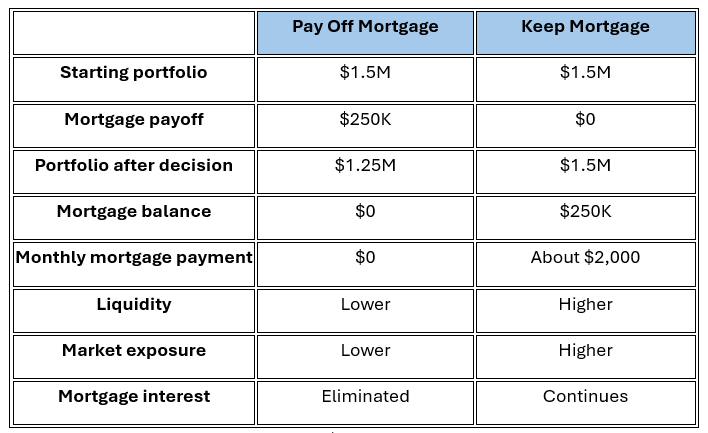
Neither household suddenly becomes $250,000 richer by choosing one option over the other. Paying off the mortgage converts part of the household's financial assets into additional home equity.
The question is which balance sheet and cash flow structure better supports their retirement plan.
Keeping the Mortgage Means Accepting Investment Risk
One argument for keeping a low-rate mortgage is that investments may earn more than the mortgage costs.
For example:
“Why pay off a 4% mortgage if my portfolio could earn 7%?”
That comparison is incomplete.
The 4% mortgage cost is contractual. The 7% investment return is an expectation, not a guarantee.
Stocks may produce attractive returns over long periods, but they can also decline significantly in individual years. Bonds and cash may provide more stability, but their expected returns may not provide a large advantage over the mortgage after considering taxes.
Keeping the mortgage therefore means making a conscious decision to retain both:
The debt, and
The investment risk on the assets that could otherwise eliminate the debt.
That may be reasonable, particularly with a low-rate mortgage and a well-funded retirement plan. But the decision should be understood as a risk tradeoff, not simply a comparison between two percentages.
Do Not Overlook Liquidity
Liquidity is one of the strongest arguments for not rushing to pay off a mortgage.
Suppose you put $250,000 into your home.
You still have the $250,000 in the form of home equity, but you cannot easily use that equity to pay for:
A major home repair
Healthcare expenses
A new vehicle
Family assistance
Travel
An investment opportunity
Unexpected retirement expenses
Accessing home equity later may require selling the house, taking out a new loan, or establishing a home equity line or similar borrowing arrangement.
This is particularly important for retirees because replacing liquidity can become more difficult after employment income ends.
Important Note: Before paying off a mortgage, determine how much liquid savings and investment assets will remain afterward. Becoming debt-free at the expense of becoming cash-poor is usually not the goal.
Taxes and Timing Can Change the Answer
Retirement creates several planning opportunities that should be coordinated with the mortgage decision.
For example, a household may retire at age 65 with a mortgage but decide not to pay it off immediately because most of its wealth is held in traditional retirement accounts.
Instead, the household could evaluate paying down the mortgage gradually using:
Existing cash
Taxable investments
Scheduled retirement distributions
Future required minimum distributions
Other sources of retirement income
Traditional IRA owners generally must begin required minimum distributions at age 73 under current rules, although individual starting ages can vary under applicable law.
This creates an important planning question:
Is it better to trigger a large tax bill today to eliminate the mortgage, or pay it down gradually while managing taxable income over several years?
For many retirees, timing the payoff can be just as important as deciding whether to pay it off.
Peace of Mind Has Financial Value Too
Not every retirement decision needs to be optimized to the last decimal point.
Some retirees strongly prefer knowing that their home is paid for.
They may sleep better during a market decline because their required monthly expenses are lower. They may value the simplicity of having fewer bills and less debt. They may also feel more comfortable taking investment risk elsewhere in the portfolio because their home is debt-free.
Those benefits are difficult to put into a spreadsheet, but they are still relevant.
On the other hand, another retiree may feel more comfortable having $250,000 available in a brokerage account rather than tied up in home equity.
Both preferences can be reasonable.
The objective is not necessarily to maximize theoretical net worth. It is to build a retirement plan that provides sustainable income, appropriate liquidity, manageable investment risk, and confidence in the household's ability to handle unexpected expenses.
Common Mortgage Payoff Mistakes Before Retirement
Several mistakes can make an otherwise reasonable mortgage payoff unnecessarily expensive.
Withdrawing a large amount from an IRA without calculating the tax impact. A $250,000 mortgage does not necessarily mean a $250,000 IRA distribution.
Comparing the mortgage rate directly with an assumed stock market return. Investment returns are uncertain. Mortgage interest savings are much more predictable.
Ignoring liquidity. A paid-off house can strengthen your balance sheet while simultaneously reducing the cash available for other needs.
Assuming mortgage interest is automatically deductible. You generally need to itemize deductions and satisfy applicable rules to receive the federal mortgage interest deduction.
Focusing only on net worth instead of retirement cash flow. Eliminating a mortgage can materially reduce the amount your portfolio needs to provide each year.
When Does Paying Off a Mortgage Before Retirement Make Sense?
Paying it off tends to make more sense when:
Your mortgage rate is relatively high.
You have sufficient cash or taxable assets available without creating a major tax bill.
You will still have substantial liquidity after the payoff.
Reducing monthly expenses materially strengthens your retirement income plan.
You want to reduce investment and sequence-of-returns risk.
Being debt-free provides meaningful peace of mind.
Keeping the mortgage tends to make more sense when:
Your mortgage carries a very low fixed interest rate.
Paying it off would require a large taxable IRA or 401(k) distribution.
The payoff would leave too little liquidity.
Your retirement plan can comfortably support the monthly payment.
You value maintaining flexible investment assets.
You are comfortable with the investment risk associated with keeping those assets invested.
Final Thoughts
The question is not simply, “Should I enter retirement debt-free?”
A better question is:
“What combination of debt, investments, taxes, liquidity, and monthly expenses gives our household the strongest retirement plan?”
For someone with $1 million to $2 million invested and a $200,000 to $300,000 mortgage, the decision can materially affect taxes, portfolio withdrawals, investment risk, and liquidity.
At Greenbush Financial Group, we believe mortgage decisions are best evaluated alongside the household's retirement income plan, investment allocation, tax strategy, and expected future expenses. Sometimes paying off the mortgage is the right choice. Sometimes keeping a low-rate mortgage is more efficient. In other situations, a gradual payoff provides a useful middle ground.
The goal is to make the decision in the context of your entire retirement plan rather than looking at the mortgage by itself.

Rob Mangold
About Rob……...
Hi, I’m Rob Mangold. I’m the Chief Operating Officer at Greenbush Financial Group and a contributor to the Money Smart Board blog. We created the blog to provide strategies that will help our readers personally, professionally, and financially. Our blog is meant to be a resource. If there are questions that you need answered, please feel free to join in on the discussion or contact me directly.
Frequently Asked Questions
-
Is it better to retire without a mortgage?Retiring without a mortgage can reduce fixed monthly expenses and provide peace of mind. However, paying it off may not be beneficial if doing so creates a large tax bill or leaves you with insufficient liquid assets.
-
Should I pay off a 3% mortgage before retirement?A 3% fixed mortgage may be worth keeping if your retirement cash flow comfortably supports the payment and paying it off would significantly reduce liquidity or create taxes. The decision should still consider investment risk and personal preferences.
-
Should I pay off a 7% mortgage before retirement?A 7% mortgage makes paying off the loan considerably more attractive because eliminating the debt avoids a relatively high borrowing cost. Taxes and liquidity should still be considered before making the payoff.
-
Should I use my IRA to pay off my mortgage?Using a traditional IRA to pay off a mortgage can create substantial taxable income because traditional IRA distributions are generally taxable. A large one-time withdrawal should be modeled carefully before proceeding.
-
Is it better to pay off the mortgage or keep the money invested?It depends on the mortgage rate, taxes, expected investment risk and return, liquidity needs, and retirement cash flow. Paying off the mortgage provides predictable interest savings, while keeping the money invested preserves liquidity and potential growth but exposes the assets to market risk.
-
How much cash should I keep after paying off my mortgage?There is no single amount that applies to every retiree. The remaining liquid assets should be sufficient to cover normal spending, emergencies, major planned expenses, and periods when selling investments may be undesirable.
-
Can paying off my mortgage reduce retirement withdrawals?Yes. Eliminating the mortgage reduces the household's required monthly cash flow. That may allow you to withdraw less from investment accounts each year, although property taxes, insurance, maintenance, and other housing expenses will continue.