
Married couples under 50 can potentially reduce their 2026 tax bill by maximizing retirement contributions, funding Health Savings Accounts, harvesting investment losses, and reviewing available tax deductions and credits. Many strategies must be completed by December 31, while certain retirement contributions can be made in early 2027. Greenbush Financial Group helps families coordinate these decisions to improve both current tax efficiency and long-term financial security.
Why Year-End Tax Planning Matters
As your household income grows, so can the complexity of your taxes.
For married couples in their 30s and 40s, higher salaries, bonuses, investment income, and raising children can create financial opportunities, but also unexpected tax bills.
You may be saving aggressively for retirement and making smart financial decisions while still overlooking opportunities to reduce your taxes.
The challenge is that many tax-saving strategies require action before December 31. Once the year ends, some of those opportunities disappear.
Here are eight strategies worth reviewing before the end of 2026.
1. Maximize Your 401(k) Contributions
One of the simplest ways to reduce taxable income is to increase contributions to your employer-sponsored retirement plan.
For 2026, employees under age 50 can contribute up to $24,500 to a 401(k) or 403(b).
If both spouses have eligible employer-sponsored plans, they could contribute a combined $49,000.
Example:
A married couple earns $250,000 annually and contributes $30,000 combined to traditional 401(k) accounts.
If they increase their combined contributions to $49,000, they could reduce their federal taxable income by another $19,000.
Assuming those additional contributions fall entirely within the 24% federal tax bracket, that represents approximately $4,560 in federal income tax savings.
Traditional 401(k) contributions generally reduce current taxable income, while Roth 401(k) contributions do not.
Planning Tip: Review your remaining paychecks now. Employee salary deferrals generally must be completed through payroll by December 31. Waiting until tax filing season is usually too late to increase your prior-year 401(k) contributions.
2. Maximize Health Savings Account Contributions
If your family participates in an HSA-eligible health plan, a Health Savings Account can provide valuable tax benefits.
For 2026, the HSA contribution limits are:
Individual coverage: $4,400
Family coverage: $8,750
HSAs offer three potential tax advantages:
Contributions are tax-deductible or made pre-tax.
Investment earnings can grow tax-free.
Withdrawals for qualified medical expenses are tax-free.
Example:
A married couple in the 24% federal tax bracket contributes $8,750 to an HSA.
That contribution could save approximately $2,100 in federal income taxes, assuming the full contribution is deductible at that rate.
Unlike flexible spending accounts, unused HSA funds can remain invested for future healthcare expenses.
Planning Tip: Eligible 2026 HSA contributions can generally be made until April 15, 2027. However, your contribution limit depends on qualifying coverage, eligibility during the year, and any employer contributions.
3. Review Roth vs. Traditional Retirement Contributions
Not every couple should automatically maximize traditional retirement accounts simply to reduce this year's taxes.
If your household expects to face higher tax rates in the future, Roth contributions may be worth considering.
Traditional retirement contributions generally provide tax benefits today, while qualified Roth withdrawals can be tax-free later.
Example:
A married couple currently falls within the 22% federal tax bracket but expects significantly higher income over the next decade.
Making Roth 401(k) contributions today may help create tax-free income in retirement, even though it means paying more taxes now.
On the other hand, a couple currently in a high tax bracket that expects significantly lower taxable income in retirement may benefit more from traditional contributions.
For 2026, married couples filing jointly face a direct Roth IRA contribution income phaseout between $242,000 and $252,000 of modified adjusted gross income.
Couples considering a Roth conversion should also evaluate the tax cost, since conversions generally create taxable income and must be completed by December 31 to count for 2026.
Key Insight: The objective isn't always to pay the least amount of taxes this year. It's to evaluate whether paying taxes now or later creates the better long-term outcome.
4. Harvest Investment Losses
If you have investments in taxable brokerage accounts, review whether any positions have unrealized losses.
Tax-loss harvesting involves selling investments at a loss to offset realized capital gains.
If losses exceed gains, up to $3,000 of net capital losses can generally offset ordinary income annually for married couples filing jointly. Remaining losses can carry forward.
Example:
You realized $15,000 in capital gains earlier this year.
You also own an investment that has declined by $10,000.
Selling that investment could offset $10,000 of your realized gains, potentially reducing your tax bill.
However, the wash-sale rule can disallow a loss if you purchase substantially identical securities within 30 days before or after the sale. Purchases in other accounts, including certain retirement accounts, may also create problems.
Planning Tip: Review realized gains and losses before December 31. Tax-loss harvesting should support your investment strategy, not dictate it. A tax deduction isn't worth making an investment decision that doesn't otherwise make sense.
5. Review Charitable Contributions
If you regularly donate to charity, year-end is a good time to evaluate how to make those contributions tax-efficiently.
For 2026, married couples filing jointly can generally deduct up to $2,000 in qualifying cash charitable contributions even when taking the standard deduction, subject to applicable requirements.
For couples who itemize, donating appreciated investments held longer than one year may provide additional benefits.
You may be able to avoid realizing capital gains while receiving a charitable deduction based on the investment's fair market value, subject to applicable limitations.
Example:
You purchased stock for $5,000 that is now worth $15,000.
Donating the shares directly to an eligible charity instead of selling them may help avoid capital gains taxes on the $10,000 appreciation.
For itemizers, charitable deductions in 2026 are also subject to a new 0.5% adjusted gross income threshold, along with other applicable limitations.
Planning Tip: Before making a large charitable gift, determine whether you will itemize deductions and whether donating cash or appreciated investments would provide the greater tax benefit.
6. Review Child-Related Tax Benefits
For married couples raising children, tax credits can make a meaningful difference.
The Child Tax Credit is worth up to $2,200 per qualifying child under age 17 in 2026.
For married couples filing jointly, the credit generally begins phasing out when modified adjusted gross income exceeds $400,000.
Families paying for childcare should also review the Child and Dependent Care Credit and any employer-sponsored dependent care flexible spending account.
These benefits can be particularly important for households with two working spouses and significant childcare costs.
Planning Tip: Coordinate childcare benefits between spouses and review how much you've contributed to dependent care accounts. The same expenses generally cannot be used for multiple tax benefits, and unused flexible spending account funds may be forfeited under the plan's rules.
7. Consider Capital Gains Before Year-End
Year-end tax planning isn't always about selling investments at a loss.
Sometimes recognizing gains intentionally makes sense.
For example, if one spouse took time off work or your household income was temporarily lower in 2026, you may have an opportunity to realize long-term capital gains at a favorable tax rate.
You could also consider realizing gains before a significant expected increase in household income.
However, capital gains can affect your adjusted gross income, eligibility for certain credits, and the 3.8% net investment income tax.
Key Insight: Evaluate investment gains and losses together. A year with unusually low income may create a valuable planning opportunity, but realizing gains simply to take advantage of a tax rate isn't always the right investment decision.
8. Review Tax Withholding and Estimated Payments
The final months of the year are a good opportunity to estimate your total 2026 tax liability.
This is especially important for couples who:
Have two high-paying jobs
Receive substantial bonuses
Earn self-employment income
Have investment income
Receive stock compensation
A common mistake among dual-income households is assuming each employer is withholding enough taxes.
Example:
Both spouses earn strong salaries, and each employer withholds federal taxes based on the information provided on that employee's Form W-4.
If those withholding elections don't properly account for the couple's combined household income, they could owe an unexpected amount when filing their joint return.
Reviewing your projected tax liability may allow you to adjust withholding or make an estimated tax payment before applicable deadlines.
Planning Tip: Don't wait until you file your tax return to discover a withholding shortfall. Review your projected income, tax payments, and potential balance due before the year ends.
Year-End Tax Planning Checklist
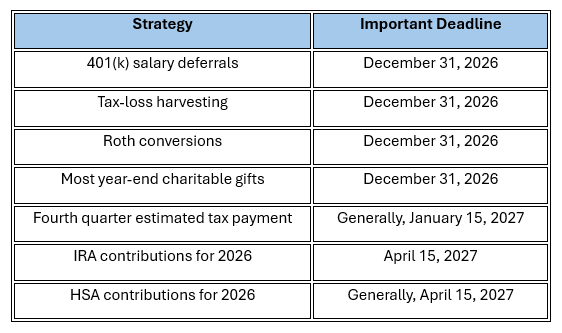
While some contributions can be made after December 31, many investment and payroll decisions must be completed before the calendar year ends.
Common Year-End Tax Planning Mistakes
Even well-intentioned tax strategies can create problems when they aren't coordinated.
Common mistakes include maximizing traditional retirement accounts without considering future tax brackets, selling investments without reviewing capital gains, and overlooking the combined income of both spouses.
Another mistake is focusing exclusively on current tax deductions rather than long-term financial goals.
For couples under 50, investment growth, career changes, children's education, and retirement savings all influence which tax strategies make sense.
The best strategy often involves coordinating several decisions rather than evaluating each tax deduction or investment transaction separately.
Five Questions to Ask Before December 31
Before the end of the year, consider:
Are we contributing enough to retirement accounts to take advantage of available tax benefits?
Should we prioritize traditional or Roth contributions based on our current and future tax situation?
Are there investment gains or losses we should review before year-end?
Are we taking advantage of the deductions and credits available to our household?
Have we withheld enough taxes based on our combined income?
Reviewing these questions before December 31 can help identify planning opportunities that may not be available once the year ends.
Final Thoughts
Year-end tax planning provides an opportunity to reduce taxes while strengthening your long-term financial position.
For married couples under 50, the most valuable strategies often involve coordinating retirement contributions, investment decisions, healthcare accounts, and household income.
At Greenbush Financial Group, we help families evaluate how these decisions work together, both to identify current tax planning opportunities and to support their long-term financial goals.
The objective isn't simply to reduce this year's tax bill. It's to make decisions today that can improve your financial position over time.
Taking time to review your options before December 31 can help you make more informed decisions for 2026 and beyond.

Rob Mangold
About Rob……...
Hi, I’m Rob Mangold. I’m the Chief Operating Officer at Greenbush Financial Group and a contributor to the Money Smart Board blog. We created the blog to provide strategies that will help our readers personally, professionally, and financially. Our blog is meant to be a resource. If there are questions that you need answered, please feel free to join in on the discussion or contact me directly.
Frequently Asked Questions
-
What is the best year-end tax strategy for married couples?
Maximizing traditional retirement contributions is often one of the most effective strategies, particularly for couples in higher tax brackets. However, HSAs, investment tax-loss harvesting, and charitable giving can also provide benefits. The best strategy depends on your household income and long-term financial goals. -
How much can a married couple contribute to a 401(k) in 2026?
If both spouses are under 50 and participate in eligible plans, they can each contribute up to $24,500, for a combined $49,000 in employee salary deferrals. -
Can married couples contribute to Roth IRAs in 2026?
Yes, subject to income and eligibility requirements. The direct Roth IRA contribution limit is $7,500 per eligible spouse under 50, with the married-filing-jointly income phaseout beginning at $242,000. -
Can I make 2026 retirement contributions in 2027?
Eligible IRA contributions can generally be made until April 15, 2027. However, employee 401(k) salary deferrals for 2026 generally must be completed by December 31, 2026.