How Do I Retire Before Age 65 and Pay for Health Insurance Until Medicare?
By Michael Ruger, CFP®
Partner and Chief Investment Officer at Greenbush Financial Group
One of the biggest obstacles to retiring before age 65 isn't necessarily having enough money in your 401(k). It's health insurance.
For many Americans, health insurance is tied to their employer. Once you retire and that employer-sponsored coverage ends, you need another solution to bridge the gap between your retirement date and Medicare eligibility. Most people become eligible for Medicare based on age at 65. That creates an important planning question for anyone considering retirement at 60, 62, 63, or even 64:
How am I going to pay for health insurance until Medicare begins?
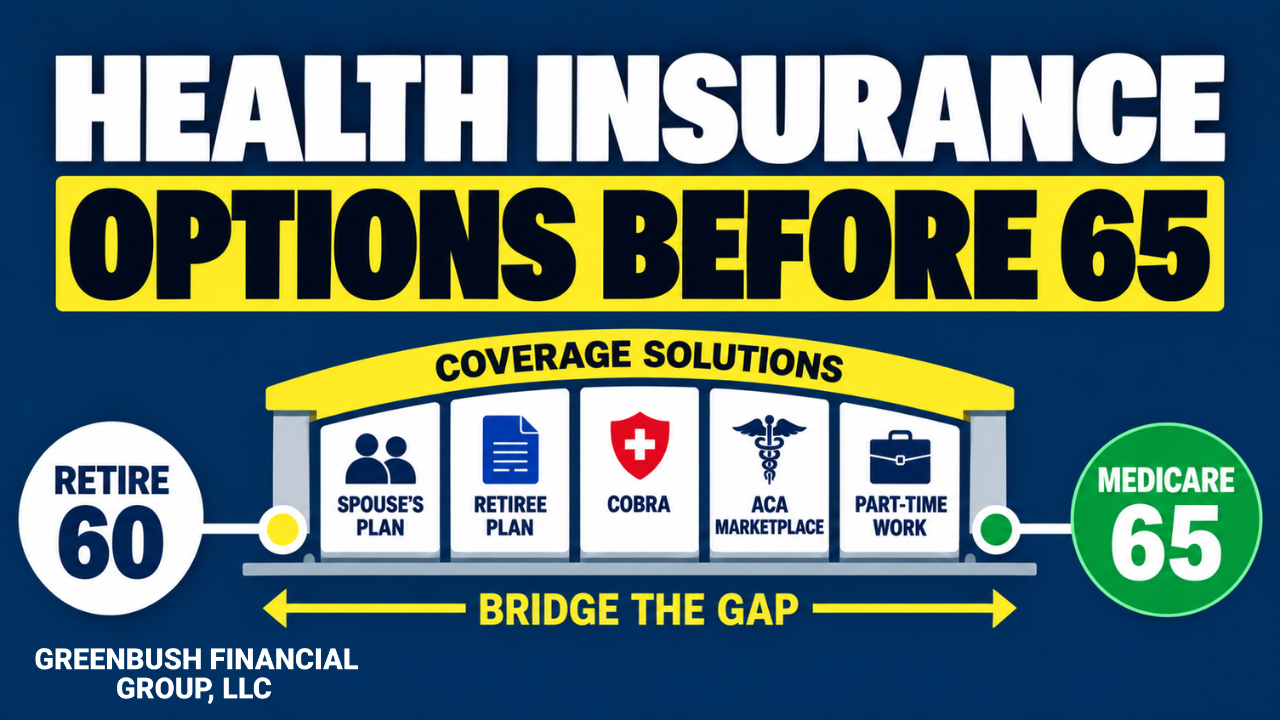
Fortunately, there are several potential solutions. The five most common options are:
Join a working spouse's employer health plan
Use retiree health insurance from your former employer
Continue your former employer's coverage through COBRA
Purchase health insurance through the Marketplace or your state's health insurance exchange
Continue working in a reduced or different role primarily to maintain employer health benefits
The right solution depends on more than simply the monthly premium. You also need to evaluate deductibles, prescription-drug coverage, doctors and hospital networks, out-of-pocket maximums, expected healthcare usage, and how long the coverage needs to last.
For someone planning to retire before 65, we generally want to know the answer to the health insurance question before setting the retirement date.
Why Health Insurance Is So Important When Retiring Before 65
When we build retirement plans for clients, healthcare is one of the first expenses we evaluate for someone who wants to retire before Medicare. Consider someone who wants to retire at age 60. They have approximately five years before Medicare eligibility based on age.
Even if they have sufficient retirement assets to cover their mortgage, property taxes, groceries, travel, utilities, and other living expenses, adding several years of private health insurance premiums and out-of-pocket medical costs can materially change the retirement projection.
Someone retiring at 64 has a much shorter bridge to Medicare.
That is why two people with exactly the same retirement assets and exactly the same annual living expenses could receive very different answers to the question:
“Can I afford to retire?”
Their healthcare situations could be completely different.
Option #1: Join Your Working Spouse's Health Insurance Plan
The simplest solution is often available when one spouse retires before the other. Suppose you are 62 and ready to retire, but your spouse is 59 and plans to continue working until age 65. If your spouse's employer offers health insurance to spouses, you may be able to join that employer-sponsored plan after your own employer coverage ends.
Losing other health coverage can generally create special enrollment rights in an employer-sponsored group plan. Under federal rules, the employee generally must request special enrollment within at least a 30-day window following the loss of the other coverage. This means you don't necessarily have to wait until your spouse's employer has its normal annual open-enrollment period. For many couples, this can be the easiest way to bridge the health insurance gap until Medicare.
Find Out What Spousal Coverage Actually Costs
Don't assume adding yourself to your spouse's health insurance will be inexpensive. Some employers heavily subsidize employee-only coverage but require employees to pay a much larger portion of the premium when adding a spouse.
Before selecting a retirement date, ask your spouse's employer for the actual premium associated with changing from employee-only coverage to employee-plus-spouse coverage. Suppose your spouse currently pays $250 per month for individual coverage. Adding you might increase the premium to $700 per month. Or it could increase it to $1,200.
The only way to build an accurate retirement plan is to obtain the actual numbers from the employer. We also want to compare the deductible, coinsurance, out-of-pocket maximum, prescription coverage, and provider network. A $600 monthly premium with a very high deductible could ultimately cost more than an $800 premium for a plan that provides significantly better coverage for your healthcare needs.
Option #2: Retiree Health Insurance From Your Former Employer
Some employers provide health insurance benefits to retirees.
These benefits aren't as common as they once were in many parts of the private sector, but they can still be available through certain employers, including some government and public-sector employers and other organizations with retiree benefit programs.
The structure varies dramatically from employer to employer. One plan might provide comprehensive medical and prescription coverage until age 65. Another might provide coverage beyond age 65 that coordinates with Medicare. Some employers subsidize a significant portion of the premium, while others require the retiree to pay a larger percentage of the cost.
If retiree healthcare is available to you, don't simply assume it's automatically your best option. Get the details.
Questions to Ask About Retiree Health Coverage
Before retiring, determine exactly how your employer's retiree health plan works.
How much will the monthly premium be?
Does the premium increase over time?
Does it cover your spouse?
What happens when you turn 65?
What happens when your spouse turns 65?
What are the deductible and out-of-pocket maximum?
Are your doctors and hospitals in-network?
How are your prescription medications covered?
Can you leave the retiree plan and later re-enroll?
These questions can have significant financial consequences.
For example, a retiree health plan might cost $600 per month but offer excellent prescription coverage. A Marketplace plan might have a lower premium but substantially higher costs for a medication you take every month.
This is why health insurance shouldn't be compared on premium alone.
Option #3: Use COBRA to Continue Your Employer Coverage
COBRA is another common solution for someone retiring before Medicare.
COBRA allows many employees and their families to temporarily continue the employer-sponsored health coverage they had before leaving employment.
Following termination of employment or a reduction in hours, federal COBRA continuation coverage is generally available for up to 18 months, assuming the employer and plan are subject to COBRA and the other requirements are met. The advantage is continuity. You may be able to maintain essentially the same employer health plan you had immediately before retirement.
That can mean keeping the same doctors, hospital network, deductible structure, and prescription coverage rather than immediately transitioning to a completely different health insurance plan. The disadvantage is usually cost.
Why Is COBRA So Expensive?
While you are working, you may not realize how much your health insurance actually costs.
Perhaps $400 is deducted from your paycheck each month. It would be easy to assume that the health plan costs $400. But your employer might be paying another $1,000 or more toward the premium behind the scenes. Once you move to COBRA, that employer subsidy may disappear.
Under federal COBRA rules, the plan can generally charge qualified beneficiaries up to 102% of the total cost of coverage. That can include both the portion you previously paid and the portion your employer previously paid, plus up to a 2% administrative charge.
Suddenly, health insurance that felt like it cost $400 per month while you were working might have a COBRA premium substantially higher than that. This is why we always want the actual COBRA premium before someone retires.
COBRA Can Work Particularly Well When You Retire Close to Age 65
The 18-month COBRA period can be especially useful for someone retiring relatively close to Medicare eligibility. Suppose you retire at age 63½. You have approximately 18 months before turning 65. COBRA may potentially bridge almost that entire period.
In that situation, the simplicity of maintaining the same health plan could make COBRA attractive, even if it isn't the cheapest available option. Now compare that with someone retiring at age 60. An 18-month COBRA period doesn't solve a five-year health insurance problem. That person may need COBRA initially and then another solution afterward, or may decide to use a Marketplace plan from the beginning.
Don't Compare COBRA and Marketplace Coverage Based Only on Premiums
This is extremely important.
Suppose COBRA costs $1,500 per month and a Marketplace plan costs $1,100.
The Marketplace plan looks like the obvious winner.
But what if you're taking an expensive prescription medication? Under your former employer's COBRA plan, perhaps that medication is covered favorably. Under the Marketplace plan, perhaps it falls into a different formulary tier, requires prior authorization, or has substantially different cost-sharing. You also need to check your doctors. Your current physician or specialist may participate in your COBRA plan but not the Marketplace plan you're considering. Hospital networks can differ as well.
The $400 per month premium savings could disappear quickly if you are paying significantly more for prescriptions or healthcare services.
The better comparison is:
Premiums + deductibles + expected out-of-pocket costs + prescription costs + provider access.
Option #4: Purchase Health Insurance Through the Marketplace
The fourth major option is purchasing individual health insurance through the Health Insurance Marketplace or the applicable state Marketplace. This is commonly referred to as ACA coverage or “Obamacare.”
Losing employer-sponsored health coverage generally creates a Special Enrollment Period, allowing you to enroll in Marketplace coverage outside the normal annual Open Enrollment period. Marketplace coverage can be particularly important for someone retiring several years before Medicare because, unlike COBRA, it isn't inherently limited to an 18-month continuation period. You can potentially use Marketplace coverage throughout the years leading up to Medicare, assuming you remain eligible and continue enrolling in available coverage.
Marketplace Coverage Can Come With Premium Tax Credits
One of the most important features of Marketplace insurance is that some households may qualify for premium tax credits that reduce their monthly health insurance costs. This is where retirement tax planning and health insurance planning begin to overlap.
Marketplace savings are generally based on your expected household income for the year of coverage.
That means retiring can dramatically change the calculation. Suppose you and your spouse earned $250,000 while you were working. You retire, your salary disappears, and your expected household income drops substantially. Depending on the applicable rules and your household circumstances, that lower income could affect the premium assistance available through the Marketplace.
This creates an important planning opportunity. But it can also create an important planning trap.
Roth Conversions Can Affect Your Marketplace Health Insurance Costs
Suppose you retire at age 62 and enroll in a Marketplace plan. Your employment income has stopped, so your household income initially looks relatively low. Your financial plan also identifies age 62 as an attractive year to process a large Roth conversion.
The Roth conversion generates additional taxable income. That additional income can affect the modified adjusted gross income used to determine Marketplace premium tax credits. You could therefore execute a Roth conversion that looks attractive from an income-tax perspective but unintentionally reduces your health insurance subsidy.
That doesn't necessarily mean the Roth conversion is a bad idea. It means the additional healthcare cost needs to be included in the analysis. When someone retires before 65 and uses Marketplace coverage, Roth conversion planning and health insurance planning should be coordinated.
Capital Gains and IRA Withdrawals Can Matter Too
Roth conversions aren't the only income events that can affect Marketplace subsidies. Traditional IRA distributions can affect income. Realized investment gains can affect income. Other taxable income can affect the calculation as well.
This is another reason why the years between retirement and Medicare can require particularly careful tax planning. Suppose you need $100,000 to support your lifestyle.
Taking the entire $100,000 from a traditional IRA may create a very different Marketplace income result than obtaining some of the cash from a taxable brokerage account with significant cost basis or from other sources. The tax characteristics of your retirement withdrawals can therefore influence not only your income-tax bill but potentially your health insurance costs.
Marketplace Coverage Isn't Necessarily Cheap for Higher-Income Retirees
It is also important not to assume that ACA Marketplace coverage will automatically be inexpensive. Premiums vary based on factors including age, location, household circumstances, plan selection, and applicable subsidies. An older pre-Medicare retiree who doesn't qualify for meaningful premium assistance could face substantial monthly premiums.
In some markets and circumstances, premiums can exceed $1,000 per month per person.
But that should not be treated as a universal estimate. The only reliable way to plan is to obtain actual quotes based on your expected retirement year, location, ages, household, and estimated income. That number should then be incorporated into your retirement cash-flow projection.
Be Careful When Moving From COBRA to Marketplace Coverage
Another issue retirees should understand is the timing of enrollment. Losing job-based health insurance can create a Marketplace Special Enrollment Period. HealthCare.gov generally provides a 60-day window surrounding the loss of qualifying coverage for applicable Special Enrollment Periods.
But voluntarily dropping COBRA later doesn't necessarily create a new Special Enrollment Period. If your COBRA coverage naturally expires, that loss can generally create a Marketplace enrollment opportunity. But if you elect COBRA and then simply decide several months later that it is too expensive and voluntarily cancel it, you may have to wait until another qualifying event or the normal Open Enrollment period to switch to Marketplace coverage.
That means the decision between COBRA and Marketplace insurance deserves careful consideration at retirement.
Option #5: Continue Working Primarily for Health Insurance
There is another option that isn't discussed nearly as often. Some people retire from their primary careers but continue working somewhere else largely because of health insurance.
Maybe you spent 30 years in a demanding executive role. At age 61, you have enough retirement assets and no longer need the same salary. But you still have four years until Medicare. Instead of continuing in the high-stress career, you might move into a lower-responsibility position, consulting role, or another job that provides access to health benefits.
In some cases, an employer may offer health insurance to eligible part-time employees. In other cases, someone may negotiate a reduced schedule with their existing employer while maintaining eligibility for benefits. The paycheck may be secondary. The real economic value of the job may be the health insurance.
Don't Underestimate the Value of Employer Health Benefits
Suppose a new position pays you only $30,000 per year.
At first glance, you might think:
“I'm financially independent. Why would I continue working for $30,000?”
But imagine that job also provides heavily subsidized health insurance that would otherwise cost your household $20,000 or $25,000 per year. Now the economics look very different.
You have the salary.
You have the health insurance subsidy.
You may have access to an HSA or other employee benefits depending on the plan.
You are also withdrawing less from your retirement portfolio during the early years of retirement.
For someone who doesn't mind continuing to work on a reduced schedule, this can be an effective bridge to Medicare. Of course, not every part-time position provides health benefits, so eligibility should be confirmed before relying on this strategy.
Compare the Five Health Insurance Options Side by Side
When we evaluate an early retirement, we generally don't want to look at these options independently.
We want to put them side by side.
For each option, identify:
Monthly premium: What will you actually pay every month?
Deductible: How much will you pay before major benefits begin?
Out-of-pocket maximum: What could healthcare cost during a bad medical year?
Doctor network: Can you continue seeing your current physicians and specialists?
Hospital network: Are your preferred hospitals covered?
Prescription coverage: Are your medications covered, and at what cost?
Length of coverage: Will this solution actually get you to Medicare?
Income sensitivity: Could changes in retirement income materially affect your premium or subsidy?
Spousal coverage: Does the option cover both spouses, and what happens when one spouse reaches 65 before the other?
Once those numbers are available, the decision becomes much easier to incorporate into the retirement plan.
A Hypothetical Early-Retirement Example
Assume John wants to retire at age 62.
His wife, Susan, is also 62 and has already retired.
Neither spouse has retiree health benefits.
They have approximately three years before Medicare eligibility based on age.
John's employer offers COBRA at a substantial monthly cost for the couple. Because COBRA following his retirement would generally last only 18 months, it doesn't solve their entire three-year problem.
They also obtain Marketplace quotes.
The Marketplace plan has a different provider network and prescription formulary, but depending on their expected household income, they may qualify for premium tax credits.
Now the retirement decision becomes more sophisticated.
Perhaps John and Susan use COBRA for the first 18 months because John is undergoing treatment with doctors who participate in his employer plan. They then transition to Marketplace coverage when COBRA is exhausted. Or perhaps the Marketplace plan provides acceptable coverage from the beginning and is significantly more cost-effective, making COBRA unnecessary. The answer depends on their actual healthcare needs and actual costs.
This is why there isn't one “best” pre-Medicare health insurance option for every retiree.
Start Planning at Least a Year Before Retirement
For someone planning to retire before age 65, I would not wait until the final month of employment to start researching health insurance. Ideally, begin the analysis approximately a year before your anticipated retirement date.
That gives you time to obtain COBRA estimates.
You can ask about retiree health coverage.
You can determine what it costs to join your spouse's plan.
You can research Marketplace coverage.
You can review prescription formularies and provider networks.
You can determine whether continuing to work part-time is an option.
Most importantly, you can incorporate those healthcare costs into the retirement plan before giving notice to your employer.
Health Insurance Can Change the Answer to “Can I Afford to Retire?”
Imagine your retirement projection shows that you can comfortably afford $80,000 of annual spending. But you didn't include health insurance. You retire at 60 and then discover that covering yourself and your spouse until Medicare costs tens of thousands of dollars per year between premiums and out-of-pocket expenses.
That could materially change the plan. This is why we consider pre-Medicare health insurance a retirement expense—not a separate insurance decision. It belongs in the same financial projection as housing, travel, property taxes, food, vehicles, and every other expense.
If health insurance costs $20,000 per year for five years, that is potentially a $100,000 expense before even accounting for inflation or out-of-pocket healthcare costs.
You need to know that before you retire.
Don't Forget to Plan the Transition to Medicare
The final part of the bridge is actually getting onto Medicare.
For most people becoming eligible based on age, the Medicare Initial Enrollment Period is a seven-month period surrounding age 65: it begins three months before the month you turn 65, includes your birthday month, and continues for three months afterward. You shouldn't assume that COBRA or retiree health coverage automatically handles your Medicare enrollment.
In particular, COBRA is not treated the same as coverage based on current active employment for every Medicare enrollment rule. Someone approaching 65 should confirm when to enroll in Medicare Part A and Part B based on their specific coverage so they don't inadvertently create a coverage gap or late-enrollment penalty.
The health insurance bridge isn't complete until the transition to Medicare has been properly planned.
So, How Do You Retire Before 65 and Pay for Health Insurance?
Retiring before Medicare is absolutely possible, but healthcare needs to be part of the retirement plan from the beginning. Start by determining whether you can join a working spouse's employer plan. If that isn't available, investigate whether your former employer provides retiree healthcare. Then compare COBRA with Marketplace coverage based on both cost and benefits.
If none of those options is financially attractive, consider whether continuing to work in a reduced role with health benefits could provide an effective bridge to age 65.
Most importantly, don't compare plans based only on monthly premiums.
The best health insurance option before Medicare depends on your doctors, prescriptions, deductibles, out-of-pocket limits, household income, available subsidies, and the number of years you need coverage.
For someone who wants to retire at 60, 62, or 64, answering the health insurance question can be just as important as determining how much money is in the 401(k).
Before deciding when you can afford to retire, determine how you will stay insured—and what that coverage is actually going to cost—until Medicare begins.

About Michael……...
Hi, I’m Michael Ruger. I’m the managing partner of Greenbush Financial Group and the creator of the nationally recognized Money Smart Board blog . I created the blog because there are a lot of events in life that require important financial decisions. The goal is to help our readers avoid big financial missteps, discover financial solutions that they were not aware of, and to optimize their financial future.
Frequently Asked Questions About Health Insurance When Retiring Before 65
-
How can I get health insurance if I retire before age 65?The most common options are joining a working spouse's employer plan, using retiree health coverage from your former employer, continuing your former employer coverage through COBRA, purchasing Marketplace insurance, or continuing to work in a job that provides health benefits. The best option depends on cost, coverage, prescriptions, provider networks, household income, and how long you need coverage before Medicare.
-
How much does health insurance cost if I retire before Medicare?There is no universal cost. Premiums vary significantly based on the type of coverage, age, location, household, employer subsidies, Marketplace premium tax credits, and plan selected. In addition to the premium, compare deductibles, coinsurance, prescription costs, and out-of-pocket maximums. Obtain actual estimates before selecting your retirement date.
-
Can I go on my spouse's health insurance after I retire?Often, yes, if you are otherwise eligible under your spouse's employer plan. Losing your own job-based health coverage can generally trigger special enrollment rights. Employer plans generally must provide at least 30 days to request applicable special enrollment following loss of other coverage, so contact the employer promptly rather than waiting for the next annual open-enrollment period.
-
How long can I stay on COBRA after I retire?For termination of employment or reduction in hours, federal COBRA continuation coverage generally lasts up to 18 months. Certain circumstances can provide longer continuation periods. This makes COBRA potentially useful for someone retiring within approximately 18 months of Medicare eligibility, although eligibility and exact timing should be confirmed with the employer's plan administrator.
-
Is COBRA or Marketplace insurance better for early retirees?Neither is automatically better. COBRA can provide continuity with your existing employer plan, doctors, and prescription coverage, but you may pay up to 102% of the plan's total cost. Marketplace coverage may offer premium tax credits based on household income, but provider networks, deductibles, and prescription coverage can differ. Compare total expected healthcare costs rather than premiums alone.
-
Can I get an ACA subsidy if I retire before age 65?Potentially. Marketplace savings are generally based on expected household income for the year of coverage. Retirement can reduce household income and potentially change eligibility for premium tax credits. IRA distributions, Roth conversions, investment income, and capital gains can affect the income calculation, so tax and health insurance planning should be coordinated.
-
Do Roth conversions affect ACA health insurance subsidies?They can. A taxable Roth conversion generally increases modified adjusted gross income, which can affect Marketplace premium tax credits. A Roth conversion that saves income taxes over the long term could simultaneously increase current health insurance costs by reducing available premium assistance. Both effects should be modeled before deciding how much to convert.
-
Can I use COBRA until I turn 65 and then switch to Medicare?COBRA can sometimes bridge the entire gap when retirement occurs within approximately 18 months of Medicare eligibility. However, Medicare enrollment rules need to be handled carefully because COBRA isn't treated the same as active-employment coverage for all Medicare enrollment purposes. Begin planning your Medicare enrollment before 65 rather than simply waiting for COBRA to end.
-
Should I work part-time just to keep health insurance before Medicare?For some early retirees, this can be a practical strategy. A lower-stress or reduced-hours position that provides employer-subsidized health coverage can reduce both healthcare expenses and withdrawals from retirement savings. However, not all part-time positions provide benefits, so confirm eligibility, premiums, deductibles, and required working hours before relying on the strategy.
-
When should I start planning for health insurance if I want to retire before 65?Ideally, begin researching coverage approximately one year before retirement. Obtain estimates for COBRA, spousal coverage, retiree health insurance, and Marketplace plans. Review doctors, prescriptions, deductibles, and out-of-pocket limits as well as premiums. Incorporating realistic healthcare expenses into the retirement projection before leaving your job can help determine whether the planned retirement date is financially sustainable.