2026 How Much Can You Spend in Retirement? Safe Withdrawal Breakdown

The amount you can safely spend in retirement depends on your portfolio size, withdrawal strategy, and how long your retirement may last. A common rule of thumb is withdrawing 3% to 4% of your portfolio annually, which aims to provide sustainable income over 25 to 30 years. At Greenbush Financial Group, our analysis shows that while these guidelines are helpful, the “right” spending level depends on your tax situation, market conditions, and flexibility in retirement.
What Is a Safe Withdrawal Rate?
A safe withdrawal rate is the percentage of your retirement portfolio you can withdraw each year without running out of money.
General Guidelines
3% withdrawal rate → More conservative, longer-lasting
4% withdrawal rate → Balanced approach
5%+ withdrawal rate → Higher income but increased risk
Example Based on Portfolio Size
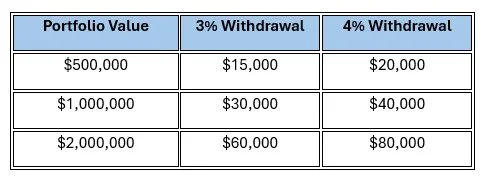
At Greenbush Financial Group, we often see retirees lean toward the lower end of this range when planning for longer life expectancies.
Why the 4% Rule Is Only a Starting Point
The 4% rule is one of the most widely used retirement planning guidelines, but it is not a guarantee.
What the Rule Assumes
A 30-year retirement
A balanced investment portfolio (stocks and bonds)
Consistent inflation adjustments
Why It Needs Adjustment
People are living longer
Market returns are unpredictable
Inflation can vary significantly
Because of these variables, our analysis at Greenbush Financial Group often incorporates more flexible withdrawal strategies rather than relying on a fixed percentage every year.
How Inflation Impacts Your Spending Power
Your retirement spending needs will likely increase over time due to inflation.
Example
Starting income need: $50,000
20 years later at 3% inflation ≈ $90,000
This means your withdrawal strategy needs to account for rising costs, not just current expenses.
Key Planning Insight
Maintaining some exposure to growth investments can help your portfolio keep pace with inflation over time.
The Role of Social Security and Other Income Sources
Your safe spending level is not just based on your portfolio.
Common Income Sources
Social Security benefits
Pensions
Rental income
Part-time work
Example Scenario
Portfolio withdrawal: $40,000
Social Security: $30,000
Total annual income: $70,000
At Greenbush Financial Group, we find that combining guaranteed income sources with portfolio withdrawals often leads to more stable retirement plans.
Sequence of Returns Risk: Why Timing Matters
One of the biggest risks to retirement spending is experiencing poor market returns early in retirement.
Why It Matters
If you withdraw from your portfolio during a market downturn, you may lock in losses that reduce long-term sustainability.
Example
Two retirees with identical portfolios can have very different outcomes depending on when market downturns occur.
Planning Strategy
Reduce withdrawals during down markets
Maintain a cash reserve
Use diversified income sources
Flexible Spending vs Fixed Spending
Rigid withdrawal strategies can increase risk. Flexibility often improves outcomes.
Fixed Spending Approach
Withdraw the same inflation-adjusted amount each year
Simple, but less adaptable
Flexible Spending Approach
Adjust withdrawals based on market performance
Spend less in down years
Increase spending when markets perform well
At Greenbush Financial Group, we often see better long-term success with flexible withdrawal strategies.
Taxes: The Hidden Impact on Retirement Spending
Your withdrawal amount is not the same as your spendable income.
Key Tax Considerations
Traditional retirement account withdrawals are taxable
Roth accounts can provide tax-free income
Social Security may be partially taxable
Required Minimum Distributions (RMDs) can increase taxable income later
Example
Withdrawal: $50,000
Taxes owed: $5,000–$10,000 (varies)
Net spendable income: $40,000–$45,000
Tax planning plays a major role in determining how much you can actually spend each year.
How to Determine Your Personal Spending Number
There is no universal answer, but you can estimate your safe spending range by combining several factors.
Step-by-Step Approach
Calculate your total retirement savings
Apply a 3% to 4% withdrawal rate
Add guaranteed income sources
Adjust for taxes
Factor in inflation and healthcare costs
Example
Portfolio: $1,000,000
4% withdrawal: $40,000
Social Security: $30,000
Estimated total income: $70,000
When You May Need to Spend Less
Certain situations require a more conservative approach.
Common Scenarios
Early retirement (longer time horizon)
High healthcare costs before Medicare
Market volatility early in retirement
High fixed expenses
In these cases, a 3% withdrawal rate or flexible strategy may be more appropriate.
Final Thoughts
Your safe retirement spending level is not just about a percentage. It is about balancing income, taxes, investment strategy, and flexibility. At Greenbush Financial Group, our analysis shows that retirees who adjust spending based on market conditions and maintain multiple income sources tend to have more sustainable outcomes.
Understanding how much you can safely spend each year is one of the most important steps in building a retirement plan that lasts.

Rob Mangold
About Rob……...
Hi, I’m Rob Mangold. I’m the Chief Operating Officer at Greenbush Financial Group and a contributor to the Money Smart Board blog. We created the blog to provide strategies that will help our readers personally, professionally, and financially. Our blog is meant to be a resource. If there are questions that you need answered, please feel free to join in on the discussion or contact me directly.
Frequently Asked Questions
-
What is the safest withdrawal rate in retirement?Around 3% is generally considered more conservative for long retirements.
-
Is the 4% rule still reliable?It is a useful guideline, but many planners now recommend flexibility depending on market conditions.
-
How much can I spend each year in retirement?Typically 3% to 4% of your portfolio, plus any additional income like Social Security.
-
Should I adjust my spending each year?Yes, adjusting based on market performance can improve long-term outcomes.
-
Do taxes reduce my retirement income?Yes, taxes can significantly reduce your net spendable income depending on account types.