
A $1 million retirement portfolio can generate meaningful income, but whether it is enough depends on your spending, longevity, and withdrawal strategy. In many cases, a balanced approach suggests withdrawing around 3% to 4% annually, which translates to $30,000 to $40,000 per year before taxes. At Greenbush Financial Group, our analysis shows that $1 million is often a solid foundation, but rarely a complete solution without additional income sources like Social Security.
How Much Income Can $1 Million Generate in Retirement?
The most common starting point is the safe withdrawal rate, which estimates how much you can withdraw annually without running out of money.
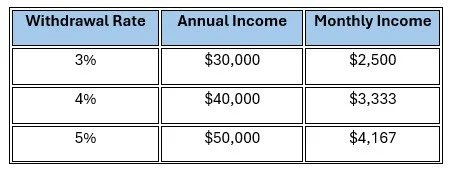
Typical Withdrawal Guidelines
3% withdrawal rate = $30,000 per year
4% withdrawal rate = $40,000 per year
5% withdrawal rate = $50,000 per year (higher risk of depletion)
What This Means in Practice
How Social Security Changes the Equation
For most retirees, Social Security becomes a critical piece of the income plan.
Example Scenario
Portfolio withdrawal (4%) = $40,000
Social Security benefit = $25,000
Total annual income = $65,000
This is where $1 million becomes much more realistic.
Key Insight
Without Social Security, $1 million alone often supports a moderate lifestyle. With Social Security, it can support a comfortable retirement for many households, depending on spending habits.
Inflation: The Silent Risk to Your Retirement Plan
One of the biggest risks retirees face is rising costs over time.
Example
Year 1 expenses = $60,000
20 years later at 3% inflation ≈ $108,000
This is why simply matching your current expenses is not enough. Your income needs to grow over time, which will usually require keeping a portion of your portfolio invested.
At Greenbush Financial Group, we emphasize maintaining a growth component even in retirement portfolios to help offset inflation risk.
How Long Will $1 Million Last?
The longevity of your portfolio depends heavily on:
Withdrawal rate
Investment returns
Market volatility
Lifespan
General Guidelines
3% withdrawal → Often sustainable for 30+ years
4% withdrawal → Historically sustainable, but not guaranteed
5%+ withdrawal → Increased risk of running out of money
Sequence of Returns Risk
Early market downturns in retirement can significantly impact how long your money lasts. This is known as sequence of returns risk, and it is one of the most important planning factors.
What Lifestyle Does $1 Million Support?
The answer varies widely depending on location, spending, and lifestyle expectations.
Likely Scenarios
Modest Lifestyle
Lower cost-of-living area
Limited travel
Paid-off home
Income need: $40,000–$60,000
Moderate Lifestyle
Some travel and discretionary spending
Healthcare costs rising over time
Income need: $60,000–$90,000
High-Spending Lifestyle
Frequent travel, luxury expenses
Higher healthcare and insurance costs
Income need: $100,000+
In many cases, $1 million alone may fall short for higher spending lifestyles without additional income sources.
Tax Considerations on Retirement Income
Not all $40,000 of income is actually spendable.
Key Tax Factors
Traditional IRA/401(k) withdrawals are taxed as ordinary income
Roth IRA withdrawals may be tax-free
Social Security may be partially taxable
Required Minimum Distributions (RMDs) begin in your 70s
At Greenbush Financial Group, tax-efficient withdrawal strategies are often the difference between a plan that works and one that struggles.
Strategies to Make $1 Million Last Longer
There are several ways to improve the sustainability of a $1 million portfolio.
Planning Strategies
Delay Social Security to increase guaranteed income
Use Roth conversions to reduce future taxes
Adjust withdrawals based on market performance
Maintain a diversified portfolio with growth exposure
Reduce fixed expenses before retirement
Real-World Insight
We often see that retirees who remain flexible with spending and withdrawals tend to have significantly better outcomes than those who follow a rigid income plan.
When $1 Million May Not Be Enough
There are specific situations where $1 million may fall short:
Early retirement (before age 62 or 65)
High healthcare costs before Medicare
Significant debt or mortgage payments
High inflation environments
Supporting family members financially
Market downturns and investment mismanagement
In these cases, additional planning becomes critical.
Final Thoughts
A $1 million portfolio can absolutely support retirement, but it is not a one-size-fits-all solution. At Greenbush Financial Group, our analysis shows that success depends on how income is generated, how taxes are managed, and how flexible the retiree is with spending.
For many households, $1 million works best when combined with Social Security and a well-structured withdrawal strategy.

Rob Mangold
About Rob……...
Hi, I’m Rob Mangold. I’m the Chief Operating Officer at Greenbush Financial Group and a contributor to the Money Smart Board blog. We created the blog to provide strategies that will help our readers personally, professionally, and financially. Our blog is meant to be a resource. If there are questions that you need answered, please feel free to join in on the discussion or contact me directly.
- Can you retire comfortably with $1 million?Yes, but it depends on your spending level, location, and whether you have additional income like Social Security.
- How much monthly income does $1 million generate?At a 4% withdrawal rate, about $3,300 per month before taxes.
- Is the 4% rule still safe in 2026?It is a useful guideline, but many financial planners now recommend closer to 3% to 4% depending on market conditions.
- What is the safest withdrawal rate for retirement?Around 3% is generally considered more conservative for long retirements.
- How long will $1 million last in retirement?It can last 25 to 30+ years depending on withdrawal rate, investment returns, and market conditions.