
You can purchase a new home before selling your current home by using a bridge loan, home equity line of credit (HELOC), investment assets, a traditional mortgage, a home sale contingency, or potentially a 60-day IRA rollover. Each option has different borrowing costs, tax implications, and risks. For retirees and individuals approaching retirement, the best solution often depends on how quickly the existing home will sell and how the purchase affects retirement income and investments. Greenbush Financial Group helps families evaluate these options as part of their overall financial plan.
Buying a New Home Before Selling Your Current Home
You've found the perfect house, but there's one problem. Your current home hasn't sold yet, and much of the money you plan to use for the new purchase is tied up in your existing property.
This situation is especially common among retirees who are downsizing, relocating closer to family, or purchasing a home better suited for retirement.
The good news is that you may not have to sell your existing home before purchasing the next one.
However, the way you finance that purchase matters. A decision that helps you buy the house today could create unexpected taxes, borrowing costs, or pressure on your retirement savings later.
Here are six strategies worth considering and the potential trade-offs of each.
6 Ways to Buy a House Before Selling Your Current Home
1. Use a Bridge Loan
A bridge loan is short-term financing designed to help homeowners purchase another property before their current home sells.
Depending on the lender and loan structure, a bridge loan may allow you to borrow against your existing home's equity to fund the new purchase.
Example:
Current home value: $700,000
Existing mortgage balance: $100,000
New home purchase price: $550,000
Expected sale of current home: Within four months
A lender may offer bridge financing secured by the existing property, allowing you to access some of its equity before the sale closes.
When the current house sells, the proceeds can be used to repay the bridge loan.
Advantages:
Access home equity without selling first.
Make an offer that isn't dependent on selling your current property.
Avoid liquidating retirement investments.
Disadvantages:
Bridge loans may carry higher interest rates and fees than traditional mortgages.
You could temporarily have multiple loan payments.
If your existing home takes longer to sell, financing costs can increase.
Loan terms may include a balloon payment or other short repayment deadline.
Key Insight: A bridge loan can make sense when you have significant home equity, sufficient cash flow, and a realistic expectation that your existing property will sell relatively quickly.
Before committing, consider whether you could comfortably manage the loan if your current home takes six months to sell instead of four.
2. Open a Home Equity Line of Credit (HELOC)
A HELOC allows you to borrow against the equity in your current home.
Unlike a traditional mortgage, a HELOC operates as a revolving line of credit. You generally pay interest only on the amount borrowed during an interest-only draw period, subject to the lender's terms.
Example:
Suppose you need $200,000 for the down payment on your new home.
You establish a HELOC on your existing residence and borrow $200,000 to complete the purchase.
Assuming an illustrative 8% annual interest rate and interest-only payments:
HELOC balance: $200,000
Approximate monthly interest: $1,333
Four months of interest: $5,333
Eight months of interest: $10,667
Once the existing home sells, the HELOC can be paid off using the proceeds.
This example excludes loan fees and assumes the interest rate stays constant.
Advantages:
Potentially lower upfront costs than some bridge loans.
Borrow only what is necessary.
May offer flexible repayment terms.
Disadvantages:
HELOC rates are typically variable.
The current home serves as collateral.
Lenders may restrict opening a HELOC once a property is listed for sale.
The outstanding balance generally must be repaid when the property sells.
Important Note: If you anticipate moving within the next year, consider discussing HELOC eligibility with your lender before listing your home.
The biggest consideration isn't just the interest rate. It's whether you can comfortably carry the loan if your home takes longer to sell than expected.
3. Temporarily Use Your Investment Portfolio
For retirees with substantial non-retirement investments, another option is to use existing investment assets to help purchase the new home.
This can be accomplished in two different ways.
Option A: Sell investments to raise cash
Suppose you have a $1.5 million investment portfolio and need $300,000 to purchase your next home.
You could liquidate $300,000 from a taxable brokerage account, purchase the property, and replenish the portfolio after your existing home sells.
However, selling appreciated investments could generate capital gains taxes. You may also miss potential market gains while the money is out of the portfolio.
Option B: Borrow against your investment portfolio
Some financial institutions offer securities-backed lines of credit, allowing eligible investors to borrow against investments without immediately selling them.
For example, you might borrow $300,000 using a taxable investment account as collateral and repay the loan when your existing home sells.
This may avoid an immediate capital gains event, but it doesn't eliminate financial risk.
If investment values decline, the lender may require additional collateral or repayment. Securities may even be sold to satisfy the lender's requirements, potentially at an unfavorable time.
Key Insight: Using investment assets may be practical for households with significant liquid savings, but the strategy should be evaluated alongside capital gains taxes, portfolio risk, and retirement income needs.
For retirees, there is also an important distinction between using a taxable brokerage account and withdrawing money from a traditional IRA or 401(k).
Withdrawals from traditional retirement accounts generally create taxable income. A large withdrawal could also affect Medicare premiums through income-related monthly adjustment amounts (IRMAA).
Before selling or borrowing against investments, consider whether the temporary financing costs could be less than the potential tax consequences or investment risks.
4. Purchase the New Home With a Traditional Mortgage
Another option is to purchase the new property with a conventional mortgage and use the sale proceeds from the existing home to reduce or eliminate that debt later.
This strategy may be especially useful for retirees who have enough income and assets to qualify for temporary financing.
Example:
You purchase a new home for $600,000 using:
$120,000 down payment
$480,000 mortgage
Six months later, your existing home sells and generates $450,000 in net proceeds.
You could apply those proceeds toward the new mortgage balance.
Depending on the loan terms, you may then have the option to pay off the remaining loan balance, refinance, or request a mortgage recast.
A mortgage recast allows an eligible borrower to make a substantial principal payment and have the lender recalculate the required monthly payment based on the remaining balance and loan term, without changing the existing interest rate.
Not every mortgage qualifies for a recast, so this option should be confirmed before closing.
Important Consideration for Retirees
Even if you have significant assets, qualifying for a new mortgage can be more complicated after retirement.
Lenders evaluate income, debt obligations, and available assets. Certain retirement income and qualifying investment assets may help demonstrate your ability to repay the loan.
You may also have to qualify while carrying the housing expenses associated with both properties.
Fannie Mae's guidelines generally require lenders to consider both homes' housing expenses when the existing residence hasn't sold. Certain exceptions apply when there is an executed sale contract and financing contingencies have been cleared.
Planning the mortgage application before retirement, or before giving up employment income, can sometimes make the financing process easier.
Planning Tip: If your strategy depends on paying down and recasting the mortgage after your current home sells, confirm the lender's requirements before making the purchase.
5. Make an Offer Contingent on Selling Your Current Home
A home sale contingency allows you to purchase a new property only if your existing home sells under the conditions specified in the purchase agreement.
This approach can reduce the need for temporary financing and help protect your retirement savings.
However, the seller may prefer another buyer whose offer does not depend on selling a property.
A contingency may work well when:
The housing market is less competitive.
The seller is flexible on closing dates.
Your current home is already under contract.
You want to avoid carrying two properties simultaneously.
Key Insight: While a contingent offer may be less competitive, it can protect your liquidity and reduce the need to take on additional debt.
For retirees who prioritize financial flexibility over moving quickly, this option may be worth considering.
6. Use a 60-Day IRA Rollover
For retirees with substantial IRA savings, another potential strategy is to temporarily access retirement funds using the IRS's 60-day rollover rule.
Under this rule, you can generally withdraw eligible funds from an IRA and redeposit the money into the same IRA or another eligible retirement account within 60 days without triggering income taxes on the amount successfully rolled over.
While this strategy is not technically a loan, it can provide temporary access to funds for purchasing a new home while waiting for your existing property to sell.
Example:
Suppose you have:
Traditional IRA balance: $1,200,000
Cash needed to purchase your new home: $300,000
Existing home already under contract
Expected closing date: Within 30 days
You could potentially withdraw $300,000 from your IRA and use those funds to purchase the new property.
Once your existing home sells, you could use $300,000 of the sale proceeds to replenish your IRA, provided the rollover is completed within the required 60-day period.
If the full amount is properly rolled over within 60 days and all applicable requirements are satisfied, the transaction generally would not create taxable income.
However, if the home sale is delayed and you cannot replace the funds by the deadline, the consequences could be significant.
Advantages:
Access retirement funds without applying for a traditional loan.
Avoid interest expenses and loan origination fees.
Potentially avoid income taxes if the full eligible amount is rolled over within 60 days.
May provide a short-term financing solution when an existing home sale is already scheduled to close.
Disadvantages:
The 60-day rollover deadline is strict.
If the funds aren't rolled over on time, the taxable portion of the distribution generally becomes taxable income.
An additional 10% early withdrawal tax may apply if you're under age 59½ and no exception applies.
The IRS generally permits only one IRA-to-IRA 60-day rollover within a 12-month period, regardless of how many IRAs you own.
Tax withholding may reduce the amount you receive, requiring additional funds to complete a full rollover.
A delayed home sale could leave you without the cash needed to replace the distribution.
Important Consideration for Retirees
The biggest risk with this strategy is relying on a home sale that has not yet closed.
For example, suppose you withdraw $300,000 from a traditional IRA to purchase a new house, expecting your existing property to sell within 30 days.
If the buyer's financing falls through or closing is delayed beyond the 60-day rollover deadline, you may be unable to return the funds in time.
In that situation, the amount that is not successfully rolled over could be treated as a taxable IRA distribution.
For retirees, this could result in substantial federal and state income taxes and potentially higher future Medicare premiums due to income-related monthly adjustment amounts (IRMAA).
There are also several important IRS restrictions to understand.
The one-rollover-per-year rule generally applies to IRA-to-IRA 60-day rollovers across all of an individual's IRAs, rather than separately to each account.
Additionally, required minimum distributions (RMDs) are not eligible for rollover treatment. This is particularly important for older retirees who are already required to take annual IRA distributions.
Traditional IRA distributions paid directly to an individual are also generally subject to 10% federal income tax withholding unless the individual elects out or selects a different withholding amount. Any amount withheld must be replaced using other funds if the goal is to complete a rollover of the full distribution.
Although the IRS may provide relief from the 60-day deadline under certain qualifying circumstances, you should not assume that a delayed home sale will qualify for an extension.
Key Insight: A 60-day IRA rollover may be worth considering when your existing home is already under contract, closing is expected soon, and you have a reliable backup source of funds to complete the rollover if the sale falls through.
Because of the strict deadline and potential tax consequences, this strategy generally carries more timing risk than a bridge loan or HELOC.
Planning Tip: Before using a 60-day IRA rollover to help purchase a home, consult your financial advisor and tax professional to confirm eligibility, withholding requirements, and your ability to replace the full distribution within 60 days.
Which Financing Option Is Best?
The right strategy depends on your available cash, home equity, investment portfolio, expected selling timeline, and retirement income.
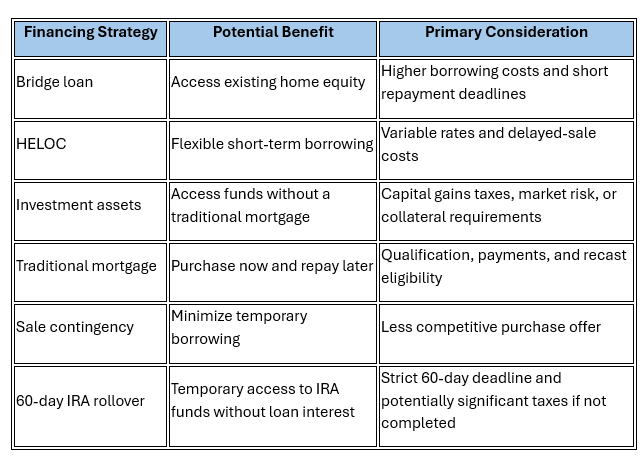
For households with substantial retirement savings, the lowest borrowing rate isn't necessarily the most cost-effective solution.
For example, paying several months of interest on temporary financing may be preferable to generating a large taxable IRA withdrawal. In other situations, using available cash may be simpler and less expensive.
A 60-day IRA rollover may appear attractive because it doesn't involve traditional loan interest or origination fees. However, that potential benefit must be weighed against the possibility of a delayed home sale and the tax consequences of missing the rollover deadline.
The important question is which option creates the least disruption to your overall retirement plan.
Retirement Planning Considerations Before Buying
Purchasing a home during retirement involves more than determining how to fund the down payment.
1. Avoid Unexpected Income Taxes
Suppose you need $250,000 to purchase a new house.
If that money comes from a traditional IRA, the withdrawal generally increases taxable income by $250,000, assuming the distribution consists entirely of previously untaxed funds.
Depending on your other income, this could push you into higher tax brackets, increase taxation of Social Security benefits, and potentially trigger higher Medicare premiums.
Medicare generally uses tax return information from two years earlier to determine income-related premium adjustments.
A short-term loan or a withdrawal from an appropriately structured taxable account may be more tax-efficient in certain situations.
A 60-day IRA rollover may provide another temporary funding option, but it requires particularly careful planning.
If an eligible IRA distribution is properly rolled over within 60 days, it generally does not create taxable income. However, missing that deadline could turn what was intended to be a temporary source of cash into a large taxable distribution.
For example, failing to roll over a $250,000 traditional IRA distribution could add $250,000 to taxable income, assuming the entire amount was previously untaxed.
This could increase federal and state income taxes, affect the taxation of Social Security benefits, and potentially increase future Medicare premiums.
Planning Tip: Before using retirement account funds to purchase a home, calculate the potential federal and state tax consequences, including any Medicare premium impact. If considering a 60-day rollover, compare the potential cost of a failed rollover against the borrowing costs of a HELOC, bridge loan, or traditional mortgage.
2. Understand the Tax Rules When Selling Your Existing Home
Under current federal tax rules, qualifying homeowners may exclude up to:
$250,000 of capital gains for single filers.
$500,000 of capital gains for married couples filing jointly.
Generally, you must meet ownership and primary residence requirements, including living in the home for at least two of the five years before selling. Additional eligibility rules apply.
Buying another home before selling your existing property does not automatically eliminate this exclusion.
However, delaying the sale for an extended period could eventually affect eligibility.
Planning Tip: If you plan to keep your previous home for an extended period, review how the timing of the eventual sale could affect your capital gains exclusion.
3. Plan for the Possibility That Your Home Takes Longer to Sell
Before committing to a purchase, calculate the cost of carrying both properties for six to twelve months.
Include mortgage payments, property taxes, insurance, utilities, maintenance, and financing costs.
For retirees, maintaining sufficient cash reserves is particularly important because a delayed sale should not force investment liquidations during a market decline.
This becomes even more important when considering a 60-day IRA rollover.
Unlike traditional financing arrangements, a 60-day rollover generally does not provide the flexibility to extend repayment simply because a home sale takes longer than expected.
If you cannot replace the IRA funds by the deadline and no exception or relief applies, you may face significant tax consequences.
Ask yourself: If my current home doesn't sell for another six months, can I still comfortably cover both properties without changing my retirement income plan?
Common Mistakes to Avoid
Several decisions can make purchasing a home before selling your current residence more expensive than necessary.
Withdrawing large amounts from an IRA without calculating taxes. The additional income could create tax consequences that exceed the cost of temporary financing.
Assuming your house will sell immediately. A longer selling period can substantially increase borrowing and carrying costs.
Failing to compare lending options before listing the house. Certain financing opportunities may become more difficult after a home is listed.
Using too much retirement liquidity. Purchasing a home should not leave your household without adequate emergency reserves.
Treating a 60-day IRA rollover like a traditional short-term loan. The rollover has strict eligibility requirements and a 60-day deadline. If your home doesn't sell in time and you cannot replace the funds, you could face substantial income taxes and potentially an early withdrawal penalty.
Overlooking IRA rollover restrictions. The IRS generally permits only one IRA-to-IRA 60-day rollover per 12-month period, and certain distributions, including required minimum distributions, cannot be rolled over.
Focusing only on the home purchase. Consider how the transaction affects retirement income, investment allocation, taxes, and the amount of money available for future healthcare expenses.
Five Questions to Ask Before Buying
Before making an offer on your next home, consider:
How much cash will I need before my current home sells?
What happens if my existing home takes six to twelve months to sell?
Would using investments or retirement accounts create unexpected taxes?
Can I comfortably cover both properties without reducing my retirement reserves?
Which financing option works best with my long-term retirement income plan?
If you're considering a 60-day IRA rollover, an additional question is whether you have a reliable backup source of funds to complete the rollover if your existing home doesn't sell within the required timeframe.
Answering these questions before purchasing can help prevent a short-term housing decision from becoming a long-term financial problem.
Final Thoughts
Buying a new home before selling your existing property is possible, even when much of your available wealth is tied up in home equity or investments.
The key is finding a solution that allows you to complete the purchase without unnecessarily disrupting the retirement plan you've spent years building.
For some households, a HELOC or bridge loan may be appropriate. Others may benefit from using taxable investments, obtaining a traditional mortgage that can be paid down after the sale, or making an offer contingent on selling their existing property.
For retirees with substantial IRA assets, a 60-day rollover may also provide temporary access to cash. However, the strict deadline and potential tax consequences make it particularly important to evaluate this strategy carefully.
At Greenbush Financial Group, we help families evaluate how these decisions fit into their overall financial picture. Comparing borrowing costs, potential taxes, retirement income, and liquidity together can help you make the transition with greater confidence.

Rob Mangold
About Rob……...
Hi, I’m Rob Mangold. I’m the Chief Operating Officer at Greenbush Financial Group and a contributor to the Money Smart Board blog. We created the blog to provide strategies that will help our readers personally, professionally, and financially. Our blog is meant to be a resource. If there are questions that you need answered, please feel free to join in on the discussion or contact me directly.
Frequently Asked Questions
-
Can I buy a house before selling my current home?Yes. You may be able to use a bridge loan, HELOC, traditional mortgage, investment assets, a contingent purchase agreement, or potentially a 60-day IRA rollover. The best option depends on your equity, income, available savings, retirement assets, and ability to manage the costs of temporarily owning two homes.
-
What is the cheapest way to buy a house before selling yours?There isn't one option that's always cheapest. A HELOC may offer lower costs than some bridge loans, while using savings could eliminate interest expense. A 60-day IRA rollover may also provide temporary access to funds without traditional borrowing costs, but missing the deadline could result in substantial taxes. Investment taxes, loan fees, repayment deadlines, and the expected selling timeline should all be compared before deciding.
-
Can retirees qualify for a mortgage without employment income?Yes. Mortgage lenders may consider Social Security, pensions, retirement account distributions, and eligible investment assets when evaluating repayment ability. Qualification depends on the lender's underwriting requirements and the borrower's financial situation.
-
Can I use my IRA to buy a house before selling my current home?Yes, but withdrawals from traditional IRAs generally create taxable income. One potential alternative is a 60-day IRA rollover, which allows eligible funds to be withdrawn and returned to an eligible retirement account within 60 days without generally triggering income taxes. However, the IRS has strict rollover rules, including a general limit of one IRA-to-IRA 60-day rollover per 12-month period. If you cannot replace the funds within the required timeframe, the distribution may become taxable and could also be subject to an early withdrawal penalty.
-
Is a bridge loan better than a HELOC?A bridge loan may be designed specifically for a short transition between homes, while a HELOC generally offers more flexible access to available home equity. The better choice depends on interest rates, fees, repayment requirements, available equity, and your expected selling timeline.
-
Can I use a 60-day IRA rollover to buy a house?Potentially. A 60-day IRA rollover can provide temporary access to eligible IRA funds while you wait for your existing home to sell. If the full distribution is properly returned to an eligible retirement account within 60 days, it generally will not be taxable. However, if your home sale is delayed and you cannot replace the money in time, you may face significant taxes. This strategy is generally most appropriate when you have a highly reliable source of repayment and a backup plan if the home sale doesn't close as expected.
-
What happens if I miss the 60-day IRA rollover deadline?If you do not complete an eligible rollover within 60 days, the taxable portion of the distribution generally must be included in your income for the year of the withdrawal. Depending on your age and circumstances, an additional 10% early withdrawal tax may also apply. The IRS provides deadline relief in certain qualifying situations, but you should not assume that a delayed home sale will qualify. Because the tax consequences can be significant, it's important to understand the rollover rules before withdrawing retirement funds.
-
Can I complete more than one 60-day IRA rollover in a year?Generally, no. The IRS limits individuals to one IRA-to-IRA 60-day rollover during any 12-month period, regardless of how many IRAs they own. This rule does not apply to certain other transactions, such as direct trustee-to-trustee IRA transfers and rollovers from qualified employer retirement plans into IRAs.
-
What happens if my current home doesn't sell?You remain responsible for the existing property's expenses and any temporary financing obligations. Depending on your loan terms, you may need to extend financing, adjust the listing price, or use other available funds to repay debt. If you used a 60-day IRA rollover, a delayed sale could be particularly costly because the rollover deadline generally cannot be extended simply because the property hasn't sold. Maintaining sufficient liquidity and a backup funding plan is an important part of preparing for this possibility.