Do I Have To Pay Taxes On My Inheritance?
Whenever people come into large sums of money, such as inheritance, the first question is “how much will I be taxed on this money”? Believe it or not, money you receive from an inheritance is likely not taxable income to you.
Of course there are some caveats to this. If the inherited money is from an estate, there is a chance the money received was already taxed at the estate level. The current federal estate exclusion is $5,430,000 (estate taxes and the exclusion amount varies for states). Therefore, if the estate was large enough, a portion of the inheritance may have been subject to estate tax which is 40% in most cases. That being said, whether the money was or was not taxed at the estate level, you as an individual do not have to pay income taxes on the money.
Although the inheritance itself is not taxable, you may end up paying taxes if there is appreciation after the money is inherited. The type of account and distribution will dictate how the income will be taxed.
Basis Of Inherited Property
Typically, the basis of inherited property is the fair market value of the property on the date of the decedent’s death or the fair market value of the property on the alternate valuation date if the estate uses the alternate valuation date for valuing assets. An estate will choose to value assets on an alternate date subsequent to the date of death if certain assets, such as stocks, have depreciated since the date of death and the estate would pay less tax using the alternate date.
What the fair market value basis means is that if you inherit stock that was originally purchased for $500 and at the date of death has appreciated to $10,000, you will have a “step-up” basis of $10,000. If you turn around and sell the stock for $11,000, you will have a $1,000 gain and if you sell the stock for $9,000, you will have a $1,000 loss.
Inheriting a personal residence also provides for a step-up in basis but the gain or loss may be treated differently. If no one lives in the inherited home after the date of death, it will be treated similar to the stock example above. If you move into the home after death, any subsequent sale at a loss will not be deductible as it will be treated as your personal asset but a gain would have to be recognized and possibly taxed. If you rent the property subsequent to inheritance, it could be treated as a trade or business which would be treated differently for tax purposes.
Inheriting An IRA or Retirement Plan Account
Please read our article “Inherited IRA’s: How Do They Work” for a more detailed explanation of the three different types of distribution options.
When you inherit a retirement account, and you are not the spouse of the decedent, in most cases you will only have one option, fully distribute the account balance 10 years following the year of the decedents death. The SECURE Act that was passed in December 2019 dramatically change the distribution options available to non-spouse beneficiaries. See the article below:
The SECURE Act was signed into law on December 19, 2019 and with it comes some very important changes to the options that are available to non-spouse beneficiaries of IRA’s, 401(k), 403(b), and other types of retirement accounts
If you are the spouse of the of the decedent, you are able to treat the retirement account as if it was yours and not be forced to take one of the options above. You will have to pay taxes on distributions but you do not have to start withdrawing funds immediately unless there are required minimum distributions needed.
Note: If the inherited account was an after tax account (i.e. Roth), the inheritor must choose one of the options presented above but no tax will be paid on distributions.
Non-Qualified Annuities
Non-qualified annuities are an exception to the step-up in basis rule. The non-spousal inheritor of a non-qualified annuity will have to take either a lump sum or receive payments over a specified time period. If the inheritor chooses a lump sum, the portion that represents the gain (lump sum balance minus decedent’s contributions) will be taxed as ordinary income. If the inheritor chooses a series of payments, distributions will be treated as last in, first out. Last in, first out means that the appreciation will be distributed first and fully taxable until there is only basis left.
If the spouse inherits the annuity, they most likely have the option to treat the annuity contract as if they were the original owner.
This article concentrated on inheritance at a federal level. There is no inheritance tax at a federal level but some states do have an inheritance tax and therefore meeting with a professional is recommended. New York currently does not have an inheritance tax.
About Rob……...
Hi, I’m Rob Mangold. I’m the Chief Operating Officer at Greenbush Financial Group and a contributor to the Money Smart Board blog. We created the blog to provide strategies that will help our readers personally , professionally, and financially. Our blog is meant to be a resource. If there are questions that you need answered, pleas feel free to join in on the discussion or contact me directly.

Health Savings Accounts offer powerful tax benefits, but those benefits can change significantly after death. This article explains how HSAs are treated when inherited by a spouse, non-spouse, or estate. Learn key tax rules, planning strategies, and how to reduce the tax burden on beneficiaries. Proper beneficiary designation is critical to maximizing HSA value.
Planning for long-term care is harder than ever as insurance premiums rise and availability shrinks. In 2025, families are turning to two main strategies: self-insuring with dedicated assets or using Medicaid trusts for protection and eligibility. This article breaks down how each option works, their pros and cons, and which approach fits your financial situation. Proactive planning today can help you protect assets, reduce risks, and secure peace of mind for retirement.
Dying without a will means state laws decide who inherits your assets, not you. It also creates longer, more expensive probate and leaves guardianship decisions for your children up to a judge. This article explores the risks of dying intestate and how a simple will can protect your family.
Losing a spouse is overwhelming, and financial matters can add to the stress. Greenbush Financial Group provides a gentle, step-by-step checklist to help surviving spouses address immediate needs, manage estate matters, and plan for the future with confidence.
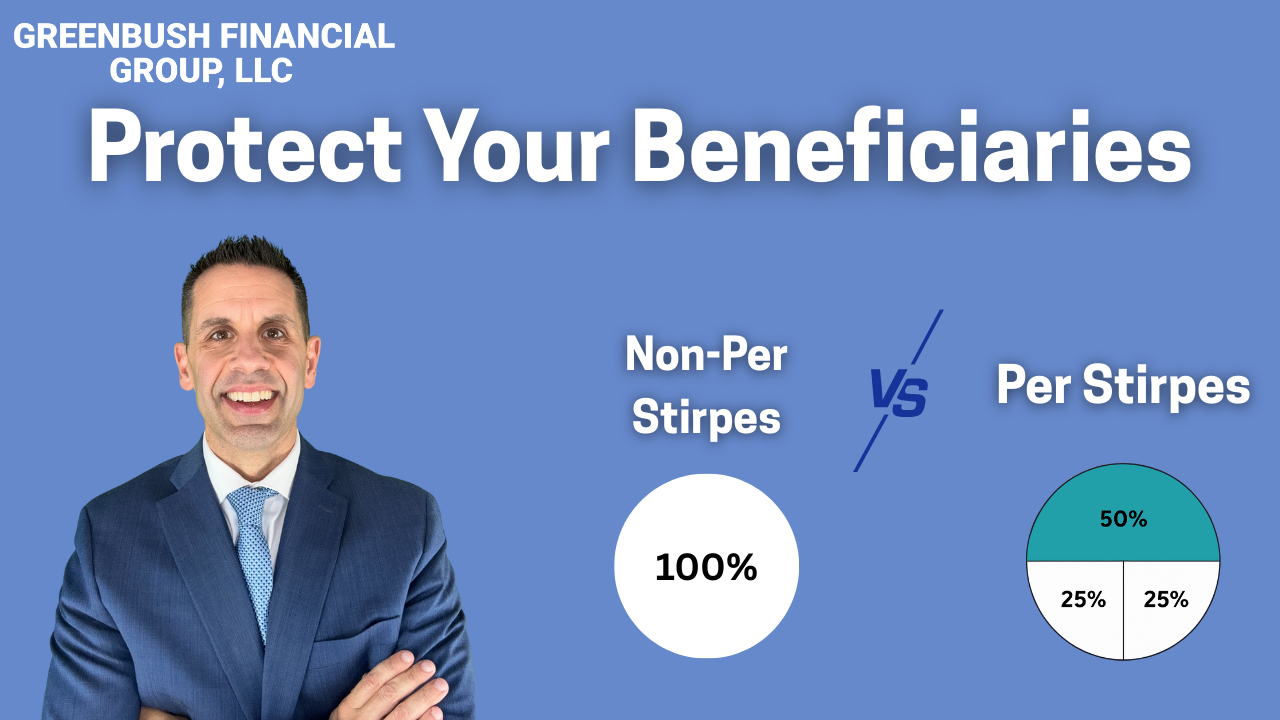
“Per stirpes” is a common estate planning term that determines how assets pass to descendants if a beneficiary dies before you. Greenbush Financial Group explains how per stirpes works, compares it to non–per stirpes designations, and outlines why updating your beneficiary forms is critical for ensuring your wishes are honored.
Trust Roles Explained Easily: Whether you're setting up a trust or are currently an interested party in a an existing trust, understanding who does what is essential.
Your home is one of the most valuable assets you'll pass on—but how you transfer it to the next generation can have major tax, legal, and financial consequences.
Confused about transfer-on-death (TOD) accounts? This article answers the most common questions about Transfer on Death designations, how they work, and how they can help you avoid probate.
When someone passes away in New York, in 2025, there is a $7.16 million estate tax exclusion amount, which is significantly lower than the $13.9M exemption amount available at the federal level. However, in addition to the lower estate tax exemption amount, there are also two estate tax traps specific to New York that residents need to be aware of when completing their estate plan. Those two tax traps are:
1) The $7.5 million Cliff Rule
2) No Portability between spouses
With proper estate planning, these tax traps can potentially be avoided, allowing residents of New York to side-step a significant state tax liability when passing assets onto their heirs.
Safeguarding a Roth IRA from the Medicaid spenddown process has long been a challenge for individuals preparing for long-term care. Unlike other assets, Roth IRAs cannot be owned by trusts, and their lack of required minimum distributions (RMDs) has historically left them vulnerable under Medicaid rules. However, a groundbreaking strategy recently developed in New York provides new hope for preserving the full value of these important retirement accounts. By voluntarily initiating RMDs on Roth IRAs, individuals can now protect these accounts from being depleted entirely during Medicaid qualification.
Topics Covered in This Article:
Challenges of Protecting Roth IRAs
The Role of Irrevocable Trusts
Understanding the Medicaid Spenddown Process
Voluntary RMDs for Roth IRAs
New York’s Innovative Strategy
Irrevocable trusts are powerful tools for long-term care planning and asset protection, but what happens when you need to access those locked-away assets?
Our latest article, Can You Break an Irrevocable Trust?, dives deep into the options available if you find yourself in this situation. Learn about key topics like:
The strict limitations on accessing the trust principal
The grantor's rights to trust income
Pros and cons of adding a gifting provision to your trust
Revoking a trust – Full or partial
Changing the trust investment objective to generate more income for the grantor
Tax trap of realized gains within grantor irrevocable trusts
Whether you’re planning your estate, serving as a trustee, or navigating Medicaid rules, this comprehensive guide is packed with expert insights you shouldn’t miss.
When we are working with clients on their estate plan, one of the primary objectives is to assist them with titling their assets so they avoid the probate process after they pass away. For anyone that has had to serve as the executor of an estate, you have probably had firsthand experience of how much of a headache the probate processes which is why it's typically a goal of an estate plan to avoid the probate process altogether.
I recently published an article called “Don’t Gift Your House To Your Children” which highlighted the pitfalls of gifting your house to your kids versus setting up a Medicaid Trust to own your house, as an asset protection strategy to manage the risk of a long-care care event taking place in the future. That article prompted a few estate attorneys to reach out to me to present a third option which involves gifting your house to your children with a life estate. While the life estate does solve some of the tax issues of gifting the house to your kids with no life estate, there are still issues that persist even with a life estate that can be solved by setting up a Medicaid trust to own your house.
A common financial mistake that I see people make when attempting to protect their house from a long-term care event is gifting their house to their children. While you may be successful at protecting the house from a Medicaid spend-down situation, you will also inadvertently be handing your children a huge tax liability after you pass away. A tax liability, that with proper planning, could be avoided entirely.
When we are constructing financial plans for clients, we inevitably get to the estate planning portion of the plan, and ask them “Do you have updated wills, a health proxy, and a power of attorney in place?
When a family member has a health event that requires them to enter a nursing home or need full-time home health care, it can be an extremely stressful financial event for their spouse, children, grandchildren, or caretaker
The tax rules are different depending on the type of assets that you inherit. If you inherit a house, you may or may not have a tax liability when you go to sell it. This will largely depend on whose name was on the deed when the house was passed to you. There are also special exceptions that come into play if the house is owned by a trust, or if it was gifted
When you say the word “trust” many people think that trusts are only used by the uber rich to protect their millions of dollars but that is very far from the truth. Yes, extremely wealthy families do use trusts to reduce the size of their estate but there are also a lot of very good reasons why it makes sense for an average individual or family to establish
You are most likely reading this article because you had a family member that had a health event and the doctors have informed you that they are not allowed to go back home to their house and will need some form of health assistance going forward. This article was written to help you understand from a high level the steps that you may need to take to
If your spouse passes away and they had either an IRA, 401(k), 403(b), or some other type of employer sponsored retirement account, you will have to determine which distribution option is the right one for you. There are deadlines that you will need to be aware of, different tax implications based on the option that you choose, forms that need to be
If you are the trustee of a trust, in most cases, you are allowed to be paid a commission from the trust assets. States have different rules with regard to the trustee commission calculation. This article will assist you in understanding how the commission is calculated, how the payments are taxed, the rules for commissions not taken in past years, and how
Do trusts have an expiration date after the death of the grantor? For most states, the answer is “Yes”. New York is one of those states that have adopted “The Rule Against Perpetuities” which requires all of the assets to be distributed from the trust by a specified date.
There are three key estate documents that everyone should have: Will, Health Proxy, Power of Attorney, If you have dependents, such as a spouse or children, the statement above graduates from “should have” to “need to
The number of conversations that we are having with our clients about planning for long term care is increasing exponentially. Whether it’s planning for their parents, planning for themselves, or planning for a relative, our clients are largely initiating these conversations as a result of their own personal experiences.
Whenever people come into large sums of money, such as inheritance, the first question is “how much will I be taxed on this money”? Believe it or not, money you receive from an inheritance is likely not taxable income to you.
Creating a will is often a task that everyone knows they should do but it gets put on the back burner. Creating a will is one of the most critical things you can do for your loved ones. Putting your wishes on paper helps your heirs avoid unnecessary hassles, and you gain the peace of mind knowing that a life's worth of possessions will end up in the right