
Deciding when to claim Social Security is one of the most important retirement decisions because it directly impacts your lifetime income. Claiming early at 62 reduces your benefit, waiting until full retirement age (67) provides your standard benefit, and delaying to age 70 increases your benefit significantly. At Greenbush Financial Group, our analysis shows that the right decision depends on your life expectancy, income needs, tax strategy, and overall retirement plan.
How Social Security Benefits Change by Age
Your benefit amount is based on your Full Retirement Age (FRA), which is typically 67 for those born in 1960 or later.
Benefit Adjustments by Claiming Age
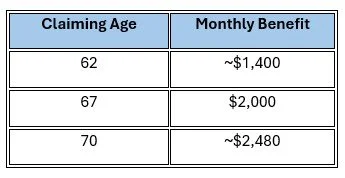
Age 62 → ~30% reduction
Age 67 → 100% of your benefit
Age 70 → ~24% increase from FRA
Example
If your FRA benefit is $2,000 per month:
At Greenbush Financial Group, we emphasize that this is a permanent decision that affects income for life.
Why This Decision Matters So Much
Social Security is one of the only income sources in retirement that is:
Guaranteed for life
Adjusted for inflation
Not impacted by market performance
This makes it a critical foundation for retirement income planning.
When It May Make Sense to Claim at Age 62
Claiming early provides income sooner, but at a reduced level.
Situations Where Age 62 May Make Sense
You need income to retire
Health concerns or shorter life expectancy
You want to preserve investment assets
You are concerned about future policy changes
Trade-Off
Lower monthly income for life.
At Greenbush Financial Group, we typically see this strategy used when income needs outweigh long-term maximization.
When Claiming at Full Retirement Age (67) Makes Sense
Full Retirement Age provides your standard benefit without reductions or credits.
Situations Where Age 67 May Make Sense
You want a balanced approach
You are still working into your mid-to-late 60s
You want to avoid early reduction penalties
You are unsure about delaying further
Key Advantage
No reduction, no delay risk.
When It Makes Sense to Delay Until Age 70
Delaying increases your benefit through delayed retirement credits.
Benefits of Waiting
Higher guaranteed monthly income
Better inflation-adjusted income over time
Increased survivor benefits for a spouse
Situations Where Age 70 May Make Sense
You have longevity in your family
You do not need income immediately
You want to maximize lifetime income
You are concerned about outliving your money
You have significant Tax Deferred Assets to drawdown
At Greenbush Financial Group, delaying to 70 is often one of the most effective ways to increase guaranteed retirement income.
The Break-Even Analysis: When Do You Come Out Ahead?
A common way to evaluate this decision is through a break-even analysis.
General Insight
Break-even age is often around 78–82
If you live beyond this range, delaying may result in higher lifetime income
Important Note
This analysis does not account for:
Taxes
Investment returns
Spousal benefits
Personal spending needs
How Taxes Impact Your Social Security Decision
Your Social Security benefits may be taxable depending on your income.
Key Considerations
Up to 85% of benefits can be taxable
IRA withdrawals can increase taxation
Claiming earlier may reduce taxable income in some scenarios
Planning Strategy
Coordinate Social Security with retirement withdrawals to manage your tax bracket effectively.
Spousal and Survivor Benefit Considerations
Married couples should evaluate this decision together.
Key Rules
Spouse can receive up to 50% of the higher earner’s benefit
Survivor receives the higher of the two benefits
Planning Insight
Delaying benefits for the higher earner can increase survivor income significantly.
At Greenbush Financial Group, spousal coordination is often one of the most impactful strategies.
A Simple Decision Framework
Instead of looking for a one-size-fits-all answer, consider these key questions:
Ask Yourself
Do I need the income now?
What is my health and life expectancy?
Do I have other income sources?
What is my tax situation?
Am I planning for a spouse or survivor benefit?
Common Mistakes to Avoid
Claiming early without a plan
Ignoring spousal benefits
Focusing only on break-even analysis
Not considering taxes
Making the decision in isolation from your full retirement plan
Final Thoughts
There is no universally “correct” age to claim Social Security. The best decision depends on your financial situation, health, and long-term goals.
At Greenbush Financial Group, our analysis shows that integrating Social Security into a broader retirement income and tax strategy leads to better outcomes than focusing on the decision in isolation.

Rob Mangold
About Rob……...
Hi, I’m Rob Mangold. I’m the Chief Operating Officer at Greenbush Financial Group and a contributor to the Money Smart Board blog. We created the blog to provide strategies that will help our readers personally, professionally, and financially. Our blog is meant to be a resource. If there are questions that you need answered, please feel free to join in on the discussion or contact me directly.
-
Is it better to take Social Security at 62 or 70?It depends on your health, income needs, and life expectancy. Delaying increases lifetime income if you live long enough.
-
How much more do you get by waiting until 70?About 8% per year after full retirement age, up to age 70.
-
What is the break-even age for Social Security?Typically around age 78 to 82.
-
Can I work while collecting Social Security at 62?Yes, but your benefits may be reduced if you exceed income limits before full retirement age.
-
What happens if I delay Social Security past 70?There is no additional benefit increase after age 70.