By Michael Ruger, CFP®
Partner and Chief Investment Officer at Greenbush Financial Group
The Big Beautiful Tax Bill that just passed is reshaping the tax landscape for many Americans, but one provision that stands out for retirees is the introduction of a new $6,000 senior tax deduction. This benefit, aimed at providing additional tax relief for older taxpayers, adds a generous layer of savings on top of the regular standard deduction and the existing age-based deduction.
This new deduction took the place of the promised “100% tax-free social security benefits,” which was too costly to include in the new tax bill.
But as with many of the bill’s provisions, there are income limitations and expiration dates to be aware of. In this article, we break down how the deduction works, who qualifies, and how to make the most of it before it sunsets in 2028.
What Is the New $6,000 Senior Tax Deduction?
Beginning in 2025, taxpayers aged 65 or older will be eligible for a new $6,000 federal tax deduction. This deduction is designed to reduce taxable income and is stacked on top of the standard deduction and the existing senior (age-based) additional deduction.
In Addition to Existing Age 65 $2,000 Deduction
The new $6,000 Senior Deduction is in addition to both the standard deduction and the existing enhanced standard deduction from individual age 65 and older. The existing enhanced senior deduction for 2025 is $2,000 for single filers and head of household, and $1,600 per qualifying individual for married couples filing jointly or separately.
If both spouses are age 65 or older, they both qualify for the $6,000 Senior Deduction ($12,000 combined).
This deduction can result in significant tax savings, especially for retirees living on fixed incomes who may not qualify for other tax credits or deductions.
Income Phase-Out Rules
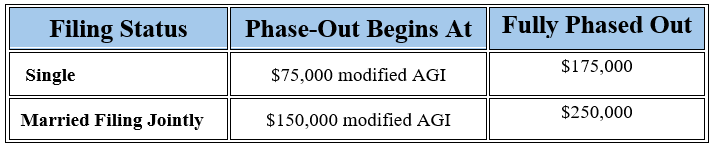
The deduction is not available to all seniors—there’s an income cap. The new deduction begins to phase out at moderate income levels:
How the Phase-Out Works
However, the deduction is gradually reduced—potentially to $0—if your Modified Adjusted Gross Income (MAGI) exceeds the applicable threshold. Once past that line:
The deduction is reduced by six cents for every $1 over the threshold.
At $175,000 MAGI for singles or $250,000 for joint filers, the deduction is fully phased out.
Example:
Let’s say you’re single and your MAGI is $100,000 in 2025:
That’s $25,000 over the $75,000 threshold.
Multiply that by $0.06:
$25,000 × $0.06 = $1,500 reductionResult:
$6,000 deduction − $1,500 = $4,500 allowable deduction
The reduction applies dollar-for-dollar across the entire overage range. The closer your MAGI is to the top of the phase-out range, the smaller your deduction becomes.
Planning Tip:
If you’re near the phaseout limit, consider deferring income (like IRA withdrawals or capital gains) or increasing deductions (such as HSA contributions or qualified charitable distributions) to stay under the threshold and preserve the full deduction.
When Does It Start (and End)?
This is a temporary provision of the tax code.
Effective Date: January 1, 2025
Expiration Date: December 31, 2028
That means taxpayers will be able to claim the deduction for four tax years (2025 through 2028), unless future legislation extends or makes the benefit permanent.
You Don’t Need to Itemize
One of the biggest benefits of this deduction is its accessibility. Unlike many tax breaks that require itemizing, the $6,000 senior deduction can be claimed even if you take the standard deduction—which most retirees already do.
This makes the deduction especially useful for seniors with:
Modest income from Social Security and pensions
Minimal mortgage interest or medical deductions
No longer itemizing after downsizing or paying off a home
Final Thoughts
The $6,000 senior deduction is a meaningful win for retirees—especially those living on fixed incomes who don’t itemize and have limited ways to reduce taxable income. When combined with the standard deduction and age-based additions, older taxpayers will be able to shelter a larger portion of their income from federal taxes for the 2025–2028 window.
As with any temporary tax benefit, timing and planning are key. Whether you're managing RMDs, structuring retirement income, or simply looking for ways to reduce your tax burden, this new deduction should be part of your strategy in the coming years.

About Michael……...
Hi, I’m Michael Ruger. I’m the managing partner of Greenbush Financial Group and the creator of the nationally recognized Money Smart Board blog . I created the blog because there are a lot of events in life that require important financial decisions. The goal is to help our readers avoid big financial missteps, discover financial solutions that they were not aware of, and to optimize their financial future.
Frequently Asked Questions (FAQs):
What is the new $6,000 senior tax deduction?
Starting in 2025, taxpayers aged 65 and older can claim a new $6,000 federal tax deduction. It reduces taxable income in addition to the standard deduction and the existing age-based deduction. Married couples where both spouses are age 65 or older can claim $12,000 combined.
How does the new senior deduction interact with existing deductions?
The new deduction stacks on top of both the regular standard deduction. This layering can provide meaningful tax relief for retirees who do not itemize.
Who qualifies for the $6,000 senior deduction?
Any taxpayer who is age 65 or older by the end of the tax year qualifies. The deduction applies to all filing statuses but begins to phase out for higher-income individuals.
What are the income phaseout thresholds for the deduction?
The deduction begins to phase out at $75,000 of Modified Adjusted Gross Income (MAGI) for single filers and $125,000 for joint filers. It is reduced by six cents for every $1 of income above these levels and fully phases out at $175,000 for singles and $250,000 for joint filers.
Do you need to itemize to claim the senior deduction?
No. The $6,000 senior deduction is available even if you take the standard deduction. This makes it particularly beneficial for retirees with modest incomes or limited itemized deductions.
When does the new senior tax deduction take effect—and when does it end?
The deduction applies beginning January 1, 2025, and is set to expire after December 31, 2028, unless Congress extends or makes it permanent. Retirees will have four tax years (2025–2028) to take advantage of it.
How can retirees maximize this deduction before it phases out?
Seniors close to the income threshold can use tax planning strategies—such as deferring income, reducing Roth conversions or distributions from pre-tax retirement acounts, or using Qualified Charitable Distributions—to keep MAGI below the phaseout range and preserve the full deduction.