By Michael Ruger, CFP®
Partner and Chief Investment Officer at Greenbush Financial Group
The Big Beautiful Tax Bill that just passed includes several targeted tax updates that will impact households beginning in the 2025 tax year. One of the more widely applicable changes is a modest increase to the Child Tax Credit (CTC)—a benefit claimed by millions of families each year.
While the increase is not dramatic, it’s important to understand who qualifies, how the credit works under the updated rules, and how income and immigration status can affect your eligibility. In this article, we break down the new $2,200 Child Tax Credit and what it means for your next few tax seasons.
What’s Changing with the Child Tax Credit?
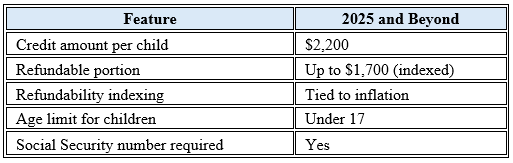
Starting with the 2025 tax year, the Child Tax Credit increases from $2,000 per child to $2,200 per child under age 17. The credit is partially refundable and continues to be subject to income-based phaseouts.
Here’s a snapshot of the updated rules:
SSN Requirement Still Applies — Mixed-Status Families Blocked
One of the more controversial aspects of the bill is the continued requirement that both the parent (taxpayer) and each qualifying child must have a valid Social Security number (SSN) to claim the credit.
This rule effectively excludes mixed-status families—where a child may be a U.S. citizen but one or both parents file taxes using an ITIN (Individual Taxpayer Identification Number). If any family member lacks a valid SSN, the household becomes ineligible to claim the credit for that child.
If a child has an ITIN instead of a SSN—even if they’re a dependent on your return—the $2,200 credit is not available.
How the Refundable Portion Works
The refundable part of the Child Tax Credit—currently capped at $1,700 per child—is designed to benefit lower-income families who may not owe enough in federal taxes to use the full $2,200 credit.
In 2025, the refundable portion remains capped at $1,700 per child, but it is now indexed for inflation—meaning it could increase slightly each year going forward. To claim the refundable portion, families must have earned income above a set threshold (currently $2,500), which will also adjust with inflation.
This means that even if your tax liability is zero, you may still receive part of the credit as a refund, depending on your income and number of qualifying children.
Income Phase-Outs: No Change from Previous Law
The Big Beautiful Tax Bill does not change the phase-out thresholds for high-income earners. The Child Tax Credit still begins to phase out at the following Modified Adjusted Gross Income (MAGI) levels:
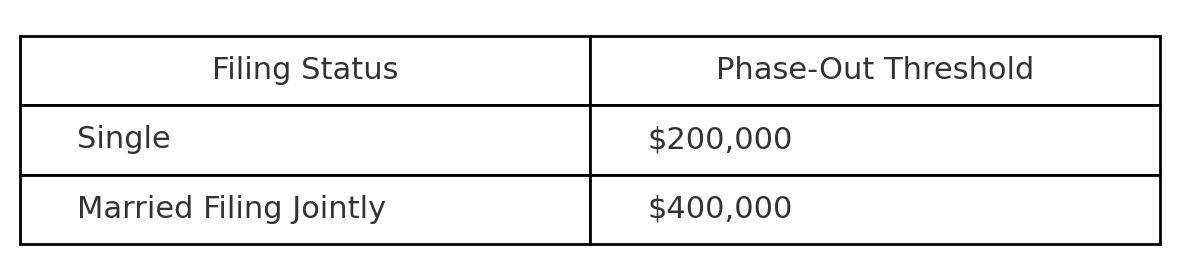
For every $1,000 your income exceeds the threshold, the credit is reduced by $50.
Example: A married couple with two children and a MAGI of $420,000 would see their credit reduced by $1,000 total ($50 × 20 = $1,000), leaving them with a remaining $3,400 in credit ($2,200 × 2 − $1,000).
Additional Child Tax Credit for Non-Filers
For individuals or families that don’t owe any federal tax or own less than the maximum credit amount, they may be able to get a partial refund of the credit by claiming the Additional Child Tax Credit (ACTC) but it’s requires a “phase-in calculation”. To determine the credit amount available for each child, the IRS multiplies your earned income amount over $2,500 by 15%. You can claim that amount for each eligible child.
For example, if a parents income is $10,000, the formula is:
$10,000 - $2,500 = $7,500
$7,500 x 15% = $1,125 Credit Per Child
If this calculated amount is less than the full $1,700 refundable amount, you would receive this lower amount per child. But in either case, the refundable amount per child is never greater than $1,700.
Planning Tips for Maximizing the Child Tax Credit
If your family qualifies, here are a few ways to maximize your tax benefit:
1. Ensure All Dependents Have Valid SSNs
If your child is a newborn, make sure to apply for their Social Security number as early as possible. No SSN = no credit.
2. Be Aware of Income Thresholds
If you're nearing the phase-out thresholds, consider strategies to reduce your taxable income, such as:
Maxing out 401(k) or traditional IRA contributions
Contributing to a Health Savings Account (HSA)
Deferring end-of-year bonuses if possible
3. Track Refundability Rules
Even if your income is modest, you can still benefit from the refundable portion. Ensure you have earned income and are filing correctly to take advantage.
Effective Date: 2025 Tax Year
All the changes to the Child Tax Credit go into effect for the 2025 tax year and are scheduled to remain in place through 2028, unless Congress acts to extend or modify the provisions before then.
Final Thoughts
While the increase from $2,000 to $2,200 may not be groundbreaking, it still represents additional tax relief for millions of families.
As always, the key to getting the most out of the Child Tax Credit is making sure your documentation is in order, understanding the income thresholds, and coordinating your year-end tax planning to align with these updated rules.

About Michael……...
Hi, I’m Michael Ruger. I’m the managing partner of Greenbush Financial Group and the creator of the nationally recognized Money Smart Board blog . I created the blog because there are a lot of events in life that require important financial decisions. The goal is to help our readers avoid big financial missteps, discover financial solutions that they were not aware of, and to optimize their financial future.
Frequently Asked Questions (FAQs):
What is the new Child Tax Credit amount under the Big Beautiful Tax Bill?
Starting with the 2025 tax year, the Child Tax Credit increases from $2,000 to $2,200 per qualifying child under age 17. The credit remains partially refundable, allowing eligible families to receive up to $1,700 per child even if they owe little or no federal income tax.
When do the new Child Tax Credit rules take effect?
The updated Child Tax Credit applies to the 2025 through 2028 tax years. Unless Congress takes further action, the provisions are set to expire after 2028.
Who qualifies for the $2,200 Child Tax Credit?
To qualify, both the taxpayer and the child must have valid Social Security numbers (SSNs), and the child must be under age 17 at the end of the tax year. The credit begins to phase out at higher income levels.
What are the income limits for the Child Tax Credit?
The phase-out thresholds remain unchanged:
$400,000 for married couples filing jointly
$200,000 for single filers and heads of household
The credit is reduced by $50 for every $1,000 of income above these thresholds.
Can families with ITINs claim the Child Tax Credit?
No. Under the new law, both the parent and each qualifying child must have a valid SSN. Families filing with ITINs (Individual Taxpayer Identification Numbers) are not eligible for the $2,200 credit. This rule also excludes mixed-status families where one or both parents lack SSNs.
How does the refundable portion of the Child Tax Credit work?
The refundable portion, known as the Additional Child Tax Credit (ACTC), allows families with earned income over $2,500 to receive a refund even if they owe no tax. The refundable amount equals 15% of earned income over $2,500, up to $1,700 per child (indexed for inflation).
Example:
If you earn $10,000 in 2025, the refundable credit is:
($10,000 − $2,500) × 15% = $1,125 per child
How can I maximize the Child Tax Credit?
Make sure each qualifying child has an SSN before filing.
Manage your income to stay below the phase-out thresholds—contributing to retirement accounts or HSAs can help.
If eligible, claim the refundable portion by reporting earned income above $2,500.
Why are mixed-status families excluded from the Child Tax Credit?
Congress maintained the SSN requirement from prior law to limit eligibility to taxpayers and children who both have valid Social Security numbers. Families where a child or parent files with an ITIN are not eligible for the credit.
Will the Child Tax Credit increase again after 2028?
As written, the $2,200 credit and related rules are temporary. The credit is scheduled to revert to prior levels in 2029, unless new legislation extends or modifies it.