By Michael Ruger, CFP®
Partner and Chief Investment Officer at Greenbush Financial Group
The Backdoor Roth IRA strategy has become increasingly common among higher-income individuals who earn too much to make a direct contribution to a Roth IRA. The concept sounds relatively simple: make a nondeductible contribution to a Traditional IRA and then convert that money to a Roth IRA. Because there is no income limitation on Roth IRA conversions, this strategy can potentially allow higher-income taxpayers to continue building Roth assets even when their income prevents them from contributing directly to a Roth IRA.
However, simple does not always mean easy. We are seeing a growing number of mistakes in the execution of Backdoor Roth IRA strategies, and some of those mistakes can create unexpected taxable income, additional tax filings, and other complications.
In this article, we will cover some of the most common Backdoor Roth IRA mistakes, including:
How the Backdoor Roth IRA strategy works for high-income earners
How the Backdoor Roth IRA aggregation rule can create unexpected taxes
Why Traditional IRA, Rollover IRA, SEP IRA, and SIMPLE IRA balances can affect a Roth conversion
What investors should know about the Backdoor Roth IRA step-transaction rule
Why a Roth 401(k) does not prevent you from completing a Backdoor Roth IRA
Why IRS Form 8606 is critical when making nondeductible IRA contributions
How investment gains before a Roth conversion can create taxable income
How to avoid common Backdoor Roth IRA tax mistakes before executing the strategy
Understanding these rules before you move any money can make a significant difference. A Backdoor Roth IRA can be a powerful retirement planning strategy, but the tax treatment depends heavily on how the transaction is executed.
What Is a Backdoor Roth IRA?
A Backdoor Roth IRA is not a special type of retirement account. It is simply a strategy that generally involves making a nondeductible contribution to a Traditional IRA and then converting those assets to a Roth IRA. The strategy is primarily used by individuals whose income is too high to make a direct Roth IRA contribution.
For 2026, the Roth IRA contribution phaseout range is $153,000 to $168,000 for single filers and heads of household and $242,000 to $252,000 for married couples filing jointly. The 2026 IRA contribution limit is $7,500 for individuals under age 50 and $8,600 for individuals age 50 or older. While there are income limits that determine whether you can contribute directly to a Roth IRA, there is no similar income limitation that prevents an individual from converting Traditional IRA assets to a Roth IRA.
That difference is what makes the Backdoor Roth IRA strategy possible. Instead of contributing directly to a Roth IRA, the individual contributes after-tax money to a Traditional IRA and later converts that money to a Roth IRA. If the strategy is properly executed and the individual has no other pre-tax IRA money, the tax consequences of the conversion may be minimal or potentially zero.
Mistake #1: Ignoring the IRA Aggregation and Pro-Rata Rule
The IRA aggregation rule, also commonly called the pro-rata rule, is probably the most important Backdoor Roth IRA mistake to understand. Many investors assume that if they open a brand-new Traditional IRA, contribute after-tax money to that account, and convert only that account to a Roth IRA, the conversion will automatically be tax-free. Unfortunately, that is not always how the tax calculation works.
For purposes of determining how much of an IRA conversion is taxable versus nontaxable, the IRS generally does not allow you to isolate your nondeductible contribution from your other Traditional IRA money. Instead, applicable Traditional IRA balances are aggregated together when determining what percentage of the conversion represents pre-tax money and what percentage represents after-tax basis. This generally includes Traditional IRAs, Rollover IRAs, Traditional SEP IRAs, and Traditional SIMPLE IRAs.
A Simple $100,000 Backdoor Roth IRA Example
Assume John already has a Traditional IRA worth $95,000, and all $95,000 is pre-tax money. John then opens a separate Traditional IRA, contributes $5,000 to it, and does not take a tax deduction for that contribution. A few days later, he converts the entire $5,000 from the new Traditional IRA into his Roth IRA.
John may assume that because he contributed $5,000 of after-tax money and converted that same $5,000, the conversion should be tax-free. However, when the aggregation rule is applied, John effectively has $100,000 of total IRA money for purposes of this simplified example: $95,000 of pre-tax money and $5,000 of after-tax basis.
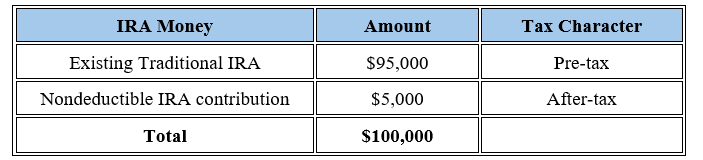
In this example, only 5% of John's IRA money represents after-tax basis, while 95% represents pre-tax money. Therefore, approximately 95% of the $5,000 Roth conversion would be taxable, or roughly $4,750. Only about $250 of the conversion would represent a nontaxable recovery of basis.
This is where many individuals get surprised. They believed they completed a tax-free $5,000 conversion, but because of the other pre-tax IRA assets, most of the conversion becomes taxable.
Opening a Separate IRA Does Not Avoid the Aggregation Rule
Another common misconception is that the aggregation rule can be avoided simply by opening a separate IRA at another financial institution. For example, someone may have a $500,000 Rollover IRA at one investment company and decide to open a brand-new Traditional IRA somewhere else specifically for the Backdoor Roth IRA strategy. Unfortunately, keeping the accounts physically separate does not necessarily separate them for tax purposes.
The same issue applies if one account is labeled a "Backdoor Roth IRA account." The IRS is generally looking at the applicable IRA balances collectively when determining the taxable portion of a distribution or conversion. Before executing a Backdoor Roth IRA, it is important to identify all existing Traditional, Rollover, SEP, and SIMPLE IRA balances that could potentially affect the calculation.
What About Money in a 401(k)?
A 401(k) is treated differently from an IRA for purposes of the Backdoor Roth aggregation calculation. Simply having a large balance in a current employer's 401(k) does not by itself create the same pro-rata problem. For example, an individual could have $800,000 in a pre-tax 401(k), no Traditional IRA balances, and still potentially execute a relatively clean Backdoor Roth IRA strategy.
This distinction can sometimes create planning opportunities. In certain situations, an employer's 401(k) may accept a rollover of pre-tax IRA assets, which could potentially move those assets out of the IRA aggregation calculation before year-end. However, that decision should not be made solely for tax convenience because investment choices, fees, creditor protections, withdrawal provisions, and other plan features should also be considered.
Mistake #2: Misunderstanding the Step-Transaction Concern
The second major issue surrounding Backdoor Roth IRAs involves what is commonly called the step-transaction doctrine. Very generally, this is a tax principle under which a series of formally separate transactions may, under certain circumstances, be viewed together based on their substance. Historically, this created concern that making a nondeductible Traditional IRA contribution and immediately converting it to a Roth IRA could potentially be viewed as an indirect way of making a Roth contribution that the individual was not otherwise eligible to make directly.
That concern has led to a lot of informal advice over the years suggesting that taxpayers should wait some period of time between making the nondeductible IRA contribution and completing the Roth conversion. You may hear recommendations to wait 30 days, 60 days, or 90 days. The important point is that there is no specific IRS safe harbor stating that waiting a particular number of days makes the strategy automatically protected from the step-transaction doctrine.
Current IRS guidance recognizes both nondeductible Traditional IRA contributions and Roth IRA conversions, and Roth conversions are not subject to the same income limits that apply to direct Roth IRA contributions. Therefore, we would be careful about presenting any specific waiting period as an IRS requirement. If you have concerns about how the step-transaction doctrine could apply to your specific situation, that is an issue to discuss with your CPA or tax attorney.
Waiting Can Create Another Backdoor Roth IRA Issue
There is another reason why blindly waiting 60 or 90 days is not necessarily the perfect solution. If the money inside the Traditional IRA is invested during that waiting period, the account could increase in value before the Roth conversion occurs. Those investment gains may create taxable income when the money is eventually converted.
For example, assume you make a $7,500 nondeductible contribution to a Traditional IRA and invest the money immediately. Over the next 90 days, the account grows to $7,900. If you then convert the entire $7,900 to the Roth IRA and you have no other IRA balances or basis, you generally have only $7,500 of after-tax basis, meaning the additional $400 of investment growth may be taxable.
This does not necessarily make the Backdoor Roth IRA strategy unsuccessful. Paying tax on a few hundred dollars of gains may be relatively minor. However, it is another reason why the timing of the contribution, investment, and conversion should be intentional rather than based on an assumed 60- or 90-day IRS requirement.
Mistake #3: Thinking a Roth 401(k) Prevents a Backdoor Roth IRA
Another common misconception is that someone who is already contributing to a Roth 401(k) cannot also execute a Backdoor Roth IRA strategy. That is not the case. Roth 401(k) contributions and IRA contributions are governed by separate annual contribution limits.
For example, assume a 45-year-old high-income employee is maxing out their Roth 401(k). For 2026, that individual could potentially contribute $24,500 to the Roth 401(k) and separately make a $7,500 nondeductible contribution to a Traditional IRA, followed by a Roth conversion, assuming the strategy is otherwise appropriate. The fact that both strategies involve Roth accounts does not cause the limits to overlap.
This can be especially valuable for higher-income households that are trying to accumulate more tax-free retirement assets. Someone who is already maximizing Roth 401(k) contributions may still have the opportunity to add additional money to a Roth IRA through the Backdoor Roth IRA strategy.
Mistake #4: Forgetting to File Form 8606
Form 8606 is one of the most important pieces of paperwork associated with a Backdoor Roth IRA. When you make a nondeductible contribution to a Traditional IRA, you need a tax record establishing that you did not take a deduction for that contribution and that the money represents after-tax basis. Without proper documentation, it may become much more difficult to prove years later how much of your IRA has already been taxed.
The IRS uses Form 8606 to report nondeductible Traditional IRA contributions, certain IRA distributions when basis exists, and conversions from Traditional IRAs to Roth IRAs. In practical terms, Form 8606 helps prevent you from potentially paying tax twice on the same money. If you contribute $7,500 to a Traditional IRA and do not claim a deduction, you do not want that same $7,500 to be treated as fully taxable when it is later converted or distributed.
This is why properly filing Form 8606 is not simply a minor administrative step. It is part of keeping an accurate tax record of your after-tax IRA basis. Individuals who execute Backdoor Roth IRA strategies year after year should pay close attention to making sure Form 8606 is prepared correctly each year.
Mistake #5: Forgetting About an Old SEP IRA or SIMPLE IRA
One of the easiest mistakes to make is forgetting about an old retirement account from years ago. Someone may currently be a W-2 employee with no obvious Traditional IRA or Rollover IRA and assume that their Backdoor Roth IRA will be straightforward. However, they may have opened a SEP IRA or SIMPLE IRA years earlier when they were self-employed or worked for a different company.
If that account still contains pre-tax money, it may affect the pro-rata calculation. For example, an old $80,000 SEP IRA sitting at another custodian may suddenly become very relevant when determining how much of a current Roth conversion is taxable.
This is why we recommend completing a retirement-account inventory before implementing the strategy. Do not simply ask whether you have a Traditional IRA. Ask whether you have any Traditional, Rollover, SEP, or SIMPLE IRA balances that could impact the calculation.
Mistake #6: Confusing the IRA Contribution Limit With the Roth Conversion Limit
Another common misunderstanding is assuming that if the annual IRA contribution limit is $7,500, then the maximum Roth conversion is also $7,500. Those are two completely different rules. The annual contribution limit determines how much new money can be contributed to an IRA, while a Roth conversion involves moving existing Traditional IRA assets into a Roth IRA.
For example, someone could make a $7,500 nondeductible Traditional IRA contribution and separately decide to convert $100,000 of existing pre-tax IRA assets to a Roth IRA. There is no general $7,500 annual limit on Roth conversions. However, converting pre-tax retirement assets to a Roth IRA generally creates taxable income, which means large conversions require careful tax planning.
This distinction is important because the Backdoor Roth IRA strategy involves both a contribution and a conversion. The contribution limit applies to the first step. The tax consequences of the conversion depend on the character of the money being converted and the individual's overall IRA situation.
A Backdoor Roth IRA Pre-Flight Checklist
Before executing a Backdoor Roth IRA, it can help to work through a short checklist. A few minutes spent reviewing your accounts before making the contribution or conversion can potentially prevent an unpleasant surprise when your tax return is prepared.
Am I above the income limit for making a direct Roth IRA contribution?
How much am I eligible to contribute to an IRA this year?
Do I have any Traditional IRAs or Rollover IRAs?
Do I have a SEP IRA or SIMPLE IRA?
Do I have existing nondeductible IRA basis from prior years?
Have I reviewed the Backdoor Roth IRA pro-rata calculation before converting?
Could investment gains occur before the Roth conversion?
Will IRS Form 8606 be properly prepared with my tax return?
Does my employer's 401(k) accept incoming IRA rollovers?
Should I review the strategy with my CPA before completing the transaction?
The more complicated your retirement-account history is, the more important this review becomes. A forgotten Rollover IRA or old SEP IRA can materially change the tax result of a Backdoor Roth IRA conversion.
The Backdoor Roth IRA Can Still Be a Powerful Strategy
None of these potential mistakes mean that investors should avoid Backdoor Roth IRAs. For the right individual, the strategy can be an excellent way to accumulate Roth assets when income prevents a direct Roth IRA contribution. Once assets are successfully inside a Roth IRA, they have the potential to grow tax-deferred, and qualified Roth IRA distributions can ultimately be tax-free.
The biggest issue is not necessarily choosing the wrong investment. It is assuming the transaction is simpler than it actually is. Before making the contribution, understand the aggregation rule; before making the conversion, understand what portion may be taxable; and after completing the transaction, make sure the tax reporting is handled properly.
The Backdoor Roth IRA strategy is often described as a simple two-step process: make a nondeductible Traditional IRA contribution and then convert it to a Roth IRA. In reality, several important tax rules sit underneath those two steps. The goal is not simply to get money into the Roth IRA—it is to get the money into the Roth IRA correctly.

About Michael……...
Hi, I’m Michael Ruger. I’m the managing partner of Greenbush Financial Group and the creator of the nationally recognized Money Smart Board blog . I created the blog because there are a lot of events in life that require important financial decisions. The goal is to help our readers avoid big financial missteps, discover financial solutions that they were not aware of, and to optimize their financial future.
Frequently Asked Questions About Backdoor Roth IRAs
-
1. What is a Backdoor Roth IRA?A Backdoor Roth IRA is a strategy commonly used by higher-income individuals who are not eligible to contribute directly to a Roth IRA. The strategy generally involves making a nondeductible contribution to a Traditional IRA and then converting those assets to a Roth IRA. It is not a separate type of retirement account; it is simply a series of transactions using existing IRA rules.
-
2. Is a Backdoor Roth IRA legal?Backdoor Roth IRA strategies use existing rules that allow nondeductible Traditional IRA contributions and Roth IRA conversions. There is no income limit on Roth conversions, even though income limits apply to direct Roth IRA contributions. However, the tax consequences can become complicated when an individual has other pre-tax IRA assets, so proper execution and reporting are important.
-
3. What is the Backdoor Roth IRA pro-rata rule?The Backdoor Roth IRA pro-rata rule determines how much of a Roth conversion is taxable when you have both pre-tax and after-tax money in your applicable IRAs. You generally cannot choose to convert only the after-tax dollars while leaving all of the pre-tax money untouched for tax purposes. Instead, the taxable and nontaxable portions are determined proportionately based on your overall IRA balances and basis.
-
4. Which IRA accounts are included in the Backdoor Roth IRA aggregation rule?Traditional IRAs, Rollover IRAs, Traditional SEP IRAs, and Traditional SIMPLE IRAs generally need to be considered when calculating the taxable portion of an IRA distribution or Roth conversion. Keeping these accounts at different financial institutions does not necessarily allow you to avoid the aggregation rule. This is why identifying all of your IRA balances before executing a Backdoor Roth IRA is so important.
-
5. Does a 401(k) count toward the Backdoor Roth IRA pro-rata rule?Generally, assets held inside a 401(k) are not included in the IRA aggregation calculation simply because they are pre-tax retirement assets. This can be an important distinction for individuals with large 401(k) balances but no pre-tax Traditional, Rollover, SEP, or SIMPLE IRA assets. In some situations, rolling eligible IRA assets into an employer 401(k) that accepts incoming rollovers may also help with future Backdoor Roth IRA planning.
-
6. How long should I wait between a Traditional IRA contribution and Roth conversion?There is no specific IRS rule establishing a required 30-day, 60-day, or 90-day waiting period between a nondeductible Traditional IRA contribution and a Roth conversion. Although the step-transaction doctrine has historically generated discussion around Backdoor Roth IRA timing, no specific waiting period creates an automatic safe harbor. Individuals concerned about how the doctrine may apply to their situation should consult a tax professional.
-
7. Can I do a Backdoor Roth IRA if I already contribute to a Roth 401(k)?Yes. Roth 401(k) contributions and IRA contributions are subject to separate annual contribution limits. An individual may potentially maximize Roth 401(k) salary deferrals and separately make a nondeductible Traditional IRA contribution followed by a Roth conversion, assuming the individual otherwise qualifies and the strategy is appropriate.
-
8. Do I need to file Form 8606 for a Backdoor Roth IRA?Form 8606 is generally an important part of reporting a Backdoor Roth IRA because it tracks nondeductible Traditional IRA contributions and after-tax IRA basis. It is also used in reporting Roth conversions. Properly tracking basis helps prevent after-tax IRA money from potentially being taxed again when it is converted or later distributed.
-
9. Do I owe taxes on a Backdoor Roth IRA conversion?You may owe taxes on a Backdoor Roth IRA conversion depending on your other IRA balances and whether the contribution generated earnings before the conversion. If you have no other pre-tax IRA assets and convert a nondeductible contribution before significant gains occur, the taxable amount may be small or potentially zero. If you have substantial pre-tax Traditional, Rollover, SEP, or SIMPLE IRA balances, however, the pro-rata rule can cause a large portion of the conversion to become taxable.
-
10. Can I do a Backdoor Roth IRA every year?Potentially, yes. Individuals who continue to meet the requirements for making an IRA contribution may be able to repeat the Backdoor Roth IRA strategy in multiple years. However, the pro-rata rule, IRA balances, contribution limits, tax laws, and reporting requirements should be reviewed each year because a strategy that worked cleanly one year may have different tax consequences in a later year.