

The Rules for Spousal IRA Contributions
Learn how spousal IRA contributions work in 2026, including contribution limits, Roth IRA income rules, Traditional IRA deductions, and common mistakes couples should avoid.

By Michael Ruger, CFP®
Partner and Chief Investment Officer at Greenbush Financial Group
One of the basic requirements for contributing to an IRA is having earned income, or what the IRS generally refers to as taxable compensation. But what happens when one spouse works and the other spouse does not?
Many married couples assume that the non-working spouse cannot contribute to an IRA because that spouse does not have earned income of their own. Fortunately, that is not always the case. The spousal IRA contribution rules can allow a married couple filing a joint tax return to use the compensation earned by one spouse to support IRA contributions for both spouses.
This can be particularly valuable when one spouse leaves the workforce to raise children, care for a family member, attend school, or simply because the household is supported by one income. Instead of losing years of potential retirement savings, the couple may be able to continue funding an IRA for the non-working spouse.
In this article, we will cover:
How spousal IRA contributions work
The 2026 spousal Roth IRA contribution rules
The 2026 traditional IRA deduction limits for married couples
How workplace retirement plans can change the traditional IRA deduction
Common mistakes that can result in excess contributions, taxes, or penalties
How the backdoor Roth IRA strategy can interact with spousal IRA contributions
What Is a Spousal IRA Contribution?
The term “spousal IRA” can be a little misleading because there is not actually a special account called a spousal IRA. The account is simply a traditional IRA or Roth IRA owned by the spouse.
Normally, an individual's IRA contributions cannot exceed that individual's taxable compensation for the year. However, special rules apply to married couples who file a joint federal income tax return. If one spouse has little or no taxable compensation, the couple may still be able to contribute to an IRA for that spouse based on the compensation earned by the other spouse.
It is helpful to think of this as a special contribution rule rather than literally transferring or assigning income from one spouse to the other. Each spouse must have their own IRA, and each spouse is subject to the applicable annual IRA contribution limit. You cannot put both spouses' contributions into a single IRA.
For 2026, the IRA contribution limit is $7,500 per person. Individuals age 50 or older can contribute an additional $1,100 catch-up contribution, bringing their 2026 limit to $8,600. These limits apply across an individual's traditional and Roth IRAs combined.
This means that, assuming sufficient compensation and all other requirements are satisfied, a married couple under age 50 could potentially contribute a combined $15,000 to IRAs for 2026, even if only one spouse works.
Spousal Roth IRA Contributions in 2026
For many married couples, the Roth IRA is the easiest place to begin the spousal IRA discussion.
Roth IRA contributions are made with after-tax dollars. There is no immediate income tax deduction for making the contribution, but qualified distributions from a Roth IRA can generally be received tax-free in retirement.
There is one major hurdle: Roth IRA contributions are subject to income limitations.
For 2026, married couples filing jointly are subject to the following Roth IRA modified adjusted gross income, or MAGI, limits:

As long as the couple meets the applicable income and compensation requirements, the fact that one spouse does not work does not automatically prevent that spouse from funding a Roth IRA.
Example: Scott and Tina
Assume Scott and Tina are married and file their tax return jointly. Scott earns $150,000 per year, while Tina does not currently work. Both are under age 50.
Because their income is below the 2026 Roth IRA income phaseout range and Scott has sufficient compensation, Scott could contribute $7,500 to his Roth IRA, and the couple could also contribute $7,500 to Tina's Roth IRA under the spousal IRA rules.
Their total Roth IRA contributions for the year would be $15,000.
This is an important planning opportunity. Without the spousal IRA rules, a couple might incorrectly assume that Tina has to wait until she returns to work before she can begin saving in an IRA again. Instead, she can potentially continue accumulating retirement assets in an account in her own name.
Over a period of many years, those additional contributions and the investment growth on those contributions can become significant.
The Couple Must Have Enough Compensation
The Roth IRA income limit is not the only number that matters. The couple also needs enough eligible compensation to support their combined IRA contributions.
For example, assume a married couple under age 50 has only $10,000 of eligible compensation for the year. They generally cannot contribute $7,500 to one spouse's IRA and another $7,500 to the other spouse's IRA simply because the individual IRA limit is $7,500. Their available compensation is not sufficient to support $15,000 of combined contributions.
This distinction can become important when a spouse works only part of the year, retires during the year, or has income that does not qualify as compensation for IRA purposes.
Investment income, interest, dividends, pension income, and many other forms of income are not treated the same as wages or self-employment earnings for purposes of determining IRA contribution eligibility. Before making a spousal IRA contribution, it is important to verify that the household has sufficient qualifying compensation.
Traditional Spousal IRA Contributions Are More Complicated
Traditional IRA contributions require another layer of analysis.
The first question is whether the couple is eligible to make the IRA contribution. The second—and separate—question is whether the contribution is deductible for income tax purposes.
These two questions are frequently confused.
A married couple may have enough compensation to make traditional IRA contributions for both spouses but still discover that some or all of the contributions are not deductible because of their income and participation in an employer-sponsored retirement plan.
For purposes of determining the traditional IRA deduction, you need to know whether each spouse is covered by a retirement plan at work.
2026 Traditional IRA Deduction Limits When the Contributor Is Covered by 401(k) or 403(b)
Assume a married couple files jointly and the spouse making the traditional IRA contribution is covered by an employer-sponsored retirement plan, such as a 401(k) or 403(b).
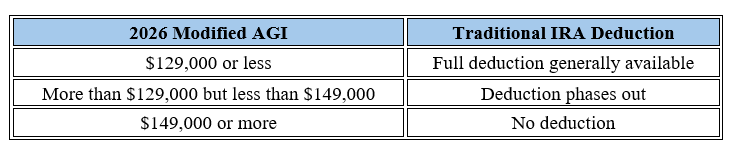
For 2026, the traditional IRA deduction phaseout for a married couple filing jointly when the IRA contributor is covered by a workplace retirement plan is:
Now consider the spouse who is not covered by a retirement plan at work. If that spouse is married to someone who is covered by a workplace retirement plan, a different—and much higher—income phaseout applies.
2026 Traditional IRA Deduction Limits for the Spouse Who Is Not Covered by 401(k) or 403(b)
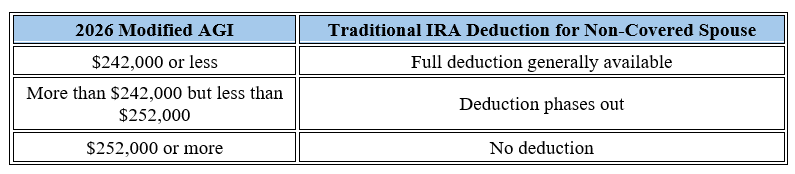
For a married couple filing jointly, when the IRA contributor is not covered by a workplace retirement plan but their spouse is, the 2026 deduction limits are:
The important point is that each spouse's workplace retirement plan coverage matters separately.
A couple should not simply look at their household income and assume that the same traditional IRA deduction limit applies to both spouses. One spouse could potentially be prohibited from deducting a traditional IRA contribution while the other spouse remains eligible for a full deduction.
The IRS specifically provides the higher $242,000–$252,000 phaseout range for 2026 when the IRA contributor is not covered by a workplace plan but is married to someone who is.
Example: One Spouse Is Covered by a 401(k)
Assume Scott and Tina file jointly and have modified AGI of $160,000. Scott works and participates in his employer's 401(k), while Tina does not work and is not covered by an employer-sponsored retirement plan.
Scott may have enough earned income to support IRA contributions for both himself and Tina. However, that does not mean their traditional IRA contributions receive identical tax treatment.
Because Scott is covered by a workplace retirement plan and their modified AGI exceeds $149,000, Scott would generally not be entitled to a traditional IRA deduction under the 2026 limits.
Tina is treated differently.
She is not covered by a workplace retirement plan. Because she is married to someone who is covered, her traditional IRA deduction is instead subject to the $242,000–$252,000 phaseout range. At $160,000 of modified AGI, she could potentially make a traditional IRA contribution and receive a full deduction, assuming the other requirements are satisfied.
Same household. Same income. Two very different IRA deduction results.
What If Neither Spouse Is Covered by a Retirement Plan at Work?
This is another important distinction.
If neither spouse is covered by a retirement plan at work, the income-based traditional IRA deduction phaseouts discussed above generally do not apply. Assuming the couple otherwise qualifies, their traditional IRA contributions can generally be deductible regardless of their income.
This is why it is important not to automatically associate a high income with an inability to deduct a traditional IRA contribution. Whether the taxpayer or their spouse is covered by a workplace retirement plan is a critical part of the analysis.
Making the Contribution and Deducting the Contribution Are Two Different Tests
This concept is worth emphasizing because it is the source of many IRA mistakes.
When evaluating a traditional IRA contribution, think of the process as two separate tests.
Test #1: Can you contribute?
The couple needs to satisfy the rules for making an IRA contribution, including having sufficient qualifying compensation and, for a spousal IRA contribution, generally filing a joint return.
Test #2: Can you deduct it?
Once you establish that the contribution can be made, you then determine whether it is fully deductible, partially deductible, or nondeductible. This calculation depends in part on modified AGI and whether the individual making the contribution—or that individual's spouse—is covered by a workplace retirement plan.
Failing the deduction test does not necessarily mean that the taxpayer cannot contribute to a traditional IRA. It may simply mean the contribution is nondeductible. That distinction leads us to another potential strategy: the backdoor Roth IRA.
Spousal IRA Contributions and the Backdoor Roth IRA
What happens when a married couple earns too much to contribute directly to Roth IRAs and also earns too much to deduct their traditional IRA contributions?
This is where the backdoor Roth IRA strategy may become relevant.
For 2026, married couples filing jointly begin losing their ability to contribute directly to Roth IRAs when modified AGI reaches $242,000, and direct contributions are eliminated at $252,000. However, Roth conversions do not have the same income restriction.
As a result, an individual may be able to:
Make a nondeductible contribution to a traditional IRA.
Convert the traditional IRA to a Roth IRA.
Properly report the nondeductible contribution and Roth conversion on their tax return.
However, there is an important trap: the pro-rata rule.
Watch Out for the Pro-Rata Rule
A backdoor Roth IRA is not automatically tax-free simply because the original traditional IRA contribution was nondeductible.
If an individual already has pre-tax money in traditional IRAs, SEP IRAs, or SIMPLE IRAs, the IRS generally looks at the individual's aggregate applicable IRA balances when determining the taxable and nontaxable portions of a Roth conversion. You generally cannot isolate only the after-tax dollars and convert those dollars while leaving all of the pre-tax IRA money untouched.
For married couples, there is an especially important distinction: the pro-rata calculation is generally determined separately for each spouse.
For example, assume Scott has a $300,000 rollover traditional IRA containing pre-tax money, while Tina has no traditional, SEP, or SIMPLE IRA balances. Scott's existing IRA could create a significant pro-rata issue for his own backdoor Roth strategy. It does not automatically contaminate Tina's backdoor Roth transaction simply because they are married and file jointly.
Each spouse owns their IRA individually.
That can create valuable planning opportunities, but it also makes careful tax reporting extremely important. Nondeductible traditional IRA contributions are generally reported on IRS Form 8606, which tracks the individual's after-tax basis in traditional IRAs.
Common Spousal IRA Contribution Mistakes
Spousal IRA contributions can be straightforward when the rules are followed, but several mistakes can create unwanted tax consequences.
One common mistake is assuming that a non-working spouse cannot contribute at all. Another is making the maximum contribution for both spouses without first confirming that the couple has enough qualifying compensation to support the contributions. Couples can also mistakenly make direct Roth IRA contributions before realizing that their year-end modified AGI exceeds the applicable Roth IRA income limit.
Traditional IRAs introduce additional opportunities for mistakes. A couple might assume a contribution is deductible without checking workplace retirement plan coverage, or they may make a nondeductible contribution but fail to properly report the basis on Form 8606. With a backdoor Roth IRA, overlooking existing pre-tax traditional, SEP, or SIMPLE IRA balances can result in a larger taxable conversion than anticipated.
If too much is contributed to an IRA, an excess contribution may need to be corrected. If it is not handled properly and within the applicable deadlines, additional taxes or penalties may apply. This is one reason year-end IRA planning should involve more than simply asking, “How much can we contribute?”
The better questions are: How much can we contribute, where should each spouse contribute it, is the contribution deductible, are we eligible for a Roth IRA, and will any existing IRA balances affect a Roth conversion?
Why Spousal IRA Contributions Can Be So Valuable
It is easy to overlook retirement savings for a spouse who temporarily or permanently leaves the workforce. But retirement is usually a household goal.
If a married couple can afford to save $15,000 instead of $7,500 in 2026, using the spousal IRA rules could substantially increase the amount accumulated for retirement over time. Just as importantly, the non-working spouse is building retirement assets in an account legally owned in their own name.
Consider a spouse who remains out of the workforce for ten years while raising children. If the family ignores the spousal IRA rules, that could potentially represent ten years of missed IRA contributions and investment growth. The spousal IRA rules can help close that retirement savings gap.

About Michael……...
Hi, I’m Michael Ruger. I’m the managing partner of Greenbush Financial Group and the creator of the nationally recognized Money Smart Board blog . I created the blog because there are a lot of events in life that require important financial decisions. The goal is to help our readers avoid big financial missteps, discover financial solutions that they were not aware of, and to optimize their financial future.
Frequently Asked Questions About Spousal IRA Contributions
-
Can I contribute to an IRA if I do not work but my spouse does?Potentially, yes. If you are married, file a joint federal income tax return, and your spouse has sufficient qualifying compensation, the spousal IRA rules may allow a contribution to an IRA in your name even if you have little or no compensation of your own.
-
What is the spousal IRA contribution limit for 2026?The 2026 IRA contribution limit is $7,500 per individual. If you are age 50 or older, the limit is $8,600 because of the additional $1,100 catch-up contribution. The limit applies to each individual's traditional and Roth IRA contributions combined.
-
Can a non-working spouse contribute to a Roth IRA in 2026?Yes, assuming the couple satisfies the spousal IRA requirements and the Roth IRA income limitations. For married couples filing jointly in 2026, the Roth IRA contribution phaseout occurs between $242,000 and $252,000 of modified AGI. At $252,000 or more, a direct Roth IRA contribution is generally not permitted.
-
Do spousal IRA contributions have to go into a special spousal IRA account?No. A "spousal IRA" is not a separate type of retirement account. The contribution is made to a traditional IRA or Roth IRA owned by the spouse. IRAs are individual accounts, so each spouse needs their own IRA.
-
Do married couples have to file jointly to make a spousal IRA contribution?Generally, yes. The special spousal IRA contribution rules allowing one spouse's compensation to support the other spouse's IRA contribution apply to married couples filing a joint return. Filing status is therefore an important consideration before assuming a non-working spouse is eligible to contribute.
-
Is a spousal traditional IRA contribution always tax-deductible?No. Eligibility to contribute and eligibility to claim a deduction are separate issues. If either spouse participates in an employer-sponsored retirement plan, modified AGI can limit or eliminate the traditional IRA deduction. In 2026, the phaseout is $129,000-$149,000 for a married-filing-jointly IRA contributor who is covered at work, while a contributor who is not covered but whose spouse is covered has a $242,000-$252,000 phaseout range.
-
Can I make a traditional IRA contribution if my income is too high to deduct it?Potentially, yes. Income can prevent a traditional IRA contribution from being deductible without necessarily preventing the contribution itself. In that situation, the contribution may be treated as nondeductible and should generally be reported appropriately on Form 8606.
-
Can both spouses do a backdoor Roth IRA?Potentially. If direct Roth IRA contributions are unavailable because of income, each spouse may be able to make a nondeductible traditional IRA contribution and subsequently convert it to a Roth IRA. However, the tax consequences should be evaluated separately for each spouse, particularly if either spouse owns pre-tax traditional, SEP, or SIMPLE IRA assets.
-
Does my spouse's traditional IRA create a pro-rata problem for my backdoor Roth IRA?Generally, the pro-rata calculation is applied at the individual level rather than combining both spouses' IRA balances. If one spouse has a large pre-tax traditional IRA and the other has no pre-tax IRA assets, their backdoor Roth tax consequences may therefore be very different even though they file a joint tax return.
-
What happens if we make an IRA contribution and later discover we were not eligible?An ineligible contribution may be considered an excess IRA contribution and should not simply be ignored. Depending on the circumstances and timing, there may be methods available to correct the contribution, but failure to correct an excess contribution can result in additional taxes or penalties. If your income is close to a Roth IRA phaseout limit or your compensation is uncertain, consider reviewing your eligibility with a tax professional before the applicable correction deadlines.






















Common Backdoor Roth IRA Mistakes
A Backdoor Roth IRA can help high-income earners build tax-free retirement savings, but mistakes with the pro-rata rule, IRA balances, Form 8606, and conversion timing can create unexpected taxes. Learn the most common mistakes to avoid.

By Michael Ruger, CFP®
Partner and Chief Investment Officer at Greenbush Financial Group
The Backdoor Roth IRA strategy has become increasingly common among higher-income individuals who earn too much to make a direct contribution to a Roth IRA. The concept sounds relatively simple: make a nondeductible contribution to a Traditional IRA and then convert that money to a Roth IRA. Because there is no income limitation on Roth IRA conversions, this strategy can potentially allow higher-income taxpayers to continue building Roth assets even when their income prevents them from contributing directly to a Roth IRA.
However, simple does not always mean easy. We are seeing a growing number of mistakes in the execution of Backdoor Roth IRA strategies, and some of those mistakes can create unexpected taxable income, additional tax filings, and other complications.
In this article, we will cover some of the most common Backdoor Roth IRA mistakes, including:
How the Backdoor Roth IRA strategy works for high-income earners
How the Backdoor Roth IRA aggregation rule can create unexpected taxes
Why Traditional IRA, Rollover IRA, SEP IRA, and SIMPLE IRA balances can affect a Roth conversion
What investors should know about the Backdoor Roth IRA step-transaction rule
Why a Roth 401(k) does not prevent you from completing a Backdoor Roth IRA
Why IRS Form 8606 is critical when making nondeductible IRA contributions
How investment gains before a Roth conversion can create taxable income
How to avoid common Backdoor Roth IRA tax mistakes before executing the strategy
Understanding these rules before you move any money can make a significant difference. A Backdoor Roth IRA can be a powerful retirement planning strategy, but the tax treatment depends heavily on how the transaction is executed.
What Is a Backdoor Roth IRA?
A Backdoor Roth IRA is not a special type of retirement account. It is simply a strategy that generally involves making a nondeductible contribution to a Traditional IRA and then converting those assets to a Roth IRA. The strategy is primarily used by individuals whose income is too high to make a direct Roth IRA contribution.
For 2026, the Roth IRA contribution phaseout range is $153,000 to $168,000 for single filers and heads of household and $242,000 to $252,000 for married couples filing jointly. The 2026 IRA contribution limit is $7,500 for individuals under age 50 and $8,600 for individuals age 50 or older. While there are income limits that determine whether you can contribute directly to a Roth IRA, there is no similar income limitation that prevents an individual from converting Traditional IRA assets to a Roth IRA.
That difference is what makes the Backdoor Roth IRA strategy possible. Instead of contributing directly to a Roth IRA, the individual contributes after-tax money to a Traditional IRA and later converts that money to a Roth IRA. If the strategy is properly executed and the individual has no other pre-tax IRA money, the tax consequences of the conversion may be minimal or potentially zero.
Mistake #1: Ignoring the IRA Aggregation and Pro-Rata Rule
The IRA aggregation rule, also commonly called the pro-rata rule, is probably the most important Backdoor Roth IRA mistake to understand. Many investors assume that if they open a brand-new Traditional IRA, contribute after-tax money to that account, and convert only that account to a Roth IRA, the conversion will automatically be tax-free. Unfortunately, that is not always how the tax calculation works.
For purposes of determining how much of an IRA conversion is taxable versus nontaxable, the IRS generally does not allow you to isolate your nondeductible contribution from your other Traditional IRA money. Instead, applicable Traditional IRA balances are aggregated together when determining what percentage of the conversion represents pre-tax money and what percentage represents after-tax basis. This generally includes Traditional IRAs, Rollover IRAs, Traditional SEP IRAs, and Traditional SIMPLE IRAs.
A Simple $100,000 Backdoor Roth IRA Example
Assume John already has a Traditional IRA worth $95,000, and all $95,000 is pre-tax money. John then opens a separate Traditional IRA, contributes $5,000 to it, and does not take a tax deduction for that contribution. A few days later, he converts the entire $5,000 from the new Traditional IRA into his Roth IRA.
John may assume that because he contributed $5,000 of after-tax money and converted that same $5,000, the conversion should be tax-free. However, when the aggregation rule is applied, John effectively has $100,000 of total IRA money for purposes of this simplified example: $95,000 of pre-tax money and $5,000 of after-tax basis.
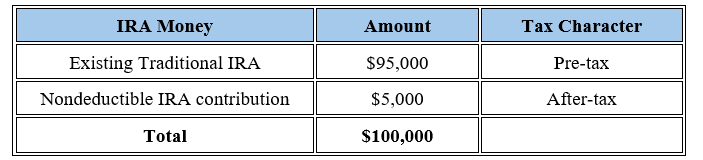
In this example, only 5% of John's IRA money represents after-tax basis, while 95% represents pre-tax money. Therefore, approximately 95% of the $5,000 Roth conversion would be taxable, or roughly $4,750. Only about $250 of the conversion would represent a nontaxable recovery of basis.
This is where many individuals get surprised. They believed they completed a tax-free $5,000 conversion, but because of the other pre-tax IRA assets, most of the conversion becomes taxable.
Opening a Separate IRA Does Not Avoid the Aggregation Rule
Another common misconception is that the aggregation rule can be avoided simply by opening a separate IRA at another financial institution. For example, someone may have a $500,000 Rollover IRA at one investment company and decide to open a brand-new Traditional IRA somewhere else specifically for the Backdoor Roth IRA strategy. Unfortunately, keeping the accounts physically separate does not necessarily separate them for tax purposes.
The same issue applies if one account is labeled a "Backdoor Roth IRA account." The IRS is generally looking at the applicable IRA balances collectively when determining the taxable portion of a distribution or conversion. Before executing a Backdoor Roth IRA, it is important to identify all existing Traditional, Rollover, SEP, and SIMPLE IRA balances that could potentially affect the calculation.
What About Money in a 401(k)?
A 401(k) is treated differently from an IRA for purposes of the Backdoor Roth aggregation calculation. Simply having a large balance in a current employer's 401(k) does not by itself create the same pro-rata problem. For example, an individual could have $800,000 in a pre-tax 401(k), no Traditional IRA balances, and still potentially execute a relatively clean Backdoor Roth IRA strategy.
This distinction can sometimes create planning opportunities. In certain situations, an employer's 401(k) may accept a rollover of pre-tax IRA assets, which could potentially move those assets out of the IRA aggregation calculation before year-end. However, that decision should not be made solely for tax convenience because investment choices, fees, creditor protections, withdrawal provisions, and other plan features should also be considered.
Mistake #2: Misunderstanding the Step-Transaction Concern
The second major issue surrounding Backdoor Roth IRAs involves what is commonly called the step-transaction doctrine. Very generally, this is a tax principle under which a series of formally separate transactions may, under certain circumstances, be viewed together based on their substance. Historically, this created concern that making a nondeductible Traditional IRA contribution and immediately converting it to a Roth IRA could potentially be viewed as an indirect way of making a Roth contribution that the individual was not otherwise eligible to make directly.
That concern has led to a lot of informal advice over the years suggesting that taxpayers should wait some period of time between making the nondeductible IRA contribution and completing the Roth conversion. You may hear recommendations to wait 30 days, 60 days, or 90 days. The important point is that there is no specific IRS safe harbor stating that waiting a particular number of days makes the strategy automatically protected from the step-transaction doctrine.
Current IRS guidance recognizes both nondeductible Traditional IRA contributions and Roth IRA conversions, and Roth conversions are not subject to the same income limits that apply to direct Roth IRA contributions. Therefore, we would be careful about presenting any specific waiting period as an IRS requirement. If you have concerns about how the step-transaction doctrine could apply to your specific situation, that is an issue to discuss with your CPA or tax attorney.
Waiting Can Create Another Backdoor Roth IRA Issue
There is another reason why blindly waiting 60 or 90 days is not necessarily the perfect solution. If the money inside the Traditional IRA is invested during that waiting period, the account could increase in value before the Roth conversion occurs. Those investment gains may create taxable income when the money is eventually converted.
For example, assume you make a $7,500 nondeductible contribution to a Traditional IRA and invest the money immediately. Over the next 90 days, the account grows to $7,900. If you then convert the entire $7,900 to the Roth IRA and you have no other IRA balances or basis, you generally have only $7,500 of after-tax basis, meaning the additional $400 of investment growth may be taxable.
This does not necessarily make the Backdoor Roth IRA strategy unsuccessful. Paying tax on a few hundred dollars of gains may be relatively minor. However, it is another reason why the timing of the contribution, investment, and conversion should be intentional rather than based on an assumed 60- or 90-day IRS requirement.
Mistake #3: Thinking a Roth 401(k) Prevents a Backdoor Roth IRA
Another common misconception is that someone who is already contributing to a Roth 401(k) cannot also execute a Backdoor Roth IRA strategy. That is not the case. Roth 401(k) contributions and IRA contributions are governed by separate annual contribution limits.
For example, assume a 45-year-old high-income employee is maxing out their Roth 401(k). For 2026, that individual could potentially contribute $24,500 to the Roth 401(k) and separately make a $7,500 nondeductible contribution to a Traditional IRA, followed by a Roth conversion, assuming the strategy is otherwise appropriate. The fact that both strategies involve Roth accounts does not cause the limits to overlap.
This can be especially valuable for higher-income households that are trying to accumulate more tax-free retirement assets. Someone who is already maximizing Roth 401(k) contributions may still have the opportunity to add additional money to a Roth IRA through the Backdoor Roth IRA strategy.
Mistake #4: Forgetting to File Form 8606
Form 8606 is one of the most important pieces of paperwork associated with a Backdoor Roth IRA. When you make a nondeductible contribution to a Traditional IRA, you need a tax record establishing that you did not take a deduction for that contribution and that the money represents after-tax basis. Without proper documentation, it may become much more difficult to prove years later how much of your IRA has already been taxed.
The IRS uses Form 8606 to report nondeductible Traditional IRA contributions, certain IRA distributions when basis exists, and conversions from Traditional IRAs to Roth IRAs. In practical terms, Form 8606 helps prevent you from potentially paying tax twice on the same money. If you contribute $7,500 to a Traditional IRA and do not claim a deduction, you do not want that same $7,500 to be treated as fully taxable when it is later converted or distributed.
This is why properly filing Form 8606 is not simply a minor administrative step. It is part of keeping an accurate tax record of your after-tax IRA basis. Individuals who execute Backdoor Roth IRA strategies year after year should pay close attention to making sure Form 8606 is prepared correctly each year.
Mistake #5: Forgetting About an Old SEP IRA or SIMPLE IRA
One of the easiest mistakes to make is forgetting about an old retirement account from years ago. Someone may currently be a W-2 employee with no obvious Traditional IRA or Rollover IRA and assume that their Backdoor Roth IRA will be straightforward. However, they may have opened a SEP IRA or SIMPLE IRA years earlier when they were self-employed or worked for a different company.
If that account still contains pre-tax money, it may affect the pro-rata calculation. For example, an old $80,000 SEP IRA sitting at another custodian may suddenly become very relevant when determining how much of a current Roth conversion is taxable.
This is why we recommend completing a retirement-account inventory before implementing the strategy. Do not simply ask whether you have a Traditional IRA. Ask whether you have any Traditional, Rollover, SEP, or SIMPLE IRA balances that could impact the calculation.
Mistake #6: Confusing the IRA Contribution Limit With the Roth Conversion Limit
Another common misunderstanding is assuming that if the annual IRA contribution limit is $7,500, then the maximum Roth conversion is also $7,500. Those are two completely different rules. The annual contribution limit determines how much new money can be contributed to an IRA, while a Roth conversion involves moving existing Traditional IRA assets into a Roth IRA.
For example, someone could make a $7,500 nondeductible Traditional IRA contribution and separately decide to convert $100,000 of existing pre-tax IRA assets to a Roth IRA. There is no general $7,500 annual limit on Roth conversions. However, converting pre-tax retirement assets to a Roth IRA generally creates taxable income, which means large conversions require careful tax planning.
This distinction is important because the Backdoor Roth IRA strategy involves both a contribution and a conversion. The contribution limit applies to the first step. The tax consequences of the conversion depend on the character of the money being converted and the individual's overall IRA situation.
A Backdoor Roth IRA Pre-Flight Checklist
Before executing a Backdoor Roth IRA, it can help to work through a short checklist. A few minutes spent reviewing your accounts before making the contribution or conversion can potentially prevent an unpleasant surprise when your tax return is prepared.
Am I above the income limit for making a direct Roth IRA contribution?
How much am I eligible to contribute to an IRA this year?
Do I have any Traditional IRAs or Rollover IRAs?
Do I have a SEP IRA or SIMPLE IRA?
Do I have existing nondeductible IRA basis from prior years?
Have I reviewed the Backdoor Roth IRA pro-rata calculation before converting?
Could investment gains occur before the Roth conversion?
Will IRS Form 8606 be properly prepared with my tax return?
Does my employer's 401(k) accept incoming IRA rollovers?
Should I review the strategy with my CPA before completing the transaction?
The more complicated your retirement-account history is, the more important this review becomes. A forgotten Rollover IRA or old SEP IRA can materially change the tax result of a Backdoor Roth IRA conversion.
The Backdoor Roth IRA Can Still Be a Powerful Strategy
None of these potential mistakes mean that investors should avoid Backdoor Roth IRAs. For the right individual, the strategy can be an excellent way to accumulate Roth assets when income prevents a direct Roth IRA contribution. Once assets are successfully inside a Roth IRA, they have the potential to grow tax-deferred, and qualified Roth IRA distributions can ultimately be tax-free.
The biggest issue is not necessarily choosing the wrong investment. It is assuming the transaction is simpler than it actually is. Before making the contribution, understand the aggregation rule; before making the conversion, understand what portion may be taxable; and after completing the transaction, make sure the tax reporting is handled properly.
The Backdoor Roth IRA strategy is often described as a simple two-step process: make a nondeductible Traditional IRA contribution and then convert it to a Roth IRA. In reality, several important tax rules sit underneath those two steps. The goal is not simply to get money into the Roth IRA—it is to get the money into the Roth IRA correctly.
About Michael……...
Hi, I’m Michael Ruger. I’m the managing partner of Greenbush Financial Group and the creator of the nationally recognized Money Smart Board blog . I created the blog because there are a lot of events in life that require important financial decisions. The goal is to help our readers avoid big financial missteps, discover financial solutions that they were not aware of, and to optimize their financial future.
Frequently Asked Questions About Backdoor Roth IRAs
-
1. What is a Backdoor Roth IRA?A Backdoor Roth IRA is a strategy commonly used by higher-income individuals who are not eligible to contribute directly to a Roth IRA. The strategy generally involves making a nondeductible contribution to a Traditional IRA and then converting those assets to a Roth IRA. It is not a separate type of retirement account; it is simply a series of transactions using existing IRA rules.
-
2. Is a Backdoor Roth IRA legal?Backdoor Roth IRA strategies use existing rules that allow nondeductible Traditional IRA contributions and Roth IRA conversions. There is no income limit on Roth conversions, even though income limits apply to direct Roth IRA contributions. However, the tax consequences can become complicated when an individual has other pre-tax IRA assets, so proper execution and reporting are important.
-
3. What is the Backdoor Roth IRA pro-rata rule?The Backdoor Roth IRA pro-rata rule determines how much of a Roth conversion is taxable when you have both pre-tax and after-tax money in your applicable IRAs. You generally cannot choose to convert only the after-tax dollars while leaving all of the pre-tax money untouched for tax purposes. Instead, the taxable and nontaxable portions are determined proportionately based on your overall IRA balances and basis.
-
4. Which IRA accounts are included in the Backdoor Roth IRA aggregation rule?Traditional IRAs, Rollover IRAs, Traditional SEP IRAs, and Traditional SIMPLE IRAs generally need to be considered when calculating the taxable portion of an IRA distribution or Roth conversion. Keeping these accounts at different financial institutions does not necessarily allow you to avoid the aggregation rule. This is why identifying all of your IRA balances before executing a Backdoor Roth IRA is so important.
-
5. Does a 401(k) count toward the Backdoor Roth IRA pro-rata rule?Generally, assets held inside a 401(k) are not included in the IRA aggregation calculation simply because they are pre-tax retirement assets. This can be an important distinction for individuals with large 401(k) balances but no pre-tax Traditional, Rollover, SEP, or SIMPLE IRA assets. In some situations, rolling eligible IRA assets into an employer 401(k) that accepts incoming rollovers may also help with future Backdoor Roth IRA planning.
-
6. How long should I wait between a Traditional IRA contribution and Roth conversion?There is no specific IRS rule establishing a required 30-day, 60-day, or 90-day waiting period between a nondeductible Traditional IRA contribution and a Roth conversion. Although the step-transaction doctrine has historically generated discussion around Backdoor Roth IRA timing, no specific waiting period creates an automatic safe harbor. Individuals concerned about how the doctrine may apply to their situation should consult a tax professional.
-
7. Can I do a Backdoor Roth IRA if I already contribute to a Roth 401(k)?Yes. Roth 401(k) contributions and IRA contributions are subject to separate annual contribution limits. An individual may potentially maximize Roth 401(k) salary deferrals and separately make a nondeductible Traditional IRA contribution followed by a Roth conversion, assuming the individual otherwise qualifies and the strategy is appropriate.
-
8. Do I need to file Form 8606 for a Backdoor Roth IRA?Form 8606 is generally an important part of reporting a Backdoor Roth IRA because it tracks nondeductible Traditional IRA contributions and after-tax IRA basis. It is also used in reporting Roth conversions. Properly tracking basis helps prevent after-tax IRA money from potentially being taxed again when it is converted or later distributed.
-
9. Do I owe taxes on a Backdoor Roth IRA conversion?You may owe taxes on a Backdoor Roth IRA conversion depending on your other IRA balances and whether the contribution generated earnings before the conversion. If you have no other pre-tax IRA assets and convert a nondeductible contribution before significant gains occur, the taxable amount may be small or potentially zero. If you have substantial pre-tax Traditional, Rollover, SEP, or SIMPLE IRA balances, however, the pro-rata rule can cause a large portion of the conversion to become taxable.
-
10. Can I do a Backdoor Roth IRA every year?Potentially, yes. Individuals who continue to meet the requirements for making an IRA contribution may be able to repeat the Backdoor Roth IRA strategy in multiple years. However, the pro-rata rule, IRA balances, contribution limits, tax laws, and reporting requirements should be reviewed each year because a strategy that worked cleanly one year may have different tax consequences in a later year.

How Long Does It Take to Build a $1 Million Roth IRA?
How long does it take to build a $1 million Roth IRA? See how a 22-year-old investing $7,500 per year could potentially become a Roth IRA millionaire, and how compounding could turn $1 million into $2 million and beyond.

By Michael Ruger, CFP®
Partner and Chief Investment Officer at Greenbush Financial Group
The Roth IRA may be one of the most powerful retirement savings vehicles available. Why? Because it combines the power of compound investment returns with the potential for tax-free retirement income.
With a Roth IRA, you contribute money that has already been taxed. Once the money is inside the account, your investments can grow without annual taxation on interest, dividends, or capital gains. Even better, qualified withdrawals can be completely tax-free in retirement. Generally, for earnings to be withdrawn tax-free, the Roth IRA must satisfy the five-year requirement and the distribution must occur after age 59½ or meet another qualifying condition.
That combination can make a Roth IRA doubly powerful: your investment returns compound over time, and those compounded returns may ultimately be withdrawn tax-free.
In this article, we will look at:
How long it could take a 22-year-old to build a $1 million Roth IRA
How much of that $1 million comes from contributions versus investment growth
Why reaching your first $1 million can be such an important milestone
How the Rule of 72 demonstrates the power of additional compounding cycles
Why starting early can have such a dramatic impact on your long-term wealth
How Does a Roth IRA Grow?
A Roth IRA is an account, not an investment itself. Within the Roth IRA, you can typically invest in stocks, bonds, mutual funds, ETFs, and other investments.
The investments you select will determine how quickly the account grows.
Unlike a taxable investment account, however, you generally do not have to pay taxes each year on investment activity occurring inside the Roth IRA. That allows the entire account balance to remain invested and continue compounding.
How Long Does It Take to Build a $1 Million Roth IRA?
Let's look at a hypothetical 22-year-old investor.
For 2026, the IRA contribution limit is $7,500 for an individual under age 50, assuming the individual has sufficient eligible compensation and qualifies to make the Roth IRA contribution. Roth IRA eligibility is also subject to income limitations.
For our example, let's assume:
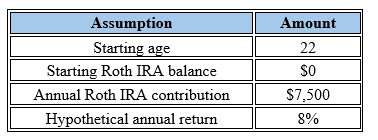
Even though IRA contribution limits may increase in future years, we will assume the investor contributes exactly $7,500 every year to keep the example simple. At an 8% annual rate of return, it would take approximately 32 years for the Roth IRA to cross the $1 million mark. That means someone starting at age 22 could potentially become a Roth IRA millionaire around age 54.
But here's where the numbers become particularly interesting. Over those 32 years, the investor would have personally contributed only:
$7,500 × 32 = $240,000
Yet the account would be worth approximately $1.02 million. That means roughly $778,000 of the account value would be attributable to compounded investment growth, based on our hypothetical assumptions. In other words, the investor contributed $240,000, but compounding did much of the heavy lifting. And because the money is inside a Roth IRA, qualified distributions of those earnings could eventually be received tax-free.
Becoming a Roth IRA Millionaire Isn't the End of the Story
Reaching $1 million may sound like the finish line. From a compounding standpoint, however, it may be closer to the beginning of the most powerful stage. Why?
Because once you've accumulated a large investment balance, you have a much larger amount of money generating potential investment returns.
An 8% return on a $50,000 portfolio is $4,000.
An 8% return on a $500,000 portfolio is $40,000.
An 8% return on a $1 million portfolio is $80,000.
The rate of return hasn't changed. What has changed is the amount of money working for you. This is why building your first $1 million can be such an important milestone. Once you have accumulated that larger base, future compounding can potentially accelerate dramatically.
The Rule of 72: How Quickly Could $1 Million Become $2 Million?
There is a simple financial concept called the Rule of 72 that can help investors estimate how long it will take an investment to double.
Take 72 and divide it by your assumed annual rate of return.
At an 8% annual return:
72 ÷ 8 = 9 years
So, according to the Rule of 72, an investment earning approximately 8% per year would double about every nine years. Now apply that concept to our Roth IRA millionaire.
Suppose our hypothetical investor reaches approximately $1 million around age 54. From that point forward, let's assume they never contribute another dollar and the account continues earning a hypothetical average return of 8%.
The potential growth looks something like this:
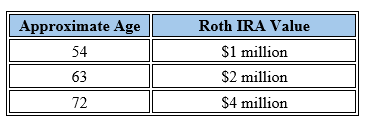
Notice what's happening.
It took roughly 32 years of annual contributions to accumulate the first $1 million.
But the next $1 million could potentially be created in only about nine additional years—with no additional contributions at all. Then $2 million could become $4 million approximately nine years later. That's the power of compounding cycles.
Most of the Potential Wealth Can Be Created Later
One of the hardest concepts for younger investors to appreciate is that the early years of investing can sometimes feel painfully slow.
You contribute $7,500. Then another $7,500. Then another. You may look at your account after several years and wonder why the balance isn't growing faster. But those early contributions are building the foundation that allows compounding to become much more powerful later.
Consider our hypothetical doubling cycle:
$1 million → $2 million: $1 million of additional growth
$2 million → $4 million: $2 million of additional growth
$4 million → $8 million: $4 million of additional growth
The percentage return didn't change. We continued to assume 8%. But the dollar amount of growth became substantially larger with each doubling cycle. This illustrates an important wealth-building principle:
The sooner you can accumulate your first meaningful pool of investment assets, the more potential compounding cycles you may have available later in life.
Why Starting at Age 22 Can Be So Powerful
Young investors often believe they don't have enough money for investing to make a meaningful difference. But when you're young, you have an asset that someone approaching retirement cannot buy: Time
A dollar invested at age 22 potentially has decades to compound. A dollar invested at age 52 simply doesn't have the same runway before retirement. This doesn't mean someone who didn't start investing in their 20s has missed their opportunity. The best strategy is generally to begin when you are financially able to do so and build from there.
But for younger investors, understanding the value of starting early can be incredibly important. Your first few Roth IRA contributions may not seem life-changing when you make them. Thirty or forty years of compounding may tell a very different story.
The Tax-Free Compounding Advantage of a Roth IRA
There is another important piece to this example.
If you accumulate $1 million in a traditional pre-tax retirement account, that $1 million isn't necessarily the same as having $1 million available to spend. Withdrawals from traditional retirement accounts are generally subject to ordinary income tax.
A Roth IRA works differently. Contributions are made with after-tax dollars, so you don't receive an upfront tax deduction. In exchange, qualified Roth IRA withdrawals can be tax-free. That means if our hypothetical Roth IRA eventually grows to $1 million, $2 million, or more, qualified distributions could potentially be received without federal income tax.
This is why we often think of Roth accounts as having two layers of compounding power:
Your investments have the opportunity to compound over time.
That compounded growth has the potential to ultimately be distributed tax-free.
For an investor with several decades before retirement, that combination can be extremely valuable.
Don't Forget About Roth IRA Income Limits
Before automatically contributing $7,500 to a Roth IRA, it is important to determine whether you are eligible.
Roth IRAs have income limitations.
For 2026, the Roth IRA contribution phase-out range is $153,000 to $168,000 for single filers and heads of household and $242,000 to $252,000 for married couples filing jointly.
Individuals above the applicable income limits may not be able to make a direct Roth IRA contribution. Depending on the individual's circumstances, other Roth strategies may be available, but those strategies have their own tax and planning considerations.
Key Takeaway
When you're young, your Roth IRA balance may seem small and the finish line may seem far away. Don't underestimate what decades of consistent investing and compounding can potentially accomplish. The goal isn't necessarily to get rich quickly. The goal is to start the compounding clock as early as possible—and give it as much time as possible to work.
About Michael……...
Hi, I’m Michael Ruger. I’m the managing partner of Greenbush Financial Group and the creator of the nationally recognized Money Smart Board blog . I created the blog because there are a lot of events in life that require important financial decisions. The goal is to help our readers avoid big financial missteps, discover financial solutions that they were not aware of, and to optimize their financial future.

Rules for Inheriting a Retirement Account from a Sibling
When inheriting an IRA or 401(k) from a sibling, the rules depend heavily on age difference and IRS guidelines under the SECURE Act. This article explains the 10-year rule, Eligible Designated Beneficiary exception, and Required Minimum Distribution requirements. It also outlines tax-efficient withdrawal strategies for both pre-tax and Roth accounts. Understanding these rules can help reduce taxes and maximize long-term value.

By Michael Ruger, CFP®
Partner and Chief Investment Officer at Greenbush Financial Group
When you inherit a retirement account , whether it’s a 401(k), Traditional IRA, or Roth IRA, the rules depend heavily on who you inherited the account from. The rules for inheriting a retirement account from a sibling are very different from inheriting from a spouse, parent, or grandparent, and the distribution rules can have major tax consequences if not handled properly.
In this article, we’re going to walk through the key rules and planning strategies, including:
The 10-year rule for inherited retirement accounts
The age exception for siblings within 10 years
Required Minimum Distribution (RMD) rules
Tax strategies for inherited IRAs and 401(k)s
The 10-Year Rule
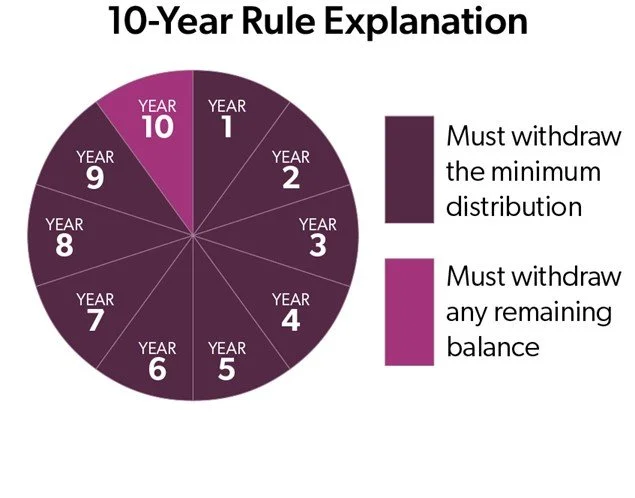
The IRS changed the rules for inherited retirement accounts starting in 2020 under the SECURE Act. For most non-spouse beneficiaries, inherited retirement accounts are now subject to the 10-year rule, which means the account must be fully depleted by the end of the 10th year following the year of death.
However, there is an important exception that often applies to siblings.
The Age Exception for Siblings
If you inherit a retirement account from a sibling and you are within 10 years of their age, you may qualify for the Eligible Designated Beneficiary exception. This allows you to use the old stretch IRA rules, instead of the 10-year rule.
This means:
You are not required to empty the account within 10 years
You are required to take annual RMDs based on your life expectancy
The account can continue to grow tax-deferred over your lifetime
Example
Let’s say:
Sue is age 50
Brian is her brother, age 45
Brian inherits Sue’s IRA
Because Brian is within 10 years of Sue’s age, he qualifies for the exception and can stretch distributions over his lifetime instead of following the 10-year rule.
He must begin taking Required Minimum Distributions (RMDs) starting the year after Sue passes away, but he is not forced to liquidate the entire account within 10 years.
Confusion With RMD Rules
This is one of the biggest areas of confusion for sibling beneficiaries.
There are two different sets of rules depending on whether the sibling qualifies for the within 10 year of age rule or not.
Situation 1: Sibling Within 10 Years of Age (Stretch Rules Apply)
If the sibling beneficiary is within 10 years of the person who passed away:
They are using the stretch IRA rules
They must take RMDs every year
RMDs begin the year after death
RMDs are calculated using the IRS Single Life Expectancy Table
They are not required to empty the account within 10 years
This is true regardless of whether the person who died had started RMDs or not.
This is where many people get confused. Under the old stretch rules, RMDs were always required for inherited IRAs, unless the beneficiary was a spouse.
Situation 2: Sibling More Than 10 Years Younger or Older (10-Year Rule Applies)
If the sibling is more than 10 years apart in age, they do not qualify for the exception and are subject to the 10-year rule.
Example:
Tim is age 55
His sister Jen is age 42
Jen inherits Tim’s IRA
Because the age difference is greater than 10 years, Jen must fully deplete the account within 10 years.
Now here’s where RMD rules depend on the age of the person who passed away:
If the person who passed away was not RMD age (under age 73) → No annual RMDs required, but account must be emptied by year 10.
If the person who passed away was already taking RMDs → The beneficiary must continue taking annual RMDs during the 10-year period.
Tax Strategies for Siblings Inheriting Retirement Accounts
This is where planning becomes very important, especially for siblings subject to the 10-year rule.
Strategy for Inherited Pre-Tax IRA or 401(k)
Distributions from inherited pre-tax retirement accounts are taxable income.
If you wait until year 10 and withdraw the entire account at once, that could push you into a very high tax bracket.
So in many cases, it may make sense to:
Take distributions gradually over the 10 years
Spread the tax liability over multiple years
Coordinate withdrawals with lower-income years
Take more in years where income is lower (retirement, job change, etc.)
Strategy for Inherited Roth IRA
If a sibling inherits a Roth IRA and is subject to the 10-year rule:
The account grows tax-free
Withdrawals are tax-free
The strategy is often to wait until year 10 and withdraw the account at the last possible moment to maximize tax-free growth
So the strategy is often:
Pre-tax account → Spread withdrawals out
Roth account → Wait as long as possible
Advanced Tax Strategy: The “Tax Bracket Wash” Strategy
There is also a more advanced strategy for individuals who are still working and inheriting a pre-tax retirement account.
If someone:
Takes a distribution from an inherited IRA (taxable)
Then increases their pre-tax contributions to their employer retirement plan (401(k), 403(b), etc.)
They may be able to offset the taxable income from the inherited IRA distribution with the tax deduction from increasing their pre-tax contributions.
In simple terms, they are:
Taking money out with one hand and putting money back into a retirement account with the other hand, while potentially neutralizing the tax impact.
This can be a very effective strategy for high-income earners who are not already maxing out their employer retirement plans.
Summary
When inheriting a retirement account from a sibling, the most important factor is the age difference between the siblings.
There are two main categories:
If Siblings Are Within 10 Years of Age:
Eligible Designated Beneficiary
Can use the stretch IRA rules
Must take annual RMDs
Do not have to empty the account within 10 years
If Siblings Are More Than 10 Years Apart:
Subject to the 10-year rule
Must empty the account within 10 years
May or may not have to take annual RMDs depending on the age of the sibling who passed away
Because inherited retirement accounts can have significant tax consequences, beneficiaries should strongly consider working with a financial advisor and tax professional to determine the best withdrawal strategy.
About Michael……...
Hi, I’m Michael Ruger. I’m the managing partner of Greenbush Financial Group and the creator of the nationally recognized Money Smart Board blog . I created the blog because there are a lot of events in life that require important financial decisions. The goal is to help our readers avoid big financial missteps, discover financial solutions that they were not aware of, and to optimize their financial future.
Frequently Asked Questions
-
Do siblings have to follow the 10-year rule when inheriting an IRA?Only if they are more than 10 years apart in age.
-
What happens if siblings are within 10 years of age?They can stretch distributions over their lifetime and take RMDs each year.
-
When do RMDs start for stretch rule inherited IRAs?Typically starting the year after the original owner passes away.
-
Do I have to take RMDs if I'm subject to the 10-year rule?It depends on whether the person who passed away had started RMDs.
-
Are inherited IRA distributions taxable?Yes, if it is a pre-tax IRA or 401(k).
-
Are inherited Roth IRA distributions taxable?No, Roth IRA distributions are typically tax-free.
-
Should I take money out each year or wait until year 10?It depends on your tax bracket and whether the account is pre-tax or Roth.
-
What is the stretch IRA rule?It allows beneficiaries to take RMDs over their lifetime instead of emptying the account in 10 years.
-
Can I reduce taxes from an inherited IRA?Yes, by spreading distributions over multiple years, waiting until lower income years to process distributions, or coordinating with retirement plan contributions.
-
Should I talk to a financial advisor about inherited retirement accounts?Yes, because the withdrawal strategy can significantly impact how much tax you pay.

The SECURE Act 10-Year Rule Explained: Higher Taxes for Kids Who Inherit IRAs
The SECURE Act 10-year rule forces heirs to withdraw inherited retirement accounts faster, often increasing taxes. Learn how it works and strategies to reduce the impact on your family.

When Congress passed the SECURE Act, one of the most significant changes for families came from the new 10-year rule for inherited IRAs. The rule eliminated the ability for most non-spouse beneficiaries, especially adult children, to stretch required distributions over their lifetime. Now, they must empty the account within 10 years of inheriting it.
While this might sound simple, the tax impact can be severe. Compressed distribution windows often push heirs into higher brackets, accelerating income tax on decades of savings. Here is what the rule actually requires and how strategic planning can reduce the hit.
What the SECURE Act’s 10-Year Rule Says
Under the SECURE Act, when a child or other non-spouse inherits an IRA or 401(k), they must withdraw all funds by December 31 of the 10th year following the account owner’s death.
Before 2020, many beneficiaries could stretch required minimum distributions over their own life expectancy, sometimes 30 years or more, allowing continued tax-deferred growth. The SECURE Act ended that option for most heirs.
The result is that your kids will likely pay taxes on inherited retirement funds faster, and at potentially higher marginal rates, than they would have under the old rules.
Who the Rule Applies To
The 10-year rule applies to most non-spouse beneficiaries, but there are exceptions.
The rule applies to:
• Adult children or grandchildren
• Siblings, nieces, nephews, or other non-spouse heirs
• Trusts named as beneficiaries unless they qualify as see-through trusts
The rule does not apply to:
• Surviving spouses
• Minor children until they reach age 21, when the 10-year clock starts
• Disabled or chronically ill beneficiaries
• Beneficiaries less than 10 years younger than the account owner
The Hidden Tax Trap
For many families, the problem is not just the loss of tax deferral. It is the timing of the withdrawals. Most heirs inherit these accounts in their 40s or 50s, right in their peak earning years. Adding large inherited IRA distributions on top of salary and bonuses can easily push them into higher tax brackets.
Example:
If your child earns $120,000 per year and inherits a $1 million traditional IRA, they have just 10 years to withdraw it. Even spreading it evenly means an extra $100,000 in taxable income per year, enough to move them into a much higher bracket and increase Medicare or Net Investment Income taxes if applicable.
Our analysis at Greenbush Financial Group shows that this compression effect often results in 5 to 10 percent higher effective tax rates on inherited IRA dollars compared to pre-SECURE Act rules.
Planning Strategies to Reduce the Impact
There are several ways to mitigate the 10-year rule’s tax impact:
Roth conversions during your lifetime
Converting pre-tax IRAs to Roths allows your children to inherit tax-free assets. They will still follow the 10-year withdrawal rule, but distributions will be tax-free.Strategic beneficiary designations
Leave portions of retirement assets to lower-income heirs or to charitable remainder trusts.Staggered inheritances
Use taxable accounts, life insurance, or non-retirement assets to balance out future income for your kids.Pre-death withdrawals
Taking larger distributions during your own lower-income retirement years can smooth taxes across generations.Trust planning
Review existing conduit trusts. Many written before 2020 no longer operate as intended under the 10-year rule.
At Greenbush Financial Group, we often run multi-scenario tax projections showing how different withdrawal schedules, Roth conversions, or charitable strategies affect heirs’ long-term tax burdens.
Why This Matters for Your Estate Plan
The 10-year rule changed how retirement wealth passes between generations. What used to be a slow, tax-efficient transfer can now create a rapid, high-tax inheritance event.
Updating your beneficiary designations, estate documents, and withdrawal strategy is critical if you want your children to keep more of what you have saved. Even a modest Roth conversion plan or trust revision can reduce total taxes by hundreds of thousands of dollars over time.

Rob Mangold
About Rob……...
Hi, I’m Rob Mangold. I’m the Chief Operating Officer at Greenbush Financial Group and a contributor to the Money Smart Board blog. We created the blog to provide strategies that will help our readers personally, professionally, and financially. Our blog is meant to be a resource. If there are questions that you need answered, please feel free to join in on the discussion or contact me directly.
FAQs: SECURE Act 10-Year Rule
-
Do my kids have to take money out every year?Maybe. Annual required minimum distributions may be required if the decedent was of RMD age at passing. The RMD amount is likely less than one tenth of the account. The beneficiaries must still empty the inherited IRA by the end of year 10, so creating a strategy to reduce the overall tax burden is recommended.
-
Does the 10-year rule apply to Roth IRAs?Yes, but Roth withdrawals are tax-free. Heirs still need to empty the account within 10 years.
-
How does this affect trusts as IRA beneficiaries?Many conduit trusts written before 2020 now force the entire balance out in year 10, losing the intended protection and control. These should be reviewed.
-
Can I avoid the 10-year rule for my kids?Not directly, unless your child qualifies as an eligible beneficiary such as a minor or disabled dependent. Strategic Roth conversions or life insurance can help achieve similar goals.
-
Should I change my IRA beneficiaries now?Possibly. If your current structure assumed lifetime stretch distributions, it is time to review it under the new law.









Attention Non-Spouse 10-Year Beneficiaries: 2030 Is Rapidly Approaching
If you inherited an IRA or other retirement account from a non-spouse after December 31, 2019, the SECURE Act’s 10-year rule may create a major tax event in 2030. Many beneficiaries don’t realize how much the account can grow during the 10-year window—potentially forcing large taxable withdrawals if they wait until the final year. In this article, we explain how the 10-year rule works, why 2030 is a high-risk tax year, and planning strategies that can reduce the tax hit long before the deadline arrives.

By Michael Ruger, CFP®
Partner and Chief Investment Officer at Greenbush Financial Group
If you inherited an IRA or other retirement account from a non-spouse after December 31, 2019, the clock is ticking—and for many families, the tax consequences are coming into sharper focus.
The SECURE Act, which went into effect in 2020, dramatically changed how non-spouse beneficiaries must handle inherited retirement accounts. While these rules may have seemed far off at the time, 2030 is now just around the corner for those who inherited accounts in the first year of the new law.
In this article, we’ll cover:
How the SECURE Act’s 10-year rule works
Why 2030 could trigger significant tax liabilities
How market growth has quietly made the problem bigger
Practical tax-planning strategies to consider now
Why waiting until the last year can be costly
A Quick Refresher: What Changed Under the SECURE Act?
Prior to 2020, most non-spouse beneficiaries could “stretch” distributions from an inherited IRA over their lifetime. This allowed smaller required distributions and, in many cases, never required the account to be fully depleted.
That all changed with the SECURE Act.
For most non-spouse beneficiaries:
The inherited retirement account must be fully depleted within 10 years
The rule applies to anyone who passed away after December 31, 2019
All pre-tax dollars distributed during that period are taxable income
From the IRS’s perspective, this rule change was a revenue raiser—it ensures that inherited retirement assets become taxable within a defined window.
Why 2030 Is Such a Big Deal
For individuals who inherited a retirement account from someone who passed away in 2020, the 10-year clock runs out at the end of 2030.
That means:
Only five tax years remain (2026–2030) before the final distribution year
Any remaining balance must be distributed—and taxed—by the end of year 10
Large balances could result in substantial one-year tax spikes
Many beneficiaries have only been taking small distributions or the minimum required amounts. While that may have felt prudent at the time, it can create a tax bombshell in the final year if the account balance is still large.
RMD Rules Add Another Layer of Complexity
Required Minimum Distribution (RMD) rules under the SECURE Act depend on whether the original account owner was already taking RMDs when they passed away.
Some beneficiaries were required to take annual RMDs
Others were not required to take annual distributions—but still must empty the account by year 10
Regardless of which category you fall into, the key issue remains the same:
Waiting too long often concentrates taxable income into fewer years.
Market Growth Has Made the Problem Bigger
Ironically, strong market performance over the past several years has amplified the issue.
For individual that have a large allocation to stocks within their inherited IRA, since the market returns have been so strong over the past few years, they may have seen the balance in their inherited IRA increase despite taking RMDs from the account each year.
This is great from a wealth-building perspective, but it also means:
Larger balances remain late in the 10-year window
Larger forced distributions
Larger tax bills await
In short, investment success can unintentionally worsen the tax outcome if distributions aren’t coordinated with a broader tax plan.
Why Smoothing Income Often Makes Sense
For many non-spouse beneficiaries, the goal should be tax smoothing—intentionally spreading distributions over the remaining years to avoid one massive taxable event in year 10.
This often means:
Taking more than the minimum each year
Coordinating distributions with your current income level
Evaluating how many years remain in your 10-year window
The sooner this planning happens, the more flexibility you typically have.
One Common Strategy: Offset Taxes With 401(K) Contributions
One tax-planning strategy we often explore with clients involves maximizing employer-sponsored retirement plan contributions.
Here’s a simplified example:
A 50-year-old employee is contributing $15,000 to their 401(k)
In 2026, they may be eligible to contribute up to $32,500
That’s an additional $17,500 of potential pre-tax deferrals
A possible strategy:
Take a $17,500 distribution from the inherited IRA (taxable)
Increase payroll deferrals so more income flows into the 401(k) pre-tax
Use the inherited IRA distribution to supplement take-home pay
Result:
Taxable income from the inherited IRA distribution is fully offset by pre-tax retirement contributions, while also shifting assets into the inherited IRA owner's personal 401(k) account, which does not have a 10-year distribution restriction.
A Critical Caveat for 2026
High-income earners should be aware that starting in 2026, certain catch-up contributions for those over age 50 may be required to be made as Roth contributions. Roth deferrals do not provide an immediate tax deduction, which could limit the effectiveness of this strategy.
When Waiting Can Make Sense
Not every situation calls for accelerating distributions.
For individuals who plan to retire before the 10-year period ends, delaying distributions may be intentional and strategic. Once paychecks stop:
Ordinary income may drop significantly
Larger inherited IRA distributions could fall into lower tax brackets
This can be a very effective approach—but only when planned in advance.
The Real Warning Sign to Watch For
This article isn’t about fear—it’s about awareness.
If you:
Inherited a retirement account after 2019
Have only been taking small distributions or RMDs
Haven’t mapped out the remaining years of your 10-year window
There’s a real risk that a large, avoidable tax liability is waiting at the end of the road.
Final Thoughts
The SECURE Act permanently changed the landscape for non-spouse beneficiaries, and 2030 is approaching faster than many realize. Thoughtful, proactive tax planning—especially in the final years of the 10-year period—can make a meaningful difference in outcomes.
Now is the time to:
Count the remaining years
Project future tax exposure
Coordinate investment, distribution, Medicare premium, and tax strategies
Advanced planning today can help turn a looming tax problem into a manageable—and sometimes even strategic—opportunity.
About Michael……...
Hi, I’m Michael Ruger. I’m the managing partner of Greenbush Financial Group and the creator of the nationally recognized Money Smart Board blog . I created the blog because there are a lot of events in life that require important financial decisions. The goal is to help our readers avoid big financial missteps, discover financial solutions that they were not aware of, and to optimize their financial future.

What Should I Do With My 401(k) From My Old Company?
When you leave a job, your old 401(k) doesn’t automatically follow you. You can leave it in the plan, roll it to your new employer’s 401(k), move it to an IRA, or cash it out. Each choice has different tax, investment, and planning implications.
Changing jobs often means leaving more than just your old desk behind. If you participated in your former employer’s 401(k) plan, you’re now faced with a decision: what should you do with that account?
It’s an important question—one that affects how you manage your retirement savings, your investment options, and potentially your tax situation. In this article, we’ll walk through the four main options for handling an old 401(k), along with the pros, cons, and planning considerations for each.
Option 1: Leave It Where It Is
Most employers allow former employees to leave their 401(k) accounts in the plan, provided the balance exceeds a minimum threshold (usually $7,000).
Pros
No immediate action required
Maintains investment options
Any growth in the account will continue to be tax-deferred
Cons
Potentially limited investment options compared to IRAs
Plan fees may be higher than alternatives
Harder to manage if you accumulate multiple old accounts
When It Makes Sense
If the old plan has strong investment options and low fees—or if you’re not ready to make a rollover decision—this can be a suitable temporary solution.
Option 2: Roll It Over to Your New Employer’s 401(k)
If your new employer offers a 401(k), you may be able to consolidate your old account into the new one.
Pros
Simplifies your retirement accounts
Keeps funds in a tax-advantaged account
May offer access to institutional fund pricing
Allows loans (if the new plan permits)
Cons
New plan may also have limited investment choices
Rollovers can take time and paperwork
Not all plans accept incoming rollovers
When It Makes Sense: If your new plan is well-managed and offers solid investment options and service, this can be a good way to consolidate and simplify your financial life.
Option 3: Roll It Over to an IRA
This is often the most flexible option for those who want greater control over their investments and potentially lower overall fees.
Pros
Broad range of investment choices
Can consolidate multiple old accounts into one
Often lower fees than 401(k) plans
More flexibility with withdrawal and Roth conversion strategies
Cons
Cannot take a loan from an IRA
Creditor protections may be weaker than in a 401(k), depending on your state
When It Makes Sense: If you’re comfortable managing your investments or working with a financial advisor, rolling into an IRA allows for more customization and control—especially when building a tax-efficient retirement income plan.
Option 4: Cash It Out
You always have the option to take the money and run—but doing so comes at a steep cost.
Pros
Provides immediate access to funds
Simple and final
Cons
Subject to income taxes
10% early withdrawal penalty if under age 59½
Permanently reduces your retirement savings
When It Makes Sense: Rarely. This is generally a last resort option, appropriate only in cases of financial emergency or if the balance is very small.
Additional Considerations
Check for Roth balances
Some plans allow Roth 401(k) contributions. If you have both pre-tax and Roth dollars, each portion must be rolled over correctly—to a Traditional IRA and Roth IRA respectively.
Watch for employer stock
If your 401(k) includes company stock, you may be eligible for Net Unrealized Appreciation (NUA) treatment, a tax strategy worth exploring with a professional.
Don’t miss the deadline
If you request a check and don’t complete a rollover within 60 days, it’s considered a distribution and taxed accordingly.
Final Thoughts
If you’ve left a job and have an old 401(k) sitting idle, now is the time to make a plan. Whether you leave it where it is, roll it over to your new plan or IRA, or—less ideally—cash it out, the decision should align with your long-term retirement goals, risk tolerance, and tax strategy.
In many cases, rolling the balance into an IRA offers the most flexibility, especially for those interested in managing taxes, investment choices, and future retirement withdrawals. If you're unsure which route is best, a financial advisor can help evaluate your options based on your full financial picture.
Rob Mangold
About Rob……...
Hi, I’m Rob Mangold. I’m the Chief Operating Officer at Greenbush Financial Group and a contributor to the Money Smart Board blog. We created the blog to provide strategies that will help our readers personally, professionally, and financially. Our blog is meant to be a resource. If there are questions that you need answered, please feel free to join in on the discussion or contact me directly.

Exceptions to the 10% Early Withdrawal Penalty for IRA Distributions
Taking money from your IRA before age 59½? Normally, that means a 10% penalty on top of income tax—but there are exceptions.
In this article, we break down the most common situations where the IRS waives the early withdrawal penalty on IRA distributions. From first-time home purchases and higher education to medical expenses and unemployment, we walk through what qualifies and what to watch out for.

When distributions are processed from an IRA account prior to age 59½, the IRS generally assesses a 10% early withdrawal penalty in addition to the ordinary income taxes owed on the amount of the distribution.
However, as with most aspects of the tax code, there are exceptions.
Whether you’re facing a financial emergency or considering strategic planning options, it’s essential to understand the legitimate circumstances under which the IRS waives the early withdrawal penalty. In this article, we’ll walk through the most common exceptions to the 10% penalty and provide some guidance on how to navigate them.
The Basics: Tax vs. Penalty
First, a quick clarification:
When you take a distribution from a traditional IRA, you generally owe ordinary income tax on the amount withdrawn. That’s true whether you’re 40 or 70. The 10% early withdrawal penalty is in addition to that tax and is designed to discourage people from prematurely accessing their retirement funds.
However, the IRS carves out several exceptions for situations it deems reasonable or necessary. These exceptions waive the penalty, not the income tax (unless otherwise noted).
Key Exceptions to the 10% Early Withdrawal Penalty
Here are the most common exceptions that apply to IRA distributions:
1. First-Time Home Purchase
One of the more well-known exceptions to the 10% early withdrawal penalty is for a first-time home purchase. The IRS allows you to take up to $10,000 from your traditional IRA—penalty-free—to put toward buying, building, or rebuilding your first home. If you’re married, both spouses can each take $10,000 from their respective IRAs for a combined total of $20,000.
Now, the term “first-time homebuyer” is a bit misleading. You don’t have to be a literal first-time buyer—you just have to not have owned a primary residence in the last two years. That opens the door for people re-entering the housing market after renting, relocating, or going through a divorce.
2. Qualified Higher Education Expenses
Tuition, fees, books, supplies, and required equipment for you, your spouse, children, or grandchildren all qualify. Room and board also qualify if the student is enrolled at least half-time.
Planning tip: If you're considering this, remember that using retirement funds for education can impact long-term growth. Exhaust other education savings options first.
3. Disability
If you become totally and permanently disabled, you can take distributions at any age without penalty. The burden of proof here is high—the IRS requires documentation from a physician.
4. Substantially Equal Periodic Payments (SEPP)
This is a strategy where you take consistent withdrawals based on your life expectancy. You must commit to this withdrawal strategy for at least 5 years or until you reach age 59½, whichever is longer.
Strategy note: SEPPs can be complex and restrictive. It’s a tool best used under close guidance from a financial advisor or CPA.
5. Unreimbursed Medical Expenses
If you have unreimbursed medical expenses that exceed 7.5% of your adjusted gross income (AGI), you can withdraw IRA funds penalty-free to cover that portion.
6. Health Insurance Premiums While Unemployed
If you’ve lost your job and received unemployment compensation for at least 12 consecutive weeks, you can use IRA funds to pay for health insurance premiums for yourself, your spouse, and dependents without triggering the penalty.
7. Death
If the IRA owner dies, the beneficiaries can take distributions from the inherited IRA without facing the 10% penalty, regardless of their age.
8. IRS Levy
If the IRS issues a levy directly on your IRA, you won’t face the penalty. Voluntary payments to the IRS, however, don’t qualify.
9. Qualified Birth or Adoption
You can withdraw up to $5,000 per child within one year of the birth or adoption without penalty. This is a relatively new provision under the SECURE Act and gives new parents a bit more flexibility.
Important Caveats
Roth IRAs have their own set of rules. Since contributions to a Roth are made with after-tax dollars, you can withdraw your contributions (not earnings) at any time, for any reason, without tax or penalty.
These 10% early withdrawal exceptions apply to IRAs, not necessarily to 401(k)s, which have a slightly different set of rules (though some overlap).
Final Thoughts
While these exceptions can be life-savers in times of need, early IRA withdrawals should still be a last resort for most people. The long-term cost in lost compounding and retirement security can be substantial.
That said, life doesn’t always go according to plan. Knowing your options—and using them strategically—can help you make informed, tax-efficient decisions when circumstances require flexibility.
About Michael……...
Hi, I’m Michael Ruger. I’m the managing partner of Greenbush Financial Group and the creator of the nationally recognized Money Smart Board blog . I created the blog because there are a lot of events in life that require important financial decisions. The goal is to help our readers avoid big financial missteps, discover financial solutions that they were not aware of, and to optimize their financial future.
Frequently Asked Questions (FAQs):
What is the 10% early withdrawal penalty on IRA distributions?
If you withdraw money from a traditional IRA before age 59½, the IRS typically charges a 10% penalty in addition to ordinary income taxes owed on the amount withdrawn.
Are there exceptions to the 10% penalty?
Yes. The IRS waives the early withdrawal penalty for specific circumstances such as:
First-time home purchase (up to $10,000)
Qualified higher education expenses
Total and permanent disability
Unreimbursed medical expenses exceeding 7.5% of AGI
Health insurance premiums while unemployed
Can I use IRA funds for a first-time home purchase without penalty?
Yes. You can withdraw up to $10,000 ($20,000 for couples) penalty-free to buy, build, or rebuild a first home. You qualify as a “first-time buyer” if you haven’t owned a primary residence in the past two years.
Are college costs or medical expenses penalty-free?
Yes. You can withdraw IRA funds penalty-free for qualified education costs for yourself, your spouse, children, or grandchildren. You can also avoid the penalty if you use funds to pay unreimbursed medical bills that exceed 7.5% of your AGI.
Do these exceptions eliminate income taxes too?
No. The 10% penalty may be waived, but standard income tax on traditional IRA withdrawals still applies unless it’s a Roth IRA contribution being withdrawn.
