By Michael Ruger, CFP®
Partner and Chief Investment Officer at Greenbush Financial Group
What a difference six weeks can make.
On October 6, 2026, the S&P 500 was up 14.22% for the year, while the Nasdaq Composite was enjoying an even stronger year-to-date return of 18.75%. Fast-forward to November 20, and much of that optimism has disappeared. The S&P 500 has surrendered nearly all its year-to-date gains, while the Nasdaq has fallen into negative territory.
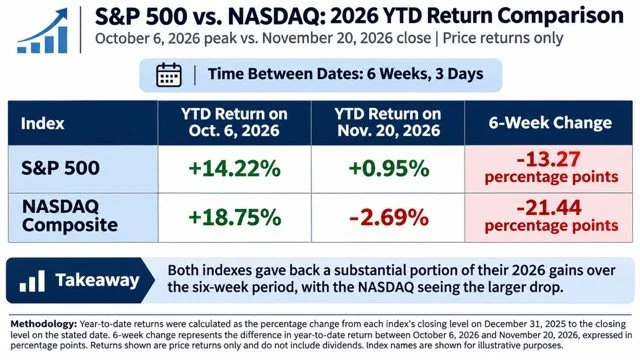
The speed and magnitude of the decline have understandably left investors asking some difficult questions. Is this simply a severe market correction that will be followed by a relatively quick recovery? Or is the recent volatility warning us that something more serious is developing beneath the surface?
Those are reasonable questions, particularly when investors are watching technology companies lose substantial amounts of market value in a matter of days. Add in a dramatic shift in Washington following the November midterm elections, uncertainty surrounding the future of artificial intelligence, and the turmoil surrounding Nvidia's leadership, and you have all the ingredients necessary to create widespread anxiety.
However, there is an important distinction investors should recognize: A sharp decline in stock prices does not automatically mean there has been an equally sharp deterioration in the underlying economy. We have experienced market corrections before where weakening economic fundamentals gave us legitimate reasons for concern. At this point, however, the economic data are telling a more encouraging story than recent stock prices would suggest.
In this article, we are going to examine several factors that we believe are worth considering before concluding that the recent market volatility represents the beginning of a prolonged downturn.
What the VIX, commonly called the market's fear index, tells us about investor sentiment and potential recoveries.
Why a Democratic Congress and Republican president do not necessarily represent bad news for the stock market.
How a slowdown in AI data-center construction could actually create a healthier long-term growth environment.
Why Nvidia's leadership uncertainty may not undermine the company's competitive strengths.
How lower oil prices and moderating Treasury yields could eventually help support an economic and market recovery.
When Fear Takes Control: Understanding the VIX Index
One of the most interesting developments over the past two weeks has been the dramatic increase in the VIX index.
The VIX, formally known as the CBOE Volatility Index, is commonly referred to as the fear index. In simple terms, it measures how much volatility investors expect in the S&P 500 over the next 30 days, based on the pricing of stock market options. When markets are relatively calm, the VIX will often trade in the teens or low twenties. When investors become increasingly nervous about the direction of the stock market, they are typically willing to pay more for downside protection. That increased demand for protection can push the VIX significantly higher.
When the VIX reaches levels above 30 or 35, it signals that investors are anticipating substantial market turbulence. It does not necessarily mean stocks are about to fall further, but it does indicate that uncertainty has become elevated.
On Friday, November 20, the VIX closed at 35.89 after trading as high as 40.03 during the session. That is an important development because periods of extremely elevated fear have historically created opportunities for long-term investors.
What Happens to the Stock Market After the VIX Peaks Above 30?
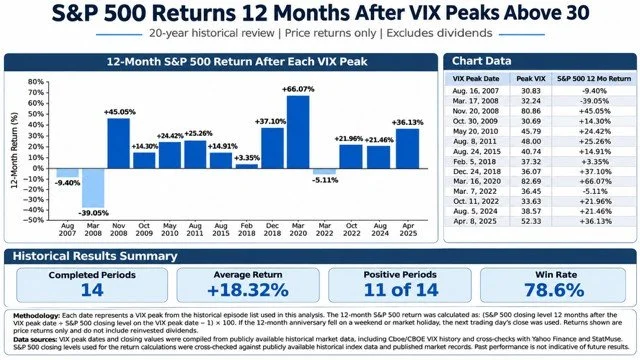
One of the most interesting historical comparisons is what happens to the S&P 500 in the 12 months following periods when the VIX spikes above 30 and subsequently peaks. The following chart looks at 14 historical episodes during the past 20 years.
Source: S&P 500 historical total returns from Slickcharts; historical political-party control from the U.S. House of Representatives. Returns are calendar-year total returns with dividends reinvested. Years before 1957 use the predecessor S&P Composite index, not the modern 500-stock index.
The results are encouraging.
Across those 14 historical periods, the S&P 500 generated a positive return over the following 12 months in 11 instances. The average 12-month return was 18.32%, and approximately 78.6% of the observations were positive.
That doesn't mean investors should expect an 18% return over the next 12 months, or that the market has necessarily found its bottom. The analysis is based on historical peaks, and we cannot yet know whether the current spike in the VIX has peaked. However, the historical evidence does reinforce an important investing principle: When fear becomes extreme, the potential for future investment returns can become more attractive.
Consider what happens when investors become convinced that the market is headed significantly lower. Some begin selling simply because prices are declining. Others sell because they are worried about what might happen next, even when there has been little change to the companies they own. Eventually, if the economic and corporate fundamentals remain reasonably healthy, buyers can begin recognizing that stock prices have fallen much further than the underlying businesses may justify. That can create the foundation for a recovery.
The Great Recession provides an important exception. During 2008, the VIX climbed to unprecedented levels because the financial system was experiencing a genuine crisis. Investors were not simply worried about an economic downturn; major financial institutions were failing, credit markets were freezing, and the economy was deteriorating rapidly.
We are not currently seeing evidence of a financial crisis comparable to 2008.
Could the VIX Continue Moving Higher?
Of course, one of the concerns investors have is whether the market has finished selling off. Unfortunately, there is no indicator that can tell us with certainty when a stock market correction will end.
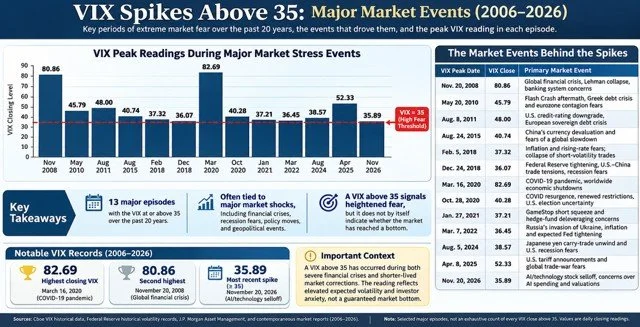
The next chart examines major periods over the past 20 years when the VIX reached levels above 35, including episodes when volatility continued increasing before the market eventually stabilized.
Source: S&P 500 Website
An interesting observation from the data above: once the VIX reached 35 (the red line in the chart), in many instances we were very close to where the VIX index peaked before falling, which may indicate that we are close to “peak fear” in the current market selloff. There were a few cases where the VIX moved substantially higher, but that was in the Great Recession and COVID.
The critical question for us is whether that fear is supported by a meaningful deterioration in economic conditions. So far, the evidence is mixed but does not point to a broad economic collapse. The most recent employment report showed that the unemployment rate remained relatively stable at 4.1% in October, while employers added 165,000 jobs. Corporate earnings, particularly among many of the large technology companies, have remained strong.
That does not eliminate the possibility of an economic slowdown, but it certainly does not resemble the backdrop we experienced during the Great Recession. Our perspective is that the recent rise in the VIX may be reflecting investor anxiety that has moved ahead of the deterioration actually visible in the economy.
The Blue Wave: Is a Democratic Congress Bad for the Stock Market?
Another concern weighing on investors is the political landscape following the November 3, 2026, midterm elections. Democrats won control of both the House of Representatives and the Senate, setting the stage for a Republican president to work with a Democratic-controlled Congress beginning in January 2027.
For some investors, that shift has created concerns about tax policy, business regulation, the artificial intelligence industry, and the broader direction of the economy. But before assuming that a divided political landscape will negatively affect investment returns, it is worth looking at history. As we discussed in our November 4 article, periods when Republicans occupied the White House while Democrats controlled Congress are not unprecedented.
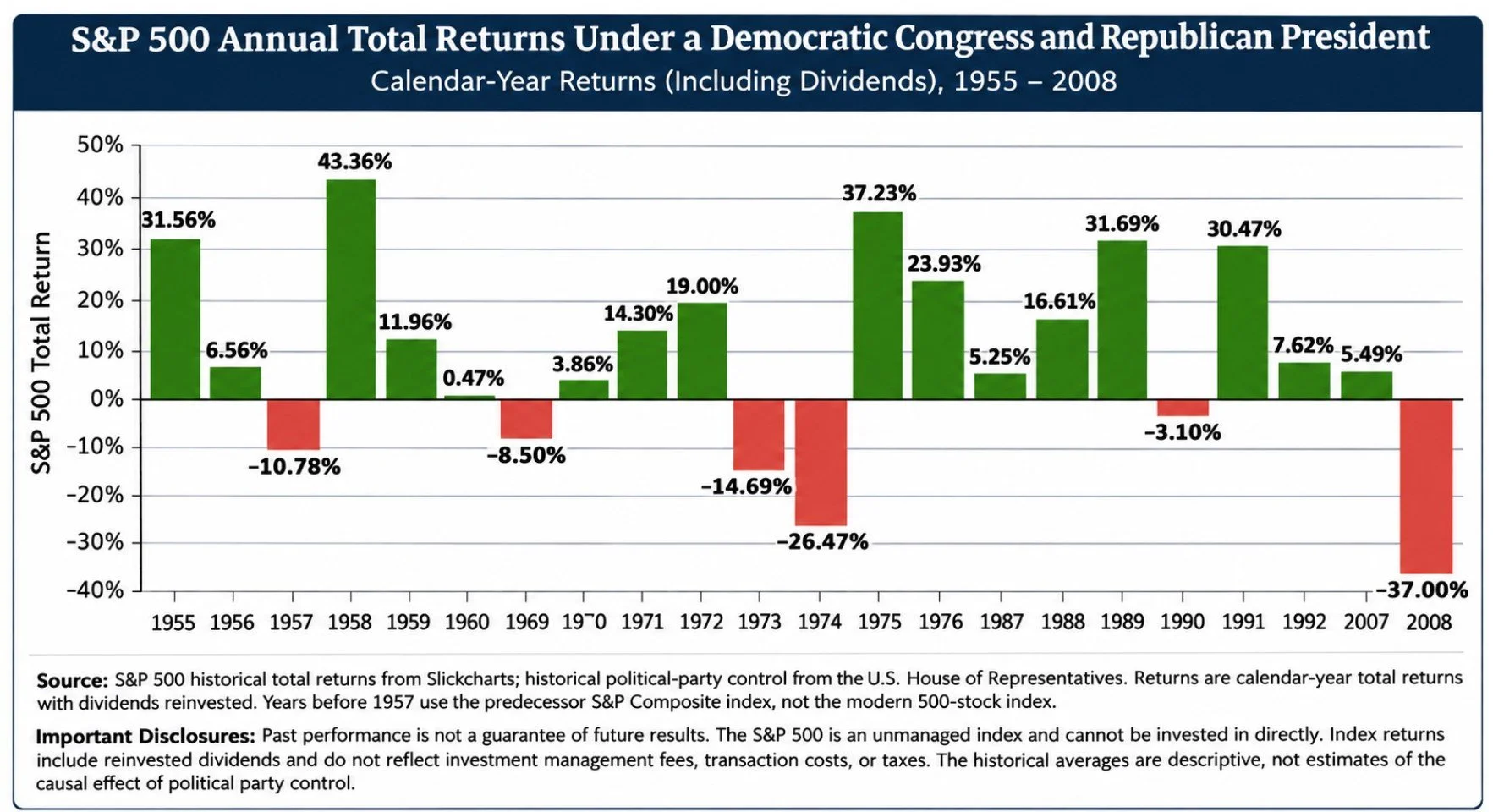
DISCLOSURE: Calculations based on historical S&P 500 calendar-year total returns. The averages are arithmetic averages, not compound annual growth rates. Excluding a period provides context, but it does not make the remaining sample a more reliable prediction
The chart illustrates that the stock market has produced numerous positive annual returns under this political arrangement. There were certainly negative years, including periods that experienced serious economic challenges. However, there were also many strong years, including returns exceeding 20% and 30%.
In other words, the political makeup of Washington has not historically prevented the stock market from generating positive investment returns. There is also an important reason for that.
While Washington can influence the economic environment through taxes, regulation, spending, and other policy decisions, the stock market is ultimately driven by a much broader collection of factors. Corporate profitability, economic growth, interest rates, technological innovation, consumer spending, and global market conditions all influence the direction of stock prices.
Simply having a Republican president and Democratic Congress does not tell us whether corporate earnings will increase or decrease in the coming year. We would also caution against interpreting historical political comparisons as evidence that one particular political arrangement causes higher stock market returns. Economic conditions and major historical events often have a far greater impact than political party control.
For that reason, we believe investors should be careful about allowing election headlines to drive major changes to their long-term investment strategies.
Could a Slowdown in Data-Center Construction Actually Be a Good Thing?
One of the primary concerns following the midterm elections is the possibility that a Democratic-controlled Congress could make it more difficult to build new AI data centers. That concern is understandable.
Data centers have become a critical component of the artificial intelligence boom. Technology companies are investing extraordinary amounts of capital to develop the infrastructure needed to train and operate increasingly sophisticated AI systems. Those investments have helped drive demand for semiconductors, electrical infrastructure, cooling equipment, construction, and numerous other industries.
If the pace of construction slows, investors worry that growth projections for companies benefiting from the AI boom will need to be revised lower. In the short term, that concern could be justified. However, we believe there may be another way of looking at the situation.
Slower Growth Is Not Necessarily Bad Growth
The pace at which companies have been committing capital to AI infrastructure has been extraordinary.
Some of the largest technology companies in the world are spending enormous amounts of money to build data centers as quickly as possible. In certain cases, that spending has also involved significant borrowing and long-term financial commitments. That creates risk.
Imagine a technology company planning to spend $100 billion constructing data centers over the next 12 months, using a significant amount of borrowed money to finance those projects. If the company completes those facilities and AI demand continues growing exactly as anticipated, the investment could be enormously profitable. But what happens if demand temporarily slows, construction costs increase, or the economy experiences an unexpected downturn?
The company could suddenly find itself carrying substantial debt tied to assets that may take longer than expected to generate the anticipated returns.
Now imagine a different scenario. Instead of spending the entire $100 billion over one year, the company spreads construction across three years. That slower timeline allows the company to use a greater portion of its ongoing earnings and cash flow to fund the projects.
The data centers still get built. The long-term opportunity from artificial intelligence still exists. But the company may be in a stronger financial position because it has reduced the need to borrow aggressively. In our view, that could create a healthier and more sustainable growth environment.
The stock market may not initially like that adjustment. Investors have become accustomed to aggressive growth forecasts for companies involved in artificial intelligence, and a moderation in spending could lead to lower near-term revenue expectations. However, there is a meaningful difference between a slower pace of growth and the disappearance of a long-term growth opportunity.
The AI boom does not necessarily need every planned data center to be completed within the next 12 months to remain a powerful investment theme over the next decade.
There are still legitimate risks to consider, including the possibility that some companies have overestimated future AI demand. We should also recognize that slower construction is not automatically beneficial for every technology company, particularly businesses whose revenue depends directly on the pace of new capital spending. But for well-capitalized technology companies with substantial earnings and established competitive positions, a more measured construction timeline could ultimately strengthen their financial flexibility.
States Need Money: Why Data Centers May Become Part of the Solution
One of the overlooked aspects of the debate surrounding data-center construction is the financial incentive that state and local governments have to accommodate these projects. Many Democratic candidates expressed concerns about data-center development during the election cycle.
Those concerns have generally focused on issues such as electricity costs, pressure on water resources, and the impact large facilities can have on surrounding communities. Those are legitimate issues that deserve attention. However, once politicians are elected, they face another important challenge: finding the revenue needed to deliver on the commitments they made to voters.
State and local governments depend on several important revenue sources.

It is important to note that data-center revenue is not a separate universal category of taxation. It generally comes through existing taxes on property, business equipment, sales, and other economic activity. Nevertheless, it has become a particularly meaningful revenue opportunity for certain communities.
Consider some of the challenges governments currently face.
Income-tax revenue depends in part on employment and wages. Although employment has remained relatively stable, wage growth has moderated compared with previous periods, which may limit the pace of revenue growth for some governments.
Property taxes are another major revenue source. In communities where residential property values are stagnating or declining, governments may have less opportunity to benefit from rising assessments without changing tax rates.
Sales-tax revenue depends on consumer spending. While higher-income households have continued to demonstrate considerable spending power, many middle- and lower-income households are facing pressure from elevated living costs.
These trends do not mean government tax collections are necessarily declining everywhere. But they illustrate why elected officials may be interested in expanding their tax base. And that brings us back to data centers.
Virginia Demonstrates the Financial Opportunity
One of the clearest examples is Loudoun County, Virginia, which has one of the largest concentrations of data centers in the world. According to the county's adopted fiscal year 2027 budget, data-center-related real estate and business equipment taxes are expected to generate approximately $1.30 billion in general fund revenue. That represents approximately 40.3% of the county's projected general fund revenue.
Think about that for a moment. More than four out of every ten dollars in Loudoun County's projected general fund revenue are expected to come from taxes associated with the data-center industry. Those revenues help support schools, public safety, infrastructure, and numerous other public services.
Loudoun County has also explained that the financial benefits associated with data-center development have helped the county maintain relatively low property tax rates for homeowners. The magnitude of those numbers provides a compelling reason why governments may ultimately seek a balance between accommodating data centers and protecting their constituents.
The Opportunity for Political Compromise
We believe this is where the conversation around data centers could become more constructive. The concern expressed by many communities is not necessarily that artificial intelligence should stop expanding. Rather, residents want assurances that they will not be forced to subsidize the infrastructure needs of some of the wealthiest technology companies in the world.
Data centers require enormous amounts of electricity, substantial power-grid infrastructure, and, depending on their design, significant water resources for cooling. If those needs cause utility costs to rise for households, it is understandable why residents and elected officials would object.
But there is a possible solution. What if governments required technology companies to contribute more directly to the infrastructure needed to support their new facilities? For example, a company seeking approval for a major data center might agree to help finance electrical substations, transmission upgrades, dedicated power generation, or more efficient cooling and water systems. That could help reduce the financial burden placed on existing utility customers.
In exchange, communities could receive substantial tax revenue, employment opportunities during construction, and investment in local infrastructure. Politicians would then have an opportunity to demonstrate that they protected consumers while also securing new revenue for their communities. Technology companies, meanwhile, could obtain the approvals necessary to move forward with projects critical to their long-term growth.
There are still practical challenges. Electricity infrastructure is expensive, water availability varies by region, and not every project will make economic sense. Nevertheless, we believe a negotiated approach is more likely over time than an outright nationwide rejection of data-center construction. In our opinion, markets may be placing too much emphasis on the possibility of restrictions while overlooking the financial incentives governments have to find workable solutions.
Nvidia: Does the Departure of Jensen Huang Change the Company's Future?
Perhaps no company has been more directly affected by the recent headlines than Nvidia. For years, Nvidia has been one of the most important companies driving the growth of artificial intelligence. Its advanced semiconductors have become essential tools for many companies building and operating AI systems.
Jensen Huang, Nvidia's co-founder and longtime CEO, has been one of the most recognizable leaders in the technology industry. His sudden departure has understandably created uncertainty among investors. However, the magnitude of Nvidia's recent stock price decline raises an important question: Has the company's long-term business opportunity deteriorated as dramatically as its stock price?
Consider what has happened since the midterm elections.
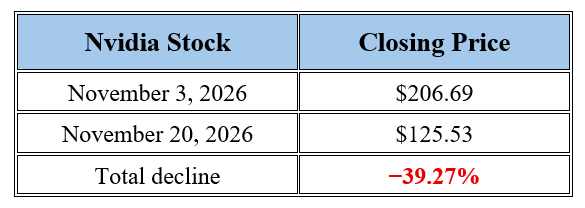
On Friday, November 20 alone, Nvidia shares declined approximately 14%.
For shareholders, that is an extraordinary amount of volatility. It is also important to acknowledge that the sell-off has not been caused solely by leadership uncertainty. Questions regarding U.S. export restrictions, regulatory investigations, accounting practices, and the sustainability of AI infrastructure spending have all contributed to investor concerns.
Those issues deserve serious attention, and we should not assume their ultimate outcomes. However, there are also reasons to believe Nvidia's underlying business remains formidable.
Scenario One: Nvidia Moves Forward With New Leadership
Nvidia's board announced that Jensen Huang resigned on November 12, and Colette Kress, the company's longtime chief financial officer, was appointed interim CEO. It is easy to understand why investors would initially react negatively to the departure of someone as influential as Huang. But there is a distinction between the person who helped build a successful company and the operating organization that exists after decades of growth.
Nvidia is not a small company whose entire success depends on one individual. It is an enormous global technology business with thousands of employees, established customer relationships, extensive intellectual property, sophisticated engineering teams, and a leadership organization responsible for developing and delivering its products. Those capabilities do not disappear overnight.
There are several examples of successful technology companies continuing to grow following the departure of highly recognizable founders or CEOs.
Apple continued developing its business following Steve Jobs' resignation as CEO in August 2011, when Tim Cook assumed leadership.
Microsoft transitioned from Bill Gates to Steve Ballmer as CEO in January 2000. The company's subsequent history demonstrates that leadership succession is not necessarily the end of a technology company's growth, although it also illustrates that stock performance can vary significantly across different leadership eras.
Google and Alphabet have undergone multiple leadership transitions, including Larry Page's move from Google CEO to Alphabet CEO in 2015 and Sundar Pichai's assumption of leadership responsibilities.
Amazon also continued expanding its operations after Jeff Bezos stepped down as CEO in July 2021.
These examples are not perfect comparisons, nor did every stock immediately perform well following its leadership transition. But they demonstrate that major technology companies can maintain their competitive positions beyond the individuals who originally helped create them.
We believe Nvidia should be evaluated in much the same way. If the board appoints a capable permanent CEO who maintains the company's product roadmap, customer relationships, and technological advantages, Nvidia may be positioned to continue growing despite the recent leadership controversy.
Scenario Two: Jensen Huang Eventually Returns
There is also the possibility that Nvidia's leadership situation could evolve further. Huang has publicly expressed a willingness to return to the company if the board determines that doing so would be appropriate.
However, Nvidia's board rejected his initial offer to return on November 17 and has indicated that it intends to pursue new leadership. That is the current position. The circumstances surrounding Huang's departure include allegations relating to his personal conduct, a reported relationship involving a suspected Chinese intelligence asset, and questions about the possible diversion of restricted U.S. AI technology to China.
It is essential to distinguish between reported allegations, confirmed corporate actions, and conclusions established through an investigation.
Questions involving possible violations of U.S. export laws are particularly serious. If investigators establish that executives knowingly participated in unlawful arrangements to circumvent export restrictions, the consequences for both the individuals and the company could be substantial.
On the other hand, investors should avoid treating every reported allegation as an established fact before the relevant investigations are completed. Whether Huang could eventually return remains uncertain, and it would be premature to assume the board will reverse its decision. Nevertheless, if the situation ultimately evolves in a way that restores investor confidence, it could remove one source of uncertainty surrounding Nvidia.
What Do Nvidia's Actual Business Results Tell Us?
While the headlines have focused heavily on leadership, Nvidia's latest financial results offer a very different perspective on its operating performance. On November 17, Nvidia reported quarterly revenue of approximately $115.8 billion, an increase of 103% from the same period a year earlier.
The company also provided a strong outlook for future revenue. Those are not the financial results of a business experiencing an immediate collapse in customer demand. They demonstrate that the underlying demand for Nvidia's technology remained substantial through its most recently reported quarter.
Of course, strong historical earnings do not guarantee future results. Regulatory investigations, new competition, customer spending decisions, and potential changes in profit margins all represent important risks. Still, we believe it is reasonable to question whether a nearly 40% stock price decline over less than three weeks fully reflects the company's continuing earnings power and competitive advantages.
Our view is that Nvidia's recent problems deserve attention, but they do not automatically mean that Nvidia's technological leadership or the broader AI opportunity has disappeared. As new information becomes available, investors will need to reassess the company based on facts rather than speculation.
What Investors May Be Overlooking: Some Economic Conditions Have Improved
With so much attention focused on falling stock prices, several potentially positive developments have received considerably less attention.
Two of the most important are the recent decline in oil prices and the moderation in longer-term interest rates. Neither guarantees a market recovery, but both could provide meaningful support to the economy if their trends continue.
Lower Oil Prices Could Help Ease Inflation Pressure
Energy prices play an important role in the U.S. economy.
When oil prices rise, the cost of gasoline, transportation, shipping, and numerous other products can increase. Those higher costs may eventually be passed along to consumers, making it more difficult for the Federal Reserve to control inflation. The opposite can also be true.
When oil prices decline, households may have more money available for other purchases, while some businesses benefit from lower operating and transportation costs. During the first three weeks of November, oil prices moved substantially lower.
Using the front-month WTI crude futures series, prices declined from approximately $96 per barrel on November 3 to approximately $83 per barrel on November 20. That is a meaningful move over a relatively short period.
If lower energy prices are sustained, they could help moderate future inflation readings and reduce one source of financial pressure on consumers. This is important because the Federal Reserve has remained concerned about inflation and has continued to maintain a restrictive interest-rate environment. If inflation pressures ease sufficiently, the Fed may have more flexibility to pause additional increases or eventually move toward lower rates.
That could provide support for borrowing, business investment, and potentially stock market valuations. We should be careful not to assume that lower oil prices automatically lead to lower interest rates. Oil prices can decline because of weakening demand, and the Fed considers a broad range of economic indicators. Nevertheless, a decline in energy costs is a development worth watching.
The 10-Year Treasury Yield Has Also Moved Lower
Another encouraging development has been the decline in longer-term Treasury yields from their elevated levels earlier this fall. On October 5, 2026, the 10-year U.S. Treasury yield was approximately 5.31%. By November 20, it had declined to approximately 4.92%.
Why is that important?
The 10-year Treasury yield influences borrowing costs throughout the economy. Mortgage rates, business financing costs, and other longer-term loans are often influenced by changes in Treasury yields. When borrowing costs decline, buying a home or financing a major business investment can become more affordable.
Lower interest rates can also influence stock valuations. Investors typically value companies based partly on the profits and cash flows they expect those companies to generate in the future. When interest rates decline, the present value investors assign to those future earnings can increase, all else being equal.
That effect can be particularly meaningful for technology companies whose valuations depend heavily on expectations for long-term growth. The recent movement in interest rates does not eliminate the risks facing the market. Yields remain relatively elevated, and investors should not assume that mortgage rates or other borrowing costs will decline immediately or by an identical amount.
However, it is encouraging that longer-term interest rates have moved lower during a period when investors have become increasingly pessimistic about the stock market.
What Could Happen if Confidence Returns?
Imagine a situation in which investors begin to recognize that the economy remains relatively stable, corporate earnings are still growing, oil prices have moved lower, and longer-term interest rates are below their earlier levels.
At the same time, several of the largest technology companies in the market have experienced substantial price declines. That combination could create an attractive environment for buyers who believe the long-term growth outlook remains intact. We have seen many market recoveries begin while investor sentiment is still extremely negative.
One reason is that stock prices often begin responding to improving expectations before the broader news environment feels reassuring. By the time investors become convinced that everything is fine, a meaningful portion of the recovery may have already occurred.
That is why trying to identify the exact bottom of a market correction can be so difficult. It is also why we believe long-term investors should avoid making major portfolio decisions solely in response to fear-driven headlines.
Our Perspective: The Market May Be Overreacting
There are times when the stock market experiences a significant decline because something fundamental has changed. Corporate earnings begin collapsing. Unemployment rises sharply. Credit markets become dysfunctional. Consumers pull back dramatically, and businesses begin cutting investment because the economic environment is deteriorating. During those periods, market corrections may be reflecting very real concerns that deserve adjustments to an investor's financial plan or portfolio.
At this point, however, we believe the current situation looks different.
While the stock market has experienced a substantial correction, the latest economic data do not indicate that the U.S. economy is entering a crisis comparable to what we experienced in 2008. Unemployment has remained relatively stable. Many major companies continue reporting substantial revenue and earnings growth. Nvidia's latest quarterly results demonstrate that demand for advanced AI technology has not suddenly disappeared.
The political shift in Washington introduces uncertainty, but history shows that stock markets can perform well when a Republican president works with a Democratic Congress. The debate around data-center construction creates challenges, but it may also lead to a more sustainable approach to AI infrastructure investment and a productive compromise between technology companies and local governments.
Meanwhile, oil prices and longer-term interest rates have recently declined, potentially providing some relief to consumers and businesses. None of these developments guarantees that the market has reached its bottom. There could be additional volatility ahead, and the ongoing investigations involving Nvidia, potential changes in AI spending, inflation, and future economic data warrant close attention. But we believe there is an important difference between acknowledging uncertainty and allowing fear to dictate investment decisions.
From our perspective, investors may be focusing heavily on everything that could go wrong while giving too little consideration to the things that are still going right.
The dramatic increase in the VIX is consistent with that environment. Fear has become a major influence on investor behavior, and when that happens, stock prices can sometimes move much further than changes in underlying business fundamentals would appear to justify. The encouraging part is that market sentiment can also change quickly.
If investors begin to regain confidence in corporate earnings, economic stability, and the long-term opportunity surrounding artificial intelligence, buyers may begin recognizing that some high-quality companies are trading at prices substantially below where they were only a few weeks ago. That could create the foundation for a meaningful recovery.
Will it happen next week? Next month? Or will markets need more time to digest the uncertainty? Nobody knows.
But for investors with a well-diversified portfolio, appropriate liquidity, and a financial plan designed around their long-term goals, the most important decision is often not trying to predict exactly when the market will recover. It is making sure that short-term emotions do not undermine a long-term investment strategy.
Markets have endured political uncertainty, recessions, wars, financial crises, and countless unexpected developments throughout history. And while every correction has its own unique circumstances, one principle has remained consistent:
Fear can change stock prices very quickly. But over time, it is the earnings, financial strength, and growth of the underlying businesses that matter most.

About Michael……...
Hi, I’m Michael Ruger. I’m the managing partner of Greenbush Financial Group and the creator of the nationally recognized Money Smart Board blog . I created the blog because there are a lot of events in life that require important financial decisions. The goal is to help our readers avoid big financial missteps, discover financial solutions that they were not aware of, and to optimize their financial future.
Frequently Asked Questions About the 2026 Midterm Elections and the Stock Market
-
How will the 2026 midterm election results affect the stock market?The 2026 midterm elections resulted in Democratic control of both chambers of Congress while Republican President Donald Trump remains in office. This creates divided government, which can make major legislative changes more difficult to pass. Historical S&P 500 returns suggest this political arrangement has not consistently been negative for stocks, although economic conditions will ultimately play an important role.
-
Does the stock market perform better under divided government?The stock market has experienced many positive years under divided government, but the historical evidence doesn't establish that divided government consistently outperforms unified government. In the specific scenario involving a Democratic House, Democratic Senate, and Republican president, the S&P 500 averaged approximately 8.6% annually across 22 historical calendar years since 1955.
-
What is the average S&P 500 return with a Democratic Congress and Republican president?Since 1955, the S&P 500 has generated an average annual total return of approximately 8.58% during calendar years when Democrats controlled both the House and Senate and a Republican served as president. Excluding 2008, when the financial crisis caused a substantial market decline, the average increases to approximately 10.75%.
-
How often has the S&P 500 increased under a Democratic Congress and Republican president?The S&P 500 produced positive annual total returns in 16 out of 22 calendar years between 1955 and 2008 when Democrats controlled both chambers of Congress and a Republican occupied the White House. That represents a positive-return frequency of approximately 72.7%.
-
Is political gridlock good or bad for the stock market?Political gridlock can have both advantages and disadvantages for investors. It may reduce the likelihood of unexpected changes to taxes, regulations, and other economic policies, providing businesses with greater predictability. However, gridlock can also create risks involving government funding, debt-ceiling negotiations, and delayed responses to economic problems.
-
Should I sell stocks after the 2026 midterm elections?The midterm election results alone generally should not be the deciding factor in whether an investor sells stocks. Investment decisions should consider financial goals, time horizon, diversification, and risk tolerance. Historical returns do not provide strong support for selling stocks simply because Democrats control Congress while a Republican is president.
-
How did the stock market perform when Democrats controlled Congress under George W. Bush?During 2007 and 2008, the final two calendar years of President George W. Bush's administration, Democrats controlled the House and Senate. The S&P 500 returned 5.49% in 2007 and -37.00% in 2008. The severe decline in 2008 was closely associated with the housing market collapse and global financial crisis.
-
Could the Iran conflict and higher oil prices impact the S&P 500 in 2027?Yes. Higher oil prices can increase business expenses, put upward pressure on inflation, and reduce consumer spending power. These developments may affect corporate earnings and Federal Reserve policy. The outcome of the Iran conflict and the direction of energy prices could be important influences on stock market performance in 2027.
-
Will artificial intelligence have a bigger impact on stocks than the midterm elections?It's possible. Artificial intelligence is driving substantial capital investment and influencing earnings expectations across major technology companies. If AI-related investments produce meaningful productivity improvements and profit growth, they could influence S&P 500 returns substantially. However, disappointing earnings or overly optimistic valuations could also create market volatility.
-
What is the S&P 500 outlook for 2027 and 2028 following the midterm elections?Historically, the S&P 500 has performed reasonably well under the specific combination of a Democratic Congress and Republican president. However, historical averages cannot reliably predict returns for 2027 and 2028. Inflation, interest rates, economic growth, corporate earnings, energy prices, and geopolitical developments are likely to be important factors in determining actual market performance.