The First 3 Years of Retirement: 7 Financial Decisions That Matter More Than You Think
The first three years of retirement can create valuable planning opportunities. Learn how withdrawals, Roth conversions, Social Security, Medicare, RMDs, and investment decisions can work together to shape your long-term retirement plan.

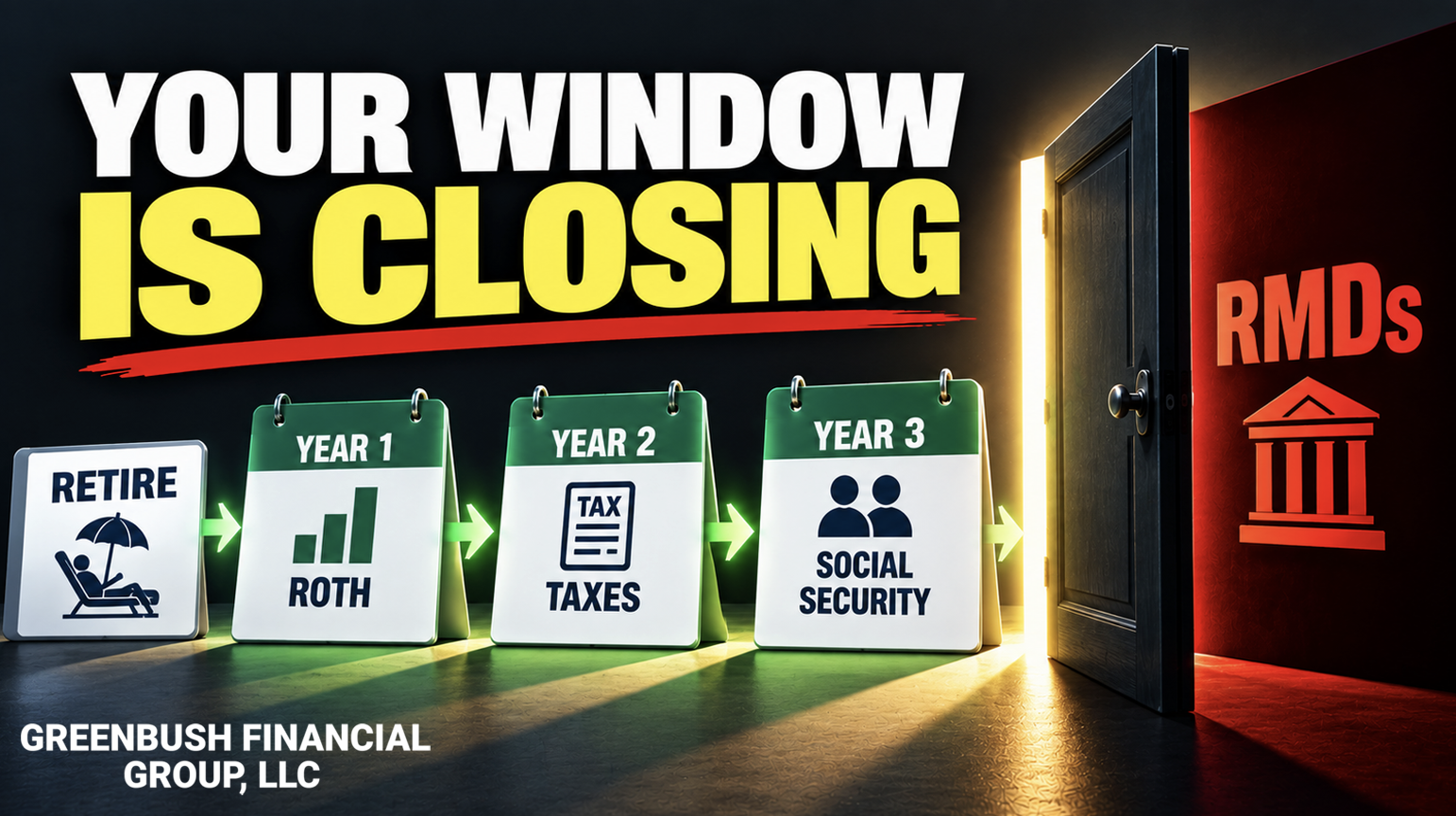
The first three years of retirement can offer valuable planning opportunities, particularly when your paycheck has stopped but Social Security and required minimum distributions have not started. Decisions about withdrawals, Roth conversions, investments, and Medicare often affect one another. Greenbush Financial Group recommends looking at these early retirement decisions as one coordinated plan rather than a series of separate choices.
Why the First Three Years Matter
When your paycheck stops, you suddenly have to decide where your income will come from.
Should you spend cash? Sell investments? Take money from your IRA? Start Social Security?
These decisions are connected.
An extra $50,000 IRA withdrawal, for example, can increase taxable income, reduce your Roth-conversion opportunity, affect capital-gains taxes, potentially increase future Medicare premiums, and reduce future RMDs.
The first few years of retirement may also be some of your lowest-income tax years. If you do nothing, some of those opportunities can disappear.
Consider Mark and Susan.
They are both 64 and retiring with $1.8 million:
$1.2 million in traditional 401(k)s and IRAs
$200,000 in Roth IRAs
$300,000 in a brokerage account
$100,000 in cash
They expect to spend about $90,000 per year after tax and have not started Social Security.
Their situation illustrates seven decisions that can shape the next several decades.
1. Decide Where Your Retirement Paycheck Comes From
There is no universal rule that says you should spend taxable accounts first and Roth accounts last.
Instead, ask:
Which combination of accounts gives us the income we need without creating unnecessary taxes?
Mark and Susan might fund part of their first year's spending from cash, dividends, and their brokerage account rather than automatically taking $90,000 from an IRA.
That could keep their taxable income lower and leave room for another strategy, such as a Roth conversion.
Retirees should also consider directing dividends and interest to cash instead of automatically reinvesting them.
A reasonable cash reserve depends on the household, but maintaining roughly 12 to 24 months of expected portfolio withdrawals in cash and short-term investments can provide flexibility during a market decline.
Key Insight: Your withdrawal strategy should be based on taxes, markets, and future income, not simply which account has the easiest transfer button.
2. Take Advantage of the Retirement Tax Window
For many retirees, there is a gap between their final paycheck and the beginning of Social Security and RMDs.
That can create unusually low taxable-income years.
Mark and Susan have $1.2 million in tax-deferred retirement accounts. If they leave that money untouched, it could grow substantially before RMDs begin.
Instead, suppose they convert $75,000 per year to Roth for their first three years.
They move:
$225,000 from tax-deferred accounts into Roth accounts.
They pay tax today, but future growth on those dollars occurs inside the Roth, and those converted dollars no longer contribute to their future traditional IRA RMD balance.
If $225,000 subsequently grew at 5% for eight years, it would become roughly $330,000.
The goal is not to convert as much as possible. A conversion can affect tax brackets, capital-gains taxes, Medicare premiums, and other parts of the plan.
The better question is:
How much can we convert at a tax rate we are comfortable paying today compared with the tax rate we may face later?
3. Coordinate Social Security With IRA Withdrawals
Social Security should not be considered separately from investment withdrawals.
Suppose Mark is the higher earner and has a $3,200 monthly benefit at full retirement age. Delaying until age 70 could increase that benefit by approximately 24%, before future cost-of-living adjustments.
But delaying means Mark and Susan need to fund those years from somewhere else.
That can be useful.
They might spend taxable assets while completing Roth conversions before Social Security begins. Later, the larger Social Security benefit reduces the amount the portfolio needs to provide.
There is also a survivor consideration.
If Mark dies first, Susan generally does not continue receiving both Social Security benefits. The higher benefit can therefore become particularly important to the surviving spouse.
Key Insight: Delaying Social Security is not always best. Health, longevity, taxes, portfolio size, and survivor needs all matter.
4. Coordinate Roth Conversions, Capital Gains, and Medicare
This is where retirement tax planning becomes a balancing act.
Suppose Mark and Susan own an investment worth $60,000 with a $30,000 cost basis.
Selling it creates a $30,000 long-term capital gain.
During a low-income retirement year, some or potentially all of that gain could qualify for the 0% federal long-term capital-gains rate, depending on their other income.
That could allow them to diversify the portfolio while increasing the cost basis of their taxable investments.
But there is a catch.
If they complete a large Roth conversion first, that additional income can reduce the amount of capital gains eligible for the 0% rate.
Medicare creates another consideration.
Medicare generally uses income from two years earlier when determining IRMAA surcharges. A large Roth conversion or capital gain today could therefore increase Medicare premiums later.
That does not automatically make the transaction a bad idea.
Sometimes paying additional tax or Medicare premiums today creates greater long-term savings.
The important part is knowing the tradeoff before making the decision.
5. Prepare for RMDs Before You Have RMDs
One of the biggest retirement mistakes is waiting until RMDs begin to start planning for them.
Mark and Susan already have $1.2 million in tax-deferred accounts at age 64.
If those accounts continue growing, future RMDs could create more taxable income than they actually need.
Before RMDs begin, they have more control through:
Roth conversions
Strategic IRA withdrawals
Social Security timing
Charitable planning
This becomes even more important when one spouse dies.
The surviving spouse may eventually file as single while still owning much of the same IRA assets. That means narrower tax brackets and lower Medicare IRMAA thresholds.
A Roth conversion today should therefore sometimes be evaluated against the survivor's future tax rate, not just the couple's current rate.
6. Have a Plan for a Bad Market in Year One
Imagine stocks fall 25% six months after Mark and Susan retire.
Their expenses do not fall 25%.
Where does their income come from?
This is why retirement portfolios should be designed differently from portfolios that are still accumulating.
If Mark and Susan need $50,000 annually from their portfolio and maintain $75,000 to $100,000 in cash and short-term investments, they may have roughly 18 to 24 months of withdrawals available without relying heavily on stock sales.
During a major decline, income could come from:
Cash
Short-term bonds
Dividends and interest
Investments that held up better
The goal is to avoid being forced to sell stocks after a major decline simply because the monthly bills are due.
This is called sequence-of-returns risk. Poor returns early in retirement can be particularly damaging when withdrawals are occurring at the same time.
That does not mean retirees should abandon stocks. A retirement lasting 25 or 30 years still needs long-term growth.
The objective is to balance short-term spending needs with long-term growth.
7. Plan for the Expenses and Life Changes That Do Not Fit the Spreadsheet
Retirement rarely follows a perfectly predictable annual budget.
Suppose Mark and Susan decide to spend $100,000 remodeling their home.
Taking $100,000 from an IRA could create a much larger tax bill, reduce Roth-conversion capacity, affect capital-gains taxation, and potentially increase future Medicare premiums.
Paying cash, selling taxable investments, taking an IRA distribution, or financing the project can each produce a different result.
The same planning applies to an RV, new vehicle, vacation home, or other major purchase.
Retirement is also a natural time to review:
Beneficiaries
Wills and trusts
Powers of attorney
Account titling
Long-term-care funding
Emergency reserves
Charitable giving
Charitably inclined retirees may also benefit from donating appreciated securities, using donor-advised funds in certain situations, or eventually making qualified charitable distributions from IRAs after reaching the eligible age.
One practical question is especially useful for married retirees:
If one of us died tomorrow, could the other person manage everything?
The surviving spouse should know where accounts are held, how income is generated, where estate documents are located, and who to contact.
Option A vs. Option B: What Coordination Can Change
Consider Mark and Susan's first three years.
Option A: Autopilot
They withdraw whatever they need from their IRAs, claim Social Security relatively early, complete no Roth conversions, and wait until RMDs begin to worry about taxes.
Their plan may still work.
But several planning opportunities may disappear.
Option B: Coordinated Planning
Instead, they:
Fund some spending from cash and taxable investments
Convert approximately $225,000 to Roth over three years
Delay the higher earner's Social Security when appropriate
Realize selected capital gains during lower-income years
Monitor Medicare IRMAA
Maintain short-term reserves for market declines
They might actually pay more tax during their first three years.
That can be intentional.
They are potentially trading a higher tax bill today for smaller future RMDs, more Roth assets, a larger Social Security benefit, and greater flexibility for the surviving spouse.
That is the difference between minimizing taxes this year and managing taxes throughout retirement.
How Much Can You Safely Spend?
There is no single withdrawal percentage that answers this question.
Your sustainable spending depends on:
Portfolio size
Social Security and pensions
Taxes
Investment allocation
Inflation
Healthcare expenses
Longevity
Large future purchases
For Mark and Susan, the better question is not simply whether $90,000 is a safe percentage of $1.8 million.
It is:
How much does the portfolio need to provide before Social Security begins, and how much will it need to provide afterward?
Retirement income changes over time. Your spending plan should account for those changes.
The First Three Years: A Simple Checklist
Year One
Determine how much you can spend, establish where your retirement paycheck will come from, build cash reserves, review the portfolio, and calculate whether a Roth conversion makes sense.
Year Two
Recalculate taxes, Roth-conversion capacity, capital gains, Medicare exposure, and Social Security timing based on what actually happened during year one.
Year Three
Stress-test the plan for a major market decline, future RMDs, long-term-care costs, large purchases, and the death of either spouse.
What Opportunities Disappear If You Do Nothing?
This may be the most important question.
Doing nothing during the first few years of retirement may not create an immediate problem.
But you may lose:
Lower-income years for Roth conversions
Opportunities to realize gains at favorable tax rates
Additional Social Security growth
Opportunities to reduce future RMDs
Years of planning while both spouses can use joint tax brackets
The cost may not show up today.
It may appear 10 or 15 years later.
Final Thoughts
The first three years of retirement are about more than replacing your paycheck.
Withdrawals affect taxes. Taxes affect Roth conversions. Roth conversions can affect Medicare. Social Security affects future withdrawals. Today's IRA balance affects future RMDs. And all of those decisions can look very different after one spouse dies.
There is no universal withdrawal order or Roth-conversion strategy.
At Greenbush Financial Group, we believe the opportunity is in coordinating these decisions around the household's complete retirement plan.
The first few years of retirement give you something valuable: choices.
The goal is to use those choices before they begin disappearing.

Rob Mangold
About Rob……...
Hi, I’m Rob Mangold. I’m the Chief Operating Officer at Greenbush Financial Group and a contributor to the Money Smart Board blog. We created the blog to provide strategies that will help our readers personally, professionally, and financially. Our blog is meant to be a resource. If there are questions that you need answered, please feel free to join in on the discussion or contact me directly.
Frequently Asked Questions
-
Which account should I withdraw from first in retirement?There is no universal order. The best approach may combine cash, taxable investments, traditional retirement accounts, and Roth accounts based on taxes, spending needs, future RMDs, and Social Security.
-
Should I take Social Security or spend investments first?It depends on longevity, taxes, portfolio size, and survivor needs. Spending investments first can sometimes create additional Roth-conversion opportunities while allowing Social Security benefits to grow.
-
Should I convert my IRA to Roth before RMDs?A partial Roth conversion may make sense if your current tax rate is attractive compared with the rate you or a surviving spouse could face later.
-
How much should I convert to Roth?Consider tax brackets, capital gains, Medicare IRMAA, state taxes, and future RMDs. The appropriate amount should generally be recalculated each year.
-
What happens if the market crashes right after I retire?Cash and short-term investments can provide spending money without requiring immediate stock sales. This is one reason retirement portfolios should be structured around both withdrawals and long-term growth.
-
Why should I worry about RMDs years before they begin?The years before RMDs often provide the most flexibility to reduce future tax-deferred balances through Roth conversions and strategic withdrawals.
This article is for educational purposes and uses simplified hypothetical examples. Tax laws, Medicare rules, investment returns, and individual circumstances can change. The examples are not intended as individualized tax, investment, or legal advice.