How Much Cash Should Retirees Keep in 2026?
How much cash should you keep in retirement? Learn why 12 to 24 months of planned portfolio withdrawals may be a better starting point than keeping years of total expenses in cash.

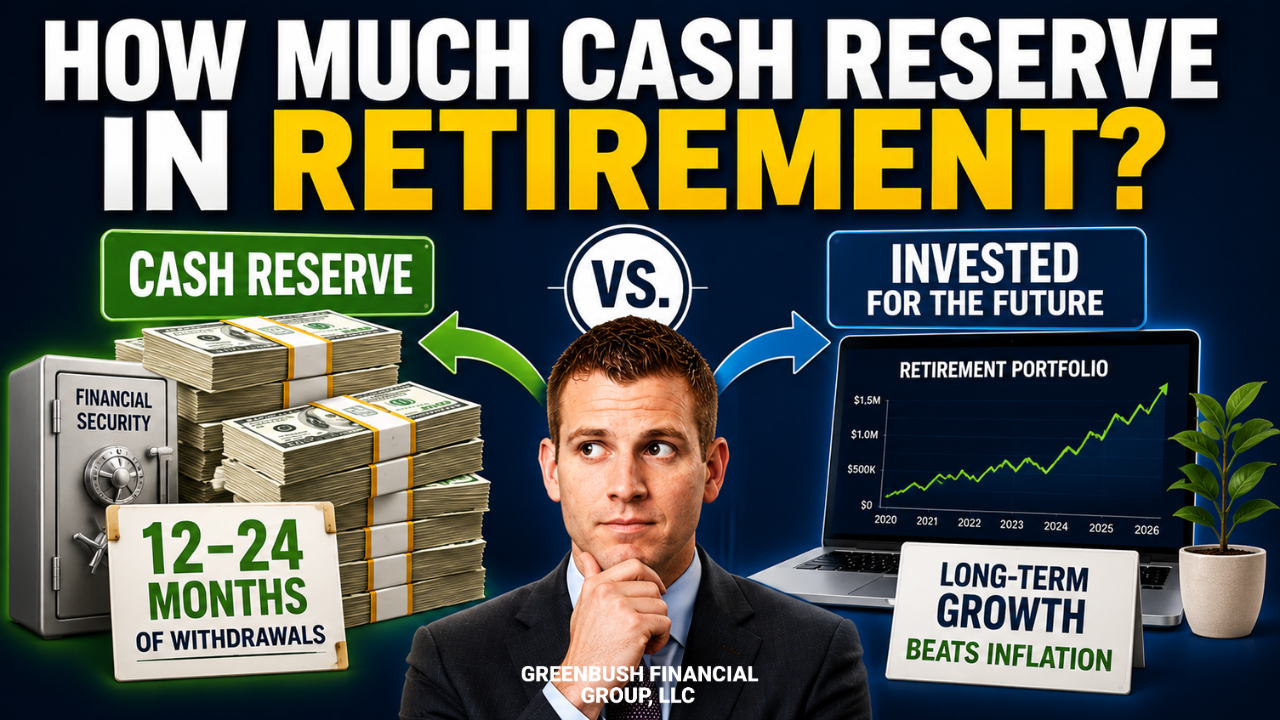
Many retirees may want enough cash and short-term reserves to cover roughly 12 to 24 months of the amount they expect to withdraw from their portfolio, not necessarily 12 to 24 months of total household expenses. The right amount depends on Social Security, pensions, upcoming expenses, taxes, and how the rest of the portfolio is invested. Greenbush Financial Group generally views cash as part of a broader retirement income strategy designed to provide liquidity without leaving too much money out of the market.
How Much Cash Should Retirees Really Keep Outside the Market?
Retirement changes the role cash plays in your financial plan.
While you are working, a market decline may be uncomfortable, but your paycheck continues. In retirement, your portfolio may be providing part of that paycheck.
That creates an important question: How much should you keep in cash so you are not forced to sell investments during a bad market?
For many retirees, a reasonable starting point is 12 to 24 months of planned portfolio withdrawals, plus money for emergencies and known near-term expenses.
The key word is portfolio withdrawals.
Don't Base Your Cash Reserve on Total Expenses
One of the most common rules of thumb is to keep one or two years of expenses in cash.
That can result in holding much more cash than necessary.
Example
Assume a retired couple spends $100,000 per year.
They receive:
$55,000 from Social Security
$15,000 from pensions
$30,000 from their investment portfolio
Their total spending is $100,000, but the portfolio only needs to provide $30,000.
Two years of total expenses would mean holding:
$200,000 in cash
Two years of expected portfolio withdrawals would be:
$60,000 in cash
That is a major difference.
Key Insight
Start by calculating your retirement income gap:
Annual spending - Social Security - pensions - other reliable income = amount needed from your portfolio
That number is usually more useful when determining how much cash to keep.
Should Retirees Keep One, Two, or Three Years in Cash?
There is no universal answer.
For many retirees, 12 to 24 months of portfolio withdrawals can provide a useful cushion.
You might consider holding more if:
Most of your income comes from investments
You have large expenses approaching
Your portfolio has a higher stock allocation
You are delaying Social Security and temporarily withdrawing more
Having additional reserves helps you remain disciplined during market declines
You may be comfortable holding less if Social Security and pensions cover most of your essential expenses or if your portfolio contains a substantial allocation to high-quality bonds.
Cash should also be considered alongside the rest of your portfolio. A retiree with 50% of a portfolio already invested in bonds may not need the same cash reserve as someone with a much more aggressive allocation.
How Does Cash Help During a Market Crash?
Cash does not prevent investment losses.
What it can do is give you time.
Suppose you need $40,000 per year from your portfolio and have $80,000 in short-term reserves.
If stocks decline significantly, you may be able to use those reserves for your planned withdrawals instead of immediately selling stocks after they have fallen.
This can help address sequence of returns risk.
Sequence of returns risk is the danger of experiencing poor investment returns early in retirement while simultaneously withdrawing money from the portfolio.
Selling investments after a significant decline means fewer shares remain invested to participate in a future recovery.
A cash reserve gives retirees another source of money during those periods.
The objective is not to predict when the next market crash will occur. It is to structure your retirement income so that a market decline does not automatically force you to sell long-term investments at an unfavorable time.
Can Retirees Keep Too Much Cash?
Yes.
Cash feels safe because its balance does not typically fluctuate like stocks. But holding too much cash creates different risks.
Inflation Risk
If living costs rise while a large amount of money remains in cash, its purchasing power can decline over time.
Opportunity Cost
Money held in cash is not participating in the potential long-term returns of the investment portfolio.
For example, assume you need $40,000 per year from your investments.
A two-year reserve would be approximately $80,000.
If you instead keep $200,000 in cash, the additional $120,000 represents another three years of withdrawals sitting outside your long-term portfolio.
That may be appropriate if the money has a specific purpose. But if it is being held indefinitely because the market "might go down," you may be sacrificing too much long-term growth for short-term stability.
Important Note
Retirement can last 20, 25, or 30 years or longer.
The goal is not to eliminate investment risk. It is to balance short-term stability with the long-term growth needed to keep pace with inflation.
Where Should Retirement Cash Actually Sit?
Not every dollar needs to sit in a checking account.
Different types of cash and short-term investments can serve different purposes.
Checking Account
Best for monthly bills and immediate spending.
You generally only need enough here to comfortably manage normal cash flow.
High-Yield Savings or Money Market Deposit Account
These accounts can be useful for emergency funds and reserves that need to remain readily accessible.
At FDIC-insured banks, eligible deposits are generally insured up to applicable FDIC limits.
Money Market Mutual Fund
Money market funds are commonly used inside brokerage and retirement accounts for short-term reserves.
They are investment products, not bank deposits, so they are not FDIC-insured.
CDs and Treasury Bills
Money that will not be needed immediately may also be held in CDs or short-term Treasury bills.
For example, you might keep:
Immediate spending needs in checking
Emergency reserves in savings
Additional planned withdrawals in short-term Treasury bills or other appropriate short-term investments
The objective is to keep the money accessible while still being thoughtful about where it is held.
Emergency Money and Retirement Income Reserves Are Different
It can help to separate two different types of cash.
Emergency reserves are for unexpected expenses.
Examples include:
Home repairs
Vehicle expenses
Insurance deductibles
Unexpected family needs
Retirement income reserves are for expected portfolio withdrawals.
For example, a household might maintain:
$25,000 emergency fund
$60,000 representing two years of planned portfolio withdrawals
Both are cash reserves, but they have different jobs.
This distinction can make it much easier to determine whether you are holding too much or too little.
Don't Forget Taxes When Setting Your Cash Target
Cash can also create valuable tax-planning flexibility.
Retirees frequently have money spread across:
Traditional IRAs
Roth IRAs
Taxable investment accounts
Bank accounts
Where retirement spending comes from can affect taxable income.
For example, a recently retired couple may want to complete Roth conversions before required minimum distributions begin.
Having sufficient cash outside the IRA could allow them to cover living expenses and potentially pay the tax associated with the conversion without taking additional taxable IRA withdrawals.
Cash planning can therefore affect:
Roth conversions
Medicare IRMAA premiums
Social Security taxation
Required minimum distributions
Capital gains
Estimated tax payments
At Greenbush Financial Group, this is why we generally look at cash reserves together with the household's investment, income, and tax strategy.
How Should You Refill Your Cash Reserve?
Your cash target does not need to remain static.
There may be opportunities to replenish it throughout retirement.
For example:
After strong stock market performance
When rebalancing the portfolio
As bonds, CDs, or Treasury bills mature
When required minimum distributions are taken
When dividends and interest accumulate
During a strong market, you may sell appreciated investments and refill the reserve.
During a significant decline, you may spend from the reserve instead.
This is not about trying to time the market. It is about having flexibility over which assets you sell and when.
Common Cash Mistakes in Retirement
1. Keeping Several Years of Total Expenses in Cash
Social Security and pensions may already cover a large portion of those expenses. Focus on the amount the portfolio actually needs to provide.
2. Keeping Too Much in Checking
Money that will not be needed immediately may have better short-term options.
3. Ignoring the Bond Allocation
Cash is only one part of the conservative side of a retirement portfolio. Bonds may also provide stability and liquidity.
4. Moving to Cash After the Market Drops
Building a large cash position after investments have already declined can mean selling at an unfavorable time. Cash reserves are most useful when established as part of the plan beforehand.
5. Never Reassessing the Cash Balance
Cash can accumulate from distributions, dividends, interest, and asset sales. Review the balance periodically so the portfolio does not unintentionally become too conservative.
A Simple Framework for Retirement Cash
Rather than choosing an arbitrary percentage of your portfolio, consider four questions:
How much do we spend each year?
How much is already covered by Social Security, pensions, and other reliable income?
How much will we need from the portfolio over the next 12 to 24 months?
Do we have major expenses or tax payments coming up?
Then add an appropriate emergency reserve.
This produces a cash target based on your household's actual needs instead of a generic rule.
Final Thoughts
For many retirees, the right question is not:
"Should I keep one year or three years of expenses in cash?"
It is:
"How much money do I need available so I am not forced to disrupt my investment strategy at the wrong time?"
Holding too little cash can create problems during a market decline. Holding too much can reduce long-term growth and expose more of your savings to inflation.
The appropriate balance depends on your income sources, spending, taxes, portfolio allocation, and upcoming financial needs.
Greenbush Financial Group generally approaches cash as one piece of the retirement income plan. When cash reserves, investments, Social Security, taxes, and withdrawals are coordinated, retirees can have a clearer process for deciding where their next dollar of retirement income should come from.

Rob Mangold
About Rob……...
Hi, I’m Rob Mangold. I’m the Chief Operating Officer at Greenbush Financial Group and a contributor to the Money Smart Board blog. We created the blog to provide strategies that will help our readers personally, professionally, and financially. Our blog is meant to be a resource. If there are questions that you need answered, please feel free to join in on the discussion or contact me directly.
Frequently Asked Questions
- How much cash should retirees keep?A common starting point is enough cash and short-term reserves to cover approximately 12 to 24 months of expected portfolio withdrawals, plus emergency savings and known near-term expenses. The appropriate amount varies by household.
- Should I keep three years of expenses in cash during retirement?Not necessarily. If Social Security and pensions cover a significant portion of your expenses, three years of total spending could result in holding much more cash than needed.
- Is holding too much cash bad in retirement?It can be. Excess cash may lose purchasing power to inflation and can reduce the long-term growth potential of the portfolio.
- Where should retirement emergency money be kept?Depending on when the money will be needed, options may include checking accounts, high-yield savings accounts, money market accounts or funds, CDs, and short-term Treasury bills. Liquidity, insurance protection, taxes, and yield should all be considered.
- How does cash protect retirees during a market crash?Cash can provide a source for near-term spending so retirees are not automatically forced to sell stocks after a significant market decline. This can help manage sequence of returns risk.