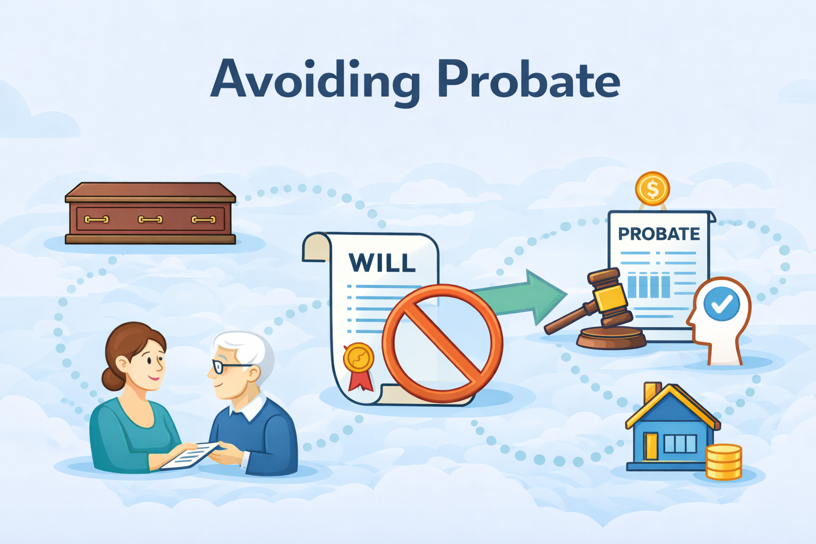
Strategies for Avoiding Probate
Proactive Planning to Protect Your Estate, Your Family, and Your Privacy
For anyone who has served as an executor of an estate, you may already be familiar with how cumbersome, time-consuming, and stressful the probate process can be from start to finish. One of the primary goals of a well-designed estate plan is to avoid probate whenever possible through thoughtful, proactive planning.
Probate must be avoided in advance—once someone passes away, it is too late to implement probate-avoidance strategies. Depending on the size and complexity of the estate, probate can be expensive, delay beneficiaries from receiving assets for months or even years, and make a family’s financial affairs public record.
We help clients understand the strategies available to avoid probate and integrate those strategies into a broader financial and estate plan.
Why Avoiding Probate Matters
The probate process can:
Delay asset distribution to beneficiaries
Increase legal and administrative costs
Expose estate details to public record
Create additional stress for surviving family members
Complicate business, real estate, and multi-state estates
With proper planning, much—or all—of the probate process can often be avoided.
Two Primary Strategies for Avoiding Probate
There are two main approaches to keeping assets out of probate:
Using beneficiary designations on accounts
Establishing trusts to own assets
The appropriate strategy depends on the complexity of the estate, asset types, and long-term objectives.
Using Beneficiary Designations (TOD Accounts)
One of the simplest ways to avoid probate for non-retirement accounts is to ensure beneficiaries are properly designated.
Many brokerage accounts, checking accounts, and savings accounts allow for a Transfer on Death (TOD) designation. When a TOD is in place:
Assets pass directly to named beneficiaries
The transfer occurs by contract, not by probate
The custodian distributes assets upon proof of death
This approach can be very effective for non-complex estates, provided beneficiary designations are kept up to date.
TOD Deeds for Real Estate
Some states allow a Transfer on Death (TOD) deed, which permits property owners to name beneficiaries directly on the deed.
When allowed:
Ownership transfers automatically at death
Probate can be avoided for the property
However, not all states permit TOD deeds. In states where TOD deeds are not available, owning real estate in your individual name may require the establishment of a trust to avoid probate.
Establishing Trusts to Avoid Probate
For many estates—especially those involving real estate, businesses, or multiple accounts—trusts are the most comprehensive solution.
Assets owned by a trust avoid probate because they pass by trust, not by will.
Revocable Trusts (Living Trusts)
A revocable trust, often called a living trust:
Allows you to maintain full control of your assets during your lifetime
Can be changed or revoked at any time
Avoids probate for assets titled in the trust
Provides privacy and administrative efficiency
Revocable trusts are commonly used for probate avoidance and estate organization.
Irrevocable Trusts
An irrevocable trust also avoids probate and may provide additional benefits depending on structure:
Asset protection from long-term care costs
Protection from creditors
Potential estate tax reduction for larger estates
More control over how and when beneficiaries receive assets
Once established, irrevocable trusts typically cannot be changed easily, which is why careful planning is essential.
Choosing the Right Strategy
There is no one-size-fits-all approach to avoiding probate. Some individuals may benefit from:
Simple TOD designations
Revocable trusts
Irrevocable trusts
A combination of strategies
The right solution depends on:
Asset types and values
State laws
Family dynamics
Long-term care considerations
Estate tax exposure
Privacy concerns
We help clients evaluate their estate holistically to determine the most appropriate strategy.



Our Avoiding Probate Articles





“Learning that only 31 states currently allow TOD deeds for houses is a bummer, but it’s good to know. For those of us in states where it’s not allowed”
This endorsement provided for Greenbush Financial Group, LLC on YouTube was a non-solicited and non-paid comment by a non-client.
Frequently Asked Questions About Avoiding Probate
-
What is probate?Probate is the court-supervised process of validating a will, settling debts, and distributing assets after someone passes away.
-
Why is probate something people try to avoid?Probate can be costly, time-consuming, public, and stressful for families—often delaying asset distribution.
-
Do beneficiary designations avoid probate?Yes. Accounts with valid beneficiary or TOD designations typically pass directly to beneficiaries and avoid probate.
-
Do retirement accounts go through probate?Generally no, as long as beneficiaries are properly named on the accounts.
-
Does owning a home require probate?If owned individually without a TOD deed or trust, real estate often goes through probate. Trust ownership can avoid this.
-
What is the difference between a revocable and irrevocable trust?A revocable trust offers flexibility and probate avoidance, while an irrevocable trust can provide asset protection and potentially reduce estate tax exposure.
-
Can I avoid probate without a trust?In some cases, yes—using TOD accounts and beneficiary designations. However, trusts offer more comprehensive protection.
-
When should probate avoidance planning be done?Probate avoidance strategies must be implemented before death. Once someone has passed, without proper planning, probate may be unavoidable.
Contact Us . . . .

All of our services start with a complimentary consult. No high pressure sales tactics. We are financial planners, not salesmen.
About Our Firm: Greenbush Financial Group is an independent registered investment advisory firm based in Albany, New York, that provides four main services to clients: fee-based financial planning services, investment management, employer-sponsored retirement plans, and retirement planning services. The firm serves clients locally in the Albany region and virtually across the United States.