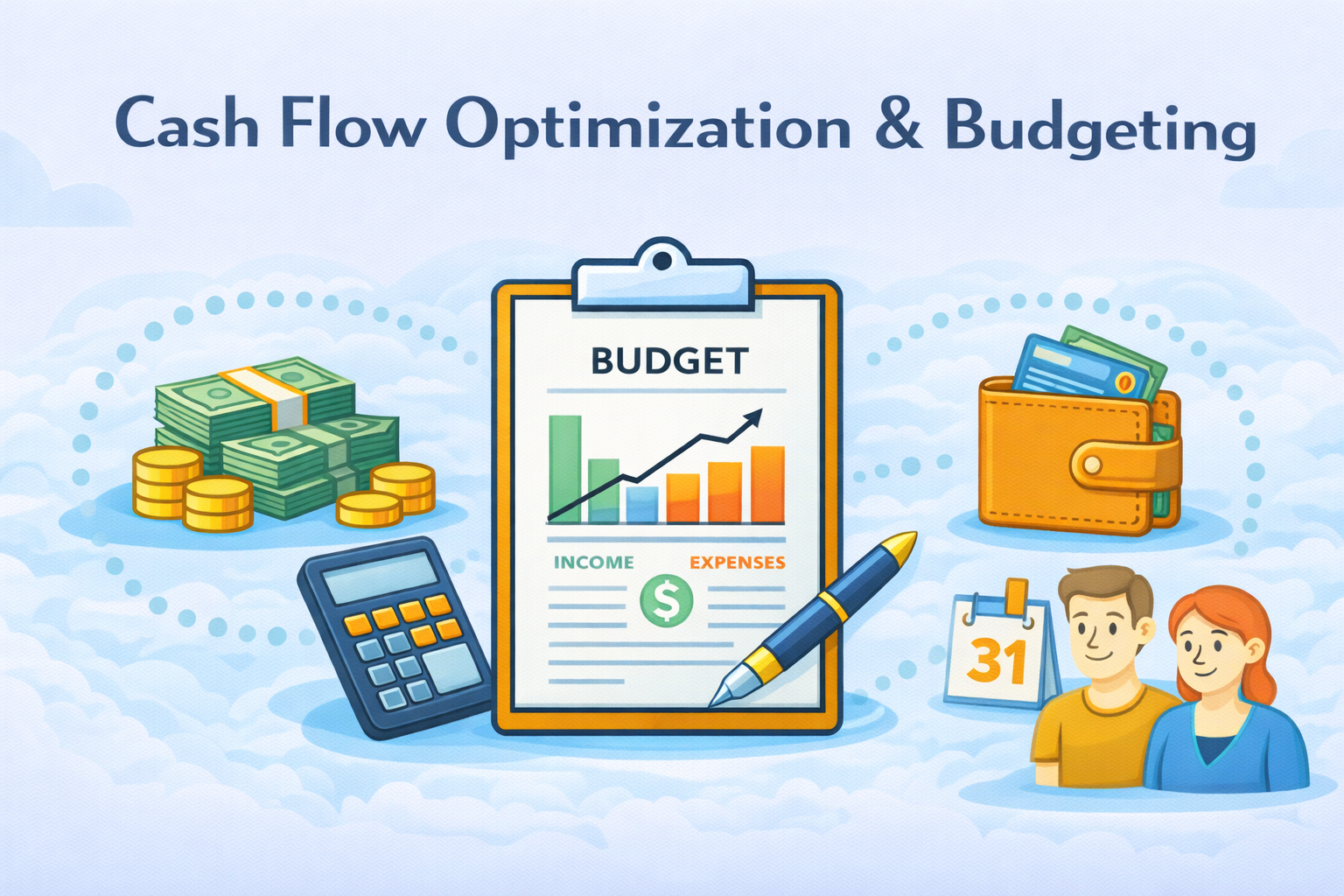
Cash Flow Optimization and Budgeting
Understanding What You Spend and Using Cash More Intentionally
Knowing how much you spend is one of the most important building blocks of a comprehensive financial plan. As financial planners, one of the most common questions we hear is:
“How much do I need to retire?”
The answer is different for everyone—because everyone has different spending habits, lifestyle goals, and annual expense needs. Without a clear understanding of cash flow, it is nearly impossible to build an accurate and reliable financial plan.
Why Budgeting Is a Core Part of Financial Planning
Most individuals have never completed a detailed budget—and even when they do, it is common for important expenses to be overlooked.
Budgets often miss:
Irregular or annual expenses
Medical and healthcare costs
Travel and lifestyle spending
Home maintenance and large purchases
Future expenses that change in retirement
This is why budgeting is not a one-time exercise—it is an evolving process that adjusts as life circumstances change.
Budgeting Across Different Life Stages
Budgeting looks different depending on where you are in life.
Younger Professionals
For individuals early in their careers, budgeting helps answer questions like:
How much can I save each month?
How aggressively can I pay down debt?
What price home can I realistically afford?
What should I have in an emergency fund?
Pre-Retirees and Retirees
As individuals approach or enter retirement, budgeting becomes even more critical.
New considerations often include:
Healthcare costs under Medicare and supplemental coverage
Long-term care expenses
Increased travel and leisure spending
Changes in tax brackets
Fixed vs. discretionary income
Many retirees are surprised by expenses they did not anticipate.
Cash Flow Optimization: Beyond Just Budgeting
While budgeting focuses on understanding where money is going, cash flow optimization focuses on how cash is used.
This includes:
Determining appropriate emergency fund levels
Tax strategies that can be utilize when deploying discretionary income
Strategically paying down debt
Deciding when excess cash should be invested rather than sitting idle
Holding too much cash can be just as problematic as not having enough. Over time, excess cash that is not deployed effectively can lose purchasing power due to inflation.
Integrating Cash Flow With Tax Strategy
Cash flow decisions often intersect with tax planning.
Examples include:
Choosing between pre-tax and Roth retirement contributions
Timing of taxable income
Managing capital gains
Funding Health Savings Accounts (HSAs)
Coordinating savings with employer benefits
Our Cash Flow Planning Process
As part of our financial planning process, we ask clients to complete a detailed expense planner.
Together, we:
Review monthly, annual, and irregular expenses
Identify gaps or overlooked costs
Stress-test assumptions for retirement
Align spending with financial priorities
Adjust strategies as goals evolve
Annual spending levels are often one of the primary drivers of retirement readiness, investment strategy, and tax planning decisions.
Why Cash Flow Drives the Entire Financial Plan
Your cash flow influences:
Retirement projections
Investment allocation
Savings strategies
Debt management
Insurance needs
Lifestyle sustainability
Without clarity around spending, even the most sophisticated financial plan can fall apart.
Our Role in Cash Flow Optimization
At Greenbush Financial Group, we help clients:
Gain clarity around where their money is going
Build realistic, sustainable budgets
Optimize cash usage to support multiple goals
Adjust strategies as life changes
Create confidence around financial decision-making



Our Cash Flow Budgeting Articles


“I read one of Michael’s blog posts and it literally changed our family budget! My wife decided to turn on Social Security early and enjoy more time writing her book and taking care of the family. Michael even replied personally to a question I had - GREAT service, smart advice for BIG life events. I would HIGHLY recommend Greenbush Financial. ⭐⭐⭐⭐⭐”
This endorsement provided for Greenbush Financial Group, LLC on Google Review was made by a non-client, and it was a non-paid review. This non-client was solicited by Greenbush Financial Group, LLC to provide the endorsement.


“Best vid on this subject. Clear info, and very informative. I went through so much clickbait, ready to end up paying somebody, but got lucky and found Michael Ruger. I’m keeping this, and will post it to others when the subject comes up. It’s a go to vid for sure.”
This endorsement provided for Greenbush Financial Group, LLC on YouTube was a non-solicited and non-paid comment by a non-client.
“You r fantastic...omg took me three days of cramming info and then found your site and it was awesome...to know that u care about this so passionately to share with your fellow community thank you and you did it with such ease and simplicity...this for u is a gift so Thank you for sharing that gift. Blessings ”
This endorsement provided for Greenbush Financial Group, LLC on YouTube was a non-solicited and non-paid comment by a non-client.
Frequently Asked Questions About Cash Flow Optimization and Budgeting
-
Why is budgeting important for financial planning?Budgeting provides the foundation for understanding spending, saving, and long-term planning decisions.
-
Do I need a budget if I’m already saving money?Yes. Even strong savers may overlook expenses that impact retirement and lifestyle sustainability.
-
How does budgeting change in retirement?Expenses shift toward healthcare, travel, and lifestyle spending, while income sources change.
-
What is cash flow optimization?Cash flow optimization focuses on using cash strategically to support savings, investing, and financial goals.
-
How much cash should I keep in an emergency fund?This depends on income stability, expenses, and risk tolerance, but typically ranges from three to six months of expenses.
-
Is holding too much cash a problem?Yes. Excess cash can lose purchasing power over time due to inflation and missed investment opportunities.
-
How often should a budget be reviewed?Budgets should be reviewed regularly and updated after major life or financial changes.
-
How does cash flow affect retirement planning?Annual spending levels are one of the biggest drivers of how much you need to retire and how long assets will last.
Contact Us . . . .

All of our services start with a complimentary consult. No high pressure sales tactics. We are financial planners, not salesmen.
About Our Firm: Greenbush Financial Group is an independent registered investment advisory firm based in Albany, New York, that provides four main services to clients: fee-based financial planning services, investment management, employer-sponsored retirement plans, and retirement planning services. The firm serves clients locally in the Albany region and virtually across the United States.