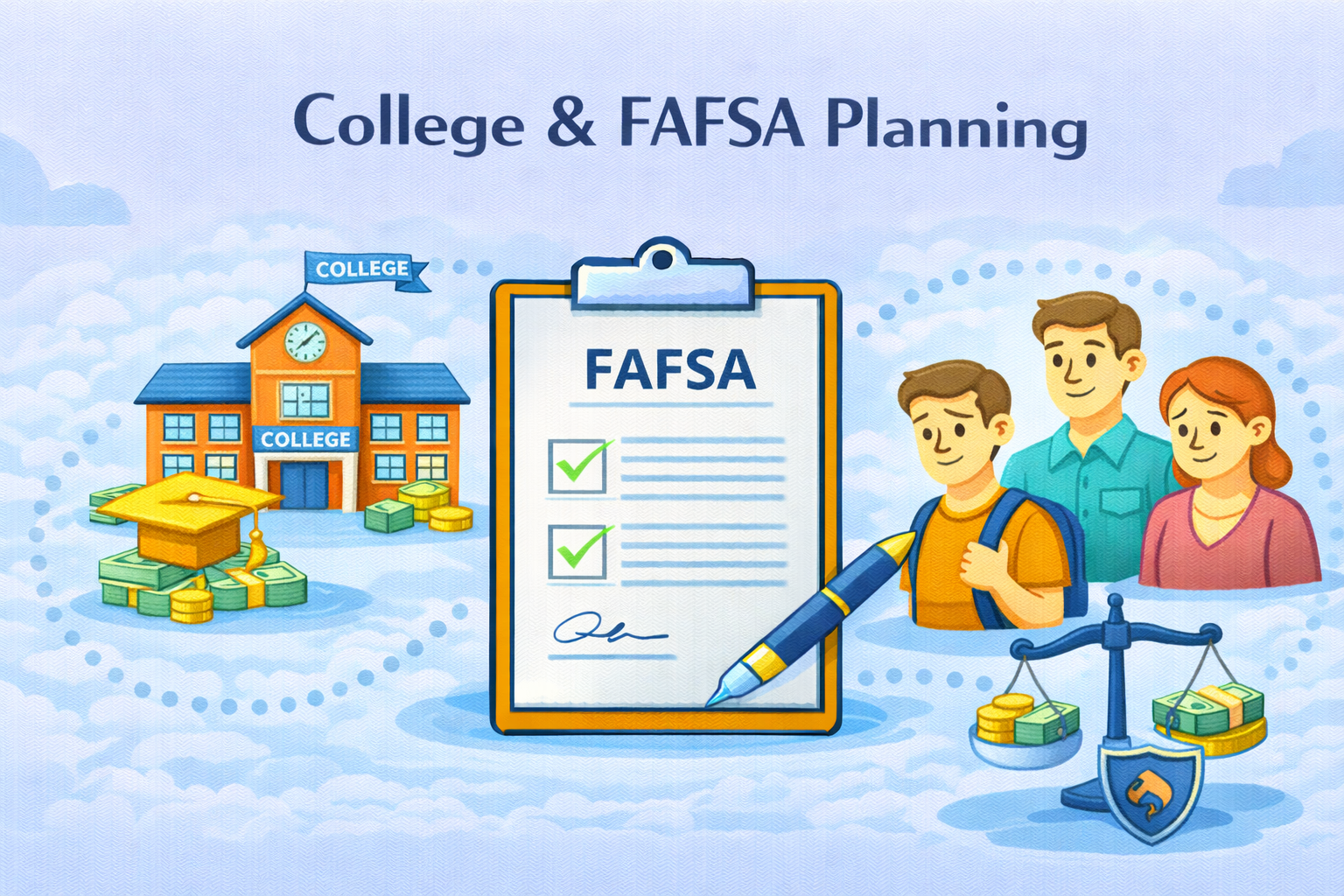
College and FAFSA Planning
Strategic Planning for College Costs and Financial Aid
For families with college-bound children, college planning is one of the most important—and complex—components of an overall financial plan. With the cost of college continuing to rise, families are often asking:
What is the best way to pay for college?
How much should we be saving each year?
Will we qualify for financial aid?
Are there strategies to increase financial aid awards?
These are exactly the questions we help families answer through proactive college and FAFSA planning.
The Importance of Advanced College Planning
College planning is rarely a last-minute decision. Because the cost of higher education is significant, it typically takes many years of intentional saving and planning to prepare effectively.
Advanced planning allows families to:
Choose the most efficient savings vehicles
Understand future cash-flow needs
Avoid costly planning mistakes
Make informed decisions well before college applications are submitted
College Savings Strategies
There are several ways families can save for college, each with different tax and financial aid implications.
Common college savings vehicles include:
529 College Savings Plans
Brokerage Accounts
Coverdell Education Savings Accounts
We help clients evaluate:
Which accounts make the most sense based on income, assets, and goals
How savings impact financial aid eligibility
What happens if funds are left over after college
What options exist if a child does not attend college
Understanding the flexibility—and limitations—of each savings vehicle is critical.
Understanding FAFSA and Financial Aid Calculations
The FAFSA process has changed significantly in recent years, which has altered how financial aid is calculated and awarded.
One major change involves how families with multiple children in college are treated:
Historically, the Expected Family Contribution (EFC) was divided among multiple students
Under current rules, the Student Aid Index (SAI) is applied fully to each child
This change has dramatically reduced need-based financial aid for many families
Because of these changes, many families are surprised by how much—or how little—aid they qualify for.
Strategies to Improve Financial Aid Outcomes
When appropriate, there are financial planning strategies that can help increase financial aid eligibility, including:
Asset positioning strategies
Income-timing considerations
Coordinating savings and spending decisions
Evaluating parent vs. student asset ownership
However, there are also situations where a family’s income or assets are simply too high to qualify for need-based aid. In those cases, we help clients avoid unnecessary planning complexity and focus on the most efficient way to fund college costs.
Public vs. Private Colleges: FAFSA vs. CSS Profile
Financial aid calculations differ depending on the type of school.
Public colleges typically rely on FAFSA calculations
Private colleges often require the CSS Profile, which uses different formulas and considers additional financial data
Understanding which methodology applies can significantly impact planning decisions.
Using Student Loans Strategically
In some cases, families choose to incorporate student loans into the college funding strategy.
Important considerations include:
Federal vs. private loans
Interest rates and repayment terms
When interest begins accruing
Parent-assisted repayment strategies
Loans are not inherently bad—but they must be used intentionally and with a clear repayment plan.
State-Specific College Planning Considerations
Certain states offer unique programs that can help reduce college costs.
For example:
New York’s Excelsior Scholarship may provide free tuition at state colleges for families under specific income thresholds
These programs often come with conditions, such as in-state residency or post-graduation employment requirements
Failure to meet those conditions can convert grants into loans
We help families understand the fine print before committing to these programs.
How College Planning Fits Into the Bigger Picture
College funding decisions impact:
Retirement planning
Cash flow
Tax strategy
Long-term financial security
Our role is to help families balance paying for college without jeopardizing their own financial future.



Our College & FAFSA Planning Articles






“spoke with Micheal about college . definitely helpful and would not hesitate to reach out to him in the future ⭐⭐⭐⭐⭐”
This endorsement provided for Greenbush Financial Group, LLC on Google Review was made by a non-client, and it was a non-paid review. This non-client was solicited by Greenbush Financial Group, LLC to provide the endorsement.
“Rob was extremely helpful answering all of my financial questions as a soon to be college graduate. I look forward to working with him in the future. ⭐⭐⭐⭐⭐”
This endorsement provided for Greenbush Financial Group, LLC on Google Review was made by a non-client, and it was a non-paid review. This non-client was solicited by Greenbush Financial Group, LLC to provide the endorsement.
“Very informative and knows his FAFSA information ⭐⭐⭐⭐⭐”
This endorsement provided for Greenbush Financial Group, LLC on Google Review was made by a non-client, and it was a non-paid review. This non-client was solicited by Greenbush Financial Group, LLC to provide the endorsement.


“The best FAFSA video I’ve seen yet.”
This endorsement provided for Greenbush Financial Group, LLC on YouTube was a non-solicited and non-paid comment by a non-client.
Frequently Asked Questions About College and FAFSA Planning
-
When should parents start saving for college?Ideally as early as possible, but planning can be effective even if started later with the right strategy.
-
Will my income and assets affect financial aid eligibility?Yes. Both income and assets are key components of financial aid calculations.
-
Are 529 plans the best way to save for college?They are often effective, but the best option depends on flexibility, tax considerations, and financial aid impact.
-
How do FAFSA changes affect families with multiple children?The SAI is no longer split among children, reducing need-based aid for many families.
-
Do private colleges calculate financial aid differently?Yes. Many private schools use the CSS Profile, which has different rules than FAFSA.
-
Can financial planning increase my child’s financial aid award?In some cases, yes—but not all families will qualify regardless of planning.
-
Is it better to use savings or student loans for college?This depends on interest rates, repayment terms, and overall financial goals.
-
What happens if college savings are left over?There are several options, including beneficiary changes or alternative uses, depending on the account type.
Contact Us . . . .

All of our services start with a complimentary consult. No high pressure sales tactics. We are financial planners, not salesmen.
About Our Firm: Greenbush Financial Group is an independent registered investment advisory firm based in Albany, New York, that provides four main services to clients: fee-based financial planning services, investment management, employer-sponsored retirement plans, and retirement planning services. The firm serves clients locally in the Albany region and virtually across the United States.