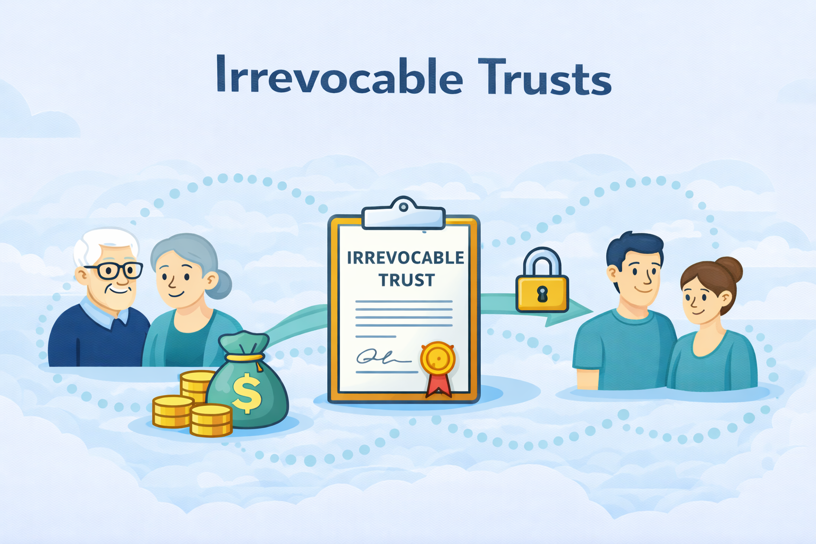
Irrevocable Trusts
Advanced Estate Planning for Asset Protection, Tax Efficiency, and Legacy Planning
An Irrevocable Trust can be a powerful estate planning tool when used appropriately. Unlike revocable trusts, irrevocable trusts offer probate avoidance, asset protection, and the potential to reduce the size of an estate. Because assets transferred into an irrevocable trust are no longer owned by the individual, these trusts can serve multiple long-term planning objectives—but they also require careful consideration and expert guidance.
At Greenbush Financial Group, we help clients understand whether an irrevocable trust fits into their overall financial plan, and if so, how it should be structured to meet their goals while minimizing unintended consequences.
Understanding the Two Types of Irrevocable Trusts
There are two distinct types of irrevocable trusts, and the differences between them are significant—especially from a tax perspective.
Grantor Irrevocable Trusts
In a grantor irrevocable trust:
The grantor is still responsible for paying income taxes on trust earnings
Assets may be removed from the estate for estate tax purposes
The trust assets receive a step-up in cost basis when they pass to the trust beneficiaries
Often used for long-term care / Medicaid asset protection planning
Non-Grantor Irrevocable Trusts
In a non-grantor irrevocable trust:
The trust itself is a separate tax-paying entity
Income may be taxed at trust tax rates unless distributed
Beneficiaries may pay taxes on distributed income
No step-up in cost basis when trust assets are distributed to beneficiaries
Commonly used to reduce the size of an estate to reduce the estate tax liability
Choosing the wrong structure can create unintended tax consequences for the individual, the estate, or the beneficiaries—making professional planning essential.
Asset Protection from a Long-Term Care Event
One of the most common reasons individuals establish an irrevocable trust is to protect assets from a long-term care spend-down, often referred to as a Medicaid trust.
By transferring assets into an irrevocable trust and successfully satisfying New York State’s five-year Medicaid look-back period, individuals may:
Avoid spending down all assets
Qualify for Medicaid coverage of long-term care costs
Preserve assets for heirs
Important Considerations
Planning must be done well in advance of a care event
The grantor typically loses access to principal
The grantor may retain access to income generated by trust assets
Once assets are transferred, control is significantly limited
This strategy requires careful planning and a clear understanding of trade-offs.
Reducing the Size of a Taxable Estate
Irrevocable trusts are also commonly used to reduce estate tax exposure for individuals with larger estates.
By gifting assets into an irrevocable trust:
Assets are removed from the taxable estate
Future appreciation occurs outside the estate
Potential estate tax liability may be reduced
At the federal level, estate tax exemptions are currently high—approximately $15 million per individual as of 2026. However, state-level estate tax exemptions vary significantly, and some states impose estate taxes at much lower thresholds.
For families with substantial wealth, irrevocable trusts can be an important estate tax planning tool.
Creditor Protection
Another key benefit of irrevocable trusts is creditor protection.
Once assets are transferred into an irrevocable trust:
The grantor no longer legally owns the assets
Assets may be protected from personal creditors
Protection depends on proper drafting and state law
This can be especially important for individuals in professions with higher liability exposure or those seeking to shield assets from future legal claims.
The Importance of Proper Trust Design
Irrevocable trusts require expert legal drafting.
There are specific provisions that can be included to:
Provide limited flexibility to the grantor
Allow trustee discretion
Protect beneficiaries
Preserve tax advantages
Without the right language, the trust may:
Be overly restrictive
Create unintended tax consequences
Limit future planning options
Additionally, key decisions must be made regarding:
Trustee selection (who manages the trust)
Beneficiaries (who benefits from the trust)
Trustee powers and gifting provisions
Distribution rules
Because irrevocable trusts involve permanently giving up control, these decisions should never be made casually.
Our Role in Irrevocable Trust Planning
At our firm, we
Help clients evaluate whether an irrevocable trust is appropriate
Model tax and estate implications
Coordinate long-term care, estate, and tax planning
Work closely with experienced estate attorneys
Ensure trust strategies align with broader financial goals
Irrevocable trusts can be extremely effective—but only when integrated thoughtfully into a comprehensive plan.



Our Irrevocable Trust Articles





“very well explained and informative, I should have done this years ago”
This endorsement provided for Greenbush Financial Group, LLC on YouTube was a non-solicited and non-paid comment by a non-client.
“THANK YOU very good information. The info on the Irrevocable trust was interesting to me.”
This endorsement provided for Greenbush Financial Group, LLC on YouTube was a non-solicited and non-paid comment by a non-client.
“Good video. Great point on selling the house if it is in a trust.”
This endorsement provided for Greenbush Financial Group, LLC on YouTube was a non-solicited and non-paid comment by a non-client.
Frequently Asked Questions About Irrevocable Trusts
-
What is an irrevocable trust?An irrevocable trust is a trust that generally cannot be changed or revoked once established, and assets transferred into it are no longer personally owned.
-
How is an irrevocable trust different from a revocable trust?A revocable trust allows full control and changes, while an irrevocable trust provides asset protection and estate reduction but limits access and flexibility.
-
Can an irrevocable trust protect assets from nursing home costs?Yes, when structured properly and funded outside the Medicaid look-back period, it may help protect assets from long-term care spend-down.
-
What is the difference between a grantor and non-grantor irrevocable trust?The difference lies in who pays income taxes on trust earnings—the grantor or the trust itself—which impacts overall tax strategy.
-
Do I still have access to assets in an irrevocable trust?Typically, you no longer have access to principal, but you may receive income generated by trust assets depending on trust design.
-
Can irrevocable trusts reduce estate taxes?Yes. By removing assets from the estate, they can reduce estate tax exposure for large estates.
-
Are assets in an irrevocable trust protected from creditors?Often yes, because the assets are no longer legally owned by the grantor—but protection depends on proper drafting and state law.
-
Should I work with a financial planner before setting up an irrevocable trust?We strongly recommend completing a full financial plan before committing assets to an irrevocable trust. Because irrevocable trusts permanently alter ownership and control, integrated financial and tax planning is critical.
Contact Us . . . .

All of our services start with a complimentary consult. No high pressure sales tactics. We are financial planners, not salesmen.
About Our Firm: Greenbush Financial Group is an independent registered investment advisory firm based in Albany, New York, that provides four main services to clients: fee-based financial planning services, investment management, employer-sponsored retirement plans, and retirement planning services. The firm serves clients locally in the Albany region and virtually across the United States.