Social Security Claiming Strategies: Early vs. Delayed Benefits Explained

By Michael Ruger, CFP®
Partner and Chief Investment Officer at Greenbush Financial Group
For many retirees, Social Security ends up being the single largest and most reliable income source in retirement. It is inflation-protected, provides survivor benefits, and lasts for life. Yet, many people cost themselves hundreds of thousands of dollars in lifetime income by claiming too early—or by ignoring the tax and spousal rules that make timing so important.
This article explores two common paths for claiming Social Security, the tax and survivor strategies that matter most, and how to build a decision framework that balances both the math and the emotional realities of retirement.
The Two Paths: Early & Active vs. Delay & Fortify
There is no one-size-fits-all answer to Social Security timing. Instead, retirees can think of two primary paths:
Path A: Early & Active (Claiming at 62–65)
Works best for those with health concerns or shorter life expectancy.
Provides cash flow to enjoy active early retirement years.
Can unlock additional benefits, such as spousal add-ons or child benefits.
Trade-off: Lower lifetime income and reduced survivor benefits.
Path B: Delay & Fortify (Claiming at 67–70)
Higher earner delays to 70, maximizing both their lifetime benefit and the survivor benefit for their spouse.
Serves as “longevity insurance,” providing a larger, inflation-adjusted check for life.
Opens the door for Roth conversions to reduce future required minimum distributions (RMDs) and future Medicare premiums.
Trade-off: Requires income from working or pensions, or drawing down on assets in the meantime
Path A: Early & Active (Claiming at 62–65)
For many retirees, claiming Social Security early feels like “getting what’s yours” after decades of paying into the system. And in some cases, it’s absolutely the right move. This path prioritizes flexibility and cash flow in the early years of retirement — often before traditional pensions, investment income, or part-time work fully kick in.
Let’s unpack when and why early claiming can make sense, and the trade-offs to watch out for.
Works Best for Those with Health Concerns or Shorter Life Expectancy
Social Security benefits are designed around actuarial averages. The longer you live, the more a delayed claim pays off. But if you have health concerns, a family history of shorter life expectancy, or simply want to maximize income during the “go-go” years of retirement, claiming early can be a rational and emotionally satisfying choice.
For example, a retiree who claims at 62 will receive about 70–75% of their full retirement age (FRA) benefit. While that’s a reduction, the earlier payments can add up over time if the individual doesn’t live into their 80s or 90s.
Rule of thumb: If you expect your life expectancy to be shorter than the early 80s, claiming before FRA may result in higher total lifetime benefits.
Provides Cash Flow to Enjoy Active Early Retirement Years
Many retirees want to travel, pursue hobbies, or help family members financially in their 60s while they’re still healthy and energetic. Social Security can serve as a predictable income base that helps fund this period — reducing the need to withdraw heavily from investment accounts during market downturns.
Consider a 63-year-old couple who wants to take advantage of early retirement while waiting for their portfolio to grow. Claiming one spouse’s benefit early might provide enough monthly income to bridge the gap and protect long-term assets.
Tip: Early claiming can work well as part of a “phased retirement” approach — easing out of the workforce while still maintaining a reliable income stream.
Can Unlock Additional Benefits, Such as Spousal Add-Ons or Child Benefits
Claiming early sometimes unlocks access to auxiliary benefits that wouldn’t otherwise be available. For instance:
A non-working spouse can start claiming a spousal benefit once the higher-earning spouse files for Social Security.
Dependent children under age 18 (or 19 if still in high school) may also qualify for benefits if a parent begins claiming.
This strategy can create a multi-benefit window, where the total family income from Social Security exceeds what the primary earner would receive alone — especially valuable for families still supporting dependents or paying for college.
Trade-Off: Lower Lifetime Income and Reduced Survivor Benefits
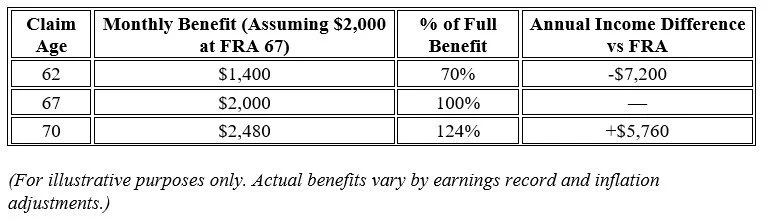
The biggest drawback to early claiming is mathematical: reduced monthly checks for life. Claiming at 62 permanently cuts benefits by roughly 25–30% compared to waiting until full retirement age. For married couples, this also means a smaller survivor benefit for the spouse who lives longer.
Over a 20- or 30-year retirement, that difference can add up to hundreds of thousands of dollars in lost income. It can also limit flexibility later in life when expenses like healthcare and long-term care rise.
To visualize this, here’s a simple comparison:
Path B: Delay & Fortify (Claiming at 67–70)
If the Early & Active path is about maximizing flexibility and early retirement enjoyment, the Delay & Fortify strategy is about building strength and security for the long haul. Delaying your Social Security claim allows your benefit to grow each year, providing powerful longevity insurance and boosting survivor protection for your spouse.
This path often works best for retirees who expect to live into their 80s or beyond, have other income sources to draw from in the meantime, or want to use the delay window for tax-efficient planning.
Higher Earner Delays to 70, Maximizing Both Their Lifetime Benefit and the Survivor Benefit for Their Spouse
For married couples, Social Security isn’t just an individual decision — it’s a household one. The higher-earning spouse’s benefit often becomes the survivor benefit for the remaining spouse.
By waiting to claim until age 70, the higher earner locks in delayed retirement credits that increase benefits by roughly 8% per year after full retirement age (up to age 70). That means a benefit that would have been $2,000 at age 67 could grow to about $2,480 per month by age 70 — a 24% increase for life.
That higher benefit continues for as long as either spouse is alive, making this strategy especially valuable for couples where one spouse is expected to live well into their 80s or 90s.
Example:
If one spouse claims early at 62 and the other delays to 70, the household creates a blend — immediate income now, and a larger, inflation-protected income base later that acts as a financial safety net for the survivor.
Serves as “Longevity Insurance,” Providing a Larger, Inflation-Adjusted Check for Life
Delaying Social Security is sometimes compared to buying an annuity — but without the fees or market risk. It’s an inflation-adjusted income stream that continues for life, backed by the U.S. government.
For those with strong health and longevity in their family history, this can be one of the best “investments” available, because the increase in monthly income provides protection against outliving assets in later years.
Breakeven point: Typically, the math favors delaying if you live past your early 80s. But beyond the numbers, many retirees value the peace of mind that comes with knowing they’ll always have a larger, guaranteed income base, no matter how long they live.
Opens the Door for Roth Conversions to Reduce Future RMDs and Medicare Premiums
One of the less-discussed advantages of delaying benefits is the tax planning window it creates. Between retirement (often mid-60s) and age 70, retirees may have lower taxable income, creating an opportunity to do Roth IRA conversions at favorable tax rates.
Here’s why this matters:
Converting pre-tax assets to Roth reduces future Required Minimum Distributions (RMDs) at age 73/75.
Lower RMDs can help manage Medicare premiums, which are based on income (IRMAA thresholds).
Roth income in retirement is tax-free, helping stabilize cash flow and protect against rising tax rates.
Strategy in action:
A retiree might use withdrawals from cash or taxable accounts to fund living expenses while converting portions of their traditional IRA to a Roth during those pre-70 years. Then, when Social Security finally starts, their taxable income is lower — improving long-term tax efficiency.
Trade-Off: Requires Income from Working or Pensions, or Drawing Down on Assets in the Meantime
The biggest hurdle in delaying Social Security is bridging the income gap. If you retire at 65 but delay claiming until 70, that’s five years of expenses that must be covered by savings, part-time work, or other income sources.
For some retirees, this is perfectly manageable. For others, it may mean drawing down more from investment accounts — which can be uncomfortable, especially during volatile markets.
The key is to view this period as a trade-off by drawing down on a larger portion of your retirement assets now for a higher guaranteed income stream later on. Many financial plans model this “bridge strategy” explicitly, showing how a few years of portfolio withdrawals can result in higher lifetime income and stronger survivor protection.
Building a Decision Framework: Balancing the Math and the Mindset
Choosing when to claim Social Security is part math, part mindset. The best decision balances financial optimization with personal goals and health considerations.
A helpful framework:
Start with longevity assumptions. Estimate based on family health and lifestyle.
Assess your income bridge. Can you fund living expenses until 67–70 without stress?
Run the household math. Model joint benefits, survivor income, and tax implications.
Weigh the emotional factors. Early claiming often feels more secure and immediate; delaying feels more strategic and protective.
Revisit regularly. If you’re 62 and unsure, you don’t have to decide today — claiming flexibility exists year to year.
The right Social Security claiming strategy isn’t about “winning” a mathematical breakeven test — it’s about creating confidence and control in retirement.
The Bottom Line
Social Security is one of the most valuable, inflation-protected income sources you’ll ever have. Taking the time to make a thoughtful, data-driven claiming decision can add tens or even hundreds of thousands of dollars to your lifetime benefits.
But just as importantly, it can bring peace of mind — knowing your retirement income is designed to support both your financial goals and your life priorities.
If you’re approaching retirement, consider running multiple claiming scenarios or working with a financial planner to build a customized Social Security plan that fits your household.
Because in the end, smart Social Security planning isn’t just about maximizing a benefit — it’s about maximizing the life you can live in retirement.

About Michael……...
Hi, I’m Michael Ruger. I’m the managing partner of Greenbush Financial Group and the creator of the nationally recognized Money Smart Board blog . I created the blog because there are a lot of events in life that require important financial decisions. The goal is to help our readers avoid big financial missteps, discover financial solutions that they were not aware of, and to optimize their financial future.
Frequently Asked Questions (FAQs)
What are the main differences between claiming Social Security early versus delaying benefits?
Claiming early (ages 62–65) provides immediate income and flexibility but permanently reduces monthly benefits by up to 30%. Delaying to age 70 increases benefits by 8% per year after full retirement age and strengthens survivor protection for a spouse.
When does it make sense to claim Social Security early?
Early claiming can make sense for retirees with health concerns, shorter life expectancy, or those who need income to support active early retirement years. It can also unlock spousal or dependent benefits sooner. However, it reduces lifetime and survivor benefits, so it’s best suited for households prioritizing flexibility over long-term income maximization.
What are the advantages of delaying Social Security until age 70?
Delaying benefits boosts lifetime and survivor income, provides inflation-adjusted longevity protection, and can create a valuable tax-planning window. Those extra years often allow retirees to perform Roth conversions at lower tax rates and reduce future Required Minimum Distributions (RMDs) and Medicare premiums.
How do spousal and survivor benefits factor into Social Security claiming decisions?
For married couples, the higher earner’s benefit often becomes the survivor benefit. By delaying their claim to age 70, the higher earner ensures the surviving spouse receives a larger, inflation-adjusted income for life—providing greater long-term financial stability.
What is the breakeven point for delaying Social Security?
Generally, if you live beyond your early 80s, delaying your claim tends to produce higher lifetime benefits. However, the optimal strategy depends on personal health, family longevity, and income needs during the delay period. Financial modeling can help identify the most efficient approach.
How can delaying Social Security support tax and Medicare planning?
The years between retirement and claiming benefits often provide a “low-income window” ideal for Roth conversions. This can lower future RMDs and taxable income, helping retirees stay below the IRMAA thresholds that trigger higher Medicare premiums.
How should I decide which Social Security claiming strategy is best for me?
The right approach balances math and mindset—combining life expectancy estimates, income bridge options, household tax impact, and emotional comfort. Working with a financial planner to test multiple claiming scenarios can clarify which path offers the best balance of income security and lifestyle freedom.