

How to Maximize Social Security Benefits with Smart Claiming and Income Planning
Social Security is a cornerstone of retirement income—but when and how you claim can have a major impact on lifetime benefits. This article from Greenbush Financial Group explains 2025 thresholds, how benefits are calculated, and smart strategies for delaying, coordinating with taxes, and managing Medicare costs. Learn how to maximize your Social Security benefits and plan your income efficiently in retirement.

By Michael Ruger, CFP®
Partner and Chief Investment Officer at Greenbush Financial Group
For many retirees, Social Security is a cornerstone of their retirement income. But when and how you claim your benefits—and how you plan your income around them—can have a major impact on the total amount you receive over your lifetime. With updated Social Security thresholds, limits, and rules, there are new opportunities to optimize your claiming strategy and coordinate Social Security with your broader financial plan.
In this article, we’ll cover:
How Social Security benefits are calculated and funded
Four ways to increase your Social Security benefit amount
How income and taxes affect your benefits
The impact of Medicare premiums and income planning
How delaying Social Security can create opportunities for Roth conversions
What to know about the earned income penalty if you claim early
Answers to common Social Security claiming questions
Maximizing Social Security During the Working Years
The foundation for a strong Social Security benefit starts during your working years. Understanding how the system works helps you make informed decisions about your career, income, and retirement planning.
How Social Security Is Funded and Calculated
Social Security is primarily funded through payroll taxes under the Federal Insurance Contributions Act (FICA). In 2025, workers and employers each pay 6.2% of wages (for a total of 12.4%) up to the taxable wage base, which is $176,000 in 2025. Any earnings above that amount are not subject to Social Security tax and do not increase your benefit.
Your benefit is based on your highest 35 years of indexed earnings—meaning each year’s income is adjusted for inflation to reflect its value in today’s dollars. If you worked fewer than 35 years, zeros are included in the calculation, which can significantly reduce your average and therefore your monthly benefit.
Key takeaway: Once your annual income exceeds the taxable wage base, additional earnings don’t raise your future Social Security benefit. However, working longer can still increase your benefit if you replace lower-earning years or zeros in your 35-year average.
Four Ways to Increase Your Social Security Benefits
1. Fill in or Replace Zero Years
If you have fewer than 35 years of work history, each missing year is counted as zero. Even one extra year of income can replace a zero and raise your benefit.
Example: If you worked 32 years and earned $80,000 annually in your final three years, adding those years could significantly boost your benefit calculation.
2. Delay Claiming to Earn Higher Benefits
You can claim Social Security as early as age 62, but doing so permanently reduces your benefit—up to 30% less than your full retirement age (FRA) amount. For those born in 1960 or later, FRA is 67.
If you wait past FRA, your benefit grows by 8% per year up to age 70, plus annual cost-of-living adjustments (COLAs).
Example:
Claiming at 62: $1,400/month
Claiming at 67: $2,000/month
Claiming at 70: $2,480/month
That’s a $1,080 per month difference for waiting between the ages of 62 and 70.
3. Maximize Spousal and Dependent Benefits
Spousal and dependent benefits can be valuable for married couples or retirees with young children.
Spousal Benefit: A spouse can claim up to 50% of the higher earner’s FRA benefit, provided the higher earner has already filed.
Divorced Spouse Benefit: You may qualify if the marriage lasted 10 years or longer, and you haven’t remarried prior to age 60.
Dependent Benefit: Retirees age 62+ with children under 18 may receive additional benefits for dependents.
Planning tip: For individuals who plan to utilize the 50% spousal benefit and/or the dependent benefit, the path to the optimal filing strategy is more complex because the spouse and dependents cannot receive these benefits until that individual has actually turned on their social security benefit, which, in some cases, can favor not waiting until age 70 to file.
4. Understand Survivor Benefits
If one spouse passes away, the surviving spouse receives the higher of the two benefits. This makes it especially beneficial for the higher-earning spouse to delay claiming to age 70, maximizing the survivor benefit and providing long-term income protection.
How Social Security Benefits Are Taxed
Up to 85% of your Social Security benefits may be taxable, depending on your combined income (adjusted gross income + nontaxable interest + half of your Social Security benefits).
Single filers: Taxes begin at $25,000 of combined income
Married filing jointly: Taxes begin at $32,000 of combined income
If you don’t need Social Security to cover living expenses right away, delaying benefits can not only increase your future income but may also help manage taxes by controlling your income levels in early retirement.
Medicare Premiums and Income Planning
Once you reach age 65, you’ll typically enroll in Medicare Part B and D, and your premiums are based on your Modified Adjusted Gross Income (MAGI). Higher income means higher premiums under the Income-Related Monthly Adjustment Amount (IRMAA) rules.
Because Social Security benefits count as income for these purposes, timing your claiming strategy can help you manage Medicare costs.
Roth Conversions: Turning Delay into an Opportunity
Delaying Social Security creates a window for Roth conversions—moving money from a traditional IRA to a Roth IRA at potentially lower tax rates before Required Minimum Distributions (RMDs) begin at age 73 or 75.
Benefits of Roth conversions include:
Paying tax now at potentially lower rates
Reducing future RMDs
Potentially reduce future Medicare premiums
Creating a tax-free income source in retirement
Leaving tax-free assets to heirs
Coordinating your claiming strategy with Roth conversions can improve long-term tax efficiency and enhance your retirement flexibility.
Claiming Early? Know the Earned Income Penalty
If you claim Social Security before full retirement age and continue to work, your benefits may be temporarily reduced.
In 2025, the earnings limit is $23,400. For every $2 earned over the limit, $1 in benefits is withheld.
In the year you reach FRA, a higher limit applies: $62,160, and only $1 is withheld for every $3 earned above that.
Once you reach full retirement age, the penalty disappears, and your benefit is recalculated to credit any withheld amounts.

About Michael……...
Hi, I’m Michael Ruger. I’m the managing partner of Greenbush Financial Group and the creator of the nationally recognized Money Smart Board blog . I created the blog because there are a lot of events in life that require important financial decisions. The goal is to help our readers avoid big financial missteps, discover financial solutions that they were not aware of, and to optimize their financial future.
Frequently Asked Questions (FAQ)
How are Social Security benefits calculated?
Social Security benefits are based on your highest 35 years of indexed earnings, adjusted for inflation. If you worked fewer than 35 years, zeros are included in your calculation, which can reduce your benefit.
What are the main ways to increase your Social Security benefits?
You can boost your benefit by replacing “zero” earning years, delaying your claim up to age 70 for an 8% annual increase past full retirement age, and coordinating spousal or survivor benefits strategically. Working longer and earning more during high-income years can also improve your benefit calculation.
How does delaying Social Security affect taxes and Medicare premiums?
Delaying benefits can help you manage taxable income in early retirement and avoid higher Medicare premiums triggered by the IRMAA income thresholds. This window can also allow for Roth conversions, which reduce future Required Minimum Distributions (RMDs) and create tax-free income in later years.
How are Social Security benefits taxed?
Up to 85% of your benefits may be taxable depending on your combined income (adjusted gross income + nontaxable interest + half of your benefits). Taxes begin at $25,000 for single filers and $32,000 for married couples filing jointly. Managing income sources can help minimize these taxes.
What is the earned income penalty for claiming Social Security early?
If you claim before full retirement age and continue working, benefits are reduced by $1 for every $2 earned above $23,400 in 2025. In the year you reach full retirement age, the limit increases to $62,160, and only $1 is withheld for every $3 earned over that amount. The penalty ends at full retirement age, when your benefit is recalculated.
What are spousal and survivor Social Security benefits?
A spouse can claim up to 50% of the higher earner’s full retirement benefit once that person has filed. If one spouse passes away, the survivor receives the higher of the two benefits. This makes it especially advantageous for the higher earner to delay claiming to age 70 to maximize long-term income protection.
How can Roth conversions complement Social Security planning?
Performing Roth conversions in the years before claiming Social Security or reaching RMD age allows retirees to shift pre-tax funds into tax-free accounts at potentially lower tax rates. This strategy can reduce future taxable income, manage Medicare premiums, and increase retirement flexibility.






















Social Security Claiming Strategies: Early vs. Delayed Benefits Explained
Social Security can be one of your most powerful retirement assets—if you claim it strategically. In this article from Greenbush Financial Group, we compare early versus delayed claiming paths, explore spousal and survivor benefits, and explain how tax and income planning can help you unlock more lifetime income.

By Michael Ruger, CFP®
Partner and Chief Investment Officer at Greenbush Financial Group
For many retirees, Social Security ends up being the single largest and most reliable income source in retirement. It is inflation-protected, provides survivor benefits, and lasts for life. Yet, many people cost themselves hundreds of thousands of dollars in lifetime income by claiming too early—or by ignoring the tax and spousal rules that make timing so important.
This article explores two common paths for claiming Social Security, the tax and survivor strategies that matter most, and how to build a decision framework that balances both the math and the emotional realities of retirement.
The Two Paths: Early & Active vs. Delay & Fortify
There is no one-size-fits-all answer to Social Security timing. Instead, retirees can think of two primary paths:
Path A: Early & Active (Claiming at 62–65)
Works best for those with health concerns or shorter life expectancy.
Provides cash flow to enjoy active early retirement years.
Can unlock additional benefits, such as spousal add-ons or child benefits.
Trade-off: Lower lifetime income and reduced survivor benefits.
Path B: Delay & Fortify (Claiming at 67–70)
Higher earner delays to 70, maximizing both their lifetime benefit and the survivor benefit for their spouse.
Serves as “longevity insurance,” providing a larger, inflation-adjusted check for life.
Opens the door for Roth conversions to reduce future required minimum distributions (RMDs) and future Medicare premiums.
Trade-off: Requires income from working or pensions, or drawing down on assets in the meantime
Path A: Early & Active (Claiming at 62–65)
For many retirees, claiming Social Security early feels like “getting what’s yours” after decades of paying into the system. And in some cases, it’s absolutely the right move. This path prioritizes flexibility and cash flow in the early years of retirement — often before traditional pensions, investment income, or part-time work fully kick in.
Let’s unpack when and why early claiming can make sense, and the trade-offs to watch out for.
Works Best for Those with Health Concerns or Shorter Life Expectancy
Social Security benefits are designed around actuarial averages. The longer you live, the more a delayed claim pays off. But if you have health concerns, a family history of shorter life expectancy, or simply want to maximize income during the “go-go” years of retirement, claiming early can be a rational and emotionally satisfying choice.
For example, a retiree who claims at 62 will receive about 70–75% of their full retirement age (FRA) benefit. While that’s a reduction, the earlier payments can add up over time if the individual doesn’t live into their 80s or 90s.
Rule of thumb: If you expect your life expectancy to be shorter than the early 80s, claiming before FRA may result in higher total lifetime benefits.
Provides Cash Flow to Enjoy Active Early Retirement Years
Many retirees want to travel, pursue hobbies, or help family members financially in their 60s while they’re still healthy and energetic. Social Security can serve as a predictable income base that helps fund this period — reducing the need to withdraw heavily from investment accounts during market downturns.
Consider a 63-year-old couple who wants to take advantage of early retirement while waiting for their portfolio to grow. Claiming one spouse’s benefit early might provide enough monthly income to bridge the gap and protect long-term assets.
Tip: Early claiming can work well as part of a “phased retirement” approach — easing out of the workforce while still maintaining a reliable income stream.
Can Unlock Additional Benefits, Such as Spousal Add-Ons or Child Benefits
Claiming early sometimes unlocks access to auxiliary benefits that wouldn’t otherwise be available. For instance:
A non-working spouse can start claiming a spousal benefit once the higher-earning spouse files for Social Security.
Dependent children under age 18 (or 19 if still in high school) may also qualify for benefits if a parent begins claiming.
This strategy can create a multi-benefit window, where the total family income from Social Security exceeds what the primary earner would receive alone — especially valuable for families still supporting dependents or paying for college.
Trade-Off: Lower Lifetime Income and Reduced Survivor Benefits
The biggest drawback to early claiming is mathematical: reduced monthly checks for life. Claiming at 62 permanently cuts benefits by roughly 25–30% compared to waiting until full retirement age. For married couples, this also means a smaller survivor benefit for the spouse who lives longer.
Over a 20- or 30-year retirement, that difference can add up to hundreds of thousands of dollars in lost income. It can also limit flexibility later in life when expenses like healthcare and long-term care rise.
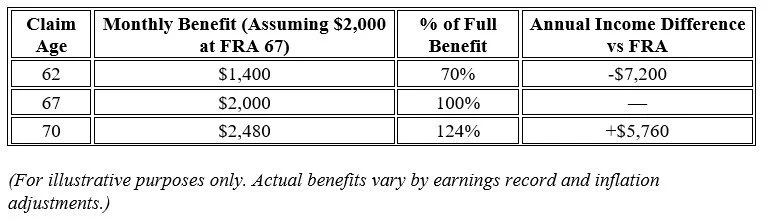
To visualize this, here’s a simple comparison:
Path B: Delay & Fortify (Claiming at 67–70)
If the Early & Active path is about maximizing flexibility and early retirement enjoyment, the Delay & Fortify strategy is about building strength and security for the long haul. Delaying your Social Security claim allows your benefit to grow each year, providing powerful longevity insurance and boosting survivor protection for your spouse.
This path often works best for retirees who expect to live into their 80s or beyond, have other income sources to draw from in the meantime, or want to use the delay window for tax-efficient planning.
Higher Earner Delays to 70, Maximizing Both Their Lifetime Benefit and the Survivor Benefit for Their Spouse
For married couples, Social Security isn’t just an individual decision — it’s a household one. The higher-earning spouse’s benefit often becomes the survivor benefit for the remaining spouse.
By waiting to claim until age 70, the higher earner locks in delayed retirement credits that increase benefits by roughly 8% per year after full retirement age (up to age 70). That means a benefit that would have been $2,000 at age 67 could grow to about $2,480 per month by age 70 — a 24% increase for life.
That higher benefit continues for as long as either spouse is alive, making this strategy especially valuable for couples where one spouse is expected to live well into their 80s or 90s.
Example:
If one spouse claims early at 62 and the other delays to 70, the household creates a blend — immediate income now, and a larger, inflation-protected income base later that acts as a financial safety net for the survivor.
Serves as “Longevity Insurance,” Providing a Larger, Inflation-Adjusted Check for Life
Delaying Social Security is sometimes compared to buying an annuity — but without the fees or market risk. It’s an inflation-adjusted income stream that continues for life, backed by the U.S. government.
For those with strong health and longevity in their family history, this can be one of the best “investments” available, because the increase in monthly income provides protection against outliving assets in later years.
Breakeven point: Typically, the math favors delaying if you live past your early 80s. But beyond the numbers, many retirees value the peace of mind that comes with knowing they’ll always have a larger, guaranteed income base, no matter how long they live.
Opens the Door for Roth Conversions to Reduce Future RMDs and Medicare Premiums
One of the less-discussed advantages of delaying benefits is the tax planning window it creates. Between retirement (often mid-60s) and age 70, retirees may have lower taxable income, creating an opportunity to do Roth IRA conversions at favorable tax rates.
Here’s why this matters:
Converting pre-tax assets to Roth reduces future Required Minimum Distributions (RMDs) at age 73/75.
Lower RMDs can help manage Medicare premiums, which are based on income (IRMAA thresholds).
Roth income in retirement is tax-free, helping stabilize cash flow and protect against rising tax rates.
Strategy in action:
A retiree might use withdrawals from cash or taxable accounts to fund living expenses while converting portions of their traditional IRA to a Roth during those pre-70 years. Then, when Social Security finally starts, their taxable income is lower — improving long-term tax efficiency.
Trade-Off: Requires Income from Working or Pensions, or Drawing Down on Assets in the Meantime
The biggest hurdle in delaying Social Security is bridging the income gap. If you retire at 65 but delay claiming until 70, that’s five years of expenses that must be covered by savings, part-time work, or other income sources.
For some retirees, this is perfectly manageable. For others, it may mean drawing down more from investment accounts — which can be uncomfortable, especially during volatile markets.
The key is to view this period as a trade-off by drawing down on a larger portion of your retirement assets now for a higher guaranteed income stream later on. Many financial plans model this “bridge strategy” explicitly, showing how a few years of portfolio withdrawals can result in higher lifetime income and stronger survivor protection.
Building a Decision Framework: Balancing the Math and the Mindset
Choosing when to claim Social Security is part math, part mindset. The best decision balances financial optimization with personal goals and health considerations.
A helpful framework:
Start with longevity assumptions. Estimate based on family health and lifestyle.
Assess your income bridge. Can you fund living expenses until 67–70 without stress?
Run the household math. Model joint benefits, survivor income, and tax implications.
Weigh the emotional factors. Early claiming often feels more secure and immediate; delaying feels more strategic and protective.
Revisit regularly. If you’re 62 and unsure, you don’t have to decide today — claiming flexibility exists year to year.
The right Social Security claiming strategy isn’t about “winning” a mathematical breakeven test — it’s about creating confidence and control in retirement.
The Bottom Line
Social Security is one of the most valuable, inflation-protected income sources you’ll ever have. Taking the time to make a thoughtful, data-driven claiming decision can add tens or even hundreds of thousands of dollars to your lifetime benefits.
But just as importantly, it can bring peace of mind — knowing your retirement income is designed to support both your financial goals and your life priorities.
If you’re approaching retirement, consider running multiple claiming scenarios or working with a financial planner to build a customized Social Security plan that fits your household.
Because in the end, smart Social Security planning isn’t just about maximizing a benefit — it’s about maximizing the life you can live in retirement.
About Michael……...
Hi, I’m Michael Ruger. I’m the managing partner of Greenbush Financial Group and the creator of the nationally recognized Money Smart Board blog . I created the blog because there are a lot of events in life that require important financial decisions. The goal is to help our readers avoid big financial missteps, discover financial solutions that they were not aware of, and to optimize their financial future.
Frequently Asked Questions (FAQs)
What are the main differences between claiming Social Security early versus delaying benefits?
Claiming early (ages 62–65) provides immediate income and flexibility but permanently reduces monthly benefits by up to 30%. Delaying to age 70 increases benefits by 8% per year after full retirement age and strengthens survivor protection for a spouse.
When does it make sense to claim Social Security early?
Early claiming can make sense for retirees with health concerns, shorter life expectancy, or those who need income to support active early retirement years. It can also unlock spousal or dependent benefits sooner. However, it reduces lifetime and survivor benefits, so it’s best suited for households prioritizing flexibility over long-term income maximization.
What are the advantages of delaying Social Security until age 70?
Delaying benefits boosts lifetime and survivor income, provides inflation-adjusted longevity protection, and can create a valuable tax-planning window. Those extra years often allow retirees to perform Roth conversions at lower tax rates and reduce future Required Minimum Distributions (RMDs) and Medicare premiums.
How do spousal and survivor benefits factor into Social Security claiming decisions?
For married couples, the higher earner’s benefit often becomes the survivor benefit. By delaying their claim to age 70, the higher earner ensures the surviving spouse receives a larger, inflation-adjusted income for life—providing greater long-term financial stability.
What is the breakeven point for delaying Social Security?
Generally, if you live beyond your early 80s, delaying your claim tends to produce higher lifetime benefits. However, the optimal strategy depends on personal health, family longevity, and income needs during the delay period. Financial modeling can help identify the most efficient approach.
How can delaying Social Security support tax and Medicare planning?
The years between retirement and claiming benefits often provide a “low-income window” ideal for Roth conversions. This can lower future RMDs and taxable income, helping retirees stay below the IRMAA thresholds that trigger higher Medicare premiums.
How should I decide which Social Security claiming strategy is best for me?
The right approach balances math and mindset—combining life expectancy estimates, income bridge options, household tax impact, and emotional comfort. Working with a financial planner to test multiple claiming scenarios can clarify which path offers the best balance of income security and lifestyle freedom.

Social Security: A Complete Guide to Benefits
Social Security isn’t just a retirement check—it’s a complex system of benefits that could impact your entire family. In this article, we walk through the four major types of Social Security benefits.

While most Americans understand Social Security as a monthly retirement benefit, the system is far more expansive than that. It provides a foundation of income not only for retirees, but also for spouses, surviving family members, and even minor children.
For many, Social Security is one of the largest sources of guaranteed income in retirement. Yet, without a clear understanding of how the program works, individuals often leave money on the table or make filing decisions that reduce lifetime benefits. In this guide, we’ll walk through the primary types of Social Security benefits available and the planning opportunities they create for you and your family.
Retirement Benefits
Retirement benefits are the most common form of Social Security income and are based on your earnings record over your working years. You must earn 40 quarters of work credit (typically 10 years of work) to qualify.
Filing Age Matters
You can begin collecting benefits as early as age 62, but doing so permanently reduces your monthly benefit. On the other hand, delaying benefits past your Full Retirement Age (FRA) can increase your monthly payment by as much as 8% per year until age 70.
For example, if your Full Retirement Age is 67 and your monthly benefit at that age is $2,000, delaying until age 70 would increase your benefit to approximately $2,480 per month for life.
Planning Strategy:
If you have other sources of income, delaying Social Security can be a powerful way to hedge against longevity risk. Higher lifetime benefits can also increase survivor benefits for a spouse, which is especially important if one spouse is expected to live significantly longer than the other.
Spousal Benefits
Spousal benefits allow a lower-earning spouse (or a non-working spouse) to claim up to 50% of their spouse’s full retirement benefit.
Eligibility Criteria:
Must be at least 62 years old
The higher-earning spouse must have filed for their own benefit
Marriage must have lasted at least 1 year (or 10 years if divorced)
For example, if your spouse's full benefit is $2,000 per month, you could receive $1,000 per month as a spousal benefit—even if you never worked.
Planning Tip:
If your own benefit is less than half of your spouse’s, spousal benefits can provide a significant boost to household income. However, if you claim before your FRA, your spousal benefit will also be reduced.
Survivor Benefits
When a worker passes away, their spouse and dependent children may be eligible for survivor benefits based on the deceased’s earnings record. These benefits can be a critical form of income replacement.
Who Can Claim:
A surviving spouse as early as age 60 (or 50 if disabled)
Surviving divorced spouses (if the marriage lasted 10+ years)
Minor children under age 18 (or 19 if still in high school)
Disabled adult children whose disability began before age 22
Survivor benefits can be up to 100% of the deceased worker’s benefit amount. However, claiming early will reduce the amount received.
Strategy Example:
A widow claiming survivor benefits at age 60 may receive 71.5% of the deceased spouse’s benefit, while waiting until her FRA allows her to claim the full 100%.
If the surviving spouse is also eligible for their own retirement benefit, they can switch between benefits to maximize lifetime payouts. For example, they might take survivor benefits early and delay their own retirement benefit until age 70 to receive delayed credits.
Benefits for Minor Children
Children of retired, disabled, or deceased workers may also qualify for Social Security benefits.
Eligibility:
Must be under age 18 (or 19 if still in high school)
Must be unmarried
Or, must have a disability that began before age 22
Each eligible child may receive up to 50% of the parent’s benefit (or 75% if the parent is deceased), subject to a family maximum of 150% to 180% of the worker’s benefit amount.
Planning Opportunity:
Parents nearing retirement who still have minor children can increase household income by claiming their own benefit and triggering minor benefits for their children. In some cases, this can result in tens of thousands of dollars in additional family income.
Disability Benefits (SSDI)
Social Security Disability Insurance (SSDI) is available to workers who have a qualifying disability and a sufficient work history.
Key Points:
The disability must be expected to last at least 12 months or result in death
The number of required work credits depends on your age at the time of disability
Benefits are based on your average lifetime earnings, similar to retirement benefits
SSDI also includes dependent benefits for minor children and spouses in certain cases, making it another critical piece of the Social Security safety net.
Taxation of Benefits
Many people are surprised to learn that Social Security benefits can be taxable at the federal level, depending on your income. The social security provisional income formula determines what portion of your social security benefits will be taxed at the federal level which ranges from 0% to 85%.
Provisional Income Calculation:
The provisional income formula is as follows:
Provisional income = AGI + tax-exempt interest + 50% of Social Security benefits
If your provisional income exceeds the IRS thresholds below, up to 85% of your Social Security benefits may be subject to federal income tax:
Single filers: Benefits become taxable if income > $25,000
Married filing jointly: Threshold starts at $32,000
Planning Tip:
Roth IRA distributions and qualified withdrawals from a Health Savings Account (HSA) do not count toward provisional income, making them useful tools in managing your tax liability in retirement.
Earnings Limits Before FRA
If you claim benefits before Full Retirement Age and continue working, your benefits may be temporarily reduced.
2025 Earnings Limit:
$23,400/year before FRA
$1 for every $2 earned above this limit is withheld
In the year you reach FRA, a higher threshold applies
No limit applies after reaching FRA
The good news: Any withheld benefits are recalculated into your future payments once you reach FRA, so the money is not lost—it’s just delayed.
Final Thoughts
Social Security is more than just a retirement benefit—it’s an income safety net for families, widows, children, and disabled workers. Understanding how and when to claim each type of benefit can create significant long-term financial value.
Whether you are approaching retirement or already receiving benefits, strategic planning around Social Security can impact your taxes, cash flow, and even legacy planning for future generations.
About Michael……...
Hi, I’m Michael Ruger. I’m the managing partner of Greenbush Financial Group and the creator of the nationally recognized Money Smart Board blog . I created the blog because there are a lot of events in life that require important financial decisions. The goal is to help our readers avoid big financial missteps, discover financial solutions that they were not aware of, and to optimize their financial future.
Frequently Asked Questions (FAQs):
What are the main types of Social Security benefits available?
Social Security provides several types of benefits, including retirement, spousal, survivor, disability (SSDI), and benefits for minor children. Each type is based on specific eligibility criteria tied to a worker’s earnings record and family situation.
How does the age at which I claim Social Security affect my benefit amount?
Claiming benefits before your Full Retirement Age (FRA) reduces your monthly payments permanently, while delaying benefits past FRA can increase them by up to 8% per year until age 70. The best claiming age depends on factors like life expectancy, income needs, and spousal considerations.
Can a spouse who never worked receive Social Security benefits?
Yes, a non-working or lower-earning spouse can receive up to 50% of their spouse’s full retirement benefit as a spousal benefit. To qualify, the higher-earning spouse must have filed for benefits, and the marriage must meet the required duration rules.
What are survivor benefits and who can claim them?
Survivor benefits provide income to the spouse, children, or other dependents of a deceased worker. A surviving spouse can claim benefits as early as age 60, while dependent children and certain disabled adults may also qualify based on the worker’s earnings record.
Are Social Security benefits taxable?
Depending on your income, up to 85% of your Social Security benefits may be subject to federal income tax. The taxable portion is determined using your “provisional income,” which includes your adjusted gross income, tax-exempt interest, and half of your Social Security benefits.
How does working before Full Retirement Age affect my benefits?
If you claim benefits before FRA and continue to work, part of your payments may be temporarily withheld if your earnings exceed annual limits. Once you reach FRA, the withheld amounts are recalculated into future payments, effectively restoring the value over time.
Can children receive Social Security benefits based on a parent’s record?
Yes, children of retired, disabled, or deceased workers may qualify for benefits if they are under 18 (or 19 if still in high school) or became disabled before age 22. These payments can provide up to 50–75% of the parent’s benefit amount, subject to family maximum limits.
