What Is the Best Order to Withdraw Money From Your 401(k), IRA, Roth IRA, and Brokerage Account?
What is the best order to withdraw money in retirement? Learn how coordinating withdrawals from your 401(k), IRA, Roth IRA, and brokerage account may help manage taxes, RMDs, and Medicare premiums throughout retirement.
By Michael Ruger, CFP®
Partner and Chief Investment Officer at Greenbush Financial Group
When you retire, you may find yourself with several different types of investment accounts.
You might have money sitting in a checking or savings account. You may have a taxable brokerage account that you have accumulated over the years. Perhaps the majority of your retirement savings is sitting in a traditional 401(k) or traditional IRA. You may also have Roth IRAs or Roth 401(k) assets that can potentially provide tax-free income during retirement.
Once your paycheck stops, an important question arises:
Which retirement accounts should you withdraw from first?
Should you spend your cash first? Should you liquidate your brokerage account? Should you begin withdrawing from your 401(k) or traditional IRA? Or should you use your Roth IRA because you can potentially withdraw money tax-free?
The answer may surprise you.
In many cases, the most tax-efficient retirement withdrawal strategy isn't to completely spend down one account and then move to the next. Instead, we frequently use a blended retirement withdrawal strategy, taking money from different account types at the same time to manage the retiree's tax bracket both today and in the future.
When determining the best order to withdraw retirement assets, some of the most important considerations include:
Your current federal and state income tax brackets
Social Security income
Pension and other recurring income
Capital gains from taxable investments
The size of your traditional 401(k) and IRA balances
Future required minimum distributions
Medicare IRMAA premiums
Roth IRA balances
Your estate and inheritance goals
The objective isn't simply to pay the least amount of income tax this year. The goal is to potentially minimize taxes over your entire retirement.
The Common Retirement Withdrawal Mistake
One of the most common retirement withdrawal strategies sounds logical at first.
Spend the cash first.
Then spend the taxable brokerage account.
Then begin taking money from the traditional 401(k) or IRA.
Finally, leave the Roth IRA until the end.
There is some logic behind this approach. Cash generally doesn't create much taxable income when it is spent, and withdrawing principal from a taxable brokerage account isn't itself an ordinary-income distribution like a traditional IRA withdrawal. Depending on the investment and cost basis, selling investments may instead generate capital gains or losses.
Meanwhile, leaving the traditional IRA untouched postpones ordinary income taxes. That sounds great. But there can be a problem.
Deferring taxes isn't necessarily the same thing as reducing taxes.
By refusing to take distributions from your traditional retirement accounts during the early years of retirement, those balances may continue growing. Eventually, required minimum distributions, or RMDs, can force increasingly large amounts out of those accounts. The result could be an unusual retirement tax pattern.
You pay very little tax during the first five or ten years of retirement, followed by much larger tax bills later. In some situations, the better strategy may be to intentionally recognize some taxable income earlier.
Why Your First Years of Retirement Can Be Valuable for Tax Planning
For many retirees, taxable income drops substantially when they stop working. Imagine someone earning $150,000 or $200,000 per year immediately before retirement. Then the paycheck stops. Perhaps Social Security hasn't started yet. There isn't a pension. Required minimum distributions are still years away. Suddenly, taxable income can be unusually low.
From a tax-planning perspective, that can create an opportunity. Instead of saying, “Great, I owe almost no taxes this year,” we may ask a different question:
“Are there lower tax brackets available that we should intentionally use?”
That could mean taking distributions from a traditional IRA or 401(k), even if you technically have enough money in your checking and brokerage accounts to cover your expenses. This concept is sometimes described as filling up the tax brackets.
The Best Withdrawal Strategy May Be a Blend
Assume you are retired and need $60,000 to supplement your other income during the year.
You have plenty of money available in a taxable brokerage account, so you could simply take the entire $60,000 from that account. But that isn't necessarily the most tax-efficient long-term strategy. Perhaps instead you take $30,000 from your traditional IRA and the other $30,000 from cash or the taxable brokerage account. Why intentionally create taxable IRA income?
Because if that $30,000 falls into a relatively low marginal income-tax bracket today, it may be preferable to recognize that income now rather than allowing the IRA to grow and potentially withdrawing the money at a higher tax rate later. This is why the “best order” for retirement withdrawals is often not:
Brokerage → Traditional IRA → Roth IRA.
Instead, it may be a coordinated combination of taxable and pre-tax accounts when appropriate.
Using Lower Tax Brackets During Retirement
Let's look at a hypothetical example. Assume a single retiree is age 65 and receives $20,000 per year from Social Security.
They need another $40,000 for annual living expenses.
The retiree has three places where that $40,000 could come from:
A taxable brokerage account, a traditional IRA, or a Roth IRA.
It might be tempting to take all $40,000 from the brokerage account because doing so could result in relatively little additional taxable income depending on the investments sold and their cost basis. However, we would want to look at the retiree's taxable income, not simply the amount they are spending.
Social Security benefits are not necessarily fully subject to federal income tax. Depending on the retiree's combined income, none, some, or up to 85% of Social Security benefits may be included in taxable income. (irs.gov) After accounting for Social Security taxation, deductions, capital gains, and other income, the retiree may still have significant room available in lower federal income-tax brackets.
That unused tax-bracket capacity may represent an opportunity. Instead of funding the entire $40,000 from the brokerage account, perhaps a portion comes from the traditional IRA. The retiree intentionally recognizes ordinary income today at a relatively low marginal tax rate while simultaneously reducing the size of the traditional IRA.
That can potentially reduce taxable distributions later in retirement.
Don't Make Retirement Withdrawal Decisions Based Only on This Year's Tax Bill
This is one of the most important concepts in retirement tax planning. Suppose Strategy A results in you paying $2,000 of federal income tax this year.
Strategy B results in you paying $6,000.
At first glance, Strategy A appears better.
Who wants to voluntarily pay an additional $4,000 in taxes?
But what if Strategy A results in paying substantially higher taxes later because your traditional IRA continues growing and eventually generates very large required minimum distributions?
Perhaps Strategy B results in slightly higher taxes during your 60s but materially lower taxes during your 70s and 80s.
The better analysis is not:
“Which strategy produces the lowest tax bill this year?”
It is:
“Which strategy may result in the lowest reasonable lifetime tax burden while still accomplishing my retirement goals?”
Those can be two very different answers.
Required Minimum Distributions Can Change the Equation
Required minimum distributions are one of the primary reasons we look years ahead when creating retirement withdrawal strategies.
Traditional IRAs and many pre-tax retirement accounts eventually become subject to RMD rules.
Under current federal law, the applicable RMD starting age depends on your birth year. For many current retirees it is 73, while individuals born in 1960 or later generally have an applicable RMD age of 75. (irs.gov) Why does this matter?
Because once RMDs begin, you generally no longer have complete control over how little taxable income comes out of those accounts. The IRS requires a minimum amount to be distributed each year.
If your traditional IRA has become very large, your RMD can also become very large.
The $2 Million IRA Example
Assume you enter your RMD years with approximately $2 million in a traditional IRA.
Using an applicable IRS distribution period around the beginning of the RMD years, a $2 million balance could generate an initial required distribution in the neighborhood of $75,000 to $80,000, depending on the applicable age and table.
That distribution is generally taxable as ordinary income to the extent it represents pre-tax funds.
Now add Social Security. Perhaps you also have pension income. Suddenly, your taxable income could be much higher than it was during the first decade of retirement. That higher income can potentially expose additional dollars to higher federal and state tax rates and may also affect Medicare premiums.
Now consider an alternative strategy.
During the 10 years before RMDs began, you intentionally took smaller annual distributions from the traditional IRA while you were in relatively low tax brackets. Perhaps you used some of those distributions for living expenses. Maybe other amounts were converted to a Roth IRA as part of a coordinated Roth conversion strategy. By the time RMDs begin, instead of having $2 million in the traditional IRA, perhaps the balance is substantially lower. That lower balance generally produces a lower required minimum distribution. This is the value of looking forward.
Medicare Premiums Are Part of the Withdrawal Strategy Too
Tax brackets aren't the only consideration. Medicare premiums can also be affected by your income. Higher-income Medicare beneficiaries can pay additional premiums for Medicare Part B and Part D through the income-related monthly adjustment amount, commonly known as IRMAA. Medicare generally looks back two years at your tax information when determining whether IRMAA applies.
That means a large IRA distribution, Roth conversion, capital gain, or other taxable event can potentially increase Medicare premiums later. This creates another balancing act. We might want to take additional money from a traditional IRA to use lower federal tax brackets and reduce future RMDs.
But if taking another $10,000 or $20,000 causes income to cross an IRMAA threshold, the additional Medicare cost needs to be included in the analysis. Retirement tax planning therefore isn't always about staying within one specific income-tax bracket. Sometimes we are managing several different thresholds at the same time.
How Taxable Brokerage Accounts Fit Into the Strategy
Taxable brokerage accounts can be extremely valuable during retirement because they provide flexibility. When you withdraw cash from a brokerage account, you are not automatically taxed on the entire amount withdrawn.
Instead, taxes generally depend on what happens when investments are sold. Suppose you sell $50,000 of stock that originally cost $40,000.
Your taxable gain is generally based on the $10,000 difference, not the entire $50,000 of sale proceeds, assuming no adjustments to basis. If the investment was held for more than one year, the gain may qualify for long-term capital-gains tax rates. This makes brokerage accounts useful when coordinating retirement income.
For example, you might take part of your annual cash needs from a traditional IRA to intentionally fill a lower ordinary-income tax bracket and then obtain the remainder from a taxable brokerage account. That can give you much more control over taxable income than simply draining one account at a time.
Taxable Brokerage Accounts Can Also Create Capital-Gains Opportunities
Low-income retirement years can create opportunities beyond IRA distributions and Roth conversions. They can also provide opportunities to realize long-term capital gains at potentially favorable federal tax rates.
Long-term capital gains are generally taxed under a different rate structure than ordinary income. Depending on taxable income and filing status, some long-term capital gains may fall within the 0% federal long-term capital-gains bracket. This creates another reason retirement withdrawal planning needs to be coordinated.
You may have a limited amount of low-tax “space” available during a particular year.
Should you use it for an IRA distribution?
A Roth conversion?
Capital-gain realization?
Some combination of the three?
There isn't one answer that works every year. The best use of that tax capacity depends on the household's current and projected future financial situation.
Why Roth IRAs Are Often Saved for Later
You may have noticed that we haven't talked much about withdrawing from Roth IRAs yet. There is a reason for that. When possible and appropriate, Roth IRAs are often among the last retirement assets we want clients to spend. Roth assets can be extremely valuable for long-term wealth accumulation because qualified Roth IRA distributions are tax-free.
Roth IRAs also do not require lifetime RMDs for the original account owner under current federal rules. That gives the assets more opportunity to remain invested and potentially compound without annual tax on the investment growth and without being forced out through lifetime RMDs. For that reason, withdrawing $50,000 from a Roth IRA simply because “it's tax-free” isn't always the best decision.
Sometimes the tax-free nature of the account is precisely why we want to leave it alone.
An Example of Why You Might Leave the Roth IRA Growing
Imagine you have $200,000 in a Roth IRA at age 65.
You don't actually need those dollars because you also have a traditional IRA and taxable brokerage account. If the Roth IRA remains invested and grows over the next 20 years, all of that potential growth remains within the Roth environment. Assuming applicable requirements are satisfied, qualified distributions can ultimately be tax-free. Compare that with taking $50,000 from the Roth today while allowing an additional $50,000 to remain in a traditional IRA.
The traditional IRA assets may also grow, but future distributions of pre-tax dollars generally create ordinary taxable income. When you have the choice, allowing the Roth dollars to compound can be very valuable.
When Are Roth IRA Withdrawals Tax-Free?
It is important to be precise when discussing Roth IRA taxation. Roth IRA contributions can generally be withdrawn under favorable ordering rules, but whether earnings are tax-free depends on the qualified-distribution rules.
Generally, for a Roth IRA distribution of earnings to be qualified, the applicable five-year requirement must be satisfied and the distribution must occur after age 59½, because of disability, following death, or for another qualifying circumstance provided under federal law. (irs.gov)
For someone who has maintained Roth IRAs for many years and is well into retirement, those requirements may already have been satisfied. But someone who recently established their first Roth IRA should pay attention to the five-year rule rather than assuming that simply reaching age 59½ automatically makes every dollar of Roth earnings tax-free.
When Does It Make Sense to Use Roth Money Earlier?
Even though Roth assets are frequently preserved for later, there are situations where using Roth money earlier can make sense. Suppose you need an additional $30,000 for a large one-time expense. Taking that money from your traditional IRA would push you into a significantly higher tax bracket or trigger IRMAA. A qualified Roth IRA withdrawal might provide the cash without adding the same taxable income.
That could make Roth the better source for that particular expense.
Roth assets can therefore function as a valuable tax-management tool. Rather than viewing the Roth IRA as an account that can never be touched, we often view it as a source of flexibility.
You might use traditional IRA dollars until reaching a particular tax threshold, taxable brokerage assets for another portion of your spending, and Roth dollars when additional taxable income would create an undesirable tax consequence. Again, the best retirement withdrawal strategy is often a blend.
Roth IRAs Can Also Be Valuable Assets to Leave to Heirs
Roth IRAs can also be attractive estate-planning assets. When a beneficiary inherits a Roth IRA, distributions can generally be received income-tax-free if the applicable requirements have been satisfied.
Many non-spouse beneficiaries are subject to the 10-year rule, meaning the inherited Roth IRA generally must be emptied by the end of the applicable 10-year period. However, unlike an inherited traditional IRA, the beneficiary may be able to receive qualified distributions without creating ordinary taxable income. This can be particularly valuable for adult children who inherit retirement accounts during their peak earning years.
Imagine your 50-year-old child is earning $250,000 per year when they inherit your retirement assets. If they inherit a large traditional IRA, taxable distributions can be layered on top of their employment income. If they inherit a Roth IRA and applicable requirements are satisfied, distributions generally do not create the same income-tax burden.
For families with a significant legacy objective, this can be another reason to preserve Roth assets when possible.
But Don't Preserve Roth Assets at the Expense of Your Own Retirement
There is an important caveat.
Your retirement accounts were accumulated primarily to support your retirement. If you need Roth assets to maintain your lifestyle, pay healthcare expenses, or accomplish other important retirement goals, you shouldn't necessarily avoid using them solely because they are attractive inheritance assets. Tax efficiency is important, but it isn't the only goal.
The financial plan should first make sure that your assets support your retirement. Estate planning comes after that.
A Hypothetical Retirement Withdrawal Strategy
Let's put the pieces together.
Assume a married couple retires with:
$100,000 in cash
$500,000 in a taxable brokerage account
$1.5 million in traditional IRAs and 401(k)s
$400,000 in Roth IRAs
They also receive Social Security.
One approach would be to spend the $100,000 of cash first, then completely liquidate the $500,000 brokerage account, then begin taking distributions from the $1.5 million of pre-tax retirement assets. But that could mean avoiding relatively low tax brackets for years while allowing the traditional retirement accounts to continue growing.
Instead, a coordinated strategy might look very different. Each year, the couple could determine how much ordinary taxable income they want to recognize from traditional retirement accounts. They might use those distributions to fill targeted federal tax brackets. Additional spending could come from cash and the taxable brokerage account. During especially low-income years, they might consider Roth conversions.
When additional taxable income would cause an undesirable tax or Medicare consequence, Roth IRA assets might be used selectively. And throughout the process, they would project future RMDs to determine whether today's strategy is reducing or increasing future tax exposure. That is very different from simply emptying one bucket before opening the next.
Think in Terms of Tax Buckets, Not a Withdrawal Order
One of the easiest ways to think about retirement accounts is to separate them into three general tax buckets.
Pre-tax bucket: Traditional IRAs, traditional 401(k)s, 403(b)s, and similar accounts. Distributions of pre-tax dollars are generally subject to ordinary income tax.
Taxable bucket: Brokerage accounts, savings accounts, CDs, and other after-tax assets. Tax consequences depend on interest, dividends, capital gains, cost basis, and the specific asset being sold.
Tax-free bucket: Roth IRAs and other Roth assets that can potentially provide qualified tax-free distributions.
The objective isn't necessarily to completely drain Bucket #1 before touching Bucket #2. The objective is to determine how much to take from each bucket every year to fund your lifestyle while managing taxes over your lifetime. That is a much more dynamic strategy.
So, What Is the Best Order to Withdraw Money From Retirement Accounts?
For many retirees, there isn't one fixed withdrawal order that should be followed every year.
A common starting framework is to use cash and taxable brokerage assets for a portion of retirement expenses while simultaneously taking strategic distributions from traditional IRAs and 401(k)s to utilize lower tax brackets.
Roth IRAs may frequently be preserved for later because of their tax-free growth potential, lack of lifetime RMDs for the original owner, and estate-planning advantages.
But even that isn't an absolute rule. Some years, Roth assets may be the best source of additional cash because another traditional IRA distribution could push you into a higher tax bracket or increase Medicare premiums. Other years, it may make sense to take more from your traditional IRA because you have unusually low taxable income. And in another year, realizing long-term capital gains from the brokerage account might be the priority.
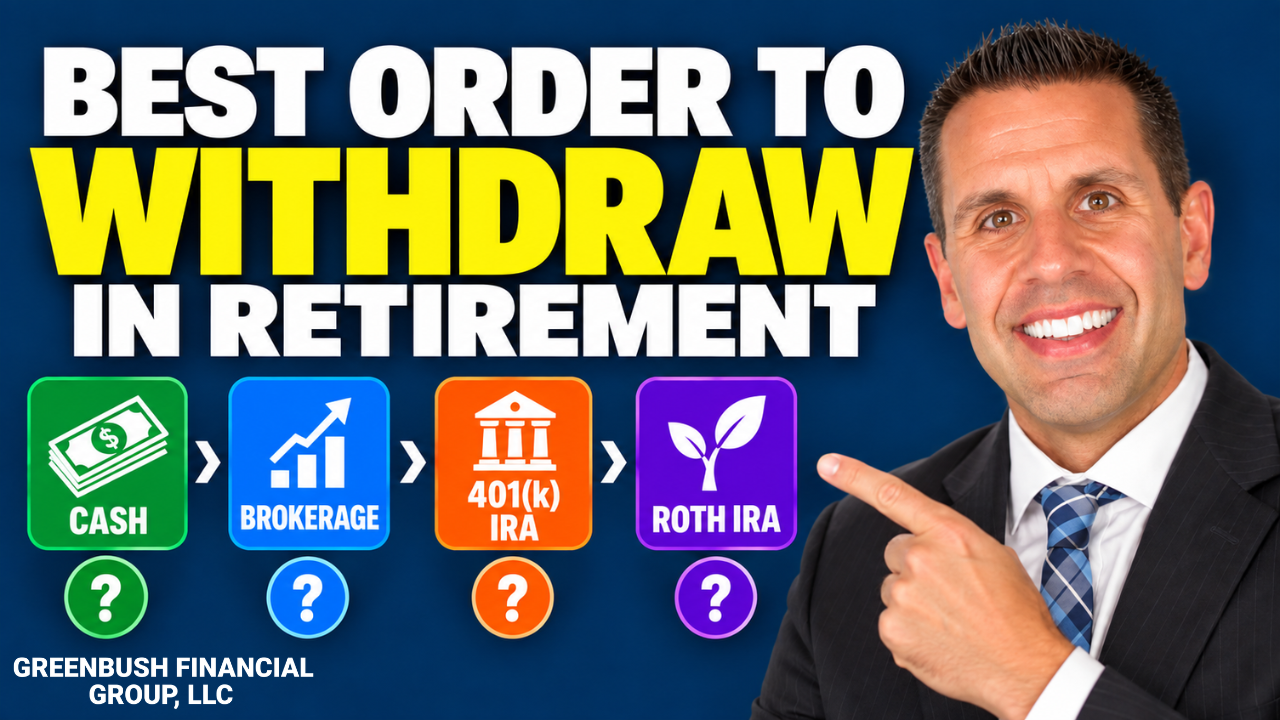
The key is to stop thinking about retirement withdrawals as a fixed sequence:
Cash → Brokerage → IRA → Roth.
Instead, think about your accounts as different tax buckets that can be coordinated each year.
A well-designed retirement distribution strategy considers your current taxes, future required minimum distributions, Social Security, Medicare premiums, capital gains, state taxes, Roth assets, and estate-planning goals. The objective isn't simply to minimize taxes this year.
The objective is to create a withdrawal strategy that supports your lifestyle while managing taxes throughout your entire retirement.

About Michael……...
Hi, I’m Michael Ruger. I’m the managing partner of Greenbush Financial Group and the creator of the nationally recognized Money Smart Board blog . I created the blog because there are a lot of events in life that require important financial decisions. The goal is to help our readers avoid big financial missteps, discover financial solutions that they were not aware of, and to optimize their financial future.
Frequently Asked Questions About the Best Order for Retirement Withdrawals
-
What accounts should I withdraw from first in retirement?There is no universal retirement withdrawal order. While some retirees begin with cash and taxable brokerage accounts, completely spending those assets before touching traditional IRAs can sometimes result in larger taxable distributions later. A blended strategy that uses taxable assets and strategic traditional IRA withdrawals may provide better control over lifetime taxes.
-
Should I withdraw from my brokerage account or IRA first?It depends on your current and projected future tax situation. Brokerage withdrawals may create capital gains rather than ordinary income, while taxable traditional IRA distributions generally create ordinary income. In low-income retirement years, intentionally taking some IRA distributions while also using brokerage assets may allow you to utilize lower tax brackets and potentially reduce future RMDs.
-
Should I spend my 401(k) or IRA before my Roth IRA?Roth IRAs are often preserved longer because qualified distributions can be tax-free, the original owner is not subject to lifetime Roth IRA RMDs, and future growth remains in the Roth environment. However, Roth withdrawals can sometimes be useful when additional traditional IRA or 401(k) income would push you into a higher tax bracket or increase Medicare premiums.
-
Should I take money from my traditional IRA before RMDs begin?It can make sense in some situations. If you have relatively low taxable income before your RMD age, taking strategic traditional IRA distributions or processing Roth conversions can utilize lower tax brackets and reduce the balance that will eventually be subject to RMDs. Whether this strategy is beneficial depends on your current tax rate compared with projected future rates.
-
What is the most tax-efficient retirement withdrawal strategy?A tax-efficient retirement withdrawal strategy generally coordinates distributions from pre-tax, taxable, and Roth accounts rather than automatically spending one account completely before moving to another. The strategy should consider federal and state tax brackets, capital gains, Social Security taxation, future RMDs, Medicare IRMAA thresholds, and estate-planning objectives.
-
Why shouldn't I spend my taxable brokerage account first?Spending the brokerage account first may minimize ordinary taxable income during the early years of retirement, but it can also allow traditional IRA and 401(k) balances to continue growing untouched. That could result in larger RMDs and potentially higher taxable income later. In some cases, intentionally recognizing traditional IRA income during lower-tax years can reduce lifetime taxes.
-
How do required minimum distributions affect retirement withdrawal planning?RMDs eventually require owners of many pre-tax retirement accounts to distribute a minimum amount annually. The applicable starting age depends on birth year under current law. Large pre-tax account balances can create substantial future RMDs, potentially increasing taxable income and Medicare premiums. Strategic distributions or Roth conversions before RMDs begin can sometimes reduce that future exposure.
-
Should I save my Roth IRA for last in retirement?Often, but not always. Roth IRAs can provide tax-free qualified distributions, tax-free growth, no lifetime RMDs for the original owner, and potentially favorable treatment for heirs. Those characteristics can make Roth dollars valuable to preserve. However, using Roth assets may make sense in years when additional taxable withdrawals would trigger higher tax rates, Medicare IRMAA, or other undesirable tax consequences.
-
Are brokerage account withdrawals taxable in retirement?Withdrawing cash from a brokerage account is not automatically taxable on the entire amount. Tax consequences generally arise when investments are sold for a gain, or when the account generates dividends, interest, or other taxable income. If an investment is sold for more than its adjusted cost basis, the gain may be taxable, with long-term gains generally receiving different federal tax treatment than ordinary income.
-
How can I reduce taxes on retirement account withdrawals?Tax planning before and during retirement can include strategically using lower income-tax brackets, coordinating traditional IRA distributions with taxable brokerage withdrawals, evaluating Roth conversions, managing capital gains, projecting future RMDs, and monitoring Medicare IRMAA thresholds. Rather than minimizing taxes in a single year, consider how today's withdrawal decisions could affect your tax liability throughout the remainder of retirement.