Do I Really Need Disability Insurance? What Working Adults Should Understand
Disability insurance helps replace income if illness or injury prevents you from working. This article explains the difference between short-term and long-term disability insurance, how employer-sponsored disability plans work, and why many professionals may have hidden coverage gaps. Learn the difference between own occupation and any occupation coverage, common disability insurance mistakes, and how income protection fits into retirement planning. Greenbush Financial Group outlines the key financial planning considerations working adults should understand before relying solely on employer benefits.

Many people insure their home, car, and life but overlook the income that supports all of those expenses. Disability insurance is designed to replace part of your income if illness or injury prevents you from working. Understanding the different types of disability coverage, how employer plans work, and where financial gaps may exist can help protect long-term financial stability. At Greenbush Financial Group, we often find that income protection becomes more important as careers, family responsibilities, and retirement savings grow.
Most People Protect Their Property Before Protecting Their Income
Many households insure:
Their home
Their car
Their health
Their life
But far fewer spend time thinking about what would happen if they suddenly could not work for months or years.
For most working adults, future earning power is one of their largest financial assets.
That income supports:
Mortgage payments
Retirement savings
Healthcare costs
Family expenses
College savings
Everyday living expenses
Disability insurance exists to help protect that income if illness or injury interrupts the ability to work.
The goal is not expecting the worst.
The goal is understanding how financial stability would be affected if paychecks unexpectedly stopped.
What Is Disability Insurance?
Disability insurance helps replace a portion of income if a person becomes unable to work because of:
Illness
Injury
Medical conditions
Certain disabilities
Coverage typically pays monthly benefits for a defined period depending on the policy structure.
Unlike health insurance, disability insurance does not primarily cover medical bills.
It helps replace lost income.
Why Disability Insurance Matters More Than Many People Realize
Many people associate disability with catastrophic accidents.
But long-term disabilities are often caused by:
Cancer
Back injuries
Chronic illness
Neurological disorders
Mental health conditions
Heart disease
Surgery recovery complications
In many cases, disabilities are medical events rather than dramatic accidents.
The financial impact can become significant because expenses usually continue even when income slows or stops.
The Two Main Types of Disability Insurance
Short-Term Disability Insurance
Short-term disability coverage typically provides income replacement for temporary situations.
Coverage periods often range from:
A few weeks
To several months
Common Uses
Short-term disability may help during:
Surgery recovery
Pregnancy and childbirth
Temporary illnesses
Injuries requiring recovery time
Benefits often begin quickly after a waiting period of:
A few days
Or a couple of weeks
Long-Term Disability Insurance
Long-term disability insurance is designed for more serious or extended work interruptions.
Coverage may last:
Several years
Until retirement age
Or for a specific policy duration
Long-term disability becomes especially important for protecting:
Retirement savings
Family cash flow
Long-term financial plans
Because prolonged income loss can significantly affect future financial security.
Employer Disability Insurance vs. Individual Coverage
Many employees already have some disability insurance through work.
But there are important details people often overlook.
Employer Coverage May:
Replace only part of income
Have benefit caps
End if employment changes
Be taxable
Offer limited portability
Some plans replace:
50%–60% of salary
Which may sound reasonable until households compare it against actual expenses.
Example
Suppose someone earns:
$140,000 annually
Employer disability coverage replaces:
60% of salary
But benefits are taxable.
Actual take-home replacement income may be significantly lower than expected while expenses remain largely unchanged.
Individual Disability Insurance
Individual policies are purchased privately and may offer:
More customized coverage
Portable benefits
Stronger definitions of disability
Higher income protection flexibility
Professionals with specialized careers often explore individual policies because their income may be difficult to replace.
Understanding “Own Occupation” vs. “Any Occupation”
This is one of the most important disability insurance concepts.
Own Occupation Coverage
This coverage generally pays benefits if you cannot perform the duties of your specific profession.
Example:
A surgeon unable to operate because of hand injuries may still technically be able to work elsewhere, but not within their specialized occupation.
Own occupation policies may still provide benefits.
Any Occupation Coverage
This standard is stricter.
Benefits may only apply if the person cannot reasonably work in almost any occupation.
This distinction can dramatically affect how coverage functions during a claim.
How Much Disability Coverage Do People Typically Need?
The answer depends on factors such as:
Income level
Savings
Family obligations
Debt
Career specialization
Retirement readiness
Questions worth considering include:
How long could savings support expenses?
Would a spouse’s income be enough?
Would retirement contributions stop?
Could mortgage payments continue comfortably?
Disability insurance is often less about replacing every dollar and more about protecting financial stability during a difficult period.
Who Often Benefits Most From Disability Insurance?
Coverage tends to become more important when people have:
High incomes
Dependents
Mortgage obligations
Specialized careers
Limited liquid savings
Long working years ahead
Especially for younger professionals, future earning power may greatly exceed current investment assets.
People Who May Need Less Disability Coverage
Not everyone needs the same level of protection.
Some people may need less coverage if they have:
Significant investment income
Pension income
Substantial liquid assets
Minimal debt
Financial independence already achieved
The key is evaluating how dependent the household remains on earned income.
A Real-World Example
Mark is 42 years old and earns:
$180,000 annually
He and his spouse have:
Young children
A mortgage
Ongoing retirement savings goals
Initially, Mark assumes his employer coverage is sufficient.
But after reviewing the details, he discovers:
Benefits are taxable
Coverage replaces less income than expected
Bonuses are excluded
Coverage would not fully support household expenses
He eventually supplements employer coverage with an individual long-term disability policy.
The decision was not based on fear.
It was based on recognizing how dependent the household remained on his future earnings.
Common Disability Insurance Mistakes
1. Assuming Employer Coverage Is Enough
Many people never review:
Benefit percentages
Tax treatment
Coverage limits
Waiting periods
2. Waiting Until Health Changes Occur
Coverage availability and pricing may change significantly after medical diagnoses.
3. Focusing Only on Accidents
Many disabilities stem from illness, not catastrophic injuries.
4. Ignoring Household Cash Flow Needs
Disability planning should evaluate:
Fixed expenses
Debt obligations
Family support needs
Long-term savings goals
5. Overinsuring or Underinsuring
Coverage should fit actual financial exposure and long-term needs.
Questions to Ask Before Buying Disability Insurance
Important questions include:
How much income would actually need replacement?
What coverage already exists through work?
Are benefits taxable?
How long could emergency savings last?
Does the policy use own occupation or any occupation definitions?
How long do benefits last?
What waiting period applies?
Would my spouse or family remain financially stable?
The answers often reveal whether meaningful protection gaps exist.
The Retirement Planning Connection
Disability insurance is often overlooked in retirement planning conversations.
But a major disability during working years can affect:
Retirement savings
Social Security timing
Investment growth
Debt repayment
College funding
Long-term financial independence
Protecting income during working years may help protect retirement goals later.
Final Thoughts
Disability insurance is not always the most exciting financial topic.
But for many working households, protecting future income may be just as important as protecting investments or property.
At Greenbush Financial Group, we often encourage clients to evaluate disability coverage not from a fear perspective, but from a financial planning perspective.
The question is not:
“What is the worst-case scenario?”
The better question is:
“How would the household function financially if earned income unexpectedly stopped for an extended period?”
For some people, the answer may reveal meaningful protection gaps.
For others, existing assets and flexibility may already provide enough security.
The key is understanding the tradeoffs before a health event forces the conversation unexpectedly.

Rob Mangold
About Rob……...
Hi, I’m Rob Mangold. I’m the Chief Operating Officer at Greenbush Financial Group and a contributor to the Money Smart Board blog. We created the blog to provide strategies that will help our readers personally, professionally, and financially. Our blog is meant to be a resource. If there are questions that you need answered, please feel free to join in on the discussion or contact me directly.
FAQ
-
What is disability insurance?Disability insurance helps replace part of your income if illness or injury prevents you from working.
-
What is the difference between short-term and long-term disability insurance?Short-term disability usually covers temporary situations lasting weeks or months, while long-term disability covers extended work interruptions that may last years.
-
Is disability insurance worth it?For many working adults, especially those dependent on earned income, disability insurance may help protect financial stability and long-term goals.
-
Does employer disability insurance provide enough coverage?Sometimes, but many employer plans replace only part of income and may include taxable benefits or coverage limits.
-
What does "own occupation" disability insurance mean?Own occupation coverage generally pays benefits if you cannot perform your specific profession, even if you could work elsewhere.
-
Are disability insurance benefits taxable?It depends on how premiums are paid. Employer-paid benefits are often taxable, while individually funded policies may provide tax-free benefits.
-
Who benefits most from disability insurance?High earners, professionals, families with dependents, and households heavily dependent on employment income often benefit most from coverage.
-
What is the biggest mistake people make with disability insurance?One of the biggest mistakes is assuming employer coverage fully protects household income without reviewing the actual policy details.







Social Security Cost of Living Increase Only 2.8% for 2026
The Social Security Administration announced a 2.8% cost-of-living adjustment (COLA) for 2026, slightly higher than 2025’s 2.5% increase but still below the long-term average. This modest rise may not keep pace with the real cost of living, as retirees continue to face rising prices for essentials like food, utilities, and healthcare. Learn how this affects your benefits, why COLA timing matters, and strategies to help offset inflation in retirement.

By Michael Ruger, CFP®
Partner and Chief Investment Officer at Greenbush Financial Group
The Social Security Administration (SSA) has announced that the annual Cost-of-Living Adjustment (COLA) for 2026 will be 2.8%, up slightly from 2.5% in 2025, but still below the ten-year average of about 3.1%. While any increase in Social Security benefits is welcome news for retirees, many experts and retirees alike worry that this modest adjustment may not be enough to keep pace with rising living costs.
In this article, we’ll cover:
How the 2026 COLA compares to previous years
Why this year’s increase may not keep up with inflation
The lag retirees face when inflation heats up
Possible strategies to help offset higher costs
The 2026 COLA: Modest in Historical Context
While the 2.8% increase may seem like a fair bump, it’s actually on the lower end of recent COLA adjustments. Here’s a look at the last five years of Social Security COLAs:
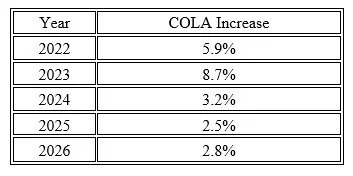
As the table shows, retirees experienced significant boosts during the high-inflation years of 2022 and 2023, but those increases have tapered off as inflation cooled — at least according to official data. However, many households continue to feel that everyday prices for groceries, utilities, and especially healthcare haven’t truly come back down.
Why the 2026 COLA May Not Be Enough
Although the 2.8% COLA aims to help beneficiaries keep up with inflation, many retirees report that their actual cost of living has increased by well over 3%. Everyday expenses — particularly healthcare premiums, prescription drugs, and food — have outpaced average inflation in recent years.
For retirees living on a fixed income, this can feel like a slow squeeze. Even small differences between the COLA and real inflation can add up to a meaningful loss in purchasing power over time.
The Timing Problem: If Inflation Heats Up, Help May Be a Year Away
One major challenge with the COLA system is timing. Adjustments are made once per year, based on inflation readings from the third quarter of the previous year.
That means if inflation begins to surge again in mid-2026 — say, to 4% or higher — retirees won’t see an increase in their Social Security benefits until January 2027. By then, a full year of higher prices could have eroded much of their financial cushion.
For retirees already struggling to cover basic costs, that lag can create a serious hardship.
What Can Retirees Do?
If the COLA isn’t keeping up with rising expenses, retirees may need to take proactive steps to protect their financial well-being. A few options to consider:
Reevaluate annual spending. Look for non-essential expenses that can be trimmed or delayed.
Explore part-time or flexible income. Even modest earnings can help bridge the gap during higher-inflation periods.
Lean on family support if necessary. Having an honest discussion about temporary help from family members can make a meaningful difference.
Revisit your financial plan. This is a good time to review your withdrawal strategy, investment income, and emergency savings to make sure your plan can weather inflation surprises.
The Importance of Adjusting Retirement Projections for Inflation
When planning for retirement, it’s critical to adjust annual expenses for inflation in your projections. Even modest inflation can dramatically change your future spending needs.
Let’s look at an example:
A 65-year-old retiree today has annual living expenses of $60,000.
If inflation averages 3% per year, by age 75, those same expenses would grow to roughly $80,600.
That’s over $20,000 more per year — just to maintain the same standard of living.
Failing to account for inflation in your retirement projections can lead to underestimating how much income you’ll truly need down the road. Whether you’re living off investment withdrawals, pensions, or Social Security, it’s essential to plan for rising costs and ensure your income sources can keep pace.
Final Thoughts
Now more than ever, staying proactive about budgeting, income planning, and inflation protection strategies is essential. Social Security was never meant to cover all retirement expenses — and in today’s environment, it’s important to ensure your broader financial plan can pick up where the COLA falls short.

About Michael……...
Hi, I’m Michael Ruger. I’m the managing partner of Greenbush Financial Group and the creator of the nationally recognized Money Smart Board blog . I created the blog because there are a lot of events in life that require important financial decisions. The goal is to help our readers avoid big financial missteps, discover financial solutions that they were not aware of, and to optimize their financial future.
Frequently Asked Questions (FAQ)
How much will Social Security benefits increase in 2026?
The Social Security Administration announced a 2.8% Cost-of-Living Adjustment (COLA) for 2026, a modest rise from 2.5% in 2025. This increase remains below the ten-year average of roughly 3.1%.
Why is the 2026 COLA increase considered modest?
While the 2.8% adjustment helps offset inflation, it’s smaller than the larger increases retirees saw in 2022 and 2023 during periods of high inflation. Many retirees feel everyday costs, especially for healthcare and essentials, continue to rise faster than official inflation measures suggest.
How does the timing of COLA adjustments affect retirees?
COLA calculations are based on inflation data from the third quarter of the previous year, meaning there’s often a delay in responding to rising prices. If inflation increases during 2026, beneficiaries won’t see higher payments until 2027, leaving a potential gap between expenses and income.
What can retirees do if their Social Security increase isn’t keeping up with inflation?
Retirees can review spending habits, trim non-essential costs, explore part-time income opportunities, and update financial plans to better manage inflation risks. Maintaining flexibility and preparing for price changes can help preserve purchasing power.
How can inflation impact long-term retirement planning?
Even moderate inflation significantly raises living costs over time. For example, a retiree spending $60,000 annually could need over $80,000 within ten years if inflation averages 3%, underscoring the importance of including inflation adjustments in retirement projections.
Why is it important to revisit a financial plan regularly during retirement?
Regularly reviewing your financial plan helps ensure that income sources, such as investments or pensions, continue to meet rising expenses. Adjusting for inflation, healthcare costs, and market changes can help retirees maintain their desired standard of living.