How Long Does It Take to Build a $1 Million Roth IRA?
How long does it take to build a $1 million Roth IRA? See how a 22-year-old investing $7,500 per year could potentially become a Roth IRA millionaire, and how compounding could turn $1 million into $2 million and beyond.
By Michael Ruger, CFP®
Partner and Chief Investment Officer at Greenbush Financial Group
The Roth IRA may be one of the most powerful retirement savings vehicles available. Why? Because it combines the power of compound investment returns with the potential for tax-free retirement income.
With a Roth IRA, you contribute money that has already been taxed. Once the money is inside the account, your investments can grow without annual taxation on interest, dividends, or capital gains. Even better, qualified withdrawals can be completely tax-free in retirement. Generally, for earnings to be withdrawn tax-free, the Roth IRA must satisfy the five-year requirement and the distribution must occur after age 59½ or meet another qualifying condition.
That combination can make a Roth IRA doubly powerful: your investment returns compound over time, and those compounded returns may ultimately be withdrawn tax-free.
In this article, we will look at:
How long it could take a 22-year-old to build a $1 million Roth IRA
How much of that $1 million comes from contributions versus investment growth
Why reaching your first $1 million can be such an important milestone
How the Rule of 72 demonstrates the power of additional compounding cycles
Why starting early can have such a dramatic impact on your long-term wealth
How Does a Roth IRA Grow?
A Roth IRA is an account, not an investment itself. Within the Roth IRA, you can typically invest in stocks, bonds, mutual funds, ETFs, and other investments.
The investments you select will determine how quickly the account grows.
Unlike a taxable investment account, however, you generally do not have to pay taxes each year on investment activity occurring inside the Roth IRA. That allows the entire account balance to remain invested and continue compounding.
How Long Does It Take to Build a $1 Million Roth IRA?
Let's look at a hypothetical 22-year-old investor.
For 2026, the IRA contribution limit is $7,500 for an individual under age 50, assuming the individual has sufficient eligible compensation and qualifies to make the Roth IRA contribution. Roth IRA eligibility is also subject to income limitations.
For our example, let's assume:
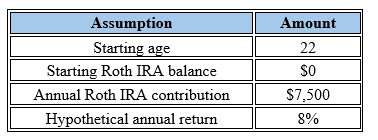
Even though IRA contribution limits may increase in future years, we will assume the investor contributes exactly $7,500 every year to keep the example simple. At an 8% annual rate of return, it would take approximately 32 years for the Roth IRA to cross the $1 million mark. That means someone starting at age 22 could potentially become a Roth IRA millionaire around age 54.
But here's where the numbers become particularly interesting. Over those 32 years, the investor would have personally contributed only:
$7,500 × 32 = $240,000
Yet the account would be worth approximately $1.02 million. That means roughly $778,000 of the account value would be attributable to compounded investment growth, based on our hypothetical assumptions. In other words, the investor contributed $240,000, but compounding did much of the heavy lifting. And because the money is inside a Roth IRA, qualified distributions of those earnings could eventually be received tax-free.
Becoming a Roth IRA Millionaire Isn't the End of the Story
Reaching $1 million may sound like the finish line. From a compounding standpoint, however, it may be closer to the beginning of the most powerful stage. Why?
Because once you've accumulated a large investment balance, you have a much larger amount of money generating potential investment returns.
An 8% return on a $50,000 portfolio is $4,000.
An 8% return on a $500,000 portfolio is $40,000.
An 8% return on a $1 million portfolio is $80,000.
The rate of return hasn't changed. What has changed is the amount of money working for you. This is why building your first $1 million can be such an important milestone. Once you have accumulated that larger base, future compounding can potentially accelerate dramatically.
The Rule of 72: How Quickly Could $1 Million Become $2 Million?
There is a simple financial concept called the Rule of 72 that can help investors estimate how long it will take an investment to double.
Take 72 and divide it by your assumed annual rate of return.
At an 8% annual return:
72 ÷ 8 = 9 years
So, according to the Rule of 72, an investment earning approximately 8% per year would double about every nine years. Now apply that concept to our Roth IRA millionaire.
Suppose our hypothetical investor reaches approximately $1 million around age 54. From that point forward, let's assume they never contribute another dollar and the account continues earning a hypothetical average return of 8%.
The potential growth looks something like this:
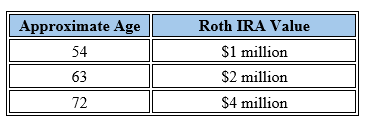
Notice what's happening.
It took roughly 32 years of annual contributions to accumulate the first $1 million.
But the next $1 million could potentially be created in only about nine additional years—with no additional contributions at all. Then $2 million could become $4 million approximately nine years later. That's the power of compounding cycles.
Most of the Potential Wealth Can Be Created Later
One of the hardest concepts for younger investors to appreciate is that the early years of investing can sometimes feel painfully slow.
You contribute $7,500. Then another $7,500. Then another. You may look at your account after several years and wonder why the balance isn't growing faster. But those early contributions are building the foundation that allows compounding to become much more powerful later.
Consider our hypothetical doubling cycle:
$1 million → $2 million: $1 million of additional growth
$2 million → $4 million: $2 million of additional growth
$4 million → $8 million: $4 million of additional growth
The percentage return didn't change. We continued to assume 8%. But the dollar amount of growth became substantially larger with each doubling cycle. This illustrates an important wealth-building principle:
The sooner you can accumulate your first meaningful pool of investment assets, the more potential compounding cycles you may have available later in life.
Why Starting at Age 22 Can Be So Powerful
Young investors often believe they don't have enough money for investing to make a meaningful difference. But when you're young, you have an asset that someone approaching retirement cannot buy: Time
A dollar invested at age 22 potentially has decades to compound. A dollar invested at age 52 simply doesn't have the same runway before retirement. This doesn't mean someone who didn't start investing in their 20s has missed their opportunity. The best strategy is generally to begin when you are financially able to do so and build from there.
But for younger investors, understanding the value of starting early can be incredibly important. Your first few Roth IRA contributions may not seem life-changing when you make them. Thirty or forty years of compounding may tell a very different story.
The Tax-Free Compounding Advantage of a Roth IRA
There is another important piece to this example.
If you accumulate $1 million in a traditional pre-tax retirement account, that $1 million isn't necessarily the same as having $1 million available to spend. Withdrawals from traditional retirement accounts are generally subject to ordinary income tax.
A Roth IRA works differently. Contributions are made with after-tax dollars, so you don't receive an upfront tax deduction. In exchange, qualified Roth IRA withdrawals can be tax-free. That means if our hypothetical Roth IRA eventually grows to $1 million, $2 million, or more, qualified distributions could potentially be received without federal income tax.
This is why we often think of Roth accounts as having two layers of compounding power:
Your investments have the opportunity to compound over time.
That compounded growth has the potential to ultimately be distributed tax-free.
For an investor with several decades before retirement, that combination can be extremely valuable.
Don't Forget About Roth IRA Income Limits
Before automatically contributing $7,500 to a Roth IRA, it is important to determine whether you are eligible.
Roth IRAs have income limitations.
For 2026, the Roth IRA contribution phase-out range is $153,000 to $168,000 for single filers and heads of household and $242,000 to $252,000 for married couples filing jointly.
Individuals above the applicable income limits may not be able to make a direct Roth IRA contribution. Depending on the individual's circumstances, other Roth strategies may be available, but those strategies have their own tax and planning considerations.
Key Takeaway
When you're young, your Roth IRA balance may seem small and the finish line may seem far away. Don't underestimate what decades of consistent investing and compounding can potentially accomplish. The goal isn't necessarily to get rich quickly. The goal is to start the compounding clock as early as possible—and give it as much time as possible to work.

About Michael……...
Hi, I’m Michael Ruger. I’m the managing partner of Greenbush Financial Group and the creator of the nationally recognized Money Smart Board blog . I created the blog because there are a lot of events in life that require important financial decisions. The goal is to help our readers avoid big financial missteps, discover financial solutions that they were not aware of, and to optimize their financial future.