
Understanding the Social Security 50% Spousal Benefit
The Social Security 50% spousal benefit allows married or divorced individuals to receive up to half of their spouse’s full retirement age benefit. This guide explains eligibility rules, timing strategies, and why delaying benefits may not always maximize household income. Learn how filing decisions affect both spouses and how to coordinate benefits for optimal retirement income. Understanding these rules is essential for building an efficient Social Security strategy.

By Michael Ruger, CFP®
Partner and Chief Investment Officer at Greenbush Financial Group
When married couples are deciding when to file for Social Security, there are several strategies to consider. One of the most important — and often misunderstood — is the 50% spousal benefit. This rule can have a major impact on when each spouse should file and how to maximize total household Social Security income over retirement.
In this article, we’ll walk through:
What the 50% spousal benefit is
Special filing rules to qualify
Why “file and suspend” is no longer allowed
Why delaying to age 70 may not always make sense
Special rules for divorced spouses
Other factors to consider when choosing a filing strategy
What Is the 50% Spousal Benefit?
When you are married and eligible for Social Security, you have the option to receive:
100% of your own Social Security benefit, or
50% of your spouse’s benefit, whichever is higher.
You do not get both — Social Security will essentially give you the higher of the two amounts.
Example
Let’s look at an example:
Paul’s Full Retirement Age (FRA) benefit: $3,600 per month
Sharon’s FRA benefit: $800 per month
When Sharon files at her full retirement age (67), she can choose:
Her own benefit: $800/month
50% of Paul’s benefit: $1,800/month
Since $1,800 is higher than $800, she would elect the 50% spousal benefit.
This filing strategy is extremely important in situations where one spouse earned significantly more than the other.
Special Filing Rules
One of the most important rules for the 50% spousal benefit is this:
The higher-earning spouse must be receiving their Social Security benefit in order for the lower-earning spouse to claim the 50% spousal benefit.
Using Paul and Sharon again:
Both are age 67
Paul’s FRA benefit = $3,600
Sharon’s FRA benefit = $800
If Paul decides to delay his Social Security until age 70, Sharon cannot collect the spousal benefit until Paul actually turns his benefit on.
So Sharon would:
Take her own benefit of $800 at 67
Elect the 50% spousal benefit when Paul turn on at age 70 increasing to $1,800
This rule alone often drives a lot of the Social Security filing decision for married couples.
File and Suspend Is No Longer Allowed
Years ago, there was a strategy called “file and suspend.”
This allowed the higher-earning spouse to:
File for Social Security
Immediately suspend their benefit
Allow their benefit to continue growing until age 70
Meanwhile, the lower-earning spouse could collect the 50% spousal benefit
This strategy was very powerful, but the Social Security Administration eliminated the file and suspend strategy. Now, the higher-earning spouse must actually be receiving benefits for the spouse to receive the spousal benefit.
Delaying Until Age 70 May Not Always Make Sense
Many people know that if you delay Social Security past full retirement age, your benefit increases by approximately 8% per year until age 70.
From an individual standpoint, delaying can make a lot of sense. However, for married couples, the spousal benefit changes the math.
Here’s the key rule:
The 50% spousal benefit is based on 50% of the higher earner’s Full Retirement Age benefit, not their age 70 benefit.
Example
Let’s go back to Paul and Sharon:
Paul’s FRA benefit: $3,600/month
Paul’s age 70 benefit: about $4,500/month
Sharon’s own benefit: $800/month
Sharon’s spousal benefit: $1,800/month (50% of $3,600)
If Paul delays until age 70:
Sharon cannot collect the spousal benefit for 3 years
Her spousal benefit does not increase — it stays at $1,800
So the couple must evaluate:
Is the increase in Paul’s benefit worth Sharon not receiving the addition $1,000/month for three years? ($1,800 spousal benefit less Sharon’s $800 FRA benefit)
In situations where the spousal benefit is a large increase for the lower-earning spouse, it may make sense for the higher earner to file earlier, even if that means giving up the delayed credits.
However, if the spousal benefit is only slightly higher than the lower earner’s own benefit, delaying may still make sense.
This is why Social Security filing decisions should always be looked at from a household strategy, not just an individual strategy.
Divorced Couples: Special Consideration
Many people don’t realize that divorced spouses may still be eligible for the spousal benefit.
You may qualify for a 50% spousal benefit on an ex-spouse’s record if:
The marriage lasted at least 10 years
You are currently unmarried
Your own Social Security benefit is less than 50% of your ex-spouse’s benefit
Your ex-spouse is eligible for Social Security (they do not have to be collecting yet if divorced more than 2 years)
Even if your ex-spouse has remarried, you may still be eligible for the spousal benefit based on their record.
Importantly:
Your ex-spouse collecting a spousal benefit does NOT reduce their benefit and does not impact their current spouse.
Other Factors to Consider When Filing for Social Security
The 50% spousal benefit is just one piece of the Social Security planning puzzle. When building a filing strategy, we also consider:
Survivor benefits
Life expectancy of both spouses
Taxation of Social Security
Other retirement income sources
Roth conversion strategy
Required Minimum Distributions (RMDs)
The difference between each spouse’s benefit
The survivor benefit is especially important — when one spouse passes away, the surviving spouse keeps the higher of the two Social Security benefits, which is another reason why delaying the higher earner’s benefit can sometimes make sense.

About Michael……...
Hi, I’m Michael Ruger. I’m the managing partner of Greenbush Financial Group and the creator of the nationally recognized Money Smart Board blog . I created the blog because there are a lot of events in life that require important financial decisions. The goal is to help our readers avoid big financial missteps, discover financial solutions that they were not aware of, and to optimize their financial future.
Frequently Asked Questions About the Social Security 50% Spousal Benefit
- What is the Social Security spousal benefit?The spousal benefit allows a married spouse to receive up to 50% of their spouse's full retirement age Social Security benefit if that amount is higher than their own benefit.
- Do I get my own benefit plus 50% of my spouse's benefit?No. You receive either your own benefit or the spousal benefit - whichever is higher - but not both.
- When can I claim the spousal benefit?You can claim the spousal benefit as early as age 62, but the benefit will be reduced if taken before your full retirement age.
- Does my spouse have to file before I can receive the spousal benefit?Yes. The higher-earning spouse must be actively receiving Social Security benefits before the lower-earning spouse can claim the 50% spousal benefit.
- Is the spousal benefit based on my spouse's age 70 benefit?No. The spousal benefit is based on 50% of your spouse's full retirement age benefit, not their age 70 benefit.
- If my spouse delays until age 70, does my spousal benefit increase?No. Your spousal benefit does not increase if your spouse delays past full retirement age. However, you must wait until they file to receive it.
- Can a divorced spouse collect a spousal benefit?Yes, if the marriage lasted at least 10 years and the individual is currently unmarried, they may be eligible for a spousal benefit based on their ex-spouse's record.
- Does my ex-spouse need to be collecting for me to claim a spousal benefit?If you have been divorced for more than two years, you may be able to claim a spousal benefit even if your ex-spouse has not filed yet, as long as they are eligible.
- What happens to the spousal benefit if my spouse passes away?The spousal benefit is replaced by a survivor benefit, which allows the surviving spouse to receive up to 100% of the deceased spouse's benefit.
- How do we know when we should file for Social Security?The optimal time to file depends on several factors including life expectancy, income needs, taxes, and the difference between each spouse's benefit. This decision should be evaluated as part of a full retirement income plan.





















How Do Social Security Survivor Benefits Work?
Social Security payments can sometimes be a significant portion of a couple’s retirement income. If your spouse passes away unexpectedly, it can have a dramatic impact on your financial wellbeing in retirement. This is especially
Social Security payments can sometimes be a significant portion of a couple’s retirement income. If your spouse passes away unexpectedly, it can have a dramatic impact on your financial well-being in retirement. This is especially true if there was a big income difference between you and your spouse. In this article, we will review:
Who is eligible to receive the Social Security Survivor's Benefit
How the benefit is calculated
Electing to take the benefit early vs. delaying the benefit
Filing strategies that allow the surviving spouse to receive more from Social Security
Social Security Earned Income Penalty
Social Security filing strategies that married couples should consider preserving the Survivor Benefit
Divorce: 2 Ex-spouses & 1 Current Spouse: All receiving the same Survivor Benefit
How Much Social Security Does A Surviving Spouse Receive?
When your spouse passes away, as the surviving spouse, you are entitled to receive the higher of the two benefits. You do not continue to collect both benefits simultaneously.
Example: Jim is age 80 and he is collecting a Social Security benefit of $2,500 per month. His wife Sarah is 79 and is collecting $2,000 per month for her Social Security benefit.
If Jim passes away first, Sarah would begin to receive $2,500 per month, but her $2,000 per month benefit would end.
If Sarah passes away first, Jim would continue to receive his $2,500 per month because his benefit was the higher of the two, and Sarah’s Social Security payments would end.
Married For 9 Months
To be eligible for the Social Security Survivor Benefit as the spouse, you have to have been married for at least nine months prior to your spouse passing away. If the marriage was shorter than that, you are not entitled to the Social Security Survivor Benefit.
Increasing Your Spouse’s Survivor Benefit
Due to this higher of the two rule, as financial planners we work this into the Social Security filing strategy for our clients. Before we get into the strategy, let’s do a quick review of your filing options and how it impacts your Social Security benefit.
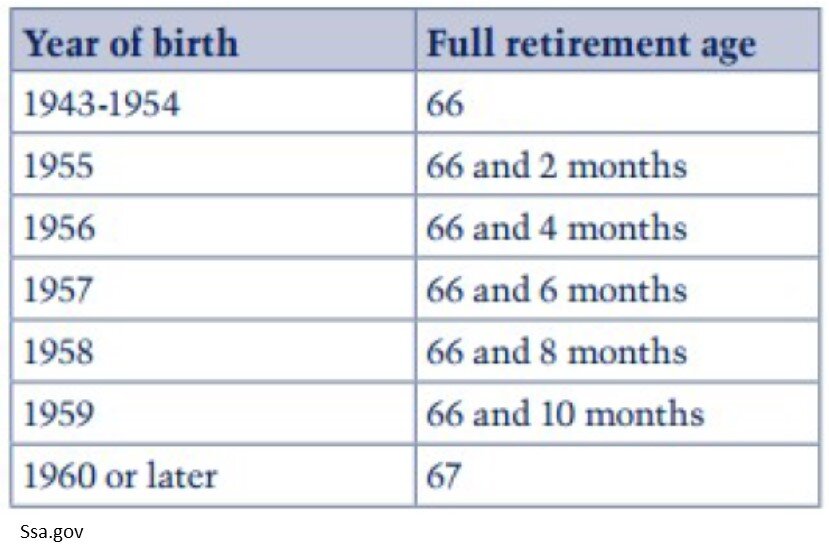
Normal Retirement Age
Each of us has a Normal Retirement Age for Social Security which is based on our date of birth. The Normal Retirement Age is the age that you are entitled to your full Social Security benefit:
Should You Turn On The Benefit Early?
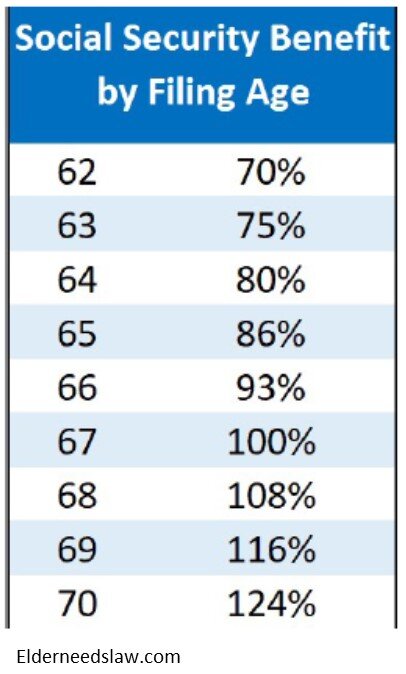
For your own personal Social Security benefit, once you reach age 62, you have the option to turn on your Social Security benefit early. However, if you elect to turn on your Social Security benefit prior to Normal Retirement Age, your monthly benefit is permanently reduced by approximately 6% per year for each year you take it early. So, if your normal retirement age is 67 and you file for Social Security at age 62, you only receive 70% of your full benefit and that is a permanent reduction.
On the flip side, if you delay filing for Social Security past your normal retirement age, your Social Security benefit increases by about 8% per year until you reach age 70.
There is no benefit to delaying Social Security past age 70.
How This Factors Into The Survivor Benefit
The decision of when you turn on your Social Security benefit will ultimately impact the Social Security Survivor Benefit that is available to your spouse should you pass away first. Remember, it’s the higher of the two. When there is a large gap between the amount that you and your spouse will receive from Social Security, it’s not uncommon for us to recommend that the higher income earner should delay filing for Social Security as long as possible. By delaying the start date, it increases the monthly amount that higher income earning spouse receives, which in turn preserves a higher monthly survivor benefit regardless of which spouse passes away first.
Example: Matt and Sarah are married, they are both 62, they retired last year, and they are trying to decide if they should turn on their Social Security benefit now, waiting until Normal Retirement Age, or delay it until age 70. Matt’s Social Security benefit at age 67 would be $2,700 per month. Sarah Social Security benefit at age 67 would be $2,000 per month.
They need $7,000 per month to meet their expenses. If Matt and Sarah both took their Social Security benefits at age 62, Matt’s benefit would be reduced to $1,890 per month and Sarah’s benefit would be reduced to $1,400 per month. At age 75, Matt passes away from a heart attack. Sarah’s Social Security benefit would increase to the amount that Matt was receiving, $1,890, and Sarah’s benefit of $1,400 per month would end. Since Sarah’s monthly expenses are still close to $7,000 per month, with the loss of the second Social Security benefit, she would have to withdraw $5,110 per month from another source to meet the $7,000 in monthly expenses. That’s $61,320 per year!!
Let’s compare that scenario to Matt waiting to file for his Social Security benefit until age 70 and Sarah turning on her Social Security benefit at age 62. By turning on Sarah’s benefit at age 62, it provides them with some additional income to meet expenses, but when Matt turns 70, he will now receive $3,348 per month from Social Security. If Matt passes away at age 75, Sarah now receives Matt’s $3,348 per month from Social Security and her lower benefit ends. However, since the Social Security payments are higher than the previous example, now Sarah only needs to withdraw $3,652 per month from her personal savings to meet her expenses. That equals $43,824 per year.
If Sarah lives to age 90, by Matt making the decision to delay his Social Security Benefit to age 70, that saved Sarah an additional $262,400 that she otherwise would have had to withdraw from her personal savings over that 15 year period.
Age 60 - Surviving Spouse Benefit
As mentioned above, with your personal Social Security retirement benefits, you have the option to turn on your Social Security payments as early as age 62 at a reduced amount. In contrast, if your spouse predeceases you, you are allowed to turn on the Social Security Survivor Benefit as early as age 60.
Similar to turning on your personal Social Security benefit at age 62, if you elect to receive the Social Security Survivor Benefit prior to reaching your normal retirement age, Social Security reduces the benefit by approximately 6% per year, for each year that you start receiving the benefit prior to your normal retirement age.
Advanced Filing Strategy
There is an advanced filing strategy associated with the Survivor Benefit. Social Security allows you to turn on the Survivor Benefit which is based on your spouse’s earnings history and defer your personal benefit until a future date. This allows your benefit to continue to grow even though you are currently receiving payments from Social Security. When you turn age 70, you can switch over to your own benefit which is at its maximum dollar threshold. But you would only do this, if your benefit was higher than the survivor benefit.
Example: Mike and Lisa are married and are both entitled to receive $2,000 per month from Social Security at age 67. Mike passes away unexpectedly at age 50. When Lisa turns 60, she will have to option to turn on the Social Security Survivor Benefit based on Mike’s earnings history at a reduced amount of $1,160 per month. In the meantime, Lisa can allow her personal Social Security benefit to continue to grow, and at age 70, Sarah can switch from the Surviving Spouse Benefit of $1,160 over to her personal benefit of $2,480 per month.
Beware of the Social Security Earned Income Penalty
If you are considering turning on your Social Security benefits prior to your normal retirement age, you must be aware of the Social Security earned income penalty. This is true for both your own personal Social Security benefits and the benefits you may receive as the surviving spouse. In 2026, if you are receiving Social Security benefits prior to your normal retirement age and you have earned income over $24,480 for that calendar year, not only are you receiving the benefit at a permanently reduced amount but Social Security assesses a penalty at the end of the year which is equal to $1 for every $2 of income over that threshold.
Example: Jackie decides to turn on her Social Security Survivor Benefits at age 60 in the amount of $1,000 per month. She is still working and will receive $40,000 in W-2 income. Based on the formula, of the $12,000 in Social Security payments that Jackie received, Social Security would assess a $8,300 penalty against that amount. So she basically loses it all to the penalty.
For clarification purposes, when Social Security levies the earned income penalty, they do not require you to issue them a check for the dollar amount of the penalty; instead, they deduct the amount that is due to them from your future Social Security payments. This usually happens shortly after you file your tax return for the previous year because the IRS uses your tax return to determine if the earned income penalty applies.
For this reason, there is a general rule of thumb that if you have not reached your normal retirement age for Social Security and you anticipate receiving income during the year well above the $24,480 threshold, it typically does not make sense to turn on the Social Security benefits early. It just ends up creating more taxable income for you, and you end up losing most or all of the money the next year when Social Security assesses the earned income penalty against your future benefits.
Once you reach normal retirement age, this earned income penalty no longer applies. You can turn on Social Security benefits and make as much as you want without a penalty.
Divorce
We find that many ex-spouses are not aware that they are also entitled to the Social Security Survivor Benefit if they were married to the decedent for more than 10 years prior to the divorce. Meaning if your ex-spouse passes away and you were married more than 10 years, if the monthly benefit that they were receiving from Social Security is higher than yours, you go back to Social Security, file under the Survivor Benefit, and your benefit will increase to their amount.
The only way you lose this option is if you remarry prior to age 60. However, if you get remarried after age 60, it does not jeopardize your ability to claim the Survivor Benefit based on your ex-spouse’s earnings history.
If your ex-spouse was remarried at the time they passed away, you are still entitled to receive the Survivor Benefit. In addition, their current spouse will also be able to claim the Survivor Benefit simultaneously and it does not reduced the amount that you receive as the ex-spouse.
There was even a case where an individual was divorced twice, both marriages lasted more than 10 years, and he was remarried at the time he passed away. After his passing, the two ex-spouses and the current spouse were all eligible to receive the full Social Security Survivor Benefit based on his earnings history.
Last updated June, 2026
About Michael……...
Hi, I’m Michael Ruger. I’m the managing partner of Greenbush Financial Group and the creator of the nationally recognized Money Smart Board blog . I created the blog because there are a lot of events in life that require important financial decisions. The goal is to help our readers avoid big financial missteps, discover financial solutions that they were not aware of, and to optimize their financial future.