

What Causes the Price of Gold to Go Up and Down?
Gold prices are influenced by several key factors, including interest rates, inflation, and the strength of the U.S. dollar. While gold is often viewed as a safe haven, it can be highly volatile and may not perform as well as stocks over the long term. This article explains what causes gold to rise and fall, how it compares to other commodities, and how it can be used for diversification. Understanding these drivers can help investors make more informed decisions about including gold in their portfolio.

By Michael Ruger, CFP®
Partner and Chief Investment Officer at Greenbush Financial Group
Over the last few years, gold has experienced a significant rally, followed by periods of sharp volatility—including some recent price declines that have caught investors’ attention. As a result, we’ve been having more frequent conversations with clients about what actually causes gold prices to rise and fall, and whether a recent dip represents an opportunity or a warning sign.
In this article, we’re going to walk through the same conversations we’ve been having with clients and explain the major variables that impact the price of gold. Specifically, you’ll learn:
Why gold is often viewed as a safe haven
How the value of the U.S. dollar affects gold prices
Why interest rates play a major role in gold movements
Whether gold is a good long-term investment
How gold compares to other commodities like silver, copper, and platinum
How gold can fit into a diversified portfolio
Gold as a Safe Haven
Gold is often referred to as a “safe haven” asset. What that means is when there is volatility in the global economy—or sometimes in the U.S. stock market—investors may sell riskier assets like stocks and move money into gold in an attempt to protect their principal.
In certain periods in history, this strategy has worked well. When markets become unpredictable, gold can hold its value or even increase while stocks are falling.
However, investors need to be careful with the idea of gold as a safe haven. While gold is sometimes viewed as a “safer” asset than stocks, it is still a very volatile asset class. It is not unusual for gold to move more than 10% in a short period of time. That’s a big difference compared to bonds, which are also considered conservative investments but typically experience much smaller price swings over short time periods.
So while gold can sometimes be a successful safe haven during global volatility, investors must remember that gold itself can be volatile. It should be viewed as a portfolio diversifier, not a guaranteed protection strategy.
Inverse Relationship to the Value of the Dollar
Historically, gold has had an inverse relationship with the value of the U.S. dollar.
In simple terms:
When the dollar goes down, gold tends to go up
When the dollar goes up, gold tends to go down
Why does this happen?
If paper currency is losing value (purchasing power), investors often move money into physical assets like gold to preserve wealth. Gold is viewed as a store of value that cannot be printed or created like paper money.
On the flip side, when the dollar is strengthening and purchasing power is increasing, investors may feel less need to hold gold, which can lead to falling gold prices.
So historically speaking, movements in the dollar are one of the biggest drivers of gold prices.
Interest Rate Fluctuations
Interest rates are another major factor that influences gold prices, largely because of their relationship with the value of the dollar.
Typically:
When the Federal Reserve lowers interest rates, the dollar often weakens, and gold may rise
When the Federal Reserve raises interest rates, the dollar often strengthens, and gold may fall
One of the primary reasons attributed to gold's rapid appreciation over the last year was due to interest rates coming down, which weakened the dollar and pushed gold prices higher.
Looking forward, if inflation continues to cool and interest rates decline later into 2026 (outside of the recent Iran events), gold could recover much of what was lost in recent weeks. However, investors must also be aware of long-term inflation risks. If inflation rises again and the Federal Reserve is forced to increase interest rates, that could strengthen the dollar and become a major headwind for gold prices.
In many ways, rising interest rates can be one of the biggest enemies of gold.
Gold as a Long-Term Investment
When we look at long-term annualized returns, gold has not historically been a great long-term investment compared to stocks. Over 20- and 30-year periods, the S&P 500 has outperformed gold.
However, that does not mean gold has no place in a portfolio.
Gold can be useful for:
Diversification
Protection during market volatility
Hedging against a declining dollar
Hedging against certain inflationary environments
Gold tends to have lower correlation to stocks and bonds, which means it doesn’t always move in the same direction as traditional investments. Because of that, gold can be a useful component within a diversified portfolio, but investors should be cautious about allocating too much to gold due to its volatility and lower long-term expected returns compared to equities.
Gold Compared to Other Commodities
Clients will often ask: why gold instead of silver, platinum, or copper?
The main reason is predictability.
Gold is primarily viewed as a store of wealth. Its price is largely influenced by:
The value of the dollar
Interest rates
Inflation
Global uncertainty
Central bank policies
However, other metals like silver, platinum, and copper have significant industrial uses. That means their prices are influenced not just by currency and global events, but also by:
Manufacturing demand
Technology demand
Construction activity
Supply chain issues
More variables typically mean more unpredictable price movements.
There are years when gold performs very well and other metals do not, and there are also years where metals like copper or silver outperform gold. In investment management, we often give extra weight to assets that are easier to analyze and understand.
Special Disclosure
This article is meant to educate investors on the price fluctuations in gold based on our experience in investment management over the past number of years. This is not a recommendation to buy or sell gold or any other commodity. Every investor’s situation is different, and decisions should be made based on your individual financial plan, time horizon, and risk tolerance.

About Michael……...
Hi, I’m Michael Ruger. I’m the managing partner of Greenbush Financial Group and the creator of the nationally recognized Money Smart Board blog . I created the blog because there are a lot of events in life that require important financial decisions. The goal is to help our readers avoid big financial missteps, discover financial solutions that they were not aware of, and to optimize their financial future.
Frequently Asked Questions About Gold
-
Why does gold go up when the market goes down?Gold is often viewed as a safe haven, so investors sometimes move money into gold during stock market volatility.
-
What is the biggest factor that affects gold prices?The value of the U.S. dollar and interest rates are two of the biggest drivers of gold prices.
-
Does gold go up when inflation rises?Often it does, because gold is viewed as a store of value when purchasing power declines.
-
Why does gold fall when interest rates rise?Rising interest rates typically strengthen the dollar, which historically puts downward pressure on gold.
-
Is gold a good long-term investment?Historically, stocks have outperformed gold over long periods, but gold can still be useful for diversification.
-
Is gold safer than stocks?Not necessarily, gold is still a very volatile asset class.
-
Why not invest in silver or copper instead of gold?Those metals have industrial uses, which makes their prices more unpredictable compared to gold.
-
How much gold should be in a portfolio?It depends on the investor, but many diversified portfolios only allocate a small percentage to gold (under 15%).
-
What causes gold to drop quickly?A rising dollar, rising interest rates, or reduced global uncertainty can all cause gold prices to fall.
-
Is a drop in gold a buying opportunity?It depends on the reason for the drop. Investors should look at interest rates, the dollar, and global conditions before making a decision.

















Is the Market About To Stage A Huge Rally?
The recent stock market pullback has been driven by rising oil prices, inflation concerns, and geopolitical tension involving Iran. As oil surged and uncertainty increased, markets reacted with increased volatility.
However, history shows that declines tied to geopolitical events are often temporary. This raises a key question for investors: is this a warning sign, or a setup for a potential market rally?

By Michael Ruger, CFP®
Partner and Chief Investment Officer at Greenbush Financial Group
If the recent market volatility has made you uneasy, you’re not alone. Over the last few weeks, markets have reacted to rising oil prices, inflation concerns, and geopolitical tension in Iran. When volatility returns after a relatively calm period, it can feel like something is seriously wrong, but history tells us this is a normal part of investing, and specifically in this case, the market could be poised to rally in the coming weeks.
In this article, we’ll cover:
Forces at work in the market that have created the recent selloff
Whether the market may be near a bottom
What assets classes are performing well YTD in 2026
Charts to guide us as to where the market could go from here
What’s Causing the Market Sell-Off?
The recent market pullback hasn’t been caused by just one issue, but rather a combination of global events and economic pressures.
The biggest driver has been the conflict involving Iran, which has pushed oil prices significantly higher. At the start of the year, oil was around $57 per barrel, and as of March 23, 2026, oil has risen to roughly $90 per barrel. When oil prices rise that quickly:
The cost of transporting goods increases
The cost of producing goods increases
Inflation fears begin to rise
The Federal Reserve becomes less likely to cut interest rates
This is why markets have reacted negatively in the short term.
However, based on analyst expectations, there is a high probability that the Iran conflict will be resolved in the reasonably near future. If that happens, oil prices could fall, transportation costs could decline, and inflation fears could ease, which could put the Federal Reserve back on a path toward lowering interest rates.
And that combination has historically been very positive for markets.
It’s also important to remember that we’ve seen this movie before. Recent geopolitical events involving Greenland and Venezuela caused short-term market drops, but the markets recovered very quickly once those situations stabilized. Geopolitical events tend to create temporary volatility, not permanent declines.
An Interesting Trend in 2026: Value vs. Growth
One of the most interesting trends this year has been the difference between large cap growth and large cap value.
As of last week:
Large cap growth is down about 7.9% year-to-date
Large cap value is up about 2.2% year-to-date
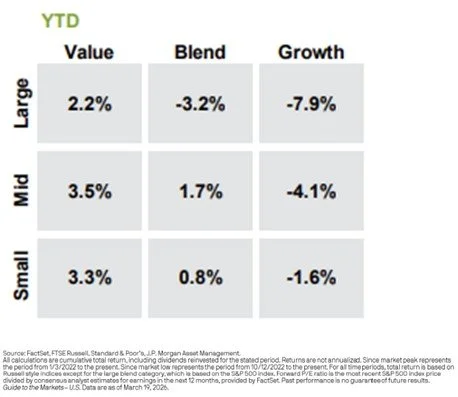
This shouldn’t be a huge surprise. Large cap value includes sectors like energy, which have performed very well due to rising oil prices. Meanwhile, many large cap growth and technology companies, including several of the “Magnificent Seven” stocks, have pulled back this year.
This is a great real-world reminder of why diversification matters.
When one part of the market struggles, another part of the market may be doing well. A properly diversified portfolio helps smooth out the ride when unexpected events occur.
Remember: Volatility Is Normal
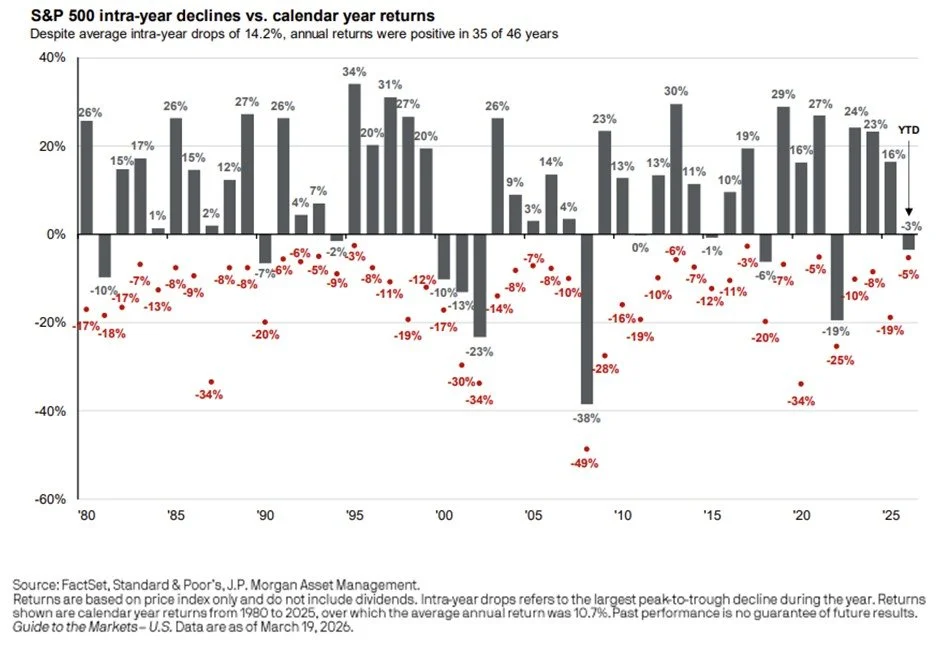
The chart below is a great reminder that selloffs and market volatility are normal even during good years for the stock market.
The chart shows two things going back to 1980:
The gray bars show the S&P 500 return for the full year
The red dots show the largest drop that occurred at some point during that year
For example:
In 2025, the market finished up 16%, but at one point during the year, it dropped by 19%
In 2024, the market finished up 23%, but had an 8% correction during the year
When you look at the last 45 years, a clear pattern emerges:
Most years the market finishes positive, but most years also have a signification correction at some point during the year.
This is the price of admission for investing. You don’t get the long-term returns of the market without experiencing volatility along the way.
Emotions and Panic Are the Enemy of Good Investment Decisions
The media and the markets will give investors something to worry about every single day.
Some of those concerns are legitimate. Many are not. The key is determining whether a current event represents a temporary disruption or a permanent change to the global economy.
Right now, the concern is Iran, oil prices, and inflation. A few months from now, it will likely be something else. That has always been the case, and it will continue to be the case.
One thing investors cannot forget is that we are currently in a massive wave of innovation and growth driven by artificial intelligence, automation, and robotics. These trends will likely have a much larger long-term impact on markets than most short-term geopolitical events.
This doesn’t mean markets won’t fall. They will.
It doesn’t mean volatility won’t happen. It will.
It doesn’t mean corrections won’t occur. They will.
But it does mean that panic-driven decisions are often the biggest mistake investors make.
Is the Market Close to the Bottom?
No one can consistently predict the exact bottom of a market correction. However, market declines driven by geopolitical events and oil shocks have historically recovered relatively quickly once the situation stabilizes. The Iran conflict is not likely be to any different.
If the Iran conflict cools down, and:
Oil prices fall
Transportation costs fall
Inflation fears ease
Then the current market pullback could reverse faster than many investors expect.
Market pullbacks often create opportunities that weren’t available when markets were at all-time highs just a few months ago.
About Michael……...
Hi, I’m Michael Ruger. I’m the managing partner of Greenbush Financial Group and the creator of the nationally recognized Money Smart Board blog . I created the blog because there are a lot of events in life that require important financial decisions. The goal is to help our readers avoid big financial missteps, discover financial solutions that they were not aware of, and to optimize their financial future.
