Can You Give Money to Your Grandkids Tax-Free? Here’s What the IRS Says
The IRS allows grandparents to give up to $19,000 per grandchild in 2025 without filing a gift tax return, and up to $13.99 million over their lifetime before any tax applies. Gifts are rarely taxable for recipients — but understanding Form 709, 529 plan rules, and tuition exemptions can help families transfer wealth efficiently and avoid IRS issues.

Many grandparents want to help their grandchildren financially—whether it’s for education, a first home, or simply to transfer wealth during their lifetime. But the question often arises: will my grandkids owe taxes on those gifts? In most cases, the answer is no—the recipient of a gift doesn’t pay taxes. Instead, the giver may need to file a gift tax return if the gift exceeds the annual exclusion amount. Here’s how the IRS actually handles gifts to grandchildren, what forms apply, and how to avoid unnecessary taxes or filing headaches.
Who Pays the Tax on a Gift?
Under IRS rules, the person making the gift (the donor) is responsible for any gift tax—not the person receiving it. This means if a grandparent gives money, investments, or property to a grandchild, the child typically doesn’t report or owe anything.
However, there are thresholds to know:
Annual gift tax exclusion (2025): $19,000 per recipient
Lifetime gift and estate tax exemption (2025): $13.99 million per person
If a grandparent gives less than $19,000 to any one grandchild during the year, no filing or tax applies. Gifts above that limit simply require Form 709, but gift tax is only owed once total lifetime gifts exceed the $13.99 million exemption.
Studies show that fewer than 1% of Americans ever owe gift tax—most gifts fall well below these thresholds.
What Counts as a Gift
The IRS defines a gift as any transfer where full value isn’t received in return. Common examples include:
Cash gifts or checks
Paying a grandchild’s tuition or medical bills directly
Contributing to a 529 plan
Transferring stocks or real estate below market value
Tuition and Medical Exceptions
Certain payments don’t count toward the annual gift limit if you pay the institution directly:
Tuition paid straight to a college or private school
Medical expenses paid directly to a hospital or provider
These payments are excluded from both the annual and lifetime gift limits, making them powerful estate-planning tools for grandparents who want to help without triggering IRS reporting.
Gifting Through a 529 Plan
A popular way to help grandchildren is through 529 college savings plans. Contributions are treated as gifts for tax purposes, but there’s a special election that allows grandparents to “front-load” five years’ worth of annual exclusions.
In 2025, you can contribute up to $95,000 per grandchild ($19,000 × 5) without using any lifetime exemption.
Married couples can jointly contribute up to $190,000 per grandchild with the same rule.
This allows for significant education funding while keeping assets out of the grandparent’s taxable estate.
What the IRS Actually Looks At
When reviewing gifts, the IRS primarily focuses on:
Value and documentation – was the transfer properly valued and recorded?
Ownership control – did the grandparent truly give up control of the asset?
Direct vs. indirect payments – paying tuition directly to a school is excluded; writing a check to the grandchild is not.
Cumulative totals – large gifts across multiple years can push a donor closer to their lifetime exemption.
It’s rare for the IRS to flag or audit small gifts, but clear documentation and Form 709 filings for larger transfers help prevent confusion or estate complications later.
Tax-Free Ways to Support Grandkids
There are several strategies to help grandchildren financially without ever triggering gift tax concerns:
Pay tuition or medical bills directly to the provider
Make annual $19,000 gifts to as many recipients as desired
Fund 529 plans using the 5-year front-loading rule
Use custodial accounts (UGMA/UTMA) for small transfers
Contribute to Roth IRAs for working grandchildren (earned income required)
Each of these options lets you transfer wealth efficiently while minimizing tax reporting.
When a Gift Tax Return Is Required
A federal gift tax return (Form 709) is required when:
You give more than $19,000 to one individual in a single year (2025 limit)
You give property or assets that exceed the annual limit in fair market value
You elect to spread a 529 plan contribution over five years
Filing doesn’t mean you owe tax—it simply allows the IRS to track your lifetime exemption usage. Most taxpayers never actually pay gift tax; they only report it for record-keeping purposes.
FAQs: Gifting to Grandchildren
Q: Do my grandchildren have to report a cash gift on their tax return?
A: No. Gifts are not considered taxable income to the recipient and don’t need to be reported.
Q: How much can I give my grandchild without filing a gift tax return?
A: You can give up to $19,000 per grandchild in 2025 without any filing requirement.
Q: What happens if I exceed the $19,000 limit?
A: You’ll file Form 709, but you likely won’t owe any gift tax unless you’ve already used your $13.99 million lifetime exemption.
Q: Do 529 plan contributions count as gifts?
A: Yes, but you can elect to treat large contributions as if they were made evenly over five years to stay within the annual exclusion limits.
Q: Can I pay my grandchild’s college tuition tax-free?
A: Yes, as long as the payment goes directly to the educational institution, it doesn’t count toward the annual exclusion.

Rob Mangold
About Rob……...
Hi, I’m Rob Mangold. I’m the Chief Operating Officer at Greenbush Financial Group and a contributor to the Money Smart Board blog. We created the blog to provide strategies that will help our readers personally, professionally, and financially. Our blog is meant to be a resource. If there are questions that you need answered, please feel free to join in on the discussion or contact me directly.









Estate Tax Exemption Raised to $15 Million Under the Big Beautiful Tax Bill: What It Means for Your Estate Plan
The newly enacted “Big Beautiful Tax Bill” includes a wide range of updates to the tax code, but one of the most impactful—and underreported—changes is the significant increase in the federal estate tax exemption. Under the new law, the federal estate tax exemption rises to $15 million per person, or $30 million for married couples with proper planning.

By Michael Ruger, CFP®
Partner and Chief Investment Officer at Greenbush Financial Group
The newly enacted “Big Beautiful Tax Bill” includes a wide range of updates to the tax code, but one of the most impactful—and underreported—changes is the significant increase in the federal estate tax exemption. Under the new law, the federal estate tax exemption rises to $15 million per person, or $30 million for married couples with proper planning.
This change opens new estate planning opportunities for high-net-worth individuals and families—but it's not as simple as just celebrating the larger exemption. There are still important state-level considerations and planning decisions that need attention.
Let’s walk through what’s changed, what hasn’t, and what you should be doing now to stay ahead.
A Quick Recap: What Is the Estate Tax Exemption?
The estate tax exemption is the amount of an individual's estate that can be passed on to heirs free of federal estate tax. Any amount over the exemption is typically taxed at a flat 40% federal rate.
Before this bill, the federal exemption had been set to sunset at the end of 2025—reverting from its inflation-adjusted ~$13.6 million in 2024 down to about $6 million. But the Big Beautiful Tax Bill not only prevented that sunset, it increased the exemption even further to:
$15 million per individual
$30 million per married couple (with proper portability election)
These new levels apply beginning in 2026 and are indexed for inflation going forward.
State Estate Taxes Still Matter
While the federal estate tax exemption is now very generous, it’s critical to remember that many states impose their own estate or inheritance taxes, often with much lower exemption thresholds.
Here are a few examples:
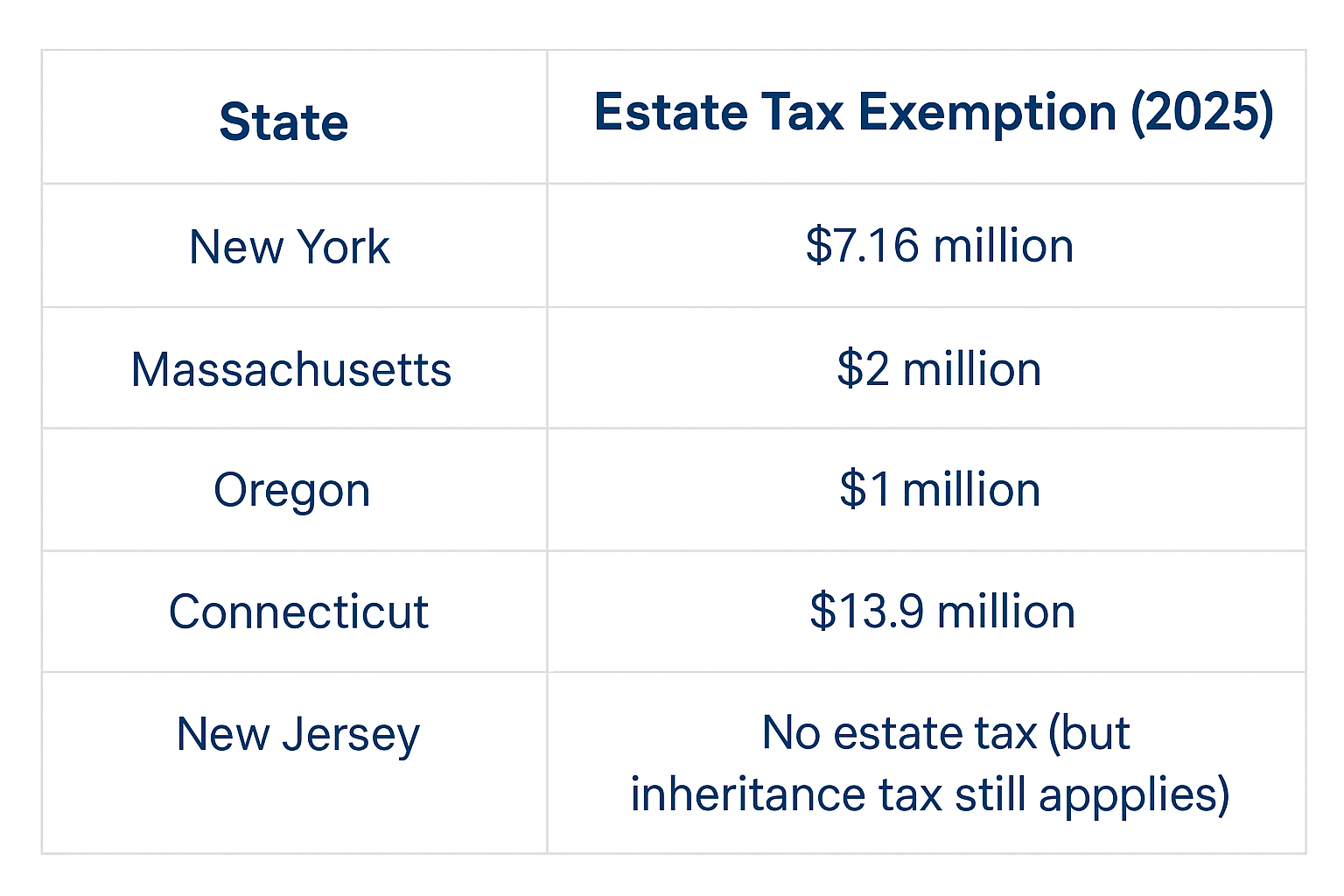
In states like Massachusetts and Oregon, even moderate estates can trigger a significant tax liability. Also, some states (like New York) have cliff provisions where exceeding the exemption by even a small amount can result in estate tax being applied to the entire estate—not just the portion over the threshold.
Bottom line: Even if you’re under the federal exemption, you may still face state-level estate taxes depending on where you live or own property.
What This Means for Your Estate Planning
The increase to a $15 million federal exemption doesn’t mean you should put your estate plan on the shelf. In fact, now may be the perfect time to refine and optimize your estate strategy.
Here’s what to consider:
1. Leverage Gifting Strategies While the Window Is Open
The $15 million exemption opens the door to making significant tax-free gifts. Techniques like spousal lifetime access trusts (SLATs), grantor retained annuity trusts (GRATs), and intentionally defective grantor trusts (IDGTs) may still be appropriate depending on your goals.
2. Don’t Overlook State-Level Planning
Work with your estate planning attorney to structure your estate to reduce or eliminate state estate tax exposure. This might include retitling assets, setting up trusts, or evaluating residency if you're near retirement.
3. Make Sure Your Documents Are Aligned
Many older estate plans were drafted with lower exemption amounts in mind. If your documents still refer to formulas like “credit shelter amount” or “maximum federal exemption,” you could unintentionally disinherit a spouse or fail to make full use of today’s exemption.
4. Portability Still Matters
Married couples should continue to file a federal estate tax return upon the death of the first spouse to elect portability and lock in both exemptions—especially now that we're talking about $30 million per couple.
The Takeaway
The Big Beautiful Tax Bill gives ultra-high-net-worth families a powerful estate tax planning opportunity. But for many, the state estate tax will continue to be a more pressing issue than the federal threshold.
Whether you’re just above the state threshold or pushing into eight-figure net worth territory, the key is proactive, coordinated planning. A well-structured estate plan not only protects wealth from unnecessary taxation but ensures that it’s distributed in alignment with your legacy goals.

About Michael……...
Hi, I’m Michael Ruger. I’m the managing partner of Greenbush Financial Group and the creator of the nationally recognized Money Smart Board blog . I created the blog because there are a lot of events in life that require important financial decisions. The goal is to help our readers avoid big financial missteps, discover financial solutions that they were not aware of, and to optimize their financial future.
Frequently Asked Questions (FAQs):
What is the new federal estate tax exemption under the Big Beautiful Tax Bill?
Beginning in 2026, the federal estate tax exemption increases to $15 million per person and $30 million for married couples who elect portability. These amounts will be indexed annually for inflation.
When does the new exemption take effect?
The higher exemption takes effect on January 1, 2026. Until then, the 2024–2025 inflation-adjusted exemption (approximately $13.6 million per person) remains in place.
Wasn’t the federal exemption supposed to decrease in 2026?
Yes. Under prior law, the exemption was scheduled to “sunset” at the end of 2025, reverting to roughly $6 million per person. The Big Beautiful Tax Bill not only prevented that reduction but raised the exemption further to $15 million.
What is the current federal estate tax rate?
Amounts exceeding the exemption are subject to a flat 40% federal estate tax.
Does this change eliminate state-level estate taxes?
No. Many states still impose their own estate or inheritance taxes with much lower exemption limits—often between $1 million and $5 million. States such as Massachusetts, Oregon, and New York have their own rules that can create substantial tax exposure even if you’re below the federal threshold.
How does portability work for married couples?
Portability allows a surviving spouse to use any unused portion of their deceased spouse’s exemption. To take advantage, the estate of the first spouse must file a federal estate tax return (Form 706), even if no federal estate tax is due.
Can I make gifts using the higher exemption before 2026?
The $15 million exemption doesn’t apply until 2026, but you can continue to make gifts under the current (2024–2025) exemption without penalty. If you plan to make large gifts, consider doing so before the law changes to preserve flexibility and confirm how the IRS applies the new thresholds.
How can I reduce or avoid state estate taxes?
Strategies may include establishing or updating trusts, retitling assets, changing residency to a state without estate tax, or leveraging lifetime gifting to reduce your taxable estate. Work with an estate planning attorney familiar with your state’s laws.
Do I need to update my estate planning documents?
Possibly. Older wills and trusts often reference outdated exemption formulas or definitions. Review your plan to ensure it reflects current law and your intentions, especially if it uses terms like “credit shelter trust” or “maximum exemption amount.”
Why is estate planning still important even with a $15 million exemption?
Beyond taxes, estate planning governs how your wealth transfers, protects beneficiaries, and ensures your legacy goals are met. It also addresses incapacity, guardianship, and charitable intentions—issues unaffected by the exemption increase.