
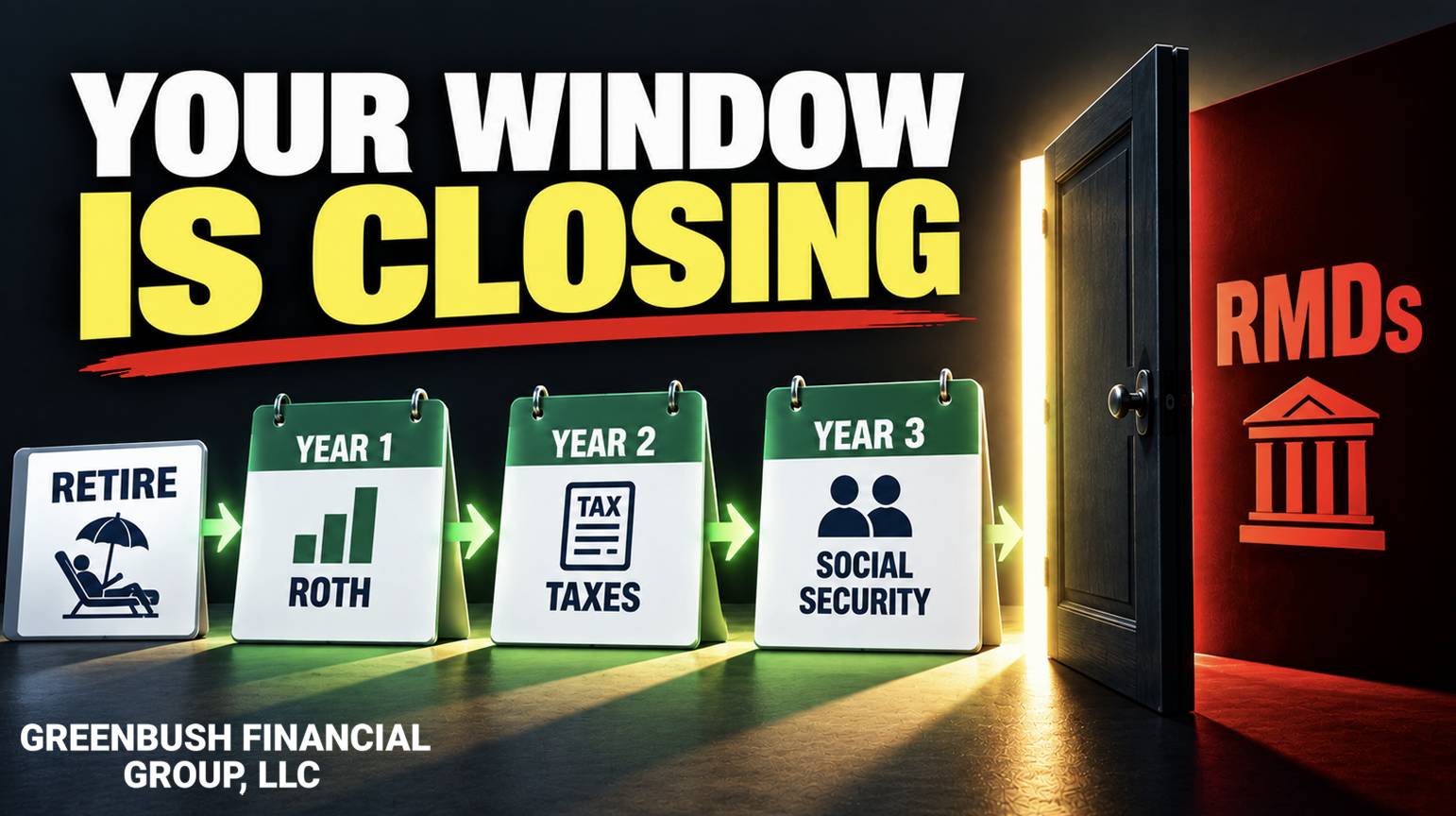
The First 3 Years of Retirement: 7 Financial Decisions That Matter More Than You Think
The first three years of retirement can create valuable planning opportunities. Learn how withdrawals, Roth conversions, Social Security, Medicare, RMDs, and investment decisions can work together to shape your long-term retirement plan.

The first three years of retirement can offer valuable planning opportunities, particularly when your paycheck has stopped but Social Security and required minimum distributions have not started. Decisions about withdrawals, Roth conversions, investments, and Medicare often affect one another. Greenbush Financial Group recommends looking at these early retirement decisions as one coordinated plan rather than a series of separate choices.
Why the First Three Years Matter
When your paycheck stops, you suddenly have to decide where your income will come from.
Should you spend cash? Sell investments? Take money from your IRA? Start Social Security?
These decisions are connected.
An extra $50,000 IRA withdrawal, for example, can increase taxable income, reduce your Roth-conversion opportunity, affect capital-gains taxes, potentially increase future Medicare premiums, and reduce future RMDs.
The first few years of retirement may also be some of your lowest-income tax years. If you do nothing, some of those opportunities can disappear.
Consider Mark and Susan.
They are both 64 and retiring with $1.8 million:
$1.2 million in traditional 401(k)s and IRAs
$200,000 in Roth IRAs
$300,000 in a brokerage account
$100,000 in cash
They expect to spend about $90,000 per year after tax and have not started Social Security.
Their situation illustrates seven decisions that can shape the next several decades.
1. Decide Where Your Retirement Paycheck Comes From
There is no universal rule that says you should spend taxable accounts first and Roth accounts last.
Instead, ask:
Which combination of accounts gives us the income we need without creating unnecessary taxes?
Mark and Susan might fund part of their first year's spending from cash, dividends, and their brokerage account rather than automatically taking $90,000 from an IRA.
That could keep their taxable income lower and leave room for another strategy, such as a Roth conversion.
Retirees should also consider directing dividends and interest to cash instead of automatically reinvesting them.
A reasonable cash reserve depends on the household, but maintaining roughly 12 to 24 months of expected portfolio withdrawals in cash and short-term investments can provide flexibility during a market decline.
Key Insight: Your withdrawal strategy should be based on taxes, markets, and future income, not simply which account has the easiest transfer button.
2. Take Advantage of the Retirement Tax Window
For many retirees, there is a gap between their final paycheck and the beginning of Social Security and RMDs.
That can create unusually low taxable-income years.
Mark and Susan have $1.2 million in tax-deferred retirement accounts. If they leave that money untouched, it could grow substantially before RMDs begin.
Instead, suppose they convert $75,000 per year to Roth for their first three years.
They move:
$225,000 from tax-deferred accounts into Roth accounts.
They pay tax today, but future growth on those dollars occurs inside the Roth, and those converted dollars no longer contribute to their future traditional IRA RMD balance.
If $225,000 subsequently grew at 5% for eight years, it would become roughly $330,000.
The goal is not to convert as much as possible. A conversion can affect tax brackets, capital-gains taxes, Medicare premiums, and other parts of the plan.
The better question is:
How much can we convert at a tax rate we are comfortable paying today compared with the tax rate we may face later?
3. Coordinate Social Security With IRA Withdrawals
Social Security should not be considered separately from investment withdrawals.
Suppose Mark is the higher earner and has a $3,200 monthly benefit at full retirement age. Delaying until age 70 could increase that benefit by approximately 24%, before future cost-of-living adjustments.
But delaying means Mark and Susan need to fund those years from somewhere else.
That can be useful.
They might spend taxable assets while completing Roth conversions before Social Security begins. Later, the larger Social Security benefit reduces the amount the portfolio needs to provide.
There is also a survivor consideration.
If Mark dies first, Susan generally does not continue receiving both Social Security benefits. The higher benefit can therefore become particularly important to the surviving spouse.
Key Insight: Delaying Social Security is not always best. Health, longevity, taxes, portfolio size, and survivor needs all matter.
4. Coordinate Roth Conversions, Capital Gains, and Medicare
This is where retirement tax planning becomes a balancing act.
Suppose Mark and Susan own an investment worth $60,000 with a $30,000 cost basis.
Selling it creates a $30,000 long-term capital gain.
During a low-income retirement year, some or potentially all of that gain could qualify for the 0% federal long-term capital-gains rate, depending on their other income.
That could allow them to diversify the portfolio while increasing the cost basis of their taxable investments.
But there is a catch.
If they complete a large Roth conversion first, that additional income can reduce the amount of capital gains eligible for the 0% rate.
Medicare creates another consideration.
Medicare generally uses income from two years earlier when determining IRMAA surcharges. A large Roth conversion or capital gain today could therefore increase Medicare premiums later.
That does not automatically make the transaction a bad idea.
Sometimes paying additional tax or Medicare premiums today creates greater long-term savings.
The important part is knowing the tradeoff before making the decision.
5. Prepare for RMDs Before You Have RMDs
One of the biggest retirement mistakes is waiting until RMDs begin to start planning for them.
Mark and Susan already have $1.2 million in tax-deferred accounts at age 64.
If those accounts continue growing, future RMDs could create more taxable income than they actually need.
Before RMDs begin, they have more control through:
Roth conversions
Strategic IRA withdrawals
Social Security timing
Charitable planning
This becomes even more important when one spouse dies.
The surviving spouse may eventually file as single while still owning much of the same IRA assets. That means narrower tax brackets and lower Medicare IRMAA thresholds.
A Roth conversion today should therefore sometimes be evaluated against the survivor's future tax rate, not just the couple's current rate.
6. Have a Plan for a Bad Market in Year One
Imagine stocks fall 25% six months after Mark and Susan retire.
Their expenses do not fall 25%.
Where does their income come from?
This is why retirement portfolios should be designed differently from portfolios that are still accumulating.
If Mark and Susan need $50,000 annually from their portfolio and maintain $75,000 to $100,000 in cash and short-term investments, they may have roughly 18 to 24 months of withdrawals available without relying heavily on stock sales.
During a major decline, income could come from:
Cash
Short-term bonds
Dividends and interest
Investments that held up better
The goal is to avoid being forced to sell stocks after a major decline simply because the monthly bills are due.
This is called sequence-of-returns risk. Poor returns early in retirement can be particularly damaging when withdrawals are occurring at the same time.
That does not mean retirees should abandon stocks. A retirement lasting 25 or 30 years still needs long-term growth.
The objective is to balance short-term spending needs with long-term growth.
7. Plan for the Expenses and Life Changes That Do Not Fit the Spreadsheet
Retirement rarely follows a perfectly predictable annual budget.
Suppose Mark and Susan decide to spend $100,000 remodeling their home.
Taking $100,000 from an IRA could create a much larger tax bill, reduce Roth-conversion capacity, affect capital-gains taxation, and potentially increase future Medicare premiums.
Paying cash, selling taxable investments, taking an IRA distribution, or financing the project can each produce a different result.
The same planning applies to an RV, new vehicle, vacation home, or other major purchase.
Retirement is also a natural time to review:
Beneficiaries
Wills and trusts
Powers of attorney
Account titling
Long-term-care funding
Emergency reserves
Charitable giving
Charitably inclined retirees may also benefit from donating appreciated securities, using donor-advised funds in certain situations, or eventually making qualified charitable distributions from IRAs after reaching the eligible age.
One practical question is especially useful for married retirees:
If one of us died tomorrow, could the other person manage everything?
The surviving spouse should know where accounts are held, how income is generated, where estate documents are located, and who to contact.
Option A vs. Option B: What Coordination Can Change
Consider Mark and Susan's first three years.
Option A: Autopilot
They withdraw whatever they need from their IRAs, claim Social Security relatively early, complete no Roth conversions, and wait until RMDs begin to worry about taxes.
Their plan may still work.
But several planning opportunities may disappear.
Option B: Coordinated Planning
Instead, they:
Fund some spending from cash and taxable investments
Convert approximately $225,000 to Roth over three years
Delay the higher earner's Social Security when appropriate
Realize selected capital gains during lower-income years
Monitor Medicare IRMAA
Maintain short-term reserves for market declines
They might actually pay more tax during their first three years.
That can be intentional.
They are potentially trading a higher tax bill today for smaller future RMDs, more Roth assets, a larger Social Security benefit, and greater flexibility for the surviving spouse.
That is the difference between minimizing taxes this year and managing taxes throughout retirement.
How Much Can You Safely Spend?
There is no single withdrawal percentage that answers this question.
Your sustainable spending depends on:
Portfolio size
Social Security and pensions
Taxes
Investment allocation
Inflation
Healthcare expenses
Longevity
Large future purchases
For Mark and Susan, the better question is not simply whether $90,000 is a safe percentage of $1.8 million.
It is:
How much does the portfolio need to provide before Social Security begins, and how much will it need to provide afterward?
Retirement income changes over time. Your spending plan should account for those changes.
The First Three Years: A Simple Checklist
Year One
Determine how much you can spend, establish where your retirement paycheck will come from, build cash reserves, review the portfolio, and calculate whether a Roth conversion makes sense.
Year Two
Recalculate taxes, Roth-conversion capacity, capital gains, Medicare exposure, and Social Security timing based on what actually happened during year one.
Year Three
Stress-test the plan for a major market decline, future RMDs, long-term-care costs, large purchases, and the death of either spouse.
What Opportunities Disappear If You Do Nothing?
This may be the most important question.
Doing nothing during the first few years of retirement may not create an immediate problem.
But you may lose:
Lower-income years for Roth conversions
Opportunities to realize gains at favorable tax rates
Additional Social Security growth
Opportunities to reduce future RMDs
Years of planning while both spouses can use joint tax brackets
The cost may not show up today.
It may appear 10 or 15 years later.
Final Thoughts
The first three years of retirement are about more than replacing your paycheck.
Withdrawals affect taxes. Taxes affect Roth conversions. Roth conversions can affect Medicare. Social Security affects future withdrawals. Today's IRA balance affects future RMDs. And all of those decisions can look very different after one spouse dies.
There is no universal withdrawal order or Roth-conversion strategy.
At Greenbush Financial Group, we believe the opportunity is in coordinating these decisions around the household's complete retirement plan.
The first few years of retirement give you something valuable: choices.
The goal is to use those choices before they begin disappearing.

Rob Mangold
About Rob……...
Hi, I’m Rob Mangold. I’m the Chief Operating Officer at Greenbush Financial Group and a contributor to the Money Smart Board blog. We created the blog to provide strategies that will help our readers personally, professionally, and financially. Our blog is meant to be a resource. If there are questions that you need answered, please feel free to join in on the discussion or contact me directly.
Frequently Asked Questions
-
Which account should I withdraw from first in retirement?There is no universal order. The best approach may combine cash, taxable investments, traditional retirement accounts, and Roth accounts based on taxes, spending needs, future RMDs, and Social Security.
-
Should I take Social Security or spend investments first?It depends on longevity, taxes, portfolio size, and survivor needs. Spending investments first can sometimes create additional Roth-conversion opportunities while allowing Social Security benefits to grow.
-
Should I convert my IRA to Roth before RMDs?A partial Roth conversion may make sense if your current tax rate is attractive compared with the rate you or a surviving spouse could face later.
-
How much should I convert to Roth?Consider tax brackets, capital gains, Medicare IRMAA, state taxes, and future RMDs. The appropriate amount should generally be recalculated each year.
-
What happens if the market crashes right after I retire?Cash and short-term investments can provide spending money without requiring immediate stock sales. This is one reason retirement portfolios should be structured around both withdrawals and long-term growth.
-
Why should I worry about RMDs years before they begin?The years before RMDs often provide the most flexibility to reduce future tax-deferred balances through Roth conversions and strategic withdrawals.
This article is for educational purposes and uses simplified hypothetical examples. Tax laws, Medicare rules, investment returns, and individual circumstances can change. The examples are not intended as individualized tax, investment, or legal advice.








How Can I Reduce Taxes in Retirement?
How can you reduce taxes in retirement? Explore strategies for managing retirement withdrawals, Roth conversions, Social Security taxes, RMDs, capital gains, charitable giving, and Medicare premiums to potentially reduce taxes over your lifetime.
By Michael Ruger, CFP®
Partner and Chief Investment Officer at Greenbush Financial Group
You would think tax planning gets easier after you retire. There is no longer a paycheck coming in every two weeks. You may no longer be contributing to a 401(k), receiving bonuses, or dealing with stock compensation. At first glance, your tax return might seem like it should become much simpler.
But from a financial planning perspective, retirement is often when tax strategy becomes more important. The reason is control.
While you are working, much of your income is determined for you. If your employer pays you a $150,000 salary, you generally have $150,000 of wages whether you want the taxable income or not. In retirement, you may have much more flexibility.
You might have traditional IRAs, 401(k)s, Roth IRAs, taxable brokerage accounts, Social Security, pensions, rental income, or even part-time self-employment income. Depending on your situation, you may be able to control how much taxable income you recognize and where your retirement cash flow comes from. That creates opportunities—but it also creates complexity.
Some of the retirement tax strategies we will cover include:
Creating a tax-efficient retirement withdrawal strategy
Using the 0% long-term capital-gains tax bracket
Managing taxes on Social Security benefits
Taking advantage of the enhanced $6,000 senior deduction
Reducing future required minimum distributions
Roth conversion planning
Using qualified charitable distributions
Managing self-employment income in retirement
Harvesting investment losses
Improving the tax efficiency of taxable investment accounts
Evaluating a change in state domicile
Managing Medicare IRMAA premiums
The objective isn't necessarily to pay the least amount of tax possible in any one year. The objective is to manage your taxes over your entire retirement.
Start With Your Retirement Withdrawal Strategy
One of the first places we look when trying to reduce taxes in retirement is the retiree's withdrawal strategy. Most retirees don't have all of their money in one type of account. You may have pre-tax retirement accounts such as traditional IRAs and 401(k)s. You may have after-tax assets in savings accounts and taxable brokerage accounts. You may also have Roth IRAs or Roth 401(k)s.
Each of these accounts is taxed differently. Traditional IRA and 401(k) distributions generally create ordinary taxable income when the money represents pre-tax contributions and earnings. A taxable brokerage account is generally taxed based on interest, dividends, and realized gains rather than the total amount of cash withdrawn. Qualified Roth distributions can potentially be received tax-free.
This gives retirees the ability to create a blended withdrawal strategy.
Don't Automatically Spend All of Your Brokerage Assets First
One of the most common mistakes we see is a retiree who decides to spend all of their cash and taxable brokerage assets before touching their traditional IRA. The reasoning seems logical.
“If I don't withdraw from my IRA, I don't have to pay taxes.”
For the first several years of retirement, that strategy may produce a very small tax bill. But it can create a much larger problem later. If you leave a large traditional IRA untouched, the account can continue growing. Eventually, required minimum distributions may force taxable money out of the account whether you need it or not.
Instead of having relatively modest taxable income throughout retirement, you may end up with very little taxable income during your 60s followed by substantial taxable income during your 70s and 80s. In some situations, it can make more sense to intentionally take traditional IRA distributions during lower-income years. You voluntarily pay some tax today to potentially avoid paying tax at higher marginal rates later.
Think About Lifetime Taxes, Not Just This Year's Taxes
Imagine two retirement strategies.
Under Strategy A, you pay $5,000 in federal income tax this year.
Under Strategy B, you pay $10,000.
Strategy A sounds better.
But what if Strategy A causes your traditional IRA to grow substantially larger and ultimately results in much higher RMDs? Perhaps you save $5,000 today but pay an additional $50,000 or $100,000 of taxes over the next 20 years.
That is why retirement tax planning requires projections.
The question shouldn't simply be:
“How can I reduce my taxes this year?”
It should be:
“How can I structure my income to potentially reduce my total tax liability throughout retirement?”
Take Advantage of the 0% Long-Term Capital-Gains Rate
For retirees with taxable brokerage accounts, one of the most valuable planning opportunities can be the 0% federal long-term capital-gains rate.
For tax year 2026, the top of the 0% long-term capital-gains bracket is $49,450 of taxable income for single filers and $98,900 for married couples filing jointly. The threshold is $66,200 for heads of household. The important phrase is taxable income.
These thresholds don't mean a married couple earning $98,000 can sell an unlimited amount of appreciated investments tax-free. Capital gains are layered on top of other taxable income.
An Example of the 0% Capital-Gains Rate
Assume a married retired couple owns an investment in Company ABC in their taxable brokerage account. The position is worth $100,000.
They originally invested $50,000, so they have a $50,000 unrealized long-term capital gain.
Now assume their other taxable income and deductions leave them with enough room that the entire $50,000 gain remains within the 0% long-term capital-gains bracket.
They may potentially be able to sell the investment and recognize that $50,000 gain while paying 0% federal long-term capital-gains tax on the gain. That can be an extremely valuable planning opportunity.
It could allow the couple to diversify a concentrated investment, raise cash for retirement expenses, or sell and reinvest in a different investment while effectively resetting the cost basis at a higher level. State income taxes can still apply.
The 0% Capital-Gains Bracket Is Not Unlimited
This is where people sometimes misunderstand the rule.
Suppose a married couple has $30,000 of taxable ordinary income and then realizes a $200,000 long-term capital gain.
They don't get the entire $200,000 gain at the 0% federal rate simply because their ordinary income began below $98,900. Instead, the income is stacked.
The ordinary taxable income uses the lower portion of the tax brackets first. Long-term capital gains then stack on top.
Using a simplified example, if $30,000 of taxable income has already occupied part of the 0% capital-gains range, approximately another $68,900 could potentially fit below the $98,900 threshold. Gains above that threshold would move into the applicable higher capital-gains rate, which for many taxpayers is 15%, with higher-income taxpayers potentially facing a 20% rate and possibly the 3.8% net investment income tax as well.
The exact calculation depends on the taxpayer's complete return. This is why we generally determine how much gain to realize before selling a large appreciated investment.
Can You Reduce Taxes on Social Security?
Social Security taxation is another important part of retirement tax planning. A common misconception is that Social Security is either completely tax-free or completely taxable.
Neither is necessarily true.
At the federal level, anywhere from none to as much as 85% of your Social Security benefits can be included in taxable income depending on your other income.
Notice what that does not mean. It does not mean the federal government imposes an 85% tax rate on Social Security. It means up to 85% of the benefit can become taxable income and is then taxed at your applicable income-tax rates.
How Social Security Taxation Is Calculated
The calculation generally begins with what is commonly called combined income or provisional income.
A simplified version includes:
Adjusted gross income before Social Security + tax-exempt interest + 50% of Social Security benefits.
That amount is then compared with certain thresholds.
For a single filer, the primary thresholds are:
$25,000 or less: Benefits generally aren't taxable.
$25,000 to $34,000: Up to 50% of benefits may be taxable.
More than $34,000: Up to 85% of benefits may be taxable.
For a married couple filing jointly, the primary thresholds are:
$32,000 or less: Benefits generally aren't taxable.
$32,000 to $44,000: Up to 50% of benefits may be taxable.
More than $44,000: Up to 85% of benefits may be taxable.
Special rules apply to married individuals filing separately, particularly when they lived with their spouse during the year.
These thresholds have remained relatively low, which means many retirees with pensions, IRA distributions, investment income, or other income sources can find themselves with a portion of Social Security subject to federal taxation.
Why One Extra Dollar of Income Can Have a Bigger Tax Impact Than Expected
Social Security taxation creates what is sometimes referred to as the Social Security tax torpedo.
Suppose you take an additional distribution from a traditional IRA. Not only can that IRA distribution itself be taxable, but the additional income may also cause a larger portion of your Social Security benefit to become taxable. In other words, $1 of additional IRA income can sometimes increase taxable income by more than $1.
This is why withdrawal strategy matters. Using qualified Roth distributions or carefully managing IRA withdrawals in certain years may help control combined income.
However, avoiding taxable income at all costs isn't necessarily the answer. If reducing today's Social Security taxation causes you to build a much larger traditional IRA and substantially larger RMDs later, you may simply be trading a smaller tax bill today for a larger one in the future. Again, lifetime tax planning matters.
The New $6,000 Enhanced Senior Deduction
Taxpayers age 65 and older may also qualify for a newer federal tax deduction.
For tax years 2025 through 2028, eligible taxpayers age 65 or older can claim an enhanced deduction of up to $6,000 per qualifying individual.
That means a married couple in which both spouses qualify could potentially receive a $12,000 deduction. Importantly, this deduction is in addition to the existing age-based additional standard deduction. It is also available to eligible taxpayers whether they use the standard deduction or itemize.
However, the enhanced senior deduction is income-limited.
For single taxpayers, the deduction begins phasing out when modified adjusted gross income exceeds $75,000 and is fully phased out above $175,000.
For married couples filing jointly, the phaseout begins above $150,000 of modified adjusted gross income and is fully phased out above $250,000.
The phaseout occurs at 6% of MAGI above the applicable threshold. This creates yet another income threshold retirees need to consider. A large IRA distribution, Roth conversion, capital gain, or other income event could reduce the senior deduction. As a result, a tax strategy that appears attractive when looking at the income-tax brackets alone may look different once the enhanced senior deduction is included.
Roth Conversions Can Help Reduce Future Retirement Taxes
Roth conversions can be another powerful retirement tax strategy. A Roth conversion involves moving money from a traditional IRA into a Roth IRA and recognizing the taxable conversion amount as income in the year of conversion.
Why voluntarily pay tax today?
Because retirement can create unusually low-income years.
Imagine you retire at age 62.
Your salary stops. Perhaps you decide to delay Social Security. Your required minimum distributions won't begin for years. That period could create an attractive Roth conversion window.
Instead of leaving lower tax brackets unused, you may choose to convert a portion of your traditional IRA each year. The goal is not simply to create a large Roth IRA. The goal is to determine whether paying tax on those dollars today at a particular marginal rate could be preferable to paying tax on them later.
Roth Conversions and Medicare Need to Be Coordinated
There is an important catch.
Roth conversions increase income. If you are on Medicare, a large Roth conversion could potentially increase your Medicare Part B and Part D premiums through IRMAA.
That doesn't necessarily mean you shouldn't process the conversion. Perhaps paying an additional Medicare premium for one year is worthwhile if the conversion substantially reduces future RMDs and future taxes.
But that Medicare cost needs to be included in the calculation. Tax planning and Medicare planning should not occur in separate silos.
RMD Planning Can Reduce Taxes Later in Retirement
Required minimum distributions are another major retirement tax consideration.
Under current federal rules, the applicable RMD age is generally 73 for individuals reaching the applicable age under the earlier SECURE 2.0 schedule, while individuals born in 1960 or later generally have an applicable RMD age of 75.
Once RMDs begin, the IRS requires minimum distributions from applicable pre-tax retirement accounts each year. Whether you need the money or not doesn't matter. This can create a problem for retirees with very large traditional IRA and 401(k) balances.
The $1 Million RMD Problem
Assume you are 65 and have $1 million in traditional retirement accounts.
You don't need the money, so you decide not to touch the account. Now assume hypothetically that by the time your RMDs begin, that $1 million has grown to $2 million. At age 75, the IRS Uniform Lifetime Table currently uses a life-expectancy factor of 24.6. A $2 million prior-year-end balance divided by 24.6 would produce an RMD of approximately $81,300.
That is more than $80,000 of potential ordinary taxable income before considering Social Security, pensions, investment income, or other sources. Compare that with someone who strategically reduced their pre-tax balance before RMDs began through IRA distributions and Roth conversions. If that person's applicable pre-tax balance entering the RMD calculation were only $1 million, an age-75 RMD using the same factor would be approximately $40,650.
The difference can materially affect both income taxes and Medicare premiums. The point isn't that everyone should empty their traditional IRA before RMDs. The point is that RMD planning should begin years before the first RMD is due.
Qualified Charitable Distributions Can Be Extremely Valuable
For retirees who regularly give money to charity, qualified charitable distributions—or QCDs—can be one of the most valuable retirement tax strategies.
You generally become eligible to make QCDs once you have reached age 70½.
A QCD involves directing money from an eligible IRA directly to a qualifying charitable organization. When all requirements are satisfied, the QCD is excluded from taxable income. This is different from taking an IRA distribution yourself, depositing the money in your checking account, and then writing a check to charity.
Why QCDs Can Be Better Than Writing a Check to Charity
Many retirees use the standard deduction.
If you give $10,000 to charity but don't have enough itemized deductions to exceed your standard deduction, that charitable gift may not create an additional federal itemized deduction.
A QCD can change the equation.
Suppose you normally donate $15,000 per year to charity. Instead of writing checks from your bank account, you direct $15,000 from your traditional IRA to eligible charities through properly executed QCDs. Assuming all QCD requirements are satisfied, that $15,000 can be excluded from taxable income. You don't also receive a charitable deduction for the same gift, but you have used pre-tax IRA dollars to accomplish a charitable goal without including the qualifying distribution in income.
QCDs Become Especially Powerful Once RMDs Begin
Now assume your annual RMD is $30,000 and you already plan to give $15,000 to charity.
You direct $15,000 from your IRA to qualifying charities as QCDs.
That $15,000 can count toward satisfying your RMD.
You then take the remaining $15,000 RMD for yourself.
Instead of recognizing $30,000 of taxable RMD income and potentially receiving little or no incremental tax benefit from a separate charitable contribution, you may only have $15,000 of that $30,000 included as taxable IRA income, assuming the QCD is otherwise fully excludable.
Reducing adjusted gross income can have benefits beyond the ordinary income-tax calculation because AGI can affect other parts of the tax return and Medicare premiums. For charitably inclined retirees, QCD planning should often be considered before simply taking an RMD and later writing a personal check to charity.
Self-Employment Income Can Create Planning Opportunities in Retirement
Retirement doesn't always mean you stop working completely. Many retirees consult, teach, freelance, serve on boards, or operate small businesses. That self-employment income is taxable, and applicable net earnings can also be subject to self-employment taxes.
However, legitimate self-employment can create planning opportunities as well.
Depending on the business and applicable rules, ordinary and necessary business expenses may be deductible. A retiree with qualifying self-employment income may also have opportunities to contribute to a retirement plan such as a SEP IRA, SIMPLE IRA, or individual 401(k), depending on the circumstances and plan requirements.
For example, someone who retires from a corporate career but continues consulting may have more tax-planning options than someone who simply receives the same amount as additional IRA distributions.
The important point is that a retirement side business should be treated like a real business. Income needs to be reported, deductions need to be legitimate, and retirement-plan contributions must follow applicable rules.
Use Tax-Loss Harvesting in Your Brokerage Account
For retirees with taxable brokerage accounts, investment losses can also be valuable from a tax-planning perspective. Suppose you sell one investment during the year and realize a $20,000 capital gain. At the same time, another investment in the portfolio has declined and is sitting at a $15,000 unrealized loss.
If selling that investment also makes sense from an investment perspective, realizing the loss could help offset capital gains. This strategy is generally referred to as tax-loss harvesting.
Pay Attention to the Investments You Hold in Taxable Accounts
Asset location can also influence taxes in retirement. Mutual funds held in taxable brokerage accounts can sometimes distribute capital gains to shareholders. Those distributions can create taxable income even if you personally didn't sell your mutual-fund shares. That can be frustrating for a retiree who is carefully managing taxable income.
ETFs can often be more tax-efficient because of the way many ETF structures handle portfolio transactions, although ETFs can still make taxable capital-gain distributions. Individual securities can provide even more control over when gains and losses are realized, although owning individual stocks introduces other considerations such as diversification and investment risk.
The objective shouldn't be to select investments based solely on taxes. But when two investment solutions are otherwise appropriate, their tax efficiency can be an important consideration in a taxable brokerage account.
Medicare IRMAA Is a Tax-Planning Issue Even Though It Isn't a Tax
When we're helping retirees manage taxes, we also pay close attention to Medicare premiums.
Higher-income Medicare beneficiaries can pay additional amounts for Medicare Part B and Part D through the Income-Related Monthly Adjustment Amount, or IRMAA.
For 2026, the standard Part B premium applies when modified adjusted gross income is $109,000 or less for an individual or $218,000 or less for a married couple filing jointly.
Above those levels, income-related premiums begin.
For 2026, the Part B premium ranges from the standard $202.90 per month to as much as $689.90 per month for beneficiaries in the highest IRMAA tier. Part D can also carry an additional income-related adjustment.
For a married couple in which both spouses are on Medicare, crossing an IRMAA threshold can have a meaningful impact on annual healthcare costs.
Medicare Uses a Two-Year Lookback
One of the more frustrating parts of IRMAA is the timing. Medicare generally uses tax-return information from two years earlier to determine current-year income-related premiums. That means an income decision you make today may not show up in your Medicare premium until two years later.
Suppose you process a very large Roth conversion, realize a large capital gain, or take an unusually large IRA distribution. The tax bill is obvious. What is less obvious is that the additional income could also increase Medicare premiums later. This doesn't mean you should never cross an IRMAA threshold. Sometimes realizing additional income is still the correct long-term financial decision. But IRMAA should be treated as another cost in the calculation.
The Enhanced Senior Deduction and IRMAA Create More Retirement Income Thresholds
This is why retirement tax planning has become increasingly complex.
You may be trying to stay within a particular federal income-tax bracket.
At the same time, you may be monitoring the 0% long-term capital-gains threshold.
You could be trying to preserve some or all of the enhanced senior deduction.
You may also be watching Social Security taxation and an IRMAA threshold.
These different rules do not necessarily use exactly the same income calculations.
As a result, simply saying, “Stay in the 12% bracket,” isn't enough to create a comprehensive retirement tax strategy. You have to look at the entire return and the financial consequences outside the return.
Could Changing Your State of Domicile Reduce Retirement Taxes?
For retirees who are already considering relocating, state taxes can become another major planning opportunity. Consider someone who owns a home in New York and another home in Florida.
If that person genuinely intends to make Florida their permanent home, changing domicile could potentially change the state taxation of certain retirement and investment income because Florida does not impose an individual state income tax. But changing domicile is not as simple as saying, “I spent six months in Florida.”
Domicile generally refers to the place you consider your permanent home and intend to return to.
For New York taxpayers in particular, the rules require careful attention.
New York states that a person's New York domicile does not change until they can demonstrate that they abandoned the New York domicile and established a new domicile elsewhere. New York looks at the broader facts and circumstances of the individual's life.
Things such as where you actually live, the location of important personal connections, and other evidence of where you have established your permanent home can matter. Registering to vote or changing your driver's license can support the facts, but no single action necessarily determines domicile by itself.
State-Tax Planning Can Be Particularly Important Before Large Transactions
Suppose you are planning to move from a higher-tax state to a state without an individual income tax. You also intend to process a $500,000 Roth conversion. Doing the conversion immediately before establishing the new domicile could produce a very different state-tax result than doing it afterward. The same could potentially apply to large IRA distributions or certain investment income.
However, state sourcing rules can be complex, and not every type of income automatically escapes taxation simply because someone changes residency. This is an area where advance planning with a qualified tax professional can be particularly important.
The Best Retirement Tax Strategy Changes From Year to Year
One of the most important concepts to understand is that your tax strategy at age 62 may be completely different from your tax strategy at age 75. At 62, you may have no salary, no Social Security, and no RMDs. That could be an attractive Roth conversion or capital-gain harvesting year.
At 65, Medicare enters the picture. Once Social Security begins, you need to consider how other income affects taxation of your benefits.
At age 70½, QCDs become available.
At age 73 or 75, depending on your applicable RMD age, required minimum distributions may become a significant part of your taxable income.
The retirement tax plan should change as you move through those stages.
So, How Can You Reduce Taxes in Retirement?
The first step is to stop looking at your tax return one year at a time.
Retirement creates an opportunity to coordinate your traditional retirement accounts, Roth accounts, brokerage assets, Social Security, charitable giving, investment gains and losses, Medicare premiums, and potentially even your state of residence.
Sometimes reducing taxes means realizing more taxable income today.
You might intentionally take an IRA distribution while you are in a low tax bracket.
You might process a Roth conversion before RMDs begin.
You might realize a long-term capital gain while it qualifies for the 0% federal rate.
You might use a QCD rather than writing a personal check to charity.
Or you may realize investment losses to offset gains elsewhere in your portfolio.
The lowest tax bill this year isn't necessarily the best tax strategy.
The goal is to manage your income so that you are taking advantage of lower tax rates and planning opportunities throughout retirement while avoiding unnecessary taxes, Medicare costs, and large taxable distributions later in life.
That is why tax planning can become more important—not less important—after the paycheck stops.

About Michael……...
Hi, I’m Michael Ruger. I’m the managing partner of Greenbush Financial Group and the creator of the nationally recognized Money Smart Board blog . I created the blog because there are a lot of events in life that require important financial decisions. The goal is to help our readers avoid big financial missteps, discover financial solutions that they were not aware of, and to optimize their financial future.
Frequently Asked Questions About Reducing Taxes in Retirement
-
How can I legally reduce my taxes in retirement?Retirees may be able to reduce taxes through coordinated withdrawals from traditional IRAs, Roth accounts, and taxable brokerage accounts; Roth conversions; 0% long-term capital-gain harvesting; qualified charitable distributions; tax-loss harvesting; and advance RMD planning. The best strategy depends on both your current tax situation and the income you expect later in retirement.
-
What is the most tax-efficient way to withdraw money in retirement?There is no universal withdrawal order. A tax-efficient retirement withdrawal strategy often combines distributions from taxable brokerage accounts with strategic withdrawals from traditional retirement accounts while preserving Roth assets when appropriate. The objective is generally to manage tax brackets over your lifetime rather than completely emptying one account before using another.
-
How can retirees pay 0% tax on long-term capital gains?For 2026, the 0% federal long-term capital-gains bracket extends to $49,450 of taxable income for single filers and $98,900 for married couples filing jointly. Ordinary taxable income generally occupies the lower portion of the income stack first, with long-term capital gains layered on top. Only the portion of qualifying gains that remains within the 0% range receives the 0% federal rate.
-
How much of my Social Security is taxable in retirement?Depending on your combined income, none, up to 50%, or up to 85% of Social Security benefits may be included in taxable income for federal purposes. For single filers, the primary combined-income thresholds are $25,000 and $34,000. For married couples filing jointly, they are $32,000 and $44,000. An 85% taxable portion does not mean Social Security is taxed at an 85% tax rate.
-
What is the $6,000 tax deduction for seniors age 65 and older?For tax years 2025 through 2028, qualifying individuals age 65 and older may receive an enhanced federal deduction of up to $6,000 per person, or $12,000 for a married couple if both spouses qualify. The deduction begins phasing out when MAGI exceeds $75,000 for single filers or $150,000 for married couples filing jointly and is fully phased out above $175,000 and $250,000, respectively.
-
Can Roth conversions reduce taxes in retirement?Roth conversions can potentially reduce lifetime taxes when pre-tax retirement assets are converted during years when the taxpayer is in a relatively favorable tax bracket. Conversions can also reduce future pre-tax balances and RMDs. However, conversions create taxable income in the year they occur and can affect Social Security taxation, the enhanced senior deduction, Medicare IRMAA, and state income taxes.
-
How can I reduce taxes on required minimum distributions?Planning before RMDs begin can be important. Strategies may include taking intentional traditional IRA distributions during lower-income years, completing partial Roth conversions, and using qualified charitable distributions once eligible. Reducing the pre-tax account balance before RMD age can potentially reduce future required distributions, although the tax cost of implementing those strategies needs to be considered.
-
Do qualified charitable distributions reduce taxable income?A properly executed QCD allows an eligible IRA owner age 70 1/2 or older to send qualifying IRA assets directly to an eligible charitable organization. The qualifying distribution can generally be excluded from taxable income and can count toward an RMD once RMDs apply. A taxpayer cannot also claim a charitable deduction for the same QCD.
-
How can I avoid higher Medicare premiums in retirement?Medicare IRMAA is based on modified adjusted gross income and generally uses tax information from two years earlier. Managing the timing of Roth conversions, IRA distributions, capital gains, and other income may help retirees manage exposure to higher Part B and Part D premiums. However, avoiding IRMAA should not necessarily take priority over a tax strategy that produces greater long-term savings.
-
Should I move to a state with no income tax when I retire?State income taxes can be one factor when deciding where to live in retirement, particularly for retirees expecting substantial IRA distributions, Roth conversions, or investment income. However, taxes should be considered alongside housing costs, healthcare, family, lifestyle, and other financial factors. If changing domicile from a state such as New York, make sure the change is legitimate under the applicable residency and domicile rules before relying on the expected state-tax savings.




















Should You Process Roth Conversions Before You Retire?
Should you process Roth conversions before you retire, or wait until retirement? Learn how tax brackets, income, Medicare premiums, state taxes, RMDs, and timing can determine when a Roth conversion may make the most sense.
By Michael Ruger, CFP®
Partner and Chief Investment Officer at Greenbush Financial Group
As you approach retirement, one of the biggest tax-planning questions you may encounter is whether you should begin converting some of your pre-tax retirement accounts to a Roth IRA.
Roth conversions can be a powerful retirement tax strategy when used correctly. They can allow you to take advantage of temporarily lower tax brackets, reduce the amount of money accumulating in pre-tax retirement accounts, potentially reduce future required minimum distributions, and create a larger pool of tax-free assets for later in retirement.
But a Roth conversion isn't automatically a good strategy simply because you are approaching retirement. In fact, processing a large Roth conversion during the wrong year can result in paying substantially more in taxes than necessary.
When we evaluate Roth conversions as part of a financial plan, some of the most important considerations include:
Your current federal and state income tax brackets
Your expected tax brackets after retirement
Whether you are experiencing an unusually low-income year
The amount you have accumulated in pre-tax retirement accounts
Your expected future required minimum distributions
Where you live now and where you plan to live in retirement
Potential future inheritances
Medicare premiums once you reach Medicare age
How you plan to pay the taxes generated by the conversion
The real question isn't simply, “Should I do a Roth conversion?” A better question is, “At what tax rate does it make sense for me to convert pre-tax retirement assets to Roth assets?”
What Is a Roth Conversion?
A Roth conversion involves moving money from a pre-tax retirement account, such as a traditional IRA, into a Roth IRA. Some 401K plan even allow “in plan Roth conversions” from pre-tax to a Roth source within the plan.
The important part is what happens for tax purposes.
Generally, the taxable portion of the amount converted from a traditional IRA to a Roth IRA is included in your taxable income for that year. You are essentially choosing to pay the income tax today in exchange for moving those assets into the Roth environment.
Why would you voluntarily accelerate a tax bill? Because qualified Roth IRA distributions can eventually be tax-free, and Roth IRAs are not subject to lifetime required minimum distributions for the original owner. By paying tax today, you may be able to create greater tax flexibility later in retirement. The strategy can be particularly attractive if you can pay tax on the conversion at the same or lower tax rate today, compared to the one you would pay in the future during the retirement years.
Be Careful With Roth Conversions During Your Peak Earning Years
One of the biggest mistakes we see in Roth conversion planning is focusing only on the benefits of the Roth IRA without considering the tax cost of getting the money there. Imagine that you are 60 years old, still working, and earning one of the highest salaries of your career. You decide to convert $200,000 from your traditional IRA into a Roth IRA.
That $200,000 doesn't replace your salary for tax purposes. Generally, the taxable conversion amount is added on top of your other taxable income. If you are already in a high federal income tax bracket—and potentially paying state income tax as well—the conversion could result in a very large tax bill. This is why Roth conversions immediately before retirement aren't always advantageous.
If you're going to retire in two years and your taxable income is expected to fall dramatically, why voluntarily recognize a large amount of additional income while you are still in one of your highest tax brackets? In some situations, waiting until retirement may provide a much better opportunity.
The Ideal Roth Conversion Opportunity: An Abnormally Low-Income Year
Some of the best Roth conversion opportunities occur when someone's income temporarily drops. This can happen before or after retirement. Consider a self-employed consultant who normally generates approximately $700,000 of annual income. For whatever reason, the business has a difficult year and the consultant only generates $100,000. If the consultant expects income to return to $700,000 the following year, that temporary decline may create an opportunity.
Instead of allowing lower tax brackets to go unused, the business owner could evaluate converting some traditional IRA assets to a Roth IRA and intentionally recognizing additional taxable income during the lower-income year.
The key word here is intentionally.
Rather than picking an arbitrary conversion amount, the taxpayer and their advisors can estimate taxable income for the year and determine how much could potentially be converted at acceptable marginal tax rates. This concept is often referred to as filling up the tax brackets.
Roth Conversions When One Spouse Retires Before the Other
Another common opportunity occurs when spouses retire at different times. Suppose both spouses have historically earned $150,000 per year. Their combined employment income is approximately $300,000.
Now assume one spouse retires at age 60 while the other continues working.
Their employment income suddenly falls from $300,000 to approximately $150,000.
Depending on their deductions and other income, this reduction could create room in lower tax brackets that wasn't available while both spouses were working. Instead of waiting until both spouses are retired, the couple could evaluate whether the period between the first and second retirement provides an attractive Roth conversion window. This is why Roth conversion planning often works best when it is mapped out over multiple years, rather than making the decision one year at a time.
What If Your Retirement Tax Rate Won't Be Lower?
A common assumption is that everyone moves into a lower tax bracket after retirement. That isn't always true. Some retirees accumulate very large balances in traditional IRAs, 401(k)s, 403(b)s, and other pre-tax retirement accounts. Eventually, distributions from those accounts can create substantial taxable income.
Required minimum distributions can also force money out of certain retirement accounts later in life, whether you need the income or not. Under current federal rules, traditional IRA owners generally begin RMDs at age 73, although applicable starting ages depend on birth year under current law.
For someone with significant pre-tax retirement assets, future taxable income may not decline nearly as much as expected. That can strengthen the case for evaluating Roth conversions earlier.
The $1 Million Traditional IRA Example
Assume you have $1 million in a traditional IRA.
You don't expect to need most of that money during the next decade. Over time, assume hypothetically that the account grows from $1 million to $2 million.
If the money remains in the traditional IRA, you have another $1 million of investment growth inside an account whose future taxable distributions will generally be subject to ordinary income tax. Now consider converting some of the traditional IRA to a Roth IRA today. You pay tax on the taxable conversion amount now, but future growth on the converted assets occurs inside the Roth IRA. If the applicable requirements are satisfied, qualified Roth distributions can eventually be received tax-free.
This can make Roth conversions particularly attractive when you expect your future marginal tax rate to be similar to or higher than your current rate. But there is an important caveat.
Don't Ignore the Tax Dollars You Give Up Today
It is easy to compare $1 million in a traditional IRA with $1 million in a Roth IRA and conclude that the Roth is obviously better. But those aren't economically equivalent balances. The traditional IRA contains money on which taxes generally haven't been paid yet. Converting it to Roth requires paying that tax.
Suppose a conversion would result in a combined federal and state marginal tax cost of 40%. That is a substantial upfront tax expense. If you pay the conversion tax from other assets, those dollars are no longer available to remain invested elsewhere. If you pay the tax from the IRA itself, less money makes it into the Roth account. That tax cost has to be included in the analysis.
In some situations, particularly when the current marginal tax rate is very high and the expected future tax rate is lower, not converting can produce a better financial result. This is why Roth conversion planning should involve an actual tax analysis rather than simply assuming that Roth accounts are always better than traditional retirement accounts.
New York Residents Have an Additional Roth Conversion Consideration
State income taxes can have a significant impact on Roth conversion decisions. New York provides a useful example.
Under current New York rules, taxpayers who meet the age requirements may exclude up to $20,000 of qualifying pension and annuity income from New York adjusted gross income. Married taxpayers who both have qualifying income can each potentially qualify for their own exclusion. New York's published guidance also recognizes qualifying IRA distributions, and state guidance specifically addresses Roth conversion income within the pension and annuity exclusion rules.
For a married couple in which both spouses qualify, this can potentially create an opportunity to convert qualifying amounts from traditional IRAs while reducing or eliminating New York income tax on a portion of the conversion.
Consider a hypothetical married couple who are both over age 59½ and each has a traditional IRA. If each spouse qualifies to use the full $20,000 exclusion against conversion income, they could potentially convert a combined $40,000 per year while excluding that qualifying amount for New York income-tax purposes.
If they did that for five years, they could potentially move $200,000 from traditional IRAs to Roth IRAs while using the available New York exclusions each year, assuming they continue to meet all applicable requirements. Federal income tax can still apply to those conversions.
Also, the $20,000 New York exclusion is not an additional $20,000 exclusively reserved for Roth conversions. Other qualifying pension or annuity income can use some or all of the same annual exclusion. This is why the taxpayer's entire income picture needs to be reviewed each year.
Your Future State of Residence Can Completely Change the Analysis
Now let's look at the state-tax question from the opposite direction. Assume you currently live and work in a state that imposes an income tax. However, you know that immediately after retirement you plan to establish residency in a state with no individual state income tax. Processing a large Roth conversion immediately before moving could potentially mean voluntarily paying state income tax that might have been avoided by waiting.
For example, imagine converting $500,000 while still domiciled in a state that taxes the conversion. If you instead retire, legitimately establish residency in a state without an individual income tax, and then process the conversion, the state-tax result could be materially different. Of course, residency and domicile involve specific rules, and moving to another state should not be treated as simply changing your mailing address.
But the larger planning point is important:
Where you live when the Roth conversion occurs can matter.
When someone is already planning a move in retirement, we want to coordinate the timing of Roth conversions with that move rather than viewing those decisions separately.
A Future Inheritance Can Affect Today's Roth Conversion Strategy
Potential inheritances can also influence Roth conversion planning. Suppose you are 60 years old and your parents are in their mid-80s. Your parents have accumulated substantial balances in traditional retirement accounts, and based on their current financial position, you expect that you may eventually inherit some of those assets.
Under current federal rules, many non-spouse designated beneficiaries who are not eligible designated beneficiaries generally must empty an inherited retirement account by the end of the tenth year following the original owner's death. Depending on when the owner died relative to their required beginning date and the beneficiary's status, annual distribution requirements can also apply during that period.
Taxable distributions from an inherited traditional IRA generally become income to the beneficiary. Now imagine inheriting a $1 million or $2 million traditional IRA while you already have significant pre-tax retirement assets of your own. That inheritance could materially increase taxable income during your retirement years.
In that situation, the assumption that “I'll be in a lower tax bracket after I retire” may turn out to be incorrect. If a significant inheritance is reasonably anticipated, it may be worth modeling whether converting some of your own traditional IRA assets earlier could reduce future tax concentration.
However, inheritances are inherently uncertain. Timing, asset values, healthcare expenses, estate-plan changes, and other circumstances can all change. For that reason, we generally would not want an entire Roth conversion strategy to depend on receiving a particular inheritance at a particular time.
Roth Conversions Can Affect Medicare Premiums
Medicare adds another important consideration.
Higher income can result in income-related monthly adjustment amounts, commonly called IRMAA, being added to Medicare Part B and Part D premiums. Roth conversions increase taxable income in the year of conversion and can therefore potentially result in higher Medicare premiums later, because Medicare generally uses income information from two years earlier when determining IRMAA.
This is particularly important for someone processing large Roth conversions at or after Medicare age.
However, there can also be a longer-term planning benefit. Reducing traditional IRA balances through Roth conversions may reduce future required minimum distributions. Lower future taxable income could potentially help reduce exposure to higher Medicare premiums in later years. In other words, Roth conversions don't automatically lower Medicare premiums.
A conversion could increase Medicare premiums in the short term while potentially helping control taxable income and Medicare costs later. That tradeoff needs to be included in the analysis.
Be Careful With Tax Withholding on Roth Conversions
Another important consideration is how you pay the tax generated by a Roth conversion. Suppose a 53-year-old wants to convert $100,000 from a traditional IRA to a Roth IRA. Assume the conversion creates an estimated $30,000 federal and state tax liability. Ideally, if appropriate and sufficient funds are available, the individual may consider paying that tax from cash or another non-retirement source so the entire $100,000 can reach the Roth IRA.
Why?
If $30,000 is withheld from the traditional IRA and only $70,000 actually reaches the Roth IRA, the withheld $30,000 is not part of the conversion. For someone under age 59½, amounts distributed and not rolled over may also be subject to the 10% additional tax on early distributions unless an exception applies. The IRS specifically illustrates this principle for rollover withholding.
That can make using retirement assets to pay conversion taxes particularly costly for someone younger than 59½. Once someone is over age 59½, the 10% early-distribution tax generally no longer applies based solely on age. However, withholding taxes from the retirement account still means fewer dollars ultimately reach the Roth IRA. For that reason, even after age 59½, paying the conversion tax from outside assets may be preferable when the overall financial plan supports it.
Why We Often Wait Until Later in the Year to Process Roth Conversions
Timing during the calendar year is another important part of Roth conversion planning. When possible, we often prefer to make final Roth conversion decisions later in the year.
Why?
Because income has a way of surprising people. This is especially true for business owners, executives, sales professionals, and anyone whose compensation includes bonuses, commissions, stock compensation, or other variable income. Consider an employee earning a $200,000 base salary who plans to process a $50,000 Roth conversion.
In March, everything looks straightforward.
The employee processes the $50,000 conversion.
Then the company has an exceptional year and, in November, the employee receives an unexpected $100,000 bonus.
That bonus may push some or all of the Roth conversion income into a higher marginal tax bracket than originally anticipated. Had the employee known about the bonus before converting, they might have reduced the conversion or skipped it entirely for that year.
November and Early December Can Be Good Planning Windows
By November or early December, you may have a much clearer picture of your annual income.
W-2 employees generally have a good idea of their salary, bonuses, and other compensation. Business owners have most of the year's financial results available. Investment income, capital gains, pension payments, and other income sources are also easier to estimate. At that point, you and your tax and financial professionals can prepare an income projection and determine how much Roth conversion room may be available within your desired tax brackets.
However, there is another side to this strategy:
Don't wait until December 31.
Financial institutions can have year-end processing deadlines, and conversion requests may require time to complete. Waiting until the final days of December creates the risk that the transaction will not be completed during the intended tax year. If you are considering a year-end Roth conversion, contact your custodian well in advance and determine its processing deadlines.
Roth Conversion Planning Should Be a Multi-Year Strategy
Perhaps the biggest mistake is viewing a Roth conversion as a one-time, all-or-nothing decision. Imagine that you have $800,000 in a traditional IRA.
The question isn't necessarily:
“Should I convert the entire $800,000?”
Doing so in one year could create an enormous tax bill and push a significant amount of the conversion into higher tax brackets. Instead, perhaps the better strategy is converting $50,000 this year, $80,000 next year, $100,000 during the first year of retirement, and additional amounts during subsequent lower-income years. The appropriate numbers will be different for everyone.
This approach allows you to potentially fill lower tax brackets over multiple years rather than creating one enormous taxable event.
The years immediately following retirement can sometimes provide an especially valuable Roth conversion window. Employment income may have stopped, Social Security may not have started, and required minimum distributions may still be years away.
That gap can provide opportunities to recognize income intentionally at tax rates you find acceptable.
So, Should You Process Roth Conversions Before Retiring?
Sometimes.
Roth conversions before retirement can make a lot of sense when you encounter an unusually low-income year, when one spouse retires before the other, when current and expected future tax rates are similar, when you have substantial pre-tax retirement balances, or when future income—including potential inherited retirement assets—could push you into higher tax brackets.
They can also make sense when state-specific tax provisions create an opportunity. But there are equally valid reasons to wait. If you are currently in your peak earning years and expect your income to fall substantially after retirement, converting today could mean voluntarily paying tax at a much higher rate.
If you plan to move from a state with an income tax to a state without one, waiting could potentially produce state-tax savings. And if you are approaching Medicare or already enrolled, the impact of conversion income on IRMAA should also be considered.
The goal isn't simply to get as much money into a Roth IRA as possible.
The goal is to determine when and how much to convert so that you can potentially reduce the amount of tax you pay over your lifetime while maintaining flexibility throughout retirement.
That requires looking beyond this year's tax return. A good Roth conversion analysis considers your current tax brackets, projected retirement income, Social Security, pensions, required minimum distributions, Medicare premiums, state taxes, investment growth, estate planning, and potentially even inherited retirement assets. When all of those variables are considered together, Roth conversions can become a powerful component of a comprehensive retirement tax strategy.
About Michael……...
Hi, I’m Michael Ruger. I’m the managing partner of Greenbush Financial Group and the creator of the nationally recognized Money Smart Board blog . I created the blog because there are a lot of events in life that require important financial decisions. The goal is to help our readers avoid big financial missteps, discover financial solutions that they were not aware of, and to optimize their financial future.
Frequently Asked Questions About Roth Conversions Before Retirement
-
Should I do a Roth conversion before I retire?A Roth conversion before retirement may make sense if your current marginal tax rate is lower than or similar to the rate you expect to pay later. It can be particularly attractive during an unusually low-income year or when one spouse retires before the other. However, individuals in their peak earning years may benefit from waiting until retirement if their taxable income is expected to decline substantially.
-
What is the best age to do a Roth conversion?There is no single best age for a Roth conversion. The best opportunities are often determined by your tax bracket rather than your age. Low-income years between retirement and the beginning of Social Security or required minimum distributions can be particularly valuable conversion windows. Your state taxes and Medicare situation should also be considered.
-
How much should I convert from my traditional IRA to a Roth IRA?The appropriate Roth conversion amount depends on your taxable income, deductions, federal and state tax brackets, Medicare considerations, and expected future income. Rather than choosing an arbitrary amount, many taxpayers evaluate how much they can convert while remaining within a targeted marginal tax bracket. A multi-year conversion strategy can sometimes be more tax-efficient than converting a large balance all at once.
-
Do I pay taxes when I convert a traditional IRA to a Roth IRA?Generally, yes. The taxable portion of a traditional IRA converted to a Roth IRA is included in income for the year of conversion. If the traditional IRA contains nondeductible contributions, the tax calculation can be more complicated. The conversion itself should therefore be coordinated with your overall tax situation.
-
Should I do Roth conversions before or after retirement?It depends primarily on your tax rates during each period. If you are in a high tax bracket while working and expect a substantially lower bracket immediately after retirement, waiting may be advantageous. If your income temporarily falls before retirement or future retirement income is expected to keep you in the same or a higher bracket, converting before retirement may deserve consideration.
-
Can a Roth conversion increase my Medicare premiums?Yes. A Roth conversion can increase modified adjusted gross income and may cause higher Medicare Part B and Part D premiums through IRMAA. Medicare generally uses tax-return information from two years earlier when determining these income-related adjustments. However, reducing pre-tax retirement balances through conversions could potentially reduce future required minimum distributions and taxable income, so both the short- and long-term Medicare effects should be considered.
-
Are Roth conversions taxable in New York State?Roth conversion income can be subject to New York income tax, but qualifying taxpayers age 59 1/2 or older may be eligible for New York's pension and annuity income exclusion of up to $20,000 per taxpayer. Married taxpayers can potentially each qualify for their own exclusion if each has qualifying income. Other pension income can also use the exclusion, so the full $20,000 may not always be available for a Roth conversion.
-
Should I pay Roth conversion taxes from my IRA or from cash?When possible and appropriate, paying the conversion tax from cash or other non-retirement assets can allow more of the retirement money to reach the Roth IRA. This can be especially important before age 59 1/2 because money distributed from an IRA for taxes rather than converted may be subject to the additional 10% early-distribution tax unless an exception applies. Even after age 59 1/2, withholding from the IRA reduces the amount transferred to the Roth.
-
Can an expected inheritance affect whether I should do Roth conversions?Yes. If you reasonably expect to inherit substantial traditional retirement accounts, future taxable distributions from those inherited accounts could increase your retirement income and potentially your marginal tax rate. Many non-spouse beneficiaries are subject to a 10-year distribution period under current federal rules. However, because the timing and amount of an inheritance are uncertain, it generally makes sense to model multiple scenarios rather than basing your entire Roth conversion strategy on an expected inheritance.
-
What time of year is best for a Roth conversion?Later in the year can be useful because you generally have a clearer picture of your salary, bonuses, business income, capital gains, and other taxable income. November or early December may provide enough information to estimate an appropriate conversion amount while still allowing time for the financial institution to process the transaction. Avoid waiting until the final days of December because custodians may have earlier year-end processing deadlines.
The Widow's Tax Penalty: Why Taxes Often Increase After a Spouse Dies
Many surviving spouses are surprised to learn that taxes can increase after a spouse dies, even when household income declines. Learn why the widow's tax penalty occurs and the strategies that may help reduce its impact.
When one spouse passes away, most families are focused on grieving, supporting loved ones, and adjusting to a new normal. Taxes are rarely at the top of the priority list.
Unfortunately, the tax code doesn't pause during this difficult time.
Many surviving spouses are surprised to learn that although household income often declines after a spouse dies, their tax rate can actually increase. Financial planners often refer to this as the widow's tax penalty.
The reason is simple. Many tax rules are designed around married couples. Once a surviving spouse begins filing as a single taxpayer, those favorable rules largely disappear while much of the household income remains.
Understanding how these changes work before they're needed can help couples make more informed decisions about Roth conversions, retirement withdrawals, Medicare planning, and estate strategies.
What Is the Widow's Tax Penalty?
The widow's tax penalty isn't a separate tax imposed by the IRS.
Instead, it's the combined effect of several tax rules that become less favorable after the death of a spouse.
These changes often occur simultaneously:
Filing status changes from Married Filing Jointly to Single.
Tax brackets become much narrower.
Medicare IRMAA thresholds are cut roughly in half.
Required Minimum Distributions (RMDs) may continue on large retirement accounts.
Investment income may remain largely unchanged.
Social Security benefits may not decrease proportionally.
The result is that many surviving spouses pay a higher percentage of their income in taxes than they did while both spouses were living.
How Filing Status Changes After a Spouse Dies
One of the biggest changes involves tax filing status.
Generally:
In the year a spouse dies, the surviving spouse can usually still file a joint tax return.
Beginning the following year, most surviving spouses file as Single, unless they qualify for another filing status such as Qualifying Surviving Spouse for a limited period when dependent children are involved.
This seemingly simple change has significant tax consequences.
Why Single Filers Reach Higher Tax Brackets Faster
The federal tax brackets for single filers are much smaller than those for married couples filing jointly.
That means the same amount of taxable income may be taxed at higher marginal rates simply because the filing status changed.
Example
John and Susan report $220,000 of taxable income while filing jointly.
After John passes away:
Susan's income falls to $185,000.
Although her income decreased by $35,000, she's now filing as a single taxpayer.
More of her income falls into higher tax brackets.
Her total tax bill may increase even though she has less income to spend.
Key Insight
Many people assume taxes automatically decrease after losing a spouse because household income is lower. In reality, the opposite is often true.
Medicare IRMAA Can Increase Even Faster
One of the least understood parts of the widow's tax penalty involves Medicare.
Higher-income retirees pay Income-Related Monthly Adjustment Amount (IRMAA) surcharges on:
Medicare Part B
Medicare Part D
While married couples benefit from higher income thresholds, surviving spouses quickly move into the much lower single thresholds.
This means someone whose Medicare premiums were previously unaffected may suddenly begin paying hundreds or even thousands of dollars more each year.
Example
A married couple with modified adjusted gross income just below an IRMAA threshold pays standard Medicare premiums.
After one spouse dies:
Income declines modestly.
Filing status changes to single.
The surviving spouse exceeds the single IRMAA threshold.
Despite earning less, Medicare premiums increase substantially.
Important Note
IRMAA is based on income from two years earlier. This delay can make premium increases feel unexpected if no planning has taken place.
Required Minimum Distributions May Stay Surprisingly High
Many retirees accumulate substantial balances in traditional IRAs and 401(k)s.
When one spouse dies:
Those retirement accounts often transfer to the surviving spouse.
The surviving spouse eventually takes RMDs based on the combined account value.
Filing status has changed to single.
As a result, the surviving spouse may have:
Large taxable RMDs
Higher tax brackets
Higher Medicare premiums
Increased taxation of investment income
This combination can significantly reduce after-tax retirement income.
Social Security Doesn't Always Offset the Tax Increase
After a spouse dies, one Social Security benefit typically stops while the survivor generally receives the larger of the two benefits.
Although total Social Security income often decreases, the reduction usually isn't enough to offset:
Higher tax rates
Larger RMDs
Higher Medicare premiums
Many surviving spouses discover that they have less income but a larger percentage going toward taxes.
Why Roth Conversions Matter Before Widowhood
One of the most valuable planning opportunities often occurs while both spouses are still alive.
During years when couples file jointly, they may have access to:
Lower effective tax rates
Wider tax brackets
Higher IRMAA thresholds
These factors can make Roth conversions significantly more attractive before the surviving spouse is forced into the single tax brackets.
Example
David and Karen retire at age 64.
Between retirement and age 73, they convert portions of their traditional IRA to a Roth IRA while filing jointly.
Several years later, David passes away.
Because much of their retirement savings has already been moved into Roth accounts:
Karen's future RMDs are smaller.
Taxable income is lower.
Medicare premiums may be lower.
She has greater flexibility when withdrawing retirement income.
The Roth conversions did not eliminate taxes. Instead, they shifted taxation into years when the couple enjoyed more favorable tax rules.
Key Insight
Many Roth conversion strategies are less about today's taxes and more about protecting the surviving spouse's future tax situation.
Other Tax Issues Surviving Spouses May Face
The widow's tax penalty extends beyond ordinary income taxes.
Additional planning issues may include:
Capital Gains
Selling appreciated investments can trigger larger taxable gains if income already places the surviving spouse in higher brackets.
Net Investment Income Tax
Higher taxable income may expose more investment earnings to additional federal taxes.
Charitable Giving
Without careful planning, charitable deductions may become less effective depending on income levels and deduction strategies.
Estate Planning
Inherited retirement accounts may eventually pass to children, who often must withdraw inherited IRA balances within ten years under current law. Large traditional IRA balances can create significant tax burdens for heirs during their highest earning years.
Common Mistakes Couples Make
Many couples unintentionally increase the future widow's tax penalty by making decisions that seem reasonable today.
Some of the most common mistakes include:
Assuming taxes will always be lower after one spouse dies.
Delaying Roth conversions because they focus only on today's tax bill.
Waiting until RMDs begin before considering tax planning.
Ignoring future Medicare premium increases.
Keeping nearly all retirement assets in pre-tax accounts.
Failing to coordinate investment, tax, and estate planning.
Planning Strategies to Consider
Every family's situation is different, but several strategies may help reduce future tax challenges.
These may include:
Evaluating Roth conversions during lower-income retirement years.
Diversifying retirement savings across taxable, tax-deferred, and Roth accounts.
Coordinating Social Security claiming decisions.
Managing capital gains strategically.
Reviewing projected RMDs well before age 73.
Modeling tax outcomes for both spouses rather than only today's joint return.
The goal isn't simply to reduce taxes this year. It's to improve lifetime after-tax income for both spouses.
Why This Planning Matters
No one likes to think about losing a spouse.
However, proactive tax planning isn't about predicting when that event will occur. It's about recognizing that one spouse will almost certainly outlive the other.
For many couples, the years before widowhood represent their best opportunity to make tax-efficient decisions while they still benefit from married filing status.
At Greenbush Financial Group, we often model retirement income under both spouses' lifetimes rather than looking only at today's tax return. That broader perspective frequently uncovers planning opportunities that could help reduce taxes, manage Medicare premiums, and preserve more after-tax wealth for the surviving spouse and future generations.
Final Thoughts
The widow's tax penalty catches many families by surprise because it isn't a single tax. It's the cumulative effect of filing status changes, compressed tax brackets, Medicare surcharges, and ongoing retirement account distributions.
While these rules can't be avoided entirely, thoughtful planning can often soften their long-term impact. For many couples, strategies such as Roth conversions, coordinated withdrawal planning, and proactive tax forecasting are most effective while both spouses are still living and filing jointly.
Understanding these issues today can help provide greater financial flexibility and peace of mind for the surviving spouse tomorrow.
Rob Mangold
About Rob……...
Hi, I’m Rob Mangold. I’m the Chief Operating Officer at Greenbush Financial Group and a contributor to the Money Smart Board blog. We created the blog to provide strategies that will help our readers personally, professionally, and financially. Our blog is meant to be a resource. If there are questions that you need answered, please feel free to join in on the discussion or contact me directly.
Frequently Asked Questions
- What is the widow's tax penalty?The widow's tax penalty refers to the higher taxes many surviving spouses pay after transitioning from married filing jointly to single filing status. It often results from narrower tax brackets, higher Medicare IRMAA premiums, and continued taxable retirement income.
- Do taxes always increase after a spouse dies?Not always. However, many surviving spouses experience higher effective tax rates even if their household income decreases because the tax rules become less favorable for single filers.
- Can Roth conversions reduce the widow's tax penalty?Potentially, yes. Completing Roth conversions while both spouses are alive and filing jointly may reduce future RMDs and taxable income for the surviving spouse.
- Does Medicare become more expensive after a spouse dies?It can. The income thresholds for Medicare IRMAA surcharges are significantly lower for single taxpayers, which may cause a surviving spouse to pay higher Part B and Part D premiums.
- Why are Required Minimum Distributions a concern for surviving spouses?A surviving spouse often inherits the combined retirement accounts but must take RMDs as a single taxpayer. Large taxable distributions can push them into higher tax brackets and increase Medicare premiums.
- When should couples begin planning for the widow's tax penalty?Ideally, planning should begin shortly before or during retirement, particularly in the years between retirement and the start of Required Minimum Distributions. Those years often provide the greatest flexibility for tax planning.

Company Stock In Your 401(k)? Don’t Forget To Elect NUA
If you’re retiring or leaving your job and have company stock in your 401(k), understanding NUA (Net Unrealized Appreciation) could save you thousands in taxes. Many miss this valuable opportunity by rolling everything into an IRA without considering the tax implications. Our latest article breaks down how NUA works, common tax mistakes, and when choosing NUA makes sense. Learn how factors like your age, retirement timeline, and stock performance play a role. Don’t overlook this strategy if your company stock has grown significantly in value—it could make a big difference in your retirement savings.

For employees with company stock as an investment holding within their 401(k) accounts, there is a special distribution rule available that provides significant tax benefits called “NUA”, which stands for Net Unrealized Appreciation. The NUA option becomes available to employees who have either retired or terminated their employment with a company and are in the process of rolling over their 401(k) balances to an IRA. The purpose of this article is to help employees understand:
How does the NUA 401(k) distribution option work?
What are the tax benefits of electing NUA?
The immediate tax event that is triggered with an NUA election
What situations should NUA be elected?
What situations should NUA be AVOIDED?
Special estate tax rules for NUA shares
The Common Rollover Mistake
For employees who have company stock in their 401(k) and do not receive proper guidance, they can easily miss the window to make the NUA election, which can cost them thousands of dollars in additional taxes in their retirement years. When employees leave a company, it’s common for the employee to open a Rollover IRA and process a direct rollover of their entire balance in their 401(k) to their IRA to avoid triggering an immediate tax event as they move their retirement savings away from their former employer.
Example: Tim retires from Company ABC and has a $500,000 balance in that 401(k) plan; $200,000 of the $500,000 is invested in ABC company stock. He sets up a traditional IRA, calls the 401(k) provider, and requests that they process a direct rollover of the full $500,000 balance from his 401K to his IRA. The 401(k) platform processes the rollover, and Tim deposits the $500,000 to his IRA with no taxes being triggered. Then, Tim begins taking distributions from his IRA to supplement his income in retirement. On the surface, everything seems perfectly fine with this scenario. However, Tim may have completely missed a huge tax-saving opportunity by failing to request NUA treatment of his company stock within his 401(k) account.
How Does NUA Work?
When an employee has company stock in their 401(k) account and they go to take a distribution/rollover from their 401(k) after they leave employment with the company, they may be able to elect NUA treatment of the portion of their 401(k) that is invested in company stock. But what does NUA treatment mean? When an employee processes a rollover from their pre-tax 401(k) balance to their Rollover IRA, and then takes distributions from their IRA in the future, they have to pay ordinary income tax on all distributions taken from the IRA account. However, prior to requesting a full rollover of their 401(k) balance to their IRA, an employee with company stock in their 401(k) account can make an NUA election, which allows the appreciation in the stock within the 401(k) account to be taxed at long-term capital gains rates in the future as opposed to ordinary income tax rates which may be higher.
But employees must be aware that by electing NUA, it triggers an immediate tax event for the employee.
Here is how NUA works as an example. Sue has a 401(k) account with Company XYZ. The total balance of Sue’s 401(k) is $800,000, but $400,000 of the $800,000 balance is invested in XYZ company stock that Sue has accumulated over the past 20 years with the company. The cost basis of Sue’s $400,000 in company stock within the 401(k) is $50,000, so over that 20-year period, the company stock has gained $350,000 in value.
When Sue retires, instead of rolling over the full $800,000 balance to her Rollover IRA, she makes an NUA election. The NUA election will send the $400,000 in company stock within her 401(k) account to an after-tax brokerage account in Sue’s name as opposed to a Rollover IRA account. When that happens, Sue has to pay ordinary income tax, not on the full $400,000 value of the stock, but on the $50,000 cost basis amount of the company stock. The $350,000 in “unrealized gain” in the company stock is now sitting in Sue’s brokerage account, and when she sells the stock, she receives long-term capital gain treatment of the $350,000 gain, as opposed to paying ordinary income tax on the $350,000 gain if it was rolled over to her IRA.
But what happens to the rest of Sue’s 401(k) balance that was not invested in company stock? The non-company stock portion of Sue’s 401(k) account can be rolled over to a Rollover IRA and it’s a 100% tax-free event. She just pays ordinary income tax on future distributions from the IRA account.
NUA – Long-Term Capital Gains Rates
Depending on Sue’s income level in retirement, her federal long-term capital gains rate may be 0%, 15%, or 20%, which may be lower than if she had realized the IRA distribution at ordinary income tax rates. Here is a quick chart that illustrates the 2025 long-term capital gains rates by filing status and income level:
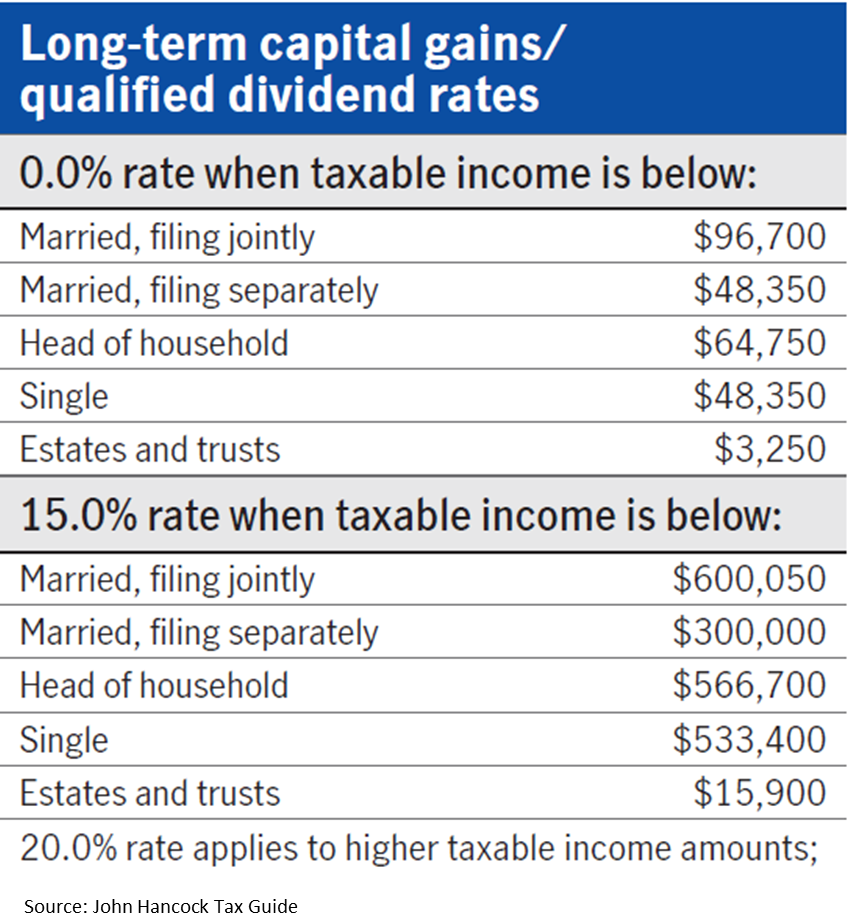
NUA Triggers A Tax Event
Now let’s go back and review the tax event that was triggered when Sue requested the $400,000 transfer of her company stock from the 401(k) to her brokerage account. Again, when the NUA is processed, she only has to pay ordinary income tax on the cost basis amount of the stock, so in Sue’s case, in the year the NUA distribution takes place, she would have to report an additional $50,000 in taxable income. The tax liability generated could either be paid with her personal cash reserve or she could liquidate some of the company stock in her after-tax brokerage account to pay the taxes.
Timing of the NUA Distribution
There is a tax strategy associated with the timing of requesting the NUA distribution. If someone works for a company until September and then retires, they already have 9 months' worth of income in that tax year. In this case, it may be beneficial to process the rollover from the 401(k) with the NUA to the brokerage account the following tax year, when the individual’s W-2 income is completely off the table, so the taxable cost basis associated with the NUA election is potentially taxed at a lower rate since there is no W2 income the following year.
The Employee’s Age Matters for NUA
Because the cost basis of the company stock is treated like a cash distribution, if an employee takes an NUA distribution before age 55 and has already left the company, the cost basis would be subject to ordinary income tax and the 10% early withdrawal penalty.
NUA – Age 55 Exception To The 10% Early Withdrawal Penalty
Why age 55 and not 59½? Qualified retirement plans (401(k), 403(b), 457(b) plans) have a special exception to the under age 59½ 10% early withdrawal penalty. If you terminate employment with the company AFTER reaching age 55 and you take a cash distribution or NUA directly from the 401(k) plan, the employee is no longer subject to the 10% early withdrawal penalty. But an employee who terminates employment at age 54 and requests the NUA distribution at age 55 would still get hit with the 10% penalty because they did not separate from service AFTER reaching age 55.
The cost basis associated with the NUA distribution is treated the same as a regular cash distribution from a 401(k) plan.
When Electing NUA Makes Sense
There are certain situations where making the NUA election makes sense, and there are situations where it should be avoided. We will start off by reviewing the common situations where electing NUA makes sense in lieu of rolling over the entire balance to an IRA.
Large Unrealized Gain In The Company Stock
In order for the NUA election to make sense, there typically has to be a large unrealized gain built up in the company stock within the 401(k) plan. Said another way, the company stock has to have performed well within the 401(k) account. If the value of the company stock in an employee's 401(k) account is $200,000 and the cost basis is $170,000, if that employee elects an NUA and then transfers the $200,000 in stock to their brokerage account, it’s going to trigger a $170,000 immediate tax event and only $30,000 would receive long-term capital gains treatment. In this case, it’s probably not worth the tax hit.
In the example with Sue, she only had to pay ordinary income tax on $50,000 of the $400,000 in company stock, so the NUA would make more sense in her situation because she is shifting $350,000 to long-term capital gains treatment.
Ordinary Income Tax vs Long Term Capital Gains Rates
For NUA to make sense, it’s a race between what tax rate someone would pay if the money were distributed from a Rollover IRA and distributed at ordinary income tax rates versus the long-term capital gains tax rate if NUA is elected. Under current tax law, the federal tax rate jumps from 12% to 22% at $96,950 for a joint tax filer. On the surface it would seem that someone with under $96,950 in income might be better off rolling over the balance to an IRA and paying ordinary income tax rates at 12% instead of the long-term capital gains rate of 15%. However, if you look at the long-term capital gains tax rates in the table earlier in the article, if in 2025 a joint filer has income below $96,700, the long-term capital gains rate is 0%, and a 0% tax rate always wins.
Time Horizon Matters
An employee's time horizon to retirement also factors into the NUA decision. If an employee leaves a company at age 40, not only would they have to pay taxes and the 10% penalty on the cost basis of the NUA distribution, but by moving the company stock to a taxable brokerage account, they are losing the tax deferred accumulation benefit associated with the Rollover IRA for the next 19+ years. Since the brokerage account is a taxable account, the owner of the account has to pay taxes every year on dividends, interest, and realized gains produced by the brokerage account. If the company stock is liquidated and the full 401(k) balance is rolled over to an IRA, all of the investment income avoids immediate taxation and continues to accumulate within the IRA account. For taxpayers in higher tax brackets, this may have its advantages.
There are a lot of factors in the NUA decision, but in general, the shorter the timeline to when distributions will begin from retirement savings, the more it favors NUA; the longer the time horizon to retirement, the less it favors NUA over the benefits of continued tax deferred accumulation in a Rollover IRA account.
Reduce Future RMDs
For individuals who have a majority of their assets in pre-tax retirement accounts, like 401(k) and IRA accounts, and are fortunate enough to not need to take large distributions from those accounts in retirement because they have other sources of income, eventually when those individuals reach RMD age (73 or 75), the IRS is going to force them to start taking large taxable distributions out of their pre-tax retirement accounts.
For an individual in this situation, electing NUA can be an attractive option. Instead of their full 401(k) balance ending up in a Rollover IRA with a future RMD requirement, the company stock is sent to a brokerage account that does not require RMDs.
Estate Planning – No Step-Up In Cost Basis for NUA
Here is a little-known estate planning fact about NUA elections. Normally, when you have unrealized gains in a brokerage account and the owner of the account passes away, the beneficiaries of the estate receive a step-up in cost basis, which eliminates the taxable gain if the beneficiaries were to sell the stock. For individuals that elect NUA from a 401(k) account, there is a special rule that states if shares are deposited into a brokerage account as a result of an NUA election, the remaining portion of the NUA will be considered “income with respect of the decedent”, meaning the beneficiaries of the estate will have to pay long-term capital gains when they eventually sell those shares.
I’m not sure how this is tracked because when you move shares into a brokerage account that has NUA, if the shares continue to appreciate in value, and shares are bought and sold throughout the decedent’s lifetime, how do you determine which portion of the remaining unrealized gain was from the NUA election and which portion represents unrealized gains post NUA? A wonderful question for your tax professional if you end up in this situation.
When To Avoid NUA
As part of the analysis above, I highlighted a number of situations where an NUA election might not make sense, but a quick hit list is:
Company stock has not performed well in 401(k) account – high cost basis
High tax rate assessed on the cost basis amount during the year of NUA election
Employee under age 55 or 59½, potentially triggering early withdrawal penalty
Long time horizon to retirement (loss of tax deferred accumulation)
Ordinary tax rate lower or similar to long-term capital gains rate
About Michael……...
Hi, I’m Michael Ruger. I’m the managing partner of Greenbush Financial Group and the creator of the nationally recognized Money Smart Board blog . I created the blog because there are a lot of events in life that require important financial decisions. The goal is to help our readers avoid big financial missteps, discover financial solutions that they were not aware of, and to optimize their financial future.
Frequently Asked Questions (FAQs):
What is NUA and how does it work?
NUA, or Net Unrealized Appreciation, is a special tax rule that allows employees with company stock in their 401(k) to move that stock to a taxable brokerage account after leaving the company. The original cost basis of the stock is taxed as ordinary income, but the stock’s appreciation is later taxed at more favorable long-term capital gains rates instead of ordinary income tax rates.
When can employees use the NUA option?
NUA treatment is available only after separating from an employer due to retirement, termination, or death. It must be elected before rolling over company stock from the 401(k) to an IRA — otherwise, the opportunity is lost permanently.
What are the tax benefits of electing NUA?
The main advantage is that the appreciation in company stock is taxed at long-term capital gains rates (0%, 15%, or 20%) instead of higher ordinary income tax rates. This can lead to significant tax savings when the stock is eventually sold.
What tax event occurs when NUA is elected?
When NUA is processed, the employee must pay ordinary income tax on the stock’s cost basis in the year of distribution. The appreciation amount is not taxed until the stock is sold and is then treated as a long-term capital gain.
When does electing NUA make sense?
NUA is most beneficial when the company stock has a low cost basis and substantial unrealized gains. It can also be a good choice for retirees looking to reduce future required minimum distributions (RMDs) since the company stock moved to a brokerage account is no longer subject to RMDs.
When should NUA be avoided?
NUA may not make sense if the company stock has a high cost basis, the taxpayer is under age 55 (potentially triggering the 10% early withdrawal penalty), or if the individual’s ordinary income tax rate is similar to or lower than the long-term capital gains rate. It may also be less beneficial for those with many years until retirement who would lose the advantage of continued tax-deferred growth.
Does company stock transferred through NUA receive a step-up in basis at death?
No. Company stock distributed under NUA rules does not receive a full step-up in cost basis when the owner passes away. The portion of the gain representing the original NUA remains taxable to heirs as long-term capital gains when the shares are sold.
What’s the biggest mistake employees make with company stock in a 401(k)?
Many employees roll their 401(k) balances directly into an IRA without evaluating whether NUA treatment applies. Once the rollover is complete, the NUA opportunity is lost forever — potentially costing thousands in unnecessary future taxes.

The Hidden Tax Traps in Retirement Most People Miss
Many retirees are caught off guard by unexpected tax hits from required minimum distributions (RMDs), Social Security, and even Medicare premiums. In this article, we break down the most common retirement tax traps — and how smart planning can help you avoid them.

Most people think retirement is the end of tax planning. But nothing could be further from the truth. There are several tax traps that retirees encounter, which range from:
How RMDs create tax surprises
How Social Security is taxed
How Medicare Premiums (IRMAA) are affected by income
A lack of tax-specific distribution planning
We will be covering each of these tax traps in this article to assist retirees in avoiding these costly mistakes in the retirement years.
RMD Tax Surprises
Once you reach a specific age, the IRS requires individuals to begin taking mandatory distributions from their pre-tax retirement accounts, called RMDs (required minimum distributions). Distributions from pre-tax retirement accounts represent taxable income to the retiree, which requires advanced planning to ensure that that income is not realized at an unnecessarily high tax rate.
All too often, Retirees will make the mistake of putting off distributions from their pre-tax retirement accounts until RMDs are required to begin, which allows the pretax accounts to accumulate and become larger during retirement, which in turn requires larger distributions once the RMD start age is reached.
Here is a common example: Tim and Sue retire from New York State at age 55 and both have pensions that are more than enough to meet their current expenses. Both of them also have retirement accounts through NYS, totaling $500,000. Assuming Tim and Sue start taking their required minimum distributions (RMDs) at age 75, and since Tim and Sue do not need to take withdrawals from their retirement account to supplement their income, those retirement accounts could grow to over $1,000,000. This sounds like a good thing, but it creates a potential tax problem. By age 75, they’ll both be receiving their pensions and have turned on Social Security, which under current tax law is 85% taxable at the federal level. On top of that, they’ll need to take a required minimum distribution of $37,735 which stacks up on top of all their other income sources.
This additional income from age 75 and beyond could:
Be subject to higher tax rates
Trigger higher Medicare Premiums
Cause them to phase out of certain tax deductions or credits
In hindsight, it may have been more prudent for Tim & Sue to begin taking distributions from their retirement accounts each year beginning the year after they retired, to avoid many of these unforeseen tax consequences 20 years after they retired.
How Is Social Security Taxed?
I start this section by saying, based on current law, because the Trump administration has on its agenda to make social security tax-free at the Federal level. At the time of this article, social security is potentially subject to taxation at the federal level for individuals based on their income. A handful of states also tax social security benefits.
Here is a quick summary of the proportion of social security benefits subject to taxation at the Federal level in 2026:
0% Taxable: Combined income for single filers below $25,000 and joint filers below $32,000.
50% Taxable: Combined income for single filers between $25,000 - $34,000 and joint filers between $32,000 - $44,000
85% Taxable: Combined income for single filers above $34,000 and joint filers above $44,000.
One-time events that occur in retirement could dramatically impact the amount of a retiree's social security benefit, subject to taxation. For example, a retiree might sell a stock at a gain in a brokerage account, surrender an insurance policy, earn part-time income, or take a distribution from a pre-tax retirement account. Any one of these events could inadvertently trigger a larger tax liability associated with the amount of an individual’s social security that is subject to taxation at the Federal level.
Medicare Premiums Are Income-Based
When you turn age 65, many retirees discover for the first time that there is a cost associated with enrolling in Medicare, primarily in the form of the Medicare Part B premiums that are deducted directly from a retiree's monthly social security benefit. The tax trap is that if a retiree shows too much income in a given year, it can cause their Medicare premium to increase for 2 years in the future.
Medicare looks back at your income from two years prior to determine the amount of your Medicare Part B premium in the current year. Here is the Medicare Part B premium table for 2025:
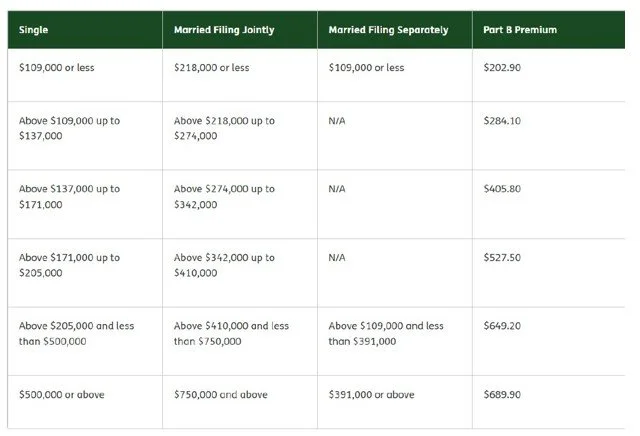
As you can see from the table, as income rises, so does the monthly premium charged by Medicare. There are no additional benefits, the retiree just has to pay more for their Medicare coverage.
This is where those higher RMDs can come back to haunt retirees once they reach the RMD start age. They might be ok between ages 65 – 75, but once they hit age 75 and must start taking RMDs from their pre-tax retirement accounts, those pre-tax RMD’s can sometimes push retirees over the Medicare based premium income threshold, and then they end up paying higher premiums to Medicare for the rest of their lives that could have been avoided.
Lack of Retirement Distribution Planning
All these tax traps surface due to a lack of proper distribution planning as an individual enters retirement. It’s incredibly important for retirees to look at their entire asset picture leading up to retirement, determine the income level that is needed to cover expenses in their retirement year, and then construct a long-term distribution plan that allows them to minimize their tax liability over the remainder of their life expectancy. This may include:
Processing sizable distributions from pre-tax accounts early in the retirement years
Processing Roth conversions
Delaying to file for social security
Developing a tax plan for surrendering permanent life insurance policies
Evaluating pension and annuity elections
A tax plan for realizing gains in taxable investment accounts
Forecasting RMDs at age 73 or 75
Developing a robust distribution plan leading up to retirement can potentially save retirees thousands of dollars in taxes over the long run and avoid many of the pitfalls and tax traps that we reviewed in the article today.
About Michael……...
Hi, I’m Michael Ruger. I’m the managing partner of Greenbush Financial Group and the creator of the nationally recognized Money Smart Board blog . I created the blog because there are a lot of events in life that require important financial decisions. The goal is to help our readers avoid big financial missteps, discover financial solutions that they were not aware of, and to optimize their financial future.
Frequently Asked Questions (FAQs):
Why is tax planning still important in retirement?
Many retirees assume that once they stop working, tax planning ends. In reality, retirement can bring new tax challenges — including required minimum distributions (RMDs), Social Security taxation, and income-based Medicare premium increases — that require proactive management to avoid costly surprises.
How do required minimum distributions (RMDs) create tax surprises?
Starting at age 73 or 75 (depending on birth year), retirees must begin taking taxable withdrawals from pre-tax retirement accounts. These RMDs can push retirees into higher tax brackets, increase Medicare premiums, and cause more of their Social Security benefits to become taxable if withdrawals aren’t planned carefully in advance.
Can delaying IRA withdrawals until RMD age cause higher taxes later?
Yes. Deferring all withdrawals until RMDs begin can cause retirement accounts to grow substantially, leading to larger mandatory distributions later in life. Spreading withdrawals earlier in retirement can help manage tax brackets, reduce future RMDs, and potentially lower long-term taxes.
How is Social Security taxed at the federal level?
In 2025, up to 85% of Social Security benefits may be taxable depending on your combined income (adjusted gross income + tax-exempt interest + 50% of benefits). For joint filers, benefits become partially taxable above $32,000 and up to 85% taxable above $44,000.
What income sources can increase the taxation of Social Security?
Capital gains, part-time wages, insurance policy surrenders, or withdrawals from pre-tax retirement accounts can all raise taxable income and cause a greater portion of Social Security benefits to become taxable.
How do Medicare premiums (IRMAA) depend on income?
Medicare Part B and Part D premiums increase for retirees with higher incomes, based on a two-year income lookback. For example, your 2025 premiums are based on your 2023 tax return. Large one-time income events — such as Roth conversions or asset sales — can trigger higher Medicare premiums for two years.
What strategies can help retirees reduce tax traps?
Effective planning may include drawing down pre-tax accounts earlier, using Roth conversions in low-income years, managing capital gains, and coordinating income sources to control how much is exposed to higher taxes or Medicare surcharges.
Last updated June, 2026
