

Tax Filing Requirements For Minor Children with Investment Income
When parents gift money to their kids, instead of having the money sit in a savings account, often parents will set up UTMA accounts at an investment firm to generate investment returns in the account that can be used by the child at a future date. Depending on the amount of the investment income, the child may be required to file a tax return.

When parents gift money to their kids, instead of having the money sit in a savings account, often parents will set up a UTMA Account at an investment firm to generate investment returns that can be used by the child at a future date. But if the child is a minor, which is often the case, we have to educate our clients on the following topics:
How UTMA accounts work for minor children
Since the child will have investment income, do they need to file a tax return?
The special standard deduction for dependents
How kiddie tax works (taxed investment income at the parent’s tax rate)
Completed gifts for estate planning
How UTMA Accounts Work
When a parent sets up an investment account for their child, if the child is a minor, they typically set up the accounts as UTMA accounts, which stands for Uniform Transfer to Minors Act. UTMA accounts are established in the social security number of the child, and the parent is typically listed on the account as the “custodian”. As the custodian, the parent has full control over the account until the child reaches the “age of majority”. Once the child reaches the age of majority, the UTMA designation is removed, the account is re-registered into the name of the adult child, and the child now has full control over the account.
Age of Majority Varies State by State for UTMA
While the age of majority varies state by state, the age of majority for UTMA purposes and the age of majority for all other reasons often varies. For most states, the “age of majority” is 18 but the “UTMA age of majority” is 21. That is true for our state: New York. If a parent establishes an UTMA account in New York, the parent has control over the account until the child reaches age 21, then the control of the account must be turned over to their child.
$19,000 Gifting Exclusion Amount
When a parent deposits money to a UTMA account, in the eyes of the IRS, the parent has completed a gift. Even though the parent has control of the minor child’s UTMA account, from that point forward, the assets in the account belong to the child. Parents with larger estates will sometimes include gifting to the kids each year in their estate planning strategy. Each parent can make a gift of $19,000 (2025 Limit) each year ($38K combined) into the child’s UTMA account, and that gift will not count against the parent’s lifetime Federal and State lifetime estate tax exclusion amount.
A parent can contribute more than $19,000 per year to the child’s UTMA account, but a gift tax return may need to be filed in that year. For more information on this topic, see our video:
Video: When You Make Cash Gifts To Your Children, Who Pays The Tax?
When Does The Minor Child Need To File A Tax Return?
For minor children that have investment income from a UTMA account, if they are claimed as a dependent on their parent’s tax return, they will need to file a tax return if their investment income is above $1,350, which is the standard deduction amount for dependents with unearned income in 2025.
For dependent children with investment income over the $1,350 threshold, the investment is taxed at different rates. Here is a quick breakdown of how it works:
$0 - $1,350: Covered by standard deduction. No tax due
1,350 - $2,700: Taxed at the CHILD’s marginal tax rate
$2,700+: Taxed at the PARENT’s marginal tax rate (“Kiddie tax”)
How Does Kiddie Tax Work?
Kiddie tax is a way for the IRS to prevent parents in high-income tax brackets from gifting assets to their kids in an effort to shift the investment income into their child’s lower tax bracket. For children that have unearned income above $2,700, that income is now taxed as if it was earned by the parent, not the child. This applies to dependent children under the age of 18 at the end of the tax year or full-time students younger than 24.
IRS Form 8615 needs to be filed with the child’s tax return, which calculates tax liability on the unearned income above $2,700 based on the parent's tax rate. A tax note here: in these cases, the parent’s tax return has to be completed before the child can file their tax return since the parent’s taxable income is included in the Kiddie tax calculation. In other words, if the parents put their tax return on extension, the child’s tax return will also need to be put on extension.
Unearned vs Earned Income
This article has focused on the unearned income of a child; if the child also has earned income from employment, there are different tax filing rules. The earned income portion of the child’s income can potentially be sheltered by the $15,000 (2025) standard deduction awarded to individual tax filers.
This topic is fully covered in our article: At What Age Does A Child Have To File A Tax Return?
Investment Strategy for Minor Child’s UTMA
Knowing the potential tax implications associated with the UTMA account for your child, there is usually a desire to avoid the Kiddie tax as much as possible. This can often drive the investment strategy within the UTMA account to focus on investment holdings that do not produce a lot of dividends or interest income. It’s also common to try to avoid short-term capital gains within a child’s UTMA account since a large short-term capital gain could be taxed as ordinary income at the parent’s tax rate.
Last updated June, 2026

About Michael……...
Hi, I’m Michael Ruger. I’m the managing partner of Greenbush Financial Group and the creator of the nationally recognized Money Smart Board blog . I created the blog because there are a lot of events in life that require important financial decisions. The goal is to help our readers avoid big financial missteps, discover financial solutions that they were not aware of, and to optimize their financial future.
Frequently Asked Questions (FAQs):
What is a UTMA account?
A UTMA, or Uniform Transfers to Minors Act account, allows parents or guardians to invest money for a minor child. The account is opened under the child’s Social Security number, with the parent listed as custodian. The custodian controls the account until the child reaches the age of majority, at which point the child assumes full ownership.
When does a child gain control of their UTMA account?
The age of majority for UTMA accounts varies by state. In most states it is 21, even though the legal age of adulthood may be 18. For example, in New York, the custodian retains control until the child turns 21.
How are contributions to a UTMA account treated for tax purposes?
Contributions to a UTMA account are considered completed gifts. For 2025, the annual gift tax exclusion is $19,000 per parent ($38,000 per couple). Contributions above this amount require the filing of a gift tax return, though gift tax is rarely due unless lifetime gifting exceeds federal estate tax limits.
Does a child with a UTMA account need to file a tax return?
If the child is a dependent and has more than $1,350 in unearned income (dividends, interest, or capital gains) in 2025, they must file a tax return. The first $1,350 is covered by the dependent standard deduction.
How is investment income in a UTMA account taxed?
The first $1,350 of unearned income is tax-free.
The next $1,350 is taxed at the child’s tax rate.
Unearned income above $2,700 is taxed at the parent’s tax rate under the Kiddie Tax rules.
What is the Kiddie Tax?
The Kiddie Tax prevents parents in high tax brackets from shifting income to their children’s lower tax bracket. For dependent children under age 18 (or full-time students under age 24), investment income above $2,700 is taxed at the parent’s marginal rate. IRS Form 8615 must be filed with the child’s tax return to calculate this amount.
What’s the difference between earned and unearned income for a child?
Earned income comes from work (such as a job) and is subject to regular income tax and payroll taxes. Unearned income includes interest, dividends, and capital gains from investments. Earned income may be sheltered by the $15,000 standard deduction in 2025, while unearned income follows the dependent thresholds described above.
How can parents minimize taxes in a child’s UTMA account?
To limit Kiddie Tax exposure, parents often invest UTMA funds in assets that produce little or no taxable income, such as growth-oriented stocks or tax-efficient mutual funds. They may also try to avoid frequent trading to prevent short-term capital gains, which are taxed at higher rates.



















Why Do Wealthy Families Set Up Foundations and How Do They Work?
When a business owner sells their business and is looking for a large tax deduction and has charitable intent, a common solution is setting up a private foundation to capture a large tax deduction. In this video, we will cover how foundations work, what is the minimum funding amount, the tax benefits, how the foundation is funded, and more…….
When a business owner sells their business or a corporate executive receives a windfall in W2 compensation, some of these individuals will set up and fund a private foundation to capture a significant tax deduction, and potentially pre-fund their charitable giving for the rest of their lives and beyond. In this video, David Wojeski of the Wojeski Company CPA firm and Michael Ruger of Greenbush Financial Group will be covering the following topics regarding setting up a private foundation:
What is a private foundation
Why do wealthy individuals set up private foundations
What are the tax benefits associated with contributing to a private foundation
Minimum funding amount to start a private foundation
Private foundation vs. Donor Advised Fund vs. Direct Charitable Contributions
Putting family members on the payroll of the foundation
What is the process of setting up a foundation, tax filings, and daily operations
About Michael……...
Hi, I’m Michael Ruger. I’m the managing partner of Greenbush Financial Group and the creator of the nationally recognized Money Smart Board blog . I created the blog because there are a lot of events in life that require important financial decisions. The goal is to help our readers avoid big financial missteps, discover financial solutions that they were not aware of, and to optimize their financial future.
Frequently Asked Questions (FAQs):
What is a private foundation?
A private foundation is a nonprofit organization typically funded by a single individual, family, or business. It’s designed to support charitable activities, either by making grants to other nonprofits or by conducting its own charitable programs. The foundation is controlled by its founders or appointed board members rather than by the public.
Why do wealthy individuals set up private foundations?
High-net-worth individuals often establish private foundations to create a lasting legacy of charitable giving, maintain control over how funds are distributed, and involve family members in philanthropy. It also allows donors to give strategically over time rather than making one-time gifts to multiple organizations.
What are the tax benefits of contributing to a private foundation?
Contributions to a private foundation are tax-deductible. Assets contributed to the foundation grow tax-free, and donors can make grants to charities in future years while capturing the tax deduction in the year of the initial contribution.
What is the minimum funding amount to start a private foundation?
While there is no legal minimum, some experts recommend starting with at least $1 million to $2 million in assets. This level of funding helps offset administrative, tax filing, and compliance costs associated with running the foundation.
How does a private foundation compare to a Donor Advised Fund or direct charitable giving?
A Donor Advised Fund (DAF) is easier and less expensive to set up and maintain than a private foundation. However, a private foundation offers more control over investment management, grant-making, and governance. Direct charitable contributions are simpler still but provide no long-term control or legacy-building opportunities.
Can family members receive compensation from a private foundation?
Yes. Family members can serve on the foundation’s board or be paid for legitimate services such as administration, accounting, or grant oversight. However, compensation must be reasonable and documented to comply with IRS rules for private foundations.
What is involved in setting up and maintaining a private foundation?
Setting up a foundation involves establishing a nonprofit corporation or trust, applying for IRS tax-exempt status under Section 501(c)(3), and creating bylaws or a governing document. Ongoing operations include annual IRS Form 990-PF filings, distributing at least 5% of assets annually to charitable causes, maintaining proper records, and adhering to self-dealing and investment regulations.

The Huge NYS Tax Credit Available For Donations To The SUNY Impact Foundation
There is a little-known, very lucrative New York State Tax Credit that came into existence within the past few years for individuals who wish to make charitable donations to their SUNY college of choice through the SUNY Impact Foundation. The tax credit is so large that individuals who make a $10,000 donation to the SUNY Impact Foundation can receive a dollar-for-dollar tax credit of $8,500 whether they take the standard deduction or itemize on their tax return. This results in a windfall of cash to pre-selected athletic programs and academic programs by the donor at their SUNY college of choice, with very little true out-of-pocket cost to the donors themselves once the tax credit is factored in.

There is a little-known, very lucrative New York State Tax Credit that came into existence within the past few years for individuals who wish to make charitable donations to their SUNY college of choice through the SUNY Impact Foundation. The tax credit is so large, that individuals who make a $10,000 donation to the SUNY Impact Foundation can receive a dollar-for-dollar tax credit of $8,500 whether they take the standard deduction or itemize on their tax return. This results in a windfall of cash to pre-selected athletic programs and academic programs by the donor at their SUNY college of choice, with very little true out-of-pocket cost to the donors themselves once the tax credit is factored in.
About Michael……...
Hi, I’m Michael Ruger. I’m the managing partner of Greenbush Financial Group and the creator of the nationally recognized Money Smart Board blog . I created the blog because there are a lot of events in life that require important financial decisions. The goal is to help our readers avoid big financial missteps, discover financial solutions that they were not aware of, and to optimize their financial future.
Frequently Asked Questions (FAQs):
What is the SUNY Impact Foundation Tax Credit?
The SUNY Impact Foundation Tax Credit is a generous New York State tax incentive that allows individuals to receive a large state tax credit for making a charitable donation to the SUNY Impact Foundation. This program was introduced in recent years to encourage private giving to support SUNY campuses and their programs.
Do you have to itemize deductions to receive the SUNY Impact Foundation tax credit?
No. Donors can claim the full New York State tax credit whether they itemize deductions or take the standard deduction on their tax return. This makes it a valuable opportunity for both high-income and middle-income taxpayers.
Where does the donation go?
All contributions are made through the SUNY Impact Foundation, a statewide nonprofit that supports State University of New York campuses. Donors can designate their gift to specific SUNY colleges or to particular athletic or academic programs at those institutions.
How does the SUNY Impact Foundation benefit SUNY schools?
The foundation channels private donations directly to SUNY institutions, providing extra funding for scholarships, research, athletics, and academic innovation. The tax credit encourages more private giving to supplement public funding for SUNY programs.
Is there a limit on how much you can donate?
The program is capped annually by the state, and only a limited number of donors can participate each year. Interested individuals should contact the SUNY Impact Foundation or their financial advisor early to confirm availability and eligibility.
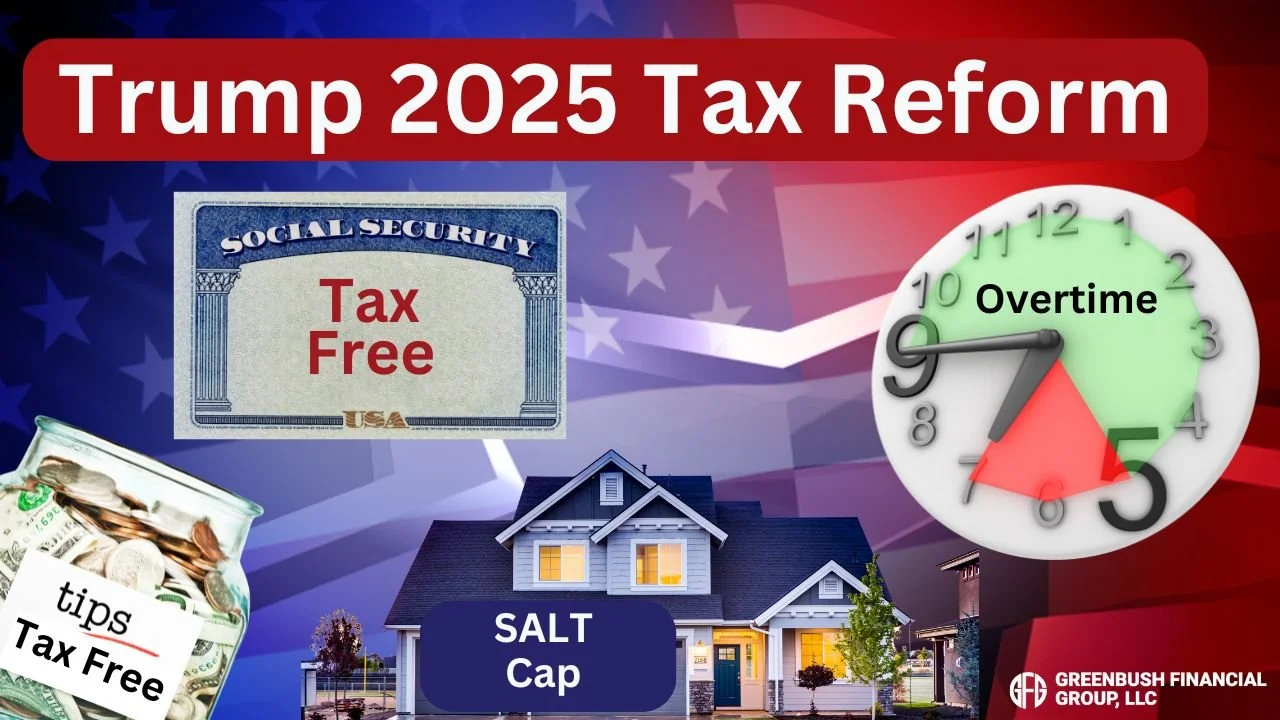
The Trump Tax Plan for 2025: Social Security, Tips, Overtime, SALT Cap, and more….
It seems as though the likely outcome of the 2024 presidential elections will be a Trump win, and potentially full control of the Senate and House by the Republicans to complete the “full sweep”. As I write this article at 6am the day after election day, it looks like Trump will be president, the Senate will be controlled by the Republicans, and the House is too close to call. If the Republicans complete the full sweep, there is a higher probability that the tax law changes that Trump proposed on his campaign trail will be passed by Congress and signed into law as early as 2025.

It looks as though the likely outcome of the 2024 presidential election will be a Trump win, and potentially full control of the Senate and House by the Republicans to complete the “full sweep”. As I write this article at 6am the day after election day, it looks like Trump will be president, the Senate will be controlled by the Republicans, and the House is too close to call. If the Republicans complete the full sweep, there is a higher probability that the tax law changes that Trump proposed on his campaign trail will be passed by Congress and signed into law as early as 2025. Here are the main changes that Trump has proposed to the current tax laws:
Making Social Security Completely Exempt from Taxation
Exempting tips from income taxes
Exempting overtime pay from taxation
A new itemized deduction for auto loan interest
Dropping the corporate tax rate from the current 21% down to 15%
Eliminating the $10,000 SALT Cap
Extension of the Tax Cut & Jobs Act beyond 2025
Even if the Democrats end up hanging on to the House by a narrow margin, there is still a chance that some of these tax law changes could be passed in 2025.
Social Security Exempt From Taxation
This one is big for retirees. Under current tax law, 85% of Social Security retirement benefits are typically taxed at the federal level. Trump has proposed that all Social Security Benefits would be exempt from taxation, which would put a lot more money into the pocket of many retirees. For example, if a retiree receives $40,000 in social security benefits each year and they are in the 22% Fed bracket, 85% of their $40,000 is currently taxed at the Federal level ($34,000), not paying tax on their social security benefit would put $7,480 per year back in their pocket.
Note: Most states do not tax social security benefits. This would be a tax change at the federal level.
Exempting Tips from Taxation
For anyone who works in a career that receives tips, such as waiters, bartenders, hair stylists, and the list goes on, under current tax law, you are supposed to claim those tips and pay taxes on those tips. Trump has proposed making tips exempt from taxation, which for industries that receive 50% or more of their income in tips could be a huge windfall. The Trump proposed legislation would create an above-the-line deduction for all tip income, including both cash and credit card tips.
Overtime Pay Exempt From Taxation
For hourly employees who work over 40 hours per week and receive overtime pay, Trump has proposed making all overtime wages exempt from taxation, which could be a huge windfall for hourly workers. The Tax Foundation estimates that 34 million Americans receive some form of overtime pay during the year.
Auto Loan Interest Deduction
Trump has also proposed a new itemized deduction for auto loan interest. However, since it’s likely that high standard deductions will be extended beyond 2026, if there is a full Republican sweep, only about 10% of Americans would elect to itemize on their tax return as opposed to taking the standard deduction. A taxpayer would need to itemize to take advantage of this new proposed tax deduction.
Reducing The Corporate Tax Rate from 21% to 15%
Trump proposed reducing the corporate tax rate from the current 21% to 15%, but only for companies that produce goods within the United States. For these big corporations, a 6% reduction in their federal tax rates could bring a lot more money to their bottom line.
Eliminating the $10,000 SALT Cap
This would be a huge win for states like New York and California, which have both high property taxes and state income taxes. When the Tax Cut and Jobs Act was passed, it was perhaps one of the largest deductions for individuals who resided in states that had both state income tax and property taxes referred to as the SALT Cap (State and Local Taxes). Trump has proposed extending the Tax Cut and Jobs Act but eliminating the $10,000 SALT cap.
For example, if you currently live in New York and have property taxes of $10,000 and you pay state income tax of $20,000, prior to the passing of the Tax Cut and Jobs Act, you were able to itemize your tax deductions and take a $30,000 tax deduction at the federal level. When TCJA passed, it capped those deductions at $10,000, so most individuals defaulted into just taking the standard deduction and lost some of that tax benefit. Under these proposed tax law changes, taxpayers will once again be able to capture the full deduction for their state income taxes and property taxes making itemizing more appealing.
No Sunset For The Tax Cut and Jobs Act
The Tax Cut and Jobs Act was passed by Trump and the Republican Congress during his first term. That major taxation legislation was scheduled to expire on December 31, 2025, which would have automatically reverted everything back to the old tax brackets, standard deductions, loss of the QBI deduction, etc., prior to the passing of TCJA. If the Republicans gain control of the House, there is a very high probability that the tax laws associated with TCJA will be extended beyond 2025.
Summary of Proposed 2025 Tax Law Changes
There could be a tremendous number of tax law changes starting in 2025, depending on the ultimate outcome of the election results within the House of Representatives. If a full sweep takes place, a large number of the reforms that were covered in this article could be passed into the law in 2025. However, if there is a divided Congress, only a few changes may make it through Congress. We should know the outcome within the next 24 to 48 hours.
It’s also important to acknowledge that these are all proposed tax law changes. Before passing them into law, Congress could place income limitations on any number of these new tax benefits, and/or new tax law changes could be introduced. It should be a very interesting 2025 from a tax standpoint.
About Michael……...
Hi, I’m Michael Ruger. I’m the managing partner of Greenbush Financial Group and the creator of the nationally recognized Money Smart Board blog . I created the blog because there are a lot of events in life that require important financial decisions. The goal is to help our readers avoid big financial missteps, discover financial solutions that they were not aware of, and to optimize their financial future.
Frequently Asked Questions (FAQs):
What tax changes has Donald Trump proposed for 2025?
If Donald Trump returns to the presidency with Republican control of Congress, several major tax changes could be enacted in 2025. His proposals include making Social Security benefits tax-free, exempting tips and overtime pay from taxation, allowing a new deduction for auto loan interest, reducing the corporate tax rate to 15%, eliminating the $10,000 SALT cap, and extending the Tax Cuts and Jobs Act (TCJA) beyond 2025.
Will Social Security benefits become tax-free under Trump’s plan?
Yes, Trump has proposed eliminating all federal taxes on Social Security benefits. Currently, up to 85% of Social Security income is taxable for many retirees. If enacted, retirees could see thousands of dollars in annual tax savings, depending on their total income and filing status.
What does it mean that tips and overtime pay would be tax-exempt?
Under Trump’s proposal, workers in industries that receive tips—such as restaurants, salons, and hospitality—would no longer have to pay federal income tax on their tip income. In addition, overtime wages earned by hourly workers would be fully exempt from taxation, providing meaningful take-home pay increases for millions of Americans.
What is the proposed auto loan interest deduction?
Trump’s plan includes creating a new itemized deduction for interest paid on auto loans. However, since most taxpayers claim the standard deduction, only those who itemize would benefit from this new deduction.
How would the corporate tax rate change?
The proposal would lower the corporate tax rate from 21% to 15%, but only for companies that manufacture goods within the United States. The goal is to incentivize domestic production and boost U.S.-based manufacturing jobs.
What would happen to the $10,000 SALT cap?
Trump has proposed eliminating the $10,000 cap on state and local tax (SALT) deductions, which would significantly benefit taxpayers in high-tax states like New York, California, and New Jersey. Removing the cap would allow taxpayers to once again deduct their full state income and property taxes.
Will the Tax Cuts and Jobs Act be extended beyond 2025?
Yes, Trump and Republican leaders have indicated they intend to make the TCJA permanent. This would preserve lower individual tax brackets, the higher standard deduction, and the 20% qualified business income (QBI) deduction for pass-through entities.
When could these proposed tax changes take effect?
If Republicans control the presidency and both chambers of Congress, some or all of these proposals could be passed and take effect as early as the 2025 tax year. However, Congress may adjust income thresholds, introduce phaseouts, or modify the scope of these benefits before enactment.

What Is A Donor Advised Fund and How Do They Work for Charitable Contributions?
Due to changes in the tax laws, fewer individuals are now able to capture a tax deduction for their charitable contributions. In an effort to recapture the tax deduction, more individuals are setting up Donor Advised Funds at Fidelity and Vanguard to take full advantage of the tax deduction associated with giving to a charity, church, college, or other not-for-profit organizations.

Due to changes in the tax laws, fewer individuals are now able to capture a tax deduction for their charitable contributions. In an effort to recapture the tax deduction, more individuals are setting up Donor Advised Funds at Fidelity and Vanguard to take full advantage of the tax deduction associated with giving to charity, church, college, or other not-for-profit organizations.
In this article, we will review:
The reason why most taxpayers can no longer deduct charitable contributions
What is a Donor Advised Fund?
How do Donor Advised Funds operate?
Gifting appreciated securities to Donor Advised Funds
How are Donor Advised Funds invested?
How to set up a self-directed Donor Advised Fund
The Problem: No Tax Deductions For Charitable Contributions
When the Tax Cut and Jobs Act was passed in 2017, it greatly limited the number of taxpayers that were able to claim a tax deduction for their charitable contributions. Primarily because in order to claim a tax deduction for charitable contributions, you have to itemize when you file your taxes because charitable contributions are an itemized deduction.
When you file your taxes, you have to choose whether to elect the standard deduction or to itemize. The Tax Cut & Jobs Act greatly increased the amount of the standard deduction, while at the same time it capped two of the largest itemized tax deductions for taxpayers - which is state income tax paid and property taxes. SALT (state and local taxes) are now capped at $10,000 per year if you itemize.
In 2025, the standard deduction for single filers is $15,000 and $30,000 for married filing joint, which means if you are a married filer, and you want to deduct your charitable contributions, assuming you reach the SALT cap at $10,000 for state income and property taxes, you would need another $20,000 in tax deductions before your reached that amount of the standard deduction. That’s a big number to hurdle for most taxpayers.
Example: Joe and Sarah file a joint tax return. They pay state income tax of $8,000 and property taxes of $6,000. They donate $5,000 to their church and a variety of charities throughout the year. They can elect to take the standard deduction of $30,000, or they could itemize. However, if they itemize while their state income tax and property taxes total $14,000, they are capped at $10,000 and the only other tax deduction that they could itemize is their $5,000 to church and charity which brings them to a total of $15,000. Since the standard deduction is $14,000 higher than if they itemized, they would forgo being able to deduct those charitable contributions, and just elect that standard deduction.
How many taxpayers fall into the standard deduction category? According to the Tax Policy Center, in 2020, about 90% of taxpayers claimed the standard deduction. Prior to the passing of the Tax Cut and Jobs Act, only about 70% of taxpayers claimed the standard deduction meaning that more taxpayers were able to itemize and capture the tax deduction for their charitable contributions.
What Is A Donor Advised Fund
For individuals that typically take the standard deduction, but would like to regain the tax deduction for their charitable contributions, establishing a Donor Advised Fund may be a solution.
A Donor Advised Fund looks a lot like a self-directed investment account. You can make contributions to your donor advisor fund, you can request distributions to be made to your charities of choice, and you can direct the investments within your account. But the account is maintained and operated by a not-for-profit organization, a 501(c)(3), that serves as the “sponsoring organization”. Two of the most recognized providers within the Donor Advised Fund space are Fidelity and Vanguard.
Both Fidelity and Vanguard have their own Donor Advised Fund program. These large investment providers have established a not-for-profit arm for the sole purpose of allowing investors to establish, operate, and invest their Donor Advised Account for their charitable giving.
Why Do People Contribute To A Donor Advised Fund?
We just answered the “What” question, now we will address the “Why” question. Why do people contribute to these special investment accounts at Fidelity and Vanguard and what is it about these accounts that allow taxpayers to capture the tax deduction for their charitable giving that was previously lost?
The short answer - it allows taxpayers that give to charity each year, to make a large lump sum contribution to an investment account designated for their charitable giving. That then allows them to itemize when they file their taxes and capture the deduction for their charitable contributions in future years.
Here’s How It Works
As an example, Tim and Linda typically give $5,000 per year to their church and charities throughout the year. Since they don’t have any other meaningful tax deductions outside of their property taxes and state income taxes that are capped at $10,000, they take the $30,000 standard deduction when they file their taxes, and do not receive any additional tax deductions for their $5,000 in charitable contributions, because they did not itemize.
Instead, Tim and Linda establish a Donor Advised Fund at Fidelity, and fund it with a one-time $50,000 contribution. Since they made that contribution to a Donor Advised Fund which qualifies as an IRS approved charitable organization, the year that they made the $50,000 contribution, they will elect to itemize when they file their taxes and they’ll be able to capture the full $50,000 tax deduction, since that amount is well over the $30,000 standard deductions.
But the $50,000 that was contributed to their Donor Advised Fund does not have to be distributed to charities all in that year. Each Donor Advised Program has different minimum annual charitable distribution requirements, but at the Fidelity program it’s just $50 per year. In other words, taxpayers that make these contributions to the Donor Advised Fund can capture the full tax benefit in the year they make the contributions, but that account can then be used to fund charitable contribution for many years into the future, they just have to distribute at least $50 per year to charity.
It gets better, Tim and Linda then get to choose how they want to invest their Donor Advised Fund, and they select a 60% stock / 40% bond portfolio. So not only are they able to give from the $50,000 that they contributed, but all of the investment returns continue to accumulate in that account that Tim and Linda will never pay tax on, that they can then use for additional charitable giving in the future.
How Do Donor Advised Funds Operate?
The example that I just walked you through laid the groundwork for how these Donor Advised Fund to operate, but I want to dive a little bit deeper into some features that are important with these types of accounts.
Funding Minimums
All Donor Advised Funds operate differently depending on the provider. One example is the minimum funding requirement to open a Donor Advised Fund. The Fidelity program does not have an investment minimum, so they can be opened with any amount. However, the Vanguard program currently has a $20,000 investment minimum.
Fees Charged By Donor Advised Sponsor
Both Vanguard and Fidelity assess an annual “administration fee” against the assets held within their Donor Advised Fund program. This is how the platform is compensated for maintaining the not-for-profit entity, processing contributions and distributions, investment services, issuing statements, trade confirmations, and other administrative responsibilities. At the time that I’m writing this article, both the Fidelity and Vanguard program charge an administrative fee of approximately 0.60% per year.
How Charitable Distributions Are Made From Donor Advised Funds
Once the Donor Advised Account is funded, owners are able to either login online to their account and request money to be sent directly to their charity of choice, or they can call the sponsor of the program and provide payment instructions over the phone.
For example, if you wanted to send $1,000 to the Red Cross, you would log in to your Donor Advised account and request that $1,000 be sent directly from your Donor Advised account to the charity. You never come into contact with the funds. The charitable distributions are made directly from your account to the charity.
When you login to their online portals, they have a long list of pre-approved not-for-profit organizations that have been already established on their platform, but you are able to give to charities that are not on that pre-approved list. A common example is a church or a local not-for-profit organization. You can still direct charitable contributions to those organizations, but you would need to provide the platform with the information that they need to issue the payment to the not-for-profit organization not on their pre-approved list.
Annual Grant Requirement
As I mentioned earlier, different donor advised programs have different requirements as to how much you are required to disperse from your account each year and some platforms only require a disbursement every couple of years. For example, the Vanguard program only requires that a $500 charitable distribution be made once every three years, but they do not require an annual distribution to be made.
Irrevocable Contributions
It’s important to understand that contributions made to Donor Advised Funds are irrevocable, meaning they cannot be reversed. Once the money is in your Donor Advised Account, you cannot ask for that money back. The platform just gives you “control” over the investment allocation, and how and to who the funds are disbursed to for your charitable giving.
What Happens To The Balance In The Donor Advised Fund After The Owner Passes Away?
Since some of our clients have substantial balances in these Donor Advised Funds, we had to ask the question, “What happens to the remaining balance in the account after the owner of the account passes away?”. Again, the answer can vary from platform to platform, but most platforms offer a few options.
Option 1: The owner of the account can designate any number of charities as final beneficiaries of the account balance after they pass away, and then the full account balance is distributed to those charities after they pass.
Option 2: The owner can name one or more successor owners for the account that will take over control of the account and the charitable giving after the original owner passes away. As planners, we then asked the additional question, “What if they have multiple children, and each child has different charitable preferences?”. The response from Vanguard was that the Donor Advisor Fund can be split into separate Donor Advised accounts controlled by each child, Then, each child can dictate how the funds in their account are distributed to charity.
Gifting Cash or Appreciated Securities
There are two main funding options when making contributions to a Donor Advised Fund. You can make a cash contribution or you can fund it by transferring securities from a brokerage account. Funding with cash is easy and straightforward. When you establish your Donor Advised Fund, you can set up bank instructions to attach your checking account to their Donor Advised Fund for purposes of making contributions to the account. There are limits on the tax deductions for cash contributions in a given year. For cash contributions, donors can receive a tax deduction up to 60% of their AGI for the year.
Funding the donor advised fund with appreciated securities from your taxable brokerage account has additional tax benefits. First, you receive the tax deduction for making the charitable contribution just like it was made in cash, but, if you transfer a stock or security directly from your taxable brokerage account to the Donor Advised Fund, the owner of the brokerage account avoids having to pay tax on the unrealized capital gains built up in that security.
For example, Sue bought $10,000 of Apple stock 10 years ago and it’s now worth $50,000. If she sells the stock, she will have to pay long term capital gains taxes on the $40,000 gain in that holding. If instead, she sets up a Donor Advised Fund and transfers the $50,000 in Apple stock directly from her brokerage account to her Donor Advised account at Fidelity, she may receive a tax deduction for the full $50,000 fair market value of the stock and avoids having to pay tax on the unrealized capital gain.
An important note regarding the deduction limits for gifting appreciated securities - the tax deduction is limited to 30% of the taxpayers AGI for the year. Example, if Sue has an AGI of $100,000 for 2025 and wants to fund her Donor Advised Fund with her appreciated stock, the most she can take a deduction for in 2025 is $30,000. ($100,000 AGI x 30% limit).
As you can see, transferring appreciated stock to a Donor Advised Fund can be beneficial, but cash offers a higher threshold for the tax deduction in a single year.
Donor Advised Funds Do Not Make Sense For Everyone
While establishing and funding a Donor Advised Fund may be a viable solution for many taxpayers, it’s definitely not for everyone. In short, your annual charitable contributions have to be large enough for this strategy to make sense.
First example, if you are contributing approximately $2,000 per year to charity, and you don’t intend on making bigger contributions to charities in the future, it may not make sense to contribute $40,000 to a Donor Advised Fund. Remember, the whole idea is you have to make a large enough one-time contribution to hurdle the standard deduction limit for itemizing to make sense. You also have to itemize to capture the tax deduction for your charitable contributions.
If you are a single filer, you don’t have any tax deductions, and you make a $5,000 contribution to a Donor Advised Fund - that is still below the $15,000 standard deduction amount. In this case, you are not realizing the tax benefit of making that contribution to the Donor Advised Fund. If instead, you made a $30,000 contribution as a single filer, now it may make sense.
Second example, not enough taxable income. For our clients that are retired, many of them are showing very little income (on purpose). If we have a client that is only showing $50,000 for their AGI, the tax deduction for their cash contributions would be limited to $30,000 (60% of AGI) and gift appreciated securities would be limited to $15,000 (30% of AGI). Unless they have other itemized deductions, that may not warrant making a contribution to a Donor Advised Fund because they are right there at the Standard Deduction amount. PLUS, they are already in a really low tax bracket, so they don’t really need the deduction.
This Strategy is Frequently Used When A Client Sells Their Business
Our clients commonly use this Donor Advised Fund strategy during abnormally large income years. The most common is when a client sells their business. They may realize a few million dollars in income from the sale of their business in a single year, and if they have some form of charitable intent either now or in the future, they may be able to fund a Donor Advised Fund with $100,000+ in cash or appreciated securities. This takes income off the table at potentially the highest tax brackets and they now have an account that is invested and growing that will fund their charitable gifts for the rest of their life.
How to Set-up A Donor Advised Fund
Setting up a Donor Advised Fund is very easy. Here are the links to the Fidelity and Vanguard Platforms for their Donor Advised Fund solutions:
Fidelity Donor Advised Fund Link: Fidelity Charitable Fund Link
Vanguard Donor Advised Fund Link: Vanguard Charitable Fund Link
Disclosure: We want to provide the links as a convenience to our readers, but it does not represent an endorsement of either platform. Investors should seek guidance from their financial professionals.
These Donor Advised Funds for the most part are self-directed platforms which allow you to select the appropriate investment allocation from their investment menu when you set up your account.
Contact Us With Questions if you have any questions on the Donor Advised Fund tax strategy, please feel free to reach out to us.
About Michael……...
Hi, I’m Michael Ruger. I’m the managing partner of Greenbush Financial Group and the creator of the nationally recognized Money Smart Board blog . I created the blog because there are a lot of events in life that require important financial decisions. The goal is to help our readers avoid big financial missteps, discover financial solutions that they were not aware of, and to optimize their financial future.
Frequently Asked Questions (FAQs):
Why can fewer taxpayers deduct charitable contributions now?
After the 2017 Tax Cuts and Jobs Act (TCJA), the standard deduction nearly doubled and capped state and local tax (SALT) deductions at $10,000. Because of this, most taxpayers now take the standard deduction instead of itemizing, which means they can’t deduct charitable donations.
What is a Donor Advised Fund (DAF)?
A Donor Advised Fund is a charitable investment account that allows you to make a large, tax-deductible contribution in one year, invest the funds for potential growth, and distribute money to charities over time. Providers like Fidelity and Vanguard operate these programs through nonprofit foundations.
How does a Donor Advised Fund help restore the tax deduction for charitable giving?
By making a single large contribution to a DAF, donors can exceed the standard deduction threshold and itemize on their tax return in that year. The donor then uses the fund to make charitable gifts gradually over future years, even though they already received the full tax deduction upfront.
Can you fund a Donor Advised Fund with appreciated stock?
Yes. You can contribute appreciated securities instead of cash. This approach allows you to receive a tax deduction for the full fair market value of the stock while also avoiding capital gains taxes on the appreciation.
What are the tax deduction limits for contributions?
Cash contributions to a DAF are deductible up to 60% of your adjusted gross income (AGI), while appreciated securities are deductible up to 30% of AGI. Any excess contributions can be carried forward for up to five years.
When does a Donor Advised Fund make sense?
DAFs make the most sense for individuals with large charitable intent who want to bunch multiple years of giving into one tax year—often after a major income event like selling a business or receiving a large bonus.
Last updated June, 2026

What Vehicle Expenses Can Self-Employed Individuals Deduct?
Self-employed individuals have a lot of options when it comes to deducting expenses for their vehicle to offset income from the business. In this video we are going to review:
1) What vehicle expenses can be deducted: Mileage, insurance, payments, registration, etc.
2) Business Use Percentage
3) Buying vs Leasing a Car Deduction Options
4) Mileage Deduction Calculation
5) How Depreciation and Bonus Depreciation Works
6) Depreciation recapture tax trap
7) Can you buy a Ferreri through the business and deduct it? (luxury cars)
8) Tax impact if you get into an accident and total the vehicle

Self-employed individuals have a lot of options when it comes to deducting expenses for their vehicle to offset income from the business. In this video we are going to review:
What vehicle expenses can be deducted: Mileage, insurance, payments, registration, etc.
Business Use Percentage
Buying vs Leasing a Car Deduction Options
Mileage Deduction Calculation
How Depreciation and Bonus Depreciation Works
Depreciation recapture tax trap
Can you buy a Ferreri through the business and deduct it? (luxury cars)
Tax impact if you get into an accident and total the vehicle
About Michael……...
Hi, I’m Michael Ruger. I’m the managing partner of Greenbush Financial Group and the creator of the nationally recognized Money Smart Board blog . I created the blog because there are a lot of events in life that require important financial decisions. The goal is to help our readers avoid big financial missteps, discover financial solutions that they were not aware of, and to optimize their financial future.
Frequently Asked Questions (FAQs):
What vehicle expenses can self-employed individuals deduct?
Self-employed individuals can generally deduct expenses related to the business use of their vehicle, including gas, insurance, registration, maintenance, repairs, lease payments, and loan interest. You can use either the standard mileage method or the actual expense method—but not both for the same vehicle in a given year.
How do you calculate the business-use percentage?
If your car is used for both personal and business purposes, only the business portion is deductible. To determine your business-use percentage, divide your business miles by your total annual miles. For example, if you drove 20,000 miles during the year and 12,000 were for business, you can deduct 60% of eligible expenses.
Is it better to buy or lease a car for business?
Both options can be tax-efficient. Lease payments are deductible based on the business-use percentage, but leased cars don’t qualify for depreciation. Purchased vehicles allow you to claim depreciation (including bonus depreciation and Section 179 deductions), but you can’t deduct the full purchase price in one year unless it qualifies for special rules.
How does the mileage deduction work?
For 2025, the IRS standard mileage rate is set annually (e.g., 67 cents per mile in 2024). Simply multiply your total business miles by that rate. This rate includes depreciation, gas, maintenance, and insurance, so you can’t deduct those costs separately if you use this method.
How does vehicle depreciation work—and what’s bonus depreciation?
If you purchase a vehicle, you can depreciate the business-use portion of its cost over several years. Heavy vehicles (over 6,000 pounds) may qualify for accelerated write-offs, including 80% bonus depreciation in 2025 or full expensing under Section 179 up to certain limits. However, “luxury” cars like Ferraris or Lamborghinis are subject to strict IRS caps that limit the deduction.
What happens if the vehicle is sold or totaled?
If you sell or total a business vehicle that has been depreciated, you may owe “depreciation recapture” tax on the portion of depreciation claimed. Essentially, you pay ordinary income tax on the amount of depreciation you previously deducted, up to your gain on the sale or insurance payout.

Focusing On Buying Dividend Paying Stocks Is A Mistake
Picking the right stocks to invest in is not an easy process but all too often I see retail investors make the mistake of narrowing their investment research to just stocks that pay dividends. This is a common mistake that investors make and, in this article, we are going to cover the total return approach versus the dividend payor approach to investing.

Picking the right stocks to invest in is not an easy process, but all too often I see retail investors make the mistake of narrowing their investment research to just stocks that pay dividends. This is a common mistake that investors make, and in this article, we are going to cover the total return approach versus the dividend payor approach to investing.
Myth: Stocks That Pay Dividends Are Safer
Retail investors sometimes view dividend paying stocks as a “safer” investment because if the price of the stock does not appreciate, at least they receive the dividend. There are several flaws to this strategy. First, when times get tough in the economy, dividends can be cut, and they are often cut by companies to preserve cash. For example, prior to the 2008/2009 Great Recession, General Electric stock was paying a solid dividend, and some retirees were using those dividends to supplement their income. When the recession hit, GE dramatically cut it dividends, forcing some shareholders to sell the stock at lower levels just to create enough cash to supplement their income. Forcing a buy high, sell low scenario.
The Magnificent 7 Stocks Do Not Pay Dividends
In more recent years, when you look at the performance of the “Magnificent 7” tech stocks which have crushed the performance of the S&P 500 Index over the past 1 year, 5 years, and 10 years, there is one thing most of those Magnificent 7 stocks have in common. As I write this article today, Nvidia, Microsoft, Google, Amazon, and Meta either don’t pay a dividend or their dividend yield is under 1%. So, if you were an investor that had a bias toward dividend paying stocks, you may have missed out on the “Mag 7 rally” that has happened over the past 10 years.
Growth Companies = No Dividends
When a company issues a dividend, they are returning capital to the shareholders as opposed to reinvesting that capital into the company. Depending on the company and the economic environment, a company paying a dividend could be viewed as a negative action because maybe the company does not have a solid growth plan, so instead of reinvesting the money into the company, they default to just returning that excess capital to their investors. It’s may feel good to have some investment income coming back to you, but if you are trying to maximize investment returns over the long term, will that dividend paying stock be able to outperform a growth company that is plowing all of their cash back into more growth?
Companies Taking Loans to Pay Their Dividend
For companies that pay a solid dividend, they are probably very aware that there are subsets of shareholders that are holding their stock for the dividend payments, and if they were to significantly cut their dividend or stop it all together, it may cause investors to sell their stock. When these companies are faced with tough financial conditions, they may resist cutting the dividends long after they really should have, putting the company in a potentially worse financial position knowing that shareholders may sell their stock as soon as the dividend cut is announced.
Some companies may even go to the extreme that since they don’t have the cash on hand to pay the dividend, they will issue bonds (go into debt) to raise enough cash for the sole purpose of being able to continue to pay their dividends, which goes completely against the reason why most companies issue dividends.
If a company generates a profit, they can decide to reinvest that profit back into the company, return that capital to investors by paying a dividend, or some combination of two. However, if a company goes into debt just to avoid having to cut the dividend payments to investors, I would be very worried about the growth prospects for that company.
Focus on Total Return
I’m a huge fan on focusing on total return. The total return of a stock equals both how much the value of the stock has appreciated AND any dividends that the stock pays while the investor holds the stock. If I gave someone the option of owning Stock ABC that does not pay a dividend and Stock XYZ that pays a 5% dividend, a lot of individuals will automatically start to build a strong bias toward buying XYZ over ABC without digging much deeper into the analysis. However, if Stock ABC does not pay a dividend due to its significant growth prospects and rises 30% in a year, while Stock XYZ pays a 5% dividend but only appreciates 8%, the total return for Stock XYZ is just 13%. This means the investor missed out on an additional 17% return by choosing the lower-performing stock.
Diversification Is Still Prudent
The purpose of this article is not to encourage investors to completely abandon dividend paying stocks for growth stocks that don’t pay dividends. Having a diversified portfolio is still a prudent approach, especially since growth stocks tend to be more volatile over time. Instead, the purpose of this article is to help investors understand that just because a stock pays a dividend does not mean it’s a “safer investment” or that it’s a “better” long-term investment from a total return standpoint.
Accumulation Phase vs Distribution Phase
We categorize investors into two phases: the Accumulation Phase and the Distribution Phase. The Accumulation Phase involves building your nest egg, during which you either make contributions to your investment accounts or refrain from taking distributions. In contrast, the Distribution Phase refers to individuals who are drawing down from their investment accounts to supplement their income.
During the Accumulation Phase, a total return approach can be prudent, as most investors have a longer time horizon and can better weather market volatility without needing to sell investments to supplement their income. These investors are typically less concerned about whether their returns come primarily from appreciation or dividends.
As you enter the Distribution Phase, often in retirement, the strategy shifts. Reducing portfolio volatility becomes crucial because you are making regular withdrawals. For instance, if you need to withdraw $50,000 annually from your Traditional IRA and the market drops, you may be forced to liquidate investments at an inopportune time, negatively impacting long-term performance. In the Accumulation Phase, you can ride out market declines since you are not making withdrawals.
Times Are Changing
Traditionally, investors would buy and hold 10 to 30 individual dividend-paying stocks indefinitely. This is why inherited stock accounts often include companies like GE, AT&T, and Procter & Gamble, known for their consistent dividends.
However, the S&P 500 now features seven tech companies that make up over 30% of the index's total market cap, driving a significant portion of stock market returns over the past decade, with very few paying meaningful dividends. This article highlights the need for investors to adapt their stock selection methodologies as the economy evolves. It’s essential to understand the criteria used when selecting investments to maximize long-term returns.
Special Disclosure: This article does not constitute a recommendation to buy or sell any of the securities mentioned and is for educational purposes only.
About Michael……...
Hi, I’m Michael Ruger. I’m the managing partner of Greenbush Financial Group and the creator of the nationally recognized Money Smart Board blog . I created the blog because there are a lot of events in life that require important financial decisions. The goal is to help our readers avoid big financial missteps, discover financial solutions that they were not aware of, and to optimize their financial future.
Frequently Asked Questions (FAQs):
Are dividend-paying stocks safer investments?
Not necessarily. Many investors view dividend-paying stocks as “safer,” but dividends can be reduced or eliminated when companies face financial challenges. For example, during the 2008–2009 recession, General Electric slashed its dividend, forcing some investors to sell shares at depressed prices. A company’s dividend does not guarantee stability or protection against losses.
Why do some high-performing stocks not pay dividends?
Many of the best-performing companies in recent years—such as Nvidia, Google, Amazon, and Meta—pay little to no dividends because they reinvest profits into growth opportunities. This reinvestment strategy has historically produced higher total returns than dividend payouts.
What is the difference between dividend income and total return?
Dividend income only reflects the cash paid to shareholders, while total return measures both price appreciation and dividend income combined. For example, a non-dividend stock that rises 30% may outperform a 5%-dividend stock that only appreciates 8%, producing a higher overall total return.
Can companies borrow money just to keep paying dividends?
Yes, and that’s often a red flag. Some firms issue debt to sustain dividend payments when cash flow is tight, which can signal financial strain. A healthy dividend policy should come from profits, not borrowing.
Should investors focus only on dividend-paying stocks?
No. Focusing solely on dividend payers can cause investors to miss out on major growth opportunities. A balanced portfolio—combining both dividend-paying and growth-oriented stocks—can help manage volatility while capturing more total return potential.
When does a dividend-focused strategy make sense?
Dividend-focused investing can make sense during the distribution phase (retirement), when investors rely on portfolio income and prefer lower volatility. During the accumulation phase (while saving for retirement), focusing on total return and reinvestment often leads to greater long-term wealth.

What Is an ETF & Why Have They Surpassed Mutual Funds in Popularity?
There is a sea change happening in the investment industry where the inflows into ETF’s are rapidly outpacing the inflows into mutual funds. When comparing ETFs to mutual funds, ETFs sometimes offer more tax efficiency, trade flexibility, a wider array of investment strategies, and in certain cases lower trading costs and expense ratios which has led to their rise in popularity among investors. But there are also some risks associated with ETFs that not all investors are aware of……..

There is a sea change happening in the investment industry where the inflows into ETF’s are rapidly outpacing the inflows into mutual funds. See the chart below, showing the total asset investments in ETFs vs Mutual Funds going back to 2000, as well as the Investment Company Institute’s projected trends going out to 2030.
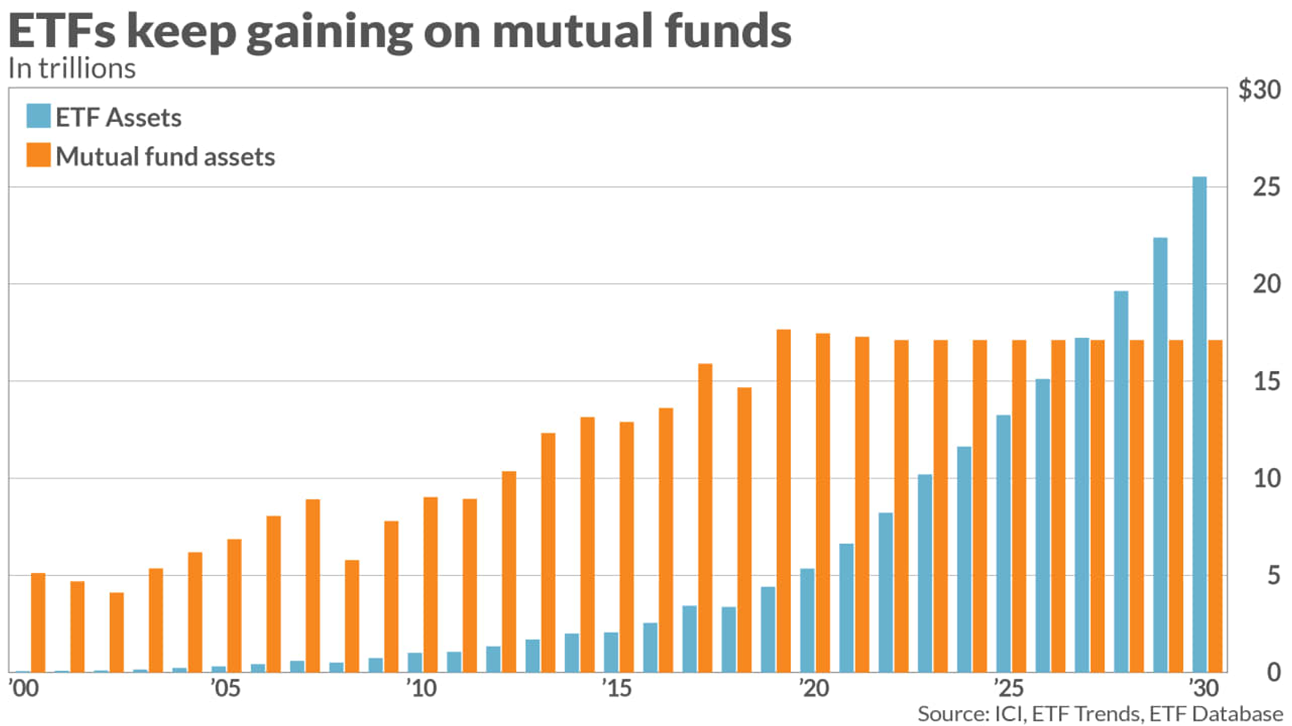
Why is this happening? While mutual funds and ETFs may look similar on the surface, there are several dramatic differences that are driving this new trend.
What is an ETF?
ETF stands for Exchange Traded Fund. On the surface, an ETF looks very similar to an index mutual fund. It’s a basket of securities often used to track an index or an investment theme. For example, Vanguard has the Vanguard S&P 500 Index EFT (Ticker: VOO), but they also have the Vanguard S&P 500 Index Fund (Ticker: VFIAX); both aim to track the performance of the S&P 500 Index, but there are a few differences.
ETFs Trade Intraday
Unlike a mutual fund that only trades at 4pm each day, an ETF can be traded like a stock intraday, so if you want to see $10,000 of the Vanguard S&P 500 ETF at 10am, you can do that, versus if you are invested in the Vanguard S&P 500 Index Fund, it will only trade at 4pm which may be at a better or worse price depending where the S&P 500 index finished the trading day compared to the price at 10am.
How ETFs Are Traded
When it comes to comparing ETFs to Mutual Funds, a big difference is not only WHEN they trade, but also HOW they trade. When you sell a mutual fund, your shares are sold back to the mutual fund company at 4pm and settled in cash. An exchange traded fund trades like a stock where shares are “exchanged” between a buyer and a seller in the open market, which is where ETF’s get their name from. They are “exchanged”, not redeemed like mutual fund shares.
ETF Tax Advantage Over Mutual Funds
One of the biggest advantages of ETFs over mutual funds is their tax efficiency, which relates back to what we just covered about how ETFs are traded. When you redeem mutual fund shares, if the fund company does not have enough in its cash reserve within the mutual fund itself, it has to go on the open market and sell securities to raise cash to meet the redemptions. Like any other type of investment account, if the security that they sell has an unrealized gain, selling the security to raise cash creates a taxable realized gain, and then the mutual fund distributes those gains to the existing shareholders, typically at the end of the calendar year as “capital gains distributions” which are then taxed to the current holders of the mutual funds.
If the current shareholders are holding that mutual fund in a taxable account when the capital gains distribution is issued, the shareholder needs to report that capital gains distribution as taxable income. This never seemed fair because that shareholder didn't redeem any shares, however since the mutual fund had to redeem securities to meet redemptions, the shareholders that remain unfortunately bear the tax burden.
Example: Jim and Sarah both own ABC Growth Fund in their brokerage accounts. ABC has performed well for the past few years, so Sarah decides to sell her shares. The mutual fund company then has to sell shares of stock within its portfolio to meet the redemption request, generating a taxable gain within the mutual fund portfolio. At the end of the year, ABC Growth Fund issues a capital gain distribution to Jim, which he must pay tax on, even though Jim did not sell his shares, Sarah did.
ETFs do not trigger capital gains distributions to shareholders because the shares are exchanged between a buyer and a seller, an ETF company does not have to redeem securities within its portfolio to meet redemptions. So, you could technically have an ABC Growth Mutual Fund and an ABC Growth ETF, same holdings, but the investor that owns the mutual fund could be getting hit with taxed on capital gains distribution each year while the holder of the ETF has no tax impact until they sell their shares.
Holding ETFs In A Taxable Account vs Retirement Account
Tax efficiency matters the most in taxable accounts, like brokerage accounts. If you are holding an ETF or mutual fund within an IRA or 401(k) account, since retirement accounts by nature are tax deferred, the capital gains distributions being issued by the mutual fund companies do not have an immediate tax impact on the shareholders because of the tax deferred nature of retirement accounts. For this reason, there has been less urgency to transition from mutual funds to ETFs in retirement accounts.
Many ETFs Don’t Trade In Fractional Shares
The second reason why ETFs have been slower to be adopted into employer sponsored retirement plans, like 401(k) plans, is most ETFs, like stocks, only trade in whole shares. Example: If you want to buy 1 share of Google, and Google is trading for $163 per share, you have to have $163 in cash to buy one whole share. You can’t buy $53 of Google because it’s not enough to purchase a whole share. Most ETF’s work the same way. They have a share price like a stock, and you have to purchase them in whole shares. Mutual funds by comparison trade in fractional shares, meaning while the “share price” or “NAV” of a mutual fund may be $80, you can buy $25.30 of that mutual fund because they can be bought and sold in fractional shares.
This is why from an operational standpoint, mutual funds can work better in 401(k) accounts because you have employees making all different levels of contributions each pay period to their 401(K) accounts - Jim is contributing $250 per pay period, Sharon $423 per pay period, Scott $30 per pay period. Since mutual funds can trade in fractional shares, the full amount of those contributions can be invested each pay period, whereas if it was a menu of ETFs that only traded in full shares, there would most likely be uninvested cash left over each pay period because only whole shares can be purchased.
ETF’s Do Not Have Minimum Initial Investments
Another advantage that ETF’s have over mutual funds is they do not have “minimum initial investments” like many mutual funds do. For example, if you look up the Vanguard S&P 500 Index Mutual Fund (Ticker VFIAX), there is a minimum initial investment of $3,000, meaning you must have at least $3,000 to buy a position in that mutual fund. Whereas the Vanguard S&P 500 Index ETF (Ticker: VOO) does not have a minimum initial investment, the current share price is $525.17, so you just need $525,17 to purchase 1 share.
NOTE: I’m not picking on Vanguard, they are in a lot of my example because we use Vanguard in our client portfolios, so we are very familiar with how their mutual funds and ETFs operate.
ETFs Do Not CLOSE To New Investors
Every now and then a mutual fund will declare either a “soft close” or “hard close”. A soft close means the mutual fund is closed to “new investors” meaning if you currently have a position in the mutual fund, you are allowed to continue to make deposits, but if you don’t already own the mutual fund, you can no longer buy it. A “hard close” is when both current and new investors are no longer allowed to purchase shares of the mutual fund, existing shareholders are only allowed to sell their holdings.
Mutual Funds will sometimes do this to protect performance or their investment strategy. If you are managing a Small Cap Value Mutual Fund and you receive buy orders for $100 billion, it may be difficult, if not impossible to buy enough of the publicly traded small cap stock to put that cash to work. Then, the fund manager might have to expand the stock holding to “B team” selections, or begin buying mid-cap stock which creates style drift out of the core small cap value strategy. To prevent this, the mutual fund will announce either a soft or hard close to prevent these big drifts from happening.
Arguably a good thing, but if you love the fund, and they tell you that you can’t put any more money into it, it can be a headache for current shareholders.
Since ETFs trade in the open market between buyers and sellers, they cannot implement hard or soft closes, it just becomes, ‘how much are the current holders of the ETF willing to sell their shares for in the open market to the buyers’.
ETFs Can Offer A Wider Selection of Investment Strategies
With ETFs, there are also a wider variety of investment strategies to choose from and the number of ETFs available in the open market are growing rapidly.

For example, if you want to replicate the performance of Brazil’s stock market within your portfolio, iShares has an ETF called MSCI Brazil (Ticker: EWZ) which seeks to track the investment results of an index composed of Brazilian equities. While traditional indexes exist within the ETF world like tracking the total bond market or S&P 500 Index, EFTs can provide access to more limited scope investment strategies.
ETF Liquidity Risk
But this brings me to one of the risks that shareholders need to be aware of when buying thinly traded ETFs. Since they are exchange traded funds, if you want to sell your position, you need a buyer that wants to buy your shares, otherwise there is no way to sell your position. One of the metrics we advise individuals to look at before buying an ETF is the daily trade volume of that security to determine how easily or difficult it would be to find a buyer for your shares if you wanted to sell them.
For example, VOO, the Vanguard S&P 500 Index ETF has an average trading volume right now about 5 million shares and as the current share price is about $2.6 Billion in activity each day, there is a high probability that if you wanted to sell $500,000 of your VOO, that order could be easily filled. If instead, you are holding a very thinly traded ETF that only has an average trading volume of 100,000 share per day and you are holding 300,000 shares, it may take you a few days or weeks to sell your position and your activity could negatively impact the price as you try to sell because it could move the market with your trade given the light trading volume. Or worse, there is no one interested in buying your shares, so you are stuck with them. You just have to do your homework when investing the more thinly traded ETFs.
Passive & Active ETFs
Similar to mutual funds, there are both passive and active ETF’s. Passive ETFs aim to replicate the performance of an existing index like the S&P 500 Index or a bond index, while active strategy ETFs are trying to outperform a specific index through the implementation of their investment strategy within the ETF.
About Michael……...
Hi, I’m Michael Ruger. I’m the managing partner of Greenbush Financial Group and the creator of the nationally recognized Money Smart Board blog . I created the blog because there are a lot of events in life that require important financial decisions. The goal is to help our readers avoid big financial missteps, discover financial solutions that they were not aware of, and to optimize their financial future.
Frequently Asked Questions (FAQs):
How do ETFs differ from mutual funds in how they trade?
Mutual funds trade once per day at their net asset value (NAV) after the market closes, while ETFs trade throughout the day on stock exchanges at market prices. This gives ETF investors the ability to buy or sell shares at real-time prices, offering more flexibility and control.
Why are ETFs considered more tax-efficient than mutual funds?
ETFs are structured so that shares are exchanged between investors rather than redeemed by the fund itself. This means ETFs typically do not have to sell underlying securities to meet redemptions, helping investors avoid unexpected capital gains distributions that are common with mutual funds.
Are ETFs better suited for taxable or retirement accounts?
ETFs tend to be more tax-efficient, which makes them especially advantageous in taxable brokerage accounts. In tax-deferred retirement accounts like IRAs or 401(k)s, the tax efficiency difference between ETFs and mutual funds is less significant.
Why are mutual funds still common in 401(k) plans?
Mutual funds can trade in fractional shares, allowing every dollar of an employee’s contribution to be invested immediately. Most ETFs trade only in whole shares, which can leave small amounts of uninvested cash in retirement plans with frequent payroll contributions.
Do ETFs have minimum investment requirements?
Unlike many mutual funds that require a minimum initial investment, ETFs typically have no such minimums beyond the cost of a single share. This makes ETFs more accessible to investors who want to start with smaller amounts.
What risks should investors consider when buying ETFs?
One key risk is liquidity. Thinly traded ETFs may be harder to sell quickly or at a favorable price, especially for large positions. Checking an ETF’s average daily trading volume can help investors assess how easily they can enter or exit a position.
