Special Tax Considerations in Retirement

By Michael Ruger, CFP®
Partner and Chief Investment Officer at Greenbush Financial Group
You might think that once you stop working, your tax situation becomes simpler — after all, no more paychecks! But for many retirees, taxes actually become more complex. That’s because retirement often comes with multiple income sources — Social Security, pensions, pre-tax retirement accounts, brokerage accounts, cash, and more.
At the same time, retirement can present unique tax-planning opportunities. Once the paychecks stop, retirees often have more control over which tax bracket they fall into by strategically deciding which accounts to pull income from.
In this article, we’ll cover:
How Social Security benefits are taxed
Pension income rules (and how they vary by state)
Taxation of pre-tax retirement accounts like IRAs and 401(k)s
Developing an efficient distribution strategy
Special tax deductions and tax credits for retirees
Required Minimum Distribution (RMD) planning
Charitable giving strategies, including QCDs and donor-advised funds
How Social Security Is Taxed
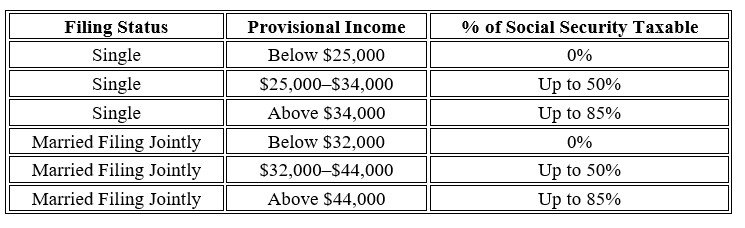
Social Security benefits may be tax-free, partially taxed, or mostly taxed — depending on your provisional income. Provisional income is calculated as:
Adjusted Gross Income (AGI) + Nontaxable Interest + ½ of Your Social Security Benefits.
Here’s a quick summary of how benefits are taxed at the federal level:
While Social Security is taxed at the federal level, most states do not tax these benefits. However, a handful of states — including Colorado, Kansas, Minnesota, Missouri, Montana, Nebraska, New Mexico, Rhode Island, Utah, and Vermont — do impose some form of state tax on Social Security income.
Pension Income
If you’re fortunate to receive a state pension, your state of residence plays a big role in determining how that income is taxed.
If you have a state pension and continue living in the same state where you earned the pension, many states exclude that income from state tax.
However, with state pensions, if you move to another state, and that state has income taxation at the stateve level, your pension may become taxable in your new state of domicile.
If you have a pension with a private sector employer, often times those pension payment are full taxable at both the federal and state level.
Some states also provide preferential treatment for private pensions or IRA income. For example, New York excludes up to $20,000 per person in pension or IRA distributions from state income tax each year — a significant benefit for retirees managing taxable income.
Taxation of Pre-Tax Retirement Accounts
Pre-tax retirement accounts — including Traditional IRAs, 401(k)s, 403(b)s, and inherited IRAs — are typically taxed as ordinary income when distributions are made.
However, the tax treatment at the state level varies:
Some states (like New York) exclude a set amount – for example New York excludes the first $20,000 per person per year — from state taxation.
Others tax all pre-tax distributions in full.
A few states offer income-based exemptions or reduced rates for lower-income retirees.
Because these rules differ so widely, it’s important to research your state’s tax laws.
Developing a Tax-Efficient Distribution Strategy
A well-designed distribution strategy can make a big difference in how much tax you pay throughout retirement.
Many retirees have income spread across:
Pre-tax accounts (401(k), IRA)
After-tax brokerage accounts
Roth IRAs
Social Security
Let’s say you need $70,000 per year to maintain your lifestyle. Some of that may come from Social Security, but you’ll need to decide where to withdraw the rest.
With smart planning, you can blend withdrawals from different accounts to minimize your overall tax liability and control your tax bracket year by year. The goal isn’t just to reduce taxes today — it’s to manage them over your lifetime.
Special Deductions and Credits in Retirement
Your Adjusted Gross Income (AGI) or Modified AGI doesn’t just determine your tax bracket — it also affects which deductions and credits you can claim.
A few important highlights:
The Big Beautiful Tax Bill that just passed in 2025 introduces a new Age 65+ tax deduction of $6,000 per person over and above the existing standard deduction.
Certain deductions and credits, however, phase out once income exceeds specific thresholds.
Your income level also affects Medicare premiums for Parts B and D, which increase if your income surpasses the IRMAA thresholds (Income-Related Monthly Adjustment Amount).
Managing your taxable income through careful distribution planning can therefore help preserve deductions and keep Medicare premiums lower.
Required Minimum Distribution (RMD) Planning
Once you reach age 73 or 75 (depending on your birth year), you must begin taking Required Minimum Distributions (RMDs) from your pre-tax retirement accounts — even if you don’t need the money.
These RMDs can significantly increase your taxable income, especially when stacked on top of Social Security and other income sources.
A proactive strategy is to take controlled distributions or perform Roth conversions before RMD age. Doing so can reduce the size of your future RMDs and potentially lower your lifetime tax bill by spreading taxable income across more favorable tax years.
Charitable Giving Strategies
Many retirees are charitably inclined, but since most take the standard deduction, they don’t receive an additional tax benefit for their donations.
There are two primary strategies to consider:
Donor-Advised Funds (DAFs) – You can “bunch” several years’ worth of charitable giving into one tax year to exceed the standard deduction, then direct the funds to charities over time.
Qualified Charitable Distributions (QCDs) – Once you reach age 70½, you can donate directly from your IRA to a qualified charity. These QCDs are excluded from taxable income and count toward your RMD once those begin.
Final Thoughts
Retirement opens up new opportunities — and new complexities — when it comes to managing taxes. Understanding how your various income sources interact and planning your distributions strategically can help you:
Reduce taxes over your lifetime
Preserve more of your retirement income
Maintain flexibility and control over your financial future
As always, it’s wise to coordinate with a financial advisor and tax professional to ensure your retirement tax strategy aligns with your goals, income sources, and state tax rules.

About Michael……...
Hi, I’m Michael Ruger. I’m the managing partner of Greenbush Financial Group and the creator of the nationally recognized Money Smart Board blog . I created the blog because there are a lot of events in life that require important financial decisions. The goal is to help our readers avoid big financial missteps, discover financial solutions that they were not aware of, and to optimize their financial future.
Frequently Asked Questions (FAQ)
How are Social Security benefits taxed in retirement?
Depending on your provisional income, up to 85% of your Social Security benefits may be subject to federal income tax. Most states don’t tax these benefits, though a few—including Colorado, Minnesota, and Utah—do.
How is pension income taxed, and does it vary by state?
Pension income is typically taxable at the federal level, but state rules differ. Some states exclude public pensions from taxation or offer partial exemptions—like New York’s $20,000 per person exclusion for pension or IRA income. If you move to another state in retirement, your pension’s tax treatment could change.
What taxes apply to withdrawals from pre-tax retirement accounts?
Distributions from Traditional IRAs, 401(k)s, and similar pre-tax accounts are taxed as ordinary income. Some states offer exclusions or partial deductions, while others tax these withdrawals in full. Understanding your state’s rules is essential for accurate tax planning.
What is a tax-efficient withdrawal strategy in retirement?
A tax-efficient strategy blends withdrawals from different account types—pre-tax, Roth, and after-tax—to control your annual tax bracket. The goal is not just to lower taxes today but to reduce lifetime taxes by managing income across multiple years and minimizing required minimum distributions later.
What new tax deductions or credits are available for retirees?
The 2025 tax law introduced an additional $6,000 deduction per person age 65 and older, in addition to the standard deduction. Keeping taxable income lower through smart planning can also help retirees preserve deductions and avoid higher Medicare IRMAA surcharges.
How do Required Minimum Distributions (RMDs) impact taxes?
Starting at age 73 or 75 (depending on birth year), retirees must withdraw minimum amounts from pre-tax retirement accounts, which increases taxable income. Performing partial Roth conversions or strategic withdrawals before RMD age can help reduce future tax exposure.
What are Qualified Charitable Distributions (QCDs) and how do they work?
QCDs allow individuals age 70½ or older to donate directly from an IRA to a qualified charity, satisfying all or part of their RMD while excluding the amount from taxable income. This strategy helps maximize charitable impact while reducing taxes in retirement.