

The Advantages of Using Appreciated Securities to Fund a Donor-Advised Fund
Many people fund their donor-advised funds with cash, but gifting appreciated securities can be a smarter move. By donating stocks, mutual funds, or ETFs instead of cash, you can avoid capital gains tax and still claim a charitable deduction for the asset’s full market value. Our analysis at Greenbush Financial Group explains how this strategy can create a double tax benefit and help you give more efficiently.

By Michael Ruger, CFP®
Partner and Chief Investment Officer at Greenbush Financial Group
Many individuals fund their donor-advised funds (DAFs) with cash — but they may be missing out on a major tax-saving opportunity. By gifting appreciated securities (such as stocks, mutual funds, or ETFs) from a brokerage account instead of cash, taxpayers can avoid capital gains taxes and still receive a charitable deduction for the fair market value of the gift.
In this article, we’ll cover:
Why donor-advised funds have grown in popularity
The pros and cons of funding a DAF with cash
How gifting appreciated securities can create a double tax benefit
Charitable deduction limitations to keep in mind when using this strategy
The Rise in Popularity of Donor-Advised Funds
Donor-advised funds have become one of the most popular charitable giving vehicles in recent years. Much of this growth is tied to changes in the tax code — particularly the increase in the standard deduction.
Since charitable contributions are itemized deductions, taxpayers must itemize in order to claim them. But with the standard deduction now so high, fewer taxpayers itemize their deductions at all.
For example:
In 2025, the standard deduction for a married couple is $31,500.
Let’s say that a couple pays $10,000 in property taxes and donates $10,000 to charity.
Their total itemized deductions would be $20,000, which is still below the $31,500 standard deduction — meaning they’d receive no additional tax benefit for their $10,000 charitable gift.
That’s where donor-advised funds come in.
If this same couple plans to give $10,000 per year to charity for the next five years (totaling $50,000), they could “bunch” those future gifts into one year by contributing $50,000 to a donor-advised fund today. This larger, one-time contribution would push their itemized deductions well above the standard deduction threshold, allowing them to capture a significant tax benefit in the current year.
Another advantage is flexibility — the funds in a donor-advised account can be invested and distributed to charities over many years. It’s a way to pre-fund future giving while taking advantage of a larger immediate tax deduction.
Funding with Cash
It’s perfectly fine to fund a donor-advised fund with cash, especially if your goal is simply to capture a large charitable deduction in a single tax year.
Cash contributions are straightforward and qualify for a deduction of up to 60% of your adjusted gross income (AGI). But while this approach helps you maximize deductions, there may be an even more tax-efficient way to give — especially if you own highly appreciated investments in a taxable brokerage or trust account.
Using Appreciated Securities to Make Donor-Advised Fund Contributions
A potentially superior strategy is to contribute appreciated securities instead of cash. Doing so provides a double tax benefit:
Avoid paying capital gains tax on the unrealized appreciation of the asset.
Receive a charitable deduction for the fair market value of the donated securities.
Here’s an example:
Suppose you bought Google stock for $5,000, and it’s now worth $50,000.
If you sell the stock and then donate the $50,000 cash to your donor-advised fund, you’d owe capital gains tax on the $45,000 gain.
Alternatively, if you donate the stock directly to your donor-advised fund, you:
Avoid paying tax on that $45,000 unrealized gain, and
Still receive a $50,000 charitable deduction for the fair market value of the stock.
After the transfer, if you’d still like to own Google stock, you can repurchase it within your brokerage account — effectively resetting your cost basis to the current market value. This approach can help manage future capital gains exposure while supporting your charitable goals.
Charitable Deduction Limitations: Cash vs. Appreciated Securities
Whether you donate cash or appreciated securities, it’s important to understand the IRS limits on charitable deductions relative to your income. These limitations are based on a percentage of your adjusted gross income (AGI) and vary depending on the type of asset you donate:

This means if you donate appreciated securities worth more than 30% of your AGI, the excess amount can’t be deducted in the current year — but it can be carried forward for up to five additional years until fully utilized.
Being mindful of these limits ensures that your charitable giving strategy is both tax-efficient and compliant.
Final Thoughts
Using appreciated securities to fund a donor-advised fund can be one of the most effective ways to maximize your charitable impact and minimize taxes. By avoiding capital gains tax on appreciated assets and receiving a deduction for their full fair market value, you can create a powerful, ongoing giving strategy that benefits both your finances and your favorite causes.
Before implementing this strategy, it’s wise to work with your financial advisor or CPA to confirm eligibility, ensure proper documentation, and coordinate timing for optimal tax efficiency.

About Michael……...
Hi, I’m Michael Ruger. I’m the managing partner of Greenbush Financial Group and the creator of the nationally recognized Money Smart Board blog . I created the blog because there are a lot of events in life that require important financial decisions. The goal is to help our readers avoid big financial missteps, discover financial solutions that they were not aware of, and to optimize their financial future.
Frequently Asked Questions (FAQ)
Why is donating appreciated securities to a donor-advised fund more tax-efficient than giving cash?
Donating appreciated securities allows you to avoid paying capital gains tax on the investment’s appreciation while still receiving a charitable deduction for its fair market value.
How does a donor-advised fund help maximize charitable deductions?
A donor-advised fund (DAF) allows you to “bunch” multiple years of charitable contributions into a single tax year, pushing your itemized deductions above the standard deduction threshold. This strategy can help you capture a larger tax benefit in the current year while retaining flexibility to distribute funds to charities over time.
What are the IRS deduction limits for donating appreciated securities versus cash?
Cash donations to public charities or donor-advised funds are generally deductible up to 60% of your adjusted gross income (AGI), while donations of appreciated securities are limited to 30% of AGI. Any unused deductions can typically be carried forward for up to five years.
Can I repurchase the same securities after donating them to a donor-advised fund?
Yes. After donating appreciated securities, you can repurchase the same investment within your brokerage account. This effectively resets your cost basis to the current market value, helping manage future capital gains exposure while maintaining your investment position.
Who might benefit most from using appreciated securities to fund a donor-advised fund?
This strategy is especially beneficial for investors with highly appreciated assets in taxable accounts who want to support charitable causes while reducing taxes. It can also help high-income earners manage taxable income in peak earning years.
What are some common mistakes to avoid when donating appreciated securities?
Common pitfalls include selling the securities before donating them (which triggers capital gains tax) or failing to meet IRS substantiation requirements for non-cash gifts. Working with a financial advisor or CPA ensures proper execution and documentation.






















Planning for Healthcare Costs in Retirement: Why Medicare Isn’t Enough
Healthcare often becomes one of the largest and most underestimated retirement expenses. From Medicare premiums to prescription drugs and long-term care, this article from Greenbush Financial Group explains why healthcare planning is critical—and how to prepare before and after age 65.

By Michael Ruger, CFP®
Partner and Chief Investment Officer at Greenbush Financial Group
When most people picture retirement, they imagine travel, hobbies, and more free time—not skyrocketing healthcare bills. Yet, one of the biggest financial surprises retirees face is how much they’ll actually spend on medical expenses.
Many retirees dramatically underestimate their healthcare costs in retirement, even though this is the stage of life when most people access the healthcare system the most. While it’s common to pay off your mortgage leading up to retirement, it’s not uncommon for healthcare costs to replace your mortgage payment in retirement.
In this article, we’ll cover:
Why Medicare isn’t free—and what parts you’ll still need to pay for.
What to consider if you retire before age 65 and don’t yet qualify for Medicare.
The difference between Medicare Advantage and Medicare Supplement plans.
How prescription drug costs can take retirees by surprise.
The reality of long-term care expenses and how to plan for them.
Planning for Healthcare Before Age 65
For those who plan to retire before age 65, healthcare planning becomes significantly more complicated—and expensive. Since Medicare doesn’t begin until age 65, retirees need to bridge the coverage gap between when they stop working and when Medicare starts.
If your former employer offers retiree health coverage, that’s a tremendous benefit. However, it’s critical to understand exactly what that coverage includes:
Does it cover just the employee, or both the employee and their spouse?
What portion of the premium does the employer pay, and how much is the retiree responsible for?
What out-of-pocket costs (deductibles, copays, coinsurance) remain?
If you don’t have retiree health coverage, you’ll need to explore other options:
COBRA coverage through your former employer can extend your workplace insurance for up to 18 months, but it’s often very expensive since you’re paying the full premium plus administrative fees.
ACA marketplace plans (available through your state’s health insurance exchange) may be an alternative, but premiums and deductibles can vary widely depending on your age, income, and coverage level.
In many cases, healthcare costs for retirees under 65 can be substantially higher than both Medicare premiums and the coverage they had while working. This makes it especially important to build early healthcare costs into your retirement budget if you plan to leave the workforce before age 65.
Medicare Is Not Free
At age 65, most retirees become eligible for Medicare, which provides a valuable foundation of healthcare coverage. But it’s a common misconception that Medicare is free—it’s not.
Here’s how it breaks down:
Part A (Hospital Insurance): Usually free if you’ve paid into Social Security for at least 10 years.
Part B (Medical Insurance): Covers doctor visits, outpatient care, and other services—but it has a monthly premium based on your income.
Part D (Prescription Drug Coverage): Also carries a monthly premium that varies by plan and income level.
Example:
Let’s say you and your spouse both enroll in Medicare at 65 and each qualify for the base Part B and Part D premiums.
In 2025, the standard Part B premium is approximately $185 per month per person.
A basic Part D plan might average around $36 per month per person.
Together, that’s about $220 per person, or $440 per month for a couple—just for basic Medicare coverage. And this doesn’t include supplemental or out-of-pocket costs for things Medicare doesn’t cover.
NOTE: Some public sector or state plans even provide Medicare Part B premium reimbursement once you reach 65—a feature that can be extremely valuable in retirement.
Medicare Advantage and Medicare Supplement Plans
While Medicare provides essential coverage, it doesn’t cover everything. Most retirees need to choose between two main options to fill in the gaps:
Medicare Advantage (Part C) plans, offered by private insurers, bundle Parts A, B, and often D into one plan. These plans usually have lower premiums but can come with higher out-of-pocket costs and limited provider networks.
Medicare Supplement (Medigap) plans, which work alongside traditional Medicare, help pay for deductibles, copayments, and coinsurance.
It’s important not to simply choose the lowest-cost plan. A retiree’s prescription needs, frequency of care, and preferred doctors should all factor into the decision. Choosing the cheapest plan could lead to much higher out-of-pocket expenses in the long run if the plan doesn’t align with your actual healthcare needs.
Prescription Drug Costs: A Hidden Retirement Expense
Prescription drug coverage is one of the biggest cost surprises for retirees. Even with Medicare Part D, out-of-pocket expenses can add up quickly depending on the medications you need.
Medicare Part D plans categorize drugs into tiers:
Tier 1: Generic drugs (lowest cost)
Tier 2: Preferred brand-name drugs (moderate cost)
Tier 3: Specialty drugs (highest cost, often with no generic alternatives)
If you’re prescribed specialty or non-generic medications, you could spend hundreds—or even thousands—per month despite having coverage.
To help, some states offer programs to reduce these costs. For example, New York’s EPIC program helps qualifying seniors pay for prescription drugs by supplementing their Medicare Part D coverage. It’s worth checking if your state offers a similar benefit.
Planning for Long-Term Care
One of the most misunderstood aspects of Medicare is long-term care coverage—or rather, the lack of it.
Medicare only covers a limited number of days in a skilled nursing facility following a hospital stay. Beyond that, the costs become the retiree’s responsibility. Considering that long-term care can easily exceed $120,000 per year, this can be a major financial burden.
Planning ahead is essential. Options include:
Purchasing a long-term care insurance policy to offset future costs.
Self-insuring, by setting aside savings or investments for potential care needs.
Planning to qualify for Medicaid through strategic trust planning
Whichever route you choose, addressing long-term care early is key to protecting both your assets and your peace of mind.
Final Thoughts
Healthcare is one of the largest—and most underestimated—expenses in retirement. While Medicare provides a foundation, retirees need to plan for premiums, prescription costs, supplemental coverage, and potential long-term care needs.
If you plan to retire before 65, early planning becomes even more critical to bridge the gap until Medicare begins. By taking the time to understand your options and budget accordingly, you can enter retirement with confidence—knowing that your healthcare needs and your financial future are both protected.
About Michael……...
Hi, I’m Michael Ruger. I’m the managing partner of Greenbush Financial Group and the creator of the nationally recognized Money Smart Board blog . I created the blog because there are a lot of events in life that require important financial decisions. The goal is to help our readers avoid big financial missteps, discover financial solutions that they were not aware of, and to optimize their financial future.
Frequently Asked Questions (FAQ)
Why isn’t Medicare enough to cover all healthcare costs in retirement?
While Medicare provides a solid foundation of coverage starting at age 65, it doesn’t pay for everything. Retirees are still responsible for premiums, deductibles, copays, prescription drugs, and long-term care—expenses that can add up significantly over time.
What should I do for healthcare coverage if I retire before age 65?
If you retire before Medicare eligibility, you’ll need to bridge the gap with options like COBRA, ACA marketplace plans, or employer-sponsored retiree coverage. These plans can be costly, so it’s important to factor early healthcare premiums and out-of-pocket expenses into your retirement budget.
What are the key differences between Medicare Advantage and Medicare Supplement plans?
Medicare Advantage (Part C) plans combine Parts A, B, and often D, offering convenience but limited provider networks. Medicare Supplement (Medigap) plans work alongside traditional Medicare to reduce out-of-pocket costs. The right choice depends on your budget, health needs, and preferred doctors.
How much should retirees expect to pay for Medicare premiums?
In 2025, the standard Medicare Part B premium is around $185 per month, while a basic Part D plan averages about $36 monthly. For a married couple, that’s roughly $440 per month for both—before adding supplemental coverage or out-of-pocket expenses. These costs should be built into your retirement spending plan.
Why are prescription drugs such a major expense in retirement?
Even with Medicare Part D, out-of-pocket drug costs can vary widely based on your prescriptions. Specialty and brand-name medications often carry high copays. Programs like New York’s EPIC can help eligible seniors manage these costs by supplementing Medicare coverage.
Does Medicare cover long-term care expenses?
Medicare only covers limited skilled nursing care following a hospital stay and does not pay for most long-term care needs. Since extended care can exceed $120,000 per year, retirees should explore options like long-term care insurance, Medicaid planning, or setting aside savings to self-insure.
How can a financial advisor help plan for healthcare costs in retirement?
A financial advisor can estimate future healthcare expenses, evaluate Medicare and supplemental plan options, and build these costs into your retirement income plan. At Greenbush Financial Group, we help retirees design strategies that balance healthcare needs with long-term financial goals.

Special Tax Considerations in Retirement
Retirement doesn’t always simplify your taxes. With multiple income sources—Social Security, pensions, IRAs, brokerage accounts—comes added complexity and opportunity. This guide from Greenbush Financial Group explains how to manage taxes strategically and preserve more of your retirement income.

By Michael Ruger, CFP®
Partner and Chief Investment Officer at Greenbush Financial Group
You might think that once you stop working, your tax situation becomes simpler — after all, no more paychecks! But for many retirees, taxes actually become more complex. That’s because retirement often comes with multiple income sources — Social Security, pensions, pre-tax retirement accounts, brokerage accounts, cash, and more.
At the same time, retirement can present unique tax-planning opportunities. Once the paychecks stop, retirees often have more control over which tax bracket they fall into by strategically deciding which accounts to pull income from.
In this article, we’ll cover:
How Social Security benefits are taxed
Pension income rules (and how they vary by state)
Taxation of pre-tax retirement accounts like IRAs and 401(k)s
Developing an efficient distribution strategy
Special tax deductions and tax credits for retirees
Required Minimum Distribution (RMD) planning
Charitable giving strategies, including QCDs and donor-advised funds
How Social Security Is Taxed
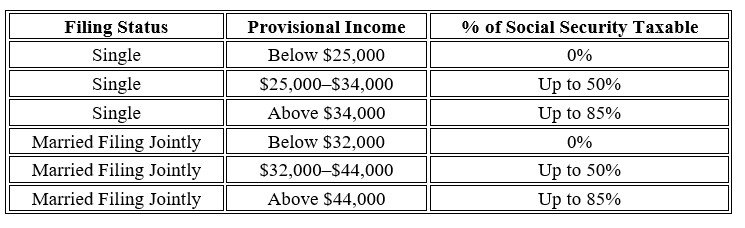
Social Security benefits may be tax-free, partially taxed, or mostly taxed — depending on your provisional income. Provisional income is calculated as:
Adjusted Gross Income (AGI) + Nontaxable Interest + ½ of Your Social Security Benefits.
Here’s a quick summary of how benefits are taxed at the federal level:
While Social Security is taxed at the federal level, most states do not tax these benefits. However, a handful of states — including Colorado, Kansas, Minnesota, Missouri, Montana, Nebraska, New Mexico, Rhode Island, Utah, and Vermont — do impose some form of state tax on Social Security income.
Pension Income
If you’re fortunate to receive a state pension, your state of residence plays a big role in determining how that income is taxed.
If you have a state pension and continue living in the same state where you earned the pension, many states exclude that income from state tax.
However, with state pensions, if you move to another state, and that state has income taxation at the stateve level, your pension may become taxable in your new state of domicile.
If you have a pension with a private sector employer, often times those pension payment are full taxable at both the federal and state level.
Some states also provide preferential treatment for private pensions or IRA income. For example, New York excludes up to $20,000 per person in pension or IRA distributions from state income tax each year — a significant benefit for retirees managing taxable income.
Taxation of Pre-Tax Retirement Accounts
Pre-tax retirement accounts — including Traditional IRAs, 401(k)s, 403(b)s, and inherited IRAs — are typically taxed as ordinary income when distributions are made.
However, the tax treatment at the state level varies:
Some states (like New York) exclude a set amount – for example New York excludes the first $20,000 per person per year — from state taxation.
Others tax all pre-tax distributions in full.
A few states offer income-based exemptions or reduced rates for lower-income retirees.
Because these rules differ so widely, it’s important to research your state’s tax laws.
Developing a Tax-Efficient Distribution Strategy
A well-designed distribution strategy can make a big difference in how much tax you pay throughout retirement.
Many retirees have income spread across:
Pre-tax accounts (401(k), IRA)
After-tax brokerage accounts
Roth IRAs
Social Security
Let’s say you need $70,000 per year to maintain your lifestyle. Some of that may come from Social Security, but you’ll need to decide where to withdraw the rest.
With smart planning, you can blend withdrawals from different accounts to minimize your overall tax liability and control your tax bracket year by year. The goal isn’t just to reduce taxes today — it’s to manage them over your lifetime.
Special Deductions and Credits in Retirement
Your Adjusted Gross Income (AGI) or Modified AGI doesn’t just determine your tax bracket — it also affects which deductions and credits you can claim.
A few important highlights:
The Big Beautiful Tax Bill that just passed in 2025 introduces a new Age 65+ tax deduction of $6,000 per person over and above the existing standard deduction.
Certain deductions and credits, however, phase out once income exceeds specific thresholds.
Your income level also affects Medicare premiums for Parts B and D, which increase if your income surpasses the IRMAA thresholds (Income-Related Monthly Adjustment Amount).
Managing your taxable income through careful distribution planning can therefore help preserve deductions and keep Medicare premiums lower.
Required Minimum Distribution (RMD) Planning
Once you reach age 73 or 75 (depending on your birth year), you must begin taking Required Minimum Distributions (RMDs) from your pre-tax retirement accounts — even if you don’t need the money.
These RMDs can significantly increase your taxable income, especially when stacked on top of Social Security and other income sources.
A proactive strategy is to take controlled distributions or perform Roth conversions before RMD age. Doing so can reduce the size of your future RMDs and potentially lower your lifetime tax bill by spreading taxable income across more favorable tax years.
Charitable Giving Strategies
Many retirees are charitably inclined, but since most take the standard deduction, they don’t receive an additional tax benefit for their donations.
There are two primary strategies to consider:
Donor-Advised Funds (DAFs) – You can “bunch” several years’ worth of charitable giving into one tax year to exceed the standard deduction, then direct the funds to charities over time.
Qualified Charitable Distributions (QCDs) – Once you reach age 70½, you can donate directly from your IRA to a qualified charity. These QCDs are excluded from taxable income and count toward your RMD once those begin.
Final Thoughts
Retirement opens up new opportunities — and new complexities — when it comes to managing taxes. Understanding how your various income sources interact and planning your distributions strategically can help you:
Reduce taxes over your lifetime
Preserve more of your retirement income
Maintain flexibility and control over your financial future
As always, it’s wise to coordinate with a financial advisor and tax professional to ensure your retirement tax strategy aligns with your goals, income sources, and state tax rules.
About Michael……...
Hi, I’m Michael Ruger. I’m the managing partner of Greenbush Financial Group and the creator of the nationally recognized Money Smart Board blog . I created the blog because there are a lot of events in life that require important financial decisions. The goal is to help our readers avoid big financial missteps, discover financial solutions that they were not aware of, and to optimize their financial future.
Frequently Asked Questions (FAQ)
How are Social Security benefits taxed in retirement?
Depending on your provisional income, up to 85% of your Social Security benefits may be subject to federal income tax. Most states don’t tax these benefits, though a few—including Colorado, Minnesota, and Utah—do.
How is pension income taxed, and does it vary by state?
Pension income is typically taxable at the federal level, but state rules differ. Some states exclude public pensions from taxation or offer partial exemptions—like New York’s $20,000 per person exclusion for pension or IRA income. If you move to another state in retirement, your pension’s tax treatment could change.
What taxes apply to withdrawals from pre-tax retirement accounts?
Distributions from Traditional IRAs, 401(k)s, and similar pre-tax accounts are taxed as ordinary income. Some states offer exclusions or partial deductions, while others tax these withdrawals in full. Understanding your state’s rules is essential for accurate tax planning.
What is a tax-efficient withdrawal strategy in retirement?
A tax-efficient strategy blends withdrawals from different account types—pre-tax, Roth, and after-tax—to control your annual tax bracket. The goal is not just to lower taxes today but to reduce lifetime taxes by managing income across multiple years and minimizing required minimum distributions later.
What new tax deductions or credits are available for retirees?
The 2025 tax law introduced an additional $6,000 deduction per person age 65 and older, in addition to the standard deduction. Keeping taxable income lower through smart planning can also help retirees preserve deductions and avoid higher Medicare IRMAA surcharges.
How do Required Minimum Distributions (RMDs) impact taxes?
Starting at age 73 or 75 (depending on birth year), retirees must withdraw minimum amounts from pre-tax retirement accounts, which increases taxable income. Performing partial Roth conversions or strategic withdrawals before RMD age can help reduce future tax exposure.
What are Qualified Charitable Distributions (QCDs) and how do they work?
QCDs allow individuals age 70½ or older to donate directly from an IRA to a qualified charity, satisfying all or part of their RMD while excluding the amount from taxable income. This strategy helps maximize charitable impact while reducing taxes in retirement.

Will Social Security Be There When You Retire?
Social Security is projected to face a funding shortfall in 2034, leading many Americans to wonder if it will still be there when they retire. While the system won’t go bankrupt, benefits could be reduced by about 20% unless Congress acts. Our analysis at Greenbush Financial Group explores what 2034 really means, why lawmakers are likely to intervene, and how to plan your retirement with Social Security uncertainty in mind.

By Michael Ruger, CFP®
Partner and Chief Investment Officer at Greenbush Financial Group
If you’ve looked at your Social Security statement recently, you may have noticed a troubling note: beginning in 2034, the system will no longer have enough funding to pay out full promised benefits. For many Americans, this raises a big question: Will Social Security even be there when I retire?
In this article, we’ll break down:
How Social Security is currently funded and why it faces challenges
What the 2034 date really means (hint: it’s not “bankruptcy”)
Why Congress is likely to act before major benefit cuts happen
Practical solutions that could shore up the system for future retirees
Why meaningful reform may not happen until the last minute
How Social Security Works Today
Social Security is funded primarily through FICA payroll taxes. Workers and employers each pay 6.2% of wages (12.4% total) into the system, which goes toward funding retirement benefits for current retirees.
Here’s the key point: the money doesn’t accumulate in a large “savings account” for future benefits. Instead, today’s payroll taxes go right back out the door to pay today’s beneficiaries. This setup worked well when there were many workers for each retiree, but demographic trends are changing the math.
Baby Boomers are retiring in large numbers.
People are living longer, so they collect benefits for more years.
Birth rates are low, meaning fewer workers are paying into the system.
This imbalance is the root of Social Security’s funding challenge.
What Happens in 2034?
Many people think 2034 is the year Social Security “goes bankrupt.” That’s not the full story.
According to the Social Security Trustees’ report, if Congress does nothing, the system’s trust funds will be depleted by 2034. At that point, incoming payroll taxes would still be enough to pay about 80% of promised benefits.
In practical terms, this would mean an immediate 20% cut in benefits for all recipients. While Social Security wouldn’t disappear, such a cut would have a huge impact on retirees who rely on it as their primary source of income.
Why We Believe Congress Will Act
It’s our opinion that Congress will not allow benefits to be cut so dramatically. Here’s why:
For a large portion of Americans over age 65, Social Security is the primary source of retirement income.
Cutting benefits by 20% would potentially impoverish millions of retirees.
Retirees also represent a powerful voting population, making it politically unlikely that lawmakers would let the system fail without intervention.
That doesn’t mean changes won’t come—but it does make drastic benefit cuts less likely.
Possible Solutions to Fix Social Security
The challenge is real, but there are several practical options available. The earlier these changes are made, the smaller the adjustments need to be. If lawmakers wait until 2034, the fixes may be more drastic. Some of the most common proposals include:
1. Increasing the Taxable Wage Base
Right now, Social Security taxes only apply to wages up to $176,100 (2025 limit). Someone earning $400,000 pays Social Security tax on less than half of their income.
Raising or eliminating the cap would bring more revenue into the system.
While no one likes higher taxes, it may be less painful than the economic impact of the sudden cut in Social Security Benefits starting in 2034
2. Extending the Full Retirement Age
Currently, full retirement age is 67. But Social Security hasn’t been properly indexed for life expectancy. Studies suggest that if it were, the full retirement age could be in the early 70s.
Extending retirement age would reduce how long people collect benefits.
This adjustment reflects the fact that Americans are living longer and the Social Security system was not originally designed to make payments to retirees for 15+ years
3. Limiting Early Filing Options
Right now, many people file early at 62, locking in a reduced benefit.
One proposal is to require younger workers (e.g., those 50 and under) to wait until full retirement age to claim.
This would preserve more assets in the trust over the long term.
Why Reform May Be Delayed
Unfortunately, even though the math is clear, we don’t expect Congress to make many changes before 2034. Why? Because fixing Social Security is a politically unfriendly topic.
To save the system, lawmakers must either raise taxes or cut benefits.
Neither of those options wins votes, which makes reform easy to push off.
This likely means the situation will get more tense as we approach 2034. If reforms aren’t passed in time, one possibility is a government bailout of the Social Security Trust, with additional money created to keep it solvent. While this could buy time, it doesn’t address the underlying funding imbalance—and could carry broader economic consequences.
How We Plan Around Social Security Uncertainty
For our clients, we don’t take a “wait and see” approach. Since we don’t know the exact fate of Social Security, for clients under a specific age, we build retirement plans that assume a reduction in benefits.
If Social Security benefits are reduced in the future, our clients’ plans are already designed to account for the cut, meaning their retirement income won’t be derailed.
If, on the other hand, Congress keeps Social Security fully intact, that’s fantastic—it simply means more income than we initially projected.
This conservative approach provides peace of mind and ensures that retirement strategies remain flexible no matter what happens in Washington.
The Bottom Line
Social Security faces real funding challenges, but it’s highly unlikely to disappear. Instead, it will probably undergo adjustments to ensure long-term solvency.
For retirees and pre-retirees, the key takeaway is this: don’t panic, but don’t ignore it either. Build your retirement plan with the assumption that Social Security may look different in the future. A fee-based financial planner can help you model different scenarios and build a strategy that works no matter how Congress acts.
If you’d like to explore how Social Security fits into your retirement plan, learn more about our financial planning services here.
About Michael……...
Hi, I’m Michael Ruger. I’m the managing partner of Greenbush Financial Group and the creator of the nationally recognized Money Smart Board blog . I created the blog because there are a lot of events in life that require important financial decisions. The goal is to help our readers avoid big financial missteps, discover financial solutions that they were not aware of, and to optimize their financial future.

What Should I Do With My 401(k) From My Old Company?
When you leave a job, your old 401(k) doesn’t automatically follow you. You can leave it in the plan, roll it to your new employer’s 401(k), move it to an IRA, or cash it out. Each choice has different tax, investment, and planning implications.

Changing jobs often means leaving more than just your old desk behind. If you participated in your former employer’s 401(k) plan, you’re now faced with a decision: what should you do with that account?
It’s an important question—one that affects how you manage your retirement savings, your investment options, and potentially your tax situation. In this article, we’ll walk through the four main options for handling an old 401(k), along with the pros, cons, and planning considerations for each.
Option 1: Leave It Where It Is
Most employers allow former employees to leave their 401(k) accounts in the plan, provided the balance exceeds a minimum threshold (usually $7,000).
Pros
No immediate action required
Maintains investment options
Any growth in the account will continue to be tax-deferred
Cons
Potentially limited investment options compared to IRAs
Plan fees may be higher than alternatives
Harder to manage if you accumulate multiple old accounts
When It Makes Sense
If the old plan has strong investment options and low fees—or if you’re not ready to make a rollover decision—this can be a suitable temporary solution.
Option 2: Roll It Over to Your New Employer’s 401(k)
If your new employer offers a 401(k), you may be able to consolidate your old account into the new one.
Pros
Simplifies your retirement accounts
Keeps funds in a tax-advantaged account
May offer access to institutional fund pricing
Allows loans (if the new plan permits)
Cons
New plan may also have limited investment choices
Rollovers can take time and paperwork
Not all plans accept incoming rollovers
When It Makes Sense: If your new plan is well-managed and offers solid investment options and service, this can be a good way to consolidate and simplify your financial life.
Option 3: Roll It Over to an IRA
This is often the most flexible option for those who want greater control over their investments and potentially lower overall fees.
Pros
Broad range of investment choices
Can consolidate multiple old accounts into one
Often lower fees than 401(k) plans
More flexibility with withdrawal and Roth conversion strategies
Cons
Cannot take a loan from an IRA
Creditor protections may be weaker than in a 401(k), depending on your state
When It Makes Sense: If you’re comfortable managing your investments or working with a financial advisor, rolling into an IRA allows for more customization and control—especially when building a tax-efficient retirement income plan.
Option 4: Cash It Out
You always have the option to take the money and run—but doing so comes at a steep cost.
Pros
Provides immediate access to funds
Simple and final
Cons
Subject to income taxes
10% early withdrawal penalty if under age 59½
Permanently reduces your retirement savings
When It Makes Sense: Rarely. This is generally a last resort option, appropriate only in cases of financial emergency or if the balance is very small.
Additional Considerations
Check for Roth balances
Some plans allow Roth 401(k) contributions. If you have both pre-tax and Roth dollars, each portion must be rolled over correctly—to a Traditional IRA and Roth IRA respectively.
Watch for employer stock
If your 401(k) includes company stock, you may be eligible for Net Unrealized Appreciation (NUA) treatment, a tax strategy worth exploring with a professional.
Don’t miss the deadline
If you request a check and don’t complete a rollover within 60 days, it’s considered a distribution and taxed accordingly.
Final Thoughts
If you’ve left a job and have an old 401(k) sitting idle, now is the time to make a plan. Whether you leave it where it is, roll it over to your new plan or IRA, or—less ideally—cash it out, the decision should align with your long-term retirement goals, risk tolerance, and tax strategy.
In many cases, rolling the balance into an IRA offers the most flexibility, especially for those interested in managing taxes, investment choices, and future retirement withdrawals. If you're unsure which route is best, a financial advisor can help evaluate your options based on your full financial picture.

Rob Mangold
About Rob……...
Hi, I’m Rob Mangold. I’m the Chief Operating Officer at Greenbush Financial Group and a contributor to the Money Smart Board blog. We created the blog to provide strategies that will help our readers personally, professionally, and financially. Our blog is meant to be a resource. If there are questions that you need answered, please feel free to join in on the discussion or contact me directly.








What Happens If You Die Without a Will?
Dying without a will means state laws decide who inherits your assets, not you. It also creates longer, more expensive probate and leaves guardianship decisions for your children up to a judge. This article explores the risks of dying intestate and how a simple will can protect your family.

By Michael Ruger, CFP®
Partner and Chief Investment Officer at Greenbush Financial Group
No one likes to think about their own death, but estate planning is one of the most important financial steps you can take to protect your family and loved ones. One of the simplest — yet most critical — estate planning tools is a will.
Unfortunately, many people pass away without one. According to surveys, more than half of Americans don’t have a will in place. But what really happens if you die without a will?
State laws decide who gets your assets — not you.
The probate process becomes longer, more expensive, and more stressful for your family.
Guardians for minor children are chosen by a judge, not by you.
Children can inherit large sums at age 18 with no safeguards, which can sometimes hurt more than help.
Simple solutions exist — a basic will can often be set up for a minimal cost.
Let’s walk through what happens if you don’t have a will, why that can create complications, and what you can do to avoid these pitfalls.
State Laws Take Over
If you die without a will, you die “intestate.” This means your estate will be distributed according to your state’s intestacy laws. These laws vary by state, but most follow a general pattern:
If you’re married, your assets may be split between your spouse and children.
If you’re single with children, everything generally goes to your kids in equal shares.
If you have no spouse or children, assets may pass to your parents, siblings, nieces, nephews, or more distant relatives.
The problem? State law or a judge, who doesn’t know you or your family dynamics will decide how your estate is distributed. You lose the ability to decide who receives what, when they receive it, or under what conditions.
A Longer, More Expensive Probate Process
With a valid will, your executor follows your instructions and distributes assets relatively quickly. Without a will, the court must:
Appoint an executor (which may take time and spark disagreements).
Require appraisals of property, attorney involvement, and court oversight.
Follow state intestacy laws to distribute assets.
This makes the probate process longer, more complicated, and often more expensive. Beneficiaries can wait months — even years — before assets are fully distributed.
For families already grieving a loss, this added complexity can be emotionally draining.
The Stakes Are Higher With Minor Children
If you have children under 18, the consequences of dying without a will become even more serious.
Guardianship: A judge will appoint a guardian for your children, without knowing who you would have chosen.
Inheritance access: At age 18, children may receive their full inheritance outright.
That means a teenager could suddenly inherit hundreds of thousands of dollars from life insurance, retirement accounts, or the sale of your home. Without safeguards in place, that money may not be used wisely and could dramatically affect your child’s life path.
A properly drafted will (or even better, a trust) can set rules, such as delaying inheritance until your children reach a more mature age or providing funds gradually over time.
Probate Isn’t the Only Issue
Estate planning attorneys often recommend going one step further than a will to avoid probate altogether. Common strategies include:
Revocable living trust: Assets in a trust bypass probate and are distributed privately according to your instructions.
Transfer on Death (TOD) accounts: Bank and brokerage accounts with TOD designations pass directly to beneficiaries without probate.
Beneficiary designations: Retirement accounts and life insurance policies allow you to name beneficiaries directly, which supersedes a will.
These strategies not only streamline the distribution process but can also protect your family from unnecessary legal fees and court delays.
A Will Doesn’t Have to Be Expensive
One of the biggest misconceptions is that creating a will is time-consuming or costly. In reality, establishing a will can be very inexpensive:
Online services like LegalZoom.com or Rocket Lawyer can help you set up a simple will for a minimal fee.
While these are good starting points, we recommend working with an estate attorney if your situation is more complex — especially if you have children, significant assets, or unique wishes.
Think of a will as one of the most affordable forms of “insurance” you can buy. For a small upfront cost, you can save your family thousands of dollars, countless hours, and significant emotional stress later.
Final Thoughts
If you die without a will, the state — not you — decides how your assets are distributed and who cares for your children. The probate process becomes more costly, more time-consuming, and much more stressful for your loved ones.
The good news is that creating a will is relatively easy and inexpensive. Whether through a simple online service or a consultation with an estate attorney, taking this step ensures you stay in control and your family is protected.
At the end of the day, a will is about more than just money — it’s about peace of mind.
About Michael……...
Hi, I’m Michael Ruger. I’m the managing partner of Greenbush Financial Group and the creator of the nationally recognized Money Smart Board blog . I created the blog because there are a lot of events in life that require important financial decisions. The goal is to help our readers avoid big financial missteps, discover financial solutions that they were not aware of, and to optimize their financial future.
Frequently Asked Questions (FAQs)
What happens if you die without a will?
If you die without a will, your estate is distributed according to your state’s intestacy laws. This means a court decides who receives your assets and when, which can lead to outcomes you may not have intended.
How does dying without a will affect the probate process?
Without a will, the probate process is usually longer, more expensive, and more complicated. The court must appoint an executor, oversee asset distribution, and may require appraisals or attorney involvement—all of which add time and cost.
What happens to minor children if a parent dies without a will?
If you have minor children and no will, a judge will decide who becomes their guardian. In addition, any inheritance they receive becomes theirs outright at age 18, without safeguards to ensure it’s managed responsibly.
Can you avoid probate without a will?
Yes. Using tools like revocable living trusts, Transfer on Death (TOD) accounts, and beneficiary designations can help assets pass directly to heirs without going through probate. These strategies can save time and reduce legal expenses.
Is creating a will expensive or time-consuming?
Creating a basic will is typically affordable and straightforward. Online services can help for a low cost, while more complex situations may benefit from an estate attorney’s guidance.
Why is having a will so important?
A will ensures your wishes are honored, your loved ones are protected, and your estate is distributed efficiently. It also provides peace of mind knowing your family won’t face unnecessary legal or financial burdens during an already difficult time.

If You Retire With $1 Million, How Long Will It Last?
Is $1 million enough to retire? The answer depends on withdrawal rates, inflation, investment returns, and taxes. This article walks through different scenarios to show how long $1 million can last and what retirees should consider in their planning.

By Michael Ruger, CFP®
Partner and Chief Investment Officer at Greenbush Financial Group
Retirement planning often circles around one big question: If I save $1 million, how long will it last once I stop working? The answer isn’t one-size-fits-all. It depends on a handful of key factors, including:
Your annual withdrawal rate
Inflation (the rising cost of goods and services over time)
Your assumed investment rate of return
Taxes (especially if most of your money is in pre-tax retirement accounts)
In this article, we’ll walk through each of these factors and then run the numbers on a few different scenarios. By the end, you’ll have a much clearer idea of how far $1 million can take you in retirement.
Step 1: Determining Your Withdrawal Rate
Your withdrawal rate is simply the amount of money you’ll need to take from your retirement accounts each year to cover living expenses. Everyone’s number looks different:
Some retirees might only need $60,000 per year after tax.
Others might need $90,000 per year after tax.
The key is to determine your annual expenses first. Then consider:
Other income sources (Social Security, pensions, part-time work, rental income, etc.)
Tax impact (if pulling from pre-tax accounts, you’ll need to withdraw more than your net spending need to cover taxes).
For example, if you need $70,000 in after-tax spending money, you might need to withdraw closer to $75,000–$90,000 per year from your 401(k) or IRA to account for taxes.
Step 2: Don’t Forget About Inflation
Inflation is the silent eroder of retirement plans. Even if you’re comfortable living on $70,000 today, that number won’t stay static. If we assume a 3% inflation rate, here’s how that changes over time:
At age 65: $70,000
At age 80: $109,000
At age 90: $147,000
Expenses like healthcare, insurance, and groceries tend to rise faster than other categories, so it’s critical to build inflation adjustments into your plan.
Step 3: The Assumed Rate of Return
Once you retire, you move from accumulation mode (saving and investing) to distribution mode (spending down your assets). This shift raises important questions about asset allocation.
During accumulation years, you weren’t withdrawing, so market dips didn’t permanently hurt your portfolio.
In retirement, selling investments during downturns locks in losses, making it harder for your account to recover.
That’s why most retirees take at least one or two “step-downs” in portfolio risk when they stop working.
For most clients, a reasonable retirement assumption is 4%–6% annual returns, depending on risk tolerance.
Step 4: The Impact of Taxes
Taxes can make a significant difference in how long your retirement savings last.
If most of your money is in pre-tax accounts (401k, traditional IRA), you’ll need to gross up withdrawals to cover taxes.
Example: If you need $80,000 after tax, and your tax bill is $10,000, you’ll really need to withdraw $90,000 from your retirement accounts.
Now, if you have Social Security income or other sources, that reduces how much you need to pull from your investments.
Example:
Annual after-tax expenses: $80,000
Grossed-up for taxes: $90,000
Social Security provides: $30,000
Net needed from retirement accounts: $60,000 (indexed annually for inflation)
Scenarios: How Long Does $1 Million Last?
Now let’s put the numbers into action. Below are four scenarios that show how long a $1 million retirement portfolio lasts under different withdrawal rates. Each assumes:
Retirement age: 65
Beginning balance: $1,000,000
Inflation: 3% annually
Investment return: 5% annually
Scenario 1: Withdrawal Rate $40,000 Per Year
Assumptions:
Annual withdrawal: $40,000 (indexed for 3% inflation)
Rate of return: 5%
Result: Portfolio lasts 36 years (until age 100).
Why not forever? Because inflation steadily raises the withdrawal amount. At age 80, withdrawals rise to $62,000/year. By age 90, they reach $83,000/year.
Math Note: For the duration math, while age 90 minus age 65 would be 35 years. We are also counting the first year age 65 all the way through age 90, which is technically 36 years. (Same for all scenarios below)
Scenario 2: Withdrawal Rate $50,000 Per Year
Assumptions:
Annual withdrawal: $50,000 (indexed for 3% inflation)
Rate of return: 5%
Result: Portfolio lasts 26 years (until age 90).
By age 80, withdrawals grow to $77,000/year. By age 90, they reach $104,000/year.
Scenario 3: Withdrawal Rate $60,000 Per Year
Assumptions:
Annual withdrawal: $60,000 (indexed for 3% inflation)
Rate of return: 5%
Result: Portfolio lasts 21 years (until age 85).
Scenario 4: Withdrawal Rate $80,000 Per Year
Assumptions:
Annual withdrawal: $80,000 (indexed for 3% inflation)
Rate of return: 5%
Result: Portfolio lasts 15 years (until age 79).
Even if you bump the return to 6%, it only extends one more year to age 80. Higher withdrawals create a significant risk of outliving your money.
Final Thoughts
If you retire with $1 million, the answer to “How long will it last?” depends heavily on your withdrawal rate, inflation, taxes, and investment returns. A $40,000 withdrawal rate can potentially last through age 100, while a more aggressive $80,000 withdrawal rate may deplete funds before age 80.
The bottom line: Everyone’s situation is unique. Your lifestyle, income sources, tax situation, and risk tolerance will shape your plan. This is why working with a financial advisor is so important — to stress-test your retirement under different scenarios and give you peace of mind that your money will last as long as you do.
For more information on our fee based financial planning services to run your custom retirement projections, please visit our website.
About Michael……...
Hi, I’m Michael Ruger. I’m the managing partner of Greenbush Financial Group and the creator of the nationally recognized Money Smart Board blog . I created the blog because there are a lot of events in life that require important financial decisions. The goal is to help our readers avoid big financial missteps, discover financial solutions that they were not aware of, and to optimize their financial future.
Frequently Asked Questions (FAQs)
What is a safe withdrawal rate in retirement?
A commonly used guideline is the 4% rule, meaning you withdraw 4% of your starting balance each year, adjusted for inflation. However, personal factors—such as market performance, expenses, and longevity—should guide your specific rate.
How does inflation affect retirement spending?
Inflation steadily increases the cost of living, which raises how much you need to withdraw each year. At a 3% inflation rate, an annual $70,000 expense today could grow to over $100,000 within 15 years, reducing how long savings can last.
Why do investment returns matter so much in retirement?
Once you start taking withdrawals, poor market performance can have a lasting impact because you’re selling investments during downturns.
How do taxes impact retirement withdrawals?
Withdrawals from pre-tax accounts like traditional IRAs and 401(k)s are taxable, so you may need to take out more than your net spending needs. For instance, needing $80,000 after tax could require withdrawing around $90,000 or more before tax.
What can help make retirement savings last longer?
Strategies like moderating withdrawal rates, maintaining some stock exposure for growth, and factoring in Social Security or pension income can extend portfolio longevity. Regularly reviewing your plan helps ensure it stays aligned with your goals and spending needs.

The Risk of Outliving Your Retirement Savings
Living longer is a blessing, but it also means your savings must stretch further. Rising costs, inflation, and healthcare expenses can quietly erode your nest egg. This article explains how to stress-test your retirement plan to ensure your money lasts as long as you do.

By Michael Ruger, CFP®
Partner and Chief Investment Officer at Greenbush Financial Group
When you imagine retirement, perhaps you see time with family, travel, golf, and more time for your hobbies. What many don’t realize is how two forces—longer lifespans and rising costs—can quietly erode your nest egg while you're still enjoying those moments. Living longer is a blessing, but it means your savings must stretch further. And inflation, especially for healthcare and long-term care, can quietly chip away at your financial comfort over the years. Let’s explore how these factors shape your retirement picture—and what you can do about it.
What you’ll learn in this article:
How life expectancy is evolving, and how it’s increasing the need for more retirement savings
The impact of inflation on a retiree's expenses over the long term
How inflation on specific items like healthcare and long-term care are running at much higher rates than the general rate of inflation
How retirees can test their retirement projections to ensure that they are properly accounting for inflation and life expectancy
How pensions can be both a blessing and a curse
1. Living Longer: A Good But Bad Thing
The Social Security life tables estimate that a 65-year-old male in 2025 is expected to live another 21.6 years (reaching about age 86.6), while a 65-year-old female can expect about 24.1 more years, extending to around 89.1 (ssa.gov).
That has consequences:
If a retiree spends $60,000 per year, a male might need 21.6 × $60,000 = $1,296,000 in total
A female might need 24.1 × $60,000 = $1,446,000
These totals—before considering inflation—highlight how long-term retirement can quickly become a multi-million-dollar endeavor.
2. Inflation: The Silent Retirement Thief
Inflation steadily erodes the real value of money. Over the past 20 years, average annual inflation has held near 3%. Let’s model how inflation reshapes $60,000 in annual after-tax expenses for a 65 year-old retiree over time with a 3% annual increase:
At age 80 (15 years after retirement):
$60,000 × (1.03)^15 ≈ $93,068 per yearAt age 90 (25 years after retirement):
$60,000 × (1.03)^25 ≈ $127,278 per year
In just the first 15 years, this retiree’s annual expenses increased by $33,068 per year, a 55% increase.
3. The Hidden Risk of Relying Too Much on Pensions
One of the most common places retirees feel this pinch is with pensions. Most pensions provide a fixed monthly amount that does not rise meaningfully with inflation. That can create a false sense of security in the early years of retirement.
Example:
A married couple has after-tax expenses of 70,000 per year.
They receive $50,000 from pensions and $30,000 from Social Security.
At retirement, their $80,000 of income in enough to meet their $70,000 in after-tax annual expenses.
Here’s the problem:
The $50,000 pension payment will not increase.
Their expenses, however, will rise with inflation. After 15 years at 3% inflation, those same expenses could total about $109,000 per year.
By then, their combined pension and Social Security will fall well short, forcing them to dip heavily into savings—or cut back their lifestyle.
This illustrates why failing to account for inflation often means retirees “feel fine” at first, only to face an unexpected shortfall 10–15 years later.
4. Healthcare & Long-term Care Expenses
While the general rise in expenses by 3% per year would seem challenging enough, there are two categories of expenses that have been rising by much more than 3% per year for the past decade: healthcare and long-term care. Since healthcare often becomes a large expense for individuals 65 year of age and older, it’s created additional pressure on the retirement funding gap.
Prescription drugs shot up nearly 40% over the past decade, outpacing overall inflation (~32.5%) (nypost.com).
Overall healthcare spending jumped 7.5% from 2022 to 2023, reaching $4.9 trillion—well above historical averages (healthsystemtracker.org).
In-home long-term care is also hefty—median rates for a home health aide have skyrocketed, with 24-hour care nearing $290,000 annually in some cases (wsj.com).
5. The Solution: Projections That Embrace Uncertainty
When retirement may stretch 20+ years, and inflation isn’t uniform across expense categories, guessing leads to risk. A projection-driven strategy helps you:
Model life expectancy: living until age 85 – 95 (depending on family longevity)
Incorporate general inflation (3%) on your expenses within your retirement projections
Determine if you have enough assets to retire comfortably
Whether your plan shows a wide cushion or flags a potential shortfall, you’ll make confident decisions—about savings, investments, expense reduction, or part-time work—instead of crossing your fingers.
6. Working with a Fee-Based Financial Planner Can Help
Here’s the bottom line: Living longer is wonderful, but it demands more planning in the retirement years as inflation, taxes, life expectancy, and long-term care risks continue to create larger funding gaps for retirees.
A fee-based financial planner can help you run personalized retirement projections, taking these variables into account—so you retire with confidence. And if the real world turns out kinder than your model, that's a bonus. If you would like to learn more about our fee-based retirement planning services, please feel free to visit our website at: Greenbush Financial Group – Financial Planning.
Learn more about our financial planning services here.
About Michael……...
Hi, I’m Michael Ruger. I’m the managing partner of Greenbush Financial Group and the creator of the nationally recognized Money Smart Board blog . I created the blog because there are a lot of events in life that require important financial decisions. The goal is to help our readers avoid big financial missteps, discover financial solutions that they were not aware of, and to optimize their financial future.
Frequently Asked Questions (FAQs)
How does longer life expectancy affect retirement planning?
People are living well into their 80s and 90s, meaning retirement savings must cover 20–30 years or more. The longer you live, the more years your portfolio must fund, increasing the importance of conservative withdrawal rates and sustainable planning.
Why is inflation such a big risk for retirees?
Inflation steadily raises the cost of living, reducing the purchasing power of fixed income sources like pensions. Even at a modest 3% inflation rate, living expenses can rise more than 50% over 15 years, requiring larger withdrawals from savings.
How does inflation impact pensions and fixed income sources?
Most pensions don’t increase with inflation, so their purchasing power declines over time. A pension that comfortably covers expenses at retirement may fall short within 10–15 years as costs rise, forcing retirees to draw more from savings.
Why are healthcare and long-term care costs such a concern in retirement?
Healthcare and long-term care expenses have been increasing faster than general inflation. Costs for prescriptions, medical services, and in-home care can grow at 5–7% annually, putting additional strain on retirement savings.
How can retirees plan for inflation and longevity risk?
Running detailed retirement projections that factor in inflation, longer life expectancy, and varying rates of return helps reveal whether savings are sufficient. This approach allows retirees to make informed decisions about spending, investing, and lifestyle adjustments.
When should retirees work with a financial planner?
Consulting a fee-based financial planner early in the retirement planning process can help test different inflation and longevity scenarios. A planner can build customized projections and ensure your plan remains flexible as costs and life circumstances evolve.
