

Special Rules for S-Corps with Employer-Sponsored Retirement Plans
Missing a Required Minimum Distribution can feel overwhelming, but the rules have changed under SECURE Act 2.0. In this article, we explain how to correct a missed RMD, reduce IRS penalties, and file the right tax forms to stay compliant.

By Michael Ruger, CFP®
Partner and Chief Investment Officer at Greenbush Financial Group
S-Corporations can be an excellent structure for small business owners, especially from a tax perspective. But when it comes to retirement plans—such as 401(k)s and profit-sharing plans—S-Corps play by a slightly different set of rules compared to other business entities. Understanding these differences is critical for maximizing retirement savings and avoiding unpleasant surprises.
In this article, we’ll cover:
How compensation is defined for S-Corp owners in a retirement plan
Why relying too heavily on distributions can limit retirement savings
The impact of employer contributions for S-Corp owners with staff
Timing considerations for employee deferrals in S-Corps versus pass-through entities
A practical example that shows how these rules work in real life
W-2 Wages Drive Retirement Contributions for S-Corp Owners
Here’s the key difference:
Partnerships and sole proprietorships – Contributions are based on total pass-through earnings from the business.
S-Corporations – Contributions are based only on W-2 wages paid to the owner.
This matters because many S-Corp owners try to minimize their W-2 salary and take more of their income in shareholder distributions. Distributions avoid payroll taxes, which can be a big tax advantage. But retirement plans only look at W-2 wages when calculating contribution limits.
Example: High Income, Low W-2
Suppose an S-Corp owner earns $500,000 total income, but only pays themselves $100,000 in W-2 wages.
Maximum employer contribution = 25% of W-2 wages = $25,000
Add employee salary deferral = up to $23,500 (2025 limit, or $31,000 if age 50+)
Total = roughly $48,500 (or $56,000 with catch-up)
That’s far below the 2025 annual addition limit of $70,000 ($77,500 with catch-up). By keeping W-2 wages artificially low, the owner unintentionally caps their retirement contributions.
The Ripple Effect on Employees
If the owner sets their employer contribution at 25% of W-2 compensation, that percentage generally applies to eligible employees as well.
In our example, if the owner receives a 25% contribution on $100,000 ($25,000), employees may also need to receive a large employer contribution for the plan to pass testing.
For a company with multiple employees, this can become a very expensive retirement plan design.
Timing of Deferrals: Another S-Corp Quirk
Another important difference involves the timing of employee salary deferrals:
S-Corp owners are on payroll, so any employee deferrals must be processed through payroll no later than the final paycheck in December. If you wait until after year-end, it’s too late to make employee deferrals for that tax year.
Partnership or sole proprietor owners may have more flexibility, since contributions can often be made up to the tax filing deadline (with extensions) and still count toward the prior year.
Translation: If you’re an S-Corp owner, don’t wait until tax season to think about retirement contributions. Deferrals need to be in place before December 31st.
Key Takeaways for S-Corp Owners
Only W-2 wages count toward retirement contributions, not shareholder distributions.
Keeping W-2 wages too low may limit your ability to maximize contributions.
Large employer contributions for the owner can trigger equally large contributions for employees.
Employee salary deferrals must run through payroll and be completed by the last December paycheck.
Careful planning throughout the year—not just at tax time—is essential.
If you’re an S-Corp owner considering a retirement plan, make sure your payroll and compensation strategy aligns with your retirement savings goals. The right plan design can help you strike a balance between tax efficiency today and meaningful retirement wealth in the future.

About Michael……...
Hi, I’m Michael Ruger. I’m the managing partner of Greenbush Financial Group and the creator of the nationally recognized Money Smart Board blog . I created the blog because there are a lot of events in life that require important financial decisions. The goal is to help our readers avoid big financial missteps, discover financial solutions that they were not aware of, and to optimize their financial future.
Frequently Asked Questions (FAQs)
How do retirement plan contributions work for S-Corporation owners?
For S-Corp owners, retirement contributions are based only on W-2 wages—not total business income or shareholder distributions. This makes salary decisions especially important for maximizing 401(k) or profit-sharing plan contributions.
Why can keeping W-2 wages low hurt retirement savings for S-Corp owners?
While taking more income as shareholder distributions can reduce payroll taxes, it also limits how much you can contribute to a retirement plan. Employer contributions are capped at 25% of W-2 wages, so a lower salary means smaller allowable contributions.
How do employer contributions for owners affect employees in an S-Corp retirement plan?
If an owner contributes a high percentage of their W-2 income (such as 25%), nondiscrimination testing may require giving the same percentage to eligible employees. This can significantly increase plan costs for businesses with multiple staff members.
When must S-Corp owners make 401(k) salary deferrals?
Employee deferrals must be processed through payroll no later than the final paycheck of the year. Unlike partnerships or sole proprietors, S-Corp owners cannot make deferrals after December 31 for the prior tax year.
Can S-Corp owners include distributions when calculating 401(k) contributions?
No. Only W-2 wages qualify for retirement plan contribution calculations. Distributions from the S-Corp are not considered “earned income” for 401(k) or profit-sharing purposes.
What steps should S-Corp owners take to maximize retirement contributions?
Plan ahead by setting a reasonable W-2 salary that supports both tax efficiency and contribution goals. Coordinate payroll timing, plan design, and employee testing requirements with your tax advisor and retirement plan administrator early in the year.




















How to Correct Missed Required Minimum Distributions (RMDs)
Missing a Required Minimum Distribution can feel overwhelming, but the rules have changed under SECURE Act 2.0. In this article, we explain how to correct a missed RMD, reduce IRS penalties, and file the right tax forms to stay compliant.
By Michael Ruger, CFP®
Partner and Chief Investment Officer at Greenbush Financial Group
Missing a Required Minimum Distribution (RMD) can cause a lot of stress, especially when you hear the words IRS excise tax. Fortunately, the rules around missed RMDs were updated under the SECURE Act 2.0, which provides some relief compared to the old law. In this article, we’ll break down:
What happens if you miss an RMD and how to correct it
The updated excise tax penalties under SECURE Act 2.0
The “first year” April 1st rule and why you may need to take two RMDs in one year
The new IRS guidance for beneficiaries who inherit retirement accounts
What tax forms need to be filed if you miss an RMD
A quick before-and-after look at the old rules versus SECURE Act 2.0
What Happens if You Miss an RMD?
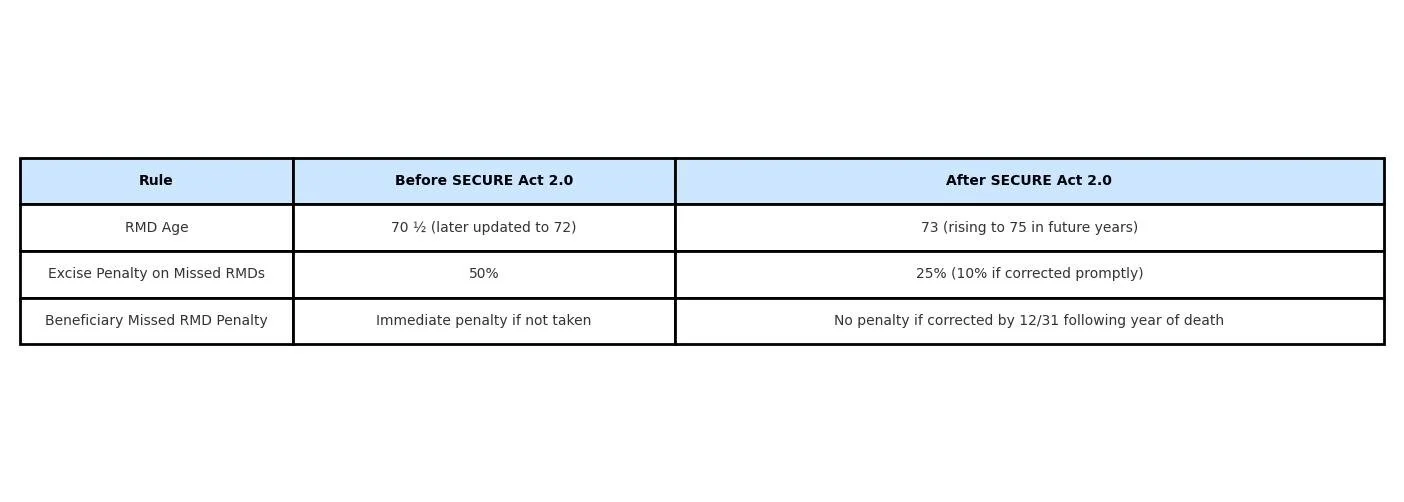
If you forget to take an RMD, the IRS assesses an excise tax penalty on the amount you should have withdrawn. Under the old law, that penalty was steep—50% of the missed RMD.
Under SECURE Act 2.0, the penalty was reduced to a much more manageable amount:
25% penalty on the missed distribution.
If corrected quickly (by taking the missed RMD and filing the proper paperwork), the penalty may be further reduced to 10%.
Example: If you missed a $10,000 RMD:
Old rule: You owed $5,000 in penalties.
New rule: You may owe only $1,000 (if corrected promptly).
The First-Year April 1st Rule
When you reach RMD age (currently age 73 under SECURE Act 2.0), your very first required distribution doesn’t have to be taken in that calendar year. Instead, you can delay it until April 1st of the following year.
But here’s the catch: if you delay your first RMD, you’ll still need to take two RMDs in that next year—the delayed one (by April 1st) plus the regular one (by December 31st).
Example:
Jane turns 73 in 2025.
She can delay her first RMD until April 1, 2026.
If she does, she must also take her 2026 RMD by December 31, 2026—meaning two taxable distributions in one year.
IRS Relief for Inherited Accounts (New Guidance)
For beneficiaries of inherited IRAs or retirement accounts, the IRS just issued new guidance under SECURE Act 2.0.
If a decedent had an RMD due in the year of their death and it wasn’t taken, the beneficiary must still withdraw it. However, the IRS has clarified that as long as the missed RMD is taken by December 31st of the year following the decedent’s death, no excise penalty will be assessed.
This is a significant update and provides more flexibility for beneficiaries who may be navigating a difficult time.
Before SECURE Act 2.0 vs. After
Filing Tax Forms for Missed RMDs
If you missed an RMD, you need to do two things:
Take the missed distribution as soon as possible.
File Form 5329 with your federal tax return to report the missed RMD and calculate the excise penalty.
If you qualify for the reduced 10% penalty, you’ll indicate this on Form 5329.
The actual RMD amount you withdraw will be reported on your Form 1099-R and included in your taxable income for the year you take it.
In some cases, the IRS has historically waived penalties if you can show “reasonable cause” for missing the RMD and that you’ve corrected the mistake. While SECURE Act 2.0 made the penalties less severe, requesting a waiver may still be an option worth considering with your tax professional.
Key Takeaways
SECURE Act 2.0 lowered the penalty for missed RMDs from 50% down to 25% (or 10% if fixed promptly).
The first-year April 1st rule gives you some flexibility but may cause two RMDs in one year.
Beneficiaries now have until December 31st of the year following the decedent’s death to take missed RMDs without penalty.
File Form 5329 to report missed RMDs and claim reduced penalties.
Missing an RMD isn’t ideal, but it’s not the end of the world—especially under the updated SECURE Act 2.0 rules. The most important step is to correct it quickly and make sure you file the proper paperwork with your tax return.
About Michael……...
Hi, I’m Michael Ruger. I’m the managing partner of Greenbush Financial Group and the creator of the nationally recognized Money Smart Board blog . I created the blog because there are a lot of events in life that require important financial decisions. The goal is to help our readers avoid big financial missteps, discover financial solutions that they were not aware of, and to optimize their financial future.
Frequently Asked Questions (FAQs)
What happens if you miss a Required Minimum Distribution (RMD)?
If you miss an RMD, the IRS may assess an excise tax penalty on the amount that should have been withdrawn. Under SECURE Act 2.0, the penalty is now 25% of the missed amount, reduced to 10% if you correct the mistake promptly by taking the distribution and filing the appropriate tax form.
How did SECURE Act 2.0 change the penalties for missed RMDs?
Previously, missing an RMD triggered a 50% penalty on the shortfall. SECURE Act 2.0 lowered this to 25%, with a further reduction to 10% if the missed distribution is corrected in a timely manner. This change provides much-needed relief for retirees who make honest errors.
What is the April 1st rule for first-year RMDs?
When you first reach RMD age (currently 73), you can delay your initial withdrawal until April 1st of the following year. However, doing so means you must take two RMDs that year—the delayed one and the new year’s required amount—potentially increasing your taxable income.
What are the new IRS rules for inherited IRAs and missed RMDs?
If a deceased account owner had an RMD due in the year of death, the beneficiary must still take that distribution. Under new guidance, if the missed RMD is taken by December 31st of the year following the death, no excise penalty will apply.
What should you do if you missed an RMD?
Take the missed distribution as soon as possible and file IRS Form 5329 with your tax return to report the oversight and calculate any applicable penalty. Your financial or tax advisor can help determine if you qualify for the reduced 10% penalty or a possible waiver.
Can the IRS waive the RMD penalty entirely?
Yes. The IRS may waive the penalty if you can demonstrate reasonable cause for missing the RMD and show that you corrected the issue promptly. While SECURE Act 2.0 reduced the penalties, requesting a waiver may still be worthwhile in some cases.
