

When Should High-Income Earners Max Out Their Roth 401(k) Instead of Pre-tax 401(k)?
While pre-tax contributions are typically the 401(k) contribution of choice for most high-income earners, there are a few situations where individuals with big incomes should make their deferrals contribution all in Roth dollars and forgo the immediate tax deduction.

While pre-tax contributions are typically the 401(k) contribution of choice for most high-income earners, there are a few situations where individuals with big incomes should make their deferral contributions all in Roth dollars and forgo the immediate tax deduction.
No Income Limits for Roth 401(k)
It’s common for high income earners to think they are not eligible to make Roth deferrals to their 401(k) because their income is too high. However, unlike Roth IRAs that have income limitations for making contributions, Roth 401(k) contributions have no income limitation.
401(k) Deferral Aggregation Limits
In 2025, the employee deferral limits are $23,500 for individuals under the age of 50, $31,000 for individuals aged 50-59 and 64 and older and $34,750 for individuals age 60-63. If your 401(k) plan allows Roth deferrals, the annual limit is the aggregate between both pre-tax and Roth deferrals, meaning you are not allowed to contribute $23,500 pre-tax and then turn around and contribute $23,500 Roth in the same year. It’s a combined limit between the pre-tax and Roth employee deferral sources in the plan.
Scenario 1: Business Owner Has Abnormally Low-Income Year
Business owners from time to time will have a tough year for their business. They may have been making $300,000 or more per year for the past year but then something unexpected happens or they make a big investment in their business that dramatically reduces their income from the business for the year. We counsel these clients to “never waste a bad year for the business”.
Normally, a business owner making over $300,000 per year would be trying to max out their pre-tax deferral to their 401(K) plans in an effort to reduce their tax liability. But, if they are only showing $80,000 this year, placing a married filing joint tax filer in the 12% federal tax bracket, I’ll ask, “When are you ever going to be in a tax bracket below 12%?”. If the answer is “probably never”, then it an opportunity to change the tax plan, max out their Roth deferrals to the 401(k) plan, and realize that income at their abnormally lower rate. Plus, as the Roth source grows, after age 59 ½ they will be able to withdrawal the Roth source ALL tax free including the earnings.
Scenario 2: Change In Employment Status
Whenever there is a change in employment status such as:
Retirement
High income spouse loses a job
Reduction from full-time to part-time employment
Leaving a high paying W2 job to start a business which shows very little income
All these events may present an abnormally low tax year, similar to the business owner that experienced a bad year for the business, that could justify the switch from pre-tax deferrals to Roth deferrals.
The Value of Roth Compounding
I’ll pause for a second to remind readers of the big value of Roth. With pre-tax deferrals, you realize a tax benefit now by avoiding paying federal or state income taxes on those employee deferrals made to your 401(k) plan. However, you must pay tax on those contributions AND the earnings when you take distributions from that account in retirement. The tax liability is not eliminated, just deferred.
Scenario 3: Too Much In Pre-Tax Retirement Accounts Already
When high income earners have been diligently saving in their 401(k) plan for 30 plus years, sometimes they amass huge pre-tax balances in their retirement plans. While that sounds like a good thing, sometimes it can come back to haunt high-income earnings in retirement when they hit their RMD start date. RMD stands for required minimum distribution, and when you reach a specific age, the IRS forces you to begin taking distributions from your pre-tax retirement account whether you need to our not. The IRS wants their income tax on that deferred tax asset.
The RMD start age varies depending on your date of birth but right now the RMD start age ranges from age 73 to age 75. If for example, you have $3,000,000 in a Traditional IRA or pre-tax 401(k) and you turn age 73 in 2025, your RMD for 2025 would be $113,207. That is the amount that you would be forced to withdrawal out of your pre-tax retirement account and pay tax on. In addition to that income, you may also be showing income from social security, investment income, pension, or rental income depending on your financial picture at age 73.
If you are making pre-tax contributions to your retirement now, normally the goal is to take that income off that table now and push it into retirement when you will hopefully be in a lower tax bracket. However, if your pre-tax balances become too large, you may not be in a lower tax bracket in retirement, and if you’re not going to be in a lower tax bracket in retirement, why not switch your contributions to Roth, pay tax on the contributions now, and then you will receive all of the earning tax free since you will now have money in a Roth source.
Scenario 4: Multi-generational Wealth
It’s not uncommon for individuals to engage a financial planner as they approach retirement to map out their distribution plan and verify that they do in fact have enough to retire. Sometimes when we conduct these meetings, the clients find out that not only do they have enough to retire, but they will not need a large portion of their retirement plan assets to live off and will most likely pass it to their kids as inheritance.
Due to the change in the inheritance rules for non-spouse beneficiaries that inherit a pre-tax retirement account, the non-spouse beneficiary now is forced to deplete the entire account balance 10 years after the decedent has passed AND potentially take RMDs during the 10- year period. Not a favorable tax situation for a child or grandchild inheriting a large pre-tax retirement account.
If instead of continuing to amass a larger pre-tax balance in the 401(k) plan, say that high income earner forgoes the tax deduction and begins maxing out their 401K contributions at $31,000 per year to the Roth source. If they retire at age 65, and their life expectancy is age 90, that Roth contribution could experience 25 years of compounding investment returns and when their child or grandchild inherits the account, because it’s a Roth IRA, they are still subject to the 10 year rule, but they can continue to accumulate returns in that Roth IRA for another 10 years after the decedent passes away and then distribute the full account balance ALL TAX FREE. That is super powerful from a tax free accumulate standpoint.
Very few strategies can come close to replicating the value of this multigenerational wealth accumulation strategy.
One more note about this strategy, Roth sources are not subject to RMDs. Unlike pre-tax retirement plans which force the account owner to begin taking distributions at a specific age, Roth accounts do not have an RMD requirement, so the money can stay in the Roth source and continue to compound investment returns.
Scenario 5: Tax Diversification Strategy
The pre-tax vs Roth deferrals strategy is not an all or nothing decision. You are allowed to allocate any combination of pre-tax and Roth deferrals up to the annual contribution limits each year. For example, a high-income earner under the age of 50 could contribute $13,000 pre-tax and $10,500 Roth in 2025 to reach the $23,500 deferral limit.
Remember, the pre-tax strategy assumes that you will be in lower tax bracket in retirement than you are now, but some individuals have the point of view that with the total U.S. government breaking new debt records every year, at some point they are probably going to have to raise the tax rates to begin to pay back our massive government deficit. If someone is making $300,000 and paying a top Fed tax rate of 24%, even if they expect their income to drop in retirement to $180,000, who’s to say the tax rate on $180,000 income in 20 years won’t be above the current 24% rate if the US government needs to generate more tax return to pay back our national debt?
To hedge against this risk, some high-income earnings will elect to make some Roth deferrals now and pay tax at the current tax rate, and if tax rates go up in the future, anything in that Roth source (unless the government changes the rules) will be all tax free.

About Michael……...
Hi, I’m Michael Ruger. I’m the managing partner of Greenbush Financial Group and the creator of the nationally recognized Money Smart Board blog . I created the blog because there are a lot of events in life that require important financial decisions. The goal is to help our readers avoid big financial missteps, discover financial solutions that they were not aware of, and to optimize their financial future.
Frequently Asked Questions (FAQs):
Can high-income earners make Roth 401(k) contributions?
Yes. Unlike Roth IRAs, Roth 401(k)s have no income limits for eligibility, meaning even high earners can make Roth contributions through their employer’s retirement plan if the plan allows them.
When might it make sense for a high-income earner to choose Roth 401(k) contributions?
Roth contributions can make sense during years of unusually low income or reduced tax brackets — such as a down business year or a job change — since the tax cost of contributing after-tax dollars is lower. These contributions can then grow tax-free for retirement.
How do Roth 401(k) and pre-tax 401(k) contributions differ in taxation?
Pre-tax 401(k) contributions lower taxable income now but are taxed upon withdrawal. Roth 401(k) contributions are made with after-tax dollars, but both contributions and earnings can be withdrawn tax-free in retirement if certain conditions are met.
What happens if you already have large pre-tax retirement balances?
Having too much in pre-tax accounts can lead to large required minimum distributions (RMDs) and higher taxable income in retirement. Switching future contributions to Roth can help balance tax exposure and reduce the impact of RMDs later.
Why might Roth 401(k)s be beneficial for multi-generational wealth planning?
Roth accounts are not subject to RMDs during the account owner’s lifetime and can be passed to heirs who can continue to grow the funds tax-free for up to 10 years. This makes Roth assets a powerful tool for tax-efficient inheritance planning.
Can you combine Roth and pre-tax 401(k) contributions?
Yes. Employees can split their deferrals between Roth and pre-tax sources in any ratio, as long as the combined total does not exceed annual IRS limits. This approach provides tax diversification and flexibility in managing future tax risk.
Why might tax diversification be valuable for retirement planning?
Future tax rates are uncertain, especially given rising government debt levels. Having both pre-tax and Roth sources allows retirees to draw income strategically depending on future tax environments.





















2023 RMDs Waived for Non-spouse Beneficiaries Subject To The 10-Year Rule
There has been a lot of confusion surrounding the required minimum distribution (RMD) rules for non-spouse, beneficiaries that inherited IRAs and 401(k) accounts subject to the new 10 Year Rule. This has left many non-spouse beneficiaries questioning whether or not they are required to take an RMD from their inherited retirement account prior to December 31, 2023. Here is the timeline of events leading up to that answer

There has been a lot of confusion surrounding the required minimum distribution (RMD) rules for non-spouse beneficiaries who inherited IRAs and 401(k) accounts subject to the new 10-Year Rule. This has left many non-spouse beneficiaries questioning whether or not they are required to take an RMD from their inherited retirement account prior to December 31, 2023. Here is the timeline of events leading up to that answer:
December 2019: Secure Act 1.0
In December 2019, Congress passed the Secure Act 1.0 into law, which contained a major shift in the distribution options for non-spouse beneficiaries of retirement accounts. Prior to the passing of Secure Act 1.0, non-spouse beneficiaries were allowed to move these inherited retirement accounts into an inherited IRA in their name, and then take small, annual distributions over their lifetime. This was referred to as the “stretch option” since beneficiaries could keep the retirement account intact and stretch those small required minimum distributions over their lifetime.
Secure Act 1.0 eliminated the stretch option for non-spouse beneficiaries who inherited retirement accounts for anyone who passed away after December 31, 2019. The stretch option was replaced with a much less favorable 10-year distribution rule. This new 10-year rule required non-spouse beneficiaries to fully deplete the inherited retirement account 10 years following the original account owner’s death. However, it was originally interpreted as an extension of the existing 5-year rule, which would not require the non-spouse beneficiary to take annual RMD, but rather, the account balance just had to be fully distributed by the end of that 10-year period.
2022: The IRS Adds RMDs to the 10-Year Rule
In February 2022, the Treasury Department issued proposed regulations changing the interpretation of the 10-year rule. In the proposed regulations the IRS clarified that RMDs would be required for select non-spouse beneficiaries subject to the 10-year rule, depending on the decedent’s age when they passed away. Making some non-spouse beneficiaries subject to the 10-year rule with no RMDs and others subject to the 10-year rule with annual RMDs.
Why the change? The IRS has a rule within the current tax law that states that once required minimum distributions have begun for an owner of a retirement account the account must be depleted, at least as rapidly as a decedent would have, if they were still alive. The 10-year rule with no RMD requirement would then violate that current tax law because an account owner could be 80 years old, subject to annual RMDs, then they pass away, their non-spouse beneficiary inherits the account, and the beneficiary could voluntarily decide not to take any RMDs, and fully deplete the account in year 10 in accordance with the new 10-year rule. So, technically, stopping the RMDs would be a violation of the current tax law despite the account having to be fully depleted within 10 years.
In the proposed guidance, the IRS clarified, that if the account owner had already reached their “Required Beginning Date” (RBD) for required minimum distributions (RMD) while they were still alive, if a non-spouse beneficiary, inherits that retirement account, they would be subject to both the 10-year rule and the annual RMD requirement.
However, if the original owner of the IRA or 401k passes away prior to their Required Beginning Date for RMDs since the RMDs never began if a non-spouse beneficiary inherits the account, they would still be required to deplete the account within 10 years but would not be required to take annual RMDs from the account.
Let’s look at some examples. Jim is age 80 and has $400,000 in a traditional IRA, and his son Jason is the 100% primary beneficiary of the account. Jim passed away in May 2023. Since Jason is a non-spouse beneficiary, he would be subject to the 10-year rule, meaning he would have to fully deplete the account by year 10 following the year of Jim’s death. Since Jim was age 80, he would have already reached his RMD start date, requiring him to take an RMD each year while he was still alive, this in turn would then require Jason to continue those annual RMDs during that 10-year period. Jason’s first RMD from the inherited IRA account would need to be taken in 2024 which is the year following Jim’s death.
Now, let’s keep everything the same except for Jim’s age when he passes away. In this example, Jim passes away at age 63, which is prior to his RMD required beginning date. Now Jason inherits the IRA, he is still subject to the 10-year rule, but he is no longer required to take RMDs during that 10-year period since Jim had not reached his RMD required beginning date at the time that he passed.
As you can see in these examples, the determination as to whether or not a non-spouse beneficiary is subject to the mandatory RMD requirement during the 10-year period is the age of the decedent when they pass away.
No Final IRS Regs Until 2024
The scenario that I just described is in the proposed regulations from the IRS but “proposed regulations” do not become law until the IRS issues final regulations. This is why we advised our clients to wait for the IRS to issue final regulations before applying this new RMD requirement to inherited retirement accounts subject to the 10-year rule.
The IRS initially said they anticipated issuing final regulations in the first half of 2023. Not only did that not happen, but they officially came out on July 14, 2023, and stated that they would not issue final regulations until at least 2024, which means non-spouse beneficiaries of retirement accounts subject to the 10-year rule will not face a penalty for not taking an RMD for 2023, regardless of when the decedent passed away.
Heading into 2024 we will once again have to wait and see if the IRS comes forward with the final regulations to implement the new RMDs rules outlined in their proposed regs.
About Michael……...
Hi, I’m Michael Ruger. I’m the managing partner of Greenbush Financial Group and the creator of the nationally recognized Money Smart Board blog . I created the blog because there are a lot of events in life that require important financial decisions. The goal is to help our readers avoid big financial missteps, discover financial solutions that they were not aware of, and to optimize their financial future.

Requesting FICA Tax Refunds For W2 Employees With Multiple Employers
If you are a W2 employee who makes over $160,200 per year and you have multiple employers or you switched jobs during the year, or you have both a W2 job and a self-employment gig, your employer(s) may be withholding too much FICA tax from your wages and you may be due a refund of those FICA tax overpayments. Requesting a FICA tax refund requires action on your part and an understanding of how the FICA tax is calculated.

If you are a W2 employee who makes over $184,500 per year in 2026 and you have multiple employers or you switched jobs during the year, or you have both a W2 job and a self-employment gig, your employer(s) may be withholding too much FICA tax from your wages and you may be due a refund of those FICA tax overpayments. Requesting a FICA tax refund requires action on your part and an understanding of how the FICA tax is calculated.
How is FICA Tax Calculated
If you are a W2 employee, you will see a FICA deduction on your paychecks, which stands for Federal Insurance Contributions Act. The FICA tax is the funding vehicle for the Medicare and Social Security programs in the U.S. The 7.65% FICA tax consists of 6.2% for Social Security and 1.45% for Medicare, but the 6.2% allocated to Social Security has a cap, which means the government only assesses the 6.2% tax up to a specified wage limit each year. That wage limit is called the “taxable wage base,” and for 2026, the taxable wage base is $184,500. Any income up to the $184,500 taxable wage base is assessed the full 7.65% FICA tax, and any amounts over the taxable wage base are just assessed the 1.45% for Medicare since the Medicare tax does not have a cap.
Note: The IRS taxable wage base usually increases each year.
Employees with Multiple Employers During The Same Tax Year
For employees who work for more than one company during the year and whose total wages are over the $184,500 taxable wage base, this can cause an over-withholding of FICA tax from their wages.
Example: Sue is a doctor employed by XYZ Hospital and earns $150,000 between January and August, then Sue accepts a new position with ABC Hospital and earns $100,000 between September and December. Both XYZ Hospital and ABC Hospital will withhold the full 7.65% in FICA tax from Sue’s paycheck because she was below the taxable wage base of $184,500 with each employer. But Sue is only required to pay the 6.2% Social Security portion of the FICA tax up to $184,500 in wages, so she has too much paid into FICA for the year.
· XYZ Hospital SS 6.2% x $150,000 = $9,300
· ABC Hospital SS 6.2% x $100,000 = $6,200
· Total SS FICA Actually Withheld: $15,500
Annual Limit: SS 6.2% x Taxable Wage Base $184,500 = $11,439
Sue’s FICA tax was over-withheld by $4,061 for the year. So, how does she get that money back from the IRS?
Requesting a FICA Tax Refund (Multiple Employers)
A refund of the excess FICA tax does not automatically occur. In the example above, if Sue identifies the FICA over withholding prior to filing her taxes for the year, she can recapture the excess withholding when she prepares her tax return (1040) for that tax year. The excess FICA withholding is applied as if it were excess federal income tax withholding.
If Sue does not identify the FICA excess withholding until after she has filed her taxes for the year, she could file IRS Form 843 to recover the excess FICA withholding. Thankfully, it’s a very easy tax form to complete. Timing-wise, it may take the IRS 3 to 4 months to review and process your FICA tax refund.
Requesting A FICA Tax Refund (Single Employer)
The FICA tax refund process is slightly different for individuals who have only one employer. Payroll mistakes will sometimes happen, causing an employer to over-withhold FICA taxes from an employee’s wages. In these cases, the IRS requires you first to try to resolve the FICA excess withholding with your employer before submitting Form 843. If resolving the FICA excess withholding is unsuccessful with your employer, you can file Form 843.
Self-Employed FICA Tax Refund
For individuals who have both a W2 job and are also self-employed they can also experience these FICA overpayment situations. Self-employed individuals pay both the employee portion of the FICA 7.65% and the employer portion of FICA 7.65%, for a total of 15.3% on their self-employment income up to the taxable wage base.
For self-employed individuals who are either sole proprietors or partners in a partnership or LLC, they typically do not have wages, so there is no direct FICA withholding as there is with W2 employees. Self-employed individuals make estimated tax payments four times a year to cover both their estimated FICA and income tax liability. If these individuals end up in a FICA overpayment situation due to W2 wages outside of their self-employment income, the overpayment can be applied toward their tax liability for the year or result in a refund from their self-employment income. They typically do not need to file IRS Form 843.
Note: S-Corp owners do have W2 wages
Requesting A Reduction In FICA Withholding
For employees that are in this two-employer situation, and they know they are going to have W2 wages over the taxable wage base, in a perfect world, they would be allowed to submit a request to one of their employers to either reduce or eliminate the social security portion of their FICA withholding to avoid the over withholding during the tax year. However, this is not allowed. Each employer is responsible for withholding the full 7.65% in FICA tax from the employee’s pay up to the taxable wage base, and this approach makes sense because each individual employer has no way of knowing what you earned in W2 wages at your other employers during the year.
3-Year Status of Limitations
If you are reading this article now, but you realize you have had excess FICA withholding for the past few years without requesting a refund, the IRS allows you to go back 3 years to request a refund of those excess FICA withholdings. Anything over 3 years back and you are out of luck, the U.S. government thanks you for your additional donations to Social Security and Medicare trusts.
The Employer Does Not Get A Refund
FICA tax is paid by both the employee and the employer:
· Employee Social Security: 6.2%
· Employer Social Security: 6.2%
· Employee Medicare: 1.45%
· Employer Medicare: 1.45%
· Total FICA EE & ER: 15.3%
So if the employee works for 2 different companies, they have combined wages over the $184,500 taxable wage base, making them eligible for a FICA refund for the 6.2% of social security tax on wages paid over the wage base, does the EMPLOYER also get a refund for those excess FICA withholdings?
The answer, unfortunately, is “No”.
If an employee works for 10 different companies and makes $100,000 in W2 wages with each company, each of those 10 employers would withhold the full FICA tax from that employee’s $100,000 in W2 wages, but since the employee had $1,000,000 in combined wages, they would be due a $50,561 refund in FICA wages ($1M - $184,500 x 6.2%). However, the government keeps that full 6.2% that was paid in by each of the 10 employers with no refund due to any of the companies.
About Michael……...
Hi, I’m Michael Ruger. I’m the managing partner of Greenbush Financial Group and the creator of the nationally recognized Money Smart Board blog . I created the blog because there are a lot of events in life that require important financial decisions. The goal is to help our readers avoid big financial missteps, discover financial solutions that they were not aware of, and to optimize their financial future.
Frequently Asked Questions (FAQs):
What is the FICA tax and how is it calculated?
FICA stands for the Federal Insurance Contributions Act and funds Social Security and Medicare. Employees pay 7.65% of their wages—6.2% for Social Security (up to the annual wage base limit of $176,100 for 2025) and 1.45% for Medicare, which has no wage cap.
Why might someone have excess FICA tax withheld?
Over-withholding often happens when a person works for multiple employers in the same year or switches jobs. Since each employer must withhold FICA up to the wage base limit independently, total Social Security tax paid across employers may exceed the annual maximum.
How can you request a refund for excess FICA tax?
If you have multiple employers and your total wages exceed the Social Security wage base, you can claim the excess FICA withheld as a credit on your tax return (Form 1040). If the overpayment is discovered after filing, you can request a refund by submitting IRS Form 843.
What if the over-withholding happened with only one employer?
When a single employer over-withholds FICA tax, you must first request reimbursement directly from that employer. If the issue is not resolved, you can then file IRS Form 843 to request a refund from the IRS.
How does FICA apply to self-employed individuals?
Self-employed individuals pay both the employee and employer portions of FICA—15.3% total—on net self-employment income up to the taxable wage base. If they also earn W2 wages that cause FICA overpayment, the excess can be credited or refunded when filing their tax return without using Form 843.
Can you ask an employer to stop withholding Social Security tax once you reach the wage limit?
No. Each employer is required by law to withhold FICA taxes on wages up to the annual wage base, even if you exceed the limit when combining income from multiple employers. Any overpayment can only be refunded through the tax filing process.
How far back can you request a FICA refund?
You can claim a refund for FICA overpayments made within the last three years. Refund claims for tax years older than three years are no longer eligible.
Do employers receive a refund for overpaid FICA taxes?
No. The FICA refund applies only to the employee’s portion of Social Security tax. Employers cannot recover their share of FICA contributions, even if an employee earns more than the wage base across multiple jobs.
Last updated June, 2026


Top 10 Things To Know About Filing A Tax Extension
Are you considering filing for a tax extension? It can be a great way to give yourself more time to organize your financial documents and ensure that the information on your return is accurate. But before you file the extension, here are a few things you should know.

There are a number of myths out there about filing a tax extension beyond the April 15th deadline. Many taxpayers incorrectly assume that there are penalties involved or it increases their chances of being audited by the IRS. In reality, filing for an extension can be a great way to give yourself more time to organize your financial documents, identify tax strategies to implement, and ensure that the information on your return is accurate. But before you file the extension, here are a few things you should know.......
1: You must file your extension by April 15th
To apply for an extension, you must file the appropriate paperwork by the April 15th filing deadline. However, filing for an extension does not extend the due date for payment of any taxes owed.
2: What is the extension deadline?
The tax extension filing due date for individual returns is October 15th in most years, but this can vary by a day or two each year, depending on what day of the week the tax deadline or extension deadline falls on. If they fall on a Saturday, Sunday, or Holiday, the IRS will typically move the date to the next business date.
3: How do you file an extension?
You or your accountant can file your extension electronically. This is the quickest and easiest way to file an extension. If you prefer to file your extension by mail, you can do so by filling out Form 4868 and sending it to the IRS.
4: What if you owe taxes?
If you owe taxes, it’s important to remember that filing for an extension does not extend the due date for payment. At least 90% of the tax owed for the year must be paid with the extension. Any remaining balance can be paid by the extended due date, although it will be subject to interest (not penalties). If you do not pay at least 90% of the balance owed, then you will be subject to interest and late payment penalties until the tax is paid.
If you pay your taxes after April 15th but before October 15th, you may be subject to a "failure to pay" penalty. This penalty is typically 0.5% of the tax owed for each month that the taxes remain unpaid, up to a maximum of 25%.
If you pay your taxes after October 15th, the “failure to pay” penalty increases to 1% per month, up to a maximum of 25%. In addition, you may also be subject to a "failure to file" penalty of 5% per month, up to a maximum of 25%.
If you can't pay the taxes due by the April 15th deadline and don't file an extension, you may be subject to both the “failure to pay” and “failure to file” penalties. This can add up to a substantial amount, so it's important to file an extension if you can't pay your taxes by the April 15th due date.
5: What if you are due a refund?
It will not take longer for the IRS to process your refund, however since your return will be submitted at a later date, your refund will be received later than if the return was submitted by April 15th.
6: Are You More Likely To Get Audited By The IRS?
No, there is absolutely no correlation between the filing of an extension and audit risk. However, filing an incomplete or incorrect tax return which necessitates the filing of an amended tax return, can increase your audit risk.
7: Do You Have To Give A Reason To File An Extension?
When you file for an extension, you don’t have to give a reason for why you need the extra time. The IRS will accept your extension request without question.
8: Do You Still Have To Make Estimated Tax Payments?
If you make estimated tax payments each year, filing an extension for the previous tax year, does not extend the due date of making your estimated tax payment for the current tax year on April 15th, June 15th, September 15th, and January 15th.
The penalty for not making estimated tax payments is 4.5% of the unpaid taxes for each quarter that the taxes remain unpaid.
9: IRA Contribution Deadline
Even if you file an extension, IRA contributions must still be made by the April 15th tax deadline.
10: Extra Time To Make Contributions to Employer-Sponsored Retirement Plans
While putting your tax return on extension does not extend the IRA contribution deadline, it does extend the deadline for self-employed individuals making contributions to their employer-sponsored retirement plans, which are not due until a tax filing deadline plus extension. This would include contributions to Simple IRAs, SEP IRAs, Solo(k), Cash Balance Plans, and employer contributions to 401(K) plans.
About Michael……...
Hi, I’m Michael Ruger. I’m the managing partner of Greenbush Financial Group and the creator of the nationally recognized Money Smart Board blog . I created the blog because there are a lot of events in life that require important financial decisions. The goal is to help our readers avoid big financial missteps, discover financial solutions that they were not aware of, and to optimize their financial future.
Frequently Asked Questions (FAQs):
Does filing a tax extension increase your chance of being audited?
No, filing an extension has no impact on your audit risk. The IRS does not view extensions negatively, but submitting incomplete or incorrect returns can increase your chance of being audited later.
When is the tax extension deadline?
For individual taxpayers, the extension deadline is generally October 15th. The exact date can vary slightly each year if it falls on a weekend or federal holiday, in which case it moves to the next business day.
Does a tax extension give you more time to pay taxes owed?
No. An extension only gives you more time to file your return, not to pay your taxes. At least 90% of the total amount owed must be paid by April 15th to avoid penalties and additional interest.
What are the penalties for paying taxes late?
If taxes are unpaid after April 15th, a “failure to pay” penalty of 0.5% per month (up to 25%) applies. After October 15th, the rate increases to 1% per month. A “failure to file” penalty of 5% per month can also apply if no extension was filed.
Can you still contribute to an IRA after filing an extension?
No. IRA contributions must be made by the regular April 15th tax deadline, regardless of whether you file an extension.
Do estimated tax payments change if you file an extension?
No. Estimated tax payments for the current year are still due on April 15th, June 15th, September 15th, and January 15th. Late or missed estimated payments can result in penalties of up to 4.5% per quarter.
Does filing an extension affect retirement plan contribution deadlines?
Yes. While IRA contributions are still due by April 15th, extensions give self-employed individuals extra time to make contributions to employer-sponsored plans such as SEP IRAs, Solo 401(k)s, and Cash Balance Plans.


The New PTET Tax Deduction for Business Owners
The PTET (pass-through entity tax) is a deduction that allows business owners to get around the $10,000 SALT cap that was put in place back in 2017. The PTET allows the business entity to pay the state tax liability on behalf of the business owner and then take a deduction for that expense.
Above is our video about the PTET (pass-through entity tax) deduction which allows business owners to get around the $10,000 SALT cap that was put in place back in 2017. The PTET allows the business entity to pay the state tax liability on behalf of the business owner and then take a deduction for that expense. This special tax deduction can save a business owner thousands of dollars in taxes. Currently, 31 states, including New York, have some form of PTET program. In this video, Dave Wojeski & Michael Ruger will cover:
How the PTET deduction works?
Which type of entities are eligible for the PTET deduction
Deadlines for electing into the PTET program
How the estimated tax payments are calculated and the deadlines for remitting them
Changes to the PTET S-corp rules in 2022
The new NYC PTET program available in 2023
The challenges faced by companies that have multiple owners that are residents of different states
About Michael……...
Hi, I’m Michael Ruger. I’m the managing partner of Greenbush Financial Group and the creator of the nationally recognized Money Smart Board blog . I created the blog because there are a lot of events in life that require important financial decisions. The goal is to help our readers avoid big financial missteps, discover financial solutions that they were not aware of, and to optimize their financial future.
Frequently Asked Questions (FAQs):
What is the Pass-Through Entity Tax (PTET) deduction?
The PTET deduction allows certain business entities to pay state income taxes at the entity level rather than the individual level. This structure helps owners bypass the $10,000 federal cap on state and local tax (SALT) deductions introduced in 2017.
How does the PTET deduction help business owners save on taxes?
By allowing the business entity to pay state taxes directly, the PTET converts what would have been a non-deductible personal expense into a deductible business expense. This can result in significant federal tax savings for eligible owners.
Which types of business entities qualify for the PTET deduction?
Eligible entities typically include pass-through structures such as S corporations, partnerships, and LLCs taxed as partnerships. Sole proprietorships and C corporations are not eligible for the PTET election.
What are the deadlines for electing into the PTET program?
Election deadlines vary by state, but most require entities to opt in annually by a specific date—often tied to the tax filing or estimated payment deadlines. Missing the election deadline usually means waiting until the next tax year to participate.
How are PTET estimated tax payments calculated and when are they due?
Estimated PTET payments are generally based on each owner’s share of income allocated to the state and are due in quarterly installments. Payment schedules vary by state, so it’s important to verify deadlines with each jurisdiction’s tax authority.
What changes were made to the PTET rules for S corporations in 2022?
In 2022, several states, including New York, clarified and expanded PTET rules for S corporations, simplifying how these entities calculate and allocate tax payments among shareholders. These updates aimed to ensure consistent treatment with partnerships.
What should businesses know about the new NYC PTET program introduced in 2023?
New York City launched its own PTET program in 2023, allowing city residents who own eligible pass-through entities to take advantage of an additional deduction at the local level. The program operates separately from the state PTET and requires a separate election.

Additional Disclosure: Wojeski & Company, American Portfolios and Greenbush Financial Group LLC are unaffiliated entities. Neither APFS nor its Representatives provide tax, legal or accounting advice. Please consult your own tax, legal or accounting professional before making any decisions.

401(K) Cash Distributions: Understanding The Taxes & Penalties
When an employee unexpectedly loses their job and needs access to cash to continue to pay their bills, it’s not uncommon for them to elect a cash distribution from their 401(K) account. Still, they may regret that decision when the tax bill shows up the following year and then they owe thousands of dollars to the IRS in taxes and penalties that they don’t have.

When an employee unexpectedly loses their job and needs access to cash to continue to pay their bills, it’s not uncommon for them to elect a cash distribution from their 401(K) account. Still, they may regret that decision when the tax bill shows up the following year and then they owe thousands of dollars to the IRS in taxes and penalties that they don’t have. But I get it; if it’s a choice between working a few more years or losing your house because you don’t have the money to make the mortgage payments, taking a cash distribution from your 401(k) seems like a necessary evil. If you go this route, I want you to be aware of a few strategies that may help you lessen the tax burden and avoid tax surprises after the 401(k) distribution is processed. In this article, I will cover:
How much tax do you pay on a 401(K) withdrawal?
The 10% early withdrawal penalty
The 401(k) 20% mandatory fed tax withholding
When do you remit the taxes and penalties to the IRS?
The 401(k) loan default issue
Strategies to help reduce the tax liability
Pre-tax vs. Roth sources
Taxes on 401(k) Withdrawals
When your employment terminates with a company, that triggers a “distributable event,” which gives you access to your 401(k) account with the company. You typically have the option to:
Leave your balance in the current 401(k) plan (if the balance is over $5,000)
Take a cash distribution
Rollover the balance to an IRA or another 401(k) plan
Some combination of options 1, 2, and 3
We are going to assume you need the cash and plan to take a total cash distribution from your 401(k) account. When you take cash distributions from a 401(k), the amount distributed is subject to:
Federal income tax
State income tax
10% early withdrawal penalty
I’m going to assume your 401(k) account consists of 100% of pre-tax sources; if you have Roth contributions, I will cover that later on. When you take distributions from a 401(k) account, the amount distributed is subject to ordinary income tax rates, the same tax rates you pay on your regular wages. The most common question I get is, “how much tax am I going to owe on the 401(K) withdrawal?”. The answer is that it varies from person to person because it depends on your personal income level for the year. Here are the federal income tax brackets for 2022:
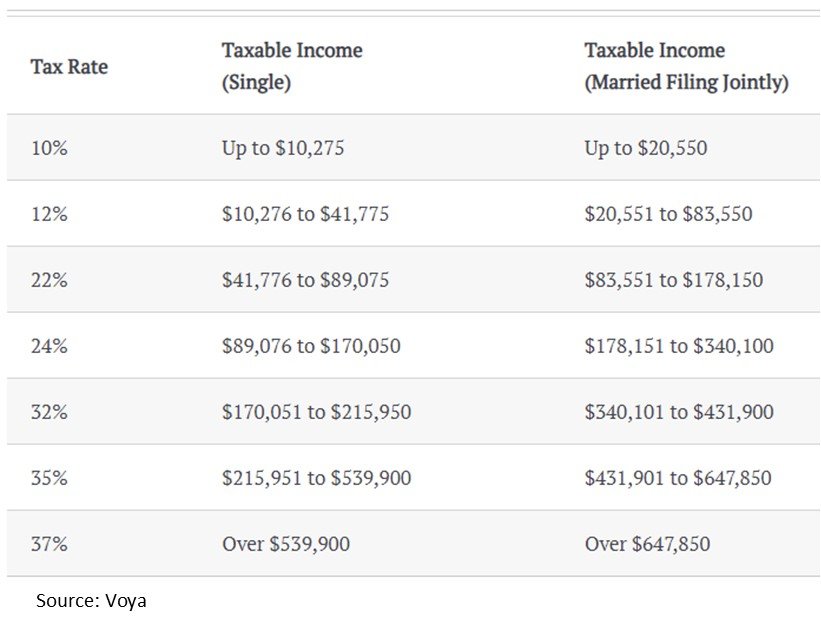
Using the chart above, if you are married and file a joint tax return, and your regular AGI (adjusted gross income) before factoring in the 401(K) distribution is $150,000, if you take a $20,000 distribution from your 401(k) account, it would be subject to a Fed tax rate of 24%, resulting in a Fed tax liability of $4,800.
If instead, you are a single filer that makes $170,000 in AGI and you take a $20,000 distribution from your 401(k) account, it would be subject to a 32% fed tax rate resulting in a federal tax liability of $6,400.
20% Mandatory Fed Tax Withholding Requirement
When you take a cash distribution directly from a 401(k) account, they are required by law to withhold 20% of the cash distribution amount for federal income tax. This is not a penalty; it’s federal tax withholding that will be applied toward your total federal tax liability in the year that the 401(k) distribution was processed. For example, if you take a $100,000 cash distribution from your 401(K) when they process the distribution, they will automatically withhold $20,000 (20%) for fed taxes and then send you a check or ACH for the remaining $80,000. Again, this 20% federal tax withholding is not optional; it’s mandatory.
Here's where people get into trouble. People make the mistake of thinking that since taxes were already withheld from the 401(k) distribution, they will not owe more. That is often an incorrect assumption. In our earlier example, the single filer was in a 32% tax bracket. Yes, they withheld 20% in federal income tax when the distribution was processed, but that tax filer would still owe another 12% in federal taxes when they file their taxes since their federal tax bracket is higher than 20%. If that single(k) tax filer took a $100,000 401(k) distribution, they could own an additional $12,000+ when they file their taxes.
State Income Taxes
If you live in a state with a state income tax, you should also plan to pay state tax on the amount distributed from your 401(k) account. Some states have mandatory state tax withholding similar to the required 20% federal tax withholding, but most do not. If you live in New York, you take a $100,000 401(k) distribution, and you are in the 6% NYS tax bracket, you would need to have a plan to pay the $6,000 NYS tax liability when you file your taxes.
10% Early Withdrawal Penalty
If you request a cash distribution from a 401(k) account before reaching a certain age, in addition to paying tax on the distribution, the IRS also hits you with a 10% early withdrawal penalty on the gross distribution amount.
Under the age of 55: If you are under the age of 55, in the year that you terminate employment, the 10% early withdrawal penalty will apply.
Between Ages 55 and 59½: If you are between the ages of 55 and 59½ when you terminate employment and take a cash distribution from your current employer’s 401(k) plan, the 10% early withdrawal penalty is waived. This is an exception to the 59½ rule that only applies to qualified retirement accounts like 401(k)s, 403(b)s, etc. But the distribution must come from the employer’s plan that you just terminated employment with; it cannot be from a previous employer's 401(k) plan.
Note: If you rollover your balance to a Traditional IRA and then try to take a distribution from the IRA, you lose this exception, and the under age 59½ 10% early withdrawal penalty would apply. The distribution has to come directly from the 401(k) account.
Age 59½ and older: Once you reach 59½, you can take cash distributions from your 401(k) account, and the 10% penalty no longer applies.
When Do You Pay The 10% Early Withdrawal Penalty?
If you are subject to the 10% early withdrawal penalty, it is assessed when you file your taxes; they do not withhold it from the distribution amount, so you must be prepared to pay it come tax time. The taxes and penalties add up quickly; let’s say you take a $50,000 distribution from your 401(k), age 45, in a 24% Fed tax bracket and a 6% state tax bracket. Here is the total tax and penalty hit:
Gross 401K Distribution: $50,000
Fed Tax Withholding (24%) ($12,000)
State Tax Withholding (6%) ($3,000)
10% Penalty ($5,000)
Net Amount: $30,000
In the example above, you lost 40% to taxes and penalties. Also, remember that when the 401(k) platform processed the distribution, they probably only withheld the mandatory 20% for Fed taxes ($10,000), meaning another $10,000 would be due when you filed your taxes.
Strategies To Reduce The Tax Liability
There are a few strategies that you may be able to utilize to reduce the taxes and penalties assessed on your 401(k) cash distribution.
The first strategy involves splitting the distribution between two tax years. If it’s toward the end of the year and you have the option of taking a partial cash distribution in December and then the rest in January, that would split the income tax liability into two separate tax years, which could reduce the overall tax liability compared to realizing the total distribution amount in a single tax year.
Note: Some 401(k) plans only allow “lump sum distributions,” which means you can’t request partial withdrawals; it’s an all or none decision. In these cases, you may have to either request a partial withdrawal and partial rollover to an IRA, or you may have to rollover 100% of the account balance to an IRA and then request the distributions from there.
The second strategy is called “only take what you need.” If your 401(k) balance is $50,000, and you only need a $20,000 cash distribution, it may make sense to rollover the entire balance to an IRA, which is a non-taxable event, and then withdraw the $20,000 from your IRA account. The same taxes and penalties apply to the IRA distribution that applies to the 401(k) distribution (except the age 55 rule), but it allows the $30,000 that stays in the IRA to avoid taxes and penalties.
Strategy three strategy involved avoiding the mandatory 20% federal tax withholding in the same tax year as the distribution. Remember, the 401(K) distribution is subject to the 20% mandatory federal tax withholding. Even though they're sending that money directly to the federal government on your behalf, it actually counts as taxable income. For example, if you request a $100,000 distribution from your 401(k), they withhold $20,000 (20%) for fed taxes and send you a check for $80,000, even though you only received $80,000, the total $100,000 counts as taxable income.
IRA distributions do not have the 20% mandatory federal tax withholding, so you could rollover 100% of your 401(k) balance to your IRA, take the $80,000 out of your IRA this year, which will be subject to taxes and penalties, and then in January next year, process a second $20,000 distribution from your IRA which is the equivalent of the 20% fed tax withholding. However, by doing it this way, you pushed $20,000 of the income into the following tax year, which may be taxed at a lower rate, and you have more time to pay the taxes on the $20,000 because the tax would not be due until the tax filing deadline for the following year.
Building on this example, if your federal tax liability is going to be below 20%, by taking the distribution from the 401K you are subject to the 20% mandatory fed tax withholding, so you are essentially over withholding what you need to satisfy the tax liability which creates more taxable income for you. By rolling over the money to an IRA, you can determine the exact amount of your tax liability in the spring, and distribute just that amount for your IRA to pay the tax bill.
Loan Default
If you took a 401K loan and still have an outstanding loan balance in the plan, requesting any type of distribution or rollover typically triggers a loan default which means the outstanding loan balance becomes fully taxable to you even though no additional money is sent to you. For example, if You have an $80,000 balance in the 401K plan, but you took a loan two years ago and still have a $20,000 outstanding loan balance within the plan, if you terminate employment and request a cash distribution, the total amount subject to taxes and penalties is $100,000, not $80,000 because you have to take the outstanding loan balance into account. This is also true when they assess the 20% mandatory fed tax withholding. The mandatory withholding is based on the balance plus the outstanding loan balance. I mention this because some people are surprised when their check is for less than expected due to the mandatory 20% federal tax withholding on the outstanding loan balance.
Roth 401(k) Early Withdrawal Penalty
401(k) plans commonly allow Roth deferrals which are after-tax contributions to the plan. If you request a cash distribution from a Roth 401(k) source, the portion of the account balance that you actually contributed to the plan is returned to you tax and penalty-free; however, the earnings that have accumulated on that Roth source you have to pay tax and potentially the 10% early withdrawal penalty on. This is different from pre-tax sources which the total amount is subject to taxes and penalties.
About Michael……...
Hi, I’m Michael Ruger. I’m the managing partner of Greenbush Financial Group and the creator of the nationally recognized Money Smart Board blog . I created the blog because there are a lot of events in life that require important financial decisions. The goal is to help our readers avoid big financial missteps, discover financial solutions that they were not aware of, and to optimize their financial future.
Frequently Asked Questions (FAQs):
How much tax do you pay when withdrawing money from a 401(k)?
The amount of tax owed on a 401(k) withdrawal depends on your income and tax bracket for the year. Distributions are taxed as ordinary income, and you may also owe state taxes depending on where you live.
What is the 10% early withdrawal penalty and when does it apply?
If you withdraw funds from your 401(k) before age 59½, the IRS generally imposes a 10% early withdrawal penalty in addition to income taxes. However, if you leave your job in or after the year you turn 55 and withdraw from that employer’s 401(k), the penalty may be waived under the “age 55 rule.”
What is the 20% mandatory federal tax withholding on 401(k) distributions?
When you take a cash distribution from a 401(k), the plan is required by law to withhold 20% of the withdrawal for federal income taxes. This amount is credited toward your total tax bill, but if your actual tax rate is higher than 20%, you may still owe additional taxes when you file.
When are taxes and penalties paid on a 401(k) distribution?
The 20% federal tax withholding is sent directly to the IRS at the time of distribution, but any remaining tax balance and the 10% early withdrawal penalty (if applicable) are paid when you file your tax return. You may also owe state income tax depending on your state’s rules.
What strategies can help reduce the tax burden from a 401(k) withdrawal?
Possible strategies include splitting withdrawals across two tax years, only taking the amount you truly need, or rolling your 401(k) into an IRA before withdrawing funds. IRA distributions don’t have mandatory 20% withholding, giving you more flexibility in managing taxable income.
How does a 401(k) loan affect taxes when you leave your job?
If you have an outstanding 401(k) loan when you terminate employment, the unpaid loan balance is treated as a taxable distribution if not repaid by the plan’s deadline. Taxes and potential penalties apply even though you don’t receive any cash from the defaulted loan amount.
How are Roth 401(k) withdrawals taxed differently?
Withdrawals from Roth 401(k) contributions are tax- and penalty-free since they were made with after-tax dollars. However, any earnings on those contributions are taxable and may be subject to the 10% early withdrawal penalty if taken before age 59½ and before meeting the five-year holding period.


$7,500 EV Tax Credit: Use It or Lose It
Claiming the $7,500 tax credit for buying an EV (electric vehicle) or hybrid vehicle may not be as easy as you think. First, it’s a “use it or lose it credit” meaning if you do not have a federal tax liability of at least $7,500 in the year that you buy your electric vehicle, you cannot claim the full $7,500 credit and it does not carryforward to future tax years.

Claiming the $7,500 tax credit for buying an EV (electric vehicle) or hybrid vehicle may not be as easy as you think. First, it’s a “use it or lose it credit” meaning if you do not have a federal tax liability of at least $7,500 in the year that you buy your electric vehicle, you cannot claim the full $7,500 credit and it does not carryforward to future tax years. Normally, most individuals and business owners adopt tax strategies to reduce their tax liability but this use it or lose it EV tax credit could cause some taxpayers to do the opposite, to intentionally create a larger federal tax liability, if they think their federal tax liability will be below the $7,500 credit threshold.
There are several other factors that you also have to consider to qualify for this EV tax credit which include:
New income limitations for claiming the credit
Limits on the purchase price of the car
The type of EV / hybrid vehicles that qualify for the credit
Inflation Reduction Act (August 2022) changes to the EV tax credit rules
Buying an EV in 2022 vs 2023+
Tax documents that you need to file with your tax return
State EV tax credits that may be available
Inflation Reduction Act Changes To EV Tax Credits
On August 16, 2022, the Inflation Reduction Act was signed into law, which changed the $7,500 EV Tax Credits that were previously available. The new law expanded and limited the EV tax credits depending on your income level, what type of EV car you want, and when you plan to buy the car. Most of the changes do not take place until 2023 and 2024, so depending on your financial situation it may be better to purchase an EV in 2022 or it may be beneficial to wait until 2023+.
$7,500 EV Tax Credit
If you purchase an electronic vehicle or hybrid that qualifies for the EV tax credit, you may be eligible to claim a tax credit of up to $7,500 in the tax year that you purchased the car. This is the government’s way of incentivizing consumers to buy electric vehicles. The Inflation Reduction Act also opened up a new $4,000 tax credit for used EVs.
New Income Limits for EV Tax Credits
Starting in 2023, your income (modified AGI) will need to be below the following thresholds to qualify for the federal EV tax credits on a new EV or hybrid:
Single Filers: $150,000
Married Filing Joint: $300,000
Single Head of Household: $225,000
There are lower income thresholds to be eligible for the used EV tax credit which is as follows:
Single Filers: $75,000
Married Filing Joint: $150,000
Single Head of Household: $112,500
Before the passage of the Income Reduction Act, there were no income limitations to claim the $7,500 Tax Credit. Taxpayers with incomes level above the new thresholds may have an incentive to purchase their new EV before December 31, 2022, before the income limitations take effect in 2023.
Restriction on EV Cars That Qualify
Not all EV or hybrid vehicles will qualify for the EV tax credit. The passage of the Inflation Reduction Act made several changes in this category.
Removal of the Manufacturers Cap
On the positive side, Tesla and GM cars will once again be eligible for the EV tax credit. Under the old EV tax credit rules, once a car manufacturer sold over 200,000 EVs, vehicles made by that manufacturer were no longer eligible for the $7,500 tax credit. The new legislation that just passed eliminated those caps making Tesla, GM, and Toyota vehicles once again eligible for the credit. The removal of the cap does not take place until January 1, 2023.
Purchase Price Limit
Adding restrictions, the Inflation Reduction Act introduced a cap on the purchase price of new EVs and hybrids that qualify for the $7,500 EV tax credit. The limit on the manufacturer’s suggested retail price is as follows:
Sedans: $55,000
SUV / Trucks / Vans: $80,000
If the MSRP is above those prices, the vehicle no longer qualified for the EV tax credit.
Assembly & Battery Requirements
Another change was made to the EV tax credit under the new legislation that will most likely limit the number of vehicles that are eligible for the credit. The new law introduced a final assembly and battery component requirement. First, to be eligible for the credit, the final assembly of the vehicle needs to take place in North America. Second, the battery used to power the vehicle must be made up of key materials and consist of components that are either manufactured or assembled in North America.
Leases Do Not Qualify
If you lease a car, that does not qualify toward the EV tax credit because you technically do not own the vehicle, the manufacturer does. You have to buy the vehicle to be eligible for the $7,500 EV tax credit.
Are You Eligible For The EV Tax Credit?
Bringing everything together, starting in 2023, to determine whether or not you will be eligible for the $7,500 EV Tax Credit, you will have to make sure that:
Your income is below the EV tax credit limits
The purchase price of the vehicle is below the EV tax credit limit
The vehicles assembly and battery components meet the new requirement
Once there is more clarification around the assembly and components piece of the new legislation there will undoubtedly be a website that lists all of the vehicles that are eligible for the $7,500 tax credit that you will be able to use to determine which vehicles qualify.
Timing of The Tax Credit
Under the current EV tax credit rule, you purchase the vehicle now, but you do not receive the tax credit until you file your taxes for that calendar year. Starting in 2024, the tax credit will be allowed to occur at the point of sale which is more favorable for consumers. Logistically, it would seem that an individual would assign the credit to the car dealer, and then the car dealer would receive an advance payment from the US Department of Treasury to apply the discount or potentially allow the car buyer to use the credit toward the down payment on the vehicle.
However, car buyers will have to be careful here. Since your eligibility for the tax credit is income based, if you apply for the credit in advance, but then your income for the year is over the MAGI threshold, you may owe that money back to the IRS when you file your taxes. It will be interesting to see how this is handled since the credits are being awarded in advance.
A Use It or Lose It Tax Credit
There are going to be some challenges with the new EV tax credit rule beyond limiting the number of people that qualify and the number of cars that qualify. The primary one is that the $7,500 EV federal tax credit is not a “refundable tax credit.” A refundable tax credit means if your total federal tax liability is less than the credit, the government gives you a refund of the remaining amount, so you receive the full amount as long as you qualify. The EV tax credit is still a “non-refundable tax credit” meaning if you do not have a federal tax liability of at least $7,500 in the year that you purchase the new EV vehicle, you may lose all or a portion of the $7,500 that you thought you were going to receive.
For example, let’s say you are a single tax filer, and you make $50,000 per year. If you just take the standard deduction, with no other tax deductions, your federal tax liability may be around $4,200 in 2023. You buy a new EV in 2023, you meet the income qualifications, and the vehicle meets all of the manufacturing qualifications, so you expect to receive $7,500 when you file your taxes for 2023. However, since your federal tax liability was only $4,200 and the EV tax credit is not refundable, you would only receive a tax credit of $4,200, not the full $7,500.
No EV Tax Credit Carryforward
With some tax deductions, there is something called tax carryforward, meaning if you do not use the tax deduction in the current tax year, you can “carry it forward” to be used in future tax years to offset future income. The EV tax credit does not allow carryforward, if you can’t use all of it in the year of the EV purchase, you lose it.
Intentionally Creating Federal Tax Liability
If you are in this scenario where you purchase an EV but you expect your federal tax liability to be below the full $7,500 credit threshold, you may have to do what I call “opposite tax planning”. Normally you are trying to find ways to reduce your tax bill, but in these cases, you are trying to find ways to increase your tax liability to get the maximum refund from the government. But how do you intentionally increase your tax liability? Here are a few ideas:
Stop or reduce the contributions being made to your pre-tax retirement accounts. When you make pretax contributions to retirement accounts it reduces your tax liability. But you have to be careful here, if your company offers an employer match, you could be leaving free money on the table, so you have to conduct some analysis here. In many cases, 401(k) / 403(b) allows either pre-tax or Roth contributions. If you are making pre-tax contributions, you may be able to just switch to Roth contributions, which are after-tax contributions, and still take advantage of the employer match.
Push more income into the current tax year. If you are a small business owner, you may want to push more income into the current tax year. If you are a W2 employee, you are expecting to receive a bonus payment, and you have a good working relationship with your employer, you may be able to request that they pay the bonus to you this year as opposed to the spring of next year.
Delay tax-deductible expenses into the following tax year. Again, if you are a small business owner and have control over when you realize expenses, you could push those into the following year. For W2 employees, if you have enough tax deductions to itemize, you may want to push some of the itemized deductions into the following tax year.
Delay getting married until the following tax year. Kidding but not kidding. Nothing says I love you like a full $7,500 tax credit. Use it toward the wedding. You may not qualify under the single file income limit but maybe you would qualify under the joint filer limit.
State EV Tax Credit
The $7,500 EV tax credit is a federal tax credit but some states also have EV tax credits in addition to the federal tax credit and those credits could have different criteria to qualify. It’s worth looking into before purchasing your new or used EV.
EV Tax Credit Tax Forms
In 2022, you apply for the federal EV tax credit when you file your tax return. You will have to file Form 8936 with your tax return.
About Michael……...
Hi, I’m Michael Ruger. I’m the managing partner of Greenbush Financial Group and the creator of the nationally recognized Money Smart Board blog . I created the blog because there are a lot of events in life that require important financial decisions. The goal is to help our readers avoid big financial missteps, discover financial solutions that they were not aware of, and to optimize their financial future.
Frequently Asked Questions (FAQs):
How does the $7,500 federal EV tax credit work?
The federal EV tax credit offers up to $7,500 for purchasing a qualifying new electric or hybrid vehicle. It is a non-refundable credit, meaning you can only claim up to your total federal tax liability for the year—it does not carry forward or result in a refund beyond what you owe.
Who qualifies for the EV tax credit under the Inflation Reduction Act?
Starting in 2023, income limits apply. To qualify, your modified adjusted gross income (MAGI) must be below $150,000 for single filers, $300,000 for joint filers, and $225,000 for heads of household. Lower income thresholds apply for the new $4,000 used EV tax credit.
What are the price limits for vehicles eligible for the EV tax credit?
Under the new rules, sedans must have a manufacturer’s suggested retail price (MSRP) of $55,000 or less, while SUVs, trucks, and vans must be priced at $80,000 or less. Vehicles that exceed these price caps are not eligible for the federal EV tax credit.
What manufacturing requirements must an EV meet to qualify?
To be eligible, the vehicle’s final assembly must take place in North America, and the battery components must include critical materials that are manufactured or assembled in North America. These requirements significantly limit which vehicles qualify.
Do leased vehicles qualify for the EV tax credit?
No. The federal EV tax credit only applies to vehicles purchased outright. Leased vehicles are owned by the manufacturer or leasing company, which may be eligible for the credit instead of the consumer.
When will buyers receive the EV tax credit?
Currently, buyers claim the credit when they file their federal tax return for the year of purchase. Beginning in 2024, the credit can be applied at the point of sale, potentially reducing the vehicle’s purchase price immediately.
What happens if my tax liability is less than $7,500?
If your total federal tax liability is below $7,500, you can only claim the credit up to that amount. Any unused portion is lost because the credit cannot be refunded or carried forward to future tax years.
Are there additional EV incentives at the state level?
Yes. Many states offer separate tax credits or rebates for electric or hybrid vehicle purchases. These programs vary widely by state, so it’s important to review your state’s eligibility rules before purchasing an EV.


Can You Contribute To An IRA & 401(k) In The Same Year?
There are income limits that can prevent you from taking a tax deduction for contributions to a Traditional IRA if you or your spouse are covered by a 401(k) but even if you can’t deduct the contribution to the IRA, there are tax strategies that you should consider

The answer to this question depends on the following items:
Do you want to contribute to a Roth IRA or Traditional IRA?
What is your income level?
Will the contribution qualify for a tax deduction?
Are you currently eligible to participate in a 401(k) plan?
Is your spouse covered by a 401(k) plan?
If you have the choice, should you contribute to the 401(k) or IRA?
Advanced tax strategy: Maxing out both and spousal IRA contributions
Traditional IRA
Traditional IRA’s are known for their pre-tax benefits. For those that qualify, when you make contributions to the account you receive a tax deduction, the balance accumulates tax deferred, and then you pay tax on the withdrawals in retirement. The IRA contribution limits for 2025 are:
Under Age 50: $7,500
Age 50+: $8,600
However, if you or your spouse are covered by an employer sponsored plan, depending on your level of income, you may or may not be able to take a deduction for the contributions to the Traditional IRA. Here are the phaseout thresholds for 2025:
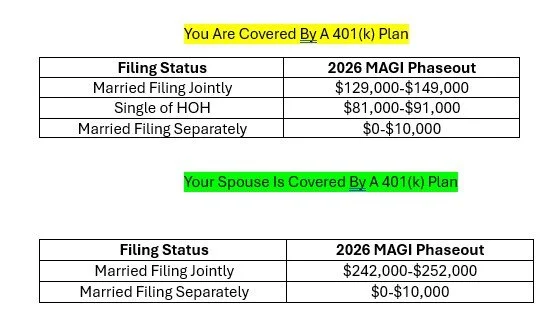
Note: If both you and your spouse are covered by a 401(k) plan, then use the “You Are Covered” thresholds above.
BELOW THE BOTTOM THRESHOLD: If you are below the thresholds listed above, you will be eligible to fully deduct your Traditional IRA contribution
WITHIN THE PHASEOUT RANGE: If you are within the phaseout range, only a portion of your Traditional IRA contribution will be deductible
ABOVE THE TOP THRESHOLD: If your MAGI (modified adjusted gross income) is above the top of the phaseout threshold, you would not be eligible to take a deduction for your contribution to the Traditional IRA
After-Tax Traditional IRA
If you find that your income prevents you from taking a deduction for all or a portion of your Traditional IRA contribution, you can still make the contribution, but it will be considered an “after-tax” contribution. There are two reasons why we see investors make after-tax contributions to traditional IRA’s. The first is to complete a “Backdoor Roth IRA Contribution”. The second is to leverage the tax deferral accumulation component of a traditional IRA even though a deduction cannot be taken. By holding the investments in an IRA versus in a taxable brokerage account, any dividends or capital gains produced by the activity are sheltered from taxes. The downside is when you withdraw the money from the traditional IRA, all of the gains will be subject to ordinary income tax rates which may be less favorable than long term capital gains rates.
Roth IRA
If you are covered by a 401(K) plan and you want to make a contribution to a Roth IRA, the rules are more straight forward. For Roth IRAs, you make contributions with after-tax dollars but all the accumulation is received tax free as long as the IRA has been in existence for 5 years, and you are over the age of 59½. Unlike the Traditional IRA rules, where there are different income thresholds based on whether you are covered or your spouse is covered by a 401(k), Roth IRA contributions have universal income thresholds.
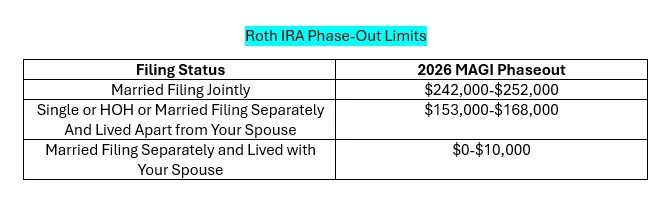
The contribution limits are the same as Traditional IRA’s but you have to aggregate your IRA contributions meaning you can’t make a $7,500 contribution to a Traditional IRA and then make a $7,500 contribution to a Roth IRA for the same tax year. The IRA annual limits apply to all IRA contributions made in a given tax year.
Should You Contribute To A 401(k) or an IRA?
If you have the option to either contribute to a 401(k) plan or an IRA, which one should you choose? Here are some of the deciding factors:
Employer Match: If the company that you work for offers an employer matching contribution, at a minimum, you should contribute the amount required to receive the full matching contribution, otherwise you are leaving free money on the table.
Roth Contributions: Does your 401(k) plan allow Roth contributions? Depending on your age and tax bracket, it may be advantageous for you to make Roth contributions over pre-tax contributions. If your plan does not allow a Roth option, then it may make sense to contribute pre-tax up the max employer match, and then contribute the rest to a Roth IRA.
Fees: Is there a big difference in fees when comparing your 401(k) account versus an IRA? With 401(k) plans, typically the fees are assessed based on the total assets in the plan. If you have a $20,000 balance in a 401(K) plan that has $10M in plan assets, you may have access to lower cost mutual fund share classes, or lower all-in fees, that may not be available within a IRA.
Investment Options: Most 401(k) plans have a set menu of mutual funds to choose from. If your plan does not provide you with access to a self-directed brokerage window within the 401(k) plan, going the IRA route may offer you more investment flexibility.
Easier Is Better: If after weighing all of these options, it’s a close decision, I usually advise clients that “easier is better”. If you are going to be contributing to your employer’s 401(k) plan, it may be easier to just keep everything in one spot versus trying to successfully manage both a 401(k) and IRA separately.
Maxing Out A 401(k) and IRA
As long as you are eligible from an income standpoint, you are allowed to max out both your employee deferrals in a 401(k) plan and the contributions to your IRA in the same tax year. If you are age 51, married, and your modified AGI is $180,000, you would be able to max your 401(k) employee deferrals at $32,500, you are over the income limit for deducting a contribution to a Traditional IRA, but you would have the option to contribute $8,600 to a Roth IRA.
Advanced Tax Strategy: In the example above, you are above the income threshold to deduct a Traditional IRA but your spouse may not be. If your spouse is not covered by a 401(k) plan, you can make a spousal contribution to a Traditional IRA because the $180,000 is below the income threshold for the spouse that is NOT COVERED by the employer-sponsored retirement plan.
Last updated June, 2026
About Michael……...
Hi, I’m Michael Ruger. I’m the managing partner of Greenbush Financial Group and the creator of the nationally recognized Money Smart Board blog . I created the blog because there are a lot of events in life that require important financial decisions. The goal is to help our readers avoid big financial missteps, discover financial solutions that they were not aware of, and to optimize their financial future.
Frequently Asked Questions (FAQs):
Can you contribute to both a 401(k) and an IRA in the same year?
Yes, as long as you meet the income requirements for IRA eligibility. For example, in 2025 you could contribute the full employee deferral limit to your 401(k) ($23,000 plus $7,500 catch-up if age 50+) and still contribute up to $7,000 or $8,000 to an IRA.
What is a spousal IRA contribution?
If one spouse does not work or isn’t covered by an employer retirement plan, the working spouse can make an IRA contribution on their behalf. This strategy allows a couple to potentially double their retirement savings and may preserve tax deductibility for the non-covered spouse.

