

You’re Retired With $2 Million. Why Are You Still Afraid to Spend It?
Many retirees with $2 million or more still hesitate to spend after decades of saving. Learn how Social Security, taxes, healthcare, longevity, market risk, and legacy goals can help determine how much you can comfortably spend in retirement.

Many retirees with $2 million or more still hesitate to spend because they spent decades learning how to save. The solution is not simply spending more. It is determining how much your retirement plan can support after accounting for Social Security, taxes, market declines, longevity, healthcare, and legacy goals. Greenbush Financial Group helps retirees turn those variables into a practical “permission to spend” number.
Why Is Spending So Difficult After You Retire?
For 30 or 40 years, successful retirement savers are rewarded for accumulating money.
You contribute to the 401(k), invest extra cash, and avoid unnecessary withdrawals. Then you retire and suddenly you are supposed to reverse that behavior.
Even when you have $2 million saved, withdrawing $50,000 can feel like you are moving backward.
That feeling is understandable, but your investment balance alone does not determine whether you can afford to spend more.
A better question is:
What does your $2 million actually need to accomplish?
It may need to fund your lifestyle, taxes, healthcare, travel, future home repairs, a surviving spouse, and perhaps an inheritance for your children.
Once those goals are defined, you can determine how much of the portfolio is actually needed and how much represents a safety margin.
Start With Your Retirement Income Gap
The simplest starting point is to compare what comes in with what goes out.
Add up your expected annual spending and taxes, then subtract reliable income such as Social Security and pensions.
The remaining amount needs to come from your investments.
Example: Retired With $2 Million
Assume a retired couple has:
$2 million invested
$70,000 of annual Social Security
$120,000 of annual lifestyle spending
$15,000 of estimated taxes
Their total annual cash need is approximately $135,000.
After Social Security, they need about $65,000 per year from their portfolio.
That represents an initial withdrawal of approximately 3.25% of their $2 million portfolio.
That percentage does not automatically mean the spending is safe. But now we have a number that can be tested.
How Do You Create a “Permission to Spend” Number?
Your permission-to-spend number is the amount your retirement plan can reasonably support after accounting for the major risks you may face.
A simple starting calculation is:
Lifestyle spending + taxes + major planned expenses − Social Security and pension income = required portfolio withdrawals
Then stress-test that number.
Ask:
What if the market falls early in retirement?
What if one or both spouses live into their 90s?
Have healthcare and potential long-term care costs been considered?
What happens financially when the first spouse dies?
Are large home repairs or vehicle purchases included?
How much do you actually want to leave to your children?
If your desired spending continues to work under reasonable stress tests, you have stronger evidence that you can afford it.
What If the Market Drops?
One of the biggest risks is a major market decline early in retirement.
Suppose the couple's $2 million portfolio falls 20%, temporarily reducing it to approximately $1.6 million before accounting for withdrawals.
Their $65,000 withdrawal is no longer 3.25% of the portfolio. It is now approximately 4.1%.
That does not mean they immediately need to cancel every vacation.
It means their plan should have flexibility.
That could include maintaining a cash reserve, holding a diversified investment allocation, and identifying discretionary expenses that could temporarily be reduced during a prolonged market decline.
The important question is not whether the market will decline. It eventually will.
The question is whether your retirement plan can absorb it without requiring major permanent changes.
What If You Live Into Your 90s?
Longevity is another reason retirees hesitate to spend.
Instead of allowing “What if I live to 100?” to become a reason to never use your money, model longer life expectancies directly.
A retirement projection can test what happens if one or both spouses live to 90, 95, or beyond.
It should also account for what happens after the first spouse dies. Social Security income may decline, tax filing status may change, and the surviving spouse may still have many of the same household expenses.
If your spending works even with conservative longevity assumptions, that provides much more useful information than simply assuming you need to preserve every dollar.
Healthcare Should Be a Number, Not an Unlimited Unknown
Healthcare and long-term care are legitimate retirement risks.
But “I might need the money for healthcare someday” can become a reason to never spend anything.
Instead, quantify the risk as much as possible.
Consider:
Medicare premiums and supplemental coverage
Normal out-of-pocket healthcare costs
Existing long-term care insurance
HSA balances
Potential long-term care expenses
How much of those costs you intend to self-fund
You cannot know exactly what healthcare will cost decades from now. You can, however, build a reasonable reserve into the plan.
That allows healthcare to become a planning assumption rather than an undefined reason to avoid spending.
How Much of Your $2 Million Is Actually Surplus?
This is often the most important question.
Suppose your retirement analysis indicates that $1.5 million is reasonably needed to support your lifestyle and future risks under conservative assumptions.
That leaves approximately $500,000 of additional cushion.
It does not mean you should immediately spend $500,000.
It means those dollars may have a different purpose.
They could potentially fund:
More travel
Gifts to children or grandchildren
Home improvements
Charitable giving
Additional financial security
A larger inheritance
There is a major psychological difference between thinking, “I cannot touch my $2 million,” and understanding, “My plan requires approximately this much, and the rest is my safety margin.”
Do You Actually Want to Leave the Money to Your Children?
Many retirees say leaving money to their children is important.
The next question should be: How much?
There is a difference between intentionally planning to leave $500,000 and leaving $2 million because you were afraid to spend throughout retirement.
Neither outcome is necessarily wrong.
But your legacy should ideally be a goal, not an accident.
If your retirement projection shows a substantial estate remaining even under conservative assumptions, you may have a choice: leave more later, give some away during your lifetime, spend more on experiences today, or simply maintain a larger safety margin.
Don't Forget About Taxes
Where your $2 million is held matters.
A retiree with $2 million in traditional IRAs has a different spending and tax situation than someone with assets spread among traditional IRAs, Roth IRAs, taxable brokerage accounts, and cash.
Traditional IRA withdrawals can increase taxable income and potentially affect Medicare IRMAA premiums. Future required minimum distributions can also increase taxable income later in retirement.
This is why spending decisions should be coordinated with:
Roth conversions
Social Security
Capital gains
Required minimum distributions
Medicare
The surviving spouse's future tax situation
Sometimes spending or converting tax-deferred money earlier can be part of a longer-term tax strategy.
When Can You Reasonably Give Yourself Permission to Spend More?
You may have room to spend more when:
Social Security and pensions cover a meaningful portion of core expenses
Portfolio withdrawals remain reasonable under conservative assumptions
The plan can withstand a significant market decline
Longevity into the 90s has been tested
Healthcare and long-term care risks have been considered
Major future expenses are included
Survivor income and taxes have been modeled
Your desired legacy is already incorporated
You still maintain a meaningful safety margin
You may need to remain more cautious if your plan depends on strong investment returns, requires consistently large withdrawals, has little flexibility during bad markets, or does not account for major future expenses.
Common Mistakes Retirees Make
Some of the most common mistakes include:
Treating principal as money that can never be spent
Using a generic withdrawal percentage without looking at the household plan
Keeping an excessive healthcare reserve with no specific calculation behind it
Ignoring the surviving spouse's financial situation
Forgetting about taxes and future RMDs
Leaving a large inheritance by default instead of by choice
Waiting until health declines to begin using money for important experiences
Final Thoughts
If you have $2 million and are still afraid to spend, the answer is not simply to spend more.
The answer is to determine what your money needs to accomplish and test whether your desired lifestyle fits within those boundaries.
At Greenbush Financial Group, we look at retirement spending in the context of income, investments, taxes, market risk, longevity, healthcare, survivor needs, and legacy goals.
Here is what gives you reasonable permission to spend more: your desired spending continues to work under conservative assumptions and leaves an adequate safety margin.
Here is what tells you to remain cautious: your plan depends on strong markets, high withdrawals, or leaves little room for unexpected expenses.
Retirement savings are meant to provide financial security. But once that security has been established, some of those dollars may also be available to help you enjoy the retirement you spent decades saving for.

Rob Mangold
About Rob……...
Hi, I’m Rob Mangold. I’m the Chief Operating Officer at Greenbush Financial Group and a contributor to the Money Smart Board blog. We created the blog to provide strategies that will help our readers personally, professionally, and financially. Our blog is meant to be a resource. If there are questions that you need answered, please feel free to join in on the discussion or contact me directly.
Frequently Asked Questions
-
Is $2 million enough to retire?It can be. Whether $2 million is enough depends on your spending, Social Security and pension income, taxes, retirement age, healthcare costs, investments, longevity, and legacy goals.
-
How much can I spend each year with $2 million?Start by subtracting reliable income from your annual spending and taxes. The remaining portfolio withdrawal should then be tested against market declines, inflation, longevity, healthcare costs, and other financial goals.
-
Is a 4% withdrawal rate safe with $2 million?A 4% initial withdrawal equals $80,000 from a $2 million portfolio. Whether that is appropriate depends on your retirement timeline, investments, inflation, other income, taxes, and ability to adjust spending.
-
Should I be afraid to spend principal in retirement?Not necessarily. Retirement assets were generally accumulated to help fund retirement. The important question is whether withdrawals are sustainable within your overall financial plan.
-
How much should I leave my children?There is no standard amount. Establishing a specific legacy goal can help determine whether additional assets should be preserved, gifted during your lifetime, or available for your own retirement spending.








In Retirement, What Healthcare Costs Can Be Paid from an HSA Account?
Health Savings Accounts offer tax-free withdrawals for qualified medical expenses in retirement, but understanding eligibility rules is critical. This guide explains which expenses qualify, including Medicare premiums, dental, vision, and out-of-pocket costs. It also covers non-eligible expenses and key withdrawal rules before and after age 65. Use this resource to avoid costly HSA mistakes and maximize your retirement healthcare strategy.
By Michael Ruger, CFP®
Partner and Chief Investment Officer at Greenbush Financial Group
As people approach retirement, or enter retirement, healthcare costs often become one of the largest expenses in a financial plan. The good news is that Health Savings Accounts (HSAs) can be a powerful tool to help cover many of these costs using tax-free dollars. However, not every healthcare expense qualifies, so it’s important to understand both what can and cannot be paid from an HSA in retirement.
In this article, we’ll cover:
Which Medicare premiums are HSA-eligible
Whether COBRA premiums qualify
Dental, vision, and hearing expenses
Out-of-pocket medical costs
Medical equipment and prescriptions
Expenses that are not HSA-eligible
HSA withdrawal rules before and after age 65
Frequently asked HSA questions in retirement
Medicare Premiums
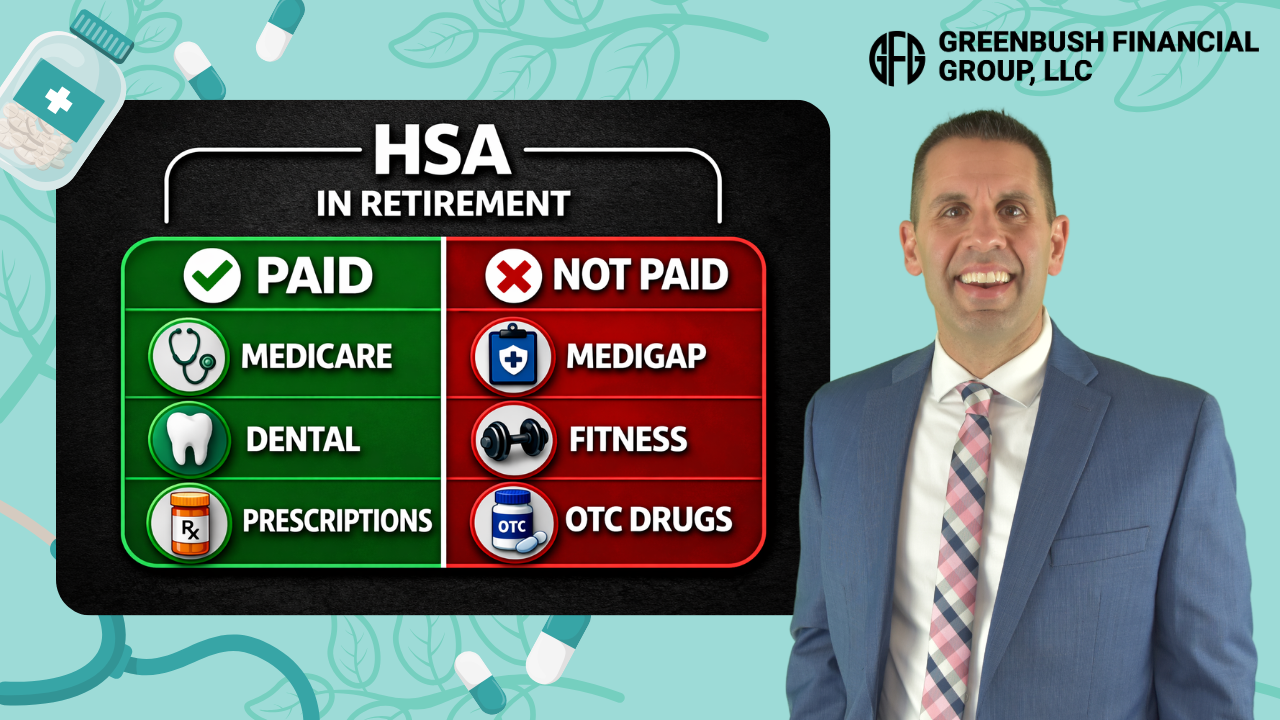
One of the most common uses for HSA funds in retirement is paying for Medicare premiums. HSA distributions can be used tax-free for:
Medicare Part B premiums
Medicare Part D premiums
Medicare Advantage (Part C) premiums
However, Medigap (Medicare Supplement) premiums are not considered a qualified HSA expense, even though Medicare Advantage plans are. This is a commonly misunderstood rule and an important one for retirees to be aware of when planning healthcare costs.
COBRA Coverage
If you retire before age 65 or leave an employer and elect COBRA coverage, those health insurance premiums can be paid from an HSA. This can be especially helpful for early retirees who need to bridge the gap before Medicare begins.
Dental, Vision, and Hearing Expenses
Dental, vision, and hearing costs are some of the most common out-of-pocket healthcare expenses in retirement — especially since many retirees no longer have employer coverage for these services.
HSA-eligible expenses include:
Dental cleanings, fillings, crowns, dentures, braces, and X-rays
Vision exams, eyeglasses, contact lenses, and LASIK surgery
Hearing aids and hearing aid batteries
Hearing aids alone can cost several thousand dollars, making the HSA a valuable tax-free resource for these expenses.
Out-of-Pocket Medical Expenses
Many routine healthcare costs in retirement are HSA-eligible, including:
Doctor visits
Specialist visits
Hospital services
Co-pays
Deductibles
Coinsurance
Surgery costs
Lab work and imaging
These are often the “everyday” medical expenses retirees experience each year.
Medical Equipment
If medical equipment is needed later in retirement, many of these expenses qualify for HSA distributions, including:
Walkers
Wheelchairs
Blood pressure monitors
Crutches
CPAP machines
Glucose monitors
Prescription Medications
Prescription drugs that are prescribed by a doctor are qualified HSA expenses.
However, over-the-counter medications typically do NOT qualify unless they are prescribed by a physician.
Expenses That Are NOT HSA-Eligible
Some healthcare-related expenses are not considered qualified medical expenses. These typically include:
Gym memberships
Nutritional supplements
Cosmetic procedures
Teeth whitening
General health items not prescribed by a doctor
Even though these may improve health, they are not considered qualified medical expenses under HSA rules.
Why HSAs Are So Powerful for Retirement
HSAs are one of the most tax-advantaged accounts available because they offer:
Tax-deductible contributions
Tax-free growth
Tax-free withdrawals for qualified medical expenses
Because healthcare costs are often highest in retirement, many individuals choose to pay for medical expenses out-of-pocket during their working years and allow their HSA to grow, using it later in retirement when healthcare costs increase.
HSA Withdrawal Rules: Before and After Age 65
It’s also important to understand the rules around HSA withdrawals:
Before age 65
Non-qualified withdrawals = taxable income + 20% penalty
After age 65
Non-qualified withdrawals = taxable income only (no penalty)
Works similar to a Traditional IRA if not used for healthcare
This provides additional flexibility later in retirement.

About Michael……...
Hi, I’m Michael Ruger. I’m the managing partner of Greenbush Financial Group and the creator of the nationally recognized Money Smart Board blog . I created the blog because there are a lot of events in life that require important financial decisions. The goal is to help our readers avoid big financial missteps, discover financial solutions that they were not aware of, and to optimize their financial future.
Frequently Asked Questions (FAQs)
-
Can HSA funds be used for Medicare premiums?Yes, for Medicare Part B, Part D, and Medicare Advantage premiums.
-
Can HSA funds be used for Medigap premiums?No, Medigap premiums are not considered a qualified expense.
-
Can I use my HSA for dental expenses in retirement?Yes, most dental expenses qualify.
-
Are vision expenses HSA-eligible?Yes, including exams, glasses, contacts, and LASIK.
-
Are hearing aids covered by an HSA?Yes, including hearing aid batteries.
-
Can I use my HSA for COBRA premiums?Yes, COBRA premiums are a qualified expense.
-
Are prescription drugs HSA-eligible?Yes, if prescribed by a doctor.
-
Are over-the-counter medications HSA-eligible?Typically no, unless prescribed by a physician.
-
What happens if I use HSA money for non-medical expenses before 65?You will owe income tax and a 20% penalty.
-
What happens if I use HSA money for non-medical expenses after 65?You will owe income tax, but no penalty.





















Can Anyone Open an HSA Account?
Health Savings Accounts offer powerful tax advantages, but strict eligibility rules apply. This guide explains who can contribute to an HSA in 2026, including HDHP requirements, contribution limits, and Medicare restrictions. Learn how to avoid costly mistakes, especially as you approach age 65. A must-read for retirement-focused healthcare planning.

By Michael Ruger, CFP®
Partner and Chief Investment Officer at Greenbush Financial Group
Health Savings Accounts (HSAs) are one of the most tax-advantaged accounts available and can be a powerful tool for paying healthcare costs in retirement. Contributions are made with pre-tax dollars, the account grows tax-deferred, and distributions are tax-free when used for qualified medical expenses. However, not everyone is eligible to contribute to an HSA, and understanding the eligibility rules is critical.
In this article, we’ll cover:
Who is eligible to contribute to an HSA
What qualifies as a High Deductible Health Plan (HDHP)
2026 HSA contribution limits
Special rules when approaching age 65 and Medicare
Frequently asked questions about HSA eligibility
Who Is Eligible to Contribute to an HSA?
To contribute to an HSA, you must meet all of the following requirements:
You must be enrolled in a High Deductible Health Plan (HDHP)
You cannot be covered by any other non-HDHP health insurance
You cannot be enrolled in Medicare
You cannot be claimed as a dependent on someone else’s tax return
The most common way people become eligible for an HSA is through their employer-sponsored high deductible health insurance plan. If your employer’s health insurance plan is not classified as a high deductible plan, then you are not eligible to contribute to an HSA.
What Qualifies as a High Deductible Health Plan in 2026?
Each year, the IRS defines what qualifies as a High Deductible Health Plan. For 2026, a plan must meet the following minimum deductible and maximum out-of-pocket limits:

If your health insurance plan does not meet these thresholds, it is not considered HSA-eligible, and you cannot contribute to an HSA.
HSA Contribution Limits for 2026
The IRS also sets contribution limits each year. For 2026, the HSA contribution limits are:
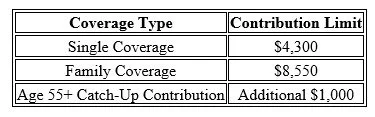
These limits include both employee and employer contributions combined. So if your employer contributes to your HSA, that amount counts toward the total annual limit.
Because these limits are indexed for inflation, they typically increase slightly each year.
Be Careful as You Approach Age 65 (Medicare Rule)
There is a very important rule regarding HSAs and Medicare that many people are not aware of:
Once you enroll in Medicare, you can no longer contribute to an HSA.
However, there is an additional rule that affects individuals who work past age 65 and delay Medicare.
The 6-Month Medicare Retroactive Rule
When someone enrolls in Medicare Part A after age 65, Medicare coverage is retroactive for 6 months (but not earlier than age 65).
Because of this:
You must stop HSA contributions 6 months before applying for Medicare
Otherwise, those contributions become excess contributions
Excess contributions can result in tax penalties if not corrected
Example
Let’s say someone is 67, still working, and contributing to an HSA.
If they plan to enroll in Medicare in December, they should stop HSA contributions by June of that year.
If they do not, they may need to withdraw excess contributions and potentially pay penalties.
Important Exception
If you enroll in Medicare right at age 65, you do not need to stop contributions 6 months early because Medicare cannot retroactively start before age 65.
Why HSAs Can Be So Valuable
HSAs are often used as a retirement healthcare savings account because:
Contributions are pre-tax
Growth is tax-deferred
Withdrawals are tax-free for medical expenses
After age 65, withdrawals for non-medical expenses are penalty-free (taxable only)
Because healthcare is often one of the largest expenses in retirement, many individuals choose to save their HSA funds during their working years and use them later in retirement.
About Michael……...
Hi, I’m Michael Ruger. I’m the managing partner of Greenbush Financial Group and the creator of the nationally recognized Money Smart Board blog . I created the blog because there are a lot of events in life that require important financial decisions. The goal is to help our readers avoid big financial missteps, discover financial solutions that they were not aware of, and to optimize their financial future.
Frequently Asked Questions (FAQs)
-
Can anyone open an HSA account?No. You must be enrolled in a qualified High Deductible Health Plan.
-
Can I contribute to an HSA if I am self-employed?Yes, as long as you have an HSA-eligible high deductible health insurance plan.
-
Can I contribute to an HSA if I am on Medicare?No. Once enrolled in Medicare, you can no longer contribute.
-
Can my employer contribute to my HSA?Yes, and employer contributions count toward the annual limit.
-
What happens if I contribute to an HSA while on Medicare?Those contributions are considered excess contributions and may be subject to penalties.
-
Can both spouses contribute to an HSA?Yes, if both spouses are eligible and covered by an HSA-qualified plan.
-
Do HSA contribution limits change each year?Yes, they are typically adjusted annually for inflation.
-
What is the catch-up contribution for people over age 55?An additional $1,000 per year.
-
Can I still use my HSA after I go on Medicare?Yes, you just cannot contribute anymore.
-
What happens if I exceed the HSA contribution limit?You may have to withdraw the excess contribution and could owe penalties if not corrected.
Health Savings Account Distribution Tax and Penalty Rules
Health Savings Account (HSA) withdrawals have different tax and penalty rules depending on age and how funds are used. This guide explains the four distribution scenarios, tax treatment before and after age 65, and advanced strategies to maximize tax-free benefits. Learn how HSAs can serve as a powerful retirement healthcare tool and how to avoid common withdrawal mistakes. Ideal for pre-retirees planning tax-efficient income strategies.
By Michael Ruger, CFP®
Partner and Chief Investment Officer at Greenbush Financial Group
Health Savings Accounts (HSAs) are one of the most tax-advantaged accounts available, but the tax treatment of distributions depends on how the money is used and the age of the account owner. There are essentially four different distribution scenarios that HSA owners can run into, and each scenario has different tax and penalty rules that are important to understand.
In this article, we’ll cover:
The four HSA distribution scenarios
Tax treatment before age 65
Tax treatment after age 65
Why HSAs are so valuable for retirement planning
Advanced HSA distribution strategies
Common HSA distribution mistakes to avoid
Frequently asked questions about HSA distributions
Why HSA Accounts Are So Valuable
Health Savings Accounts are unique because they offer a rare triple tax advantage:
Contributions are made pre-tax
The account grows tax-deferred
Distributions are tax-free if used for qualified medical expenses
Very few accounts receive this type of tax treatment. Traditional retirement accounts are tax-deferred, and Roth accounts are tax-free on the way out, but HSAs can be tax-free on both the contribution and distribution side when used correctly.
Because of this, many financial planners recommend not spending HSA funds during working years if possible, and instead allowing the account to grow and using it later in retirement when healthcare costs are typically much higher.
The Four HSA Distribution Scenarios
There are four main distribution scenarios that determine whether you owe taxes and/or penalties on HSA withdrawals:
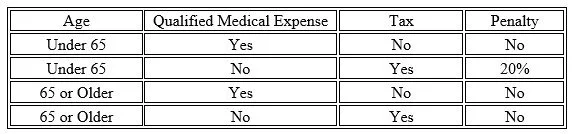
Let’s walk through each scenario.
Distributions Prior to Age 65 (Qualified Medical Expenses)
If you take a distribution from an HSA before age 65 and use the money for a qualified medical expense, the distribution is:
Tax-free
Penalty-free
This is the ideal use of an HSA. Qualified expenses can include:
Doctor visits
Deductibles and coinsurance
Dental and vision care
Hearing aids
Prescription medications
Medicare premiums (after age 65)
Medical equipment
In these cases, the HSA functions exactly as intended — a tax-free healthcare account.
Distributions Prior to Age 65 (Non-Qualified Expenses)
If you take a distribution before age 65 and the expense is not qualified, the distribution is:
Subject to ordinary income tax
Subject to a 20% penalty
For example, if someone is in a 30% tax bracket and takes a non-qualified distribution:
30% tax
20% penalty
Total loss = 50% of the distribution
This is why it is usually recommended to preserve HSA funds for medical expenses whenever possible.
Distributions Age 65 or Older (Qualified Medical Expenses)
This scenario works the same as before age 65.
If the distribution is used for qualified medical expenses, the withdrawal is:
Tax-free
Penalty-free
This is why HSAs are often used as a retirement healthcare fund.
Common qualified expenses in retirement include:
Medicare Part B premiums
Medicare Part D premiums
Medicare Advantage premiums
Out-of-pocket medical expenses
Deductibles and coinsurance
Dental and vision care
Hearing aids
Medical equipment
Distributions Age 65 or Older (Non-Qualified Expenses)
This is where the rules change.
After age 65, if you take money from an HSA for non-qualified expenses:
You pay ordinary income tax
No 20% penalty
At this point, the HSA starts to function similarly to a Traditional IRA. The money can be used for anything, but it becomes taxable income if not used for medical expenses.
This provides flexibility in retirement in case the funds are needed for non-medical expenses.
Important Rule: Reimbursed Expenses Do NOT Qualify
One important rule that retirees need to be aware of:
If a medical expense is reimbursed by insurance or a former employer, you cannot also take a tax-free HSA distribution for that same expense.
For example:
Some retirees have employer retiree health plans that reimburse Medicare premiums.
If the retiree is reimbursed for Medicare Part B or Part D, those expenses cannot also be reimbursed from the HSA tax-free.
This would be considered a non-qualified distribution, and taxes would apply.
Advanced HSA Distribution Strategies
There are several advanced strategies that can make HSAs even more powerful:
1. Save Receipts and Reimburse Yourself Later
There is no time limit on when you reimburse yourself from an HSA for a qualified expense, as long as:
The expense occurred after the HSA was established
You kept the receipt
This means someone could:
Pay medical expenses out-of-pocket during working years
Allow the HSA to grow
Reimburse themselves years later tax-free
This effectively turns the HSA into a tax-free retirement account.
2. Use HSA for Medicare Premiums
HSA funds can be used tax-free for:
Medicare Part B
Medicare Part D
Medicare Advantage
(This becomes a built-in retirement healthcare fund.)
3. Treat HSA Like a Backup Traditional IRA
After age 65, if needed, HSA funds can be withdrawn for non-medical expenses and simply taxed as income, with no penalty.
Common HSA Distribution Mistakes
Some of the most common mistakes include:
Using HSA funds for non-qualified expenses before 65
Losing receipts for reimbursement
Using HSA funds for reimbursed expenses
Spending HSA funds during working years instead of investing them
Not investing HSA funds for long-term growth
Forgetting that non-qualified withdrawals before 65 have a 20% penalty
About Michael……...
Hi, I’m Michael Ruger. I’m the managing partner of Greenbush Financial Group and the creator of the nationally recognized Money Smart Board blog . I created the blog because there are a lot of events in life that require important financial decisions. The goal is to help our readers avoid big financial missteps, discover financial solutions that they were not aware of, and to optimize their financial future.
Frequently Asked Questions (FAQs)
-
Do I pay taxes on HSA distributions?Only if the distribution is used for a non-qualified expense.
-
What is the penalty for non-qualified HSA withdrawals before age 65?A 20% penalty plus ordinary income tax.
-
What happens to the penalty after age 65?The 20% penalty goes away, but distributions are still taxable if not used for medical expenses.
-
Can I use my HSA for Medicare premiums?Yes, for Medicare Part B, Part D, and Medicare Advantage.
-
Can I reimburse myself years later from my HSA?Yes, as long as the expense occurred after the HSA was established and you kept the receipt.
-
Are HSA distributions reported on a tax return?Yes, distributions are reported on IRS Form 8889.
-
Can I use my HSA for my spouse's medical expenses?Yes, even if your spouse is not on your health insurance plan.
-
What happens to my HSA when I turn 65?You can still use it tax-free for medical expenses, and penalty-free for non-medical expenses (taxable).
-
Can I use my HSA for dental and vision expenses?Yes, most dental and vision expenses qualify.
-
Is an HSA better than a 401(k)?For medical expenses, an HSA can be more tax-efficient because it is tax-free on both contributions and qualified distributions.
