The Never Retirement Plan: The Benefits of Continuing to Work by Choice
What if the goal of retirement planning wasn’t to stop working, but to make work optional? Explore the financial, social, and personal benefits of continuing to work after reaching financial independence—and why the traditional retirement path may not be right for everyone.

By Michael Ruger, CFP®
Partner and Chief Investment Officer at Greenbush Financial Group
As a financial planner, I spend a large part of my day helping people answer the question, “When can I retire?” Ironically, every once in a while a client turns that question around and asks me, “Mike, when do you plan to retire?”
To their surprise, my answer is always the same: “Never.”
That response tends to catch people off guard because you would think that, as a financial planner, my ultimate goal, like everyone else, would be to accumulate enough money to become financially independent and spend most of my day spending time with friends, family, travel, golfing, pickleball, in general, non-work stuff.
While I agree with the financial independence goal, I do not necessarily tie that too the common goal of full retirement. This place me in the unique Never Retirement Plan, which is the opposite of the new FIRE (Financial Independent Retire Early) movement.
However, “never retire” does not mean you have to continue to work 40 or 60 hours per week into your 70’s, 80’s, and 90’s. You may only be working 15, 20, or 30 hours per week and spend more time traveling, social activities, or hobbies. Or maybe you completely change industries, start a small business, or join a not-for-profit organization.
Continuing to work offers benefits that extend well beyond a paycheck. In this article, we will review the potential health benefits of working later in life, the importance of the social interaction that work creates, the financial advantages of continuing to earn income, how working longer can benefit your family, and how financial independence may allow you to pursue projects or careers that you always wanted to explore.
We will also look at how artificial intelligence could make experienced workers even more valuable, the impact of additional compounding years on your investment accounts, and how continuing to work can become part of the legacy that you leave behind.
The Health Benefits Of Working By Choice
A friend of mine told me a story that I have always remembered. He was down in Florida, and he went to visit his doctor, who was 87 years old, and still practicing medicine. My friend asked his 87-year-old doctor the obvious question, “What is the key to longevity?” The doctor's answer was simple: “Don’t retire.”
Obviously, one 87-year-old doctor is not a scientific study, but there is research showing an association between working later in life and longevity.
Researchers at Oregon State University studied 2,956 individuals who retired in the U.S. Among the individuals classified as healthy retirees, retiring one year beyond age 65 was associated with an 11% lower risk of death from all causes. Even among participants who were classified as unhealthy retirees, working an additional year was associated with a 9% lower mortality risk.
There are a lot of possible reasons why work may have health benefits. Work keeps us mentally challenged. Work creates challenges that need to be solved, decisions that need to be made, and puts us in an environment of continuous learning. Work also brings social interaction with coworkers, clients, customers, and the general public.
There is also an important difference between working because you have to and working because you want to. If someone is 70 years old, financially independent, and absolutely miserable at their job, I am not suggesting that they keep working simply because there may be health benefits associated with staying employed.
The Never Retirement Plan is really about reaching the point where work becomes optional and then deciding whether some form of work still adds value to your life. Maybe you work three days per week instead of five. Maybe you stop managing employees and transition into a consulting role. Maybe you only work six months out of the year and spend the other six months traveling. Financial independence gives you the ability to redesign work around your life instead of constantly designing your life around work.
The Social Benefits Of Continuing To Work
One benefit of work that many retirees dramatically underestimate is the social interaction it creates.
Think about how many conversations you have during a normal workday. You talk to coworkers. You interact with clients. Someone asks how your weekend was. You hear about someone's kids, grandchildren, vacation, or new house. People check in with you when they know something is going on in your life. Those may seem like small interactions, but over a 30- or 40-year career, they become a major part of your social network.
Then one day you retire, and depending on what your retirement looks like, a large portion of that daily interaction can disappear almost immediately.
This matters because social relationships are strongly connected to health. A large meta-analysis published in PLOS Medicine reviewed 148 studies involving 308,849 participants. The researchers found that individuals with stronger social relationships had a 50% greater likelihood of survival during the study periods compared with people with weaker social relationships.
That certainly does not mean you have to keep working in order to maintain strong social relationships. Many retirees have very active social lives through family, friends, golf, pickleball, volunteering, religious organizations, clubs, travel, or community involvement. But work automatically creates a social network that many people do not fully appreciate until it is gone.
As financial planners, we spend a tremendous amount of time helping people determine how they are going to replace their paycheck in retirement. But it can be equally important for retirees to ask themselves how they are going to replace the social interaction that came with that paycheck.
If you already have a full calendar outside of work, that may not be an issue. But if most of your daily interaction currently comes from coworkers and clients, maintaining some type of work schedule after reaching financial independence may provide benefits that have nothing to do with money.
The Monetary Benefits Of Not Retiring
The most obvious benefit of continuing to work is that you continue to receive a paycheck. However, the purpose of that paycheck may change dramatically once you have accumulated enough assets to retire.
Before you reach financial independence, your paycheck is paying the mortgage, groceries, utilities, insurance premiums, college costs, and retirement plan contributions. Once you have accumulated enough money to support your lifestyle without working, the income from your job can become much more discretionary.
Maybe continuing to work allows you to take two large trips each year that you otherwise would not have taken. Maybe it allows you to buy a second home. Maybe you give more money to charity. Maybe you make larger gifts to your children or grandchildren. Or perhaps you simply continue saving and investing the additional income.
There is also a psychological benefit of continuing to receive income that I have observed many times as a financial planner. No matter how much money some individuals have accumulated, there can be a tremendous amount of anxiety when the paycheck stops.
Someone may have spent the last 35 years watching money go into their retirement accounts every month. Then they retire, and suddenly they have to reverse the process. Instead of money going into investment accounts, they now withdraw money from those accounts to pay monthly expenses. Mathematically, their retirement projection may show that they are in excellent shape. They could have several million dollars saved and very little risk of running out of money. But psychologically, it can still be uncomfortable to watch those account balances fund their lifestyle.
We see this all the time when preparing retirement projections for clients. There is a difference between knowing that you can afford to withdraw money from your retirement accounts and actually feeling comfortable doing it. If earned income continues, even on a part-time basis, it may reduce the amount that needs to be withdrawn from the portfolio and can make that transition into retirement much easier emotionally.
Financial Support For Your Family
This benefit is closely related to the monetary advantage of continuing to work, but I think it deserves its own section.
Let's assume you're 67 years old and your financial plan shows that you have enough money to retire comfortably. You don't need another paycheck to support yourself, but you still enjoy what you're doing and decide to continue working for another five years.
Those additional five years of income can create opportunities for your family that might not exist otherwise.
Maybe you help pay for your grandchildren's college education. Maybe one of your children wants to put an addition on their house because their family is growing and you're able to help fund the project. You may be able to assist a child with a down payment on their first house, help a family member start a business, or make annual cash gifts that remove some financial stress from their household.
This is where the financial planning question begins to change. Instead of asking, “Do I have enough money to retire?” you begin asking, “If I continue working, what additional opportunities can I create for the people that I care about?”
Obviously, you want to make sure your own retirement is secure before you start making significant gifts to family members. We never want someone jeopardizing their own financial independence in an effort to help the next generation. But once your own retirement is well funded, continuing to earn income can expand the number of people that benefit from your financial success.
The Freedom To Pursue Your Passions
This may be one of the most exciting aspects of the Never Retirement Plan.
Once you have accumulated enough money to retire, you don't necessarily have to retire from work altogether. Instead, you may have the ability to retire from the work that you had to do and begin doing the work that you want to do.
Let's say you've spent the last 30 years working in corporate America, but you've always wanted to open a Pilates studio. Maybe you're passionate about pickleball and you would enjoy teaching people the sport as a teaching pro at your local pickleball club. Starting your own business take time, time that you may have never had before but now that you are not reliant on that small business to meet you expense needs, building a business can actually be fun instead of stressful.
If your retirement assets are already sufficient to support your lifestyle, your next career does not necessarily have to replace the income from your previous career. That can give you the freedom to focus more heavily on whether you enjoy the work and less on whether it produces the maximum possible paycheck.
There is one important warning that comes with this strategy. Financial independence does not mean you should put your entire retirement nest egg at risk trying to turn a passion project into a successful business.
If you have accumulated $2 million for retirement, that does not mean you should invest $1.5 million of it into a new pickleball facility. Before starting a business or funding a passion project, determine how much capital you are willing to commit and, more importantly, how much you could afford to lose without jeopardizing your retirement. The goal is to use financial independence to create new opportunities, not put your financial independence at risk.
Why Retire When You're At Your Peak?
There is another unusual aspect of retirement that I think deserves more attention. Many people retire at the exact point when they may be the most valuable they have ever been in their profession.
Think about someone who has worked in the same industry for 30 or 40 years. They have experienced recessions, industry changes, technology shifts, difficult clients, failed projects, successful projects, and managing teams of people where trust has been built over decades of working together.
Because they are so valuable to the company that they work for, in many cases, they are also earning the highest income of their career. Then they turn 65 and because many of their friends have begun to retire, they feel like that is naturally the next thing to do.
If you still enjoy the work, there is no rule that says age 62, or 65, or 67 has to be the finish line. Adding another five, ten, or fifteen years during what may be your peak earning years can have a tremendous financial impact.
But something else often happens later in a successful career. Your role begins to change. You may spend less time trying to advance your own career and more time helping the next generation advance theirs. You become the go-to person for your team to assist in the knowledge transfer from one generation to the next. At this point, continuing to work is no longer just about the money that you're earning or what you are personally accomplishing. It becomes part of your legacy.
AI Supports The Never Retirement Plan
Artificial intelligence could make the Never Retirement Plan even more attractive over the next decade.
There is a common assumption that younger workers will have an advantage with AI because they tend to adopt new technology quickly. That may be true in certain areas, but I think there is another side to the equation.
AI can produce an enormous amount of work, but someone still has to know how to prompt the AI bot and be able to review the results being produced by AI for accuracy.
Take two people using the same large language model. One person has three years of experience in an industry and the other has 35 years of experience. The younger employee may be very efficient at using the technology, but the person with 35 years of experience understands where projects typically go wrong, which questions clients are going to ask, what assumptions need to be challenged, what risks need to be addressed, the logistics of implementing the solution, and whether there are errors in the results being produced by the AI model.
AI can help with research, first drafts, data organization, coding, presentations, analysis, and routine administrative tasks. The experienced professional can spend more of their time reviewing the output, asking better questions, making decisions, mentoring employees, solving higher-level problems, and maintaining client relationships. This could completely change what working later in life looks like.
Maybe someone who is 72 years old has no interest in working 50 hours per week anymore. But what if artificial intelligence allows that person to accomplish in 15 or 20 hours what previously required 50 hours? Now you have an individual with 30 or 40 years of experience combined with technology that allows them to produce a tremendous amount of output without maintaining the same workload that they carried earlier in their career. It could make highly experienced workers some of the most valuable people in the workforce.
More Compounding Interest
Now we get to one of the most powerful financial benefits of continuing to work. Assume that you reach age 65 with $1 million in your retirement investment accounts. Your financial plan shows that you have enough money to retire, but retiring would require you to begin taking withdrawals from that $1 million to supplement your Social Security, pension, or other income sources. What happens if you decide to continue working and your paycheck is sufficient to cover most or all of your living expenses?
Your $1 million gets more time to compound.
Using a hypothetical 8% annual rate of return, the Rule of 72 tells us that an investment would approximately double every nine years. In a simplified example, $1 million at age 65 could potentially grow to approximately $2 million by age 74 and approximately $4 million by age 83 if there were no withdrawals.
It may have taken you your entire working career to accumulate the first $1 million. But once you have accumulated a large asset base, each additional doubling cycle represents a much larger dollar amount. The move from $1 million to $2 million creates another $1 million of wealth. The next doubling from $2 million to $4 million creates another $2 million of wealth. The approximate amount of time is the same, but the dollar amount created by the second doubling is twice as large.
There may also be an investment allocation benefit if you do not need to take withdrawals from your portfolio. Someone who is relying heavily on their investment accounts to support their lifestyle may need to keep more money in cash or bonds to protect against a major market downturn early in retirement. If your paycheck continues to cover a large portion of your expenses, you may be able to maintain a higher level of stocks in your investment portfolio, which may result in higher rates of return.
That does not mean everyone who continues working should invest aggressively. Your investment allocation should always be based on your risk tolerance, financial goals, time horizon, income needs, and overall retirement plan. But continuing to receive a paycheck can materially change the investment planning conversation.
Building A Legacy
Legacy does not necessarily mean creating a billion-dollar company or having your name on a building. Legacy is really about the lasting impact that you have on other people and the world around you.
Maybe you spend ten years helping a nonprofit organization grow and use the business relationships that you developed over your career to connect the organization with donors. Maybe you continue advancing your industry. Maybe you develop a product or piece of software that solves a problem, or you build a company that provides jobs for other families.
If you're 70 years old and you've accumulated 50 years of experience, there is an enormous amount of knowledge that you can pass on to someone who is 30 years old and just beginning their career. That person may eventually become a leader themselves and go on to mentor ten more people, and when later in life people ask them how they got where they are, they will often give credit to their mentors within the industry.
Continuing to work gives you more time to contribute your experience, relationships, knowledge, financial resources, and perspective to the people around you. For some individuals, that becomes much more important than accumulating another dollar.
None of this means that everyone should work forever. Some people cannot wait to retire. They want to travel, play golf, spend time with grandchildren, volunteer, or simply have complete control over their calendar. If that's your dream, that's a perfectly good retirement plan. But other people reach financial independence and discover that they really do not want to stop working. They may want to work less. They may want more flexibility and control. They may want to eliminate the parts of their job that they no longer enjoy. But they still enjoy solving problems, helping people, building things, learning, and contributing.
For those individuals, retirement may never really be the goal.
A parting note….
The traditional retirement plan follows a fairly predictable path. You work for 30 or 40 years, save money, invest, reach retirement age, stop working, and then begin drawing down the assets that you accumulated during your career. There is absolutely nothing wrong with that plan.
But financial independence gives you the ability to write a different one. The goal of financial planning does not necessarily have to be getting you to the point where you never work again. The goal can simply be getting you to the point where work becomes optional.
Once you reach that point, you get to decide what comes next. You may continue working full-time because you enjoy what you do. You may cut your schedule in half. You may become a consultant, start a business, pursue a passion project, mentor the next generation, volunteer, or combine several of those things together. Continuing to work can provide additional income, mental stimulation, social interaction, more opportunities to financially help your family, additional years of compounding for your investments, and more time to build a meaningful legacy.
If this sounds like your cup of tea, the next time a friend or co-working ask you, “when do you plan to retire?”, respond with a smile………Never.

About Michael……...
Hi, I’m Michael Ruger. I’m the managing partner of Greenbush Financial Group and the creator of the nationally recognized Money Smart Board blog . I created the blog because there are a lot of events in life that require important financial decisions. The goal is to help our readers avoid big financial missteps, discover financial solutions that they were not aware of, and to optimize their financial future.
Frequently Asked Questions About Working in Retirement
-
What are the benefits of continuing to work after retirement age?Continuing to work after traditional retirement age can provide additional income, social interaction, mental stimulation, and a continued sense of purpose. It may also allow your retirement investments to remain invested longer rather than immediately relying on them for living expenses.
-
Is it better financially to keep working instead of retiring at 65?It can be. If employment income covers some or all of your living expenses, you may be able to delay withdrawals from retirement accounts and give your investments additional time to compound. However, the best decision depends on your income needs, investments, taxes, Social Security strategy, and overall retirement plan.
-
What is a "Never Retirement Plan"?A Never Retirement Plan is the idea of reaching financial independence without necessarily stopping work altogether. Instead, financial independence makes work optional, allowing you to continue working full-time, reduce your hours, consult, start a business, volunteer, or pursue work you find meaningful.
-
Can working part-time in retirement help my retirement savings last longer?Potentially. Part-time income can reduce how much you need to withdraw from retirement accounts each year. This may give your investments more time to grow and reduce your reliance on your portfolio during periods of market volatility.
-
Are there health and social benefits to working later in life?Work can provide mental stimulation, problem-solving, routine, and regular interaction with coworkers, clients, and customers. However, the article emphasizes an important distinction between continuing to work because you want to and continuing because you financially have to.
-
How does working longer affect investment growth in retirement?If your paycheck allows you to postpone or reduce portfolio withdrawals, your investments may have additional years to compound. For example, the article illustrates how $1 million invested at a hypothetical 8% annual return could approximately double every nine years under the Rule of 72, assuming no withdrawals.
-
What can I do instead of fully retiring?Retirement does not have to mean going directly from full-time work to no work. You could transition to part-time employment, consulting, seasonal work, volunteering, mentoring, starting a small business, or pursuing a passion project. The goal can be to design work around your life once you no longer depend on a paycheck.
-
How do I know if continuing to work in retirement is right for me?Start by determining whether you are financially independent and what role you want work to play in the next stage of your life. Consider your finances, health, family, social life, personal interests, and whether your current work still gives you purpose or enjoyment. For some people, the goal of retirement planning may not be to stop working-it may simply be to reach the point where working becomes a choice.



















In Retirement, What Healthcare Costs Can Be Paid from an HSA Account?
Health Savings Accounts offer tax-free withdrawals for qualified medical expenses in retirement, but understanding eligibility rules is critical. This guide explains which expenses qualify, including Medicare premiums, dental, vision, and out-of-pocket costs. It also covers non-eligible expenses and key withdrawal rules before and after age 65. Use this resource to avoid costly HSA mistakes and maximize your retirement healthcare strategy.
By Michael Ruger, CFP®
Partner and Chief Investment Officer at Greenbush Financial Group
As people approach retirement, or enter retirement, healthcare costs often become one of the largest expenses in a financial plan. The good news is that Health Savings Accounts (HSAs) can be a powerful tool to help cover many of these costs using tax-free dollars. However, not every healthcare expense qualifies, so it’s important to understand both what can and cannot be paid from an HSA in retirement.
In this article, we’ll cover:
Which Medicare premiums are HSA-eligible
Whether COBRA premiums qualify
Dental, vision, and hearing expenses
Out-of-pocket medical costs
Medical equipment and prescriptions
Expenses that are not HSA-eligible
HSA withdrawal rules before and after age 65
Frequently asked HSA questions in retirement
Medicare Premiums
One of the most common uses for HSA funds in retirement is paying for Medicare premiums. HSA distributions can be used tax-free for:
Medicare Part B premiums
Medicare Part D premiums
Medicare Advantage (Part C) premiums
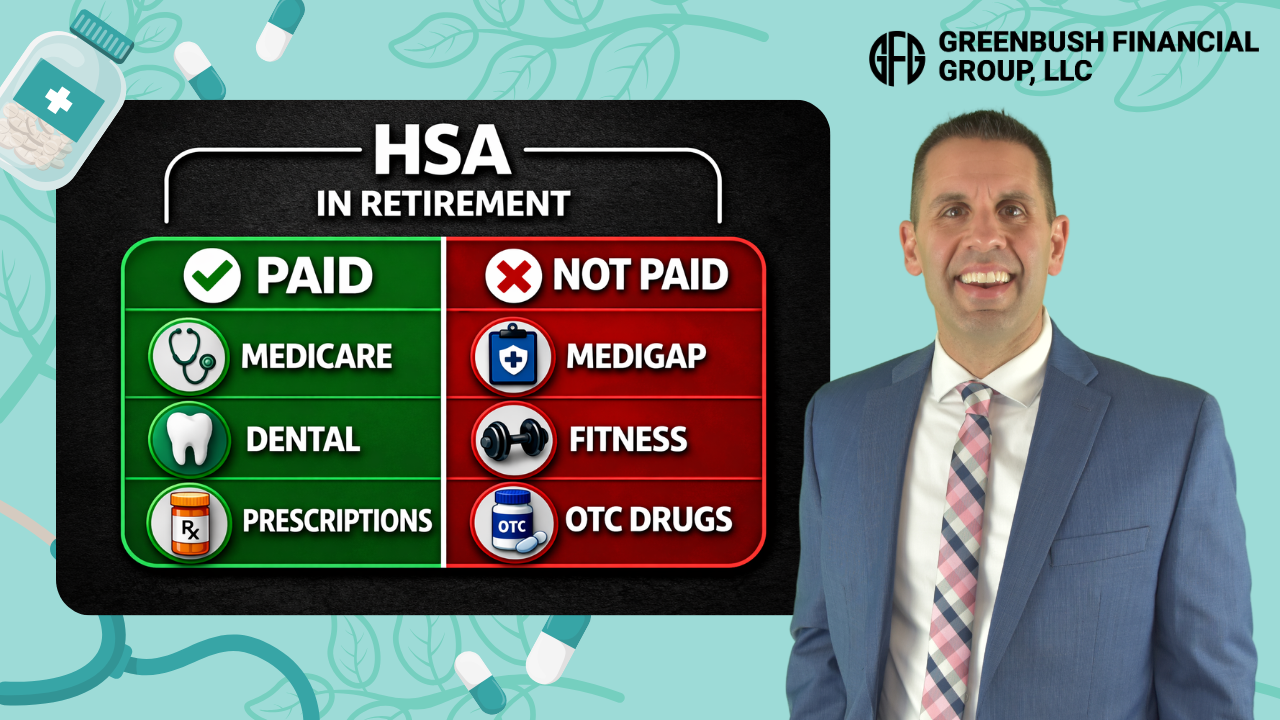
However, Medigap (Medicare Supplement) premiums are not considered a qualified HSA expense, even though Medicare Advantage plans are. This is a commonly misunderstood rule and an important one for retirees to be aware of when planning healthcare costs.
COBRA Coverage
If you retire before age 65 or leave an employer and elect COBRA coverage, those health insurance premiums can be paid from an HSA. This can be especially helpful for early retirees who need to bridge the gap before Medicare begins.
Dental, Vision, and Hearing Expenses
Dental, vision, and hearing costs are some of the most common out-of-pocket healthcare expenses in retirement — especially since many retirees no longer have employer coverage for these services.
HSA-eligible expenses include:
Dental cleanings, fillings, crowns, dentures, braces, and X-rays
Vision exams, eyeglasses, contact lenses, and LASIK surgery
Hearing aids and hearing aid batteries
Hearing aids alone can cost several thousand dollars, making the HSA a valuable tax-free resource for these expenses.
Out-of-Pocket Medical Expenses
Many routine healthcare costs in retirement are HSA-eligible, including:
Doctor visits
Specialist visits
Hospital services
Co-pays
Deductibles
Coinsurance
Surgery costs
Lab work and imaging
These are often the “everyday” medical expenses retirees experience each year.
Medical Equipment
If medical equipment is needed later in retirement, many of these expenses qualify for HSA distributions, including:
Walkers
Wheelchairs
Blood pressure monitors
Crutches
CPAP machines
Glucose monitors
Prescription Medications
Prescription drugs that are prescribed by a doctor are qualified HSA expenses.
However, over-the-counter medications typically do NOT qualify unless they are prescribed by a physician.
Expenses That Are NOT HSA-Eligible
Some healthcare-related expenses are not considered qualified medical expenses. These typically include:
Gym memberships
Nutritional supplements
Cosmetic procedures
Teeth whitening
General health items not prescribed by a doctor
Even though these may improve health, they are not considered qualified medical expenses under HSA rules.
Why HSAs Are So Powerful for Retirement
HSAs are one of the most tax-advantaged accounts available because they offer:
Tax-deductible contributions
Tax-free growth
Tax-free withdrawals for qualified medical expenses
Because healthcare costs are often highest in retirement, many individuals choose to pay for medical expenses out-of-pocket during their working years and allow their HSA to grow, using it later in retirement when healthcare costs increase.
HSA Withdrawal Rules: Before and After Age 65
It’s also important to understand the rules around HSA withdrawals:
Before age 65
Non-qualified withdrawals = taxable income + 20% penalty
After age 65
Non-qualified withdrawals = taxable income only (no penalty)
Works similar to a Traditional IRA if not used for healthcare
This provides additional flexibility later in retirement.
About Michael……...
Hi, I’m Michael Ruger. I’m the managing partner of Greenbush Financial Group and the creator of the nationally recognized Money Smart Board blog . I created the blog because there are a lot of events in life that require important financial decisions. The goal is to help our readers avoid big financial missteps, discover financial solutions that they were not aware of, and to optimize their financial future.
Frequently Asked Questions (FAQs)
-
Can HSA funds be used for Medicare premiums?Yes, for Medicare Part B, Part D, and Medicare Advantage premiums.
-
Can HSA funds be used for Medigap premiums?No, Medigap premiums are not considered a qualified expense.
-
Can I use my HSA for dental expenses in retirement?Yes, most dental expenses qualify.
-
Are vision expenses HSA-eligible?Yes, including exams, glasses, contacts, and LASIK.
-
Are hearing aids covered by an HSA?Yes, including hearing aid batteries.
-
Can I use my HSA for COBRA premiums?Yes, COBRA premiums are a qualified expense.
-
Are prescription drugs HSA-eligible?Yes, if prescribed by a doctor.
-
Are over-the-counter medications HSA-eligible?Typically no, unless prescribed by a physician.
-
What happens if I use HSA money for non-medical expenses before 65?You will owe income tax and a 20% penalty.
-
What happens if I use HSA money for non-medical expenses after 65?You will owe income tax, but no penalty.

Can Anyone Open an HSA Account?
Health Savings Accounts offer powerful tax advantages, but strict eligibility rules apply. This guide explains who can contribute to an HSA in 2026, including HDHP requirements, contribution limits, and Medicare restrictions. Learn how to avoid costly mistakes, especially as you approach age 65. A must-read for retirement-focused healthcare planning.

By Michael Ruger, CFP®
Partner and Chief Investment Officer at Greenbush Financial Group
Health Savings Accounts (HSAs) are one of the most tax-advantaged accounts available and can be a powerful tool for paying healthcare costs in retirement. Contributions are made with pre-tax dollars, the account grows tax-deferred, and distributions are tax-free when used for qualified medical expenses. However, not everyone is eligible to contribute to an HSA, and understanding the eligibility rules is critical.
In this article, we’ll cover:
Who is eligible to contribute to an HSA
What qualifies as a High Deductible Health Plan (HDHP)
2026 HSA contribution limits
Special rules when approaching age 65 and Medicare
Frequently asked questions about HSA eligibility
Who Is Eligible to Contribute to an HSA?
To contribute to an HSA, you must meet all of the following requirements:
You must be enrolled in a High Deductible Health Plan (HDHP)
You cannot be covered by any other non-HDHP health insurance
You cannot be enrolled in Medicare
You cannot be claimed as a dependent on someone else’s tax return
The most common way people become eligible for an HSA is through their employer-sponsored high deductible health insurance plan. If your employer’s health insurance plan is not classified as a high deductible plan, then you are not eligible to contribute to an HSA.
What Qualifies as a High Deductible Health Plan in 2026?
Each year, the IRS defines what qualifies as a High Deductible Health Plan. For 2026, a plan must meet the following minimum deductible and maximum out-of-pocket limits:

If your health insurance plan does not meet these thresholds, it is not considered HSA-eligible, and you cannot contribute to an HSA.
HSA Contribution Limits for 2026
The IRS also sets contribution limits each year. For 2026, the HSA contribution limits are:
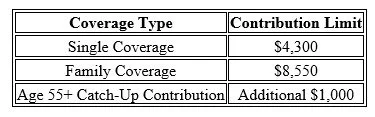
These limits include both employee and employer contributions combined. So if your employer contributes to your HSA, that amount counts toward the total annual limit.
Because these limits are indexed for inflation, they typically increase slightly each year.
Be Careful as You Approach Age 65 (Medicare Rule)
There is a very important rule regarding HSAs and Medicare that many people are not aware of:
Once you enroll in Medicare, you can no longer contribute to an HSA.
However, there is an additional rule that affects individuals who work past age 65 and delay Medicare.
The 6-Month Medicare Retroactive Rule
When someone enrolls in Medicare Part A after age 65, Medicare coverage is retroactive for 6 months (but not earlier than age 65).
Because of this:
You must stop HSA contributions 6 months before applying for Medicare
Otherwise, those contributions become excess contributions
Excess contributions can result in tax penalties if not corrected
Example
Let’s say someone is 67, still working, and contributing to an HSA.
If they plan to enroll in Medicare in December, they should stop HSA contributions by June of that year.
If they do not, they may need to withdraw excess contributions and potentially pay penalties.
Important Exception
If you enroll in Medicare right at age 65, you do not need to stop contributions 6 months early because Medicare cannot retroactively start before age 65.
Why HSAs Can Be So Valuable
HSAs are often used as a retirement healthcare savings account because:
Contributions are pre-tax
Growth is tax-deferred
Withdrawals are tax-free for medical expenses
After age 65, withdrawals for non-medical expenses are penalty-free (taxable only)
Because healthcare is often one of the largest expenses in retirement, many individuals choose to save their HSA funds during their working years and use them later in retirement.
About Michael……...
Hi, I’m Michael Ruger. I’m the managing partner of Greenbush Financial Group and the creator of the nationally recognized Money Smart Board blog . I created the blog because there are a lot of events in life that require important financial decisions. The goal is to help our readers avoid big financial missteps, discover financial solutions that they were not aware of, and to optimize their financial future.
Frequently Asked Questions (FAQs)
-
Can anyone open an HSA account?No. You must be enrolled in a qualified High Deductible Health Plan.
-
Can I contribute to an HSA if I am self-employed?Yes, as long as you have an HSA-eligible high deductible health insurance plan.
-
Can I contribute to an HSA if I am on Medicare?No. Once enrolled in Medicare, you can no longer contribute.
-
Can my employer contribute to my HSA?Yes, and employer contributions count toward the annual limit.
-
What happens if I contribute to an HSA while on Medicare?Those contributions are considered excess contributions and may be subject to penalties.
-
Can both spouses contribute to an HSA?Yes, if both spouses are eligible and covered by an HSA-qualified plan.
-
Do HSA contribution limits change each year?Yes, they are typically adjusted annually for inflation.
-
What is the catch-up contribution for people over age 55?An additional $1,000 per year.
-
Can I still use my HSA after I go on Medicare?Yes, you just cannot contribute anymore.
-
What happens if I exceed the HSA contribution limit?You may have to withdraw the excess contribution and could owe penalties if not corrected.
Health Savings Account Distribution Tax and Penalty Rules
Health Savings Account (HSA) withdrawals have different tax and penalty rules depending on age and how funds are used. This guide explains the four distribution scenarios, tax treatment before and after age 65, and advanced strategies to maximize tax-free benefits. Learn how HSAs can serve as a powerful retirement healthcare tool and how to avoid common withdrawal mistakes. Ideal for pre-retirees planning tax-efficient income strategies.
By Michael Ruger, CFP®
Partner and Chief Investment Officer at Greenbush Financial Group
Health Savings Accounts (HSAs) are one of the most tax-advantaged accounts available, but the tax treatment of distributions depends on how the money is used and the age of the account owner. There are essentially four different distribution scenarios that HSA owners can run into, and each scenario has different tax and penalty rules that are important to understand.
In this article, we’ll cover:
The four HSA distribution scenarios
Tax treatment before age 65
Tax treatment after age 65
Why HSAs are so valuable for retirement planning
Advanced HSA distribution strategies
Common HSA distribution mistakes to avoid
Frequently asked questions about HSA distributions
Why HSA Accounts Are So Valuable
Health Savings Accounts are unique because they offer a rare triple tax advantage:
Contributions are made pre-tax
The account grows tax-deferred
Distributions are tax-free if used for qualified medical expenses
Very few accounts receive this type of tax treatment. Traditional retirement accounts are tax-deferred, and Roth accounts are tax-free on the way out, but HSAs can be tax-free on both the contribution and distribution side when used correctly.
Because of this, many financial planners recommend not spending HSA funds during working years if possible, and instead allowing the account to grow and using it later in retirement when healthcare costs are typically much higher.
The Four HSA Distribution Scenarios
There are four main distribution scenarios that determine whether you owe taxes and/or penalties on HSA withdrawals:
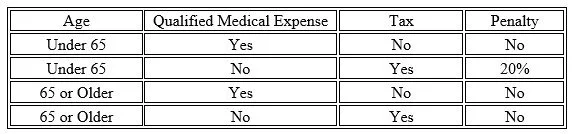
Let’s walk through each scenario.
Distributions Prior to Age 65 (Qualified Medical Expenses)
If you take a distribution from an HSA before age 65 and use the money for a qualified medical expense, the distribution is:
Tax-free
Penalty-free
This is the ideal use of an HSA. Qualified expenses can include:
Doctor visits
Deductibles and coinsurance
Dental and vision care
Hearing aids
Prescription medications
Medicare premiums (after age 65)
Medical equipment
In these cases, the HSA functions exactly as intended — a tax-free healthcare account.
Distributions Prior to Age 65 (Non-Qualified Expenses)
If you take a distribution before age 65 and the expense is not qualified, the distribution is:
Subject to ordinary income tax
Subject to a 20% penalty
For example, if someone is in a 30% tax bracket and takes a non-qualified distribution:
30% tax
20% penalty
Total loss = 50% of the distribution
This is why it is usually recommended to preserve HSA funds for medical expenses whenever possible.
Distributions Age 65 or Older (Qualified Medical Expenses)
This scenario works the same as before age 65.
If the distribution is used for qualified medical expenses, the withdrawal is:
Tax-free
Penalty-free
This is why HSAs are often used as a retirement healthcare fund.
Common qualified expenses in retirement include:
Medicare Part B premiums
Medicare Part D premiums
Medicare Advantage premiums
Out-of-pocket medical expenses
Deductibles and coinsurance
Dental and vision care
Hearing aids
Medical equipment
Distributions Age 65 or Older (Non-Qualified Expenses)
This is where the rules change.
After age 65, if you take money from an HSA for non-qualified expenses:
You pay ordinary income tax
No 20% penalty
At this point, the HSA starts to function similarly to a Traditional IRA. The money can be used for anything, but it becomes taxable income if not used for medical expenses.
This provides flexibility in retirement in case the funds are needed for non-medical expenses.
Important Rule: Reimbursed Expenses Do NOT Qualify
One important rule that retirees need to be aware of:
If a medical expense is reimbursed by insurance or a former employer, you cannot also take a tax-free HSA distribution for that same expense.
For example:
Some retirees have employer retiree health plans that reimburse Medicare premiums.
If the retiree is reimbursed for Medicare Part B or Part D, those expenses cannot also be reimbursed from the HSA tax-free.
This would be considered a non-qualified distribution, and taxes would apply.
Advanced HSA Distribution Strategies
There are several advanced strategies that can make HSAs even more powerful:
1. Save Receipts and Reimburse Yourself Later
There is no time limit on when you reimburse yourself from an HSA for a qualified expense, as long as:
The expense occurred after the HSA was established
You kept the receipt
This means someone could:
Pay medical expenses out-of-pocket during working years
Allow the HSA to grow
Reimburse themselves years later tax-free
This effectively turns the HSA into a tax-free retirement account.
2. Use HSA for Medicare Premiums
HSA funds can be used tax-free for:
Medicare Part B
Medicare Part D
Medicare Advantage
(This becomes a built-in retirement healthcare fund.)
3. Treat HSA Like a Backup Traditional IRA
After age 65, if needed, HSA funds can be withdrawn for non-medical expenses and simply taxed as income, with no penalty.
Common HSA Distribution Mistakes
Some of the most common mistakes include:
Using HSA funds for non-qualified expenses before 65
Losing receipts for reimbursement
Using HSA funds for reimbursed expenses
Spending HSA funds during working years instead of investing them
Not investing HSA funds for long-term growth
Forgetting that non-qualified withdrawals before 65 have a 20% penalty
About Michael……...
Hi, I’m Michael Ruger. I’m the managing partner of Greenbush Financial Group and the creator of the nationally recognized Money Smart Board blog . I created the blog because there are a lot of events in life that require important financial decisions. The goal is to help our readers avoid big financial missteps, discover financial solutions that they were not aware of, and to optimize their financial future.
Frequently Asked Questions (FAQs)
-
Do I pay taxes on HSA distributions?Only if the distribution is used for a non-qualified expense.
-
What is the penalty for non-qualified HSA withdrawals before age 65?A 20% penalty plus ordinary income tax.
-
What happens to the penalty after age 65?The 20% penalty goes away, but distributions are still taxable if not used for medical expenses.
-
Can I use my HSA for Medicare premiums?Yes, for Medicare Part B, Part D, and Medicare Advantage.
-
Can I reimburse myself years later from my HSA?Yes, as long as the expense occurred after the HSA was established and you kept the receipt.
-
Are HSA distributions reported on a tax return?Yes, distributions are reported on IRS Form 8889.
-
Can I use my HSA for my spouse's medical expenses?Yes, even if your spouse is not on your health insurance plan.
-
What happens to my HSA when I turn 65?You can still use it tax-free for medical expenses, and penalty-free for non-medical expenses (taxable).
-
Can I use my HSA for dental and vision expenses?Yes, most dental and vision expenses qualify.
-
Is an HSA better than a 401(k)?For medical expenses, an HSA can be more tax-efficient because it is tax-free on both contributions and qualified distributions.

How Much Life Insurance Should I Have?
Many people know they should have life insurance, but few know how much is enough. The right coverage amount depends on your income, debt, family size, and long-term goals. Whether you’re buying a policy for the first time or re-evaluating an old one, having the right number matters.

Many people know they should have life insurance, but few know how much is enough. The right coverage amount depends on your income, debt, family size, and long-term goals. Whether you’re buying a policy for the first time or re-evaluating an old one, having the right number matters.
This guide breaks down how to determine your ideal coverage—and why the wrong number can leave your family exposed.
Why Life Insurance Matters
Life insurance provides a financial safety net for your loved ones if you pass away unexpectedly. The payout can help:
Replace your income
Cover your mortgage and debts
Fund your children's education
Pay for funeral expenses
Maintain your family’s lifestyle
At its core, life insurance is about protecting the people who rely on you. It offers them financial time and stability during one of the hardest periods of their lives.
What Happens If You’re Underinsured?
A coverage gap could leave your spouse unable to afford the mortgage or force your children to delay college. Even a shortfall of $250,000 can mean long-term consequences like selling the family home, lifestyle changes for your family, dipping into retirement accounts, or accumulating debt.
Many people mistakenly believe their employer policy or small individual plan is “good enough.” In reality, it often isn’t.
How to Estimate Your Need?
Several variables play into estimating the need for life insurance, but it mostly comes back down to why life insurance matters and who you are trying to protect. When analyzing insurance coverage for financial planning clients, we focus on debt, income, future expenses, and retirement benefits (i.e. a future pension).
Let’s consider a typical family of four with the following assumptions.
Husband – Age 45 with Income of $75,000
Wife – Age 43 with Income of $150,000
2 Children – Age 3 and 7
Mortgage - $350,000
Husband Pension – $225,000 (Lump Sum Present Value of Future Payments)

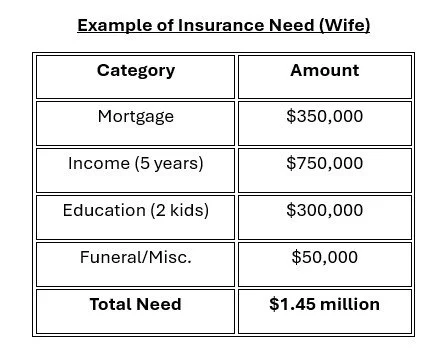
As you can see in the examples, the amounts for the husband and wife are different. A lot of families will just obtain the same coverage for each spouse, when the need is often not the same. We strongly recommend working with a financial professional as there are several other factors that could come into play. For example, younger couples with children may want more than 5 years of income replacement because they’ve had less time to grow their other assets. Some folks may sleep better at night with a larger amount.
Term vs. Permanent: What’s the Difference?
Term Life Insurance
Covers you for a set period (10, 20, or 30 years)
Ideal for covering temporary obligations like a mortgage or child-rearing years
Lower monthly cost
Permanent Life Insurance
Covers you for life
Includes a cash value component
Used more often in estate planning or legacy strategies
Higher cost, more complex
What Type of Insurance Should I Get?
For most people in their working years, term coverage offers the most protection for the lowest cost. This is typically what we recommend to families to make sure the amount of coverage is sufficient to cover the need. Over time, most families will continue to accumulate assets, pay down their mortgage, and see the kids grow up and come off the family payroll. This means that the amount of insurance coverage recommended today could be very different 10-15 years from now.
Term policies are a cost-effective way to cover the need while it is there. The annual savings from obtaining a term policy over a permanent policy could also be used to execute other financial strategies that may help in the near and long term.
Another cost saving strategy could be to ladder insurance policies over different periods. In general, the shorter the term period, the lower cost the policy. If the need for insurance is greater for the next 10 years, obtaining a 10-year policy for part of the need and then a 20- or 30-year policy for the remainder could lower the overall cost.
When Should You Review Your Coverage?
It’s smart to review your life insurance every few years or whenever your life changes. Key moments include:
Getting married or divorced
Buying a home
Having or adopting a child
Significant changes to income or debt
Changes to a beneficiary’s needs
These events can shift the amount of coverage you need or how long you need it.
Final Thoughts
Life insurance is not just about numbers—it’s about protecting your family’s future. Whether you need $500,000 or $2 million in coverage depends on your unique circumstances.
Having the wrong amount can leave loved ones exposed. Too little could cause hardship. Too much might waste dollars better used elsewhere.
If you’re unsure how much coverage is right for you, this is a perfect time to consult with a financial advisor who can walk you through the math and build a plan that gives you peace of mind.

Rob Mangold
About Rob……...
Hi, I’m Rob Mangold. I’m the Chief Operating Officer at Greenbush Financial Group and a contributor to the Money Smart Board blog. We created the blog to provide strategies that will help our readers personally, professionally, and financially. Our blog is meant to be a resource. If there are questions that you need answered, please feel free to join in on the discussion or contact me directly.