

Can Anyone Open an HSA Account?
Health Savings Accounts offer powerful tax advantages, but strict eligibility rules apply. This guide explains who can contribute to an HSA in 2026, including HDHP requirements, contribution limits, and Medicare restrictions. Learn how to avoid costly mistakes, especially as you approach age 65. A must-read for retirement-focused healthcare planning.

By Michael Ruger, CFP®
Partner and Chief Investment Officer at Greenbush Financial Group
Health Savings Accounts (HSAs) are one of the most tax-advantaged accounts available and can be a powerful tool for paying healthcare costs in retirement. Contributions are made with pre-tax dollars, the account grows tax-deferred, and distributions are tax-free when used for qualified medical expenses. However, not everyone is eligible to contribute to an HSA, and understanding the eligibility rules is critical.
In this article, we’ll cover:
Who is eligible to contribute to an HSA
What qualifies as a High Deductible Health Plan (HDHP)
2026 HSA contribution limits
Special rules when approaching age 65 and Medicare
Frequently asked questions about HSA eligibility
Who Is Eligible to Contribute to an HSA?
To contribute to an HSA, you must meet all of the following requirements:
You must be enrolled in a High Deductible Health Plan (HDHP)
You cannot be covered by any other non-HDHP health insurance
You cannot be enrolled in Medicare
You cannot be claimed as a dependent on someone else’s tax return
The most common way people become eligible for an HSA is through their employer-sponsored high deductible health insurance plan. If your employer’s health insurance plan is not classified as a high deductible plan, then you are not eligible to contribute to an HSA.
What Qualifies as a High Deductible Health Plan in 2026?
Each year, the IRS defines what qualifies as a High Deductible Health Plan. For 2026, a plan must meet the following minimum deductible and maximum out-of-pocket limits:

If your health insurance plan does not meet these thresholds, it is not considered HSA-eligible, and you cannot contribute to an HSA.
HSA Contribution Limits for 2026
The IRS also sets contribution limits each year. For 2026, the HSA contribution limits are:
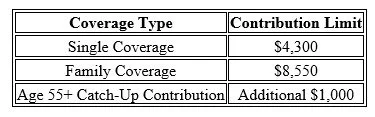
These limits include both employee and employer contributions combined. So if your employer contributes to your HSA, that amount counts toward the total annual limit.
Because these limits are indexed for inflation, they typically increase slightly each year.
Be Careful as You Approach Age 65 (Medicare Rule)
There is a very important rule regarding HSAs and Medicare that many people are not aware of:
Once you enroll in Medicare, you can no longer contribute to an HSA.
However, there is an additional rule that affects individuals who work past age 65 and delay Medicare.
The 6-Month Medicare Retroactive Rule
When someone enrolls in Medicare Part A after age 65, Medicare coverage is retroactive for 6 months (but not earlier than age 65).
Because of this:
You must stop HSA contributions 6 months before applying for Medicare
Otherwise, those contributions become excess contributions
Excess contributions can result in tax penalties if not corrected
Example
Let’s say someone is 67, still working, and contributing to an HSA.
If they plan to enroll in Medicare in December, they should stop HSA contributions by June of that year.
If they do not, they may need to withdraw excess contributions and potentially pay penalties.
Important Exception
If you enroll in Medicare right at age 65, you do not need to stop contributions 6 months early because Medicare cannot retroactively start before age 65.
Why HSAs Can Be So Valuable
HSAs are often used as a retirement healthcare savings account because:
Contributions are pre-tax
Growth is tax-deferred
Withdrawals are tax-free for medical expenses
After age 65, withdrawals for non-medical expenses are penalty-free (taxable only)
Because healthcare is often one of the largest expenses in retirement, many individuals choose to save their HSA funds during their working years and use them later in retirement.

About Michael……...
Hi, I’m Michael Ruger. I’m the managing partner of Greenbush Financial Group and the creator of the nationally recognized Money Smart Board blog . I created the blog because there are a lot of events in life that require important financial decisions. The goal is to help our readers avoid big financial missteps, discover financial solutions that they were not aware of, and to optimize their financial future.
Frequently Asked Questions (FAQs)
-
Can anyone open an HSA account?No. You must be enrolled in a qualified High Deductible Health Plan.
-
Can I contribute to an HSA if I am self-employed?Yes, as long as you have an HSA-eligible high deductible health insurance plan.
-
Can I contribute to an HSA if I am on Medicare?No. Once enrolled in Medicare, you can no longer contribute.
-
Can my employer contribute to my HSA?Yes, and employer contributions count toward the annual limit.
-
What happens if I contribute to an HSA while on Medicare?Those contributions are considered excess contributions and may be subject to penalties.
-
Can both spouses contribute to an HSA?Yes, if both spouses are eligible and covered by an HSA-qualified plan.
-
Do HSA contribution limits change each year?Yes, they are typically adjusted annually for inflation.
-
What is the catch-up contribution for people over age 55?An additional $1,000 per year.
-
Can I still use my HSA after I go on Medicare?Yes, you just cannot contribute anymore.
-
What happens if I exceed the HSA contribution limit?You may have to withdraw the excess contribution and could owe penalties if not corrected.




















Health Savings Account Distribution Tax and Penalty Rules
Health Savings Account (HSA) withdrawals have different tax and penalty rules depending on age and how funds are used. This guide explains the four distribution scenarios, tax treatment before and after age 65, and advanced strategies to maximize tax-free benefits. Learn how HSAs can serve as a powerful retirement healthcare tool and how to avoid common withdrawal mistakes. Ideal for pre-retirees planning tax-efficient income strategies.
By Michael Ruger, CFP®
Partner and Chief Investment Officer at Greenbush Financial Group
Health Savings Accounts (HSAs) are one of the most tax-advantaged accounts available, but the tax treatment of distributions depends on how the money is used and the age of the account owner. There are essentially four different distribution scenarios that HSA owners can run into, and each scenario has different tax and penalty rules that are important to understand.
In this article, we’ll cover:
The four HSA distribution scenarios
Tax treatment before age 65
Tax treatment after age 65
Why HSAs are so valuable for retirement planning
Advanced HSA distribution strategies
Common HSA distribution mistakes to avoid
Frequently asked questions about HSA distributions
Why HSA Accounts Are So Valuable
Health Savings Accounts are unique because they offer a rare triple tax advantage:
Contributions are made pre-tax
The account grows tax-deferred
Distributions are tax-free if used for qualified medical expenses
Very few accounts receive this type of tax treatment. Traditional retirement accounts are tax-deferred, and Roth accounts are tax-free on the way out, but HSAs can be tax-free on both the contribution and distribution side when used correctly.
Because of this, many financial planners recommend not spending HSA funds during working years if possible, and instead allowing the account to grow and using it later in retirement when healthcare costs are typically much higher.
The Four HSA Distribution Scenarios
There are four main distribution scenarios that determine whether you owe taxes and/or penalties on HSA withdrawals:
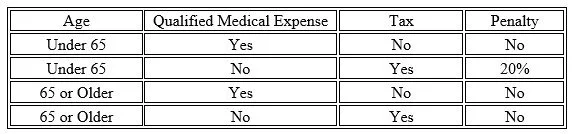
Let’s walk through each scenario.
Distributions Prior to Age 65 (Qualified Medical Expenses)
If you take a distribution from an HSA before age 65 and use the money for a qualified medical expense, the distribution is:
Tax-free
Penalty-free
This is the ideal use of an HSA. Qualified expenses can include:
Doctor visits
Deductibles and coinsurance
Dental and vision care
Hearing aids
Prescription medications
Medicare premiums (after age 65)
Medical equipment
In these cases, the HSA functions exactly as intended — a tax-free healthcare account.
Distributions Prior to Age 65 (Non-Qualified Expenses)
If you take a distribution before age 65 and the expense is not qualified, the distribution is:
Subject to ordinary income tax
Subject to a 20% penalty
For example, if someone is in a 30% tax bracket and takes a non-qualified distribution:
30% tax
20% penalty
Total loss = 50% of the distribution
This is why it is usually recommended to preserve HSA funds for medical expenses whenever possible.
Distributions Age 65 or Older (Qualified Medical Expenses)
This scenario works the same as before age 65.
If the distribution is used for qualified medical expenses, the withdrawal is:
Tax-free
Penalty-free
This is why HSAs are often used as a retirement healthcare fund.
Common qualified expenses in retirement include:
Medicare Part B premiums
Medicare Part D premiums
Medicare Advantage premiums
Out-of-pocket medical expenses
Deductibles and coinsurance
Dental and vision care
Hearing aids
Medical equipment
Distributions Age 65 or Older (Non-Qualified Expenses)
This is where the rules change.
After age 65, if you take money from an HSA for non-qualified expenses:
You pay ordinary income tax
No 20% penalty
At this point, the HSA starts to function similarly to a Traditional IRA. The money can be used for anything, but it becomes taxable income if not used for medical expenses.
This provides flexibility in retirement in case the funds are needed for non-medical expenses.
Important Rule: Reimbursed Expenses Do NOT Qualify
One important rule that retirees need to be aware of:
If a medical expense is reimbursed by insurance or a former employer, you cannot also take a tax-free HSA distribution for that same expense.
For example:
Some retirees have employer retiree health plans that reimburse Medicare premiums.
If the retiree is reimbursed for Medicare Part B or Part D, those expenses cannot also be reimbursed from the HSA tax-free.
This would be considered a non-qualified distribution, and taxes would apply.
Advanced HSA Distribution Strategies
There are several advanced strategies that can make HSAs even more powerful:
1. Save Receipts and Reimburse Yourself Later
There is no time limit on when you reimburse yourself from an HSA for a qualified expense, as long as:
The expense occurred after the HSA was established
You kept the receipt
This means someone could:
Pay medical expenses out-of-pocket during working years
Allow the HSA to grow
Reimburse themselves years later tax-free
This effectively turns the HSA into a tax-free retirement account.
2. Use HSA for Medicare Premiums
HSA funds can be used tax-free for:
Medicare Part B
Medicare Part D
Medicare Advantage
(This becomes a built-in retirement healthcare fund.)
3. Treat HSA Like a Backup Traditional IRA
After age 65, if needed, HSA funds can be withdrawn for non-medical expenses and simply taxed as income, with no penalty.
Common HSA Distribution Mistakes
Some of the most common mistakes include:
Using HSA funds for non-qualified expenses before 65
Losing receipts for reimbursement
Using HSA funds for reimbursed expenses
Spending HSA funds during working years instead of investing them
Not investing HSA funds for long-term growth
Forgetting that non-qualified withdrawals before 65 have a 20% penalty
About Michael……...
Hi, I’m Michael Ruger. I’m the managing partner of Greenbush Financial Group and the creator of the nationally recognized Money Smart Board blog . I created the blog because there are a lot of events in life that require important financial decisions. The goal is to help our readers avoid big financial missteps, discover financial solutions that they were not aware of, and to optimize their financial future.
Frequently Asked Questions (FAQs)
-
Do I pay taxes on HSA distributions?Only if the distribution is used for a non-qualified expense.
-
What is the penalty for non-qualified HSA withdrawals before age 65?A 20% penalty plus ordinary income tax.
-
What happens to the penalty after age 65?The 20% penalty goes away, but distributions are still taxable if not used for medical expenses.
-
Can I use my HSA for Medicare premiums?Yes, for Medicare Part B, Part D, and Medicare Advantage.
-
Can I reimburse myself years later from my HSA?Yes, as long as the expense occurred after the HSA was established and you kept the receipt.
-
Are HSA distributions reported on a tax return?Yes, distributions are reported on IRS Form 8889.
-
Can I use my HSA for my spouse's medical expenses?Yes, even if your spouse is not on your health insurance plan.
-
What happens to my HSA when I turn 65?You can still use it tax-free for medical expenses, and penalty-free for non-medical expenses (taxable).
-
Can I use my HSA for dental and vision expenses?Yes, most dental and vision expenses qualify.
-
Is an HSA better than a 401(k)?For medical expenses, an HSA can be more tax-efficient because it is tax-free on both contributions and qualified distributions.
