
Avoid Taking Auto Loans For More Than 5 Years – The Negative Equity Wave
There is a negative equity problem building within the U.S. auto industry. Negative equity is when you go to trade in your car for a new one but the outstanding balance on your car loan is GREATER than the value of your car. You have the option to either write a check for the remaining balance on the loan or “roll” the negative equity into your new car loan. More and more consumers are getting caught in this negative equity trap.

There is a negative equity problem building within the U.S. auto industry. Negative equity is when you go to trade in your car for a new one but the outstanding balance on your car loan is GREATER than the value of your car. You have the option to either write a check for the remaining balance on the loan or “roll” the negative equity into your new car loan. More and more consumers are getting caught in this negative equity trap. Below is a chart of the negative equity trend over the past 10 years.

In 2010, 22% of new car buyers with trade-ins had negative equity when they went to go purchase a new car. In 2020, that number doubled to 44% (source Edmunds.com). The dollar amount of the negative equity also grew from an average of $3,746 in 2010 to $5,571 in 2020.
Your Car Is A Depreciating Asset
The first factor that is contributing to this trend is the simple fact that a car is a depreciating asset, meaning, it decreases in value over time. Since most people take a loan to buy a car, if the value of your car drops at a faster pace than the loan amount, when you go to trade in your car, you may find out that your car has a trade-in value of $5,000 but you still owe the bank $8,000 for the outstanding balance on your car loan. In these cases, you either have to come out of pocket for the $3,000 to payoff the car loan or some borrowers can roll the $3,000 into their new car loan which right out of gates put them in the same situation over the life of the next car.
Compare this to a mortgage on a house. A house, historically, appreciates in value over time, so you are paying down the loan, while at the same time, your house is increasing in value a little each year. The gap between the value of the asset and what you owe on the loan is called “wealth”. You are building wealth in that asset over time versus the downward spiral horse race between the value of your car and the amount due on the loan.
How Long Should You Take A Car Loan For?
When I’m consulting with younger professionals, I often advise them to stick to a 5-year car loan and not be tempted into a 6 or 7 year loan. The longer you stretch out the payments, the more “affordable” your car payment will be, but you also increase the risk of ending up in a negative equity situation when you go to turn in your car for a new one. In my opinion, one of the greatest contributors to this negative equity issue is the rise in popularity of 6 and 7 year car loan. Can’t afford the car payment on the car you want over a 5 year loan, no worries, just stretch out the term to 6 or 7 years so you can afford the monthly payment.
Let’s say the car you want to buy costs $40,000 and the interest rate on the auto loan is 3%. Here is the monthly loan payment on a 5 year loan versus a 7 year loan:
5 Year Loan Monthly Payment: $718.75
7 Year Loan Monthly Payment: $528.53
A good size difference in the payment but what happens if you decide to trade in your car anytime within the next 7 years, it increases your chances of ending up in a negative equity situation when you go to trade in your car. Also, when comparing the total interest that you would pay on the 5-year loan versus the 7 year loan, the 7 year car loan costs you another $1,271 in interest.
But Cars Last Longer Now……
The primary objection I get to this is “well cars last longer now than they did 10 years ago so it justifies taking out a 6 or 7 year car loan versus the traditional 5 year loan.” My response? I agree, cars do last longer than what they used to 10 years ago BUT you are forgetting the following life events which can put you in a negative equity scenario:
Not everyone keeps their car for 7+ years. It’s not uncommon for car owners to get bored with the car they have and want another one 3 – 5 years later. Within the first 3 years of buying your car that is when you have the greatest negative equity because your car depreciates by a lot within those first few years, and the loan balance does not decrease by a proportionate amount because a larger portion of your payments are going toward interest at the onset of the loan.
Something breaks on the car, you are out of the warrantee period, and you worry that new problems are going to continue to surface, so you decide to buy a new car earlier than expected.
Change in the size of your family (more kids)
You move to a different climate. You need a car for snow or would prefer a convertible for down south
You move to a major city and no longer need a car
You get in an accident and total your car before the loan is paid off
The moral of the story is this, it’s difficult to determine what is going to happen next year, let alone what’s going to happen over the next 7 years, the longer the car loan, the greater the risk that a life event will take place that will put you in a negative equity position.
The Negative Equity Snowball
A common solution to the negative equity problem is just to roll the negative equity into your next car loan. If that negative equity keeps building up car, after car, after car, at some point you hit a wall, and the bank will no longer lend you the amount needed to buy the new car and absorb the negative equity amount within the new car loan.
Payoff Your Car Loan
Too many people think it’s normal to just always have a car loan, so they dismiss the benefit of taking a 5-year car loan, paying it off in 5 years, and then owning the car for another 2 to 3 years without a car payment, not only did you save a bunch of interest but now you have extra income to pay down debt, increase retirement savings, or build up your savings.
Short Term Pain for Long Term Gain
Rarely is the best financial decision, the easiest one to make. Taking a 5-year car loan instead of a 6-year loan will result in a higher monthly car payment which will eat into your take home pay, but you will thank yourself down the road when you go to trade in your current car and you have equity in your current car to use toward the next down payment as opposed to having to deal with headaches that negative equity brings to the table.
Post COVID Problem
Unfortunately, we could see this problem get worse over the next 7 years due to the rapid rise in the price of automobiles in the U.S. post COVID due to the supply shortages. When people trade in their cars they are getting a higher value for their trade in which is helping them to avoid a negative equity situation now but they are simultaneously purchasing a new car at an inflated price, which could cause more people to end up in a negative equity event when the price of cars normalizes, the car is worth far less than what they paid for it, and they still have a sizable outstanding loan against the vehicle.

About Michael……...
Hi, I’m Michael Ruger. I’m the managing partner of Greenbush Financial Group and the creator of the nationally recognized Money Smart Board blog . I created the blog because there are a lot of events in life that require important financial decisions. The goal is to help our readers avoid big financial missteps, discover financial solutions that they were not aware of, and to optimize their financial future.
Frequently Asked Questions (FAQs):
What does negative equity mean when trading in a car?
Negative equity occurs when your car loan balance is higher than the car’s trade-in or market value. To complete the trade, you must either pay the difference out of pocket or roll the negative balance into your next car loan, which can make the new loan more expensive and prolong debt.
Why are more car buyers ending up with negative equity?
A key reason is that cars are depreciating assets—they lose value faster than the loan balance is repaid. The growing use of 6- and 7-year car loans also contributes to the problem, as longer repayment terms slow down how quickly equity builds in the vehicle.
How do long-term car loans increase the risk of negative equity?
While longer loan terms reduce monthly payments, they extend the repayment period and increase total interest costs. Because cars depreciate quickly in the first few years, borrowers often owe more than their car is worth if they trade it in before the loan is paid off.
Is it better to choose a 5-year car loan instead of a 6- or 7-year loan?
Yes, shorter loan terms help you build equity faster and reduce total interest paid over time. Although monthly payments are higher, a 5-year loan minimizes the risk of owing more than the car’s value if you sell or trade it in early.
What life events can cause negative equity even if cars last longer now?
Unexpected changes—such as job relocation, growing family needs, vehicle breakdowns, or accidents—often lead people to replace cars sooner than planned. These early trades typically occur when depreciation is steepest, making negative equity more likely.
What happens if you keep rolling negative equity into new car loans?
Rolling negative balances into new loans compounds the problem over time. Each new loan starts “underwater,” increasing total debt and eventually making it difficult to qualify for future car financing.
How can you avoid negative equity when buying a car?
Limit loan terms to five years or less, make a meaningful down payment, and hold the car long enough to pay it off before buying another one. Owning a paid-off car for several years frees up cash flow and helps avoid the debt cycle associated with long-term car loans.


















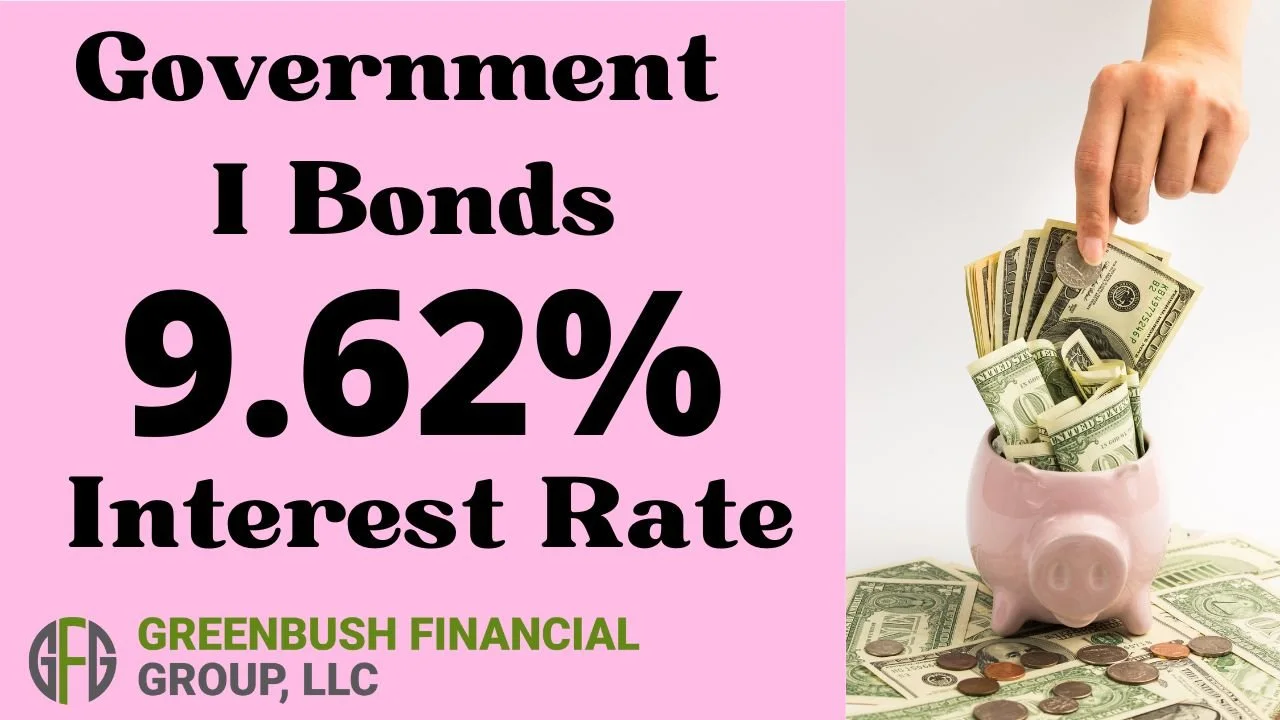
Government Savings Bonds (I Bonds) Are Paying A 9.62% Interest Rate
U.S. Government Savings Bonds called I Bonds are currently paying an interest rate of 9.62%. There are certain restrictions associated with these bonds that you should be aware of……..

There are U.S. Government Savings Bonds, called “I Bonds”, that are currently paying a 9.62% interest rate as of August 2022, you can continue to buy the bonds at that interest rate until October 2022, and then the rate resets. Before you buy these bonds, you should know the 9.62% interest rate is only for the first 6 months that you own the bonds and there are restrictions as to when you can redeem the bonds. In this article I will cover:
How do I Bonds works?
Are they safe investments?
Purchase limits
Why does the interest rate vary over the life of the bond?
How do you purchase an I Bond?
Redemption restrictions
Tax considerations
How do I Bonds Work?
I Bonds are issued directly from the U.S. Treasury. These bonds earn interest that compounds every six months but the interest is not paid to the bondholder until the bond is either redeemed or when the bond matures (30 years from the issue date).
Variable Interest Rate
Unlike a bank CD that pays the same interest rate until it matures, an I Bond has a variable interest rate the fluctuates every 6 months based on the rate of inflation. There are two components that make up the I Bond’s interest rate:
The Fixed Rate
The Inflation Rate
The fixed rate, as the name suggests, stays the same over the life of the bond. The fixed rate on the I Bonds that are being issued until October 31, 2022 is 0%.
The inflation rate portion of the bond interest usually varies every 6 months. A new inflation rate is set by the Treasury in May and in November. The inflation rate is based on the non-seasonally adjusted Consumer Price Index for all Urban Consumers (CPI-U) for all items, excluding food and energy. You can find the rates that the bonds are currently paying via this link: I Bond Rates
The total initial interest rate ends up being the Fixed Rate + the Inflation Rate which is currently 9.62%. But that initial interest rate only lasts for the first 6 months that you own the bond, after the first 6 months, the new inflation rate is used to determine what interest rate your bond will pay for the next 6 months. Your 6 month cycle is based on when you purchased your bond, here is the chart:

For example, if you purchase an I Bond in September 2022 at a current rate of 9.62%, that bond will accumulate 4.81% in interest over the next 6 months (50% of the annual 9.62% rate) and then on March 1, 2023, you will receive the new rate based on the new inflation rate. Between March 2023 – August 2023, you will receive that new rate, and then it will be recalculated again on September 1, 2023. This pattern continues until you redeem the bond.
Was The Fixed Rate Ever Higher Than 0%?
Yes, in May 2019, the fixed rate was 0.50% but the last time it was above 1% was November 2007.
Can These Bonds Lose Value?
To keep my compliance department happy, I’m going to quote this directly from the U.S. Treasury Direct website:
“No. The interest rate can’t go below zero and the redemption value of your I bond can’t decline” (Source www.treasurydirect.com)
These bonds are viewed as very safe investments.
Purchase Restrictions $10,000 - $15,000 Per Year
There are purchase restrictions on these bonds but it’s not income based. They restrict purchases to $10,000 - $15,000 each calendar year PER tax ID. Why the $10,000 to $15,000 range? Most taxpayers are restricted to purchasing $10,000 per calendar year but if you are due a federal tax refund, they allow you to buy up to an additional $5,000 with your tax refund, so an individual with a large enough federal tax return, could purchase up to $15,000 in a given calendar year.
If your married, you can purchase $10,000 for your spouse and $10,000 for yourself.
Self Employed Individuals
If you are self employed and your company has an EIN, your company would be allowed to purchase $10,000 in the EIN number.
Trusts Can Purchase I Bonds
If you have a trust that has an EIN number, your trust may be eligible to purchase $10,000 worth of I Bonds each year.
Gift An I Bond
You can buy a bond in the name and social security number of someone else, this is common when parents purchase a bond for their child, or grandparents for their grandchildren.
$80,000 Worth of I Bonds In A Single Year
Let’s look at an extreme hypothetical example of how someone could make an $80,000 purchase of I Bonds in a single year. You have a family that is comprised of two parents and three children, one of the parents owns an accounting firm setup as an S-Corp, and the parents each have a trust with a Tax ID.
Parent 1: $10,000
Parent 2: $10,000
Child 1: $10,000
Child 2: $10,000
Child 3: $10,000
S-Corp: $10,000
Parent 1 Trust: $10,000
Parent 2 Trust: $10,000
Total: $80,000
The $80,000 is just for one calendar year. If this structure stays the same, they could keep purchasing $80,000 worth of I Bonds each year. Given what’s happened with the markets this year, investors may welcome a guaranteed 4.61% rate of return over the next 6 months.
Restrictions on Selling Your I Bonds
You are not allowed to sell your I Bond within 12 months of the issue date. If you decide to sell your bond after 1 year but before 5 years, you will lose the last three months of interest earned by the bond. Once you are past the 5-year holding period, there is no interest penalty for selling the bond.
When Do You Pay Tax On The I Bond Interest?
The interest that you earn on I Bonds is subject to federal income tax but not state or local income tax but you have a choice as to when you want to realize the interest for tax purposes. You can either report the interest each year that is accumulated within the bond or you can wait to realize all of the interest for tax purposes when the bond is redeemed, gifted to another person, or it matures.
Warning: If you elect to realize the interest each year for tax purposes, you must continue to do so every year after for ALL of your saving bonds, and any I Bonds that you acquire in the future.
How Do You Purchase An I Bond?
I Bonds are issued electronically from the Treasury Direct website. You have to establish an online account and purchase the bonds within your account. Paper bonds are not available unless you are purchasing them with your federal tax refund. If you are purchasing I bonds with your federal tax refund, you can elect to take either electronic or paper delivery.
I Bond Minimum Purchase Amount
The minimum purchase amount for an electronic I Bond is $25. Over that threshold, you can purchase any amount you want to the penny. If you wanted to you could purchase an I Bond for $81.53. If you elect to receive paper bonds from a fed tax refund, those are issued in increments of $50, $100, $200, $500, and $1,000.
How Do You Redeem Your I Bonds
If you own the bonds electronically, you can redeem them by logging into your online account at Treasury Direct and click the link for “cashing securities” within the Manage Direct menu.
If you own paper bonds, you can ask your local bank if they cash I Bonds. If they don’t, you will have to mail them to the Treasury Retail Securities Services with FP Form 1522. The mailing address is listed on the form. You DO NOT need to sign the back of the bonds before mailing them in.
What Are Your Savings Bonds Worth?
If you want to know how much your savings bonds are worth before cashing them in, for electronic bonds you can log into to your online account to see the value. If you have paper bonds, you can use the Savings Bond Calculator provided by the Treasury.
DISCLOSURE: This article is for educational purposes only and is not a recommendation to buy I Bonds. Please consult your financial professional for investment advice.
About Michael……...
Hi, I’m Michael Ruger. I’m the managing partner of Greenbush Financial Group and the creator of the nationally recognized Money Smart Board blog . I created the blog because there are a lot of events in life that require important financial decisions. The goal is to help our readers avoid big financial missteps, discover financial solutions that they were not aware of, and to optimize their financial future.
Frequently Asked Questions (FAQs):
What are I Bonds and how do they work?
I Bonds are U.S. government savings bonds that earn interest based on both a fixed rate and an inflation-adjusted rate. Interest compounds every six months and is added to the bond’s value, but it isn’t paid out until you redeem the bond or it matures after 30 years.
Are I Bonds a safe investment?
Yes. I Bonds are backed by the U.S. Treasury and cannot lose value. Their interest rate can never fall below zero, and their redemption value is guaranteed to increase over time regardless of inflation changes.
Why does the I Bond interest rate change?
The interest rate on I Bonds combines a fixed rate (set at purchase) and a variable inflation rate that adjusts every six months based on the Consumer Price Index (CPI-U). As inflation rises or falls, the overall rate on the bond adjusts accordingly.
How much can you invest in I Bonds each year?
Individuals can purchase up to $10,000 per year in electronic I Bonds through TreasuryDirect. An additional $5,000 in paper I Bonds can be purchased using a federal tax refund, allowing for a potential total of $15,000 per person annually. Entities such as businesses and trusts with their own tax IDs can also purchase up to $10,000 per year.
What are the redemption restrictions for I Bonds?
I Bonds cannot be redeemed within the first 12 months of purchase. If redeemed within the first five years, you forfeit the last three months of interest. After five years, they can be cashed in at any time with no penalty.
How are I Bonds taxed?
Interest from I Bonds is subject to federal income tax but exempt from state and local taxes. You can choose to report interest each year as it accrues or defer taxes until you redeem the bonds, transfer ownership, or they mature.
How do you buy and redeem I Bonds?
I Bonds are purchased electronically through the TreasuryDirect website, with a minimum purchase of $25. To redeem electronic bonds, you log in to TreasuryDirect and request a redemption. Paper bonds, if owned, can be cashed at some banks or mailed to the Treasury with Form 1522.


This Market Rally Could Be A Bear Trap!! Here’s why……
The recent stock market rally could end up being a bear market trap for investors. If it is, this would be the 4th bear market trap of 2022.

After a really tough first 6 months of the year, the stock market has been in rally mode, rising over 9% within the last 30 days. It’s left investors anxious to participate in the rally to recapture the losses that were incurred in the first half of the year. Our guidance to clients, while there are plenty of bobbing heads on TV talking about “buying the dip” and trying to call the “bottom” in the market, this could very well be what we call a “bear trap”. A bear trap is a short-term rally that baits investors into thinking the market has bottomed only to find out that they fell for the trap, and experience big losses when the market retreats to new lows.
The 4th Bear Trap In 2022
If the current rally ends up being a bear trap, it would actually be the 4th bear trap so far in 2022.
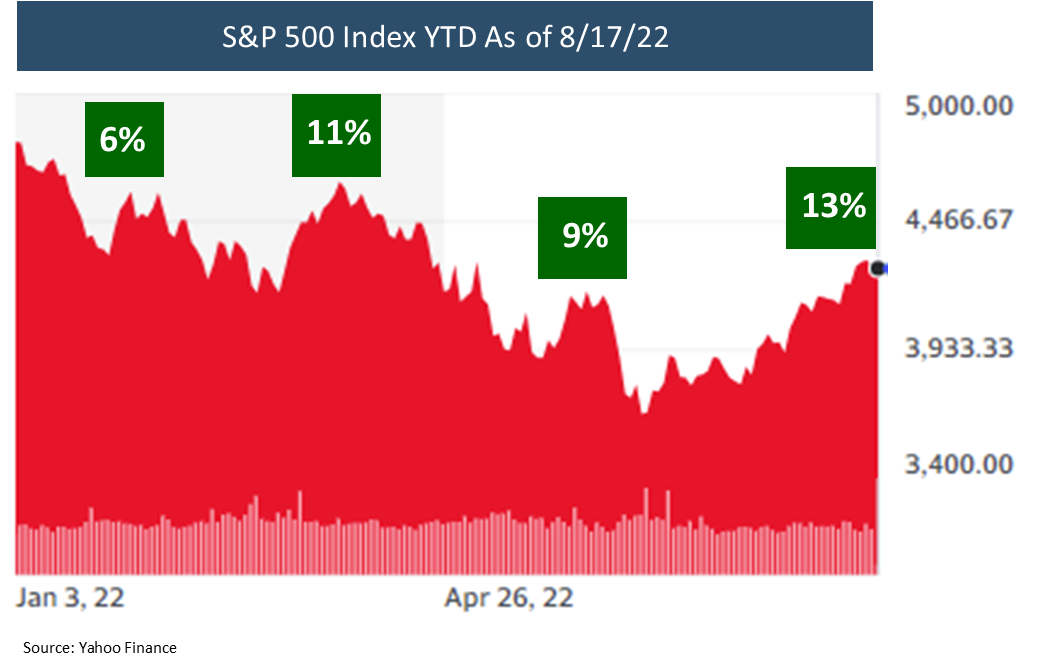
The green boxes in the chart show when the rallies occurred and the magnitude. Notice how the market moved to a new lower level after each rally, this is a common pattern when you are in a prolonged bear market environment.
So how do you know when the bear market is over and the new sustainable bull market rally has begun? It’s actually pretty simple. Ask yourself, what were the issues that drove the market lower in the first place? Next question, “Is the economy making MEANINGFUL progress to resolve those issues?” If the answer is yes, you may in fact be at the beginning of the rally off of the bottom; if the answer is no, you should resist the temptation to begin loading up on risk assets.
It's Not A Secret
It’s not a secret to anyone that inflation is the main issue plaguing not just the U.S. economy but economies around the world. Everyone is trying to call the “peak” but we did a whole video on why the peak doesn’t matter.
The market cheered the July inflation report showing that headline year over year inflation dropped from 9.1% in June to 8.5% in July. While progress is always a good thing, if the inflation rate keeps dropping by only 0.60% per month, we are going to be in a lot of trouble heading into 2023. Why? As long as the inflation rate (the amount prices are going up) is higher than the wage growth rate (how much more people are making), it will continue to eat away at consumer spending which is the bedrock of the U.S. economy. As of July, wages are growing at only 6.2% year over year. That’s still a big gap until we get to that safety zone.
Understand The Math Behind The CPI Data
While it’s great that the CPI (Consumer Price Index) is dropping, the main CPI number that hits the headlines is the year-over-year change, comparing where prices were 12 months ago to the prices on those same goods today. Let me explain why that is an issue as we look at the CPI data going forward. If I told you I will sell you my coffee mug today for $100, you would say “No way, that’s too expensive.” But a year from now I try and sell you that same coffee mug for $102 and I tell you that the cost of this mug has only risen by 2% over the past year, does that make you more likely to buy it? No, it doesn’t because the price was already too high to begin with.
In August 2021, inflation was already heating up. The CPI headline number for August 2021 was 5.4%, already running above the Fed’s comfort level of 3%. Similar to the example I just gave you above with the coffee mug, if the price of everything was ALREADY at elevated levels a year ago, and it went up another 8.5% on top of that elevated level, why is the market celebrating?
Probability of A 2023 Recession
Even though no single source of data is an accurate predicator as to whether or not we will end up in a recession in 2023, the chart that I am about to show you is being weighted heavily in the investment decisions that we are making for our clients.
Historically an “inverted” yield curve has been a fairly accurate predicator of a coming recession. Without going into all of the details of what causes a yield curve inversion, in its simplest form, it’s the bond market basically telling the stock market that a recession could be on the horizon. The chart below shows all of the yield curve inversions going back to 1970. The red arrows are where the inversion happened and the gray shaded areas are where recession occurred.
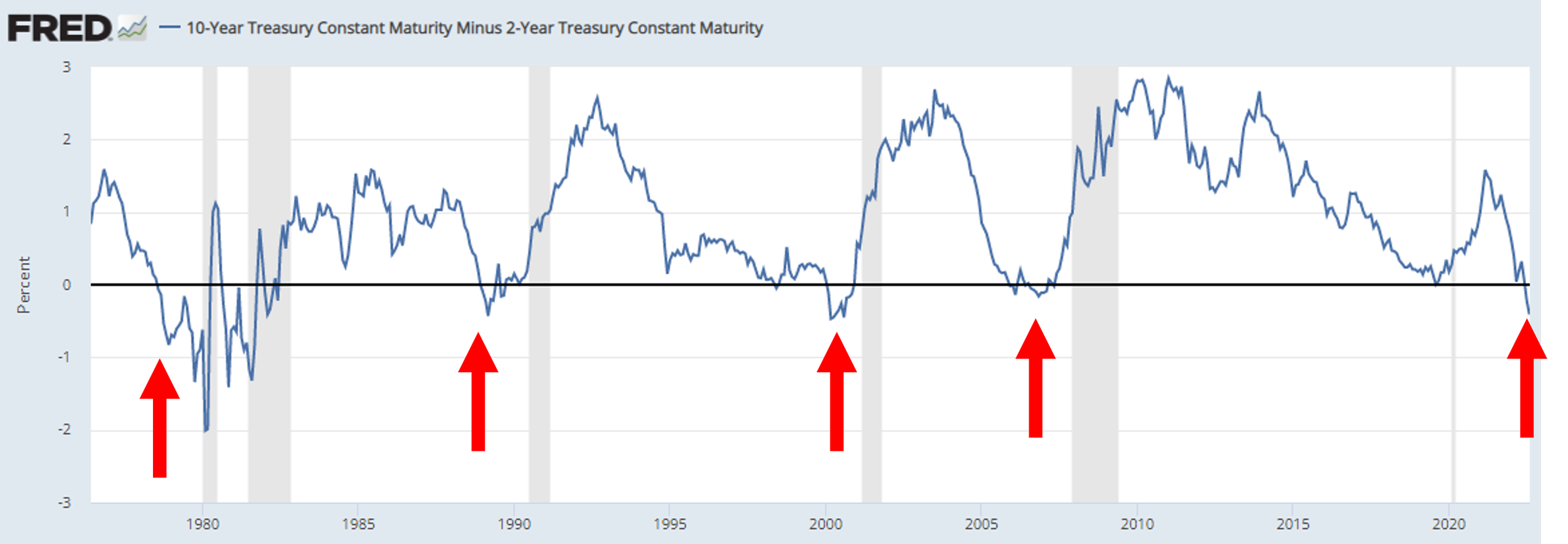
Look at where we are right now on the far right-hand side of the chart. There is no question that the yield curve is currently inverted and not just by a little bit. There are two main takeaways from this chart, first, there has been a yield curve inversion prior to every recession going back to 1970, an accurate data point. Second, there is typically a 6 – 18 month delay between the time the yield curve inverts and when the recession actually begins.
Playing The Gap
I want to build off of that last point about the yield curve. Investors will sometimes ask, “if there is historically a 6 – 18 month delay between the inversion and the recession, why would you not take advantage of the market rally and then go to cash before the recession hits?” My answer, if someone could accurately do that on a consistent basis, I would be out of a job, because they would manage all of the money in the world.
Recession Lessons
I have been in the investment industry since 2002. I experienced the end of the tech bubble bust, the Great Recession of 2008/2009, Eurozone Crisis, and 2020 COVID recession. I have learned a number of valuable lessons with regard to managing money prior to and during those recessions that I’m going to share with you now:
It’s very very difficult to time the market. By the time most investors realize we are on the verge of a recession, the market losses have already piled up.
Something typically breaks during the recession that no one expects. For example, in the 2008 Housing Crisis, on the surface it was just an issue with inflated housing prices, but it manifested into a leverage issue that almost took down our entire financial system. The questions becomes if we end up in a recession in 2023, will something break that is not on the surface?
Do not underestimate the power of monetary and fiscal policy.
The Power of Monetary & Fiscal Policy
I want to spend some time elaborating on that third lesson. The Fed is in control of monetary policy which allows them to use interest rates and bond activity to either speed up or slow down the growth rate of the economy. The Fed’s primary tool is the Fed Funds Rate, when they want to stimulate the economy, they lower rates, and when they want to slow the economy down (like they are now), they raise rates.
Fiscal policy uses tax policy to either stimulate or slow down the economy. Similar to what happened during COVID, the government authorized stimulus payments, enhanced tax credits, and created new programs like the PPP to help the economy begin growing again.
Many investors severely underestimate the power of monetary and fiscal stimulus. COVID was a perfect example. The whole world economy came to a standstill for the first time in history, but the Fed stepped in, lowered rates to zero, injected liquidity into the system via bond purchases, and Congress injected close to $7 Trillion dollars in the U.S. economy via all of the stimulus policies. Even though the stock market dropped by 34% within two months at the onset of the COVID crisis in 2020, the S&P 500 ended up posting a return of 16% in 2020.
Now those same powerful forces that allowed the market to rally against unsurmountable odds are now working against the economy. The Fed is raising rates and decreasing liquidity assistance. Since the Fed has control over short term interest rates but not long-term rates, that is what causes the yield curve inversion. Every time the Fed hikes interest rates, it takes time for the impact of those rate hikes to make their way through the economy. Some economists estimate that the delay between the rate hike and the full impact on the economy is 6 – 12 months.
The Fed Is Raising More Aggressively
The Fed right now is not just raising interest rates but raising them at a pace and magnitude that is greater than anything we have seen since the 1970’s. A chart below shows historical data of the Fed Fund Rate going back to 2000.
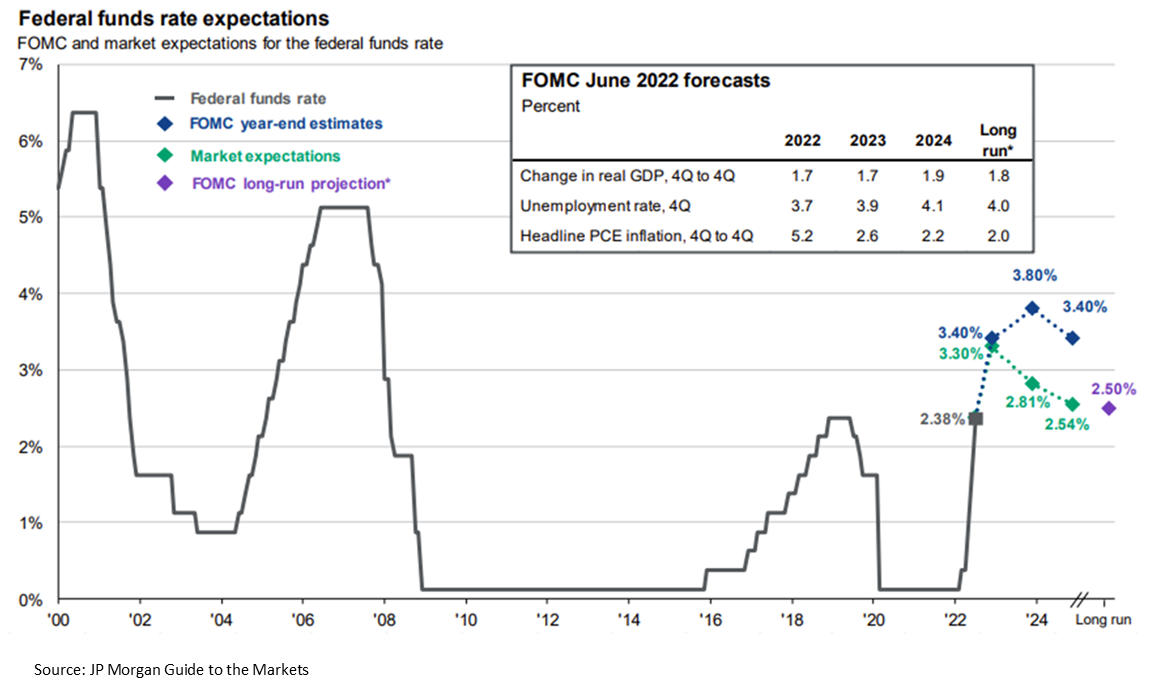
Look at 2004 and 2016, it looks like a staircase. Historically the Fed has raised rates in small steps of 0.25% - 0.50%. This gives the economy the time that it needs to digest the rate hikes. If you look at where we are now in 2022, the line shoots up like a rocket because they have been raising rates in 0.75% increments and another hike of 0.50% - 0.75% is expected at the next Fed meeting in September. When the Fed hikes rates bigger and faster than it ever has in recent history, it increases the chances that something could “break” unexpectedly 6 to 12 months from now.
Don’t Fight The Fed
You will frequently hear the phrase “Don’t Fight The Fed”. When you look back at history, when the Fed is lowering interest rates in an effort to jump start the economy, it usually works. Conversely, when the Fed is raising rates to slow down the economy to fight inflation, it usually works but it’s a double edged sword. While they may successfully slow down inflation, to do so, they have to slow down the economy, which is traditionally not great news for the stock market.
I have to credit Rob Mangold in our office with this next data point that was eye opening to me, when you look back in history, the Fed has NEVER been able to reduce the inflation rate by more than 2% without causing a recession. Reminder, the inflation rate is at 8.5% right now and they are trying to get the year over year inflation rate back down to the 2% - 3% range. That’s a reduction of a lot more than 2%.
Stimulus Packages Don’t Work
In the 1970’s, when we had hyperinflation, the government made the error of issuing stimulus payments and subsidies to taxpayers to help them pay the higher prices. They discovered very quickly that it was a grave mistake. If there is inflation and the people have more money to spend, it allows them to keep paying those higher prices which creates MORE inflation. That is why in the late 70’s and early 80’s, interest rates rose well above 10%, and it was a horrible decade for the stock market.
In the U.S. we have become accustomed to recessions that are painful but short. The COVID Recession and 2008/2009 Housing Crisis were both painful but short because the government stepped in, lowered interest rates, printed a bunch of money, and got the economy growing again. However, when inflation is the root cause of our pain, unless the government repeats their mistakes from the 1970’s, there is very little the government can do to help until the economy has contracted by enough to curb inflation.
Is This The Anomaly?
Investors have to be very careful over the next 12 months. If by some chance, the economy is able to escape a recession in 2023, based on the historical data, that would be an “anomaly” as opposed to the rule. Over my 20 year career in the industry, I have heard the phrase “well this time it’s different because of X, Y, and Z” but I have found that it rarely is. Invest wisely.
About Michael……...
Hi, I’m Michael Ruger. I’m the managing partner of Greenbush Financial Group and the creator of the nationally recognized Money Smart Board blog . I created the blog because there are a lot of events in life that require important financial decisions. The goal is to help our readers avoid big financial missteps, discover financial solutions that they were not aware of, and to optimize their financial future.


Medicare Is Projected To Be Insolvent In 2028
The trustees of the Medicare program just released their 2022 annual report and it came with some really bad news. The Medicare Part A Hospital Insurance (HI) Trust is expected to be insolvent in 2028 which currently provides health benefits to over 63 million Americans. We have been kicking the can down the road for the past 40 years and we have finally run out of road.

The trustees of the Medicare program just released their 2022 annual report and it came with some really bad news. The Medicare Part A Hospital Insurance (HI) Trust is expected to be insolvent in 2028 which currently provides health benefits to over 63 million Americans. The U.S. has been kicking the can down the road for the past 40 years and we have finally run out of road. In this article I will be covering:
What benefits Medicare Part A provides that are at risk
The difference between the Medicare HI Trust & Medicare SMI Trust
If Medicare does become insolvent in 2028, what happens?
Changes that Congress could make to prevent insolvency
Actions that retirees can take to manage the risk of a Medicare insolvency
Medicare HI Trust vs. Medicare SMI Trust
The Medicare program provides health insurance benefits to U.S. citizens once they have reached age 65, or if they become disabled. Medicare is made up of a few parts: Part A, Part B, Part C, and Part D.
Part A covers services such as hospitalization, hospice care, skilled nursing facilities, and some home health service. Medicare is made up of two trusts, the Hospital Insurance (HI) Trust and the Supplemental Medical Insurance (SMI) Trust. The HI Trust supports the Medicare Part A benefits and that is the trust that is in jeopardy of becoming insolvent in 2028. This trust is funded primarily through the 2.9% payroll tax that is split between employees and employers.
Medicare Part B, C, and D cover the following:
Part B: Physician visits, outpatient services, and preventative services
Part C: Medicare Advantage Programs
Part D: Prescription drug coverage
Part B and Part D are funded through a combination of general tax revenues and premiums paid by U.S. citizens that are deducted from their social security benefits. Most of the funding though comes from the tax revenue portion, in 2021, about 73% of Part B and 74% of Part D were funded through income taxes (CNBC). Even though they are supported by the SMI Trust, it would be very difficult for these sections of Medicare to go insolvent because they can always raise the premiums charged to retirees, which they did in 2022 by 14%, or increase taxes.
Part C is Medicare Advantage plans which are partially supported by both the HI and SMI Trust, and depending on the plan selected, premiums from the policyholder.
What Happens If Medicare Part A Becomes Insolvent in 2028?
The trustees of the Medicare trusts issue a report every year providing the public the funding status of the HI and SMI trusts. Based on the 2022 report, if no changes are made, there would not be enough money in the HI trust that supports all of the Part A health benefits to U.S. citizen. The system does not completely implode but there would only be enough money in the trust to pay about 90% of the promised benefits starting in 2029.
This mean that Medicare would not have the funds needed to fully pay hospitals and skilled nursing facilities for the services covered by Medicare. It could force these hospital and healthcare providers to accept a lower reimbursement from the service provider or it could delay when the reimbursement payments are received. In response, hospitals may have to cut cost, layoff workers, stop providing certain services, and certain practices may choose not to accept patients with Medicare coverage, limiting access to certain doctors.
Possible Solutions To Avoid Medicare Insolvency
The natural question is: If this is expected to happen in 2028, shouldn’t they make changes now to prevent the insolvency from taking place 6 years from now?” The definitely should but Medicare is a political football. When you have a government program that is at risk of going insolvent, there are really only three solutions:
Raise taxes
Cut Benefits
Restructure the Medicare Program
As a politician, whatever weapon you choose to combat the issue, you are going to tick off a large portion of the voting population which is why there probably have been no changes even though the warning bells has been ringing for years. The reality is that the longer they wait to implement changes, the larger, and more painful those changes need to be.
Some relatively small changes could go a long way if they act now. It’s estimated that if Congress raises the payroll tax that funds the HI Trust from 2.9% to 3.6% that would bump out the insolvency date of the HI Trust by about 75 years. If you go to the spending side, it’s estimated that if Part A were to cut its annual expenses by about 15% per year starting in 2022, it would have a similar positive impact (Source: Senate RPC).
Another possible fix, they could restructure the Medicare system, and move some of the Part A services to Part B. But this is not a great solution because even though it helps the Part A Trust insolvency issue, it pushes more of the cost to Part B which is funded be general tax revenues and premiums charged to retirees.
A third solution, Medicare could more aggressively negotiate the reimbursement rates paid to healthcare providers but that would of course have the adverse effect of putting revenue pressure on the hospitals and potentially jeopardize the quality of care provided.
The fourth, and in my opinion, the most likely outcome, no changes will be made between now and 2028, we will be on the doorstep of insolvency, and then Congress will pass legislation for an emergency bailout out package for the Medicare Part A HI Trust. This may buy them more time but it doesn’t solve the problem, and it will add a sizable amount to debt to the U.S. deficit.
What Should Retirees Do To Prepare For This?
Even though the government may try to issue more debt to bailout the Medicare Part A trust, as a retiree, you have to ask yourself the question, what if by the time we reach 2028, the U.S. can’t finance the amount a debt needed to stave off the insolvency? The Medicare Part A HI Trust is not the only government program facing insolvency over the next 15 years. One of the PBGC trusts that provides pension payments to workers that were once covered by a bankrupt pension plan is expected to be insolvent within the next 10 years. Social Security is expected to be insolvent in 2035 (2022 Trustees Report).
The solution may be to build a large expense cushion within your annual retirement budget so if the cost for your healthcare increases substantially in future years, you will already have a plan to handle those large expenses. This may mean paying down debt, not taking on new debt, cutting back on expenses, taking on some part-time income to build a large nest egg, or some combination of these planning strategies.
About Michael……...
Hi, I’m Michael Ruger. I’m the managing partner of Greenbush Financial Group and the creator of the nationally recognized Money Smart Board blog . I created the blog because there are a lot of events in life that require important financial decisions. The goal is to help our readers avoid big financial missteps, discover financial solutions that they were not aware of, and to optimize their financial future.
Frequently Asked Questions (FAQs):
What is the Medicare Part A Hospital Insurance (HI) Trust and why is it at risk?
The Medicare Part A HI Trust funds hospital-related services such as inpatient care, hospice, and skilled nursing facilities. It is primarily funded through payroll taxes, but rising healthcare costs and an aging population are depleting the trust faster than it’s being replenished, putting it on track for insolvency by 2028.
What’s the difference between the Medicare HI Trust and the SMI Trust?
The HI Trust supports Medicare Part A, which covers hospital and inpatient services, while the Supplemental Medical Insurance (SMI) Trust funds Part B (doctor visits and outpatient care) and Part D (prescription drug coverage). The SMI Trust is less vulnerable to insolvency because it is financed by general tax revenues and premiums that can be adjusted as needed.
What happens if the Medicare Part A trust becomes insolvent?
If no changes are made, the HI Trust will only have enough funds to pay about 90% of promised Part A benefits beginning in 2029. Hospitals and healthcare providers could face lower reimbursements or payment delays, which might reduce access to certain services for retirees.
What options does Congress have to prevent Medicare insolvency?
Lawmakers could raise payroll taxes, cut benefits, or restructure the program. For example, increasing the Medicare payroll tax rate from 2.9% to 3.6% could extend the HI Trust’s solvency by decades. Delaying reforms, however, would require more drastic and painful adjustments later.
Could Medicare be bailed out if insolvency occurs?
A short-term bailout is possible, as Congress could allocate emergency funding to keep the HI Trust solvent temporarily. However, this would increase the national debt and delay rather than solve the underlying structural funding problem.
How can retirees prepare for potential Medicare funding issues?
Retirees can build financial resilience by paying down debt, reducing expenses, and saving more to cover potential increases in out-of-pocket healthcare costs. Establishing an emergency savings buffer or maintaining part-time income may also help offset rising healthcare expenses if Medicare benefits are reduced.


Social Security Income Penalties Are Refunded To You When You Reach Fully Retirement Age
If you turn on social security prior to your fully retirement age andmake too much money in a given tax year, Social Security will assess an earned income penalty against your social security benefit but not many taxpayers realize that your get those penalties refunded to you once you reach Full Retirement Age

If you decide to turn on your Social Security payments before your full retirement age, the IRS has something called the Social Security Earnings Test where they assess a penalty if you make over a specified amount during that tax year. For 2025, that amount is $23,400 and the penalty is $1 for every $2 you earn over that threshold, but not many taxpayers realize that Social Security actually refunds you the penalty amounts once you reach full retirement age. In this article, I will walk you through:
• Social Security Full Retirement Age Based on Date of Birth
• Social Security Earnings Test
• How they assess the Social Security earnings penalty
• How does Social Security refund you the penalties paid when you reach full retirement age
• Other social security filing considerations
Social Security Full Retirement Age
As I mentioned in the intro, if you turn on Social Security PRIOR to your Full Retirement Age (“FRA”) and you continue to work, you are subject to the SS earnings test and possible penalties. Your SS full retirement age varies based on your date of birth:

The final column in the chart above shows the permanent reduction in your social security benefit if you turn on your SS benefit at age 62. If you plan to turn on your social security prior to your full retirement age and you plan to continue to work, you have to be careful with this decision. Not only are you permanently reducing your SS benefit, but you are also subject to the Social Security earnings test.
Once you reach Full Retirement Age, the SS earnings test goes away, you can make as much money as you want, and social security does not assess a penalty.
Social Security Earnings Test
Here’s how the social security earnings test works. If you turn on your SS benefit prior to full retirement age and you make more than $23,400 in 2025, SS will assess a penalty of $1 for every $2 you earn over that limit (50% penalty). The IRS increases the income threshold a little each year. Let’s look at the example below:
• You are age 63
• Your monthly social security benefit is $1,000 ($12,000 annually)
• You made $26,320 in earned income in 2025
In the example above, you earned $4,000 in income above the limit ($26,320 - $23,400 = $2,920). Social Security will assess a penalty of $1,460 ($2,920 × 50%).
How Do You Pay The Social Security Earned Income Penalty?
Let’s keep building on the previous example, you failed the earnings test, and you owe the $1,460 penalty, how do you pay it? The good news is you don’t have to write a check for it; instead, social security will withhold your social security payments the following year until you have satisfied the penalty. In the example above, your monthly SS benefit was $1,000 and you had a $1,460 penalty. Social security will withhold two of your monthly SS payments the following year and then your monthly social security payment will resume as normal.
Note: Social security does not withhold partial months, only full months to assess the penalty which means they may technically assess a larger penalty than what is actual due based on the 50% over the limit calculation.
The math for this example came out easy, 2 months exactly, but what if your monthly benefit is $1,000 and the penalty is $2,400, which would be 2.4 months of benefit payments? Social security rounds UP all fractional months, so they would withhold 3 full months of your social security payments even though that means they are withholding $3,000 to pay back a $2,400 penalty. The additional $600 that they withheld will be refunded back to you when they process the refund of the earned income penalty at your full retirement age. *reword to match example? (YES DELETE THIS SECTION)
Social Security Does Refund You The Penalties At Full Retirement Age
If social security withheld some of your monthly payments due to a failed earnings test prior to reaching your FRA, the good news is, once you reach full retirement age, social security refunds those penalties back to you. Unfortunately, they do not just send you a check for the dollar amount of all of those missed payments. Instead, upon reaching full retirement age, they recalculate your monthly social security payment taking into account those missed payments.
The easiest way to explain the refund calculation is via an example:
• Your SS full retirement age is 67
• You turned on your SS payment at age 62
• Your monthly SS benefit payments are $2,000
• Every year you made $8,000 over the SS earnings test limit
• This resulted in a $4,000 earned income penalty each year
• SS withheld 2 months of your benefit payments each year to assess the penalty
• 2 months × 5 years of SS payments = 10 months of missed payments
Between age 62 and reaching age 67, social security withheld a total of 10 months of your social security payments. Upon reaching FRA 67, instead of continuing your monthly benefit at $2,000, they credit you back those 10 months of payments, by recalculating your social security benefit assuming you originally turned on your SS benefit at age 62 & 10 months instead of age 62 & 0 months. This reduces the amount of the permanent penalty that you incurred for turning on your social security benefit prior to full retirement age, and you will receive a slightly higher social security benefit for the rest of your life to repay you for those earned income penalties that were assessed prior to full retirement age. It may take you a number of years to recoup those penalty payments, but how long you live will ultimately determine whether this refund calculation benefits you or the social security system.
Other Considerations Before Turning on Your SS Benefit Early
After reading this article, it may seem like a no-brainer to turn on your SS benefit early: if you earn too much in a given year and get assessed a penalty, so what — you just get the money back later. But it’s important to understand that there are other factors that you need to take into consideration before turning on your social security benefits early which include:
• The impact on the survivor benefits for your spouse
• The breakeven age of turning on the benefits early versus waiting
• How social security benefits are taxed
• Taking advantage of the automatic increase in the amount of the benefit each year
• The 50% spousal benefit
• Your life expectancy
Here is our article on Social Security Filing Strategies covering these other considerations.
About Michael……...
Hi, I’m Michael Ruger. I’m the managing partner of Greenbush Financial Group and the creator of the nationally recognized Money Smart Board blog . I created the blog because there are a lot of events in life that require important financial decisions. The goal is to help our readers avoid big financial missteps, discover financial solutions that they were not aware of, and to optimize their financial future.
Frequently Asked Questions (FAQs):
What is the Social Security Earnings Test?
The Social Security Earnings Test applies if you claim benefits before your full retirement age and continue to work. In 2025, you can earn up to $23,400 without penalty; beyond that, Social Security withholds $1 in benefits for every $2 you earn over the limit.
Does the earnings test apply after reaching full retirement age?
No. Once you reach your full retirement age (FRA), the earnings test no longer applies. You can earn an unlimited amount without any reduction in your Social Security benefits.
How is the Social Security earnings penalty paid?
You don’t pay the penalty out of pocket. Instead, Social Security withholds full monthly benefit payments until the total amount of the penalty is recovered. Because the program only withholds full months, it may temporarily take more than the exact penalty amount.
Does Social Security refund withheld benefits at full retirement age?
Yes. Once you reach your FRA, Social Security recalculates your benefit to credit back the months that were withheld due to the earnings test. Rather than sending a lump-sum refund, your monthly benefit is permanently increased to reflect those previously lost months.
How does the refund adjustment work?
When you reach full retirement age, Social Security recalculates your benefit as if you had started payments later—reducing the early-claiming penalty. For example, if you began benefits at age 62 and had ten months of payments withheld, your benefits would be adjusted as though you started at age 62 and 10 months, increasing your future monthly payments.
What factors should you consider before claiming Social Security early?
Before turning on benefits early, consider the long-term impact on survivor benefits, the break-even age compared to waiting, potential taxation of your benefits, annual cost-of-living adjustments, spousal benefit eligibility, and your life expectancy.

Removing Excess Contributions From A Roth IRA
If you made the mistake of contributing too much to your Roth IRA, you have to go through the process of pulling the excess contributions back out of the Roth IRA. The could be IRS taxes and penalties involved but it’s important to understand your options.
You discovered that you contributed too much to your Roth IRA, now it’s time to fix it. This most commonly happens when individuals make more than they expected which causes them to phaseout of their ability to make a contribution to their Roth IRA for a particular tax year. In 2025, the phase out ranges for Roth IRA contributions are:
Single Filer: $150,000 - $165,000
Married Filing Joint: $236,000 - $246,000
The good news is there are a few options available to you to fix the problem but it’s important to act quickly because as time passes, certain options for removing those excess IRA contributions will be eliminated.
You Discover The Error Before You File Your Taxes
If you discover the contribution error prior to filing your tax return, the most common fix is to withdraw the excess contribution amount plus EARNINGS by your tax filing deadline, April 18th. Custodians typically have a special form for removing excess contributions from your Roth IRA that you will need to complete.
If you withdraw the excess contribution before the tax deadline, you will avoid having to pay the IRS 6% excise penalty on the contribution, but you will still have to pay income tax on the earnings generated by the excess contribution. In addition, if you are under the age of 59½, you will also have to pay the 10% early withdrawal penalty on just the earnings portion of the excess contribution.
Example, you contribute $6,000 to your Roth IRA in September 2024 but you find out in March 2025 that your income level only allows you to make a $2,000 contribution to your Roth IRA for 2024 so you have a $4,000 excess contribution. You will have to withdraw not just the $4,000 but also the earnings produced by the $4,000 while it was in the account, for purposes of this example let’s assume that’s $400. The $4,000 is returned to you tax and penalty free but when the $400 in earnings is distributed from the account, you will have to pay tax on the earnings, and if under age 59½, a 10% withdrawal penalty on the $400.
October 15th Deadline
If you have already filed your taxes and you discover that you have an excess contribution to a Roth IRA, but it’s still before October 15th, you can avoid having to pay the 6% penalty by filing an amended tax return. You still have pay taxes and possibly the 10% early withdrawal penalty on the earnings but you avoid the 6% penalty on the excess contribution amount. This is only available until October 15th following the tax year that the excess contribution was made.
You Discover The Mistake After The October 15th Extension Deadline
If you already filed your taxes and you did not file an amended tax return by October 15th, the IRS 6% excess contribution penalty applies. If you contributed $6,000 to Roth IRA but your income precluded you from contributing anything to a Roth IRA in that tax year, it would result in a $360 (6%) penalty. But it’s important to understand that this is not a one-time 6% penalty but rather a 6% PER YEAR penalty on the excess amount UNTIL the excess amount is withdrawn from the Roth IRA. If you discovered that 5 years ago you made a $5,000 excess contribution to your Roth IRA but you never removed the excess contributions, it would result in a $1,500 penalty.
6% x 5 Years = 30% Total Penalty x $5,000 Excess Contribution = $1,500 IRS Penalty
A 6% Penalty But No Earnings Refund
Here’s a little known fact about the IRS excess contribution rules, if you are subject to the 6% penalty because you did not withdraw the excess contributions out of your Roth IRA prior to the tax deadline, when you go to remove the excess contribution, you are no longer required to remove the earnings generated by the excess contribution.
Reminder: If you remove the excess contribution prior to the initial tax deadline, you AVOID the 6% penalty on the excess contribution amount but you have to pay taxes and possibly the 10% early withdrawal penalty on just the earnings portion of the excess contribution.
If you remove the excess contribution AFTER the tax deadline, you do not have to pay taxes or penalties on the EARNINGS portion because you are not required to distribute the earnings, but you pay a flat 6% penalty per year based on the actual excess contribution amount.
Example: You contributed $6,000 to your Roth IRA in 2024, your income ended up being too high to allow any Roth IRA contributions in 2024, you discover this error in November 2025. You will have to withdraw the $6,000 excess contribution, pay the 6% penalty of $360, but you do not have to distribute any of the earnings associated with the excess contribution.
Why does it work this way? This is only a guess but since most taxpayers probably try to remove the excess contributions as soon as possible, maybe the 6% IRS penalty represents an assumed wipeout of a modest rate of return generated by those excess contributions while they were in the IRA.
Advanced Tax Strategy
There is an advanced tax strategy that involves evaluating the difference between the flat 6% penalty on the excess contribution amount and paying tax and possibly the 10% penalty on the earnings. Before I explain the strategy, I strongly advise that you consult with your tax advisor before executing this strategy.
I’ll show you how this works in an example. You make a $6,000 contribution to your Roth IRA in 2024 but then find out in March 2025 that based on your income, you are not allowed to make a Roth contribution for 2024. Your Roth IRA experienced a 50% investment return between the time you made the $6,000 contribution and now. You are 35 years old. So now you have a choice:
Option A: Prior to your 2024 tax filing, withdraw the $6,000 tax and penalty free, and also withdraw the $3,000 in earnings which will be subject to ordinary income tax and a 10% penalty. Assuming you are in a 32% Fed bracket, 6% State Bracket, that would cost you 48% in taxes and penalties on the $3,000 in earnings.
Total Taxes and Penalties = $1,440
Option B: Waiting until November 2025, pull out the $6,000 excess contribution, and pay the 6% penalty, but you get to leave the $3,000 in earnings in your Roth IRA. $6,000 x 6% = $360
Total Taxes and Penalties = $360
PLUS you have an additional $3,000 that gets to stay in your Roth IRA, compound returns, and then be withdrawn tax and penalty free after age 59½.
FINANCIAL NERD NOTE: If the only balance in your Roth IRA is from earnings that originated from excess contributions, it’s does not start the 5-year holding period required to receive the Roth IRA earnings tax free after age 59½ because they are considered ineligible contributions retained within the Roth IRA.
Losses Within The Roth IRA
Since I’m writing this in April 2024 and most of the equity indexes are down year-to-date, I’ll explain how losses within a Roth IRA impact the excess contribution calculation. If your Roth IRA has lost value between the time you made the excess contribution and the withdrawal date, it does reduce the amount that you have to withdraw from the IRA. If your excess contribution amount is $3,000 but the Roth IRA dropped 20% in value, you would only have to withdraw $2,400 from the Roth IRA to satisfy the removal of the excess contributions. If withdrawn prior to your tax filing deadline, no taxes or penalties would be due because there were no earnings.
Other Options Besides Cash Withdrawals
Up until now we have just talked about withdrawing the excess contribution from your IRA by taking the cash back but there are a few other options that are available to satisfy the excess contribution rules.
The first is “recharacterizing” your excess Roth contribution as a traditional IRA contribution. If your income allows, you may be able to transfer the excess Roth contribution amount and earnings from your Roth IRA to your Traditional IRA but this must be done in the same tax year to avoid the 6% penalty.
Second option, if you are eligible to make a Roth IRA contribution the following year, the excess contribution can be used to offset the Roth contribution amount for the following tax year. Example, if you had an excess Roth IRA contribution of $1,000 in 2024 and your income will allow you to make a $6,000 Roth IRA contribution in 2025, you can reduce the Roth contribution limit by $1,000 in 2025, leave the excess in the account, and just deposit the remaining $5,000. You would still have to pay the 6% penalty on the $1,000 because you never withdrew it from the Roth IRA but it’s $60 penalty versus having to take the time to go through the excess withdrawal process.
Which Contributions Get Pulled Out First
It’s not uncommon for investors to make monthly contributions to their Roth IRA accounts but when it comes to an excess contribution scenario, you don’t get to choose which contributions are entered into the earning calculation. The IRS follows the LIFO (last-in-first-out) method for determining which contributions should be removed to satisfy the excess refund.
You Have Multiple IRA’s
If you have multiple Roth IRA’s and there is an excess contribution, you have to remove the excess contribution from the same Roth IRA that the contribution was made to, you can’t take it from a different Roth IRA to satisfy the removal of the excess.
If you have both a Traditional IRA and a Roth IRA and you exceed the aggregate contribution limit for the year, by default, the IRS assumes the excess contribution was made to the Roth IRA, so you have to begin taking corrective withdrawals from your Roth IRA first.
About Michael……...
Hi, I’m Michael Ruger. I’m the managing partner of Greenbush Financial Group and the creator of the nationally recognized Money Smart Board blog . I created the blog because there are a lot of events in life that require important financial decisions. The goal is to help our readers avoid big financial missteps, discover financial solutions that they were not aware of, and to optimize their financial future.
Frequently Asked Questions (FAQs):
What happens if I contribute too much to my Roth IRA?
If your income is too high or you accidentally contribute more than the annual Roth IRA limit, the excess amount is considered an “excess contribution.” The IRS assesses a 6% penalty each year that the excess remains in the account until it’s corrected.
How can I fix a Roth IRA excess contribution before filing my taxes?
If you catch the mistake before your tax filing deadline (typically April 15), you can withdraw the excess contribution and any earnings. You’ll avoid the 6% penalty, but the earnings portion is taxable—and may be subject to a 10% early withdrawal penalty if you’re under age 59½.
What if I already filed my tax return but it’s before October 15?
You can file an amended return and withdraw the excess contribution plus earnings before October 15 to avoid the 6% excise tax. However, you’ll still owe income taxes and possibly the 10% early withdrawal penalty on the earnings portion.
What happens if I discover the excess contribution after October 15?
Once the October 15 deadline passes, you can no longer avoid the 6% annual penalty. The penalty continues each year until the excess amount is removed from your Roth IRA, but you no longer have to withdraw the earnings associated with that excess contribution.
Can I recharacterize or apply the excess contribution to a future year?
Yes. You can recharacterize the excess Roth contribution as a traditional IRA contribution, if eligible, by transferring it and any earnings. Alternatively, you can apply the excess toward next year’s contribution limit, but you’ll owe a 6% penalty for the current year.
What if my Roth IRA lost money after I made the excess contribution?
If the value of your Roth IRA declines, you only need to withdraw the reduced value of the excess contribution. For example, if your $3,000 excess contribution dropped 20% in value, you would only withdraw $2,400, and no taxes or penalties would apply if withdrawn before the filing deadline.
How does the IRS determine which contributions to remove?
The IRS uses a last-in, first-out (LIFO) method, meaning the most recent contributions are treated as the ones being withdrawn first. Excess withdrawals must come from the same Roth IRA where the contribution was made.

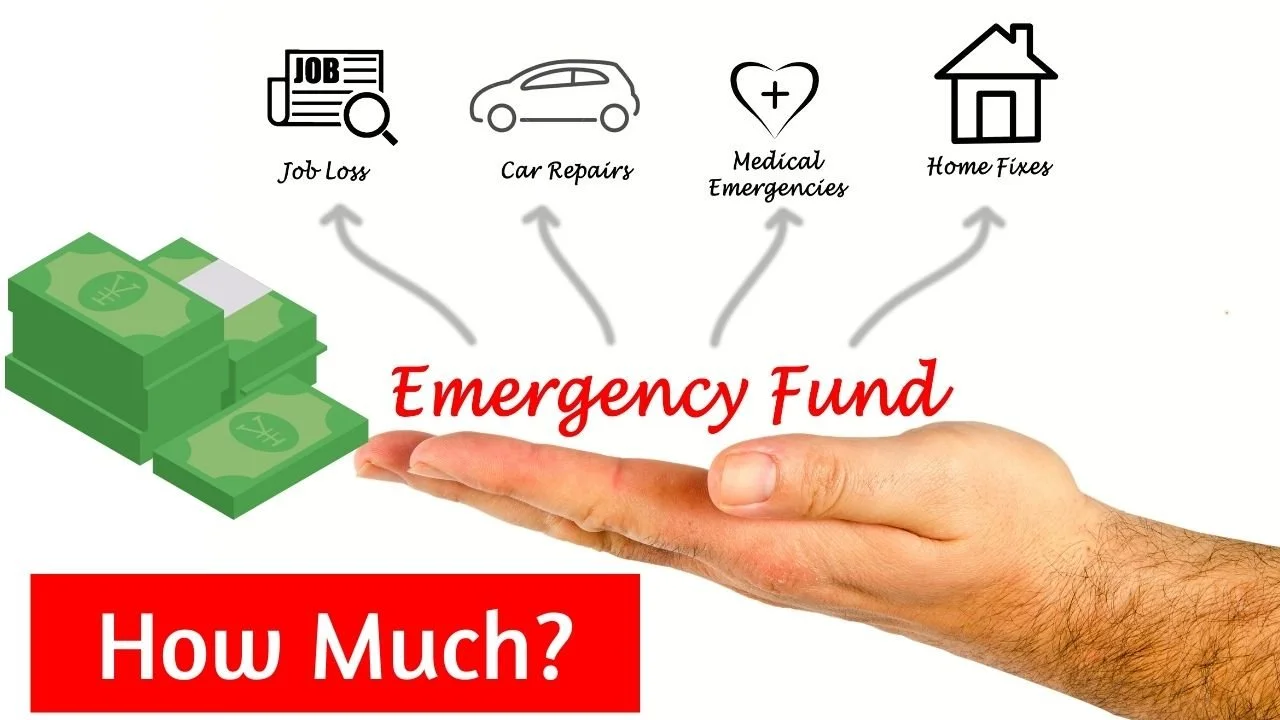
How Much Should You Have In An Emergency Fund?
Establishing an emergency fund is an important step in achieving financial stability and growth. Not only does it help protect you when big expenses arise or when a spouse loses a job but it also helps keep your other financial goals on track.
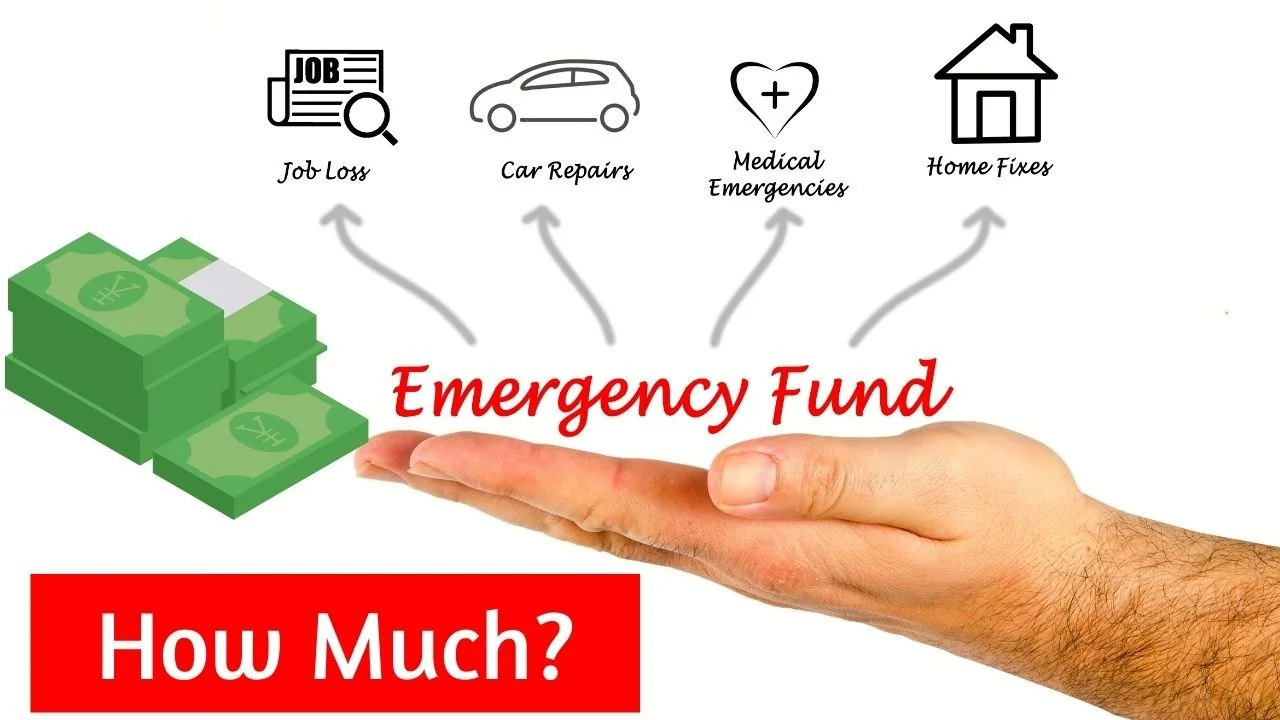
Establishing an emergency fund is an important step in achieving financial stability and growth. Not only does it help protect you when big expenses arise or when a spouse loses a job but it also helps keep your other financial goals on track. When we educate clients on emergency funds, the follow questions typically arise:
How much should you have in an emergency fund?
Does the amount vary if you are retired versus still working?
Should your emergency fund be held in a savings account or invested?
When is your emergency fund too large?
How do you coordinate this with your other financial goals?
Emergency Fund Amount
In general, your emergency fund should typically be 4 to 6 months of your total monthly expenses. To calculate this, you will have to complete a monthly budget listing all of your expenses. Here is a link to an excel spreadsheet that we provide to our clients to assist them with this budgeting exercise: GFG Expense Planner.
Big unforeseen expenses come in all shapes and sizes but frequently include:
You or your spouse lose a job
Medical expenses
Unexpected tax bill
Household expenses (storm, flooding, roof, furnace, fire)
Major car expenses
Increase in childcare expenses
Family member has an emergency and needs financial support
Without a cash reserve, surprise financial events like these can set you back a year, 5 years, 10 years, or worse, force you into bankruptcy, require you to move, or to sell your house. Having the discipline to establish an emergency fund will help to insulate you and your family from these unfortunate events.
Cash Is King
We usually advise clients to keep their emergency fund in a savings account that is liquid and readily available. That will usually prompt the question: “But my savings account is earning minimal interest, isn’t it a waste to have that much sitting in cash earning nothing?” The purpose of the emergency fund it to be able write a check on the spot in the event of a financial emergency. If your emergency fund is invested in the stock market and the stock market drops by 20%, it may be an inopportune time to liquidate that investment, or your emergency fund amount may no longer be the adequate amount.
Even though that cash is just sitting in your savings account earning little to no interest, it prevents you from having to go into debt, take a 401(k) loan, or liquidate investments at an inopportune time to meet the unforeseen expense.
Cash Reserve When You Retire
I will receive the question from retirees: “Should your cash reserve be larger once you are retired because you are no longer receiving a paycheck?” In general, my answer is “no”, as long as you have your 4 months of living expenses in cash, that should be sufficient. I will explain why in the next section.
Your Cash Reserve Is Too Large
There is such a thing as having too much cash. Cash can provide financial security but beyond that, holding cash does not provide a lot of financial benefits. If 4 months of your living expenses is $20,000 and you are holding $100,000 in cash in your savings account, whether you are retired or not, that additional $80,000 in cash over and above your emergency fund amount could probably be working harder for you doing something else. There is a long list of options, but it could include:
Paying down debt (including the mortgage)
Making contributions to retirement accounts to lower your income tax liability
Roth conversions
College savings accounts for your kids or grandchildren\
Gifting strategies
Investing the money in an effort to hedge inflation and receive a higher long-term return
Emergency Fund & Other Financial Goals
It’s not uncommon for individuals and families to find it difficult to accumulate 4 months worth of savings when they have so many other bills. If you are living paycheck to paycheck right now and you have debt such as credit cards or student loans, you may first have to focus on a plan for paying down your debt to increase the amount of extra money you have left over to begin working toward your emergency fund goal. If you find yourself in this situation, a great book to read is “The Total Money Makeover” by Dave Ramsey.
The probability of achieving your various financial goals in life increases dramatically once you have an emergency fund in place. If you plan to retire at a certain age, pay for your children to go college, be mortgage and debt free, purchase a second house, whatever the goal may be, large unexpected expenses can either derail those financial goals completely, or set you back years from achieving them.
Remember, life is full of surprises and usually those surprises end up costing you money. Having that emergency fund in place allows you to handle those surprise expenses without causing stress or jeopardizing your financial future.
About Michael……...
Hi, I’m Michael Ruger. I’m the managing partner of Greenbush Financial Group and the creator of the nationally recognized Money Smart Board blog . I created the blog because there are a lot of events in life that require important financial decisions. The goal is to help our readers avoid big financial missteps, discover financial solutions that they were not aware of, and to optimize their financial future.
Frequently Asked Questions (FAQs):
How much should you have in an emergency fund?
Most financial experts recommend saving between four and six months’ worth of essential living expenses. To determine your target amount, create a monthly budget of housing, utilities, insurance, food, transportation, and other recurring costs, then multiply that total by the desired number of months.
Should your emergency fund be different if you’re retired?
Not necessarily. A reserve of about four months of living expenses is usually sufficient for retirees, provided that regular income sources such as pensions or Social Security are stable. Holding too much cash in retirement can limit growth opportunities and reduce purchasing power over time.
Where should you keep your emergency fund?
An emergency fund should be kept in a liquid, low-risk account such as a savings or money market account. While the interest rate may be modest, the priority is accessibility and protection from market fluctuations, ensuring the money is available when needed.
Can an emergency fund be too large?
Yes. Once your fund exceeds four to six months of expenses, the extra cash could be more productive elsewhere—such as paying down debt, contributing to retirement accounts, or investing for long-term goals. Cash beyond what you truly need for emergencies often loses value to inflation.
How can you build an emergency fund while managing debt or other goals?
If you’re living paycheck to paycheck or carrying high-interest debt, start small and automate savings to gradually build your fund. Paying off debt first can free up monthly cash flow, making it easier to reach your savings goal without sacrificing progress toward other financial priorities.
Why is an emergency fund important for long-term financial success?
An emergency fund protects you from having to use credit cards, take loans, or sell investments at a loss when unexpected expenses occur. It provides peace of mind and keeps your retirement, education, and other financial goals on track even during difficult times.

What Causes Bonds To Lose Value In Certain Market Environments?
Bonds are often revered as a safe investment compared to stocks but make no mistake, bonds like other investments are not risk-free, and there are certain market environments where they can lose value. As I write this article in May 2022, the Aggregate Bond Index is currently down 8% year to date.
Bonds are often revered as a safe investment compared to stocks but make no mistake, bonds like other investments are not risk-free, and there are certain market environments where they can lose value. As I write this article in May 2022, the Aggregate Bond Index is currently down 8% year to date. While this is definitely a more extreme year for the bond market, there are other years in the past where bonds have lost value.
How do bonds work?
Bonds in their most basic form are essentially loans paid with interest. Companies, government entities, and countries issue bonds to raise money to fund their operations. When you buy a bond you are essentially lending money to these organizations in return for interest payments and potentially appreciation on the value of the bond. Similar to traditional loans, bonds can default, interest can be fixed or variable, and bonds are issued for varying durations. But unlike loans, the value of your original investment can fluctuate over the life of the bond.
Bond example
Before we get into all of the variables associated with bonds, let’s first look at a basic example. The US government is issuing a 10-year treasury bond with a 3% interest rate. You buy $10,000 worth of bonds so essentially you are lending the US government $10,000 for a duration of 10 years and during that 10 years, the US government will pay you 3% interest every single year, then after 10 years, the bond matures, the US government hands you back your $10,000.
Credit worthiness
Similar to someone asking to borrow money from you, all bond issuers are not created equal. You have to assess the credit worthiness of the company or organization that is issuing the bonds to make sure that they are going to be able to make their interest payments and return your principal at the maturity date. “Maturity date” is just bond lingo for when the bond issuer has to repay you the amount that you lent to them. When the US government issues bonds, they are considered by the market to be some of the safest bonds in the world because they are backed by the credit worthiness of the United States government. It would be a historic event if the US government were to default on its debt because the government can always print more money or raise taxes to make the debt payments. Compare this to a risky company, that is trying to emerge from bankruptcy, and is issuing bonds to raise capital to turn the company around. This could be viewed as a much riskier investment because if you lend that company $10,000, you may never see it again if the company is unable to emerge from bankruptcy successfully. For this reason, you have to be selective as to who is issuing you the bond.
Bond rating agencies
Thankfully there are bond rating agencies that help investors assess the credit worthiness of the bond issuer. The two main credit rating agencies are Standard & Poors and Moody’s. Both have grades that they assign to each bond issuer that can range from AAA for the highest quality issuers all the way down to D. It’s important to look at both rating agencies because they may assign different credit scores or in the bond world called “quality ratings” to a bond issuer. But as we learned during the 2008 and 2009 recession, even the bond rating agencies sometimes make the wrong call, so you should complete your own due diligence in assessing the credit worthiness of a particular bond issuer.
Bond defaults
When a company or government agency defaults on its debt it’s ugly. All of the creditors of the company including the bondholders line up to split up whatever’s left, if there is anything left. There could be a number of creditors that have priority over bondholders of a company even though bondholders have priority over stockholders in a company. If you bought a $10,000 bond from a company that goes bankrupt, you have to wait for the bankruptcy process to play out to find out how much, if any, of your original $10,000 investment will be returned to you.
Bond coupon rate
A bond coupon is the interest rate that is paid to the bondholder each year. If a bond has a 5% coupon that means it pays the bondholder 5% in interest each year over the life of that bond. While there are many factors that determine the interest rate of a bond, two of the primary factors are the credit worthiness of the organization issuing the bonds and the bond’s duration.
The credit worthiness of the bond issuer probably has the greatest weight. If a high-risk company is issuing bonds, investors will most likely demand a high coupon rate compared to a more financial stable company to compensate them for the increased level of risk. If a 10 year US government bond is being issued for a 3% coupon rate, a high-risk corporate bond may be issued at a coupon rate of 7% or more. Higher risk bonds are sometimes referred to as high yield bonds or junk bonds. On the flipside, organizations with higher credit ratings, normally have the luxury of issuing their bonds at lower interest rates because the market views them as safer.
The coupon payments, or interest payments, can be made to the bondholder in different durations during the year depending on the terms of the bond. Some bonds issue interest payments quarterly, semi-annually, once a year, and some bonds don’t issue any interest payments until the bonds matures.
It’s because of this fixed interest-rate structure that high quality bonds are often viewed as a safer investment than stocks because the value of a stock varies every day based on what the value of the company is perceived to be. Whereas bonds just make fixed interest payments and then re-pay you the face value of the bond at a future date. “Face value” is bond lingo for the dollar amount the bond was issued for and the amount that is returned to the bondholder at maturity.
Fixed interest versus variable interest
While most bonds are issued with a fixed interest rate, some bonds have a variable interest rate. If it’s a fixed interest rate, the bond pays the holder a set interest payment over the life of the bond. If it’s a variable interest rate, the interest rate paid to the bond holder can vary throughout the life of the bond. Some of the more common types of bonds that have variable interest rates are floating rate bonds. The interest rate that these bonds pay is typically tied to the variable rate associated with a short term bond benchmark like the LIBOR or the fed funds rate. As the interest of those benchmarks moves up and down, so do the corresponding interest rate paid by the bond.
Duration of a bond
The next big factor that influences the interest rate on a bond is the duration of the bond. “Duration” is bond lingo for the length from time between when the bond is first issued and when the bond matures. Typically, the longer the duration of the bond, the higher the interest rate which makes sense. If a company wants to borrow $10,000 from you for 1 year versus 10 years, as the person lending them the money, you will most likely want a higher interest rate for a 10 year loan versus a 1 year loan because they are holding onto your money for a longer period of time which represents a greater risk to you as the bondholder.
Interest rate risk
Bonds also have something called interest rate risk. Typically, when interest rates rise, the value of a bond falls, and vice versa if interest rates fall, the value of a bond rises. Up until this point, we have really just talked about coupon payments or interest payments made to a bondholder but the bond itself can change in value over the life of the bond. Let’s say a company is issuing bonds at $1,000 face value each, you buy a bond for $1,000 and at maturity you would expect to receive $1,000 back, but from the time that bond is issued and when it matures, you can normally trade that bond in the open market, and the value of that bond could sell for more or less than your original $1,000 investment.
If you buy a bond from a company that is a 10 year bond with a 5% interest rate but then interest rates across the economy begin to fall, and a year from now investors have difficulty finding bonds that are being issued with a 5% interest rate, another investor may pay you more than $1,000 to buy your bond and collect the 5% interest payment for the rest of that bonds life. So instead of just receiving $1,000 for the bond you may receive $1,500. The value paid over and above the bonds face value is considered appreciation which adds to your total return so the total return on a bond investment includes both dividends received and any appreciation if you sell it prior to maturity.
But that is a two way street, using that same example above, let’s say a company issues you a bond for $1,000 paying a 5% coupon, but now interest rates have moved higher over the next year, and that same company is now issuing bonds at a 7% interest rate, no one wants your 5% bond because they can get a higher interest-rate by buying the new bonds today. If you were to try and sell your bond in the open market you may only receive $900 from another investor because again, they can just pay $1,000 by purchasing the new bonds with the higher interest rate.
Holding to maturity
If you hold bonds to their maturity, which means you don’t trade them while you’re waiting for the bond to mature, it eliminates a lot of this interest-rate risk because then it’s just a pure loan. You lent a company $1,000, they pay you interest over the life of the loan, and then they hand you back your $1,000 at maturity. Interest rates do not impact the face value of a bond in most cases.
However, when we talk about bond mutual funds, those bond funds can hold hundreds or thousands of bonds, and those mutual funds are priced by “marking to market” each day, meaning they total up all of the value of the bonds in that portfolio as if they were all being sold at 4pm each day. It’s similar with bond ETFs but they trade intraday. Thus, if you own bonds via mutual funds or ETFs, interest-rate fluctuations will have a greater influence on the total return of your bond investment because there’s no option to just hold it to maturity. Depending on the interest rate environment this could either work for you or against you. The reason why many high-quality bond funds have lost value in 2022 is because interest rates have risen rapidly this year which has caused the value of those bonds to fall.
Duration Matters
There is a correlation between the time to maturity and the impact of interest rates on the price of a bond. The longer the duration of the bond, the more that can happen to interest rates between the time a bond is issued and the time the bond matures. For this reason, when interest rates move, it typically has a greater price impact on longer term bonds versus short-term bond.
Simple example, your own a bond paying 4% that is maturing in 1 year and another bond paying 4% that matures in 20 years, interest rates are moving higher, and the equivalent bonds are now being issued at a 5% coupon rate. Both of your bonds would most likely drop in value but the bond that is maturing in one year will most likely drop by less because they will return your investment sooner, and you can reinvest that money at the new higher rate compared to the 20 year bond that is locked in at the lower interest rate for the next 20 years.
Why would you own a bond mutual fund?
After reading this, I’ll have investors ask, “why would you own a bond mutual fund versus individual bonds if you have this interest rate risk?” For most investors, the answer is diversification. If you have $100,000 to allocate to bonds, purchasing a few different bond funds may be a more efficient and cost-effective way to obtain a diversified bond portfolio compared to purchasing individual bonds. As mentioned earlier, these bond mutual funds may have thousands of bonds within this single investment which have been selected by a professional bond manager that understands all of the intricacies of the fixed income markets. Compare this to an individual investor that now has to go out and select each bond, do their own analysis on a variety of different bond issuer‘s to create diversification of credit, duration, and coupon payments to create their own diversified portfolio. Also, since we’ve been in historically low interest rate environments, many fixing income investors have been reluctant to lock into a bond ladder which is a popular strategy for individual bond investors.
Creating a diversified bond portfolio
Similar to stocks, when investing in bonds, it’s important to create a diversified portfolio to help safeguard bondholders against risk. Within a diversified bond portfolio, you may have bonds with varying credit ratings to help achieve a higher level of interest overall with the safer bond issuer‘s offsetting some of the more risky ones that are paying a higher interest rate. You may have bonds that are varying in duration from short-term, intermediate term, all the way to long-term bonds which may also allow a bond investor to achieve higher rates of return over the long term but maintain the necessary amount of liquidity because the short-term bonds are always maturing and are less sensitive to interest rate risks.
About Michael……...
Hi, I’m Michael Ruger. I’m the managing partner of Greenbush Financial Group and the creator of the nationally recognized Money Smart Board blog . I created the blog because there are a lot of events in life that require important financial decisions. The goal is to help our readers avoid big financial missteps, discover financial solutions that they were not aware of, and to optimize their financial future.
Frequently Asked Questions (FAQs):
How do bonds work?
Bonds are loans made by investors to governments, corporations, or other entities in exchange for regular interest payments and the return of principal at maturity. The bond’s interest rate, called a “coupon,” is determined by factors such as the issuer’s creditworthiness and the bond’s duration.
Why do bonds lose value when interest rates rise?
When market interest rates increase, newly issued bonds offer higher yields, making older bonds with lower rates less attractive. As a result, the market value of existing bonds typically falls, even though the issuer continues to make the same interest payments.
What is interest rate risk?
Interest rate risk is the potential for bond prices to decrease when interest rates rise. The longer the bond’s duration, the more sensitive it is to interest rate changes, which is why long-term bonds generally experience greater price swings than short-term bonds.
Are government bonds safer than corporate bonds?
Generally, yes. U.S. government bonds are backed by the full faith and credit of the federal government, making them among the safest investments. Corporate bonds, on the other hand, carry varying degrees of risk depending on the company’s financial health and credit rating.
What role do bond rating agencies play?
Agencies like Standard & Poor’s and Moody’s assign credit ratings to bond issuers, helping investors assess default risk. Ratings range from AAA (highest quality) to D (in default). While helpful, investors should still perform their own due diligence.
Why would an investor choose a bond fund instead of individual bonds?
Bond mutual funds and ETFs provide diversification by holding many bonds across different sectors, maturities, and credit qualities. This approach spreads risk and simplifies management, though it also exposes investors to daily price fluctuations and interest rate risk.
What is the difference between fixed and variable rate bonds?
Fixed-rate bonds pay a set interest rate for their entire term, while variable-rate bonds adjust their interest payments periodically based on a benchmark rate, such as the federal funds rate or LIBOR. Variable-rate bonds can help reduce interest rate risk in rising-rate environments.

Additional Disclosure: All bonds are subject to interest rate risk and you may lose money. Before investing in, you should carefully consider and understand the risks associated with investing. U.S. Treasury bonds and municipal bonds maybe susceptible to some of the following risks: Lower yields, interest rate risk, call risk, inflation risk and credit or default risk. Investors need to be aware that bonds may have the risk of default.