

A Complex Mess: Simple IRA Maximum Contributions 2025 and Beyond
Prior to 2025, it was very easy to explain to an employee what the maximum Simple IRA contribution was for that tax year. Starting in 2025, it will be anything but “Simple”. Thanks to the graduation implementation of the Secure Act 2.0, there are 4 different limits for Simple IRA employee deferrals that both employees and companies will need to be aware of.

Prior to 2025, it was very easy to explain to an employee what the maximum Simple IRA contribution was for that tax year. Starting in 2025, it will be anything but “Simple”. Thanks to the gradual implementation of the Secure Act 2.0, there are 4 different limits for Simple IRA employee deferrals that both employees and companies will need to be aware of.
2025 Normal Simple IRA Deferral Limit
Like past years, there is a normal employee deferral limit of $16,500 in 2025.
NEW: Roth Simple IRA Deferrals
When Secure Act 2.0 passed, for the first time ever, it allowed Roth Deferrals to Simple IRA plans. However, due to the lack of guidance from the IRS, we are still not aware of any investment platforms that are currently accepting Roth deferrals into their Simple IRA platforms. So, for now, most employees are still limited to making pre-tax deferrals to their Simple IRA plan, but at some point, this will be another layer of complexity, whether or not an employee wants to make pre-tax or Roth Simple IRA deferrals.
2025 Age 50+ Catch-up Contribution
Like in past years, any employee aged 50+ is also allowed to make a catch-up contribution to their Simple IRA over and above the regular $16,500 deferral limit. In 2025, the age 50+ catch-up is $3,500, for a total of $20,000 for the year.
Under the old rules, this would have been it, plain and simple, but here are the new more complex Simple IRA employee deferral maximum contribution rules for 2025+.
NEW: Age 60 to 63 Additional Catch-up Contribution
Secure Act 2.0 introduced a new enhanced catch-up contribution starting in 2025, but it is only available to employees that are age 60 – 63. Employees ages 60 – 63 are now able to contribute the regular deferral limit ($16,500) PLUS the age 50 catch-up ($3,500) PLUS the new age 60 – 63 catch-up ($1,750).
The calculation for the new age 60 – 63 catch-up is an additional 50% above the current catch-up limit. So for 2025 it would be $3,500 x 50% = $1,750. For employees ages 60 – 63 in 2025, their deferral limit would be as follows:
Regular Deferral: $16,500
Regular Age 50+ Catch-up: $3,500
New Age 60 – 63 Catch-up: $1,750
Total: $21,750
But, the additional age 60 – 63 catch-up contribution is lost in the year that the employee turns age 64. When they turn 64, they revert back to the regular catch-up limit of $3,500
NEW: Additional 10% EE Deferral for ALL Employees
I wish I could say the complexity stops there, but it doesn’t. Introduced in 2024 was a new additional 10% employee deferral contribution that is available to ALL employees regardless of age, but automatic adoption of this additional 10% contribution depends on the size of the employer sponsoring the Simple IRA plan.
If the employer that sponsors the Simple IRA plan has no more than 25 employees who received $5,000 or more in compensation on the preceding calendar year, adoption of this new additional 10% deferral limit is MANDATORY, even though no changes have been made to the 5304 and 5305 Simple Forms by the IRS.
What that means is for 2025 is if an employer had 25 or fewer employees that made $5,000 in the previous year, the regular employee deferral limit AND the regular catch-up contribution limit will automatically be increased by 10% of the 2024 limit. Something odd to note here: The additional 10% is based just on the 2024 contribution limits, even though there are new increased limits for 2025. (This has been the most common interpretation of the new rules that we have seen to date)
Employee Deferral Limit: $16,500
Employee Deferral with Additional 10%: $17,600 ($16,000 2024 limit x 110%)
Employee 50+ Catch-up Limit: $3,500
Employee 50+ Catch-up Limit with Additional 10%: $3,850 ($3,500 2024 limit x 110%)
What this means is if an employee is covered by a Simple IRA plan in 2025 and that employer had less than 26 employees in 2024, for an employee under the age of 50, the Simple IRA employee deferral limit is not $16,500 it’s $17,600. For employees ages 50 – 59 or 64+, the employee deferral limit with the catch-up is not $20,000, it’s $21,450.
For employers that have 26 – 100 employees who, in the previous year, made at least $5,000 in compensation, in order for the employees to gain access to the additional 10% employee deferral, the company has to sponsor either a 4% matching contribution or 3% non-elective which is higher than the current standard 3% match and 2% non-elective.
NOTE: The special age 60 – 63 catch-up contribution is not increased by this 10% additional contribution because it was not in existence in 2024, and this 10% additional contribution is based on 2024 limits. The age 60 – 63 special catch-up contribution remains at $5,250, regardless of the size of the employer sponsoring the Simple IRA plan.
Summary of Simple IRA Employee Deferral Limits for 2025
Bringing all of these things together, here is a quick chart to illustrate the Simple IRA employee deferral limits for 2025:
EMPLOYER UNDER 26 EMPLOYEES
Employee Deferral Limit: $17,600
Employees Ages 50 – 59: $21,450
Employees Ages 60 – 63: $22,850
Employees Age 64+: $21,450
EMPLOYERS 26 EMPLOYEES or MORE
(Assuming they do not sponsor the enhanced 4% match or 3% non-elective ER contribution)
Employee Deferral Limit: $16,500
Employees Ages 50 – 59: $20,000
Employees Ages 60 – 63: $21,750
Employees Age 64+: $20,000
However, if the employer with 26+ employees sponsors the enhanced employer contribution amounts, the employee deferral contribution limits would be the same as the Under 26 Employees grid.
What a wonderful mess……
Voluntary Additional Simple IRA Non-Elective Contribution
Everything we have addressed up to this point focuses solely on the employee deferral limits to Simple IRA plans. Secure Act 2.0 also introduced a voluntary non-elective contribution that employers can make to their employees in Simple IRA plans. Prior to Secure Act 2.0, the only EMPLOYER contributions allowed to Simple IRA plans was either the 3% matching contribution or the 2% non-elective contribution.
Starting in 2024, employers that sponsor Simple IRA plans are now allowed to voluntarily make an additional non-elective employer contribution to all of the eligible employees based on the LESSER of 10% of compensation or $5,000. This additional employer contribution can be made any time prior to the company’s tax filing, plus extensions.

About Michael……...
Hi, I’m Michael Ruger. I’m the managing partner of Greenbush Financial Group and the creator of the nationally recognized Money Smart Board blog . I created the blog because there are a lot of events in life that require important financial decisions. The goal is to help our readers avoid big financial missteps, discover financial solutions that they were not aware of, and to optimize their financial future.
Frequently Asked Questions (FAQs):
What is the Simple IRA contribution limit for 2025?
For 2025, the standard Simple IRA employee deferral limit is $16,500 for employers with more than 25 employees. For employers with 25 or fewer employees, the 2025 employee deferral limit is $17,600. Employees aged 50 or older can make an additional $3,500 catch-up contribution for employer with 25 or more employees and the a catch-up contribution of $3,850 for employers with 25 or less employees, bringing their total allowable deferral to $20,000 or $21,450, depending on the size of the employer.
What new changes apply to Simple IRA plans in 2025?
Beginning in 2025, several new rules from the SECURE Act 2.0 will apply to Simple IRA plans. There are now four potential contribution limits depending on an employee’s age and employer size. These include new Roth deferrals, a special age 60–63 catch-up contribution, and an additional 10% deferral increase for smaller employers.
Can employees make Roth contributions to a Simple IRA in 2025?
Yes, the SECURE Act 2.0 allows Roth deferrals to Simple IRA plans. However, as of early 2025, most custodians and investment platforms have not yet implemented this option, so most employees are still limited to pre-tax contributions.
What is the age 50+ catch-up contribution limit for 2025?
It depends on the size of your employer. As mentioned above, employees aged 50 or older can make an additional $3,500 catch-up contribution for employers with 25 or more employees and the a catch-up contribution of $3,850 for employers with 25 or less employees, bringing their total allowable deferral to $20,000 or $21,450, depending on the size of the employer.
What is the new age 60–63 catch-up contribution?
Starting in 2025, employees aged 60 through 63 can make an additional catch-up contribution equal to 50% of the standard catch-up limit. For 2025, this adds $1,750, to the maximum limits listed above. Once an employee turns 64, this enhanced catch-up no longer applies.
How does the new 10% additional employee deferral rule work?
Employers with 25 or fewer employees who earned $5,000 or more in the previous year must automatically offer a 10% higher employee deferral limit. This raises the standard limit from $16,500 to $17,600 and the age 50+ catch-up from $3,500 to $3,850.
Do larger employers also have access to the 10% deferral increase?
Employers with 26 to 100 employees can offer the additional 10% deferral if they increase their matching contribution to 4% or provide a 3% non-elective contribution.
Does the 10% increase apply to the new age 60–63 catch-up contribution?
No. The 10% deferral increase is based on 2024 contribution limits, and since the age 60–63 catch-up did not exist in 2024, it remains at $1,750 for 2025 regardless of employer size.
What are the 2025 Simple IRA limits for small employers (25 or fewer employees)?
Under age 50: $17,600
Ages 50–59: $21,450
Ages 60–63: $22,850
Age 64 and older: $21,450
What are the 2025 limits for larger employers (26 or more employees)?
If the employer does not offer the enhanced match or non-elective contribution:
Under age 50: $16,500
Ages 50–59: $20,000
Ages 60–63: $21,750
Age 64 and older: $20,000
If the employer does offer the enhanced contribution, the higher limits for small employers apply.
What is the new voluntary employer non-elective contribution option?
Starting in 2024, employers may make an additional non-elective contribution equal to the lesser of 10% of employee compensation or $5,000. This contribution is optional and can be made in addition to the standard employer match or non-elective contribution before the company’s tax filing deadline, including extensions.






















Rules for Using A 529 Account To Repay Student Loans
When the Secure Act passed in 2019, a new option was opened up for excess balances left over in 529 accounts called a “Qualified Loan Repayment” option. This new 529 distribution option allows the owner of a 529 to distribute money from a 529 account to repay student loans for the beneficiary of the 529 account AND the beneficiary’s siblings. However, this distribution option is not available to everyone, and there are rules and limits associated with these new types of distributions.

When the Secure Act passed in 2019, a new option opened up for excess balances left over in 529 accounts called a “Qualified Loan Repayment” option. This new 529 distribution option allows the owner of a 529 to distribute money from a 529 account to repay student loans for the beneficiary of the 529 account AND the beneficiary’s siblings. However, this distribution option is not available to everyone, and there are rules and limits associated with these new types of distributions.
State Level Restrictions
While the Secure Act made this option available at the Federal level, it’s important to understand that college 529 programs are sponsored at the state level, and the state’s allowable distribution options can deviate from what’s allowed at the Federal Level. For example, specific to this Qualified Loan Repayment option, the Secure Act began allowing these at the Federal Level in 2019, but New York did not recognize these as “qualified distributions” from a 529 account until just recently, in September of 2024.
So, if an owner of a NYS 529 account processed a distribution from the account and applied that amount toward a student loan taken by the beneficiary of the account, it often triggered negative tax events such as having to pay state income tax and a 10% penalty on the earnings portion of the distribution, as well as a recapture of the state tax deduction that was given from the contributions to the 529 account. Fortunately, some states like New York are beginning to change their 529 programs to more closely match the options available at the Federal level, but you still have to check the distribution rules in the state that the account owner lives in before processing distributions from a 529 to repay student loans for the account beneficiary and/or their siblings.
$10,000 Lifetime Limit
There are limits to how much you can withdraw from a 529 account to apply toward a student loan balance. Each BORROWER has a $10,000 lifetime limit for qualified student loan repayment distributions. It’s an aggregate limit per child. So, if the child has multiple 529 accounts that they are the beneficiary of, it’s an aggregate limit of $10,000 between all of their 529 accounts. This is true even if the 529 accounts have different owners. For example, if the parents have a 529 account for their child with a $30,000 balance and the grandparents have a 529 account for the same child with a $10,000 balance, there’s an aggregate limit of $10,000 between both 529 accounts, meaning parents cannot take a $10,000 distribution and apply it toward the child’s student loan balance, and then the grandparents distribute an additional $10,000 to apply to that same child’s outstanding student loan balance.
Sibling Student Loan Payments
In addition to being able to distribute $10,000 from the 529 and apply it towards the account beneficiary's outstanding student loans, the account owner can also distribute up to $10,000 for each sibling of the 529 account beneficiary and apply that toward their outstanding student loan balance. The definition of siblings includes sisters, brothers, stepbrothers, and stepsisters.
Parent Plus Loans
If the parents took out Parent Plus Loans to help pay for their child’s college, after distributing $10,000 to repay student loans in their child’s name, they could then change the beneficiary on the 529 to themselves and distribute $10,000 to repay any outstanding Parent Plus loans taken in the parent’s name since the parent is considered a different “borrower”.
Most but Not All Student Loans Qualify
Most Federal and private student loans qualify for repayment under this special 529 distribution option. However, there is additional criteria to make sure a private student loan qualifies for repayment. The list is too long to include in this article, but just know if you plan to take a distribution from a 529 account to repay a private student loan, additional research is required.
Forfeiting Student Loan Interest Tax Deduction
If a distribution is made from a 529 account and applied toward a student loan, it may limit the taxpayer’s ability to deduct the student loan interest when they file their taxes. The student loan interest deduction is currently $2,500 per year. Whether or not the distribution from the 529 will limit or eliminate the $2,500 tax deduction will depend on how much of the 529 distribution was made to repay the student loans cost basis versus earnings.
Example: If a parent distributes $10,000 from their child’s 529 account and applies it toward their outstanding student loan balance, and $6,000 of the $10,000 was cost basis (what the parent originally contributed to the 529) and $4,000 was earnings, the earnings portion of the distribution is applied against the $2,500 student loan tax deduction amount. So, any distributions made from a 529 to repay a student loan with earnings equal to or greater than $2,500 would completely eliminate the student loan tax deduction for that year.
About Michael……...
Hi, I’m Michael Ruger. I’m the managing partner of Greenbush Financial Group and the creator of the nationally recognized Money Smart Board blog . I created the blog because there are a lot of events in life that require important financial decisions. The goal is to help our readers avoid big financial missteps, discover financial solutions that they were not aware of, and to optimize their financial future.
Frequently Asked Questions (FAQs):
What is the 529 Qualified Loan Repayment option?
The Qualified Loan Repayment option allows 529 plan owners to use funds from a 529 account to repay student loans for the account’s beneficiary and the beneficiary’s siblings. This provision was introduced under the Secure Act in 2019.
Are all states required to allow 529 loan repayment distributions?
No. While the Secure Act allows these distributions at the federal level, each state determines whether they qualify as tax-free distributions under its own rules. For example, New York did not recognize these as qualified distributions until September 2024. Before that, loan repayments from a 529 could trigger state income tax, penalties, and loss of prior deductions.
What is the lifetime limit for 529 loan repayment distributions?
Each borrower has a $10,000 lifetime limit for student loan repayments made using 529 funds. This is an aggregate limit per borrower across all 529 accounts, even if the accounts are owned by different people.
Can 529 funds be used to pay a sibling’s student loans?
Yes. Up to $10,000 can be distributed for each sibling of the 529 account beneficiary to repay their student loans. Siblings include brothers, sisters, stepbrothers, and stepsisters.
Can 529 funds be used to repay Parent PLUS loans?
Yes. After using $10,000 for the child’s student loan, the 529 owner can change the beneficiary to themselves and take another $10,000 distribution to repay Parent PLUS loans in their own name.
Do all student loans qualify for repayment with 529 funds?
Most federal and private student loans qualify. However, private loans must meet specific IRS criteria to be eligible. Account owners should verify loan eligibility before making a 529 distribution for private student loans.
How does using a 529 to pay loans affect the student loan interest deduction?
Using 529 funds to repay student loans may reduce or eliminate eligibility for the $2,500 annual student loan interest deduction. The portion of a 529 distribution that represents earnings (not contributions) is counted against this deduction. For example, if $4,000 of a $10,000 529 distribution represents earnings, the full $2,500 deduction could be lost for that tax year.

Tax Filing Requirements For Minor Children with Investment Income
When parents gift money to their kids, instead of having the money sit in a savings account, often parents will set up UTMA accounts at an investment firm to generate investment returns in the account that can be used by the child at a future date. Depending on the amount of the investment income, the child may be required to file a tax return.

When parents gift money to their kids, instead of having the money sit in a savings account, often parents will set up a UTMA Account at an investment firm to generate investment returns that can be used by the child at a future date. But if the child is a minor, which is often the case, we have to educate our clients on the following topics:
How UTMA accounts work for minor children
Since the child will have investment income, do they need to file a tax return?
The special standard deduction for dependents
How kiddie tax works (taxed investment income at the parent’s tax rate)
Completed gifts for estate planning
How UTMA Accounts Work
When a parent sets up an investment account for their child, if the child is a minor, they typically set up the accounts as UTMA accounts, which stands for Uniform Transfer to Minors Act. UTMA accounts are established in the social security number of the child, and the parent is typically listed on the account as the “custodian”. As the custodian, the parent has full control over the account until the child reaches the “age of majority”. Once the child reaches the age of majority, the UTMA designation is removed, the account is re-registered into the name of the adult child, and the child now has full control over the account.
Age of Majority Varies State by State for UTMA
While the age of majority varies state by state, the age of majority for UTMA purposes and the age of majority for all other reasons often varies. For most states, the “age of majority” is 18 but the “UTMA age of majority” is 21. That is true for our state: New York. If a parent establishes an UTMA account in New York, the parent has control over the account until the child reaches age 21, then the control of the account must be turned over to their child.
$19,000 Gifting Exclusion Amount
When a parent deposits money to a UTMA account, in the eyes of the IRS, the parent has completed a gift. Even though the parent has control of the minor child’s UTMA account, from that point forward, the assets in the account belong to the child. Parents with larger estates will sometimes include gifting to the kids each year in their estate planning strategy. Each parent can make a gift of $19,000 (2025 Limit) each year ($38K combined) into the child’s UTMA account, and that gift will not count against the parent’s lifetime Federal and State lifetime estate tax exclusion amount.
A parent can contribute more than $19,000 per year to the child’s UTMA account, but a gift tax return may need to be filed in that year. For more information on this topic, see our video:
Video: When You Make Cash Gifts To Your Children, Who Pays The Tax?
When Does The Minor Child Need To File A Tax Return?
For minor children that have investment income from a UTMA account, if they are claimed as a dependent on their parent’s tax return, they will need to file a tax return if their investment income is above $1,350, which is the standard deduction amount for dependents with unearned income in 2025.
For dependent children with investment income over the $1,350 threshold, the investment is taxed at different rates. Here is a quick breakdown of how it works:
$0 - $1,350: Covered by standard deduction. No tax due
1,350 - $2,700: Taxed at the CHILD’s marginal tax rate
$2,700+: Taxed at the PARENT’s marginal tax rate (“Kiddie tax”)
How Does Kiddie Tax Work?
Kiddie tax is a way for the IRS to prevent parents in high-income tax brackets from gifting assets to their kids in an effort to shift the investment income into their child’s lower tax bracket. For children that have unearned income above $2,700, that income is now taxed as if it was earned by the parent, not the child. This applies to dependent children under the age of 18 at the end of the tax year or full-time students younger than 24.
IRS Form 8615 needs to be filed with the child’s tax return, which calculates tax liability on the unearned income above $2,700 based on the parent's tax rate. A tax note here: in these cases, the parent’s tax return has to be completed before the child can file their tax return since the parent’s taxable income is included in the Kiddie tax calculation. In other words, if the parents put their tax return on extension, the child’s tax return will also need to be put on extension.
Unearned vs Earned Income
This article has focused on the unearned income of a child; if the child also has earned income from employment, there are different tax filing rules. The earned income portion of the child’s income can potentially be sheltered by the $15,000 (2025) standard deduction awarded to individual tax filers.
This topic is fully covered in our article: At What Age Does A Child Have To File A Tax Return?
Investment Strategy for Minor Child’s UTMA
Knowing the potential tax implications associated with the UTMA account for your child, there is usually a desire to avoid the Kiddie tax as much as possible. This can often drive the investment strategy within the UTMA account to focus on investment holdings that do not produce a lot of dividends or interest income. It’s also common to try to avoid short-term capital gains within a child’s UTMA account since a large short-term capital gain could be taxed as ordinary income at the parent’s tax rate.
About Michael……...
Hi, I’m Michael Ruger. I’m the managing partner of Greenbush Financial Group and the creator of the nationally recognized Money Smart Board blog . I created the blog because there are a lot of events in life that require important financial decisions. The goal is to help our readers avoid big financial missteps, discover financial solutions that they were not aware of, and to optimize their financial future.
Frequently Asked Questions (FAQs):
What is a UTMA account?
A UTMA, or Uniform Transfers to Minors Act account, allows parents or guardians to invest money for a minor child. The account is opened under the child’s Social Security number, with the parent listed as custodian. The custodian controls the account until the child reaches the age of majority, at which point the child assumes full ownership.
When does a child gain control of their UTMA account?
The age of majority for UTMA accounts varies by state. In most states it is 21, even though the legal age of adulthood may be 18. For example, in New York, the custodian retains control until the child turns 21.
How are contributions to a UTMA account treated for tax purposes?
Contributions to a UTMA account are considered completed gifts. For 2025, the annual gift tax exclusion is $19,000 per parent ($38,000 per couple). Contributions above this amount require the filing of a gift tax return, though gift tax is rarely due unless lifetime gifting exceeds federal estate tax limits.
Does a child with a UTMA account need to file a tax return?
If the child is a dependent and has more than $1,350 in unearned income (dividends, interest, or capital gains) in 2025, they must file a tax return. The first $1,350 is covered by the dependent standard deduction.
How is investment income in a UTMA account taxed?
The first $1,350 of unearned income is tax-free.
The next $1,350 is taxed at the child’s tax rate.
Unearned income above $2,700 is taxed at the parent’s tax rate under the Kiddie Tax rules.
What is the Kiddie Tax?
The Kiddie Tax prevents parents in high tax brackets from shifting income to their children’s lower tax bracket. For dependent children under age 18 (or full-time students under age 24), investment income above $2,700 is taxed at the parent’s marginal rate. IRS Form 8615 must be filed with the child’s tax return to calculate this amount.
What’s the difference between earned and unearned income for a child?
Earned income comes from work (such as a job) and is subject to regular income tax and payroll taxes. Unearned income includes interest, dividends, and capital gains from investments. Earned income may be sheltered by the $15,000 standard deduction in 2025, while unearned income follows the dependent thresholds described above.
How can parents minimize taxes in a child’s UTMA account?
To limit Kiddie Tax exposure, parents often invest UTMA funds in assets that produce little or no taxable income, such as growth-oriented stocks or tax-efficient mutual funds. They may also try to avoid frequent trading to prevent short-term capital gains, which are taxed at higher rates.

Do You Have Enough To Retire? The 60 Second Calculation
Do you have enough to retire? Believe it or not, as financial planners, we can often answer that question in LESS THAN 60 SECONDS just by asking a handful of questions. In this video, I’m going to walk you through the 60-second calculation.

Do you have enough to retire? Believe it or not, as financial planners, we can often answer that question in LESS THAN 60 SECONDS just by asking a handful of questions. In this video, I’m going to walk you through the 60-second calculation.
About Michael……...
Hi, I’m Michael Ruger. I’m the managing partner of Greenbush Financial Group and the creator of the nationally recognized Money Smart Board blog . I created the blog because there are a lot of events in life that require important financial decisions. The goal is to help our readers avoid big financial missteps, discover financial solutions that they were not aware of, and to optimize their financial future.
Frequently Asked Questions (FAQs):
What is the 60-second retirement readiness calculation?
The 60-second retirement readiness calculation is a quick method we use to estimate whether someone has saved enough to retire comfortably. It relies on a few key data points — typically your total retirement savings, desired annual income in retirement, and expected Social Security or pension benefits.
What information do you need for the 60-second retirement check?
To make the quick calculation, you’ll need:
Your total retirement savings (IRAs, 401(k)s, brokerage accounts, etc.)
The annual income you want in retirement
Your estimated Social Security or pension income
Your age and desired retirement age
How accurate is the 60-second retirement calculation?
This calculation is a fast way to estimate retirement readiness, but it’s not a substitute for a full financial plan. It doesn’t account for taxes, inflation, healthcare costs, market performance, or other personal factors. It’s best used as a starting point for more detailed retirement planning.
What’s the next step after doing the quick calculation?
If your savings fall short, the next step is to build a customized retirement plan that incorporates your income sources, spending goals, and tax strategy.

New Age 60 – 63 401(k) Enhanced Catch-up Contribution Starting in 2025
Good news for 401(k) and 403(b) plan participants turning age 60 – 63 starting in 2025: there is now an enhanced employee catch-up contribution thanks to Secure Act 2.0 that passed back in 2022. For 2025, the employee contributions limits are as follows: Employee Deferral Limit $23,500, Age 50+ Catch-up Limit $7,500, and the New Age 60 – 63 Catch-up: $3,750.

Good news for 401(k) and 403(b) plan participants turning age 60 – 63 starting in 2025: there is now an enhanced employee catch-up contribution thanks to Secure Act 2.0 that passed back in 2022. For 2025, the employee contributions limits are as follows:
Employee Deferral Limit: $23,500
Age 50+ Catch-up: $7,500
New Age 60 – 63 Catch-up: $3,750
401K Age 60 – 63 Catch-up Contribution
Under the old rules, in 2025, a 401(k) plan participant age 60 – 63 would have been limited to the employee deferral limit of $23,500 plus the age 50+ catch-up of $7,500 for a total employee contribution of $31,000.
However, thanks to the passing of the Secure Act in 2022, an additional catch-up contribution will be introduced to employer-sponsored qualified retirement plans, only available to employees age 60 – 63, equal to “50% of the regular catch-up contribution for that plan year”. In 2025, the catch-up contribution is $7,500, making the additional catch-up contribution for employees age 60 – 63 $3,750 ($7,500 x 50%). Thus, a plan participant age 60 – 63 would be able to contribute the regular employee deferral limit of $23,500, plus the normal age 50+ catch-up of $7,500, PLUS the new age 60 – 63 catch-up contribution of $3,750, for a total employee contribution of $34,750 in 2025.
Age 64 – Revert Back To Normal 401(k) Catch-up Limit
This is a very odd way to assess a special catch-up contribution because it is ONLY available to employees between the ages of 60 and 63. In the year the 401(k) plan participant obtains age 64, the new additional age 60 – 63 contribution is completely eliminated. Here is a quick list of the contribution limits for 2025 based on an employee’s age:
Under Age 50: $23,500
Age 50 – 59: $31,000
Age 60 – 63: $34,750
Age 64+: $31,000
The Year The Employee OBTAINS Age 60 – 63
The employee just has to OBTAIN age 60 – 63 during that year to be eligible for the enhanced catch-up contribution. The enhanced catch-up contribution is not pro-rated based on WHEN the employee turns age 60. For example, if an employee turns 60 on December 31st, they are eligible to make the full $3,750 additional catch-up contribution for the year.
By that same token, if the employee turns age 64 by December 31st, they are no longer allowed to make the new enhanced catch-up contribution for that year.
Optional Provision At The Plan Level
The new 60 – 63 enhanced catch-up contribution is an OPTIONAL provision for qualified retirement plans, meaning some employers may allow this new enhanced catch-up contribution while others may not. If no action is taken by the employer sponsoring the plan, be default, the new age 60 – 63 catch-up contributions starting in 2025 will be allowed.
If an employer prefers to opt out of allowing employees ages 60 – 63 from making this new enhanced catch-up contribution, they will need to contact their TPA firm (third-party administrator) as soon as possible to amend their plan to disallow this new type of employee contributions starting in 2025.
Contact Payroll Company
Since this a brand new 401(k) employee contribution starting in 2025, we strongly recommend that plan sponsors reach out to their payroll company to make sure they are aware that your plan will either ALLOW or NOT ALLOW this new age 60 – 63 catch-up contribution, so the payroll system doesn’t incorrectly cap employees age 60 – 63 from making the additional catch-up contribution.
Formula: 50% of Normal Catch-up Contribution
For future years, the formula for this age 60 – 63 enhanced catch-up contribution is 50% of the regular catch-up contribution limit. The IRS usually announces the updated 401(k) contribution limits in either October or November of each year for the following calendar year. For example, if the IRS announces that the new catch-up limit in 2026 is $8,000, the enhanced age 60 – 63 catch-up contribution would be $4,000 over the regular $8,000 catch-up limit.
About Michael……...
Hi, I’m Michael Ruger. I’m the managing partner of Greenbush Financial Group and the creator of the nationally recognized Money Smart Board blog . I created the blog because there are a lot of events in life that require important financial decisions. The goal is to help our readers avoid big financial missteps, discover financial solutions that they were not aware of, and to optimize their financial future.
Frequently Asked Questions (FAQs):
What is the new 401(k) and 403(b) age 60–63 catch-up contribution for 2025?
Starting in 2025, employees aged 60–63 can contribute an extra “enhanced” catch-up contribution to their 401(k) or 403(b) plan. This new contribution equals 50% of the standard catch-up contribution for that year. For 2025, that means an additional $3,750 on top of the normal catch-up limit.
How much can employees aged 60–63 contribute to a 401(k) in 2025?
For 2025, employees aged 60–63 can contribute:
Regular employee deferral: $23,500
Standard age 50+ catch-up: $7,500
New age 60–63 catch-up: $3,750
Total: $34,750
What happens when an employee turns 64?
The new enhanced catch-up contribution is only available through age 63. In the year an employee turns 64, they revert back to the standard catch-up limit of $7,500, for a total maximum contribution of $31,000 in 2025.
Do employees need to be 60 for the full year to qualify?
No. The employee only needs to obtain age 60–63 during the tax year to be eligible. Even if they turn 60 on December 31, they qualify for the full additional $3,750 catch-up contribution for that year.
Is the new 60–63 catch-up contribution mandatory for employers?
No. The provision is optional. Employers must decide whether to allow the new enhanced catch-up contribution in their retirement plan. If an employer takes no action, the new contribution will automatically be allowed starting in 2025.
Should employers notify their payroll company?
Yes. Plan sponsors should confirm with their payroll provider whether their plan will allow the new 60–63 catch-up contributions. Payroll systems will need to be updated to ensure eligible employees can contribute correctly.
How will future enhanced catch-up amounts be calculated?
Each year, the enhanced age 60–63 catch-up limit will equal 50% of that year’s regular catch-up contribution. For example, if the standard catch-up limit rises to $8,000 in 2026, the new enhanced catch-up would be $4,000.

Surrendering an Annuity: Beware of Taxes and Surrender Fees
There are many reasons why individuals decide to surrender their annuities. Unfortunately, one of the most common reasons that we see is when individuals realize that they were sold the annuity by a broker and that annuity investment was either not in their best interest or they discover that there are other investment solutions that will better meet the investment objectives. This situation can often lead to individuals making the tough decision to cut their losses and surrender the annuity. But before surrendering their annuity, it’s important for investors to understand the questions to ask the annuity company about the surrender fees and potential tax liability before making e the final decision to end their annuity contract.

There are many reasons why individuals decide to surrender their annuities. Unfortunately, one of the most common reasons that we see is that individuals realize they were sold the annuity by a broker that was either not in their best interest, or they discover that there are other investment solutions that will better meet their investment objectives. This situation can often lead to individuals making the tough decision to cut their losses and surrender the annuity. But before surrendering their annuity, it’s important for investors to understand the questions to ask the annuity company about the surrender fees and potential tax liability before making the final decision to end their annuity contract.
Surrender Fee Schedule
Most annuities have what are called “surrender fees,” which are fees that are charged against the account balance in the annuity if the contract is terminated within a specific number of years. The surrender fee schedule varies greatly from annuity to annuity. Some have a 5-year surrender schedule, others have a 7-year surrender schedule, and some have 8+ year surrender fees. Typically, the amount of the surrender fees decreases over time, but the fees can be very high within the first few years of obtaining the annuity contract.
For example, an annuity may have a 7-year surrender fee schedule that is as follows:
Year 1: 8%
Year 2: 7%
Year 3: 6%
Year 4: 5%
Year 5: 4%
Year 6: 3%
Year 7: 3%
Year 8+: 0%
If you purchased an annuity with this surrender fee schedule and two years after purchasing the annuity you realize it was not the optimal investment solution for you, you would incur a 7% surrender fee. If your annuity had a $100,000 value, the annuity company would assess a $7,000 surrender fee when you cancel your contract and move your account.
When It Makes Sense To Pay The Surrender Fee
In some cases, it may make financial sense to pay the surrender fee to get rid of the annuity and just move your money into a more optimal investment solution. If a client has had an annuity for 6 years and they would only incur a 3% surrender fee to cancel the annuity, it may make sense to pay the 3% surrender fee as opposed to waiting 2 more years to surrender the annuity contract without a surrender fee. For example, if the annuity contract is only expected to produce a 4% rate of return over the next year, but they have another investment solution that is expected to produce an 8%+ rate of return over that same one-year period, it may make sense to just surrender the annuity and pay the 3% surrender fee, so they can start earning those higher rates of return sooner, which essentially more than covers the surrender fee that they paid to the annuity company.
Potential Tax Liability Associated with Annuity Surrender
An investor may or may not incur a tax liability when they surrender their annuity contract. Assuming the annuity is a non-qualified annuity, if the cash surrender value is not more than an investor's original investment, then there would not be a tax liability associated with the surrender process because the annuity contract did not create any “gain” in value for the investor. However, if the cash surrender value is greater than the initial investment in the contract, then the investors would trigger a realized gain when they surrender the contract, which is taxed at an ordinary income tax rate. Annuity investments do not receive long-term capital gain preferential tax treatment for contacts held for more than 12 months like stocks and other investments held in brokerage accounts. The gains are always taxed as ordinary income rates because it’s technically an insurance contract.
Not all annuity companies list your total “cost basis” on your statement. Often, we advise clients to call the annuity company to obtain their cost basis in the policy and have the annuity company tell them whether or not there would be a tax liability if they surrendered the annuity contract. You can call the annuity company directly; you do not need to call the broker that sold you the annuity.
If there is no tax liability associated with surrendering the contract, surrendering the contract can be an easy decision for an investor. However, if there is a large tax liability associated with surrendering an annuity, some tax planning may be required. There are tax strategies associated with surrendering annuities that have unrealized gains, such as if you are close to retirement, you could wait to surrender the annuity until the year that you are fully retired, making the taxable gain potentially subject to a lower tax rate. We have had clients that have surrendered an annuity, incurred a $15,000 taxable gain, and then turned around and contributed up to $23,500 (or $31,000 if age 50+), pre-tax, to their 401(k) account at work, which offset the additional taxable income from the annuity surrender in that tax year.
Is Paying The Surrender Fee and Taxes Worth It?
For investors who face either a surrender fee, taxes, or both when surrendering an annuity contract, the decision of whether or not to surrender the annuity contract comes down to whether or not paying those taxes and/or penalties is worth it, just to get out of that annuity that was not the right fit in the first place. Or maybe it was the right investment when you first purchased it, but now your investment needs have changed, or there is a better investment opportunity elsewhere. If there are no surrender fees and minimal tax liability, the decision can be very easy, but when large surrender fees and/or tax liability exists, additional analysis is often required to determine if delaying the surrender of the annuity contract makes sense.
About Michael……...
Hi, I’m Michael Ruger. I’m the managing partner of Greenbush Financial Group and the creator of the nationally recognized Money Smart Board blog . I created the blog because there are a lot of events in life that require important financial decisions. The goal is to help our readers avoid big financial missteps, discover financial solutions that they were not aware of, and to optimize their financial future.
Frequently Asked Questions (FAQs):
Why do investors surrender their annuities?
Many investors choose to surrender an annuity when they realize it no longer fits their financial goals or when they discover better investment alternatives. In some cases, annuities are sold by brokers under less-than-ideal circumstances, prompting investors to cut their losses and move to more flexible investment options.
What are annuity surrender fees?
Surrender fees are charges imposed by the insurance company if you cancel (surrender) your annuity within a certain period—typically 5 to 8 years after purchase. These fees decline over time. For example, a 7-year surrender schedule might charge 8% in the first year, 7% in the second, and gradually drop to 0% after year seven.
When might it make sense to pay the surrender fee?
It can make sense to pay a surrender fee if switching to a new investment is expected to produce significantly higher returns. For example, if your annuity is projected to earn 4% annually but another investment could earn 8%, paying a small surrender fee (like 3%) could be worthwhile because the higher returns may quickly offset the cost of surrendering the contract.
What taxes apply when you surrender an annuity?
If your annuity’s cash value exceeds your original investment (cost basis), the gain is taxable as ordinary income in the year you surrender it. Unlike stocks or mutual funds, annuities do not qualify for long-term capital gains tax treatment. However, if your cash surrender value is less than or equal to your original investment, no tax will be due.
How can you find out your annuity’s cost basis?
Your annuity company can tell you your exact cost basis and whether surrendering the annuity would trigger taxable gains. You can contact the insurance company directly—there’s no need to go through the broker who sold you the annuity.
Are there tax strategies for surrendering an annuity with gains?
Yes. Timing matters. For instance, if you’re close to retirement, surrendering the annuity after you stop working could mean the taxable gain falls into a lower tax bracket. Another strategy is to offset taxable gains by making a pre-tax 401(k) or IRA contribution in the same year.
How do you decide if paying surrender fees or taxes is worth it?
The decision depends on your time horizon, expected investment returns, and tax impact. If surrender fees are low and tax exposure is minimal, surrendering may be the best move. If both are high, it might make sense to wait or consult a financial planner to explore tax-efficient options.

Why Do Wealthy Families Set Up Foundations and How Do They Work?
When a business owner sells their business and is looking for a large tax deduction and has charitable intent, a common solution is setting up a private foundation to capture a large tax deduction. In this video, we will cover how foundations work, what is the minimum funding amount, the tax benefits, how the foundation is funded, and more…….

When a business owner sells their business or a corporate executive receives a windfall in W2 compensation, some of these individuals will set up and fund a private foundation to capture a significant tax deduction, and potentially pre-fund their charitable giving for the rest of their lives and beyond. In this video, David Wojeski of the Wojeski Company CPA firm and Michael Ruger of Greenbush Financial Group will be covering the following topics regarding setting up a private foundation:
What is a private foundation
Why do wealthy individuals set up private foundations
What are the tax benefits associated with contributing to a private foundation
Minimum funding amount to start a private foundation
Private foundation vs. Donor Advised Fund vs. Direct Charitable Contributions
Putting family members on the payroll of the foundation
What is the process of setting up a foundation, tax filings, and daily operations
About Michael……...
Hi, I’m Michael Ruger. I’m the managing partner of Greenbush Financial Group and the creator of the nationally recognized Money Smart Board blog . I created the blog because there are a lot of events in life that require important financial decisions. The goal is to help our readers avoid big financial missteps, discover financial solutions that they were not aware of, and to optimize their financial future.
Frequently Asked Questions (FAQs):
What is a private foundation?
A private foundation is a nonprofit organization typically funded by a single individual, family, or business. It’s designed to support charitable activities, either by making grants to other nonprofits or by conducting its own charitable programs. The foundation is controlled by its founders or appointed board members rather than by the public.
Why do wealthy individuals set up private foundations?
High-net-worth individuals often establish private foundations to create a lasting legacy of charitable giving, maintain control over how funds are distributed, and involve family members in philanthropy. It also allows donors to give strategically over time rather than making one-time gifts to multiple organizations.
What are the tax benefits of contributing to a private foundation?
Contributions to a private foundation are tax-deductible. Assets contributed to the foundation grow tax-free, and donors can make grants to charities in future years while capturing the tax deduction in the year of the initial contribution.
What is the minimum funding amount to start a private foundation?
While there is no legal minimum, some experts recommend starting with at least $1 million to $2 million in assets. This level of funding helps offset administrative, tax filing, and compliance costs associated with running the foundation.
How does a private foundation compare to a Donor Advised Fund or direct charitable giving?
A Donor Advised Fund (DAF) is easier and less expensive to set up and maintain than a private foundation. However, a private foundation offers more control over investment management, grant-making, and governance. Direct charitable contributions are simpler still but provide no long-term control or legacy-building opportunities.
Can family members receive compensation from a private foundation?
Yes. Family members can serve on the foundation’s board or be paid for legitimate services such as administration, accounting, or grant oversight. However, compensation must be reasonable and documented to comply with IRS rules for private foundations.
What is involved in setting up and maintaining a private foundation?
Setting up a foundation involves establishing a nonprofit corporation or trust, applying for IRS tax-exempt status under Section 501(c)(3), and creating bylaws or a governing document. Ongoing operations include annual IRS Form 990-PF filings, distributing at least 5% of assets annually to charitable causes, maintaining proper records, and adhering to self-dealing and investment regulations.

Tax-Loss Harvesting Rules: Short-Term vs Long-Term, 30-Day Wash Rule, $3,000 Tax Deduction, and More…….
As an investment firm, November and December is considered “tax-loss harvesting season” where we work with our clients to identify investment losses that can be used to offset capital gains that have been realized throughout the year in an effort to reduce their tax liability for the year. But there are a lot of IRS rule surrounding what “type” of realized losses can be used to offset realized gains and retail investors are often unaware of these rules which can lead to errors in their lost harvesting strategies.

As an investment firm, November and December is considered “tax-loss harvesting season”, where we work with our clients to identify investment losses that can be used to offset capital gains that have been realized throughout the year to reduce their tax liability for the year. But there are a lot of IRS rules surrounding what “type” of realized losses can be used to offset realized gains, and retail investors are often unaware of these rules which can lead to errors in their lost harvesting strategies. In this article, we will cover loss harvesting rules for:
Realized Short-term Gains
Realized Long-term Gains
Mutual Fund Capital Gains Distributions
The $3,000 Annual Realized Loss Income Deduction
Loss Carryforward Rules
Wash Sale Rules
Real Estate Investments
Business Gains or Losses
Short-Term vs Long-Term Gain and Losses
Investment gains and losses fall into two categories: Long-Term and Short-Term. Any investment, whether it’s a stock, mutual fund, or real estate, if you buy it and then sell it within 12 months, that gain or loss is classified as a “short-term” capital gain or loss and is taxed to you as ordinary income.
If you make an investment and hold it for more than 1 year before selling it, your gain or loss is classified as a “long-term” capital gain or loss. If it’s a gain, it’s taxed at the preferential long-term capital gains rates. The long-term capital gains tax rate that you pay varies based on the amount of your income for the year (including the amount of the long-term capital gain). For 2024, here is the table:
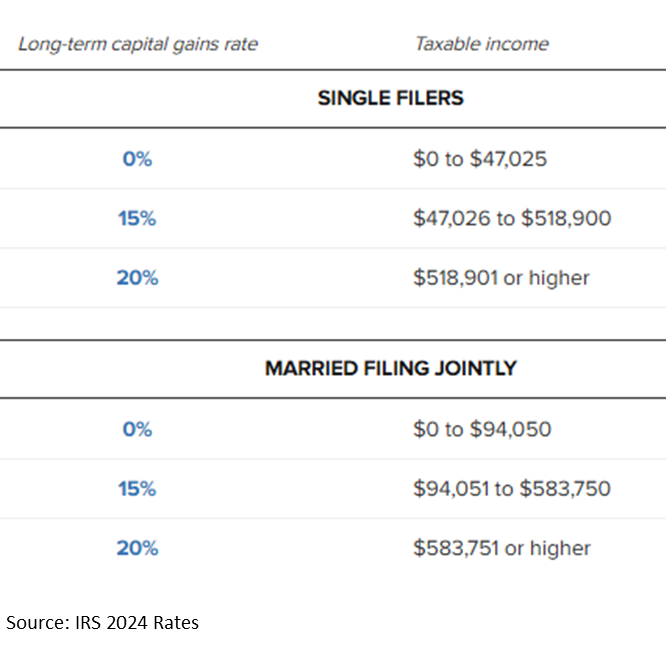
Note: For individuals in the top tax bracket, there is a 3.8% Medicare surcharge added on top of the federal 20% long-term capital gains tax rate, so the top long-term capital gains rate ends up being 23.8%. For individuals that live in states with income tax, many do not have special tax rates for long-term capital gains and they are simply taxed as additional ordinary income at the state level.
What Is Year End Loss Harvesting?
Loss harvesting is a tax strategy where investors intentionally sell investments that have lost value to generate a realized loss to offset a realized gain that they may have experienced in another investment. Example, if a client sold Nvidia stock in May 2024 and realized a long-term capital gain of $100,000 in November and they look at their investment portfolio an notice that their Plug Power stock has an unrealized loss of $100,000, if they sell the Plug Power stock and generate a $100,000 realized loss, it would completely wipes out the tax liability on the $100,000 gain that they realized on the sale of their Nvidia stock earlier in the year.
Loss harvesting is not an all or nothing strategy. In that same example above, even if that client only had $30,000 in unrealized losses in Plug Power, realizing the loss would at least offset some of the $100,000 realized gain in their Nvidia stock sale.
Long-Term Losses Only Offset Long-Term Gains
It's common for investors to have both short-term realized capital gains and long-term realized capital gains in a given tax year. It’s important for investors to understand that there are specific IRS rules as to what TYPE of investment losses offset investment gains. For example, realized long-term losses can only be used to offset realized long-term capital gains. You cannot use realized long-term losses to offset a short-term capital gain.
Short-Term Losses Can Offset Both Short-Term & Long-Term Gain
However, realized short-term losses can be used to offset EITHER short-term or long-term capital gains. If an investor has both short-term and long-term gains, the short-term realized losses are first used to offset any short-term gains, and then the remainder is used to offset the long-term gains.
Loss Carryforward
What happens when your realized loss is greater than your realized gain? You have what’s called a “loss carryforward”. If you have unused realized investment losses, those unused losses can be used to offset investment gains in future tax years. Example, Joe sells company XYZ and has a $30,000 realized long-term loss. The only other investment income that Joe has is a short-term gain of $5,000. Since you cannot use a long-term loss to offset a short-term gain, Joe’s $30,000 in realized long-term losses cannot be used in this tax year. However, that $30,000 loss will carryforward to the next tax year, and if Joe has a long-term realized gain of $40,000 that next year, he can use the $30,000 carryforward loss to offset a larger portion of that $40,000 realized gain.
When do carryforward losses expire? Answer: never (except for when you pass away). The carryforward loss will continue until you have a gain to offset it.
$3,000 Capital Loss Annual Tax Deduction
Even if you have no realized capital gains for the year, it may still make sense from a tax standpoint to generate a $3,000 realized loss from your investment accounts because the IRS allows you deduct up to $3,000 per year in capital losses against your ordinary income. Both short-term and long-term losses qualify toward that $3,000 annual tax deduction.
Example: Sarah has no realized capital gains for the year, but on December 15th she intentionally sells shares of a mutual fund to generate a $3,000 long-term realized loss. Sarah can now use that $3,000 loss to take a deduction against her ordinary income.
Tax Note: You do not need to itemize to take advantage of the $3,000 tax deduction for capital losses. You can elect to take the standard deduction when filing your taxes and still capture the $3,000 tax deduction for capital losses.
The $3,000 annual loss tax deduction can also be used to eat up carryforward losses. If we go back to our example with Joe who had the $30,000 realized long-term loss, if he does not have any future capital gains to offset them with the carryforward loss, he could continue to deduct $3,000 per year against his ordinary income over the next 10 years, until the loss has been fully deducted.
Mutual Fund Capital Gain Distribution
For investors that use mutual funds as an investment vehicle within a taxable investment account, certain mutual funds will issue a “capital gains distribution”, typically in November or December of each year, which then generates taxable income to the shareholder of that mutual fund, whether they sold any shares during the year.
When mutual funds issue capital gains distributions, it’s common that a majority of the capital gains distributions will be long-term capital gains. Similar to normal realized long-term capital gains, investors can loss harvest and generate realized losses to offset the long-term capital gains distribution from their mutual fund holdings in an effort to reduce their tax liability.
The Wash Sale Rule
When loss harvesting, investors have to be aware of the IRS “Wash Sale Rule”. The wash sale rule states that if you sell a security at a loss and the rebuy a substantially identical security within 30 days following the date of the sale, a realized loss cannot be captured by the taxpayer.
Example: Scott sells the Nike stock on December 1, 2024 which generates a $10,000 realize loss, but then Scott repurchases Nike stock on December 25, 2024. Since Scott repurchased Nike stock within 30 days of the sell day, he can no longer use the $10,000 realized loss generated by his sell transaction on December 1st due to the IRS 30 Day Wash Rule.
Also make note of the term “substantially identical” security. If you sell the Vanguard S&P 500 Index ETF to realize a loss but then purchase the Fidelity S&P 500 Index ETF 15 days later, while they are two different investments with different ticker symbols, the IRS would most likely consider them substantially identical triggering the Wash Sale rule.
Real Estate & Business Loss Harvesting
While most of the examples today have been centered around stock investments, the lost harvesting strategy can be used across various asset classes. We have had clients that have sold their business, generating a large long-term capital gain, and then we have them going into their taxable brokerage account looking for investment holdings that have unrealized losses that we can realize to offset the taxable long-term gain from the sale of their business.
The same is true for real estate investments. If a client sells a property at a gain, they may be able to use either carryforward losses from previous tax years or intentionally realize losses in their investment accounts in the same tax year to offset the taxable gain from the sale of their investment property.
About Michael……...
Hi, I’m Michael Ruger. I’m the managing partner of Greenbush Financial Group and the creator of the nationally recognized Money Smart Board blog . I created the blog because there are a lot of events in life that require important financial decisions. The goal is to help our readers avoid big financial missteps, discover financial solutions that they were not aware of, and to optimize their financial future.
Frequently Asked Questions (FAQs):
What is tax-loss harvesting?
Tax-loss harvesting is a year-end tax strategy where investors sell investments that have declined in value to realize a loss that can be used to offset realized capital gains for the year. For example, if you realized a $100,000 gain from one stock, selling another stock with a $100,000 loss could eliminate the tax liability from that gain.
What is the difference between short-term and long-term capital gains and losses?
Short-term gains or losses come from investments held for one year or less and are taxed as ordinary income. Long-term gains or losses come from investments held for more than one year and qualify for lower, preferential long-term capital gains tax rates.
Can long-term losses offset short-term gains?
No. Realized long-term losses can only be used to offset realized long-term gains. However, realized short-term losses can be used to offset both short-term and long-term capital gains.
What happens if my realized losses are greater than my gains?
If your realized losses exceed your gains, the remaining amount becomes a loss carryforward. You can carry forward unused losses indefinitely and use them to offset future realized gains.
What is the $3,000 capital loss deduction?
Even if you have no capital gains, you can deduct up to $3,000 in realized capital losses per year against ordinary income. For married couples filing separately, the limit is $1,500. Any remaining unused losses can continue to carry forward to future tax years.
What are mutual fund capital gain distributions?
Mutual funds often distribute capital gains to shareholders at the end of the year, usually in November or December. These distributions create taxable income for the investor—even if no shares were sold. Tax-loss harvesting can help offset the tax impact of these mutual fund capital gains distributions.
What is the wash sale rule?
The IRS wash sale rule disallows a realized loss if you sell a security at a loss and buy a “substantially identical” security within 30 days before or after the sale. For instance, selling a Vanguard S&P 500 Index ETF and repurchasing a similar Fidelity S&P 500 ETF within 30 days would likely violate the wash sale rule.
Do loss harvesting rules apply to real estate and business sales?
Yes. The same loss-harvesting concept can apply when selling real estate or a business at a gain. Investors can use realized losses from their taxable brokerage accounts or carryforward losses from prior years to offset taxable gains from these sales.
