
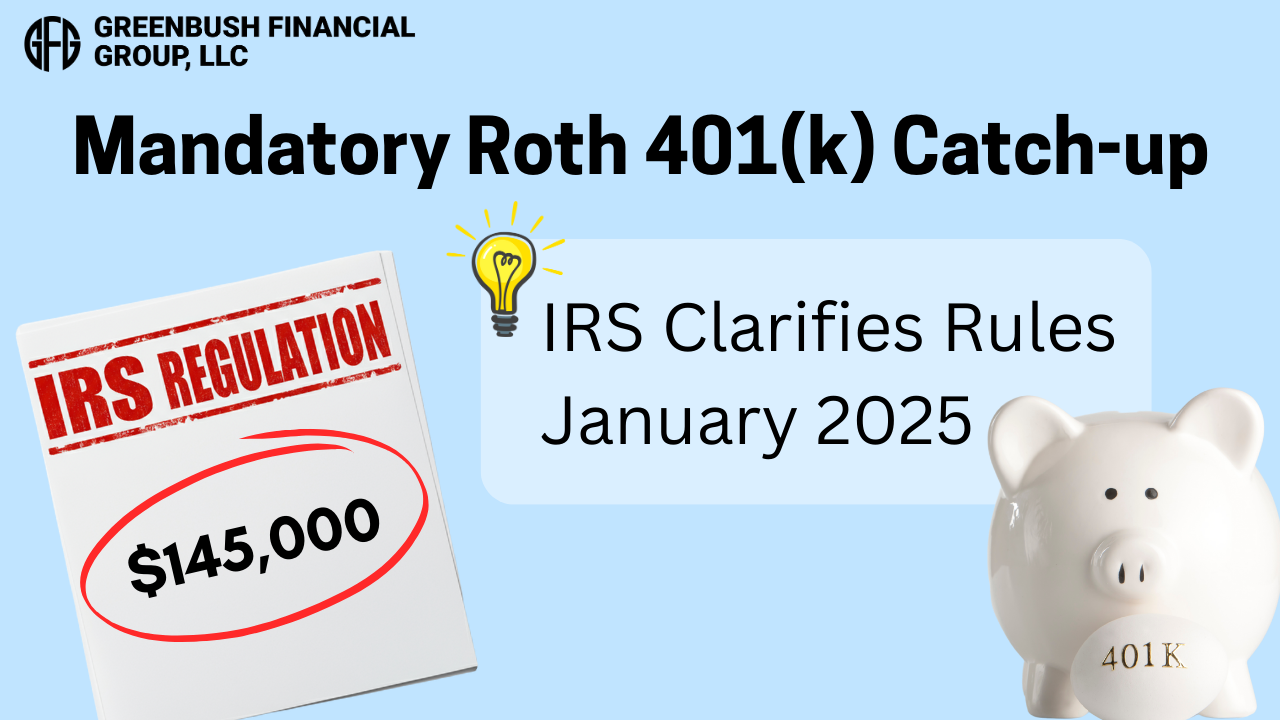
Mandatory 401(k) Roth Catch-up Details Confirmed by IRS January 2025
IRS Issues Guidance on Mandatory 401(k) Roth Catch-up Starting in 2026
Starting January 1, 2026, high-income earners will face a significant shift in retirement savings rules due to the new Mandatory Roth Catch-Up Contribution requirement. If you earn more than $145,000 annually (indexed for inflation), your catch-up contributions to 401(k), 403(b), or 457 plans will now go directly to Roth, rather than pre-tax.
The IRS just released guidance in January 2025 regarding how the new mandatory Roth catch-up provisions will work for high-income earners. This article dives into everything you need to know!
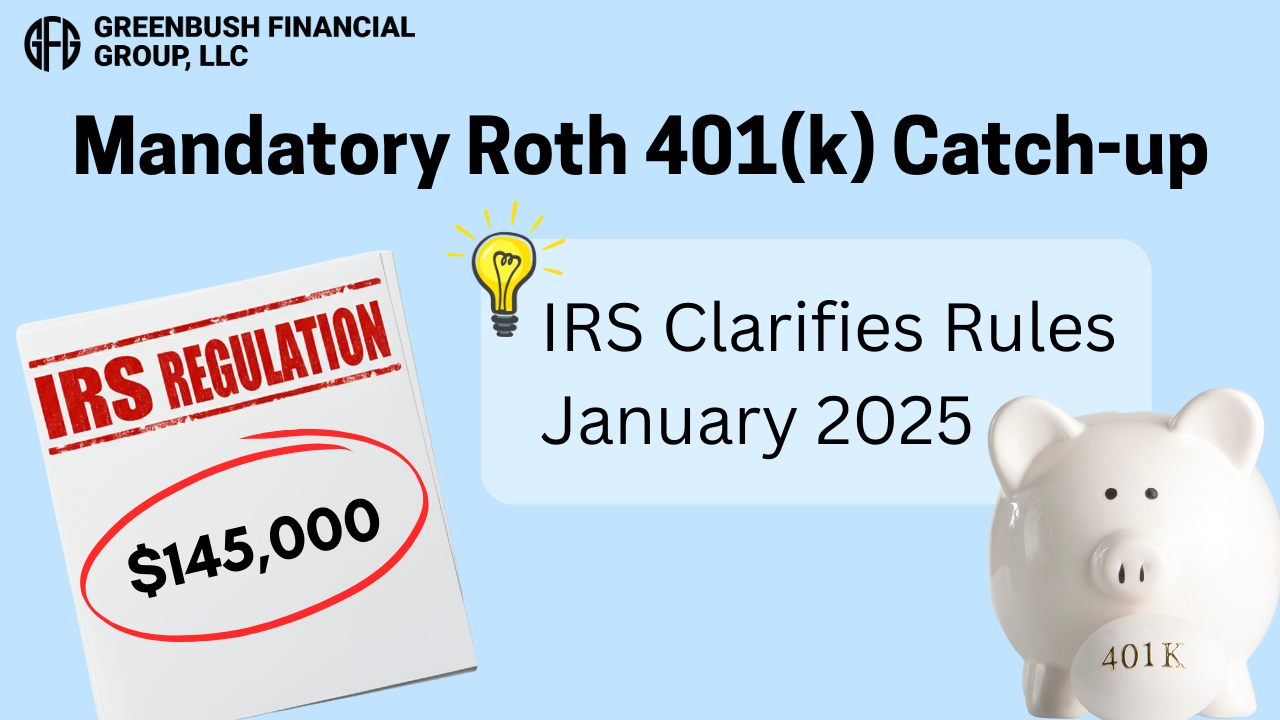
On January 10, 2025, the IRS issued proposed regulations that provided much-needed clarification on the details associated with the Mandatory Roth Catch-up Contribution rule for high-income earners that are set to take effect on January 1, 2026. Employers, payroll companies, and 401(k) providers alike will undoubtedly be scrambling for the remainder of 2025 to get their systems ready for this restriction that will be placed on 401(k) plans starting in 2026.
This is a major change within 401(k) plans, and it is not a welcome change for high-income earners, since individuals in high tax brackets typically like to defer as much as they can pre-tax into 401(k), 403(b), and 457 plans to reduce their current tax liability. Here’s a quick list of the items that will be covered in this article:
General overview of new mandatory 401(k) Roth Catch-up Requirement
Income threshold for employees that will be impacted by the new rule
Definition of “wages” for purposes of the income threshold
Will it apply to Simple IRA plans as well?
“First year of employment” exception for the new Roth rule
Will a 401(k) plan be required to adopt Roth deferrals prior to 1/1/26?
401(k) Mandatory Roth Catch-up Contributions
When an employee reaches age 50, they can make an additional employee deferral called a catch-up contribution. Prior to 2026, all employees were allowed to select whether they wanted to make their catch-up contributions in pre-tax, Roth, or a combination of both. Starting in 2026, the freedom of choice will be taken away from W-2 employees that have more than $145,000 in wages in the prior calendar year (indexed for inflation).
Employees that are above the $145,000 threshold for the previous calendar year, are with the SAME employer, and are age 50 or older, will not be given the option to make their catch-up in pre-tax dollars. If an employee over this wage threshold wishes to make a catch-up contribution to their qualified retirement plan (401K, 403b, 457b), they will only be given the Roth deferral option.
Definition of Wages
One of the big questions that surfaced when the Secure Act 2.0 regulations were first released regarding the mandatory Roth catch-up contribution was the definition of “wages” for the purpose of the $145,000 income threshold. The IRS confirmed in their new regulation that only wages subject to FICA tax would count towards the $145,000 threshold. This is good news for self-employed individuals such as sole proprietors and partnerships that have earnings that are more than the $145,000 threshold, but do not receive W-2 wage, allowing them to continue to make their catch-up contributions all pre-tax for years 2026+.
So essentially, you could have partners of a law firm making $500,000+, and they would be able to continue to make catch-up contributions all pre-tax, but the firm could have a W-2 attorney on their staff that makes $180,000 in wages, and that individual would be forced to make their catch-up contributions all in Roth dollars and pay income tax on those amounts.
Will Mandatory Roth Catch-up Apply to Simple IRA Plans?
Many small employers sponsor Simple IRA plans, which also allow employees aged 50 or older to make pre-tax catch-up contributions, but at lower dollar limits. Fortunately, Simple IRA plans have been granted a pass by the IRS when it comes to the new mandatory Roth catch-up contributions. All employees that are covered by a Simple IRA plan, regardless of their wages, will be allowed to continue to make their catch-up contributions, all pre-tax, for tax years 2026+.
First Year of Employment Exception
Since the $145,000 wage threshold is based on an employee’s “prior year” wages, the IRS confirmed in the new regulations that an employer is allowed to give employees a pass on making pre-tax catch-up contributions during the first calendar year that the company employs them. Meaning, if Sue is hired by Company ABC in February of 2025 and makes $250,000 from February – December in 2025, she would be allowed to contribute her 401(k) catch-up contributions all pre-tax if she is over 50 years old, since Sue doesn’t have wages with Company ABC in 2024, even though her wages for the 2025 were over the $145,000 threshold.
Some High-Income Employees Will Get A 2-Year Pass
There are also situations where new employees with wages over $145,000 will get a 2-year pass on the application of the mandatory Roth catch-up rule. Let’s say Tim is hired by a law firm as a W-2 employee on July 1, 2025, at an annual salary of $200,000. Tim automatically gets a pass for 2025 for the mandatory Roth catch-up, because he did not have wages in 2024 with that company. However, between July 1, 2025 – December 31, 2025, he will only earn half his salary ($100,000), so when they look at Tim’s W-2 wages for purposes of the mandatory Roth catch-up in 2026, his 2025 W-2 will only be showing $100,000, allowing him to make his catch-up contribution all pre-tax in both 2025 and 2026.
Will 401(k) Plans Be Forced to Adopt Roth Deferrals
Not all 401(k) or 403(b) plans allow employees to make Roth employee deferrals. Roth deferrals have historically been an optional provision within an employer-sponsored retirement plan that a company had to voluntarily adopt. When the regulations for the new mandatory Roth catch-up were first released, the regulations seemed to state that if a plan did not allow Roth deferrals, NO EMPLOYEES, regardless of their wage level, were allowed to make catch-up contributions to the plan.
In the proposed regulations that the IRS just released, the IRS clarified that if a retirement plan does not allow Roth deferrals, only the employees above the $145,000 wage threshold would be precluded from making contributions. Employees below the $145,000 wage threshold would still be able to make catch-up contributions pre-tax, even without the Roth deferral feature in the plan.
Due to this restriction, it is expected that if a plan did not previously allow Roth deferrals, many plans will elect to adopt a Roth deferral option by January 1, 2026, to avoid this restriction on their employees with wages in excess of $145,000 (indexed for inflation).
For more information on this new Mandatory Roth Catch-Up Contribution effective 2026, please see our article: https://www.greenbushfinancial.com/all-blogs/roth-catch-up-contributions-high-wage-earners-secure-act-2

About Michael……...
Hi, I’m Michael Ruger. I’m the managing partner of Greenbush Financial Group and the creator of the nationally recognized Money Smart Board blog . I created the blog because there are a lot of events in life that require important financial decisions. The goal is to help our readers avoid big financial missteps, discover financial solutions that they were not aware of, and to optimize their financial future.
Frequently Asked Questions (FAQs):
What is the new Mandatory Roth Catch-Up Contribution rule?
Beginning January 1, 2026, employees age 50 and older who earned more than $145,000 in wages (indexed for inflation) from their employer in the previous calendar year must make all catch-up contributions to their 401(k), 403(b), or 457(b) plan as Roth (after-tax) contributions. High-income employees will no longer have the option to make pre-tax catch-up contributions.
Who is affected by the new Roth catch-up rule?
Only W-2 employees with wages over $145,000 in the previous calendar year from the same employer are affected. Employees earning $145,000 or less may continue to choose between pre-tax and Roth catch-up contributions.
How does the IRS define “wages” for this rule?
The IRS clarified that “wages” refer to compensation subject to FICA tax (i.e., W-2 wages). This means self-employed individuals, partners, or sole proprietors whose income is not reported as W-2 wages are not subject to the mandatory Roth catch-up requirement and can continue making pre-tax catch-up contributions after 2026.
Do Simple IRA or SEP IRA plans have to comply with this rule?
No. The Mandatory Roth Catch-Up rule applies only to qualified employer-sponsored plans such as 401(k), 403(b), and 457(b) plans. Simple IRAs and SEP IRAs are exempt, allowing all employees to continue making pre-tax catch-up contributions regardless of income.
What is the “first year of employment” exception?
The IRS confirmed that the $145,000 wage limit applies only to wages from the prior calendar year with the same employer. Therefore, employees in their first year with a new employer are not subject to the Roth catch-up rule, even if their current-year wages exceed $145,000.
Can new high-income employees get a two-year pass?
Yes, in some cases. For example, if an employee joins a company midyear (e.g., July 2025) and earns less than $145,000 that year, they will be exempt in both 2025 and 2026 because their prior-year wages were below the threshold.
What if my 401(k) plan doesn’t currently allow Roth deferrals?
If a plan does not offer a Roth option, the IRS clarified that only high-income employees (earning over $145,000) will be barred from making catch-up contributions starting in 2026. Employees earning below the threshold can continue making pre-tax catch-ups even if the plan lacks a Roth feature.
Will employers be required to add Roth deferral options to their 401(k) plans?
While not legally required, most employers are expected to add Roth deferral options by January 1, 2026, to prevent their high-income employees from losing the ability to make catch-up contributions altogether.
Why are these changes being implemented?
The new Roth catch-up rule was introduced under the SECURE Act 2.0 to increase tax revenue in the short term by requiring high-income employees to pay income tax on their catch-up contributions now rather than deferring taxation until retirement withdrawals.





















Inherited IRA $20,000 State Tax Exemption for New York Beneficiaries Under Age 59 ½
Have you or someone you know recently inherited an IRA in New York? There’s a tax-saving opportunity that many beneficiaries overlook, and we’re here to help you take full advantage of it.
Did you know that if the decedent was 59 ½ or older, you might qualify for a $20,000 New York State income tax exemption on distributions from the inherited IRA—even if you’re under age 59 ½? This little-known benefit could save you a significant amount on taxes, but navigating the rules can be tricky.
Topics covered:
🔹 The $20,000 annual NY State tax exemption for inherited IRAs
🔹 Rules for New York beneficiaries under age 59 ½
🔹 How this exemption can impact the 10-Year Rule distribution strategy
🔹 How tax exemptions are split between multiple beneficiaries
🔹 What if one of the beneficiaries is located outside of NY?

For individuals who inherit a retirement account in New York state, there is a little-known tax law that allows an owner of an inherited IRA to distribute up to $20,000 from their inherited IRA EACH YEAR without having to pay New York State income tax on those distributions. While this $20,000 state tax exemption typically only applies to individuals age 59 ½ or older, there is a special rule that allows beneficiaries of retirement accounts to “inherit” the $20,000 tax exemption from the decedent and avoid having to pay state tax on the distributions from their Inherited IRA, even though they themselves are under the age of 59 ½.
Inherited IRA Owners Under Age 59½
If you inherit a retirement account and you are under the age of 59 ½, there is a whole host of rules that you have to follow in regard to the new 10-Year Distribution Rule, required minimum distributions, and beneficiaries grandfathered in under the old “stretch rules.” We have a separate article that covers these topics in detail:
GFG Article on Inherited IRA Rules for Non-spouse Beneficiaries
However, for the purposes of this article, we are just going to focus on the taxation of distributions from inherited IRAs, specifically the tax exemption for residents of New York State.
Universal Tax Rules at the Federal Level
Regardless of what state you live in, there are tax laws at the federal level that apply to all owners of inherited IRA accounts. The two main rules are:
For inherited IRA owners that are under the age of 59 ½, the 10% early withdrawal penalty does not apply to distributions taken from an inherited IRA.
All distributions from inherited IRA accounts are subject to taxation at the federal level.
IRA Taxation Rules Vary State by State
While the federal taxation rules are the same for everyone, the state rules for the taxation of inherited IRAs vary from state to state. In this article, we will be focusing on the inherited IRA tax rules for residents of New York State.
New York State IRA Taxation
New York has a special rule that once an individual reaches age 59 ½ they are allowed to take distributions from pre-tax retirement account sources and not pay NYS Income tax on the first $20,000 each year. This includes distributions from any type of pre-tax IRA, 401(k), private pension plans, or other types of pre-tax employer-sponsored retirement plans.
But……..New York has another special rule that allows a beneficiary of a retirement account to INHERIT the decedent’s $20,000 state income tax exemption and use it when they take distributions from the inherited IRA account, even though the beneficiary may be under the age of 59 ½.
Rule 1: Decedent Must Have Reached Age 59 ½
For the beneficiary to “inherit” the decedent’s $20,000 NYS IRA tax exemption, the decent must have reached age 59 ½ before they passed away. If the decedent passed away prior to age 59 ½, the beneficiaries of the retirement account are not eligible to inherit the $20,000 NYS tax exemption.
Rule 2: The Beneficiary Must Be A Resident of New York
In order to qualify for the $20,000 NYS tax exemption on the distributions from the inherited IRA account, the beneficiary must be a resident of New York State, which makes sense because if the beneficiary was not a resident of New York, they would not be filing a NY tax return.
Rule 3: The $20,000 NYS Exemption with Multiple Beneficiaries
It’s not uncommon for someone to have more than one beneficiary assigned to their retirement accounts. For purposes of the allocation of the NYS $20,000 exemption, the $20,000 annual exemption is split evenly between the beneficiaries of their retirement accounts. For example, if Sue passed away at age 62 and her 2 children Tracy and Mia, both New York Residents, are listed as 50%/50% beneficiaries, once the assets have been moved into the inherited IRAs for Tracy and Mia, they would both be eligible to claim a $10,000 state tax exemption each year for any distributions taken from the Inherited IRA even though Tracy & Mia are both under that age of 59 ½.
Rule 4: What If One of the Beneficiaries Lives Outside of New York?
But what happens if not all of the beneficiaries are New York residents? Does the beneficiary that lives in New York get to keep the full $20,000 New York State tax exemption?
Answer: No. In cases where one beneficiary is a NY resident and there are other beneficiaries that live outside of New York State, the $20,000 New York State tax exemption is still split evenly among the number of beneficiaries even though there is no tax benefit for the beneficiaries that are domiciled outside of New York.
Follow Up Question: Is there any way for the beneficiaries outside of New York to assign their portion of the $20,000 NYS IRA tax exemption to the beneficiary that lives in New York? Answer: No.
Rule 5: Multiple Retirement Accounts with Different Beneficiaries
So what happens if Tim is age 35, and is the 100% beneficiary of his father’s Traditional IRA, but his father also had a 401(k) account with Tim and his 3 siblings listed as beneficiaries? Does Tim get the full $20,000 NYS exemption for distribution from his Inherited IRA that came from the IRA that he was the sole beneficiary of?
Answer: No. Technically, the $20,000 exemption is split evenly among all of the beneficiaries of the decedent’s retirement accounts in aggregate. In the example above, since Tim was one of four beneficiaries on his father’s 401(k), he would be allocated $5,000 (25%) of the $20,000 New York State exemption each year.
Rule 6: How Would You Find Out “IF” There Are Other Beneficiaries?
There are cases where someone will get notified that they are a beneficiary of a retirement account without knowing who the other beneficiaries are on that account. Most custodians will not disclose who the other beneficiaries are, they typically just notify you of the share of the retirement account that you are entitled to. In this case, how do you know how to split up the $20,000 NYS exemption?
Answer: That is an excellent question. I have no idea.
Rule 7: The $20,000 exemption is an ANNUAL Exemption
The $20,000 NYS tax exemption for distributions from inherited IRAs is an ANNUAL exemption, meaning the owners of the inherited IRAs can use this exemption each year. For example, Ryan’s father passed away at age 70, Ryan is only age 45, he was the sole beneficiary of his father’s Traditional IRA account, Ryan would be allowed to distribute $20,000 per year for his Inherited IRA account and he would avoid having to pay New York State income tax on those distributions up to $20,000 each year.
Tax Note: Once the annual distributions exceed $20,000, NYS income tax will apply.
Rule 8: Beneficiary Already Age 59 ½ or Older
If a non-spouse beneficiary is a New York resident and already age 59 ½ or older, do they get to claim both their own $20,000 NYS tax exemption on distributions from their personal pre-tax retirement accounts and then another $20,000 exemption from the inherited accounts?
Answer: No. The $20,000 NYS tax exemption has an aggregate limit for all pre-tax retirement accounts in a given tax year.
Rule 9: State Pensions PLUS $20,000 NYS Exemption
New York also has the favorable rule that if you are receiving a NYS pension, the amount received from the state pension does not count towards the $20,000 annual IRA tax exemption rule. For example, you could have someone who retired from NYS at age 55 is receiving a NYS pension for $40,000 per year, and if they inherited an IRA, they may also be able to exclude the first $20,000 distributed from the IRA from NYS income taxation.
Tax Strategies For Non-Spouse Beneficiaries Subject to 10-Year Rule
Now that many non-spouse beneficiaries are subject to the new Secure Act 10-Year Rule, requiring them to deplete the inherited IRA within 10 years, if the decedent was over the age of 59 ½ when they passed, it’s important to proactively plan the distribution schedule to take full advantage of the $20,000 NYS tax exemption otherwise owners of the inherited IRA could end up paying more taxes to New York State that could have been avoided.
About Michael……...
Hi, I’m Michael Ruger. I’m the managing partner of Greenbush Financial Group and the creator of the nationally recognized Money Smart Board blog . I created the blog because there are a lot of events in life that require important financial decisions. The goal is to help our readers avoid big financial missteps, discover financial solutions that they were not aware of, and to optimize their financial future.
Frequently Asked Questions (FAQs):
What is the New York State $20,000 exemption for inherited IRAs?
New York allows beneficiaries of inherited retirement accounts to exclude up to $20,000 per year in distributions from New York State income tax. This rule typically applies to individuals age 59½ or older, but beneficiaries can “inherit” this exemption from the decedent even if they are under 59½.
Who qualifies for the $20,000 New York State exemption on inherited IRAs?
To qualify, the decedent must have been at least age 59½ at the time of death, and the beneficiary must be a current resident of New York State. If both conditions are met, the beneficiary can exclude up to $20,000 in distributions per year from state income tax.
Does the decedent’s age matter for the exemption?
Yes. The decedent must have reached age 59½ before passing away for the beneficiary to inherit the $20,000 exemption. If the decedent died before age 59½, the exemption does not apply to the inherited IRA.
Can beneficiaries outside of New York use this exemption?
No. The beneficiary must be a New York State resident to claim the exemption. Beneficiaries living outside New York cannot use or assign their portion of the $20,000 exemption to others.
How is the $20,000 exemption divided among multiple beneficiaries?
If multiple beneficiaries inherit the decedent’s retirement accounts, the $20,000 annual exemption is split evenly among them. For example, if there are two beneficiaries, each can claim a $10,000 exemption per year; if there are four, each can claim $5,000.
What happens if only one of several beneficiaries lives in New York?
The $20,000 exemption is still split evenly among all beneficiaries, even if only one resides in New York. Nonresident beneficiaries cannot transfer their unused exemption to New York residents.
Does the exemption apply separately to each inherited account?
No. The $20,000 exemption applies in total across all inherited retirement accounts from the same decedent. It does not reset per account.
Can beneficiaries use this exemption every year?
Yes. The $20,000 exemption is an annual benefit. Beneficiaries can exclude up to $20,000 in inherited IRA distributions from New York State income tax each year until the account is depleted.
If the beneficiary is already age 59½, can they claim two exemptions?
No. A beneficiary who is already 59½ or older can only claim one $20,000 exemption per year in total across all their retirement accounts, including both personal and inherited accounts.
Does the exemption affect New York State pensions?
No. New York State pension income is already fully exempt from state income tax. The $20,000 retirement distribution exemption applies separately to IRA and 401(k) distributions, meaning eligible retirees can exclude both their NYS pension income and up to $20,000 in IRA distributions annually.
How can beneficiaries maximize the tax benefit under the 10-Year Rule?
Beneficiaries subject to the Secure Act’s 10-Year Rule should consider spreading withdrawals strategically to use the $20,000 New York exemption each year, reducing overall state taxes on inherited IRA distributions.

Trump Tariffs 2025 versus Trump Tariffs 2017 to 2020: The Stock Market Reaction
President Trump just announced tariffs against Canada, Mexico, and China that will go into effect this week, which has sent the stock market sharply lower. I have received multiple emails from clients over the past 24 hours, all asking the same question:
“With the Trump tariffs that were just announced, should we be going to cash?”

President Trump just announced tariffs against Canada, Mexico, and China that will go into effect this week, which has sent the stock market sharply lower. I have received multiple emails from clients over the past 24 hours, many asking the same question:
“With the Trump tariffs that were just announced, should we be going to cash?”
Investors have to remember that we have seen Trump’s tariff playbook during his first term as president between 2017 and 2020, but investors' memories are short, and they forget how the stock market reacted to tariffs during his first term. While history does not always repeat itself, today we are going to look back on how the stock market reacted to the Trump tariffs during his first term, how those tariffs compare in magnitude to new tariffs that were just announced, and what changes investors should be making to their investment portfolio.
Trump Tariffs 2017 – 2020
During Trump’s first term as president, he introduced multiple rounds of tariffs, including the tariffs in 2018 on solar panels, washing machines, steel, and aluminum. The tariffs were levied against Canada, Mexico, and the European Union. Throughout his first term, he also escalated tariffs against China, which led to the news headlines of the trade war during his first four years in office.
How did the U.S. stock market react to these tariff announcements? Similar to today, not good. There were sharp selloffs in the stock market in the days following each tariff announcement, but here were the returns for the S&P 500 Index during Trump’s first term in office:
2017: 21.9%
2018: -4.41%
2019: 31.74%
2020: 18.38%
If we are looking to history as a guide, the first round of Trump tariffs created heightened levels of volatility in the markets, financially harmed specific industries in the U.S., and raised prices on various goods and services throughout the US economy. In the end, despite all of the negative press about the tariffs and trade wars, the U.S. stock market posted solid gains in 3 of the 4 years during Trumps first term as president.
The Trump Tariffs Are Larger This Time
However, we also have to acknowledge the difference between the tariffs that were announced in Trump’s first term and the tariffs that were just announced on February 2, 2025. The tariffs that Trump just announced are dramatically larger than the tariffs that we imposed during his first term, which could translate to a larger impact on the U.S. economy and higher prices. During his first term, Trump was very strategic as to which types of goods would be hit with the tariffs, but the latest round of tariffs is a 25% tariff on ALL goods from Canada and Mexico (with the exception of oil) and a 10% tariff on goods coming from China.
Negotiating Tool
Trump historically has used tariffs as a negotiating tool. During his first term, there were multiple rounds of delays in the tariffs being implemented as trade terms were negotiated; that could happen again. Even if the tariff is implemented this week, it’s tough to estimate how long those tariffs will stay in place, if they will be reduced or increased in coming months, and since they are so widespread this time, which industries in the US will get hit the hardest in this new round of tariffs.
U.S. Unfair Advantage in the Tariff Game
While the trade war / tariff game hurts all countries involved because it ultimately drives prices higher on specific goods and services, investors have to acknowledge the advantage that the United States has over other countries when tariffs are imposed. The U.S……by FAR…..is the largest consumer economy in the WORLD, so when we put tariffs on goods coming into our country, the US consumer historically will begin to shift their buying habits to lower-cost goods or buy less of those higher-cost items.
While the US consumer feels some pain from the impact of higher costs on the imported goods being tariffed, the pain is 3x or 5x for the country that tariffs are being imposed on because it’s immediately impacting their sales in the largest consumer economy in the world. This is why Trump has identified tariffs as such a powerful negotiating tool, even if the action that the president is trying to resolve has nothing to do with trade.
Investor Action
While the knee-jerk reaction to the tariff announcement may be to run for the hills, in our opinion, it’s too soon to make a dramatic shift in investment strategy given the opposing forces of the possible outcomes to the stock market beyond the initial reaction from the stock market. On the positive side of the argument, the stock market reacted similarly to the tariff announcements during his first term but still produced sizable gains throughout that four-year period. We don’t know how long these tariffs may be in place, they may not be permanent, or they may be reduced as negotiations progress. Third, the U.S. economy is healthy right now and may be able to absorb some of the negative impact of short-term price increases from the tariffs.
On the other side of the argument, the tariffs are much larger this time compared to Trump’s first term so it could have a larger negative impact. Also, the tariffs this round are broader versus the more surgical approach that he took during his first term, which could negatively impact more businesses in the US than it did the first time. Third, the retaliatory tariffs by Canada, Mexico, and China could be larger this time, which again, could have a larger negative impact on the U.S. economy compared to the 2017 – 2020 time frame.
The word “could” is used a lot in this article because the tariffs were just announced, and there are so many outcomes that could unfold in the coming months. When counseling clients on asset allocation, we find it prudent to hold off on making dramatic changes to the investment strategy until the path forward becomes clearer, even though it’s very tempting to want to react immediately to the events that trigger market sell-offs.
About Michael……...
Hi, I’m Michael Ruger. I’m the managing partner of Greenbush Financial Group and the creator of the nationally recognized Money Smart Board blog . I created the blog because there are a lot of events in life that require important financial decisions. The goal is to help our readers avoid big financial missteps, discover financial solutions that they were not aware of, and to optimize their financial future.
Frequently Asked Questions (FAQs):
What tariffs did President Trump announce in February 2025?
On February 2, 2025, President Trump announced new tariffs against Canada, Mexico, and China that will take effect immediately. The tariffs include a 25% tariff on all goods from Canada and Mexico (except oil) and a 10% tariff on goods from China.
Why did the stock market drop after the tariff announcement?
Markets sold off sharply following the announcement because tariffs generally increase costs for businesses and consumers, which can lead to lower corporate profits and slower economic growth. Historically, markets have reacted negatively in the short term to new tariffs or trade restrictions.
Should investors move to cash because of the new tariffs?
It may be too soon to make drastic portfolio changes. During Trump’s first term (2017–2020), similar tariff announcements caused short-term volatility, but the S&P 500 still gained strongly in three of those four years. Investors should remain focused on data, diversification, and long-term objectives rather than reacting immediately to headlines.
How do these new tariffs compare to the tariffs from Trump’s first term?
The 2025 tariffs are much broader and larger than those imposed during Trump’s first term. The earlier tariffs targeted specific products such as steel, aluminum, and solar panels, while the new tariffs apply across nearly all imports from Canada and Mexico, and all goods from China.
What is Trump’s strategy behind using tariffs?
President Trump often uses tariffs as a negotiating tool to pressure trading partners into reaching more favorable agreements with the United States. In the past, tariffs were sometimes delayed, reduced, or eliminated as trade deals were negotiated.
Why does the U.S. have an advantage in trade disputes?
The U.S. is the largest consumer economy in the world, meaning other countries rely heavily on selling goods to American consumers. While tariffs can raise prices in the U.S., they often cause much greater economic pain for the exporting countries whose access to the U.S. market is restricted.
What should investors expect in the short term?
Short-term volatility is likely as markets adjust to the uncertainty surrounding the tariffs and potential retaliatory actions from other countries. Investors should monitor updates on trade negotiations and watch key indicators such as inflation, consumer spending, and corporate earnings.
Could the tariffs eventually be rolled back or delayed?
Yes. In the past, Trump has used tariff announcements as leverage in negotiations and has paused or reduced tariffs once trade agreements were reached. The duration and scope of the current tariffs may change depending on how trade discussions progress in the coming weeks.
What actions should investors consider now?
For most investors, the best course of action is to stay disciplined and avoid emotional reactions. Broad diversification, periodic rebalancing, and patience often outperform attempts to time the market during politically driven volatility. It may be wise to reassess portfolio exposure once more clarity emerges on how long the tariffs will remain in place.

A Complex Mess: Simple IRA Maximum Contributions 2025 and Beyond
Prior to 2025, it was very easy to explain to an employee what the maximum Simple IRA contribution was for that tax year. Starting in 2025, it will be anything but “Simple”. Thanks to the graduation implementation of the Secure Act 2.0, there are 4 different limits for Simple IRA employee deferrals that both employees and companies will need to be aware of.

Prior to 2025, it was very easy to explain to an employee what the maximum Simple IRA contribution was for that tax year. Starting in 2025, it will be anything but “Simple”. Thanks to the gradual implementation of the Secure Act 2.0, there are 4 different limits for Simple IRA employee deferrals that both employees and companies will need to be aware of.
2025 Normal Simple IRA Deferral Limit
Like past years, there is a normal employee deferral limit of $16,500 in 2025.
NEW: Roth Simple IRA Deferrals
When Secure Act 2.0 passed, for the first time ever, it allowed Roth Deferrals to Simple IRA plans. However, due to the lack of guidance from the IRS, we are still not aware of any investment platforms that are currently accepting Roth deferrals into their Simple IRA platforms. So, for now, most employees are still limited to making pre-tax deferrals to their Simple IRA plan, but at some point, this will be another layer of complexity, whether or not an employee wants to make pre-tax or Roth Simple IRA deferrals.
2025 Age 50+ Catch-up Contribution
Like in past years, any employee aged 50+ is also allowed to make a catch-up contribution to their Simple IRA over and above the regular $16,500 deferral limit. In 2025, the age 50+ catch-up is $3,500, for a total of $20,000 for the year.
Under the old rules, this would have been it, plain and simple, but here are the new more complex Simple IRA employee deferral maximum contribution rules for 2025+.
NEW: Age 60 to 63 Additional Catch-up Contribution
Secure Act 2.0 introduced a new enhanced catch-up contribution starting in 2025, but it is only available to employees that are age 60 – 63. Employees ages 60 – 63 are now able to contribute the regular deferral limit ($16,500) PLUS the age 50 catch-up ($3,500) PLUS the new age 60 – 63 catch-up ($1,750).
The calculation for the new age 60 – 63 catch-up is an additional 50% above the current catch-up limit. So for 2025 it would be $3,500 x 50% = $1,750. For employees ages 60 – 63 in 2025, their deferral limit would be as follows:
Regular Deferral: $16,500
Regular Age 50+ Catch-up: $3,500
New Age 60 – 63 Catch-up: $1,750
Total: $21,750
But, the additional age 60 – 63 catch-up contribution is lost in the year that the employee turns age 64. When they turn 64, they revert back to the regular catch-up limit of $3,500
NEW: Additional 10% EE Deferral for ALL Employees
I wish I could say the complexity stops there, but it doesn’t. Introduced in 2024 was a new additional 10% employee deferral contribution that is available to ALL employees regardless of age, but automatic adoption of this additional 10% contribution depends on the size of the employer sponsoring the Simple IRA plan.
If the employer that sponsors the Simple IRA plan has no more than 25 employees who received $5,000 or more in compensation on the preceding calendar year, adoption of this new additional 10% deferral limit is MANDATORY, even though no changes have been made to the 5304 and 5305 Simple Forms by the IRS.
What that means is for 2025 is if an employer had 25 or fewer employees that made $5,000 in the previous year, the regular employee deferral limit AND the regular catch-up contribution limit will automatically be increased by 10% of the 2024 limit. Something odd to note here: The additional 10% is based just on the 2024 contribution limits, even though there are new increased limits for 2025. (This has been the most common interpretation of the new rules that we have seen to date)
Employee Deferral Limit: $16,500
Employee Deferral with Additional 10%: $17,600 ($16,000 2024 limit x 110%)
Employee 50+ Catch-up Limit: $3,500
Employee 50+ Catch-up Limit with Additional 10%: $3,850 ($3,500 2024 limit x 110%)
What this means is if an employee is covered by a Simple IRA plan in 2025 and that employer had less than 26 employees in 2024, for an employee under the age of 50, the Simple IRA employee deferral limit is not $16,500 it’s $17,600. For employees ages 50 – 59 or 64+, the employee deferral limit with the catch-up is not $20,000, it’s $21,450.
For employers that have 26 – 100 employees who, in the previous year, made at least $5,000 in compensation, in order for the employees to gain access to the additional 10% employee deferral, the company has to sponsor either a 4% matching contribution or 3% non-elective which is higher than the current standard 3% match and 2% non-elective.
NOTE: The special age 60 – 63 catch-up contribution is not increased by this 10% additional contribution because it was not in existence in 2024, and this 10% additional contribution is based on 2024 limits. The age 60 – 63 special catch-up contribution remains at $5,250, regardless of the size of the employer sponsoring the Simple IRA plan.
Summary of Simple IRA Employee Deferral Limits for 2025
Bringing all of these things together, here is a quick chart to illustrate the Simple IRA employee deferral limits for 2025:
EMPLOYER UNDER 26 EMPLOYEES
Employee Deferral Limit: $17,600
Employees Ages 50 – 59: $21,450
Employees Ages 60 – 63: $22,850
Employees Age 64+: $21,450
EMPLOYERS 26 EMPLOYEES or MORE
(Assuming they do not sponsor the enhanced 4% match or 3% non-elective ER contribution)
Employee Deferral Limit: $16,500
Employees Ages 50 – 59: $20,000
Employees Ages 60 – 63: $21,750
Employees Age 64+: $20,000
However, if the employer with 26+ employees sponsors the enhanced employer contribution amounts, the employee deferral contribution limits would be the same as the Under 26 Employees grid.
What a wonderful mess……
Voluntary Additional Simple IRA Non-Elective Contribution
Everything we have addressed up to this point focuses solely on the employee deferral limits to Simple IRA plans. Secure Act 2.0 also introduced a voluntary non-elective contribution that employers can make to their employees in Simple IRA plans. Prior to Secure Act 2.0, the only EMPLOYER contributions allowed to Simple IRA plans was either the 3% matching contribution or the 2% non-elective contribution.
Starting in 2024, employers that sponsor Simple IRA plans are now allowed to voluntarily make an additional non-elective employer contribution to all of the eligible employees based on the LESSER of 10% of compensation or $5,000. This additional employer contribution can be made any time prior to the company’s tax filing, plus extensions.
About Michael……...
Hi, I’m Michael Ruger. I’m the managing partner of Greenbush Financial Group and the creator of the nationally recognized Money Smart Board blog . I created the blog because there are a lot of events in life that require important financial decisions. The goal is to help our readers avoid big financial missteps, discover financial solutions that they were not aware of, and to optimize their financial future.
Frequently Asked Questions (FAQs):
What is the Simple IRA contribution limit for 2025?
For 2025, the standard Simple IRA employee deferral limit is $16,500 for employers with more than 25 employees. For employers with 25 or fewer employees, the 2025 employee deferral limit is $17,600. Employees aged 50 or older can make an additional $3,500 catch-up contribution for employer with 25 or more employees and the a catch-up contribution of $3,850 for employers with 25 or less employees, bringing their total allowable deferral to $20,000 or $21,450, depending on the size of the employer.
What new changes apply to Simple IRA plans in 2025?
Beginning in 2025, several new rules from the SECURE Act 2.0 will apply to Simple IRA plans. There are now four potential contribution limits depending on an employee’s age and employer size. These include new Roth deferrals, a special age 60–63 catch-up contribution, and an additional 10% deferral increase for smaller employers.
Can employees make Roth contributions to a Simple IRA in 2025?
Yes, the SECURE Act 2.0 allows Roth deferrals to Simple IRA plans. However, as of early 2025, most custodians and investment platforms have not yet implemented this option, so most employees are still limited to pre-tax contributions.
What is the age 50+ catch-up contribution limit for 2025?
It depends on the size of your employer. As mentioned above, employees aged 50 or older can make an additional $3,500 catch-up contribution for employers with 25 or more employees and the a catch-up contribution of $3,850 for employers with 25 or less employees, bringing their total allowable deferral to $20,000 or $21,450, depending on the size of the employer.
What is the new age 60–63 catch-up contribution?
Starting in 2025, employees aged 60 through 63 can make an additional catch-up contribution equal to 50% of the standard catch-up limit. For 2025, this adds $1,750, to the maximum limits listed above. Once an employee turns 64, this enhanced catch-up no longer applies.
How does the new 10% additional employee deferral rule work?
Employers with 25 or fewer employees who earned $5,000 or more in the previous year must automatically offer a 10% higher employee deferral limit. This raises the standard limit from $16,500 to $17,600 and the age 50+ catch-up from $3,500 to $3,850.
Do larger employers also have access to the 10% deferral increase?
Employers with 26 to 100 employees can offer the additional 10% deferral if they increase their matching contribution to 4% or provide a 3% non-elective contribution.
Does the 10% increase apply to the new age 60–63 catch-up contribution?
No. The 10% deferral increase is based on 2024 contribution limits, and since the age 60–63 catch-up did not exist in 2024, it remains at $1,750 for 2025 regardless of employer size.
What are the 2025 Simple IRA limits for small employers (25 or fewer employees)?
Under age 50: $17,600
Ages 50–59: $21,450
Ages 60–63: $22,850
Age 64 and older: $21,450
What are the 2025 limits for larger employers (26 or more employees)?
If the employer does not offer the enhanced match or non-elective contribution:
Under age 50: $16,500
Ages 50–59: $20,000
Ages 60–63: $21,750
Age 64 and older: $20,000
If the employer does offer the enhanced contribution, the higher limits for small employers apply.
What is the new voluntary employer non-elective contribution option?
Starting in 2024, employers may make an additional non-elective contribution equal to the lesser of 10% of employee compensation or $5,000. This contribution is optional and can be made in addition to the standard employer match or non-elective contribution before the company’s tax filing deadline, including extensions.

Rules for Using A 529 Account To Repay Student Loans
When the Secure Act passed in 2019, a new option was opened up for excess balances left over in 529 accounts called a “Qualified Loan Repayment” option. This new 529 distribution option allows the owner of a 529 to distribute money from a 529 account to repay student loans for the beneficiary of the 529 account AND the beneficiary’s siblings. However, this distribution option is not available to everyone, and there are rules and limits associated with these new types of distributions.

When the Secure Act passed in 2019, a new option opened up for excess balances left over in 529 accounts called a “Qualified Loan Repayment” option. This new 529 distribution option allows the owner of a 529 to distribute money from a 529 account to repay student loans for the beneficiary of the 529 account AND the beneficiary’s siblings. However, this distribution option is not available to everyone, and there are rules and limits associated with these new types of distributions.
State Level Restrictions
While the Secure Act made this option available at the Federal level, it’s important to understand that college 529 programs are sponsored at the state level, and the state’s allowable distribution options can deviate from what’s allowed at the Federal Level. For example, specific to this Qualified Loan Repayment option, the Secure Act began allowing these at the Federal Level in 2019, but New York did not recognize these as “qualified distributions” from a 529 account until just recently, in September of 2024.
So, if an owner of a NYS 529 account processed a distribution from the account and applied that amount toward a student loan taken by the beneficiary of the account, it often triggered negative tax events such as having to pay state income tax and a 10% penalty on the earnings portion of the distribution, as well as a recapture of the state tax deduction that was given from the contributions to the 529 account. Fortunately, some states like New York are beginning to change their 529 programs to more closely match the options available at the Federal level, but you still have to check the distribution rules in the state that the account owner lives in before processing distributions from a 529 to repay student loans for the account beneficiary and/or their siblings.
$10,000 Lifetime Limit
There are limits to how much you can withdraw from a 529 account to apply toward a student loan balance. Each BORROWER has a $10,000 lifetime limit for qualified student loan repayment distributions. It’s an aggregate limit per child. So, if the child has multiple 529 accounts that they are the beneficiary of, it’s an aggregate limit of $10,000 between all of their 529 accounts. This is true even if the 529 accounts have different owners. For example, if the parents have a 529 account for their child with a $30,000 balance and the grandparents have a 529 account for the same child with a $10,000 balance, there’s an aggregate limit of $10,000 between both 529 accounts, meaning parents cannot take a $10,000 distribution and apply it toward the child’s student loan balance, and then the grandparents distribute an additional $10,000 to apply to that same child’s outstanding student loan balance.
Sibling Student Loan Payments
In addition to being able to distribute $10,000 from the 529 and apply it towards the account beneficiary's outstanding student loans, the account owner can also distribute up to $10,000 for each sibling of the 529 account beneficiary and apply that toward their outstanding student loan balance. The definition of siblings includes sisters, brothers, stepbrothers, and stepsisters.
Parent Plus Loans
If the parents took out Parent Plus Loans to help pay for their child’s college, after distributing $10,000 to repay student loans in their child’s name, they could then change the beneficiary on the 529 to themselves and distribute $10,000 to repay any outstanding Parent Plus loans taken in the parent’s name since the parent is considered a different “borrower”.
Most but Not All Student Loans Qualify
Most Federal and private student loans qualify for repayment under this special 529 distribution option. However, there is additional criteria to make sure a private student loan qualifies for repayment. The list is too long to include in this article, but just know if you plan to take a distribution from a 529 account to repay a private student loan, additional research is required.
Forfeiting Student Loan Interest Tax Deduction
If a distribution is made from a 529 account and applied toward a student loan, it may limit the taxpayer’s ability to deduct the student loan interest when they file their taxes. The student loan interest deduction is currently $2,500 per year. Whether or not the distribution from the 529 will limit or eliminate the $2,500 tax deduction will depend on how much of the 529 distribution was made to repay the student loans cost basis versus earnings.
Example: If a parent distributes $10,000 from their child’s 529 account and applies it toward their outstanding student loan balance, and $6,000 of the $10,000 was cost basis (what the parent originally contributed to the 529) and $4,000 was earnings, the earnings portion of the distribution is applied against the $2,500 student loan tax deduction amount. So, any distributions made from a 529 to repay a student loan with earnings equal to or greater than $2,500 would completely eliminate the student loan tax deduction for that year.
About Michael……...
Hi, I’m Michael Ruger. I’m the managing partner of Greenbush Financial Group and the creator of the nationally recognized Money Smart Board blog . I created the blog because there are a lot of events in life that require important financial decisions. The goal is to help our readers avoid big financial missteps, discover financial solutions that they were not aware of, and to optimize their financial future.
Frequently Asked Questions (FAQs):
What is the 529 Qualified Loan Repayment option?
The Qualified Loan Repayment option allows 529 plan owners to use funds from a 529 account to repay student loans for the account’s beneficiary and the beneficiary’s siblings. This provision was introduced under the Secure Act in 2019.
Are all states required to allow 529 loan repayment distributions?
No. While the Secure Act allows these distributions at the federal level, each state determines whether they qualify as tax-free distributions under its own rules. For example, New York did not recognize these as qualified distributions until September 2024. Before that, loan repayments from a 529 could trigger state income tax, penalties, and loss of prior deductions.
What is the lifetime limit for 529 loan repayment distributions?
Each borrower has a $10,000 lifetime limit for student loan repayments made using 529 funds. This is an aggregate limit per borrower across all 529 accounts, even if the accounts are owned by different people.
Can 529 funds be used to pay a sibling’s student loans?
Yes. Up to $10,000 can be distributed for each sibling of the 529 account beneficiary to repay their student loans. Siblings include brothers, sisters, stepbrothers, and stepsisters.
Can 529 funds be used to repay Parent PLUS loans?
Yes. After using $10,000 for the child’s student loan, the 529 owner can change the beneficiary to themselves and take another $10,000 distribution to repay Parent PLUS loans in their own name.
Do all student loans qualify for repayment with 529 funds?
Most federal and private student loans qualify. However, private loans must meet specific IRS criteria to be eligible. Account owners should verify loan eligibility before making a 529 distribution for private student loans.
How does using a 529 to pay loans affect the student loan interest deduction?
Using 529 funds to repay student loans may reduce or eliminate eligibility for the $2,500 annual student loan interest deduction. The portion of a 529 distribution that represents earnings (not contributions) is counted against this deduction. For example, if $4,000 of a $10,000 529 distribution represents earnings, the full $2,500 deduction could be lost for that tax year.

Tax Filing Requirements For Minor Children with Investment Income
When parents gift money to their kids, instead of having the money sit in a savings account, often parents will set up UTMA accounts at an investment firm to generate investment returns in the account that can be used by the child at a future date. Depending on the amount of the investment income, the child may be required to file a tax return.

When parents gift money to their kids, instead of having the money sit in a savings account, often parents will set up a UTMA Account at an investment firm to generate investment returns that can be used by the child at a future date. But if the child is a minor, which is often the case, we have to educate our clients on the following topics:
How UTMA accounts work for minor children
Since the child will have investment income, do they need to file a tax return?
The special standard deduction for dependents
How kiddie tax works (taxed investment income at the parent’s tax rate)
Completed gifts for estate planning
How UTMA Accounts Work
When a parent sets up an investment account for their child, if the child is a minor, they typically set up the accounts as UTMA accounts, which stands for Uniform Transfer to Minors Act. UTMA accounts are established in the social security number of the child, and the parent is typically listed on the account as the “custodian”. As the custodian, the parent has full control over the account until the child reaches the “age of majority”. Once the child reaches the age of majority, the UTMA designation is removed, the account is re-registered into the name of the adult child, and the child now has full control over the account.
Age of Majority Varies State by State for UTMA
While the age of majority varies state by state, the age of majority for UTMA purposes and the age of majority for all other reasons often varies. For most states, the “age of majority” is 18 but the “UTMA age of majority” is 21. That is true for our state: New York. If a parent establishes an UTMA account in New York, the parent has control over the account until the child reaches age 21, then the control of the account must be turned over to their child.
$19,000 Gifting Exclusion Amount
When a parent deposits money to a UTMA account, in the eyes of the IRS, the parent has completed a gift. Even though the parent has control of the minor child’s UTMA account, from that point forward, the assets in the account belong to the child. Parents with larger estates will sometimes include gifting to the kids each year in their estate planning strategy. Each parent can make a gift of $19,000 (2025 Limit) each year ($38K combined) into the child’s UTMA account, and that gift will not count against the parent’s lifetime Federal and State lifetime estate tax exclusion amount.
A parent can contribute more than $19,000 per year to the child’s UTMA account, but a gift tax return may need to be filed in that year. For more information on this topic, see our video:
Video: When You Make Cash Gifts To Your Children, Who Pays The Tax?
When Does The Minor Child Need To File A Tax Return?
For minor children that have investment income from a UTMA account, if they are claimed as a dependent on their parent’s tax return, they will need to file a tax return if their investment income is above $1,350, which is the standard deduction amount for dependents with unearned income in 2025.
For dependent children with investment income over the $1,350 threshold, the investment is taxed at different rates. Here is a quick breakdown of how it works:
$0 - $1,350: Covered by standard deduction. No tax due
1,350 - $2,700: Taxed at the CHILD’s marginal tax rate
$2,700+: Taxed at the PARENT’s marginal tax rate (“Kiddie tax”)
How Does Kiddie Tax Work?
Kiddie tax is a way for the IRS to prevent parents in high-income tax brackets from gifting assets to their kids in an effort to shift the investment income into their child’s lower tax bracket. For children that have unearned income above $2,700, that income is now taxed as if it was earned by the parent, not the child. This applies to dependent children under the age of 18 at the end of the tax year or full-time students younger than 24.
IRS Form 8615 needs to be filed with the child’s tax return, which calculates tax liability on the unearned income above $2,700 based on the parent's tax rate. A tax note here: in these cases, the parent’s tax return has to be completed before the child can file their tax return since the parent’s taxable income is included in the Kiddie tax calculation. In other words, if the parents put their tax return on extension, the child’s tax return will also need to be put on extension.
Unearned vs Earned Income
This article has focused on the unearned income of a child; if the child also has earned income from employment, there are different tax filing rules. The earned income portion of the child’s income can potentially be sheltered by the $15,000 (2025) standard deduction awarded to individual tax filers.
This topic is fully covered in our article: At What Age Does A Child Have To File A Tax Return?
Investment Strategy for Minor Child’s UTMA
Knowing the potential tax implications associated with the UTMA account for your child, there is usually a desire to avoid the Kiddie tax as much as possible. This can often drive the investment strategy within the UTMA account to focus on investment holdings that do not produce a lot of dividends or interest income. It’s also common to try to avoid short-term capital gains within a child’s UTMA account since a large short-term capital gain could be taxed as ordinary income at the parent’s tax rate.
About Michael……...
Hi, I’m Michael Ruger. I’m the managing partner of Greenbush Financial Group and the creator of the nationally recognized Money Smart Board blog . I created the blog because there are a lot of events in life that require important financial decisions. The goal is to help our readers avoid big financial missteps, discover financial solutions that they were not aware of, and to optimize their financial future.
Frequently Asked Questions (FAQs):
What is a UTMA account?
A UTMA, or Uniform Transfers to Minors Act account, allows parents or guardians to invest money for a minor child. The account is opened under the child’s Social Security number, with the parent listed as custodian. The custodian controls the account until the child reaches the age of majority, at which point the child assumes full ownership.
When does a child gain control of their UTMA account?
The age of majority for UTMA accounts varies by state. In most states it is 21, even though the legal age of adulthood may be 18. For example, in New York, the custodian retains control until the child turns 21.
How are contributions to a UTMA account treated for tax purposes?
Contributions to a UTMA account are considered completed gifts. For 2025, the annual gift tax exclusion is $19,000 per parent ($38,000 per couple). Contributions above this amount require the filing of a gift tax return, though gift tax is rarely due unless lifetime gifting exceeds federal estate tax limits.
Does a child with a UTMA account need to file a tax return?
If the child is a dependent and has more than $1,350 in unearned income (dividends, interest, or capital gains) in 2025, they must file a tax return. The first $1,350 is covered by the dependent standard deduction.
How is investment income in a UTMA account taxed?
The first $1,350 of unearned income is tax-free.
The next $1,350 is taxed at the child’s tax rate.
Unearned income above $2,700 is taxed at the parent’s tax rate under the Kiddie Tax rules.
What is the Kiddie Tax?
The Kiddie Tax prevents parents in high tax brackets from shifting income to their children’s lower tax bracket. For dependent children under age 18 (or full-time students under age 24), investment income above $2,700 is taxed at the parent’s marginal rate. IRS Form 8615 must be filed with the child’s tax return to calculate this amount.
What’s the difference between earned and unearned income for a child?
Earned income comes from work (such as a job) and is subject to regular income tax and payroll taxes. Unearned income includes interest, dividends, and capital gains from investments. Earned income may be sheltered by the $15,000 standard deduction in 2025, while unearned income follows the dependent thresholds described above.
How can parents minimize taxes in a child’s UTMA account?
To limit Kiddie Tax exposure, parents often invest UTMA funds in assets that produce little or no taxable income, such as growth-oriented stocks or tax-efficient mutual funds. They may also try to avoid frequent trading to prevent short-term capital gains, which are taxed at higher rates.

Do You Have Enough To Retire? The 60 Second Calculation
Do you have enough to retire? Believe it or not, as financial planners, we can often answer that question in LESS THAN 60 SECONDS just by asking a handful of questions. In this video, I’m going to walk you through the 60-second calculation.

Do you have enough to retire? Believe it or not, as financial planners, we can often answer that question in LESS THAN 60 SECONDS just by asking a handful of questions. In this video, I’m going to walk you through the 60-second calculation.
About Michael……...
Hi, I’m Michael Ruger. I’m the managing partner of Greenbush Financial Group and the creator of the nationally recognized Money Smart Board blog . I created the blog because there are a lot of events in life that require important financial decisions. The goal is to help our readers avoid big financial missteps, discover financial solutions that they were not aware of, and to optimize their financial future.
Frequently Asked Questions (FAQs):
What is the 60-second retirement readiness calculation?
The 60-second retirement readiness calculation is a quick method we use to estimate whether someone has saved enough to retire comfortably. It relies on a few key data points — typically your total retirement savings, desired annual income in retirement, and expected Social Security or pension benefits.
What information do you need for the 60-second retirement check?
To make the quick calculation, you’ll need:
Your total retirement savings (IRAs, 401(k)s, brokerage accounts, etc.)
The annual income you want in retirement
Your estimated Social Security or pension income
Your age and desired retirement age
How accurate is the 60-second retirement calculation?
This calculation is a fast way to estimate retirement readiness, but it’s not a substitute for a full financial plan. It doesn’t account for taxes, inflation, healthcare costs, market performance, or other personal factors. It’s best used as a starting point for more detailed retirement planning.
What’s the next step after doing the quick calculation?
If your savings fall short, the next step is to build a customized retirement plan that incorporates your income sources, spending goals, and tax strategy.

New Age 60 – 63 401(k) Enhanced Catch-up Contribution Starting in 2025
Good news for 401(k) and 403(b) plan participants turning age 60 – 63 starting in 2025: there is now an enhanced employee catch-up contribution thanks to Secure Act 2.0 that passed back in 2022. For 2025, the employee contributions limits are as follows: Employee Deferral Limit $23,500, Age 50+ Catch-up Limit $7,500, and the New Age 60 – 63 Catch-up: $3,750.

Good news for 401(k) and 403(b) plan participants turning age 60 – 63 starting in 2025: there is now an enhanced employee catch-up contribution thanks to Secure Act 2.0 that passed back in 2022. For 2025, the employee contributions limits are as follows:
Employee Deferral Limit: $23,500
Age 50+ Catch-up: $7,500
New Age 60 – 63 Catch-up: $3,750
401K Age 60 – 63 Catch-up Contribution
Under the old rules, in 2025, a 401(k) plan participant age 60 – 63 would have been limited to the employee deferral limit of $23,500 plus the age 50+ catch-up of $7,500 for a total employee contribution of $31,000.
However, thanks to the passing of the Secure Act in 2022, an additional catch-up contribution will be introduced to employer-sponsored qualified retirement plans, only available to employees age 60 – 63, equal to “50% of the regular catch-up contribution for that plan year”. In 2025, the catch-up contribution is $7,500, making the additional catch-up contribution for employees age 60 – 63 $3,750 ($7,500 x 50%). Thus, a plan participant age 60 – 63 would be able to contribute the regular employee deferral limit of $23,500, plus the normal age 50+ catch-up of $7,500, PLUS the new age 60 – 63 catch-up contribution of $3,750, for a total employee contribution of $34,750 in 2025.
Age 64 – Revert Back To Normal 401(k) Catch-up Limit
This is a very odd way to assess a special catch-up contribution because it is ONLY available to employees between the ages of 60 and 63. In the year the 401(k) plan participant obtains age 64, the new additional age 60 – 63 contribution is completely eliminated. Here is a quick list of the contribution limits for 2025 based on an employee’s age:
Under Age 50: $23,500
Age 50 – 59: $31,000
Age 60 – 63: $34,750
Age 64+: $31,000
The Year The Employee OBTAINS Age 60 – 63
The employee just has to OBTAIN age 60 – 63 during that year to be eligible for the enhanced catch-up contribution. The enhanced catch-up contribution is not pro-rated based on WHEN the employee turns age 60. For example, if an employee turns 60 on December 31st, they are eligible to make the full $3,750 additional catch-up contribution for the year.
By that same token, if the employee turns age 64 by December 31st, they are no longer allowed to make the new enhanced catch-up contribution for that year.
Optional Provision At The Plan Level
The new 60 – 63 enhanced catch-up contribution is an OPTIONAL provision for qualified retirement plans, meaning some employers may allow this new enhanced catch-up contribution while others may not. If no action is taken by the employer sponsoring the plan, be default, the new age 60 – 63 catch-up contributions starting in 2025 will be allowed.
If an employer prefers to opt out of allowing employees ages 60 – 63 from making this new enhanced catch-up contribution, they will need to contact their TPA firm (third-party administrator) as soon as possible to amend their plan to disallow this new type of employee contributions starting in 2025.
Contact Payroll Company
Since this a brand new 401(k) employee contribution starting in 2025, we strongly recommend that plan sponsors reach out to their payroll company to make sure they are aware that your plan will either ALLOW or NOT ALLOW this new age 60 – 63 catch-up contribution, so the payroll system doesn’t incorrectly cap employees age 60 – 63 from making the additional catch-up contribution.
Formula: 50% of Normal Catch-up Contribution
For future years, the formula for this age 60 – 63 enhanced catch-up contribution is 50% of the regular catch-up contribution limit. The IRS usually announces the updated 401(k) contribution limits in either October or November of each year for the following calendar year. For example, if the IRS announces that the new catch-up limit in 2026 is $8,000, the enhanced age 60 – 63 catch-up contribution would be $4,000 over the regular $8,000 catch-up limit.
About Michael……...
Hi, I’m Michael Ruger. I’m the managing partner of Greenbush Financial Group and the creator of the nationally recognized Money Smart Board blog . I created the blog because there are a lot of events in life that require important financial decisions. The goal is to help our readers avoid big financial missteps, discover financial solutions that they were not aware of, and to optimize their financial future.
Frequently Asked Questions (FAQs):
What is the new 401(k) and 403(b) age 60–63 catch-up contribution for 2025?
Starting in 2025, employees aged 60–63 can contribute an extra “enhanced” catch-up contribution to their 401(k) or 403(b) plan. This new contribution equals 50% of the standard catch-up contribution for that year. For 2025, that means an additional $3,750 on top of the normal catch-up limit.
How much can employees aged 60–63 contribute to a 401(k) in 2025?
For 2025, employees aged 60–63 can contribute:
Regular employee deferral: $23,500
Standard age 50+ catch-up: $7,500
New age 60–63 catch-up: $3,750
Total: $34,750
What happens when an employee turns 64?
The new enhanced catch-up contribution is only available through age 63. In the year an employee turns 64, they revert back to the standard catch-up limit of $7,500, for a total maximum contribution of $31,000 in 2025.
Do employees need to be 60 for the full year to qualify?
No. The employee only needs to obtain age 60–63 during the tax year to be eligible. Even if they turn 60 on December 31, they qualify for the full additional $3,750 catch-up contribution for that year.
Is the new 60–63 catch-up contribution mandatory for employers?
No. The provision is optional. Employers must decide whether to allow the new enhanced catch-up contribution in their retirement plan. If an employer takes no action, the new contribution will automatically be allowed starting in 2025.
Should employers notify their payroll company?
Yes. Plan sponsors should confirm with their payroll provider whether their plan will allow the new 60–63 catch-up contributions. Payroll systems will need to be updated to ensure eligible employees can contribute correctly.
How will future enhanced catch-up amounts be calculated?
Each year, the enhanced age 60–63 catch-up limit will equal 50% of that year’s regular catch-up contribution. For example, if the standard catch-up limit rises to $8,000 in 2026, the new enhanced catch-up would be $4,000.
