
What is the Process for Setting Up a Will?
Creating a will is often a task that everyone knows they should do but it gets put on the back burner. Creating a will is one of the most critical things you can do for your loved ones. Putting your wishes on paper helps your heirs avoid unnecessary hassles, and you gain the peace of mind knowing that a life's worth of possessions will end up in the right

What is the Process for Setting Up a Will?
Creating a will is often a task that everyone knows they should do but it gets put on the back burner. Creating a will is one of the most critical things you can do for your loved ones. Putting your wishes on paper helps your heirs avoid unnecessary hassles, and you gain the peace of mind knowing that a life's worth of possessions will end up in the right hands. But before for you do, it helps to know the overall process of setting up a will to save you time and money.
What is a will?
A will is simply a legal document in which you, the testator, declare who will manage your estate after you die. Your estate can consist of big, expensive things such as a vacation home but also small items that might hold sentimental value such as photographs. The person named in the will to manage your estate is called the executor because he or she executes your stated wishes. Sometimes though, people get confused by this and aren't too sure what the meaning of an executor.
A will can also serve to declare who you wish to become the guardian for any minor children or dependents, and who you want to receive specific items that you own - Aunt Sally gets the silver, Cousin Billy the bone china, and so on. Someone designated to receive any of your property is called a "beneficiary."
Some types of property, including certain insurance policies and retirement accounts, generally aren't covered by wills. You should've listed beneficiaries when you took out the policies or opened the accounts. Check if you can't remember, and make sure you keep beneficiaries up to date, since what you have on file when you die should dictate who receives those assets.
What happens if I die without a will?
If you die without a valid will, you'll become what's called intestate. That usually means your estate will be settled based on the laws of your state that outline who inherits what. Probate is the legal process of transferring the property of a deceased person to the rightful heirs.
Since no executor was named, a judge appoints an administrator to serve in that capacity. An administrator also will be named if a will is deemed to be invalid. All wills must meet certain standards such as being witnessed to be legally valid. Again, requirements vary from state to state.
An administrator will most likely be a stranger to you and your family, and he or she will be bound by the letter of the probate laws of your state. As such, an administrator may make decisions that wouldn't necessarily agree with your wishes or those of your heirs.
Do I need an attorney to prepare my will?
No, you aren't required to hire a lawyer to prepare your will, though an experienced attorney can provide useful advice on estate-planning strategies such as establishing testamentary, revocable, and irrevocable trusts. But as long as your will meets the legal requirements of your state, it's valid whether a lawyer drafted it or you wrote it yourself on the back of a napkin.
Do-it-yourself will kits are widely available online which are of course better than nothing but we usually recommend that our clients at least have an attorney review their will and make sure the specifications in their will match their wishes.
Should my spouse and I have a joint will or separate wills?
Estate planners almost universally advise against joint wills, and some states don't even recognize them. Odds are you and your spouse won't die at the same time, and there's probably property that's not jointly held. That's why separate wills make better sense, even though your will and your spouse's will might end up looking remarkably similar.
In particular, separate wills allow for each spouse to address issues such as ex-spouses and children from previous relationships. Ditto for property that was obtained during a previous marriage. Be very clear about who gets what. Probate laws generally favor the current spouse.
Who should I name as my executor?
You can name your spouse, an adult child, or another trusted friend or relative as your executor. If your affairs are complicated, it might make more sense to name an attorney or someone with legal and financial expertise. You can also name joint executors, such as your spouse or partner and your attorney.
One of the most important things your will can do is empower your executor to pay your bills and deal with debt collectors. Make sure the wording of your will allows for this, and also gives your executor leeway to take care of any related issues that aren't specifically outlined in your will.
How do I leave specific items to specific heirs?
If you wish to leave certain personal property to certain heirs, indicate as much in your will. In addition, you can create a separate document called a letter of instruction that you should keep with your will.
A letter of instruction, which isn't legally binding in some states, can be written more informally than a will and can go into detail about which items go to whom. You can also include specifics about any number of things that will help your executor settle your estate including account numbers, passwords and even burial instructions.
Another option is to leave everything to one trusted person who knows your wishes for distributing your personal items. This, of course, is risky because you're relying on this person to honor your intentions without fail. Consider carefully.
Who has the right to contest my will?
Contesting a will refers to challenging the legal validity of all or part of the document. A beneficiary who feels slighted by the terms of a will might choose to contest it. Depending on which state you live in, so too might a spouse, ex-spouse or child who believes your stated wishes go against local probate laws.
A will can be contested for any number of other reasons: it wasn't properly witnessed; you weren't competent when you signed it; or it's the result of coercion or fraud. It's usually up to a probate judge to settle the dispute. The key to successfully contesting a will is finding legitimate legal fault with it. A clearly drafted and validly executed will is the best defense.

Michael Ruger
About Michael.........
Hi, I'm Michael Ruger. I'm the managing partner of Greenbush Financial Group and the creator of the nationally recognized Money Smart Board blog . I created the blog because there are a lot of events in life that require important financial decisions. The goal is to help our readers avoid big financial missteps, discover financial solutions that they were not aware of, and to optimize their financial future.
























How Should I Incorporate My Business?
Starting your own business is an incredible achievement, and for most, your business will shape your life not only professionally but personally. That being said, setting up your business in the correct way and having the necessary pieces in place day one is extremely important.

Business owner
Starting your own business is an incredible achievement, and for most, your business will shape your life not only professionally but personally. That being said, setting up your business in the correct way and having the necessary pieces in place day one is extremely important.
Here we will discuss some of the different options for structuring your business which is just a piece of the business infrastructure. We will define the structure as well as give some details such as tax filing. It is recommended you speak with a professional (accountant/attorney) when making this decision as incorporating a business the wrong way may have ramifications like paying more in taxes. Constant communication with a professional about your business as you start to make money and grow is also recommended as the structure of your company may have to evolve.
Sole Proprietorship
This is the most basic type of business structure. There is one owner of the company that is responsible for the business assets and liabilities. No formal action is needed to set up a sole proprietorship. Once business activities commence and you are the only owner, you are a sole proprietor. That being said, there are still registration, licenses, and permits that are generally required which vary based on industry and location.
A sole proprietorship is not separate from the owner for tax purposes and therefore the business activity is included on Schedule C of Form 1040. It is important to know that the owner is responsible for paying all the taxes related to owning a sole proprietorship which includes estimated taxes, if necessary.
The biggest pitfall of a sole proprietorship is that there is unlimited liability. This means the owner is personally responsible for any liability of the company.
Partnership
A partnership includes multiple owners (partners) and can be set up a number of ways. The three types of partnerships include general partnerships, limited partnerships, and joint ventures. Choosing the type of partnership depends on matters such as the participation of each partner in the business and length of time the partnership will be in place.
Partnership agreements are not legally required but are highly recommended as they should document how decisions will be made, the responsibilities of each partner, how profits and losses will be divided, and ownership changes.
To form a partnership, you must register with your state and include the legal name of the partnership. This will allow you to obtain an Employer Identification Number (EIN) for the company. The licenses, permits, and other regulations associated with forming a partnership depend on your location and industry.
Unlike a sole proprietorship, a partnership files a separate tax form (Form 1065). This form is known as an information return as the income shown on Form 1065 passes through to the owners who claim the income on their personal return. There are local excise taxes and other fees that the partnership will be responsible for but the income of the company is passed through to the owners. Form 1065 generates what are known as K-1's for each partner. The K-1 will show what the partner should claim on their personal return.
Advantages of partnerships include multiple sources of additional capital, a shared financial commitment, and the individual skills and experiences of each partner. Pitfalls include unlimited liability, disagreements between owners, and shared profits.
Corporation
A corporation is typically more complex and meant for larger companies with multiple employees. Unlike sole proprietorships and partnerships, corporations are treated as its own legal entity separate from the owners. Forming a corporation requires more filings and registrations and they are typically more costly to administer due to the complexity.
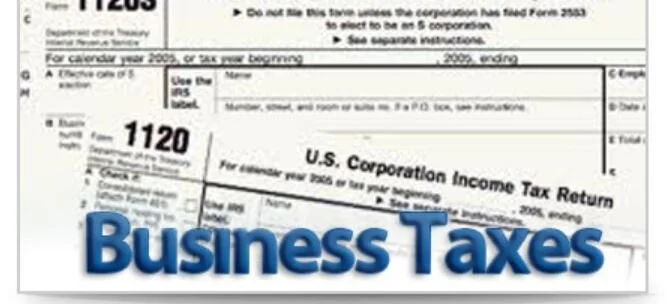
Since corporations are treated separate from individuals, they are required to pay federal, state, and local (if necessary) taxes. For federal purposes, Form 1120 is used to show the activities of the business and pay income tax.
Unlike sole proprietorships and partnerships, individuals are protected from corporate liabilities usually up to the amount they have invested in the company. This structure makes it easier to generate capital for the business and it is possible to become publically traded on a stock exchange. Pitfalls of a corporation include the amount of time and money it takes to set up and administer the corporation and potential double taxation. The corporation pays income tax and then distributes profits (in the form of dividends) to owners. Those dividends are now taxable to the individual after they were already taxed at the corporate level.
S Corporation
An S corporation is similar to a C corporation but is taxed at a personal level and avoids double taxation. The S Corp election passes through income to the owner's personal tax return rather than taxing the corporation and then the individual's dividends.
It is important to determine whether or not your corporation will be eligible to qualify as an S Corp under IRS regulations. A business must first register as a corporation and then file Form 2553 (signed by all owners) to apply for S Corp status.
Form 1120S is used to file taxes at a federal level. Again, S Corp income is passed through to the owners for federal tax purposes. Some states recognize this election but others (like New York) do not and will tax the company as a C Corp.
Limited Liability Company
An LLC provides limited liability features associated with a corporation with the same tax and operational efficiencies of a sole proprietorship or partnership. Owners of a corporation are not personally responsible for the liabilities of a company like sole proprietorships or partnerships.
Forming an LLC is similar to forming a partnership including choosing a business name, registering with the state (filing the "Articles of Organization"), obtaining necessary licenses and permits, and creating an operating agreement (similar to the partnership agreement). New York State also requires you to announce your LLC formation in a local newspaper.
An LLC can be structured similar to a sole proprietorship (single member LLC), a partnership, or an LLC filing as a C Corporation for tax purposes. The same filings will be completed as if the LLC was a sole proprietor, partnership, or corporation. A special election can also be made with the IRS allowing an LLC to be treated as an S Corp in some circumstances.
The main advantage of an LLC is that members are protected from personal liability for business decisions and actions. If provisions are not documented in the operating agreement, one of the pitfalls of an LLC is that when one member leaves, the LLC must dissolve completely. The remaining members can create a new LLC if they choose to continue operations.
About Rob.........
Hi, I'm Rob Mangold. I'm the Chief Operating Officer at Greenbush Financial Group and a contributor to the Money Smart Board blog. We created the blog to provide strategies that will help our readers personally , professionally, and financially. Our blog is meant to be a resource. If there are questions that you need answered, pleas feel free to join in on the discussion or contact me directly.




















Simple IRA vs. 401(k) - Which one is right for your company?
There are a lot of options available to small companies when establishing an employer sponsored retirement plan. For companies that have employees in addition to the owners of the company, the question is do they establish a 401(k) plan or a Simple IRA?The right fit for your company depends on:
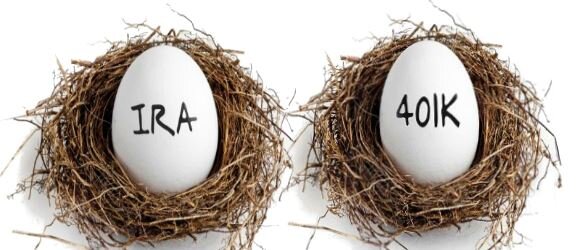
compare simple ira and 401k
There are a lot of options available to small companies when establishing an employer sponsored retirement plan. For companies that have employees in addition to the owners of the company, the question is do they establish a 401(k) plan or a Simple IRA?The right fit for your company depends on:
What are the company's primary goals for establishing the plan?
How much the owner(s) plan to contribute to the plan?
How many employees does the company have?
Do you want to restrict the plan to only full time employees?
The cost of maintaining each plan?
Does the company intend to make an employer contribution to the plan?
Diversity of the investment menu
Below is a chart that contains a quick comparison of some of the main features of each type of plan:

simple ira vs 401K comparison chart
For many small companies it often makes sense to start with a Simple IRA plan and then transition to a 401K plan as the company grows or when the owner intends to start accessing the upper deferral limits offered by the 401(k) plan.
Simple IRA's are relatively easy to setup and the administrative fees to maintain these plans are typically lower in comparison to 401(k) plans. Most Simple IRA providers will only charge $10 - $30 to custody the accounts.
By comparison, 401(k) plans are ERISA covered plans which require a TPA Firm (third party administrator) to maintain the plan documents, conduct year end plan testing, and file the 5500 each year. The TPA fees vary based on the provider and the number of employees eligible to participate in the plan. A ballpark range is $1,500 - $2,500 for companies with under 50 employees.
However, the additional TPA fees associated with establishing a 401(k) plan may be justified if:
The owners intend to max out their employee deferrals
The owners are approaching retirement and need to make big contributions
The company wants to maintain flexibility with the employer contribution
The company would like to make Roth contributions, loans, or rollovers available
WARNING: Most investment providers are "one trick ponies". They will talk about 401(k) plans and not present other options because they either do not have a thorough understand of how Simple IRA plans work or they are only able to offer 401(k) plans. Before establishing a retirement plan it is important to work with a firm that presents both options, helps you to understand the difference between the two types of plans, and assist you in evaluating which plan would best meet your company's goals and objectives.
Michael Ruger
About Michael.........
Hi, I'm Michael Ruger. I'm the managing partner of Greenbush Financial Group and the creator of the nationally recognized Money Smart Board blog . I created the blog because there are a lot of events in life that require important financial decisions. The goal is to help our readers avoid big financial missteps, discover financial solutions that they were not aware of, and to optimize their financial future.


















Comparing Different Types of Employer Sponsored Retirement Plans
Employer sponsored retirement plans are typically the single most valuable tool for business owner when attempting to:
Reduce their current tax liability
Attract and retain employees
Accumulate wealth for retirement
But with all of the different types of plans to choose from which one is the right one for your business? Most business owners are familiar with how 401(k) plans work but that might not be the right fit given variables such as:

comparison of different types of retirement plans
Employer sponsored retirement plans are typically the single most valuable tool for business owner when attempting to:
Reduce their current tax liability
Attract and retain employees
Accumulate wealth for retirement
But with all of the different types of plans to choose from which one is the right one for your business? Most business owners are familiar with how 401(k) plans work but that might not be the right fit given variables such as:
# of Employees
Cash flows of the business
Goals of the business owner
There are four main stream employer sponsored retirement plans that business owners have to choose from:
SEP IRA
Single(k) Plan
Simple IRA
401(k) Plan
Since there are a lot of differences between these four types of plans we have included a comparison chart at the conclusion of this newsletter but we will touch on the highlights of each type of plan.
SEP IRA PLAN
This is the only employer sponsored retirement plan that can be setup after 12/31 for the previous tax year. So when you are sitting with your accountant in the spring and they deliver the bad news that you are going to have a big tax liability for the previous tax year, you can establish a SEP IRA up until your tax filing deadline plus extension, fund it, and take a deduction for that year.
However, if the company has employees that meet the plan’s eligibility requirement, these plans become very expensive very quickly if the owner(s) want to make contributions to their own accounts. The reason being, these plans are 100% employer funded which means there are no employee contributions allowed and the employer contribution is uniform for all plan participants. For example, if the owner contributes 15% of their income to the SEP IRA, they have to make an employer contribution equal to 15% of compensation for each employee that has met the plans eligibility requirement. If the 5305-SEP Form, which serves as the plan document, is setup correctly a company can keep new employees out of the plan for up to 3 years but often times it is either not setup correctly or the employer cannot find the document.
Single(k) Plan or “Solo(k)”
These plans are for owner only entities. As soon as you have an employee that works more than 1000 hours in a 12 month period, you cannot sponsor a Single(k) plan.
The plans are often times the most advantageous for self-employed individuals that have no employees and want to have access to higher pre-tax contribution levels. For all intensive purposes it is a 401(k) plan, same contributions limits, ERISA protected, they allow loans and Roth contributions, etc. However, they can be sponsored at a much lower cost than traditional 401(k) plans because there are no non-owner employees. So there is no year-end testing, it’s typically a boiler plate plan document, and the administration costs to establish and maintain these plans are typically under $400 per year compared to traditional 401(k) plans which may cost $1,500+ per year to administer.
The beauty of these plans is the “employee contribution” of the plan which gives it an advantage over SEP IRA plans. With SEP IRA plans you are limited to contributes up to 25% of your income. So if you make $24,000 in self-employment income you are limited to a $6,000 pre-tax contribution.
With a Single(k) plan, for 2016, I can contribute $18,000 per year (another $6,000 if I’m over 50) up to 100% of my self-employment income and in addition to that amount I can make an employer contribution up to 25% of my income. In the previous example, if you make $24,000 in self-employment income, you would be able to make a salary deferral contribution of $18,000 and an employer contribution of $6,000, effectively wiping out all of your taxable income for that tax year.
Simple IRA
Simple IRA’s are the JV version of 401(k) plans. Smaller companies that have 1 – 30 employees that are looking to start a retirement plan will often times start with implementing a Simple IRA plan and eventually graduate to a 401(k) plan as the company grows. The primary advantage of Simple IRA Plans over 401(k) Plans is the cost. Simple IRA’s do not require a TPA firm since they are self-administered by the employer and they do not require annual 5500 filings so the cost to setup and maintain the plan is usually much less than a 401(k) plan.
What causes companies to choose a 401(k) plan over a Simple IRA plan?
Owners want access to higher pre-tax contribution limits
They want to limit to the plan to just full time employees
The company wants flexibility with regard to the employer contribution
The company wants a vesting schedule tied to the employer contributions
The company wants to expand the investment menu beyond just a single fund family
401(k) Plans
These are probably the most well recognized employer sponsored plans since at one time or another each of us has worked for a company that has sponsored this type of plan. So we will not spend a lot of time going over the ins and outs of these types of plan. These plans offer a lot of flexibility with regard to the plan features and the plan design.
We will issue a special note about the 401(k) market. For small business with 1 -50 employees, you have a lot of options regarding which type of plan you should sponsor but it’s our personal experience that most investment advisors only have a strong understanding of 401(k) plans so they push 401(k) plans as the answer for everyone because it’s what they know and it’s what they are comfortable talking about. When establishing a retirement plan for your company, make sure you consult with an advisor that has a working knowledge of all these different types of retirement plans and can clearly articulate the pros and cons of each type of plan. This will assist you in establishing the right type of plan for your company.
Michael Ruger
About Michael……...
Hi, I’m Michael Ruger. I’m the managing partner of Greenbush Financial Group and the creator of the nationally recognized Money Smart Board blog . I created the blog because there are a lot of events in life that require important financial decisions. The goal is to help our readers avoid big financial missteps, discover financial solutions that they were not aware of, and to optimize their financial future.
How to Create a Business Plan
Starting your own business can be an exciting and rewarding experience. It can offer numerous advantages such as being your own boss, setting your own schedule and making a living doing something you enjoy. But, becoming a successful entrepreneur requires thorough planning, creativity, and hard work. After making the decision to start your
How to Create a Business Plan
Starting your own business can be an exciting and rewarding experience. It can offer numerous advantages such as being your own boss, setting your own schedule and making a living doing something you enjoy. But, becoming a successful entrepreneur requires thorough planning, creativity, and hard work. After making the decision to start your own business, you'll need to be realistic about the sort of goals and targets you want to achieve at first. Businesses need targets though, so be sure to set some. Meeting targets does usually indicate business growth and success, so that's why they are so important. As with any business though, it all starts with a solid plan...
Learn from those before you
Before you make the leap to start your own business, make sure you talk or work for the person that you want to be 5 years from now. Working in the industry before taking your leap of faith will most likely increase your success rate. On the surface some businesses seem simple and straight forward. No business ever is. You have to figure out how the successful companies in that industry currently make money, what are their margins, who are the customers, who are the competitors, and more importantly what are the missteps that you should avoid when building you own business.
You must be able to answer these questions
Why am I starting a business?
What kind of business do I want?
Who is my ideal customer?
What products or services will my business provide?
Am I prepared to spend the time and money needed to get my business started?
What differentiates my business idea and the products or services I will provide from others in the market?
Where will my business be located?
How many employees will I need?
What types of suppliers do I need?
How much money do I need to get started?
Will I need to get a loan?
How soon will it take before my products or services are available?
How long do I have until I start making a profit?
Who is my competition?
How will I price my product compared to my competition?
How will I set up the legal structure of my business?
What taxes do I need to pay?
What kind of insurance do I need?
How will I manage my business?
How will I advertise my business?
Do not spend a dime until you can clearly answer all of these questions otherwise you are leaving your fate to chance.
Write your business plan
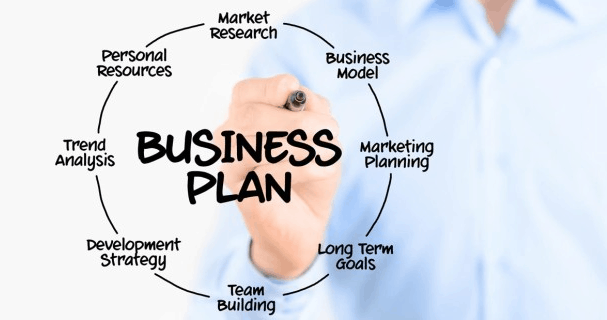
Your business plan is your roadmap to success. Business plans typically forecast out 3 to 5 years. Any shorter than that and you will have no idea where you are going with the business. Any longer than that is irrelevant because you may need to make material adjustments to your plan within the first 3 years as obstacles present themselves and as the competitive landscape changes along the way. Here are the key elements that you will want include in your business plan:
Executive Summary: Your executive summary is a snapshot of your business plan as a whole and touches on your company profile and goals. Read these tips about what to include.
Company Description: Your company description provides information on what you do, what differentiates your business from others, and the markets your business serves.
Market Analysis: Before launching your business, it is essential for you to research your business industry, market and competitors.
Organization & Management: Every business is structured differently. Find out the best organization and management structure for your business.
Service or Product Line: What do you sell? How does it benefit your customers? What is the product lifecycle? Get tips on how to tell the story about your product or service.
Marketing & Sales: How do you plan to market your business? What is your sales strategy? Read more about how to include this information in your plan.Funding Request: If you are seeking funding for your business, find out about the necessary information you should include in your plan.
Financial Projections: If you need funding, providing financial projections to back up your request is critical. Find out what information you need to include in your financial projections for your small business.
Your Competitive Advantage: What makes your business unique? Determining this could help you stand out from the crowd and give you advantages over your competitors.
Appendix: An appendix is optional, but a useful place to include information such as resumes, permits and leases. Find additional information you should include in your appendix.
Surround yourself with a great team of advisors.
Most business should have an accountant to ensure your books are correct and that all of the money your business is involved with is accounted for. You will collaborate with an attorney. You will also need a financial advisor. they will provide you with advice on where you can spend more money, what do you need to keep back or whether you need to reduce the money your spending on marketing for example. These professionals will help you to get your business established and help you with the key decisions that need to be made when you are establishing a business for the first time.
How should I incorporate?
What business expenses can I deduct?
How much cash do I need to sustain my business on a monthly basis?
It is likely that many of these professionals will be working with a client in your industry so they can provide you with real world guidance on the pros and cons of the decisions that you have to make.
Rule #1: Make sure you trust and like who you are working with. Do not just select a firm because they have a big name or because your friend uses them. You are going to be busy building your business so you will rely heavily on your team of professional advisors to make sure from a legal, tax, and financial standpoint that you are maximizing your resources.
Michael Ruger
About Michael.........
Hi, I'm Michael Ruger. I'm the managing partner of Greenbush Financial Group and the creator of the nationally recognized Money Smart Board blog . I created the blog because there are a lot of events in life that require important financial decisions. The goal is to help our readers avoid big financial missteps, discover financial solutions that they were not aware of, and to optimize their financial future.

Target Date Mutual Funds and Their Role in the 401(k) Space
A target date mutual fund is a fund in the hybrid category that automatically resets the asset mix of stocks, bonds and cash equivalents in its portfolio according to a selected time frame that is appropriate for a particular investor. In simpler terms, an investor can purchase a target date fund based on their anticipated retirement date and the fund will

target date mutual funds
In recent years, a growing trend in the 401(k) space has been the use of target date mutual funds.
Target Date Mutual Funds
A target date mutual fund is a fund in the hybrid category that automatically resets the asset mix of stocks, bonds and cash equivalents in its portfolio according to a selected time frame that is appropriate for a particular investor. In simpler terms, an investor can purchase a target date fund based on their anticipated retirement date and the fund will automatically become more conservative as the investor approaches retirement.
This is often times a suitable investment for the average investor or participant in a 401(k) plan that would not typically make allocation adjustments on their own. During the financial crisis of 2008 and 2009, many investors approaching retirement were overexposed to the stock market and lost half of their savings with no time to make it back before retirement. This is where the benefit of a well-managed target date fund would have been useful as investors who needed an allocation change as they approached retirement would have got it. Emphasis on the well-managed.
At year end 2013, there was approximately $595.5 billion dollars invested in target date mutual funds, up from approximately $111.9 billion in 2006 based on a study conducted by Morningstar. With so much money being placed in these funds, it is important to know how they work and what to look for when choosing the correct fund for your risk tolerance and time horizon.
As mentioned previously, the allocation of assets within a target date fund will automatically rebalance throughout the life of the investment to focus more on income. With that being said, how does the rebalancing happen and how often does the rebalancing take place? The rebalancing takes place automatically when fund managers of that target date fund determine the allocation in the fund no longer meets its intentions. It is argued that most target date mutual funds do not rebalance nearly enough as some can be as long as 4-5 years.
It is important to know that the date of a target date fund is the date the investor plans to retire and is not the date in which the fund is at its most conservative allocation. Fund families operate their target date mutual funds very differently. For example, one fund family may have a 2020 fund that is 30% stocks and 70% bonds compared to another more aggressive fund family that is allocated 60% stocks and 40% bonds in their 2020 target date fund.
There are arguments for both allocations. Since an investor is at their retirement age, they should typically be more conservative. On the other hand, just because the investor hit their retirement age they may not be taking distributions from the account for another 5-10 years, and therefore could possibly achieve more growth.
A target date fund can be a suitable investment option for investors who would like a hands off approach in their 401(k), but participants must be aware that there is still due diligence necessary throughout the life of the investment. Below is a chart showing the results of a study conducted by Morningstar in 2010. It shows the allocation of target date mutual funds for different fund families during the financial crisis of 2008 and 2009. These target date mutual funds were meant for investors retiring in 2010 and therefore should have been allocated in a way that would not over expose them to a significant decline in the market two years from retirement.

comparing target date fund performance
As you can see, the equity (stock) allocation varies greatly between fund families and the over exposure led to significant declines in investors accounts. Too many people had their retirement account nearly halved two years from retirement which is devastating for an individuals quality of life.
There are definitely pitfalls to target date mutual funds but they can be appropriate in the right circumstances. It is important that investors are educated on what target date mutual funds are and more importantly what they are not. Here are a few takeaways that may help you determine which, if any, target date fund is appropriate for you.
Determine Your Risk Tolerance First
The first questions an investment advisor will typically have for a client are: “What is your time horizon?” and “What is your risk tolerance?”. Since target date mutual funds allocate assets for a group of investors based on a date in the future, the only piece that is somewhat satisfied is time horizon. Just because a group of investors have the same time horizon does not mean they should be invested the same way. Fund managers cannot allocate funds in a way that satisfies both questions without knowing the risk tolerance for each individual investor. That means, the risk tolerance piece relies on you. Two 45 year old investors may be 20 years from retirement and have completely different portfolio allocations due to their risk tolerance. One may be more aggressive and tolerant of stock market fluctuations while the other may be conservative and less willing to risk their savings. Even though each investor has the same time horizon, the appropriate portfolio for each would vary greatly. It is important to know your risk tolerance and apply that knowledge to the appropriate target date fund.
Research the Different Target Date Fund Options
As shown in the chart on the previous page, the asset allocation for a target date fund for one fund family could be drastically different when compared to the same target date fund for another fund family. This can be confusing for investors which is why it is important to research the fund and the current allocation before investing. The charts below show the asset allocation of two 2020 target date mutual funds from different families.

401K target date funds
Both target date mutual funds are the same in terms of retirement date but drastically different in exposure to the stock market. The MFS 2020 fund with approximately 63% allocated to bonds/cash and 37% to stocks is a much more conservative portfolio than the Fidelity 2020, which is approximately 37% bonds/cash and 63% stocks. An investor with 5 years to retirement could have very different objectives with their retirement account and therefore each fund may be appropriate as a 2020 fund. An over exposure to the stock market for someone retiring in 5 years could be devastating as shown in 2008/2009 which is why it is important for each individual to determine their time horizon, risk tolerance, and investment objectives when selecting the correct target date fund for their portfolio.
Difference Between Target Date and Active Management
Although target date mutual funds are often referred to as “set it and forget it”, there are a number of factors that must be taken into consideration. Most target date mutual funds are typically managed exclusively on time horizon. Fund managers traditionally do not make significant allocation adjustments to these types of funds based on changing market conditions which can leave investors exposed to big drops in the stock market as they approach retirement. Investors within 10 years to retirement should work closely with their investment advisor to make sure they have the right mix of stocks and bonds in their portfolio.
About Rob……...
Hi, I’m Rob Mangold. I’m the Chief Operating Officer at Greenbush Financial Group and a contributor to the Money Smart Board blog. We created the blog to provide strategies that will help our readers personally , professionally, and financially. Our blog is meant to be a resource. If there are questions that you need answered, pleas feel free to join in on the discussion or contact me directly.
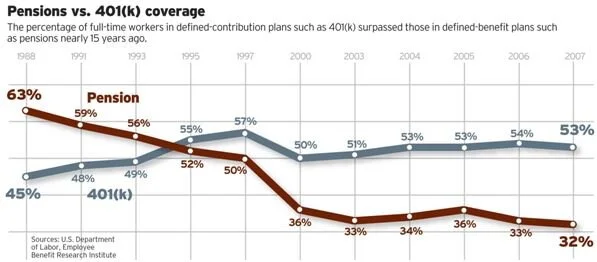
The Shift from Defined Benefit to Defined Contribution Plans
As defined benefit plans continue to become a thing of the past and workers realize they will not have a pension (and possibly Social Security) to rely on during retirement, it is important to be educated on the investments and opportunities available in employer sponsored defined contribution plans. This newsletter will briefly discuss the

The Shift from Defined Benefit to Defined Contribution Plans
As defined benefit plans continue to become a thing of the past and workers realize they will not have a pension (and possibly Social Security) to rely on during retirement, it is important to be educated on the investments and opportunities available in employer sponsored defined contribution plans. This newsletter will briefly discuss the difference between defined benefit plans and defined contribution plans, why the dramatic shift from one to the other, and why it is important to be educated on retirement and the investment options available.
Defined Benefit Plans
Defined benefit plans (commonly referred to as pension plans) are promises made by an organization to pay a specific amount, usually monthly, to an employee during retirement. These amounts are calculated based on a number of factors including an employees earnings history, service, and age. Since the organization is responsible for funding these plans during an employee’s retirement, investment returns are the concern of the organization, not the employee.
Defined Contribution Plans
Rather than an employer guaranteeing a benefit during retirement as is the case with defined benefit plans, the employee (and often times the employer) will make contributions to a defined contribution plan which accumulates over time and is drawn upon by the employee during retirement. One of the most common forms of defined contribution plans available to workers is the 401(k) plan. Since the guarantee of a monthly benefit during retirement is not there in a 401(k) plan, whatever is accumulated from employee/employer contributions and investment returns over the years is what will be available to the employee throughout retirement. In other words, this is the amount that must last throughout retirement.
Why the shift to 401(k)s and other defined contribution plans?
Defined benefit plans were set up to reward employees with consistent income during retirement since they are no longer earning. This is a great benefit to employees if available but these plans are becoming obsolete. As baby boomers continue to retire and live longer than previous generations, defined benefit plans are becoming too expensive to fund.
It is extremely difficult for companies (and municipalities) to turn a profit when they continue paying employees twenty years after their last day. Think of a defined benefit plan like you would a bad contract in baseball. Let me use one of the most scrutinized contracts in baseball history as an example. The Mets contract with Bobby Bonilla.
The last time Bonilla had an at bat for the Mets was in 1999, yet in 2015 he received a check for $1.19 million dollars. That amount is more than 17 of the current 25 players will make in 2015. Not the best business model when you are paying that kind of money to a player that hasn’t filled a seat (generated income for a company) in 15 years. The payment is guaranteed to Bonilla through 2035, which can be compared to a worker retiring at 55 and receiving a guaranteed payment for life.
For the reasons that seem obvious now, the past 30 years has seen a dramatic shift from defined benefit plans to defined contribution plans.
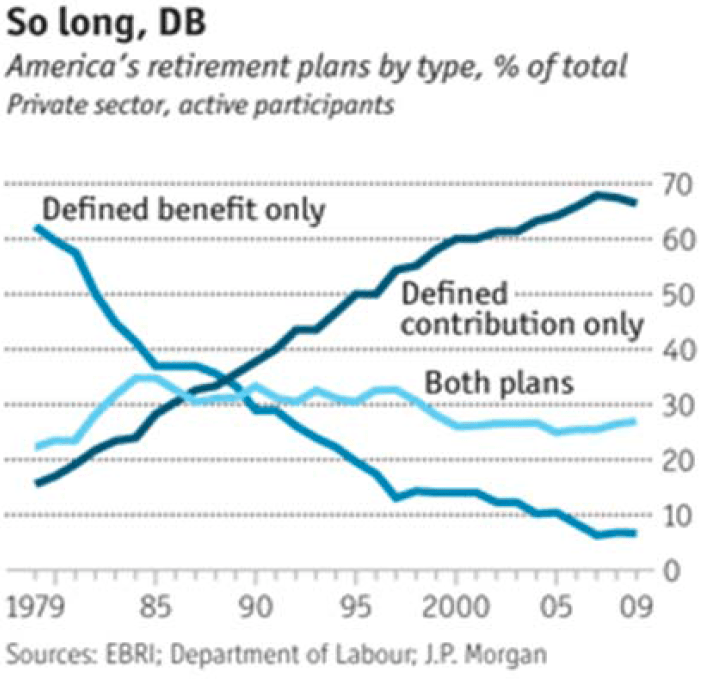
This chart illustrates the shift noted above. The breakeven point is shown around 1990 with no signs of the trend reversing.
As of June 30, 2014, 401(k) plans held an estimated $4.4 trillion in assets which is compared to $2.2 trillion in 2004.
Savings and Investment Performance
So, with less retirees having a pension plan to rely on for consistent income throughout retirement, how well are people preparing for retirement? The USA Today released an article in March 2015 titled “For millions, 401(k) plans have fallen short”, which describes the lack of retirement savings and inability for the majority of retirees to maintain their current lifestyle during retirement. The article references a report issued by the Employee Benefit Research Institute that stated the median amount in 401(k) savings accounts is $18,433. The median is higher for older employees as Vanguard 401(k) accounts for savers age 55 to 64 was $76,381 in 2013.
The Social Security website calculates life expectancy and determined that a man reaching age 65 today is expected to live until 84.3 years old (86.6 years old for women). That being said, an employee expecting to retire at age 65 with less than $100,000 in retirement savings has to live off that and social security for 20 plus years. The shift in retirement has led to many retirees not enjoying the retirement they had once planned.
As mentioned earlier, the migration from defined benefit plans to defined contribution plans has led to employees being responsible for managing their retirement. It is apparent that the savings rate for the average employee has not been sufficient to fund retirement, so now let us look at how employees are performing compared to major asset classes.
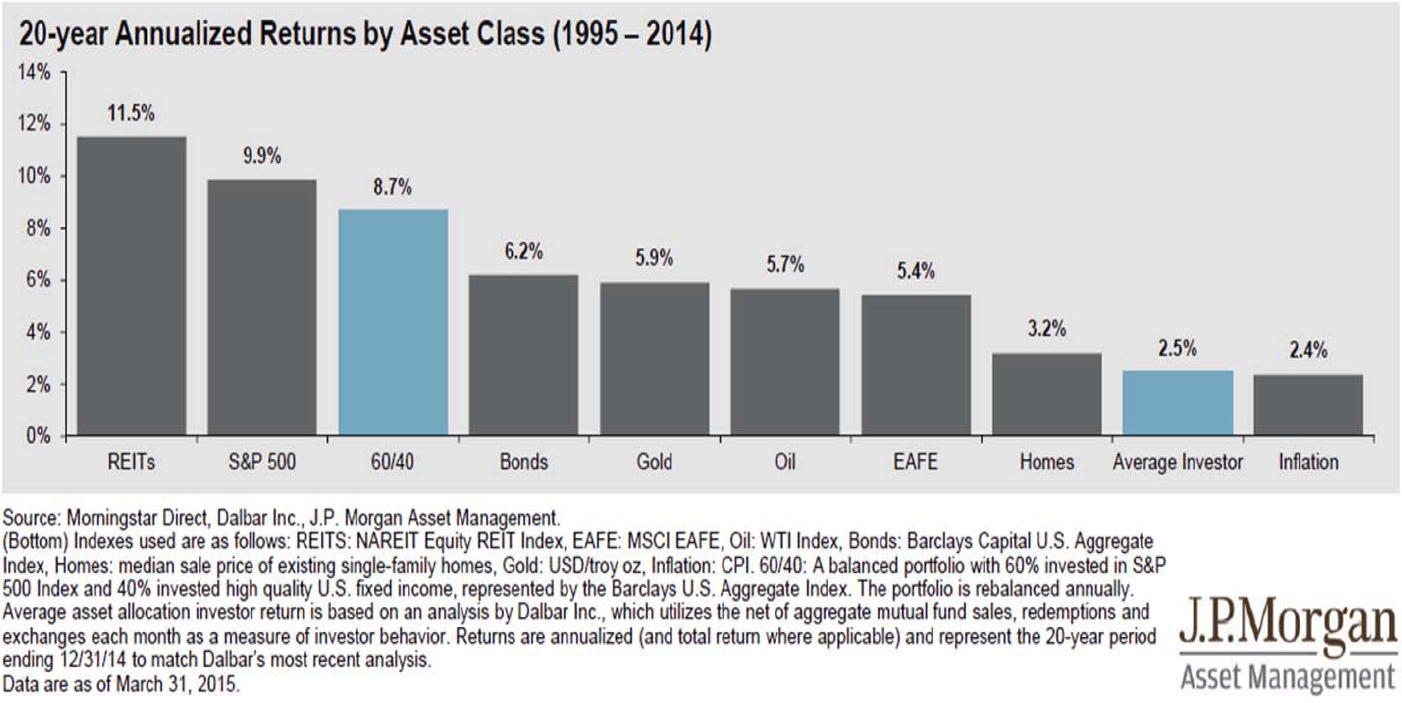
Contributions are only one part of a 401(k) balance with the other being interest earned. The chart above shows how the average investor has performed compared to different asset classes over the past 20 years. The 2.5% earned by the average investor was only .1% higher than inflation. This essentially means that in real dollars the average investor did not have any earnings during this period.
We typically look at the S&P 500 when determining how the stock market is performing which was up 9.9% over the same period. The other highlighted bar in the graph shows a portfolio with 60% in stocks and 40% in bonds, which is more of a conservative allocation but still saw an increase of 8.7%. When participating in a 401(k) for 20, 30, or 40 years, the majority of the balance when approaching retirement is not the contributions made but the interest that has compounded over an extended period of time. Losing 6-8% annually has a dramatic impact on an account, especially over a 20 year period.

This chart shows the impact of lost earnings over 40 years. In the example, the investor makes an initial investment of $10,000 earning 0%, 2%, 5%, and 8% annually with no additional contributions. Two quick takeaways are the interest that compounds at 5% and 8% are much more than the initial investment and after 20 years the difference between 5% and 8% is almost double.
Taking Control Of Your 401(k)
As defined contribution plans continue to takeover as the main income vehicle for retirees, how can employees benefit and take advantage of the available resources from these plans?
Start contributing as soon as possible - As shown earlier, the interest that compounds in a retirement account makes up the majority of the balance when invested for an extended period of time. The sooner you can start contributing the longer the account has to grow and the need to play catch-up as you approach retirement may be avoided. Also, you will be less reliable on the dollars being contributed as you are not used to the income each pay period.
Take advantage of the employer match - If your employer is generous enough to offer a match, take advantage of it. For example, you make $50,000 a year and your employer matches up to 3% of your compensation. This means that you can contribute $1,500 of pre-tax money and automatically double your investment. That is a 100% return just for participating in the plan.
Use the available resources - If your plan has a financial advisor, sit down with him or her and discuss your retirement goals and how to invest your contributions. The reason the average investor performs so poorly compared to the indexes is because they try to time the market and when they pull out they are reluctant to get back in. Discuss your time horizon and risk tolerance with your advisor and let them allocate your investments in a way that makes sense.
It is important to be educated, and historically, investors do not benefit over longer periods if they try to beat the market. JP Morgan put out a study that showed an investor who missed the 10 best days in the stock market from 1994-2014 earned a little more than half of an investor who was fully invested during the same period. If you have a long time horizon, it is important to hold through the ups and downs as historically the stock market goes up over long periods. For most investors, 10-15 years from retirement is when participants should start reassessing their allocation and determine if it is still the appropriate position for them.
Final Thoughts
As money continues to pour into defined contribution plans, it is important that the public be educated on what this means for retirement. Now more than ever it is up to employees to take responsibility for their retirement and save enough to last as defined benefit plans become obsolete and Social Security needs an overhaul that no one will touch.
About Rob……...
Hi, I’m Rob Mangold. I’m the Chief Operating Officer at Greenbush Financial Group and a contributor to the Money Smart Board blog. We created the blog to provide strategies that will help our readers personally , professionally, and financially. Our blog is meant to be a resource. If there are questions that you need answered, pleas feel free to join in on the discussion or contact me directly.

401(k) March 15th Deadline
For all companies that sponsor a 401(k) plan, the March 15th deadline is quickly approaching. March 15th is deadline for processing corrective distributions for failed actual deferred percentage (ADP) test. Failure to meet the deadline will result in a 10% excise penalty for any refund amounts that were due to the Highly Compensated Employees

401k march 15 deadline
For all companies that sponsor a 401(k) plan, the March 15th deadline is quickly approaching. March 15th is deadline for processing corrective distributions for failed actual deferred percentage (ADP) test. Failure to meet the deadline will result in a 10% excise penalty for any refund amounts that were due to the Highly Compensated Employees (HCE).
HCE’s are defined as an employee that is 5%+ owner or $115,000+ in annual compensation. The ADP test compares what the HCE’s deferred into the 401(k) versus what the Non-Highly Compensated Employees Deferred (NHCE). If there is too large of a gap between the average of the HCE’s versus the average of the NHCE, the plan is required to refund contributions to the HCE’s until the contribution level can pass testing. The typical rule of thumb is the HCE’s cannot defer more than 2% of the average of the NHCE’s to pass testing but this amount will vary based on the actual testing results.
If you are a safe harbor plan, you do not have to worry about the March 15th deadline because safe harbor plans are automatically deemed to pass the ADP test regardless of how much the HCE’s defer into plan. This makes safe harbor plans a very effective plan design for owners that are looking to max out their 401(k) deferrals in a given plan year.
Michael Ruger
About Michael……...
Hi, I’m Michael Ruger. I’m the managing partner of Greenbush Financial Group and the creator of the nationally recognized Money Smart Board blog . I created the blog because there are a lot of events in life that require important financial decisions. The goal is to help our readers avoid big financial missteps, discover financial solutions that they were not aware of, and to optimize their financial future.
