
Beneficiaries May Need To Take An RMD From A Decedent’s IRA In The Year They Pass Away
A common mistake that beneficiaries of retirement accounts make when they inherit either a Traditional IRA or 401(k) account is not knowing that if the decedent was required to take an RMD (required minimum distribution) for the year but did not distribute the full amount before they passed, the beneficiaries are then required to withdrawal that amount from the retirement account prior to December 31st of the year they passed away. Not taking the RMDs prior to December 31st could trigger IRS penalties unless an exception applies.
A common mistake that beneficiaries of retirement accounts make when they inherit either a Traditional IRA or 401(k) account is not knowing that if the decedent was required to take an RMD (required minimum distribution) for the year but did not distribute the full amount before they passed, the beneficiaries are then required to withdrawal that amount from the retirement account prior to December 31st of the year they passed away. Not taking the RMDs prior to December 31st could trigger IRS penalties unless an exception applies.
The RMD Requirement for the Decedent
Once you reach a specific age, the IRS requires taxpayers to begin taking mandatory annual distributions from their pre-tax retirement account each year. These mandatory annual distributions are called RMDs or required minimum distributions. The age at which an individual is required to begin taking RMDs is also referred to as the “Required Beginning Date” (RBD). The Required Beginning Date is based on your date of birth:
Born 1950 or earlier: Age 72
Born 1951 – 1959: Age 73
Born 1960 or later: Age 75
Example: If Jim was born in 1953 and turns age 73 this year, and Jim has a Traditional IRA with a $500,000 balance, in 2026, Jim would be required to withdraw $18,867 from his IRA as his annual RMD and pay tax on the distribution.
Undistributed RMD Amount When Someone Passes Away
It’s a common situation for an individual who has reached their Required Beginning Date for RMDs to pass away prior to distributing the required amount from their IRA account for that calendar year.
Example: Jen is age 81; she passed away in February 2026 with a $300,000 balance in her Traditional IRA. Her RMD amount for 2026 would be $15,463. If Jen only distributed $3,000 from her IRA prior to passing away in February, the beneficiary or beneficiaries of Jen’s IRA would be required to withdraw the remaining amount of her RMD, $12,463, prior to December 31, 2026, otherwise the beneficiaries will be faced with a 10% to 25% excise tax on the amount of the RMD that was not withdrawn prior to December 31st.
A Single Beneficiary
If there is only one beneficiary that is inheriting the entire account balance, the process is easy: determine the remaining amount of the decedent’s RMD, and then process the remaining RMD amount from the IRA account prior to December 31st of the year that they passed away.
Multiple Beneficiaries
When there are multiple beneficiaries of a pre-tax retirement account, the IRS recently released new regulations clarifying a question that has been in existence for a very long time.
The question has been, “If there are multiple beneficiaries of a retirement account, does EACH beneficiary need to distribute an equal share of the decedent’s remaining RMD amount OR do they collectively just have to make sure the remaining RMD amount was distributed but it does not have to be in equal shares?”
I’ll show you why this matters in an example:
Susan passed away before taking her $20,000 RMD for the year. She has a $200,000 balance in her Traditional IRA, and her two kids, Scott and Wanda, are both 50% primary beneficiaries on her account. The kids set up separate inherited IRAs and transfer their $100,000 shares into their respective accounts. Scott intends to take a $50,000 distribution from his Inherited IRA, pay the tax, and buy a boat, but Wanda, who is a high-income earner, wants to avoid taking taxable distributions from her Inherited IRA until after she retires.
Since Scott took enough out of his Inherited IRA to cover Susan’s full $20,000 undistributed RMD in the year she passed, is Wanda relieved of having to take an RMD from her account in the year that Susan passed, or does she still need to distribute her $10,000 share of the $20,000 RMD?
The new IRS regulations state that the decedent’s undistributed RMD amount is allowed to be satisfied by “any beneficiary” in the year that they pass away. Meaning the RMD does not have to be distributed in equal amounts to each beneficiary, as long as the total remaining RMD amount is distributed by one or more of the beneficiaries of the decedent.
In the example above, if Scott processed $50,000 from his inherited IRA in the year that Susan passed, Wanda would not be required to take a distribution from her inherited IRA that year because Susan’s $20,000 remaining RMD amount is deemed to be fulfilled.
A Decedent With Multiple IRAs
It’s not uncommon for an individual to have more than one Traditional IRA account when they pass away. The question becomes if they have multiple IRAs and each of those IRAs has an undistributed RMD amount at the time the decedent passes away, can the beneficiaries total up all of the undistributed RMD amounts and take the full amount from one single IRA account OR do they have to take the undistributed RMD amount from each IRA account?
The answer is “it depends”. It depends on whether the beneficiaries are the same or different for each of their IRA accounts.
Multiple IRAs – Same Beneficiaries
If the decedent has multiple IRAs but the beneficiaries are exactly the same as all of their IRAs, then the beneficiaries are allowed to aggregate the undistributed RMD amounts together and distribute that amount from any IRA or IRAs that they choose before the end of the year.
Multiple IRAs – Different Beneficiaries
However, in the instance that the decedent has multiple IRAs but has different beneficiaries listed amongst the different IRA accounts, then the decedent’s undistributed RMD amount needs to be taken from each IRA account.
Privacy Issue with Multiple Beneficiaries
I have been a financial planner long enough to know that not all family members get along after someone passes away. If the decedent had an undistributed RMD amount in the year that they passed and the beneficiaries are not openly sharing their plans regarding how much they plan to withdraw out of their inherited IRA in the year the decedent passed away, it may be impossible to coordinate the disproportionate distributions between the multiple beneficiaries defaulting the beneficiary to taking their equal share of the undistributed RMD amount.
IRS Penalty For Missing RMD
If the beneficiaries fail to distribute the decedent’s remaining RMD amount before December 31st of the year that they pass away, then the IRS will assess a 25% penalty against the amount that was not timely distributed from the IRA account.
Special Note: The IRS penalty is reduced to 10% if corrected in a timely fashion.
Automatic Waiver of the RMD Penalty
The final regulations released by the IRS in 2024 granted a very favorable automatic waiver of the missed RMD penalty that did not exist prior to July 2024. The automatic waiver originally stemmed from the common scenario that if the decedent passed away in December and had not yet satisfied their RMD amount for the year, it was often difficult for the beneficiaries to work with the custodians of the IRA to get those distributions processed prior to December 31st. However, the IRS, being oddly gracious, now provides beneficiaries with an automatic waiver of the missed RMD penalty, specifically for undistributed RMD amounts for a decedent, up until December 31st of the year AFTER the decedent’s death to satisfy the RMD requirement.
When Is No RMD Required?
I have gone through numerous scenarios without stating the obvious. If the decedent either died before their Required Beginning Date for RMDs or if they died AFTER their Required Beginning Date but distributed their full RMD amount prior to passing away, the beneficiaries are not required to distribute anything from the decedent’s IRA prior to December 31st in the year that they passed away.
Also, if the Decedent had a Roth IRA, Roth IRAs do not have an RMD requirement, so the beneficiaries of the Roth IRA would not be required to take an RMD prior to December 31st in the year the decedent passes away.

About Michael……...
Hi, I’m Michael Ruger. I’m the managing partner of Greenbush Financial Group and the creator of the nationally recognized Money Smart Board blog . I created the blog because there are a lot of events in life that require important financial decisions. The goal is to help our readers avoid big financial missteps, discover financial solutions that they were not aware of, and to optimize their financial future.
Last updated June, 2026
Frequently Asked Questions (FAQs):
What happens if someone dies before taking their full RMD for the year?
If a person passes away without taking their full required minimum distribution (RMD), their beneficiaries must withdraw the remaining amount by December 31 of that same year. Failing to do so can result in IRS penalties unless an exception or waiver applies.
How can beneficiaries determine if the decedent had an RMD requirement?
The RMD obligation depends on the decedent’s age and date of birth. The Required Beginning Date (RBD) is age 72 for those born in 1950 or earlier, 73 for those born between 1951 and 1959, and 75 for those born in 1960 or later. If the decedent was past their RBD, the RMD rule applies.
If there are multiple beneficiaries, does each person need to take part of the RMD?
No. The IRS clarified in 2024 that any one or more beneficiaries can collectively satisfy the decedent’s remaining RMD. As long as the total required amount is withdrawn from the inherited accounts before year-end, it doesn’t need to be split evenly among beneficiaries.
How are RMDs handled if the decedent had multiple IRA accounts?
If all IRAs have the same beneficiaries, the total RMD amount can be aggregated and taken from any one or more accounts. However, if the IRAs have different beneficiaries, each account’s undistributed RMD must be withdrawn separately from that account.
What are the penalties for missing a decedent’s RMD?
The IRS can impose a 25% excise tax on any undistributed RMD amount not withdrawn by year-end. If corrected promptly, the penalty may be reduced to 10%.
Did the IRS change the RMD penalty rules recently?
Yes. Under final regulations released in 2024, beneficiaries now have an automatic waiver of the missed RMD penalty if they take the decedent’s remaining RMD by December 31 of the year after the death. This provides flexibility in situations where distributions are delayed.
When are beneficiaries not required to take a decedent’s RMD?
No RMD is required if the decedent passed away before reaching their Required Beginning Date or had already completed their RMD for the year. In addition, Roth IRAs are exempt from RMD requirements, so beneficiaries of Roth accounts do not need to take year-of-death distributions.





















The Final Rules For Non-spouse Beneficiary Inherited IRAs Has Been Released: The 10-Year Rule, Annual RMD Requirement, Tax Strategies, New 401(k) Roth Rules, and More…….
In July 2024, the IRS released its long-awaited final regulations clarifying the annual RMD (required minimum distribution) rules for non-spouse beneficiaries of retirement accounts that are subject to the new 10-year rule. But like most IRS regulations, it’s anything but simple and straightforward.
In July 2024, the IRS released its long-awaited final regulations clarifying the annual RMD (required minimum distribution) rules for non-spouse beneficiaries of retirement accounts that are subject to the new 10-year rule. But like most IRS regulations, it’s anything but simple and straightforward. The short answer is for non-spouse beneficiaries that are subject to the 10-year rule; some beneficiaries will be required to begin taking annual RMDs starting in 2025 while others will not. In this article, we will review:
The RMD requirement for non-spouse beneficiaries
RMD start date
IRS penalty relief for missed RMDs
Are one-time distributions required for missed RMDs 2020 - 2024?
Different RMD rules for Traditional IRAs versus Roth IRAs
Different RMD rules for Roth 401(k) versus Roth IRAs
Common RMD mistake for stretch rule beneficiaries
In addition to covering the topics above related to the new RMD rules, we want this article to be a “one-stop shop” for non-spouse beneficiaries to understand how these non-spouse inherited IRAs work from start to finish, so we will start this article by covering:
How Inherited IRA work for non-spouse beneficiaries
Rules for a decedent that pass either before or after 2019
The new 10-year Rule
Beneficiaries that are granted an exception to the new 10-year rule
Required minimum distributions (RMDs)
Taxation of distributions from inherited IRAs
Tax strategies and Pitfalls associated with Inherited IRA accounts
Special rules for minor children with Inherited IRAs
(If you are reading this just for the new RMD rules, you can skip to the second half of the article)
Non-spouse Beneficiaries of Retirement Accounts
When you inherit a retirement account, there are different options available to you depending on whether you are a “spouse beneficiary” or a “non-spouse beneficiary”. In this article, we are going to be focusing on the options available to a non-spouse beneficiary.
Non-spouse Beneficiary Rules Prior to 2020
In 2019, the SECURE Act 1.0 was passed, which greatly limited the inherited IRA options that were available to non-spouse beneficiaries of IRAs, 401(k)’s, and other types of employer-sponsored retirement plans. Under the old rules, if someone passed away prior to January 1, 2020, you as a non-spouse beneficiary, were allowed to move the balance of that IRA into an inherited IRA in your name, avoid any immediate tax implications, and you only had to take small distributions each year called RMDs (required minimum distributions) based on IRS life expectancy table. This was called the “stretch rule” which allowed a non-spouse beneficiary to stretch the distributions over their lifetime.
If you wanted to take more out of the account, you could, since it’s an inherited IRA, even if you were under the age of 59 ½, you avoided the 10% early withdrawal penalty and either had to pay income tax on a pre-tax retirement account or avoided tax altogether on Roth inherited IRA accounts. These beneficiaries had a lot of flexibility with this option with minimal emergency tax planning needed.
For individuals in this camp who inherited a retirement account from someone who passed away prior to January 1, 2020, the good news is you are grandfathered in under the old rules, and none of the changes that we are going to cover in this article apply to you. You still have access to the stretch provision.
Non-spouse Beneficiary of Decedent That Passed After December 31, 2019
SECURE Act 1.0, which passed in 2019, took away the “stretch option” for most non-spouse beneficiaries and replaced it with a much more restrictive “10-Year Rule,” which requires a non-spouse beneficiary to fully deplete the account balance of that inherited retirement account within 10 years start the year after the decedent passed away. If you inherited a retirement account from someone who passed away AFTER December 31, 2019, and you are non-spouse beneficiaries, you are subject to the new 10-Year Rule UNLESS you meet one of the exceptions. Non-spouse beneficiaries that qualify for an exception to the 10-year rule are referred to as “Eligible Designated Beneficiaries” in the new tax regulations if you choose to read the 260 pages that were just released by the IRS.
Here is the list of beneficiaries that are exempt from the new 10-year rule and still have the stretch option available to them:
Surviving spouse
Person less than 10 years younger than the decedent
Minor children
Disabled person
Chronically ill person
Some See-Through Trusts benefitting someone on this exception list
Non-Spouse Beneficiary Not More Than 10 Years Younger Than The Decedent
I wanted to highlight this exception because it’s the most common exception to the 10-rule for non-spouse beneficiaries that we see amongst our clients. If you are a non-spouse beneficiary of a retirement account from someone that was not more than 10 years younger than you like a sibling or a cousin, the new 10-year distribution rule does not apply to you. You are allowed to roll over the balance to your own inherited IRA and stretch annual RMDs over your lifetime.
Example: Tim passes away at the age of 55 and his sister Susan age 58 is the 100% primary beneficiary of his Traditional IRA account, since Susan is a non-spouse beneficiary, she normally would be subject to the 10-year rule requiring her to fully distribute and pay tax on Tim’s IRA balance within a 10 year period. However, since Tim was less than 10 years younger than Susan, she qualifies for the exception to the 10-year rule. She can rollover Tim’s IRA balance into an Inherited IRA in her name, and she would only be required to take small required minimum distributions each year starting the year after Tim passed away.
Minor Children As Beneficiary of Retirement Accounts
The minor child exception is a little tricker. If a minor child is the beneficiary of a retirement account, and they inherited the retirement account from their parents, they are only required to take those small annual RMDs until they reach age 21, but then as soon as they turn 21, they switch over to the 10-Year Rule. If they inherited the retirement account from someone other than their parent, then the 10-year period begins the year after the decedent passes away like the rest of the non-spouse beneficiaries.
Example: Josh is age 12 and his mother unexpectedly passes away and Josh is listed as the primary beneficiary on his mother’s 401(K) account at work. Josh, as a non-spouse beneficiary, would not immediately be subject to the 10-year rule, but instead, he would be temporarily allowed to use the stretch provision; he would be required to take annual RMDs each year from the retirement account until he reaches age 21. Once Josh reaches age 21, he will then be subject to the 10-year rule, and he will be required to fully distribute the retirement account 10 years following when he turns age 21.
Age of Majority: Normally the “age of majority” is defined by the state that the minor lives in. For some states, it’s age 18, and in other states, it’s age 21. The new IRS regulations addressed this issue and stated that regardless of the age of majority for the state that the minor lives in and regardless of whether or not the child is a student past the age of 18, the age of majority for purposes of triggering the 10-year rule for non-spouse beneficiaries will be age 21.
Non-Spouse Beneficiary Subject To The 10-Year Rule
If you are a non-spouse beneficiary who inherited a retirement account from someone who passed away AFTER December 31, 2019, and you DO NOT qualify for one of the exceptions previously listed, then you are subject to the new “10-Year Rule”. The 10-Year Rule requires a non-spouse beneficiary to fully deplete the inherited retirement account balance no later than 10 years following the year after the decedent passes away.
The 10-Year Rule Applies to Both Pre-Tax and Roth Retirement Accounts
Regardless of whether you inherited a pre-tax retirement account like a Traditional IRA, SEP IRA, or 401(k) account or a Roth retirement account like a Roth IRA or Roth 401(k), the 10-year rule applies.
Example: Sarah’s father just passed away in February 2024, and she was the 100% primary beneficiary of his Traditional IRA account with a balance of $300,000. Sarah is age 60. Sarah, as a non-spouse beneficiary, would be subject to the 10-year rule and would be required to fully distribute and pay tax on the full $300,000 before December 31, 2034, which is 10 years following the year after her father passed away.
The RMD Mystery
When the 10-Year Rule first came into being in 2020, it was assumed that this 10-year rule was an extension of the previous “5-year rule”, which only required the beneficiary to deplete the account balance within 5 years but there was no annual RMDs requirement during that 5-year period. The IRS just simply eliminated the “stretch option” and extended the 5-year rule to a 10-year rule.
But then, two after the IRS passed SECURE Act 1.0 with this new 10-year rule, the IRS came out with new proposed regulations that basically said, “Whoops, I know we wrote it that way, but that’s not what we meant.”
In the proposed regulations that the IRS released in February 2022, the IRS clarified that what they meant to say was that certain non-spouse beneficiaries that are subject to the new 10-year rule would ALSO be required to take annual RMDs during that 10-year period. This was not welcome news for many non-spouse beneficiaries, and it created a lot of confusion since a few years had already gone by since the new 10-year rule was signed into law.
The New RMD Rules for Inherited IRA for Non-spouse Beneficiaries
The finalized IRS regulations that were just released in July 2024 made their stance official. Whether or not a non-spouse beneficiary will be subject to BOTH the 10-Year Rule and annual RMDs will be dependent on two factors:
The age of the decedent when they passed away
The type of retirement account that the beneficiary inherited (Pre-tax or Roth)
RMD Requirement Based on Age of Decedent
If you are the original owner of a retirement account (Traditional IRA, 401(k), etc.), once you reach a specific age, the IRS requires you to start taking small distributions from that pre-tax account each year, which are called required minimum distributions (RMDs).
The age at which you are required to begin taking RMDs is called your Required Beginning Date (“RBD”), not to be confused with the “RMD”. There are too many acronyms in the finance world “The IRS wants you to take your RMD by your RBD ASAP so they can collect their TAX.”
The date at which RMDs are required to begin varies based on your date of birth:
Born 1950 or earlier: Age 72
Born 1951 – 1959: Age 73
Born 1960 or later: Age 75
Someone that is born in 1956 would be required to start taking RMDs from their pre-tax retirement accounts at age 73. Why is this relevant to non-spouse beneficiaries? Because whether or not the decedent died before or after their Required Beginning Date for RMDs will determine whether or not you, as the non-spouse beneficiary, are required to take annual RMDs during the 10-Year Rule period.
The Decedent Passes Away Prior to Their RMD Required Beginning Date
If the decedent passed away prior to their Required Beginning Date, then you, as the non-spouse beneficiary, are subject to the 10-Year Rule, but you ARE NOT REQUIRED to take annual RMDs during the 10-year period. You simply have to deplete the account balance prior to the end of the 10 years.
Example: Brad’s father passes away at age 68 and Brad is the 100% beneficiary of his Traditional IRA. Brad’s father was born in 1956, making his RMD start at age 73. Since Brad’s father passed away prior to reaching age 73 (RBD), Brad would be subject to the 10-year rule but would not be required to take annual RMDs during that 10-year period.
The Decedent Passes Away After Their RMD Required Beginning Date
If the decedent passes away AFTER their Required Beginning Date for RMDs, then the non-spouse beneficiary is subject to BOTH the 10-year rule AND is required to take annual RMDs during that 10-year period.
Example: Dave’s father passed away at age 80, and he had been taking RMDs for many years since he was beyond his Required Beginning Date. When Dave inherits his father’s Traditional IRA, he will not only be subject to the 10-year rule as a non-spouse beneficiary, but he will also be required to distribute annual RMDs every year from the Inherited IRA account since his father had already begun receiving RMDs for his account.
RMDs Not Required Until 2025
Since the IRS just released the final regulation in July 2024, for non-spouse beneficiaries that are subject to both the 10-Year Rule and annual RMDs, RMDs are not required to begin until 2025.
Good news: For non-spouse beneficiaries subject to the 10-year rule, the IRS has waived all penalties for the “missed RMDs” between 2020 and 2024, and they are not requiring these non-spouse beneficiaries to “make up” for missed RMDs for years leading up to 2025. The RMDs will be calculated in 2025 like everything has been working smoothly since Day 1.
No Reset of the 10-Year Depletion Timeline
It’s important to note that even though the IRS took 4 years to clarify the RMD rules associated with the new 10-year rule, it does not reset the 10-year clock for the depletion of the inherited retirement account.
Example: Jessica’s uncle passed away in 2020 at the age of 82. Jessica, as a non-spouse beneficiary, would be subject to the 10-year rule requiring her to fully deplete the Traditional IRA by December 31, 2030. Since her uncle was past his Required Beginning Date for RMDs, Jessica would be required to take annual RMD in the years 2025 – 2030. (Note that the 2021 – 2024 RMDs were waived due to the IRS delay). Even though her first RMD will not be until 2025, she is still required to deplete the Traditional IRA account by December 31, 2030.
Annual RMD Rules
Many of these examples incorporate the delay in annual RMDs due to the delay in the IRS regulations being released. However, if someone passes away in 2024 and has a non-spouse beneficiary listed on their pre-tax retirement account, the 10-year timeline and the first annual RMD calendar would begin in 2025, which is the year following the decedent’s date of death.
The first RMD is required to be taken by a non-spouse beneficiary by December 31st of the year following the decedent's death.
Inherited Roth IRAs – No RMD Requirement
You will notice in most of my examples that I specifically use a “Traditional IRA” or “Pre-tax Retirement Account.” That is because only pre-tax retirement accounts have the RMD requirement. If you are the original owner of a Roth IRA, Roth IRAs do not require you to take an RMD regardless of your age. So, under the new rules, if you inherit a Roth IRA, since the decedent would not have been required to take an RMD from a Roth IRA at any age, they never had a “Required Beginning Date”. This makes the non-spouse beneficiary subject to the 10-year rule, but no annual RMDs would be required from an inherited Roth IRA.
Note: If you inherit a Roth IRA and you are eligible for the stretch options, annual RMDs are then required from you Inherited Roth IRA account.
Roth 401(k)s Are Different
While typically, Roth IRAs and Roth 401(k)s have the same rules, the IRS included a weird rule for Roth 401(k)s in the final regulations regarding the RMD requirement. If you inherit a 401(k) plan, it’s possible that there are both Pre-tax and Roth monies within that same account since most 401(k) plans allow plan participants to make either pre-tax deferrals or Roth deferrals to the plan.
Normally I would have thought if a 401(k) account contains both Pre-tax and Roth dollars, as a non-spouse beneficiary, you would have the 10-year rule for the full account balance, but you could ignore the RMD requirement for the Roth dollars, but the annual RMDs on the pre-tax portion of the account would depend on whether or not the decedent passed away before or after their Required Beginning Date for RMDs. Assuming this, I would have been correct for the pre-tax portion of the 401(k) account but potentially wrong about no annual RMDs for the Roth portion of the 401(k) account.
The final regulations state that if the 401(k) account contains ONLY Roth dollars, no pre-tax dollars within the account, then a non-spouse beneficiary is subject to the 10-year rule but DOES NOT have to take annual RMDs during that 10-year period.
However, if the 401(k) account contains both Roth and any other type of pre-tax source, like employee pre-tax deferrals, employer match, and employer profit sharing, which is much more common for 401(k) plans, then the ENTIRE BALANCE in the 401(k) plan, INCLUDING THE ROTH SOURCE, is subject to the annual RMD requirement during the 10-year period. Yuck!!!
This new rule will encourage individuals who have a Roth source within their employer-sponsored retirement plans to roll over their Roth monies within the plan to a Roth IRA before they pass away. By removing that Roth source from the employer-sponsored retirement plans and moving it into a Roth IRA, now when the non-spouse beneficiary inherits the Roth IRA, they are allowed to accumulate those Roth dollars longer within the 10-year period since they are not required to take annual RMDs from a Roth IRA account.
Note: The pre-tax sources within a 401(k) works the same way as inheriting a Traditional IRA. A non-spouse beneficiary would be subject to the 10-year rule and may or may not have to take RMDs during the 10-year period depending on whether or not the decedent dies before or after their Required Beginning Date for RMDs.
Non-Spouse Beneficiaries Eligible For The Stretch Rule Only Had An RMD Waiver for 2020
In 2020, part of the COVID relief packages was the ability to waive taking an RMD during that calendar year. I have run into a few cases where non-spouse beneficiaries that were grandfathered in under the “stretch rules” requiring them to take an annual RMD each year, are getting confused with the delay in the RMD requirement for non-spouse beneficiaries that are subject to the new 10-year rule after December 2019. The delay in the annual RMDs until 2025 for non-spouse beneficiaries ONLY applies to individuals subject to the 10-year rule. If you inherited a retirement account from someone who passed away prior to 2020 or you qualify for one of the exceptions to the 10-Year Rule as a non-spouse beneficiary, you are grandfathered in under the old “Stretch Rule,” which requires the owner of that Inherited IRA to take annual RMD’s from that account each year starting in the calendar year following the decedent’s date of death.
In summary, if you are a stretch rule non-spouse beneficiary, the only year you were allowed to skip your RMD was 2020 per the COVID relief; you should have restarted your annual RMDs in 2021 and taken an RMD for 2021, 2022, and 2023, and subsequent years. If you missed this, the good news is the Secure Act 2.0 also lowered the IRS penalty amount for missed RMDs, from 50% to 25% and even lower to 10% if timely corrected.
Non-Spouse Inherited IRA Tax Strategies
We will be writing a separate article that contains all of the advanced tax strategies that we implement for clients who are non-spouse beneficiaries subject to the 10-year rule since there are a number of them, but here is some of the standard guidance that we provide to our clients.
If you inherit a Roth IRA, that is an ideal situation because even though you are subject to the 10-year rule as a non-spouse beneficiary, all of the accumulation in an Inherited Roth IRA can be withdrawn tax-free.
Example: John inherits a $200,000 Roth IRA from his mother in 2024. John, as a non-spouse beneficiary, will be subject to the 10-year rule, so the account has to be depleted by 2034, but he is not required to take annual RMDs because it’s a Roth IRA account. If John invests the $200,000 wisely and receives an 8% annual rate of return, at the end of 10-year the $200,000 has grown to $431,785 within that Inherited Roth IRA, and the full balance will be distributed to him ALL TAX-FREE.
For this reason, we have a lot more clients processing Roth Conversions in retirement to push more of their net worth from the pre-tax bucket over to the Roth bucket, which is much more favorable for non-spouse beneficiaries when they inherit the account.
For clients that inherit larger pre-tax retirement accounts that are subject to the 10-year rule, we have to develop a detailed tax plan for the next 10 years since we know all of that money will need to be distributed and taxed within the next 10 years, which could cause the money to be taxed at a higher tax rate, increased Medicare premiums, lower financial aid awards for parents with kids in college, have their social security taxed at a higher rate, lose tax deductions, or other negative consequences for showing too much income in a single year.
About Michael……...
Hi, I’m Michael Ruger. I’m the managing partner of Greenbush Financial Group and the creator of the nationally recognized Money Smart Board blog . I created the blog because there are a lot of events in life that require important financial decisions. The goal is to help our readers avoid big financial missteps, discover financial solutions that they were not aware of, and to optimize their financial future.
Frequently Asked Questions (FAQs):
What did the IRS clarify about non-spouse beneficiary RMDs in 2024?
In July 2024, the IRS issued final regulations confirming that some non-spouse beneficiaries subject to the 10-year rule must begin taking annual required minimum distributions (RMDs) starting in 2025. Whether annual RMDs are required depends on the decedent’s age at death and the type of retirement account inherited.
Who must take annual RMDs under the 10-year rule?
If the decedent passed away after reaching their Required Beginning Date (the age at which RMDs must begin), the non-spouse beneficiary must take annual RMDs during the 10-year depletion period. If the decedent passed before reaching that age, the beneficiary is only required to deplete the account by the end of the 10 years—no annual RMDs are needed.
What are the new RMD start dates for non-spouse beneficiaries?
The IRS delayed required RMDs for non-spouse beneficiaries until 2025. Any missed RMDs for the years 2020–2024 are waived, and beneficiaries are not required to make catch-up distributions for those years.
Does the 10-year rule clock reset under the new regulations?
No. Even though the IRS delayed annual RMDs until 2025, the 10-year period to deplete the inherited account still begins the year after the decedent’s death. Beneficiaries must empty the account by the original deadline.
Do Roth IRAs have RMD requirements for non-spouse beneficiaries?
No. Inherited Roth IRAs are subject to the 10-year rule, but they do not require annual RMDs since Roth owners are never required to take RMDs during their lifetimes. Beneficiaries can let the Roth IRA grow tax-free for the full 10 years before withdrawing the balance.
Are Roth 401(k)s treated differently?
Yes. If a Roth 401(k) contains only Roth dollars, no annual RMDs are required during the 10-year period. However, if the account also contains any pre-tax sources—such as employer matches—the entire balance, including the Roth portion, becomes subject to annual RMDs. Rolling Roth 401(k) funds into a Roth IRA before death can avoid this issue.
What happens to non-spouse beneficiaries who still qualify for the stretch rule?
Those grandfathered under the old stretch rule must continue taking annual RMDs each year. Only 2020 distributions were waived under COVID relief. Any missed RMDs after 2020 may trigger penalties unless corrected under the new reduced penalty rules.
What are key tax considerations for non-spouse beneficiaries?
Inherited Roth IRAs are generally ideal since withdrawals are tax-free. Beneficiaries of large pre-tax accounts should work with a tax professional to spread distributions over several years, minimizing the impact on income taxes, Medicare premiums, and financial aid eligibility.
2023 RMDs Waived for Non-spouse Beneficiaries Subject To The 10-Year Rule
There has been a lot of confusion surrounding the required minimum distribution (RMD) rules for non-spouse, beneficiaries that inherited IRAs and 401(k) accounts subject to the new 10 Year Rule. This has left many non-spouse beneficiaries questioning whether or not they are required to take an RMD from their inherited retirement account prior to December 31, 2023. Here is the timeline of events leading up to that answer

There has been a lot of confusion surrounding the required minimum distribution (RMD) rules for non-spouse beneficiaries who inherited IRAs and 401(k) accounts subject to the new 10-Year Rule. This has left many non-spouse beneficiaries questioning whether or not they are required to take an RMD from their inherited retirement account prior to December 31, 2023. Here is the timeline of events leading up to that answer:
December 2019: Secure Act 1.0
In December 2019, Congress passed the Secure Act 1.0 into law, which contained a major shift in the distribution options for non-spouse beneficiaries of retirement accounts. Prior to the passing of Secure Act 1.0, non-spouse beneficiaries were allowed to move these inherited retirement accounts into an inherited IRA in their name, and then take small, annual distributions over their lifetime. This was referred to as the “stretch option” since beneficiaries could keep the retirement account intact and stretch those small required minimum distributions over their lifetime.
Secure Act 1.0 eliminated the stretch option for non-spouse beneficiaries who inherited retirement accounts for anyone who passed away after December 31, 2019. The stretch option was replaced with a much less favorable 10-year distribution rule. This new 10-year rule required non-spouse beneficiaries to fully deplete the inherited retirement account 10 years following the original account owner’s death. However, it was originally interpreted as an extension of the existing 5-year rule, which would not require the non-spouse beneficiary to take annual RMD, but rather, the account balance just had to be fully distributed by the end of that 10-year period.
2022: The IRS Adds RMDs to the 10-Year Rule
In February 2022, the Treasury Department issued proposed regulations changing the interpretation of the 10-year rule. In the proposed regulations the IRS clarified that RMDs would be required for select non-spouse beneficiaries subject to the 10-year rule, depending on the decedent’s age when they passed away. Making some non-spouse beneficiaries subject to the 10-year rule with no RMDs and others subject to the 10-year rule with annual RMDs.
Why the change? The IRS has a rule within the current tax law that states that once required minimum distributions have begun for an owner of a retirement account the account must be depleted, at least as rapidly as a decedent would have, if they were still alive. The 10-year rule with no RMD requirement would then violate that current tax law because an account owner could be 80 years old, subject to annual RMDs, then they pass away, their non-spouse beneficiary inherits the account, and the beneficiary could voluntarily decide not to take any RMDs, and fully deplete the account in year 10 in accordance with the new 10-year rule. So, technically, stopping the RMDs would be a violation of the current tax law despite the account having to be fully depleted within 10 years.
In the proposed guidance, the IRS clarified, that if the account owner had already reached their “Required Beginning Date” (RBD) for required minimum distributions (RMD) while they were still alive, if a non-spouse beneficiary, inherits that retirement account, they would be subject to both the 10-year rule and the annual RMD requirement.
However, if the original owner of the IRA or 401k passes away prior to their Required Beginning Date for RMDs since the RMDs never began if a non-spouse beneficiary inherits the account, they would still be required to deplete the account within 10 years but would not be required to take annual RMDs from the account.
Let’s look at some examples. Jim is age 80 and has $400,000 in a traditional IRA, and his son Jason is the 100% primary beneficiary of the account. Jim passed away in May 2023. Since Jason is a non-spouse beneficiary, he would be subject to the 10-year rule, meaning he would have to fully deplete the account by year 10 following the year of Jim’s death. Since Jim was age 80, he would have already reached his RMD start date, requiring him to take an RMD each year while he was still alive, this in turn would then require Jason to continue those annual RMDs during that 10-year period. Jason’s first RMD from the inherited IRA account would need to be taken in 2024 which is the year following Jim’s death.
Now, let’s keep everything the same except for Jim’s age when he passes away. In this example, Jim passes away at age 63, which is prior to his RMD required beginning date. Now Jason inherits the IRA, he is still subject to the 10-year rule, but he is no longer required to take RMDs during that 10-year period since Jim had not reached his RMD required beginning date at the time that he passed.
As you can see in these examples, the determination as to whether or not a non-spouse beneficiary is subject to the mandatory RMD requirement during the 10-year period is the age of the decedent when they pass away.
No Final IRS Regs Until 2024
The scenario that I just described is in the proposed regulations from the IRS but “proposed regulations” do not become law until the IRS issues final regulations. This is why we advised our clients to wait for the IRS to issue final regulations before applying this new RMD requirement to inherited retirement accounts subject to the 10-year rule.
The IRS initially said they anticipated issuing final regulations in the first half of 2023. Not only did that not happen, but they officially came out on July 14, 2023, and stated that they would not issue final regulations until at least 2024, which means non-spouse beneficiaries of retirement accounts subject to the 10-year rule will not face a penalty for not taking an RMD for 2023, regardless of when the decedent passed away.
Heading into 2024 we will once again have to wait and see if the IRS comes forward with the final regulations to implement the new RMDs rules outlined in their proposed regs.
About Michael……...
Hi, I’m Michael Ruger. I’m the managing partner of Greenbush Financial Group and the creator of the nationally recognized Money Smart Board blog . I created the blog because there are a lot of events in life that require important financial decisions. The goal is to help our readers avoid big financial missteps, discover financial solutions that they were not aware of, and to optimize their financial future.


Secure Act 2.0: RMD Start Age Pushed Back to 73 Starting in 2023
On December 23, 2022, Congress passed the Secure Act 2.0, which moved the required minimum distribution (RMD) age from the current age of 72 out to age 73 starting in 2023. They also went one step further and included in the new law bill an automatic increase in the RMD beginning in 2033, extending the RMD start age to 75.

On December 23, 2022, Congress passed the Secure Act 2.0, which moved the required minimum distribution (RMD) age from the current age of 72 out to age 73 starting in 2023. They also went one step further and included in the new law bill an automatic increase in the RMD beginning in 2033, extending the RMD start age to 75.
This is the second time within the past 3 years that Congress has changed the start date for required minimum distributions from IRAs and employer-sponsored retirement plans. Here is the history and the future timeline of the RMD start dates:
1986 – 2019: Age 70½
2020 – 2022: Age 72
2023 – 2032: Age 73
2033+: Age 75
You can also determine your RMD start age based on your birth year:
1950 or Earlier: RMD starts at age 72
1951 – 1959: RMD starts at age 73
1960 or later: RMD starts at age 75
What Is An RMD?
An RMD is a required minimum distribution. Once you hit a certain age, the IRS requires you to start taking a distribution each year from your various retirement accounts (IRA, 401(K), 403(b), Simple IRA, etc.) because they want you to begin paying tax on a portion of your tax-deferred assets whether you need them or not.
What If You Turned Age 72 In 2022?
If you turned age 72 anytime in 2022, the new Secure Act 2.0 does not change the fact that you would have been required to take an RMD for 2022. This is true even if you decided to delay your first RMD until April 1, 2023, for the 2022 tax year.
If you are turning 72 in 2023, under the old rules, you would have been required to take an RMD for 2023; under the new rules, you will not have to take your first RMD until 2024, when you turn age 73.
Planning Opportunities
By pushing the RMD start date from age 72 out to 73, and eventually to 75 in 2033, it creates more tax planning opportunities for individuals that do need to take distributions out of their IRAs to supplement this income. Since these distributions from your retirement account represent taxable income, by delaying that mandatory income could allow individuals the opportunity to process larger Roth conversions during the retirement years, which can be an excellent tax and wealth-building strategy.
Delaying your RMD can also provide you with the following benefits:
Reduce the amount of your Medicare premiums
Reduce the percentage of your social security benefit that is taxed
Make you eligible for tax credits or deductions that you would have phased out of
Potentially allow you to realize a 0% tax rate on long-term capital gains
Continue to keep your pre-tax retirement dollars invested and growing
Additional Secure Act 2.0 Articles
About Michael……...
Hi, I’m Michael Ruger. I’m the managing partner of Greenbush Financial Group and the creator of the nationally recognized Money Smart Board blog . I created the blog because there are a lot of events in life that require important financial decisions. The goal is to help our readers avoid big financial missteps, discover financial solutions that they were not aware of, and to optimize their financial future.
Frequently Asked Questions (FAQs):
What is the new RMD age under the Secure Act 2.0?
Starting in 2023, the required minimum distribution (RMD) age increased from 72 to 73. Beginning in 2033, the RMD age will rise again to 75.
How does the new RMD timeline compare to previous rules?
Before 2020, RMDs began at age 70½. The Secure Act of 2019 moved it to age 72, and Secure Act 2.0 now increases it to age 73 in 2023 and age 75 starting in 2033.
How do you determine your RMD start age based on birth year?
If you were born in 1950 or earlier, your RMD started at 72. Those born between 1951 and 1959 begin at 73, and anyone born in 1960 or later will start at 75.
What if I turned 72 in 2022?
If you reached age 72 in 2022, you are still required to take your first RMD for that tax year, even if you delayed it until April 1, 2023. The new rule applies only to individuals turning 72 in 2023 or later.
What are the benefits of delaying RMDs?
Delaying RMDs can create valuable tax planning opportunities, including the ability to complete larger Roth conversions, reduce taxable income, lower Medicare premiums, and minimize taxes on Social Security benefits.
Can delaying RMDs impact long-term investment growth?
Yes. By postponing mandatory withdrawals, your tax-deferred savings can remain invested and continue to grow, potentially increasing your retirement assets over time.

Removing Excess Contributions From A Roth IRA
If you made the mistake of contributing too much to your Roth IRA, you have to go through the process of pulling the excess contributions back out of the Roth IRA. The could be IRS taxes and penalties involved but it’s important to understand your options.
You discovered that you contributed too much to your Roth IRA, now it’s time to fix it. This most commonly happens when individuals make more than they expected which causes them to phaseout of their ability to make a contribution to their Roth IRA for a particular tax year. In 2026, the phase out ranges for Roth IRA contributions are:
· Single Filer: $153,000 - $167,999
· Married Filing Joint: $242,000 - $251,999
The good news is there are a few options available to you to fix the problem but it’s important to act quickly because as time passes, certain options for removing those excess IRA contributions will be eliminated.
You Discover The Error Before You File Your Taxes
If you discover the contribution error prior to filing your tax return, the most common fix is to withdraw the excess contribution amount plus EARNINGS by your tax filing deadline, April 18th. Custodians typically have a special form for removing excess contributions from your Roth IRA that you will need to complete.
If you withdraw the excess contribution before the tax deadline, you will avoid having to pay the IRS 6% excise penalty on the contribution, but you will still have to pay income tax on the earnings generated by the excess contribution. In addition, if you are under the age of 59½, you will also have to pay the 10% early withdrawal penalty on just the earnings portion of the excess contribution.
Example, you contribute $6,000 to your Roth IRA in September 2025 but you find out in March 2026 that your income level only allows you to make a $2,000 contribution to your Roth IRA for 2025 so you have a $4,000 excess contribution. You will have to withdraw not just the $4,000 but also the earnings produced by the $4,000 while it was in the account, for purposes of this example let’s assume that’s $400. The $4,000 is returned to you tax and penalty free but when the $400 in earnings is distributed from the account, you will have to pay tax on the earnings, and if under age 59½, a 10% withdrawal penalty on the $400.
October 15th Deadline
If you have already filed your taxes and you discover that you have an excess contribution to a Roth IRA, but it’s still before October 15th, you can avoid having to pay the 6% penalty by filing an amended tax return. You still have pay taxes and possibly the 10% early withdrawal penalty on the earnings but you avoid the 6% penalty on the excess contribution amount. This is only available until October 15th following the tax year that the excess contribution was made.
You Discover The Mistake After The October 15th Extension Deadline
If you already filed your taxes and you did not file an amended tax return by October 15th, the IRS 6% excess contribution penalty applies. If you contributed $6,000 to Roth IRA but your income precluded you from contributing anything to a Roth IRA in that tax year, it would result in a $360 (6%) penalty. But it’s important to understand that this is not a one-time 6% penalty but rather a 6% PER YEAR penalty on the excess amount UNTIL the excess amount is withdrawn from the Roth IRA. If you discovered that 5 years ago you made a $5,000 excess contribution to your Roth IRA but you never removed the excess contributions, it would result in a $1,500 penalty.
6% x 5 Years = 30% Total Penalty x $5,000 Excess Contribution = $1,500 IRS Penalty
A 6% Penalty But No Earnings Refund
Here’s a little known fact about the IRS excess contribution rules, if you are subject to the 6% penalty because you did not withdraw the excess contributions out of your Roth IRA prior to the tax deadline, when you go to remove the excess contribution, you are no longer required to remove the earnings generated by the excess contribution.
Reminder: If you remove the excess contribution prior to the initial tax deadline, you AVOID the 6% penalty on the excess contribution amount but you have to pay taxes and possibly the 10% early withdrawal penalty on just the earnings portion of the excess contribution.
If you remove the excess contribution AFTER the tax deadline, you do not have to pay taxes or penalties on the EARNINGS portion because you are not required to distribute the earnings, but you pay a flat 6% penalty per year based on the actual excess contribution amount.
Example: You contributed $6,000 to your Roth IRA in 2025, your income ended up being too high to allow any Roth IRA contributions in 2025, you discover this error in November 2026. You will have to withdraw the $6,000 excess contribution, pay the 6% penalty of $360, but you do not have to distribute any of the earnings associated with the excess contribution.
Why does it work this way? This is only a guess but since most taxpayers probably try to remove the excess contributions as soon as possible, maybe the 6% IRS penalty represents an assumed wipeout of a modest rate of return generated by those excess contributions while they were in the IRA.
Advanced Tax Strategy
There is an advanced tax strategy that involves evaluating the difference between the flat 6% penalty on the excess contribution amount and paying tax and possibly the 10% penalty on the earnings. Before I explain the strategy, I strongly advise that you consult with your tax advisor before executing this strategy.
I’ll show you how this works in an example. You make a $6,000 contribution to your Roth IRA in 2025 but then find out in March 2026 that based on your income, you are not allowed to make a Roth contribution for 2025. Your Roth IRA experienced a 50% investment return between the time you made the $6,000 contribution and now. You are 35 years old. So now you have a choice:
Option A: Prior to your 2025 tax filing, withdraw the $6,000 tax and penalty free, and also withdraw the $3,000 in earnings which will be subject to ordinary income tax and a 10% penalty. Assuming you are in a 32% Fed bracket, 6% State Bracket, that would cost you 48% in taxes and penalties on the $3,000 in earnings.
Total Taxes and Penalties = $1,440
Option B: Waiting until November 2026, pull out the $6,000 excess contribution, and pay the 6% penalty, but you get to leave the $3,000 in earnings in your Roth IRA. $6,000 x 6% = $360
Total Taxes and Penalties = $360
PLUS you have an additional $3,000 that gets to stay in your Roth IRA, compound returns, and then be withdrawn tax and penalty free after age 59½.
FINANCIAL NERD NOTE: If the only balance in your Roth IRA is from earnings that originated from excess contributions, it’s does not start the 5-year holding period required to receive the Roth IRA earnings tax free after age 59½ because they are considered ineligible contributions retained within the Roth IRA.
Losses Within The Roth IRA
Since I’m writing this in March 2026 and most of the equity indexes are down year-to-date, I’ll explain how losses within a Roth IRA impact the excess contribution calculation. If your Roth IRA has lost value between the time you made the excess contribution and the withdrawal date, it does reduce the amount that you have to withdraw from the IRA. If your excess contribution amount is $3,000 but the Roth IRA dropped 20% in value, you would only have to withdraw $2,400 from the Roth IRA to satisfy the removal of the excess contributions. If withdrawn prior to your tax filing deadline, no taxes or penalties would be due because there were no earnings.
Other Options Besides Cash Withdrawals
Up until now we have just talked about withdrawing the excess contribution from your IRA by taking the cash back but there are a few other options that are available to satisfy the excess contribution rules.
The first is “recharacterizing” your excess Roth contribution as a traditional IRA contribution. If your income allows, you may be able to transfer the excess Roth contribution amount and earnings from your Roth IRA to your Traditional IRA but this must be done in the same tax year to avoid the 6% penalty.
Second option, if you are eligible to make a Roth IRA contribution the following year, the excess contribution can be used to offset the Roth contribution amount for the following tax year. Example, if you had an excess Roth IRA contribution of $1,000 in 2025 and your income will allow you to make a $6,000 Roth IRA contribution in 2026, you can reduce the Roth contribution limit by $1,000 in 2026, leave the excess in the account, and just deposit the remaining $5,000. You would still have to pay the 6% penalty on the $1,000 because you never withdrew it from the Roth IRA but it’s $60 penalty versus having to take the time to go through the excess withdrawal process.
Which Contributions Get Pulled Out First
It’s not uncommon for investors to make monthly contributions to their Roth IRA accounts but when it comes to an excess contribution scenario, you don’t get to choose which contributions are entered into the earning calculation. The IRS follows the LIFO (last-in-first-out) method for determining which contributions should be removed to satisfy the excess refund.
You Have Multiple IRA’s
If you have multiple Roth IRA’s and there is an excess contribution, you have to remove the excess contribution from the same Roth IRA that the contribution was made to, you can’t take it from a different Roth IRA to satisfy the removal of the excess.
If you have both a Traditional IRA and a Roth IRA and you exceed the aggregate contribution limit for the year, by default, the IRS assumes the excess contribution was made to the Roth IRA, so you have to begin taking corrective withdrawals from your Roth IRA first.
About Michael……...
Hi, I’m Michael Ruger. I’m the managing partner of Greenbush Financial Group and the creator of the nationally recognized Money Smart Board blog . I created the blog because there are a lot of events in life that require important financial decisions. The goal is to help our readers avoid big financial missteps, discover financial solutions that they were not aware of, and to optimize their financial future.
Frequently Asked Questions (FAQs):
What happens if I contribute too much to my Roth IRA?
If your income is too high or you accidentally contribute more than the annual Roth IRA limit, the excess amount is considered an “excess contribution.” The IRS assesses a 6% penalty each year that the excess remains in the account until it’s corrected.
How can I fix a Roth IRA excess contribution before filing my taxes?
If you catch the mistake before your tax filing deadline (typically April 15), you can withdraw the excess contribution and any earnings. You’ll avoid the 6% penalty, but the earnings portion is taxable—and may be subject to a 10% early withdrawal penalty if you’re under age 59½.
What if I already filed my tax return but it’s before October 15?
You can file an amended return and withdraw the excess contribution plus earnings before October 15 to avoid the 6% excise tax. However, you’ll still owe income taxes and possibly the 10% early withdrawal penalty on the earnings portion.
What happens if I discover the excess contribution after October 15?
Once the October 15 deadline passes, you can no longer avoid the 6% annual penalty. The penalty continues each year until the excess amount is removed from your Roth IRA, but you no longer have to withdraw the earnings associated with that excess contribution.
Can I recharacterize or apply the excess contribution to a future year?
Yes. You can recharacterize the excess Roth contribution as a traditional IRA contribution, if eligible, by transferring it and any earnings. Alternatively, you can apply the excess toward next year’s contribution limit, but you’ll owe a 6% penalty for the current year.
What if my Roth IRA lost money after I made the excess contribution?
If the value of your Roth IRA declines, you only need to withdraw the reduced value of the excess contribution. For example, if your $3,000 excess contribution dropped 20% in value, you would only withdraw $2,400, and no taxes or penalties would apply if withdrawn before the filing deadline.
How does the IRS determine which contributions to remove?
The IRS uses a last-in, first-out (LIFO) method, meaning the most recent contributions are treated as the ones being withdrawn first. Excess withdrawals must come from the same Roth IRA where the contribution was made.
Last updated June, 2026


Can You Contribute To An IRA & 401(k) In The Same Year?
There are income limits that can prevent you from taking a tax deduction for contributions to a Traditional IRA if you or your spouse are covered by a 401(k) but even if you can’t deduct the contribution to the IRA, there are tax strategies that you should consider

The answer to this question depends on the following items:
Do you want to contribute to a Roth IRA or Traditional IRA?
What is your income level?
Will the contribution qualify for a tax deduction?
Are you currently eligible to participate in a 401(k) plan?
Is your spouse covered by a 401(k) plan?
If you have the choice, should you contribute to the 401(k) or IRA?
Advanced tax strategy: Maxing out both and spousal IRA contributions
Traditional IRA
Traditional IRA’s are known for their pre-tax benefits. For those that qualify, when you make contributions to the account you receive a tax deduction, the balance accumulates tax deferred, and then you pay tax on the withdrawals in retirement. The IRA contribution limits for 2025 are:
Under Age 50: $7,500
Age 50+: $8,600
However, if you or your spouse are covered by an employer sponsored plan, depending on your level of income, you may or may not be able to take a deduction for the contributions to the Traditional IRA. Here are the phaseout thresholds for 2025:
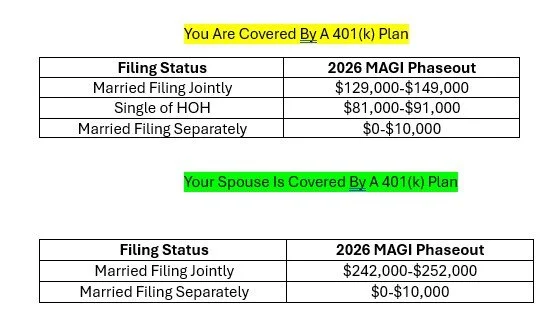
Note: If both you and your spouse are covered by a 401(k) plan, then use the “You Are Covered” thresholds above.
BELOW THE BOTTOM THRESHOLD: If you are below the thresholds listed above, you will be eligible to fully deduct your Traditional IRA contribution
WITHIN THE PHASEOUT RANGE: If you are within the phaseout range, only a portion of your Traditional IRA contribution will be deductible
ABOVE THE TOP THRESHOLD: If your MAGI (modified adjusted gross income) is above the top of the phaseout threshold, you would not be eligible to take a deduction for your contribution to the Traditional IRA
After-Tax Traditional IRA
If you find that your income prevents you from taking a deduction for all or a portion of your Traditional IRA contribution, you can still make the contribution, but it will be considered an “after-tax” contribution. There are two reasons why we see investors make after-tax contributions to traditional IRA’s. The first is to complete a “Backdoor Roth IRA Contribution”. The second is to leverage the tax deferral accumulation component of a traditional IRA even though a deduction cannot be taken. By holding the investments in an IRA versus in a taxable brokerage account, any dividends or capital gains produced by the activity are sheltered from taxes. The downside is when you withdraw the money from the traditional IRA, all of the gains will be subject to ordinary income tax rates which may be less favorable than long term capital gains rates.
Roth IRA
If you are covered by a 401(K) plan and you want to make a contribution to a Roth IRA, the rules are more straight forward. For Roth IRAs, you make contributions with after-tax dollars but all the accumulation is received tax free as long as the IRA has been in existence for 5 years, and you are over the age of 59½. Unlike the Traditional IRA rules, where there are different income thresholds based on whether you are covered or your spouse is covered by a 401(k), Roth IRA contributions have universal income thresholds.
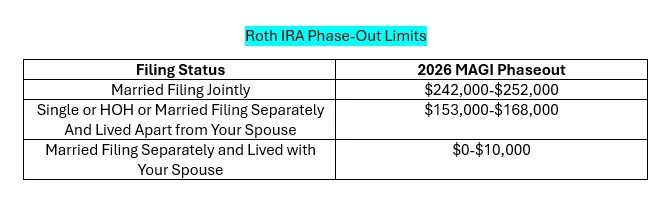
The contribution limits are the same as Traditional IRA’s but you have to aggregate your IRA contributions meaning you can’t make a $7,500 contribution to a Traditional IRA and then make a $7,500 contribution to a Roth IRA for the same tax year. The IRA annual limits apply to all IRA contributions made in a given tax year.
Should You Contribute To A 401(k) or an IRA?
If you have the option to either contribute to a 401(k) plan or an IRA, which one should you choose? Here are some of the deciding factors:
Employer Match: If the company that you work for offers an employer matching contribution, at a minimum, you should contribute the amount required to receive the full matching contribution, otherwise you are leaving free money on the table.
Roth Contributions: Does your 401(k) plan allow Roth contributions? Depending on your age and tax bracket, it may be advantageous for you to make Roth contributions over pre-tax contributions. If your plan does not allow a Roth option, then it may make sense to contribute pre-tax up the max employer match, and then contribute the rest to a Roth IRA.
Fees: Is there a big difference in fees when comparing your 401(k) account versus an IRA? With 401(k) plans, typically the fees are assessed based on the total assets in the plan. If you have a $20,000 balance in a 401(K) plan that has $10M in plan assets, you may have access to lower cost mutual fund share classes, or lower all-in fees, that may not be available within a IRA.
Investment Options: Most 401(k) plans have a set menu of mutual funds to choose from. If your plan does not provide you with access to a self-directed brokerage window within the 401(k) plan, going the IRA route may offer you more investment flexibility.
Easier Is Better: If after weighing all of these options, it’s a close decision, I usually advise clients that “easier is better”. If you are going to be contributing to your employer’s 401(k) plan, it may be easier to just keep everything in one spot versus trying to successfully manage both a 401(k) and IRA separately.
Maxing Out A 401(k) and IRA
As long as you are eligible from an income standpoint, you are allowed to max out both your employee deferrals in a 401(k) plan and the contributions to your IRA in the same tax year. If you are age 51, married, and your modified AGI is $180,000, you would be able to max your 401(k) employee deferrals at $32,500, you are over the income limit for deducting a contribution to a Traditional IRA, but you would have the option to contribute $8,600 to a Roth IRA.
Advanced Tax Strategy: In the example above, you are above the income threshold to deduct a Traditional IRA but your spouse may not be. If your spouse is not covered by a 401(k) plan, you can make a spousal contribution to a Traditional IRA because the $180,000 is below the income threshold for the spouse that is NOT COVERED by the employer-sponsored retirement plan.
Last updated June, 2026
About Michael……...
Hi, I’m Michael Ruger. I’m the managing partner of Greenbush Financial Group and the creator of the nationally recognized Money Smart Board blog . I created the blog because there are a lot of events in life that require important financial decisions. The goal is to help our readers avoid big financial missteps, discover financial solutions that they were not aware of, and to optimize their financial future.
Frequently Asked Questions (FAQs):
Can you contribute to both a 401(k) and an IRA in the same year?
Yes, as long as you meet the income requirements for IRA eligibility. For example, in 2025 you could contribute the full employee deferral limit to your 401(k) ($23,000 plus $7,500 catch-up if age 50+) and still contribute up to $7,000 or $8,000 to an IRA.
What is a spousal IRA contribution?
If one spouse does not work or isn’t covered by an employer retirement plan, the working spouse can make an IRA contribution on their behalf. This strategy allows a couple to potentially double their retirement savings and may preserve tax deductibility for the non-covered spouse.


Roth Conversions In Retirement

Roth conversions in retirement are becoming a very popular tax strategy. It can help you to realize income at a lower tax rate, reduce your RMD’s, accumulate assets tax free, and pass Roth money onto your beneficiaries. However, there are pros and cons that you need to be aware of, because processing a Roth conversion involves showing more taxable income in a given year. Without proper tax planning, it could lead to unintended financial consequences such as:
· Social Security taxed at a higher rate
· Higher Medicare premiums
· Assets lost to a long term care event
· Higher taxes on long term capital gains
· Losing tax deductions and credits
· Higher property taxes
· Unexpected big tax liability
In this video, Michael Ruger will walk you through some of the strategies that he uses with his clients when implementing Roth Conversions. This can be a very effective wealth building strategy when used correctly.

About Michael……...
Hi, I’m Michael Ruger. I’m the managing partner of Greenbush Financial Group and the creator of the nationally recognized Money Smart Board blog . I created the blog because there are a lot of events in life that require important financial decisions. The goal is to help our readers avoid big financial missteps, discover financial solutions that they were not aware of, and to optimize their financial future.










Retirement Account Withdrawal Strategies
The order in which you take distributions from your retirement accounts absolutely matters in retirement. If you don’t have a formal withdraw strategy it could end up costing you in more ways than one. Click to read more on how this can effect you.

The order in which you take distributions from your retirement accounts absolutely matters in retirement. If you don’t have a formal withdraw strategy it could end up costing you more in taxes long-term, causing you to deplete your retirement assets faster, pay higher Medicare premiums, and reduce the amount of inheritance that your heirs would have received. Retirees will frequently have some combination of the following income and assets in retirement:
· Pretax 401(k) and IRA’s
· Roth IRA IRA’s
· After tax brokerage accounts
· Social Security
· Pensions
· Annuities
As Certified Financial Planner’s®, we look at an individual’s income needs, long-term goals, and map out the optimal withdraw strategy. In this article, I will be sharing with you some of the considerations that we use with our clients when determining the optimal withdrawal strategy.
Layer One : Pension Income
When you develop a withdrawal strategy for your retirement assets it’s similar to building a house. You have to start with a foundation which is taxable income that you expect to receive before you begin taking withdrawals from your retirement accounts. For retirees that have pensions, this is the first layer. Income from pensions are typically taxable income at the federal level but may or may not be taxable at the state level depending on which state you live in and who the sponsor of the pension plan is. While pensions are great, retirees that have pension income have to be very careful about how they make withdrawals from their retirement accounts because any withdraws from pre-tax accounts will stack up on top of their pension income making those withdrawal potentially subject to higher tax rates or cause you to lose tax deductions and credits that were previously received.
Layer Two: Social Security
Social Security income is also something that has to be factored into the mix. Most retirees will have to pay federal income tax on a large portion of their Social Security benefit. When we are counseling clients on their Social Security filing strategy, one of the largest influencers in that decision is what type of retirement accounts that have and how much is in each account. Delaying Social Security each year, increases the amount that an individual receives in the range of 6% to 8% per year forever. As financial planners, we view this as a “guaranteed rate of return” which is tough to replicate in other asset classes. Not turning your Social Security benefit prior to your normal retirement age can:
· Increase 50% spousal benefit
· Increase the survivor benefit
· Increase the value of SS cost of living adjustments
· Reduce the amount required to be withdrawn for other sources
For purposes of this article, we will just look at Social Security as another layer of income but know that depending on your financial situation your Social Security filing strategy does factor into your asset withdrawal strategy.
Roth Accounts: Last To Touch
In most situations, Roth assets are typically the last asset that you touch in retirement. Since Roth assets accumulate and are withdrawn tax free, they are by far the most valuable vehicle to accumulate wealth long-term. The longer they accumulate, the more valuable they are.
The other wonderful feature about Roth IRAs is that there is no required minimum distributions (RMD’s) at age 72. Meaning the government does not force you to take distributions once you have reached a certain age so you can continue to accumulate wealth within that asset class.
Roth’s are also one of the most valuable assets to pass onto beneficiaries because they can continue to accumulate tax free and are withdrawn tax free. For spousal beneficiaries, they can roll over the balance into their own Roth IRA and continue to accumulate wealth tax free. For non-spouse beneficiaries, under the new 10 year rule, they can continue to accumulate wealth for a period of up to 10 years after inheriting the Roth before they are required to distribute the full balance but they don’t pay tax on any of it.
Financial Nerd Note: While Roth are great accumulation vehicles, it’s impossible to protect them from a long term care event spend down situation. They cannot be transferred into a Medicaid trust and they are subject to full spend down for purposes of qualifying for Medicaid in New York since there is no RMD requirements. It’s just a risk that I want you to be aware of.
Pre-tax Assets
Pre-taxed retirement assets often include:
· Traditional & Rollover IRAs
· 401k / 403b / 457 plans
· Deferred compensation plans
· Qualified Annuities
When you withdraw money from these pre-tax sources you have to pay federal income tax on the amount withdrawn but you may also have to pay state income tax as well. If you live in a state that has state income tax, it’s very important to understand the taxation rules for retirement accounts within your state.
For example, New York has a unique rule that each person over the age of 59½ is allowed to withdraw $20,000 from a pre-tax retirement account without having to pay state income tax. Any amounts withdrawn over that threshold in a given tax year are subject to state income tax.
Pretax retirement accounts are usually subject to something called a required minimum distribution (RMD). The IRS requires you to start taking small distributions out of your pre-tax retirement accounts at 72. Without proper guidance, retirees often make the mistake of withdrawing from their after tax assets first, and then waiting until they are required to take the RMD’s from their pre-tax retirement accounts at age 72 and beyond. But this creates a problem for many retirees because it causes:
· The distribution to be subject to higher tax rates
· Loss of tax deductions and credits
· Increase the tax ability of Social Security Increase Medicare premiums Loss of certain property tax credits for
seniors
· Other adverse consequences……
Instead as planners, we proactively plan ahead and ask questions like:
“instead of waiting until age 72 and taking larger RMD’s from the pre-tax account, does it make sense to start making annual distribution from the pre-tax retirement accounts leading up to age 72, thus spreading those distribution in lower amounts, across more tax year resulting in:
· Lower tax liability
· Lower Medicare premiums
· Maintaining tax deductions and credits
· The assets last longer due to a lower aggregate tax liability
· More inheritance for their family members
Since everyone’s tax situation and retirement income situation is different, we have to work closely with their tax professional to determine what the right amount is to withdraw out of the pre-tax retirement accounts each year to optimize their net worth long-term.
After Tax Accounts
After tax assets can include:
· Savings accounts
· Brokerage accounts
· Non-qualified annuities
· Life Insurance with cash value
Just because I’m listing them as “after tax assets” does not mean the whole account value is free and clear of taxes. What I’m referring to is the accounts listed above typically have some “cost basis” meaning a portion of the account it what was originally contributed to the account and can be withdrawal tax fee. The appreciation within the account would be taxes at either ordinary income or capital gains rates depending on the type of the account and how long the assets have been held in the account.
Having after tax assets often provides retirees with a tax advantage because they may be able to “choose their tax rate” when they retire. Meaning they can choose to withdrawal “X” amount from an after tax source and pay little know taxes and show very little taxable income in any given year which opens the door for more long term advanced tax planning.
Withdrawal Strategies
Now that have covered all of the different types of retirement assets and how they are taxed, let move into some of the common withdrawal strategies that we use with our clients:
Retirees With All Three: Pre-tax, Roth, and After-tax Assets
When retirees have all three types of retirement account sources, the strategy usually involves leaving the Roth assets for last, and then meeting with their accountant to determine the amount that should be withdrawn out of their pre-tax and after tax accounts year to minimize the amount of aggregate taxes that they pay long term.
Example: Jim and Carol are both age 67 and just retired and they financial picture consists of the following:
Joint brokerage account: $200,000
401(k)’s: $500,000
Roth IRA‘s: $50,000
Combined Social Security: $40,000
Annual Expenses $100,000
Residents of New York State
An optimal withdrawal strategy may include the following:
Assuming we recommend that they turn on Social Security at their normal retirement age, it will provide them with $40,000 pre-tax Income, 85% of their Social Security benefit will be taxed at the federal level but there will be no state tax deal, resulting in an estimated $35,000 after tax.
That means we need an additional $65,000 after-tax per year from another source to meet their $100,000 per year in expenses. Instead of taking all the money from their joint brokerage account, we could have them rollover their 401(k) balances into Traditional IRAs and then take $20,000 distributions each from their accounts which they not have to pay state income tax on because it’s below the $20K threshold. That would result in another $40,000 in pre-tax income, translating to $35,000 after-tax.
The final $30,000 that is needed to meet their annual expenses would most likely come from their after tax brokerage account unless their accountant advises differently.
This strategy accomplishes a number of goals:
1) We are withdrawing pre-tax retirement assets in smaller increments and taking advantage of the New York
State tax free portion every year. This should result in lower total taxes paid over their lifetime as opposed to waiting until RMD’s start at age 72 and then being required to take larger distributions which could push them over the $20,000 annual limit making them subject in your state tax income tax and higher federal tax rates.
2) We are preserving the after-tax brokerage account for a longer period of time as opposed to using it all to supplement their expenses which would only last for about two years and then they would be forced to take all of their distributions from their pre-tax retirement account making them subject to a higher tax liability
3) For the Roth accounts, we are law allowing them to continue to accumulate as much as possible resulting in more tax free dollars to be withdrawn in the future, or if they pass onto their children, they are inheriting a larger assets that can be withdrawn tax free.
All Pre-Tax Retirement Savings
It’s not uncommon for retirees to have 100% of their retirement savings all within a pre-tax sources like 401(k)s, 403(b)s, traditional IRA‘s, and other types of pre-tax retirement account. This makes the withdrawal strategy slightly more tricky because if there are any big one-time expenses that are incurred during retirement, it forces the retiree to take a large withdrawal from a pre-tax source which also increases the tax liability associate the distribution.
A common situation that we often have to maneuver around is retirees that have plans to purchase a second house in retirement but in order to do that they need to have the cash to come up with a down payment. If they don’t have any after-tax retirement savings, those amounts will most likely have to come from a pre-tax account. Withdrawing $60,000 or more for a down payment can lead to a higher tax liability, higher Medicare premiums the following year, and make a larger portion of your Social Security taxable. For clients in the situation, we often have to plan a few year ahead, and will begin taking pre-text Distributions over multiple tax years leading up to the purchase of the retirement house in an effort to spread the tax liability over multiple years and avoiding the adverse tax and financial consequences of taking one large distribution.
Since many retirees are afraid of taking on debt in retirement, we often get the question in these second house situations is “Should I just take a big distribution from my retirement, pay for the house in full, and not have a mortgage?” If all of the retirement assets are tied up in pre-tax sources, it typically makes the most sense to take a mortgage which allows you to then take smaller distributions from your IRA accounts over multiple tax years to make the mortgage payments compared to taking an enormous tax hit by withdrawing $200,000+ out of a pre-tax return account in a single year.
Pensions With No Need For Retirement Accounts
For retirees that have pensions, it’s not uncommon for their pension and Social Security to provide enough income to meet all of their expenses. But these individual may also have pre-tax retirement accounts and the question becomes “what do we do with them if we don’t need them, and we expect the kids to inherit them?”
This situation often involves a Roth conversion strategy where each year we convert money from the pre-tax IRA’s over to Roth IRA’s. This allows those retirement accounts to accumulate tax free and ultimately withdrawn tax free by the beneficiaries. Versus if they continue to accumulate in pre-tax retirement accounts, the beneficiaries will have to distribute those accounts within 10 years and pay tax on the full balance.
Also when those retirees turn age 72 they have to start taking required minimum distributions which they don’t necessarily need. Since they are receiving pension and Social Security income, those distributions from the retirement accounts could be subject to higher tax rates. By proactively moving assets from a pre-tax source to a Roth source we are essentially reducing the amount of retirement assets that will be subject to RMD’s at age 72 because Roth assets are not subject to RMD‘s.
Using this Roth conversion strategy, it’s also not uncommon for us to have these retirees delay their Social Security. Since Social Security is taxable at the federal level, if we delay Social Security, it gives us more room to process larger Roth conversions because it free up those lower tax brackets. At the same time, it also allows Social Security to accumulate at a guaranteed rate of 6% - 8%.
Nerd Note: When you process these Roth conversions, make sure you’re taking into account the tax liability that’s being generated. You have to have a way to pay the taxes on the amounts converted because the money goes directly from your traditional IRA to your Roth IRA. Retirees that implement this strategy typically have large cash holdings, after tax retirement holdings, or we convert some of the money, and take pre-tax IRA distribution to cover the taxes.

About Michael……...
Hi, I’m Michael Ruger. I’m the managing partner of Greenbush Financial Group and the creator of the nationally recognized Money Smart Board blog . I created the blog because there are a lot of events in life that require important financial decisions. The goal is to help our readers avoid big financial missteps, discover financial solutions that they were not aware of, and to optimize their financial future.

