

How Pass-Through Income Will Be Taxed For Small Business Owners
While one of the most significant changes incorporated in the new legislation was reducing the corporate tax rate from the current 35% rate to a 21% rate in 2018, the tax bill also contains a big tax break for small business owners. Unlike large corporations that are taxed at a flat rate, most small businesses, are "pass-through" entities, meaning that the

While one of the most significant changes incorporated in the new legislation was reducing the corporate tax rate from the current 35% rate to a 21% rate in 2018, the tax bill also contains a big tax break for small business owners. Unlike large corporations that are taxed at a flat rate, most small businesses, are "pass-through" entities, meaning that the profits from the business flow through to the business owner's personal tax return and then are taxed at ordinary income tax rates.While pass-through income will continue to be taxed at ordinary income tax rates, many small business owners will be eligible to deduct 20% of their "qualified business income" (QBI) starting in 2018. In other words, some pass-through entities will only be taxes on 80% of their pass-through income.
Pass-through entities include
Sole proprietorships
Partnerships
LLCs
S-Corps
Unanswered Questions
I wanted to write this article to give our readers the framework of what we know at this point about the treatment of the pass-through income in 2018. However, as many accountants will acknowledge, there seems to be more questions at this point then there are answers. The IRS will need to begin issuing guidance at the beginning of 2018 to clear up many of the unanswered questions as to who will be eligible and not eligible for the new 20% deduction.
Above or Below "The Line"
This 20% deduction will be a below-the-line deduction which is an important piece to understand. Tax lingo makes my head spin as well, so let's pause for a second to understand the difference between an "above-the-line deduction" and a "below-the-line deduction".The "line" refers to the AGI line on your tax return which is the bottom line on the first page of your Form 1040. While both above-the-line and below-the-line deductions reduce your taxable income, it's important to understand the difference between the two.
Above-The-Line Deductions
Above-the-line deductions happen on the first page of your tax return. These deductions reduce your gross income to eventually reach your AGI (adjusted gross income) for the year. Above-the-line deductions include:
Contributions to health savings accounts
Contributions to retirement plans
Deduction for one-half of the self-employment taxes
Health insurance premiums paid
Alimony paid, student loan interest, and a few others
The AGI is important because the AGI is used to determine your eligibility for certain tax credits and it will also have an impact on which below-the-line deductions you are eligible for. In general, the lower your AGI is, the more deductions and credits you are eligible to receive.
Below-The-Line Deductions
Below-the-line deductions are reported on lines that come after the AGI calculation. They are comprised mainly of your “standard deduction” or “itemized deductions” and “personal exemptions” (most of which will be gone starting in 2018). The 20% deduction for qualified business income will fall into this below-the-line category. It will lower the income of small business owners but it will not lower their AGI.
However, it was stated in the tax legislation that even though the 20% qualified business deduction will be a below –the-line deduction it will not be considered an “itemized deduction”. This is a huge win!!! Why? If it’s not an itemized deduction, then small business owners can claim the 20% qualified business income deduction and still claim the standard deduction. This is an important note because many small business owners may end up taking the standard deduction for the first time in 2018 due to all of the deductions and tax exemptions that were eliminated in the new tax bill. The tax bill took away a lot of big deductions:
Capped state and local taxes at $10,000 (this includes state income taxes and property taxes)
Eliminated personal exemptions ($4,050 for each individual) (Eliminated in 2018)
Family of 4 = $4,050 x 4 = $16,200 (Eliminated in 2018)
Miscellaneous itemized deductions subject to 2% of AGI floor (Eliminated in 2018)
Restrictions On The 20% Deduction
If life were easy, you could just assume that I'm a sole proprietor, I make $100,000 all in pass-through income, so I will get a $20,000 deduction and only have to pay tax on $80,000 of my income. For many small business owners it may be that easy but what's a tax law without a list of restrictions.The restriction were put in place to prevent business owners from reclassifying their W2 wages into 100% pass-through income to take advantage of the 20% deduction . They also wanted to restrict employees from leaving their company as a W2 employee, starting a sole proprietorship, and entering into a sub-contractor relationship with their old employer just to reclassify their W2 wages into 100% pass-through income.
S-Corps
Qualified business income will specifically exclude "reasonable compensation" paid to the owner-employee of an S-corp. While it would seem like an obvious reaction by S-corp owners to reduce their W2 wages in 2018 to create more pass through income, they will still have to adhere to the "reasonable compensation" restriction that exists today.
Partnerships & LLCs
Qualified business income will specifically exclude guaranteed payments associated with partnerships and LLCs. This creates a grey area for these entities. Partnerships do not have a “reasonable compensation” requirement like S-corps since companies taxed as partnerships are not allowed to pay W2 wages to the owners. Also the owners of partnerships are not required to take guaranteed payments. My guess is, and this is only a guess, that as we get further into 2018, the IRS may require partnerships to classify a percentage of a owners total compensation as a “guaranteed payment” similar to the “reasonable compensation” restriction that S-corps currently adhere too. Otherwise, partnerships can voluntarily eliminate guaranteed payments and take the 20% deduction on 100% of the pass-through income.
This may also prompt some S-corps to look at changing their structure to a partnership or LLC. For high income earners, S-corps have an advantage over the partnership structure in that the owners do not pay self-employment tax on the pass-through income that is distribution to the owner over and above their W2 wages. However, S-corp owners will have to weigh the self-employment tax benefit against the option of changing their corporate structure to a partnership and potentially receiving a 20% deduction on 100% of their income.
Sole Proprietors
Sole proprietors do not have "reasonable compensation" requirement or "guaranteed payments" so it would seem that 100% of the income generated by sole proprietors will count as qualified business income. Unless the IRS decides to enact a "reasonable compensation" requirement for sole proprietors in 2018, similar to S-corps. Before everyone runs from a single member LLC to a sole proprietorship, remember, a sole proprietorship offers no liability barrier between the owner and liabilities that could arise from the business.
Income Restrictions
There are limits that are imposed on the 20% deduction based on how much the owner makes in “taxable income”. The thresholds are set at the following amounts:
Individual: $157,500
Married: $315,000
The thresholds are based on each business owner’s income level, not on the total taxable income of the business. We need help from the IRS to better define what is considered “taxable income” for purposes of this phase out threshold. As of right now, it seems that “taxable income” will be defined as the taxpayer’s own taxable income (not AGI) less deductions.
If the owner’s taxable income is below this threshold, then the calculation is a simple 20% deduction of the pass-through income. If the owner’s taxable income exceeds the threshold, the qualified business deduction is calculated as follows:
The LESSER of:
20% of its business income OR 50% of the total wages paid by the business to its employees
Let’s look at this in a real life situation. A manufacturing company has a net profit of $2M in 2018 and pays $500,000 in wages to its employees during the year. That company would only be able to take the qualified business income deduction for $250,000 since 50% of the total employee wages ($500,000 x 50% = $250,000) are less than 20% of the net income of the business ($2M x 20% = $400,000).
This creates another grey area because it seems that the additional calculation is triggered by the taxable income of each individual owner but the calculation is based on the total profitability and wages paid by the company. For the owners that required this special calculation for exceeding the threshold, how is their portion of the lower deduction amount allocated? Multiplying the lower total deduction amount by the percent of their ownership? Just more unanswered questions.:
Restrictions For "Service Business"
There will be restrictions on the 20% deduction for pass-through entities that are considered a "service business" under IRC Section 1202(e)(3)(A). The businesses specifically included in this definition as a services business are:
Health
Law
Accounting
Actuarial Sciences
Performing Arts
Consulting
Athletics
Financial Services
Any other trade or business where the principal asset of the business is the reputation or skill of 1 or more of its employees
In a last minute change to the regulations, to their favor, engineers and architects were excluded from the definition of “service businesses”.
This is another grey area. Many small businesses that fall outside of the categories listed above will undoubtedly be asking the question: “Am I considered a service business or not?” Outside of the industries specifically listed in the tax bill, we really need more guidance from the IRS.
If you are a “services business”, when the tax reform was being negotiated it looked like service businesses were going to be completely excluded from the 20% deduction. However, the final regulations were more kind and instead implemented a phase out of the 20% deduction for owners of service businesses over a specified income threshold. The restriction will only apply to those whose “taxable income” exceeds the following thresholds:
Individual: $157,500
Married: $315,000
If you are a consultant or owner of a services business and your taxable income is below these thresholds, it would seem at this point that you will be able to capture the 20% deduction for your pass-through income. As mentioned above, we need help from the IRS to clarify the definition of “taxable income”.
Phase Out For Service Businesses
The amounts listed above: $157,500 for individual and $315,000 for a married couple filing joint, are where the thresholds for the phase out begins. The service business owners whose income rises above those thresholds will phase out of the 20% deduction over the next $50,000 of taxable income for individual filers and $100,000 of taxable income for married filing joint. This means that the 20% pass-through deduction is completely gone by the following income levels:
Individual: $207,500
Married: $415,000
Any taxpayer’s falling in between the threshold and the phase out limit will receive a portion of the 20% deduction.
Since the thresholds are assessed based on the taxpayer’s own taxable income and not the total income of the business, a service business could be in a situation, like in an accounting firm, where the partners with the largest ownership percentage may not qualify for 20% deduction but the younger partners may qualify for the deduction because their income is lower.
Tax Planning For 2018
It's an understatement to say that most small business owners will need to spend a lot of time with their accountant in the first quarter of 2018 to determine the best of course of action for their company and their personal tax situation.While we are still waiting for clarification on a number of very important items associated with the 20% deduction for qualified business income, hopefully this article has provided our small business owners with a preview of things to come in 2018.
Disclosure: I'm a Certified Financial Planner® but not an accountant. The information contained in this article was generated from hours and hours of personal research on the topic. I advise each of our readers to consult with your personal tax advisor for tax advice.

About Michael.........
Hi, I’m Michael Ruger. I’m the managing partner of Greenbush Financial Group and the creator of the nationally recognized Money Smart Board blog . I created the blog because there are a lot of events in life that require important financial decisions. The goal is to help our readers avoid big financial missteps, discover financial solutions that they were not aware of, and to optimize their financial future.
















Should You Prepay Your Property Taxes?
If you live in New York or any other state with "higher" property taxes you should determine whether or not it makes sense to pay your 2018 property taxes prior to December 31, 2017. Why? Tax reform will be capping your state and local tax deductions at $10,000 beginning in 2018. Don't forget though, that it's important to make sure you keep on

If you live in New York or any other state with "higher" property taxes you should determine whether or not it makes sense to pay your 2018 property taxes prior to December 31, 2017. Why? Tax reform will be capping your state and local tax deductions at $10,000 beginning in 2018. Don't forget though, that it's important to make sure you keep on top of your taxes, as you don't want to cause an issue further down the line.
To prevent taxpayers from navigating around the $10,000 deduction cap that will take effect in 2018, Congress wrote right into the tax bill that taxpayers will not be able to prepay their 2018 state income taxes and take the tax deduction in 2017. However, they left the door open for prepaying your 2018 property taxes in 2017 and taking the deduction in 2017 before the cap goes into effect.
Should you do this? The answer depends on your expected income for the 2017 tax year.
Alternative Minimum Tax
Before you rush down to your town office in the last week of December to prepay your 2018 taxes, if you think your income level in 2017 is going to make you subject to AMT, I will save you the trip. Alternative Minimum Tax (AMT) is a special tax calculation that was implemented back in 1969 to make sure the "wealthy" pay their fair share of taxes. The AMT calculation allows fewer deductions and exemptions than the standard tax system. Taxpayers have to calculate their taxes the "normal way" and then calculate their taxes under the AMT method. Whichever method generates the higher tax liability is the one that you pay.
The problem with AMT is over time they did not index the exemption level adequately for wage inflation since its inception in 1969. Again it was supposed to stop the wealthy from taking advantage of tax deductions. In 2017, the exemptions amounts for AMT are as follows:
Single Filer: $54,300
Married Filing Joint: $84,500
Not exactly what many of us would considered wealthy. It gets better, that exemption begins to phase out at the following levels in 2017 making more of your income subject to the special AMT calculation.
Single Filers: $120,700
Married Filing Joint: $160,900
Why am I going into so much detail amount AMT? Remember, AMT adds back deductions that were previously allowed under the standard calculation. One of those add backs is property taxes. So if your AMT tax liability exceeds your tax liability calculated with the standard formula, there is no point in prepaying your 2018 property taxes because you won't be able to deduct them anyways. Those deductions get added back in as part of the AMT calculation.
Contact Your Accountant
The AMT calculation is complex. If you are not able to accurately estimate whether or not your AMT tax liability will be greater than the standard calculation, you should contact your accountant for guidance.
Those Not Subject To AMT
If you are not subject to AMT and you plan to itemize in 2017, it probably does makes sense to prepay your property taxes for 2018 by December 29, 2017. Otherwise you are just going to lose the deduction in 2018 because it will most likely be more advantageous at that income level to just take the larger standard deduction that will be available in 2018. You end up with the best of both worlds. You get to deduct your 2018 property taxes in 2017 which reduces your income and then capture the large standard deduction in 2018,
How Do You Prepay Your Property Taxes?
So how do you pay your property taxes early? It's most likely going to require your checkbook and a trip to your town office, First, call your town office to make sure the 2018 property tax invoices are available. Once you know that they are available, you should drive down to your town office prior to December 29, 2017 and pay the tax bill.
If you escrow taxes, which many homeowners do, there is a good chance that your mortgage company will not receive your property tax bill in time to issue a check from your escrow account prior to December 29th. For this reason, you should call your mortgage services company and determine what they need to prove that you paid your 2018 property taxes with a personal check. This will hopefully prevent them from issuing a check out of your escrow account for the property taxes that you already paid with your personal check for 2018.
About Michael.........
Hi, I’m Michael Ruger. I’m the managing partner of Greenbush Financial Group and the creator of the nationally recognized Money Smart Board blog . I created the blog because there are a lot of events in life that require important financial decisions. The goal is to help our readers avoid big financial missteps, discover financial solutions that they were not aware of, and to optimize their financial future.























The House Passed The Tax Bill. What's The Next Step?
Last night the house passed the Tax Cut & Jobs Act Bill with ease. Next up is the Senate vote. It’s important to understand the House and the Senate are voting on two different tax reform bills. Below is a chart illustrating the main differences between the House version and the Senate version of the tax reform bill.

Last night the house passed the Tax Cut & Jobs Act Bill with ease. Next up is the Senate vote. It’s important to understand the House and the Senate are voting on two different tax reform bills. Below is a chart illustrating the main differences between the House version and the Senate version of the tax reform bill.
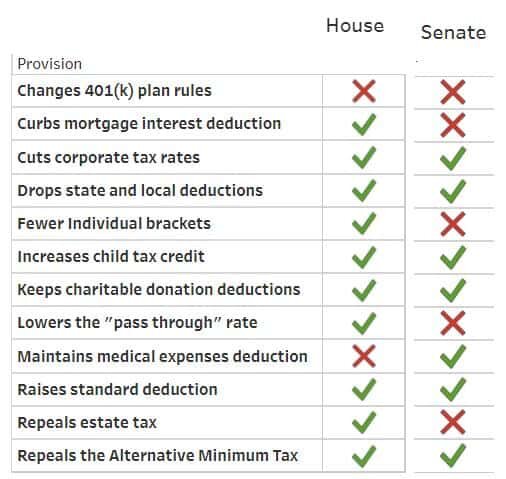
As you can see, there are a number of dramatic differences between the two bills. The easy part was getting the House to approve their version because the Republican Party own 239 of the 435 seats. In other words, they own 55% of the votes.
The Senate Vote
Next, the Senate will put their tax reform bill to a vote. The vote is expected to take place during the week of Thanksgiving. However, in the Senate , which the Republican have the majority, they only have 52 of the 100 seats. In this case, they would need at least 50 “Yes” votes to get the bill approved in the senate. It’s 50, not 51 votes, because in the event of a “tie”, the Vice President gets a vote to break the tie and he is likely to vote “Yes” to keep tax reform moving along.
Reconciliation Process
Once the House and Senate have approved their own separate tax bills, they will then have to begin the reconciliation process of blending the two bills together. This will be the difficult part. The two tax bills are dramatically different so there will be a fair amount of grappling between the House and the Senate committees as to which features stay and which features get tossed out or adjusted as part of the final tax bill. In the end, the final tax reform bill cannot add more than $1.5 Trillion to the national debt over the next 10 years. Otherwise, the bill would need to return to the Senate and would require “60” votes to approve the bill. There is a slim too no chance of that happening.
Tax Reform by Christmas
President Trump wants the bill on his desk to sign into law before Christmas. While it seems likely that the Senate will pass their tax bill next week, the battle will take place in the reconciliation process that will begin immediately after that vote. It’s a tall order to fill given that there are only six weeks left in the year and how different the two bills are in their current form. However, don’t underestimate how badly the Republican party wants to put a run on the scoreboard before the end of the year. If they get tax reform through in the last week of the year, it’s an understatement to say that it will be an intense final week of December for year-end tax planning. Stay tuned for more………
About Michael……...
Hi, I’m Michael Ruger. I’m the managing partner of Greenbush Financial Group and the creator of the nationally recognized Money Smart Board blog . I created the blog because there are a lot of events in life that require important financial decisions. The goal is to help our readers avoid big financial missteps, discover financial solutions that they were not aware of, and to optimize their financial future.


Tax Reform: Your Company May Voluntarily Terminate Your Retirement Plan
Make no mistake, your company retirement plan is at risk if the proposed tax reform is passed. But wait…..didn’t Trump tweet on October 23, 2017 that “there will be NO change to your 401(k)”? He did tweet that, however, while the tax reform might not directly alter the contribution limits to employer sponsored retirement plans, the new tax rates

Make no mistake, your company retirement plan is at risk if the proposed tax reform is passed. But wait…..didn’t Trump tweet on October 23, 2017 that “there will be NO change to your 401(k)”? He did tweet that, however, while the tax reform might not directly alter the contribution limits to employer sponsored retirement plans, the new tax rates will produce a “disincentive” for companies to sponsor and make employer contributions to their plans.
What Are Pre-Tax Contributions Worth?
Remember, the main incentive of making contributions to employer sponsored retirement plans is moving income that would have been taxed now at a higher tax rate into the retirement years, when for most individuals, their income will be lower and that income will be taxed at a lower rate. If you have a business owner or executive that is paying 45% in taxes on the upper end of the income, there is a large incentive for that business owner to sponsor a retirement plan. They can take that income off of the table now and then realize that income in retirement at a lower rate.
This situation also benefits the employees of these companies. Due to non-discrimination rules, if the owner or executives are receiving contributions from the company to their retirement accounts, the company is required to make employer contributions to the rest of the employees to pass testing. This is why safe harbor plans have become so popular in the 401(k) market.
But what happens if the tax reform is passed and the business owners tax rate drops from 45% to 25%? You would have to make the case that when the business owner retires 5+ years from now that their tax rate will be below 25%. That is a very difficult case to make.
An Incentive NOT To Contribute To Retirement Plans
This creates an incentive for business owners NOT to contribution to employer sponsored retirement plans. Just doing the simple math, it would make sense for the business owner to stop contributing to their company sponsored retirement plan, pay tax on the income at a lower rate, and then accumulate those assets in a taxable account. When they withdraw the money from that taxable account in retirement, they will realize most of that income as long term capital gains which are more favorable than ordinary income tax rates.
If the owner is not contributing to the plan, here are the questions they are going to ask themselves:
Why am I paying to sponsor this plan for the company if I’m not using it?
Why make an employer contribution to the plan if I don’t have to?
This does not just impact 401(k) plans. This impacts all employer sponsored retirement plans: Simple IRA’s, SEP IRA’s, Solo(k) Plans, Pension Plans, 457 Plans, etc.
Where Does That Leave Employees?
For these reasons, as soon as tax reform is passed, in a very short time period, you will most likely see companies terminate their retirement plans or at a minimum, lower or stop the employer contributions to the plan. That leaves the employees in a boat, in the middle of the ocean, without a paddle. Without a 401(k) plan, how are employees expected to save enough to retire? They would be forced to use IRA’s which have much lower contribution limits and IRA’s don’t have employer contributions.
Employees all over the United States will become the unintended victim of tax reform. While the tax reform may not specifically place limitations on 401(k) plans, I’m sure they are aware that just by lowering the corporate tax rate from 35% to 20% and allowing all pass through business income to be taxes at a flat 25% tax rate, the pre-tax contributions to retirement plans will automatically go down dramatically by creating an environment that deters high income earners from deferring income into retirement plans. This is a complete bomb in the making for the middle class.
About Michael……...
Hi, I’m Michael Ruger. I’m the managing partner of Greenbush Financial Group and the creator of the nationally recognized Money Smart Board blog . I created the blog because there are a lot of events in life that require important financial decisions. The goal is to help our readers avoid big financial missteps, discover financial solutions that they were not aware of, and to optimize their financial future.



















Tax Reform: At What Cost?
The Republicans are in a tough situation. There is a tremendous amount of pressure on them to get tax reform done by the end of the year. This type of pressure can have ugly side effects. It’s similar to the Hail Mary play at the end of a football game. Everyone, including the quarterback, has their eyes fixed on the end zone but nobody realizes that no

The Republicans are in a tough situation. There is a tremendous amount of pressure on them to get tax reform done by the end of the year. This type of pressure can have ugly side effects. It’s similar to the Hail Mary play at the end of a football game. Everyone, including the quarterback, has their eyes fixed on the end zone but nobody realizes that no one is covering one of the defensive lineman and he’s just waiting for the ball to be hiked. The game ends without the ball leaving the quarterback’s hands.
The Big Play
Tax reform is the big play. If it works, it could lead to an extension of the current economic rally and more. I’m a supporter of tax reform for the purpose of accelerating job growth both now and in the future. It’s not just about U.S. companies keeping jobs in the U.S. That has been the game for the past two decades. The new game is about attracting foreign companies to set up shop in the U.S. and then hire U.S. workers to run their plants, companies, subsidiaries, etc. Right now we have the highest corporate tax rate in the world which has not only prevented foreign companies from coming here but it has also caused U.S. companies to move jobs outside of the United States. If everyone wants more pie, you have to focus on making the pie bigger, otherwise we are all just going to sit around and fight over who’s piece is bigger.
Easier Said Than Done
How do we make the pie bigger? We have to lower the corporate tax rate which will entice foreign companies to come here to produce the goods and services that they are already selling in the U.S. Which is easy to do if the government has a big piggy bank of money to help offset the tax revenue that will be lost in the short term from these tax cuts. But we don’t.
$1.5 Trillion In Debt Approved
Tax reform made some headway in mid-October when the Senate passed the budget. Within that budget was a provision that would allow the national debt to increase by approximately $1.5 trillion dollars to help offset the short-term revenue loss cause by tax reform. While $1.5 trillion sounds like a lot of money, and don’t get me wrong, it is, let’s put that number in context with some of the proposals that are baked into the proposed tax reform.
Pass-Through Entities
One of the provisions in the proposed tax reform is that income from “pass-through” businesses would be taxed at a flat rate of 25%.
A little background on pass-through business income: sole proprietorships, S corporations, limited liability companies (LLCs), and partnerships are known as pass-through businesses. These entities are called pass-throughs, because the profits of these firms are passed directly through the business to the owners and are taxed on the owners’ individual income tax returns.
How many businesses in the U.S. are pass-through entities? The Tax Foundation states on its website that pass-through entities “make up the vast majority of businesses and more than 60 percent of net business income in America. In addition, pass-through businesses account for more than half of the private sector workforce and 37 percent of total private sector payroll.”
At a conference in D.C., the American Society of Pension Professionals and Actuaries (ASPPA), estimated that the “pass through 25% flat tax rate” will cost the government $6 trillion - $7 trillion in tax revenue. That is a far cry from the $1.5 trillion that was approved in the budget and remember that is just one of the many proposed tax cuts in the tax reform package.
Are Democrats Needed To Pass Tax Reform?
Since $1.5 trillion was approved in the budget by the senate, if the proposed tax reform is able to prove that it will add $1.5 trillion or less to the national debt, the Republicans can get tax reform passed through a “reconciliation package” which does not require any Democrats to step across the aisle. If the tax reform forecasts exceed that $1.5 trillion threshold, then they would need support from a handful of Democrats to get the tax reformed passed which is unlikely.
Revenue Hunting
To stay below that $1.5 trillion threshold, the Republicans are “revenue hunting”. For example, if the proposed tax reform package is expected to cost $5 trillion, they would need to find $3.5 trillion in new sources of tax revenue to get the net cost below the $1.5 trillion debt limit.
State & Local Tax Deductions – Gone?
One for those new revenue sources that is included in the tax reform is taking away the ability to deduct state and local income taxes. This provision has created a divide among Republicans. Since many southern states do not have state income tax, many Republicans representing southern states support this provision. Visa versa, Republicans representing states from the northeast are generally opposed to this provision since many of their states have high state and local incomes taxes. There are other provisions within the proposed tax reform that create the same “it depends on where you live” battle ground within the Republican party.
Obamacare
One of the main reasons why the Trump administration pushed so hard for the Repeal and Replace of Obamacare was “revenue hunting”. They needed the tax savings from the repeal and replace of Obamacare to carrry over to fill the hole that will be created by the proposed tax reform. Since that did not happen, they are now looking high and low for other revenue sources.
Retirement Accounts At Risk?
If the Republicans fail to get tax reform through they run the risk of losing face with their supporters since they have yet to get any of the major reforms through that they campaigned on. Tax reform was supposed to be a layup, not a Hail Mary and this is where the hazard lies. Republicans, out of the desperation to get tax reform through, may start making cuts where they shouldn’t. There are rumors that the Republican Party may consider making cuts to the 401(k) contribution limits and employers sponsored retirement plan. Even though Trump tweeted on October 23, 2017 that he would not touch 401(k)’s as part of tax reform, they are running out of the options for other places that they can find new sources of tax revenue. If it comes down to the 1 yard line and they have the make the decision between making deep cuts to 401(k) plans or passing the tax reform, retirement plans may end up being the sacrificial lamb. There are other consequences that retirement plans may face if the proposed tax reform is passed but it’s too broad to get into in this article. We will write a separate article on that topic.
Tax Reform May Be Delayed
Given all the variables in the mix, passing tax reform before December 31st is starting to look like a tall order to fill. If the Republicans are looking for new sources of revenue, they should probably look for sources that are uniform across state lines otherwise they risk splintering the Republican Party like we saw during the attempt to Repeal and Replace Obamacare. We are encouraging everyone to pay attention to the details buried in the tax reform. While I support tax reform to secure the country’s place in the world both now and in the future, if provisions that make up the tax reform are rushed just to get something done, we run the risk of repeating the short lived glory that tax reform saw during the Reagan Era. They passed sweeping tax cuts, the deficits spiked, and they were forced to raise tax rates a few years later.
About Michael……...
Hi, I’m Michael Ruger. I’m the managing partner of Greenbush Financial Group and the creator of the nationally recognized Money Smart Board blog . I created the blog because there are a lot of events in life that require important financial decisions. The goal is to help our readers avoid big financial missteps, discover financial solutions that they were not aware of, and to optimize their financial future.













Who Pays The Tax On A Cash Gift?
This question comes up a lot when a parent makes a cash gift to a child or when a grandparent gifts to a grandchild. When you make a cash gift to someone else, who pays the tax on that gift? The short answer is “typically no one does”. Each individual has a federal “lifetime gift tax exclusion” of $5,400,000 which means that I would have to give

This question comes up a lot when a parent makes a cash gift to a child or when a grandparent gifts to a grandchild. When you make a cash gift to someone else, who pays the tax on that gift? The short answer is “typically no one does”. Each individual has a federal “lifetime gift tax exclusion” of $13,990,000 which means that I would have to give away $13.99 million dollars before I would owe “gift tax” on a gift. For married couples, they each have a $13.99 million dollar exclusion so they would have to gift away $27.98M before they would owe any gift tax. When a gift is made, the person making the gift does not pay tax and the person receiving the gift does not pay tax below those lifetime thresholds.
“But I thought you could only gift $19,000 per year per person?” The $19,000 per year amount is the IRS “gift exclusion amount” not the “limit”. You can gift $19,000 per year to any number of people and it will not count toward your $13.99M lifetime exclusion amount. A married couple can gift $38,000 per year to any one person and it will not count toward their $27.98 million lifetime exclusion. If you do not plan on making gifts above your lifetime threshold amount you do not have to worry about anyone paying taxes on your cash gifts.
Let’s look at an example. I’m married and I decide to gift $20,000 to each of my three children. When I make that gift of $60,000 ($20K x 3) I do not owe tax on that gift and my kids do not owe tax on the gift. Also, that $60,000 does not count toward my lifetime exclusion amount because it’s under the $38,000 annual exclusion for a married couple to each child.
In the next example, I’m single and I gift $1,000,000 my neighbor. I do not owe tax on that gift and my neighbor does not owe any tax on the gift because it is below my $13.99M threshold. However, since I made a gift to one person in excess of my $19,000 annual exclusion, I do have to file a gift tax return when I file my taxes that year acknowledging that I made a gift $981,000 in excess of my annual exclusion. This is how the IRS tracks the gift amounts that count against my $13.99M lifetime exclusion.
Important note: This article speaks to the federal tax liability on gifts. If you live in a state that has state income tax, your state’s gift tax exclusion limits may vary from the federal limits.
About Michael……...
Hi, I’m Michael Ruger. I’m the managing partner of Greenbush Financial Group and the creator of the nationally recognized Money Smart Board blog . I created the blog because there are a lot of events in life that require important financial decisions. The goal is to help our readers avoid big financial missteps, discover financial solutions that they were not aware of, and to optimize their financial future.

Tax Secret: R&D Tax Credits…You May Qualify
When you think of Research and Development (R&D) many people envision a chemistry lab or a high tech robotics company. It’s because of this thinking that millions of dollars of available tax credits for R&D go unused every year. R&D exists in virtually every industry and business owners need to start thinking about R&D in a different light because

When you think of Research and Development (R&D) many people envision a chemistry lab or a high tech robotics company. It’s because of this thinking that millions of dollars of available tax credits for R&D go unused every year. R&D exists in virtually every industry and business owners need to start thinking about R&D in a different light because there could be huge tax savings waiting for them.
Most companies don't realize that they qualify
Road paving companies, manufactures, a meatball company, software firms, and architecture firms are just a few examples of companies that have met the criteria to qualify for these lucrative tax credits.
Think of R&D as a unique process within your company that you may be using throughout the course of your everyday business that is specific to your competitive advantage. The purpose of these credits is to encourage companies to be innovative with the end goal of keeping more jobs here in the U.S. If you have an engineers on your staff, whether software engineers, design engineers, mechanical engineers there is a very good chance that these tax credits may be available to you. The R&D tax credits also allow you to look back to all open tax years so for companies that discover this for the first time, the upside can be huge. Tax years typically stay open for three years.
Accountants may not be aware of these credits
One of the main questions we get from business owners is “Shouldn’t my accountant have told me about this?” Many accounting firms are unaware of these tax credits and the process for qualifying which is why there are specialty consulting firms that work with companies to determine whether or not they are eligible for the credit. Some of our clients have worked with these firms and the company only pays the consulting firm if you qualify for the tax credits. Kind of a win-win situation.
We recently attended a seminar that was sponsored by Alliantgroup out of New York City and on their website it listed the following description of companies that qualify for these credits:“
Any company that designs, develops, or improves products, processes, techniques, formulas, inventions, or software may be eligible. In fact, if a company has simply invested time, money, and resources toward the advancement and improvement of its products and processes, it may qualify”.
We love helping our clients save taxes and in this case, like many others, we were looking at R&D in a different light.
About Michael……...
Hi, I’m Michael Ruger. I’m the managing partner of Greenbush Financial Group and the creator of the nationally recognized Money Smart Board blog . I created the blog because there are a lot of events in life that require important financial decisions. The goal is to help our readers avoid big financial missteps, discover financial solutions that they were not aware of, and to optimize their financial future.
Avoid These 1099 “Employee” Pitfalls
As financial planners we are seeing more and more individuals, especially in the software development and technology space, hired by companies as “1099 employees”. “1099 employees” is an ironic statement because if a company is paying you via a 1099 technically you are not an “employee” you are a self-employed sub-contractor. It’s like having

As financial planners we are seeing more and more individuals, especially in the software development and technology space, hired by companies as “1099 employees”. “1099 employees” is an ironic statement because if a company is paying you via a 1099 technically you are not an “employee” you are a self-employed sub-contractor. It’s like having your own separate company and the company that you work for is your “client”.
There are advantages to the employer to pay you as a 1099 sub-contractor as opposed to a W2 employee. When you are a W2 employee they may have to provide you with health benefits, the company has to pay payroll taxes on your wages, there may be paid time off, you may qualify for unemployment benefits if you are fired, eligibility for retirement plans, they have to put you on payroll, pay works compensation insurance, and more. Basically companies have a lot of expenses associated with you being a W2 employee that does not show up in your paycheck.
To avoid all of these added expenses the employer may decide to pay you as a 1099 “employee”. Remember, if you are a 1099 employee you are “self-employed”. Here are the most common mistakes that we see new 1099 employees make:
Making estimated tax payments throughout the year
This is the most common error. When you are a W2 employee, it’s the responsibility of the employer to withhold federal and state income tax from your paycheck. When you are a 1099 sub-contractor, you are not an employee, so they do not withhold taxes from your compensation…………that is now YOUR RESPONSIBILITY. Most 1099 individuals have to make what is called “estimated tax payments” four times a year which are based on either your estimated income for the year or 110% of the previous year’s income. Best advice……..if 1099 income is new for you, setup a consultation with an accountant. They will walk you through tax withholding requirements, tax deductions, tax filing forms, etc. It’s very difficult to get everything right using Turbo Tax when you are a self-employed individual.
Tracking mileage and expenses throughout the year
Since you are self-employed you need to keep track of your expenses including mileage which can be used as deductions against your income when you file your tax return. Again, we recommend that you meet with a tax professional to determine what you do and do not need to track throughout the year.
The tax return is prepared incorrectly
No one wants a love letter from the IRS. Those letters usually come with taxes due, penalties, and a “guilty until proven innocent” approach. There may be additional “schedules” that you need to file with your tax return now that you are self-employed. The tax schedules detail your self-employment income, deductions, estimated tax payments, and other material items.
Important rule, do not cut corners by reducing the gross amount of your 1099 income. This is a big red flag that is easy for the IRS to catch. The company that issued the 1099 to you usually reports that 1099 payment to the IRS with your social security number or the Tax ID number of your self-employment entity. The IRS through an automated system can run your social security number or tax ID to cross check the 1099 payment and 1099 income to make sure it was reported.
Legal protection
As a 1099 sub-contractor, you have to consider the liability that could arise from the services that you are providing to your “client” (your employer). As a self-employed individual, the company that you “work for” could sue you for any number of reasons and if you are operating the business under your social security number (which most are) your personal assets could be at risk if a lawsuit arises. Advice, talk to an attorney that is knowledgeable in business law to discuss whether or not setting up a corporate entity makes sense for your self-employment income to better protect yourself.
About Michael……...
Hi, I’m Michael Ruger. I’m the managing partner of Greenbush Financial Group and the creator of the nationally recognized Money Smart Board blog . I created the blog because there are a lot of events in life that require important financial decisions. The goal is to help our readers avoid big financial missteps, discover financial solutions that they were not aware of, and to optimize their financial future.
