

How To Teach Your Kids About Investing
As kids enter their teenage years, as a parent, you begin to teach them more advanced life lessons that they will hopefully carry with them into adulthood. One of the life lessons that many parents teach their children early on is the value of saving money. By their teenage years many children have built up a small savings account from birthday gifts,

As kids enter their teenage years, as a parent, you begin to teach them more advanced life lessons that they will hopefully carry with them into adulthood. One of the life lessons that many parents teach their children early on is the value of saving money. By their teenage years many children have built up a small savings account from birthday gifts, holidays, and their part-time jobs. As parents you have most likely realized the benefit of compounding interest through working with a financial advisor, contributing to a 401(k) plan, or depositing money to a college savings account. As financial planners, we often get the question: “What is the best way to teach your children about the value of investing and compounding interest? "
The #1 rule.......
We have been down this road many times with our clients and their children. Here is the number one rule: Make it an engaging experience for your kids. Investments can be a very dull topic to talk about and it can be painfully dull from a child’s point of view. All they know is the $1,000 that was in their savings account is now with their parent’s investment guy.
Ignoring the life lessons for a moment, the primary investment vehicle for brokerage accounts with balances under $50,000 is typically a mutual fund. But let’s pause for a moment. We have a dual objective here. We of course want our children to make as much money as possible in their investment account but we also want to simultaneously teach them life long lessons about investing.
The issue with young investors
Explaining how a mutual fund operates can be a complex concept for a first time investor because you have all of these companies in one investment, expense ratios, different types of funds, and different fund families. It’s not exciting, it’s intimidating.
Consider this approach. Ask the child what their hobbies are? Do they have a cell phone? Have them take their cell phone out during the meeting and ask them how often they use it during the day and how many of their friends have cell phones. Then ask them, if you received $20 every time someone in this area bought a cell phone would you have a lot of money? Then explain that this scenario is very similar to owning stock in a cell phone company. The more they sell the more money the company makes. As a “shareholder” you own a piece of that company and you receive a piece of the profits if the company grows. If your child plays sports, do they wear a lot of Nike or Under Armour? Explain investing to them in a way that they can relate it to their everyday life. Now you have their attention because you attached the investment idea to something they love.
A word of caution....
If they are investing in stocks it is also important for them to understand the concept of risk. Not every investment goes up and you could start with $1,000 and end the year with $500, so they need to understand risk and time horizon.
While it’s not prudent in most scenarios to invest 100% of a portfolio in one stock, there may be some middle ground. Instead of investing their entire $1,000 in a mutual fund, consider investing $500 – $700 in a mutual fund but let them pick one to three stocks to hold in the account. It may make sense to have them review those stock picks with your investment advisor for two reasons. One, you want them to have a good experience out of the gates and that investment advisor can provide them with their option of their stock picks. Second, the investment advisor can tell them more about the companies that they have selected to further engage them.
Don't forget the last step......
Download an app on their smartphone so they can track the investments that they selected. You may be surprise how often they check the performance of their stock holdings and how they begin to pay attention to news and articles applicable to the companies that they own.At that point you have engaged them and as they hopefully see their investment holdings appreciate in value they will become even more excited about saving money in their investment account and making their next stock pick. In addition, they also learn valuable investment lessons early on like when one of their stocks loses value. How do they decide whether to sell it or continue to hold it? It’s a great system that teaches them about investing, decision making, risk, and the value of compounding investment returns.

About Michael……...
Hi, I’m Michael Ruger. I’m the managing partner of Greenbush Financial Group and the creator of the nationally recognized Money Smart Board blog . I created the blog because there are a lot of events in life that require important financial decisions. The goal is to help our readers avoid big financial missteps, discover financial solutions that they were not aware of, and to optimize their financial future.




















Financial Planning To Do's For A Family
My wife and I just added our first child to the family so this is a topic that has been weighing on my mind over the last 40 weeks. I will share just one non-financial takeaway from the entire experience. The global population may be much lower if men had to go through what women do. That being said, this article is meant to be a guideline for some of the important financial items to consider with children. Worrying about your children will never end and being comfortable with the financial aspects of parenthood may allow you to worry a little less and be able to enjoy the time you have with the

My wife and I just added our first child to the family so this is a topic that has been weighing on my mind over the last 40 weeks. I will share just one non-financial takeaway from the entire experience. The global population may be much lower if men had to go through what women do. That being said, this article is meant to be a guideline for some of the important financial items to consider with children. Worrying about your children will never end and being comfortable with the financial aspects of parenthood may allow you to worry a little less and be able to enjoy the time you have with them.
There is a lot of information to take into consideration when putting together a financial plan and the larger your family the more pieces to the puzzle. It is important to set goals and celebrate them when they are met. Everything cannot be done in a day, a week, or a month, so creating a task list to knock off one by one is usually an effective approach. Using relatives, friends, and professionals as resources is important to know what should be on that list for topics you aren’t familiar with.
Create a Budget
It may seem tedious but this is one of the most important pieces of a family’s financial plan. You don’t have to track every dollar coming in and out but having a detailed breakdown on where your money is being spent is necessary in putting together a plan. This simple Expense Planner can serve as a guideline in starting your budget. If you don’t have an accurate idea of where your money is being spent then you can’t know where you can cut back or afford to spend more if needed. Also, the budget is a great topic during a romantic dinner.
You will always want to have 4-6 months expenses saved up and accessible in case a job is lost or someone becomes disabled and cannot work. Having an accurate budget will help you determine how much money you should have liquid.
Insurance
You want to be sure you are sufficiently covered if anything ever happened. One terrible event could leave your family in a situation that may have been avoidable. Insurance is also something you want to take care of as soon as possible so you know the coverage is there if needed.
Health Insurance
Research the policies that are available to you and determine which option may be the most appropriate in your situation. It is important to know the medical needs of your family when making this decision.
Turning one spouse’s single coverage into family coverage is one of the more common ways people obtain coverage for a family. Insurance companies will usually only allow changes to policies through open enrollment or when a “qualifying event” occurs. Having a child is usually a qualifying event but this may only allow the child to be added to one’s coverage, not the spouse. If that is the case, the spouse will want to make sure they have their own coverage until they can be added to the family plan.
It is important to use the resources available to you and consult with your health insurance provider on the ins and outs. If neither spouse has coverage through work, the exchange can be a resource for information and an option to obtain coverage (https://www.healthcare.gov/).
Life Insurance
The majority of people will obtain Term Life Insurance as it is a cost effective way to cover the needs of your family. Life insurance policies have an extensive underwriting process so the sooner you start the sooner you will be covered if anything ever happened. How Much Life Insurance Do I Need?, is an article that may help answer the question regarding the amount of life insurance sufficient for you.
Disability Insurance
The probability of using disability insurance is likely more than that of life insurance. Like life insurance, there is usually a long underwriting process to obtain coverage. Disability insurance is important as it will provide income for your family if you were unable to work. Below are some terms that may be helpful when inquiring about these policies.
Own Occupation – means that insurance will turn on if you are unable to perform YOUR occupation. “Any Occupation” is usually cheaper but means that insurance will only turn on if you can prove you can’t do ANY job.
60% Monthly Income – this represents the amount of the benefit. In this example, you will receive 60% of your current income. It is likely not taxable so the net pay to you may be similar to your paycheck. You can obtain more or less but 60% monthly income is a common benefit amount.
90 Day Elimination Period – this means the benefit won’t start until 90 days of being disabled. This period can usually be longer or shorter.
Cost of Living or Inflation Rider – means the benefit amount will increase after a certain time period or as your salary increases.
Wills, POA’s, Health Proxies
These are important documents to have in place to avoid putting the weight of making difficult decisions on your loved ones. There are generic templates that will suffice for most people but it is starting the process that is usually the most difficult. “What Is The Process Of Setting Up A Will?, is an article that may help you start.
College Savings
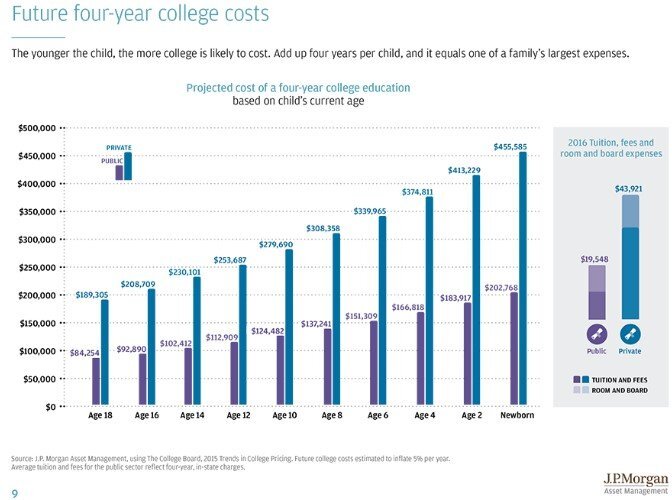
The cost of higher education is increasing at a rapid rate and has become a financial burden on a lot of parents looking to pick up the tab for their kids. 529 accounts are a great way to start saving early. There are state tax benefits to parents in some states (including NYS) and if the money is spent on tuition, books, or room and board, the gain from the investments is tax free. Roth IRA’s are another investment vehicle that can be used for college but for someone to contribute to a Roth IRA they must have earned income. Therefore, a newborn wouldn’t be able to open a Roth IRA. Since the gain in 529’s is tax free if used for college, the earlier the dollars go into the account the longer they have to potentially earn income from the market.
529’s can also be opened by anyone, not just the parents. So if the child has a grandparent that likes buying savings bonds or a relative that keeps purchasing clothes the child will wear once, maybe have them contribute to a 529. The contribution would then be eligible for the tax deduction to the contributor if available in the state.
Below is a chart of the increasing college costs along with links to information on college planning.
About Rob……...
Hi, I’m Michael Ruger. I’m the managing partner of Greenbush Financial Group and the creator of the nationally recognized Money Smart Board blog . I created the blog because there are a lot of events in life that require important financial decisions. The goal is to help our readers avoid big financial missteps, discover financial solutions that they were not aware of, and to optimize their financial future.


Should I Buy Or Lease A Car?
This is one of the most common questions asked by our clients when they are looking for a new car. The answer depends on a number of factors:
How long do you typically keep your cars?
How many miles do you typically drive each year?
What do you want your down payment and monthly payment to be?

This is one of the most common questions asked by our clients when they are looking for a new car. The answer depends on a number of factors:
How long do you typically keep your cars?
How many miles do you typically drive each year?
What do you want your down payment and monthly payment to be?
We typically start off by asking how long clients usually keep their cars. If you are the type of person that trades in their car every 2 or 3 year for the new model, leasing a car is probably a better fit. If you typically keep your cars for 5 plus years, then buying a car outright is most likely the better option.
“How many miles do you drive each year?”
This is often times the trump card for deciding to buy instead of lease. Most leases allow you to drive about 12,000 miles per year but this varies from dealer to dealer. If you go over the mileage allowance there are typically sever penalties and it becomes very costly when you go to trade in the car at the end of the lease. We see younger individuals get caught in this trap because they tend to change jobs more frequently. They lease a car when they live 10 miles away from work but then they get a job offer from an employer that is 40 miles away from their house and the extra miles start piling on. When they go to trade in the car at the end of the lease they owe thousands of dollars due to the excess mileage.
We also ask clients how much they plan to put down on the car and what they want their monthly payments to be. If you think you can stay within the mileage allowance, a lease will more often require a lower down payment and have a lower monthly payment. Why? Because you are not “buying” the car. You are simply “borrowing” it from the dealership and your payments are based on the amount that the dealership expects the car to depreciate in value during the duration of the lease. When you buy a car……you own it……and at the end of the car loan you can sell it or continue to drive the car with no car payments.
About Michael……...
Hi, I’m Michael Ruger. I’m the managing partner of Greenbush Financial Group and the creator of the nationally recognized Money Smart Board blog . I created the blog because there are a lot of events in life that require important financial decisions. The goal is to help our readers avoid big financial missteps, discover financial solutions that they were not aware of, and to optimize their financial future.


NY Free Tuition - Facts and Myths
On April 9th New York State became the first state to adopt a free tuition program for public schools. The program was named the “Excelsior Scholarship” and it will take effect the 2017 – 2018 school year. It has left people with a lot of unanswered questions

On April 9th New York State became the first state to adopt a free tuition program for public schools. The program was named the “Excelsior Scholarship” and it will take effect the 2017 – 2018 school year. It has left people with a lot of unanswered questions
Do I qualify?
How much does it cover?
What’s the catch?
Can I move my finances around to qualify for the program?
This article was written to help people better understand some of the facts and myths surrounding the NY Free Tuition Program.
Who qualifies for free tuition?
It’s based on the student’s household income and it phases in over a three year period:
2017: $100,000
2018: $110,000
2019: $125,000
MYTH #1: “If I reduce my household income in 2017 to get under the $100,000 threshold, it will help my child qualify for the free tuition program for the 2017 – 2018 school year.” WRONG. The income “determination year” is the same determination year that is used for FASFA filing. FASFA changed the rules in 2016 to look back two years instead of one for purposes of qualifying for financial aid. Those same rules will apply to the NY Free Tuition Program. So for the 2017 – 2018 school year, the $100,000 free tuition threshold will apply to your income in 2015.
MYTH #2: “If I make contributions to my retirement plan it will help reduce my household income to qualify for the free tuition program.” WRONG. Again, the free tuition program will use the same income calculation that is used in the FASFA process so it is not as simple as just looking at the bottom line of your tax return. For FASFA, any contributions that are made to retirement plans are ADDED back into your income for purposes of determining your income for that “determination year”. So making big contributions to a retirement plan will not help you qualify for free tuition.
What does it cover?
MYTH #3: “As long as my income is below the income threshold my kids (or I) will go to college for free.” DEFINE “FREE”. The Excelsior Scholarship covers JUST tuition. It does not cover books, room and board, transportation, or other costs associated with going to college. Annual tuition at a four-year SUNY college is currently $6,470. Here are the total fees obtained directly from the SUNY.edu website:
Tuition: $6,470 Covered
Student Fee: $1,640 Not Covered
Room & Board: $12,590 Not Covered
Books & Supplies: $1,340 Not Covered
Personal Expenses: $1,560 Not Covered
Transportation: $1,080 Not Covered
Total Costs $24,680
When you do the math for a student living on campus, the “Free” tuition program only covers 26% of the total cost of attending college.
What’s the catch?
There are actually a few:
CATCH #1: After the student graduates from college they have to LIVE and WORK in NYS for at least the number of years that the free tuition was awarded to the student OTHERWISE the “free tuition” turns into a LOAN that will be required to be paid back. Example: A student receives the free tuition for four years, works in New York for two years, and then moves to Massachusetts for a new job. That student will have to pay back two years of the free tuition.
CATCH #2: The student must maintain a specified GPA or higher otherwise the “free tuition” turns into a LOAN. However, the GPA threshold has yet to be released.
CATCH #3: It’s only for FULL TIME students earning at least 30 credit hours every academic year. This could be a challenge for students that have to work in order to put themselves through college.
CATCH #4: This is a “Last Dollar Program” meaning that students have to go through the FASFA process and apply for all other types of financial aid and grants that are available before the Free Tuition Program kicks in.
CATCH #5: The free tuition program is only available for two and four year degrees obtained within that two or four year period of time. If it take the student five years to obtain their four year bachelor’s degree, only four of the five years is covered under the free tuition program.
Summary
There are many common misunderstandings associated with the NYS Free Tuition Program. In general, it’s our view that this new program is only going to make college “more affordable” for a small sliver of students were not previously covered under the traditional FASFA based financial aid. Given the rising cost of college and the complexity of the financial aid process it has never been more important than it is now for individuals to work with a professional that have an in depth knowledge of the financial aid process and college savings strategies to help better prepare your household for the expenses associated with paying for college.
About Michael……...
Hi, I’m Michael Ruger. I’m the managing partner of Greenbush Financial Group and the creator of the nationally recognized Money Smart Board blog . I created the blog because there are a lot of events in life that require important financial decisions. The goal is to help our readers avoid big financial missteps, discover financial solutions that they were not aware of, and to optimize their financial future.
















Do I Have To Pay Taxes On My Inheritance?
Whenever people come into large sums of money, such as inheritance, the first question is “how much will I be taxed on this money”? Believe it or not, money you receive from an inheritance is likely not taxable income to you.

Whenever people come into large sums of money, such as inheritance, the first question is “how much will I be taxed on this money”? Believe it or not, money you receive from an inheritance is likely not taxable income to you.
Of course there are some caveats to this. If the inherited money is from an estate, there is a chance the money received was already taxed at the estate level. The current federal estate exclusion is $5,430,000 (estate taxes and the exclusion amount varies for states). Therefore, if the estate was large enough, a portion of the inheritance may have been subject to estate tax which is 40% in most cases. That being said, whether the money was or was not taxed at the estate level, you as an individual do not have to pay income taxes on the money.
Although the inheritance itself is not taxable, you may end up paying taxes if there is appreciation after the money is inherited. The type of account and distribution will dictate how the income will be taxed.
Basis Of Inherited Property
Typically, the basis of inherited property is the fair market value of the property on the date of the decedent’s death or the fair market value of the property on the alternate valuation date if the estate uses the alternate valuation date for valuing assets. An estate will choose to value assets on an alternate date subsequent to the date of death if certain assets, such as stocks, have depreciated since the date of death and the estate would pay less tax using the alternate date.
What the fair market value basis means is that if you inherit stock that was originally purchased for $500 and at the date of death has appreciated to $10,000, you will have a “step-up” basis of $10,000. If you turn around and sell the stock for $11,000, you will have a $1,000 gain and if you sell the stock for $9,000, you will have a $1,000 loss.
Inheriting a personal residence also provides for a step-up in basis but the gain or loss may be treated differently. If no one lives in the inherited home after the date of death, it will be treated similar to the stock example above. If you move into the home after death, any subsequent sale at a loss will not be deductible as it will be treated as your personal asset but a gain would have to be recognized and possibly taxed. If you rent the property subsequent to inheritance, it could be treated as a trade or business which would be treated differently for tax purposes.
Inheriting An IRA or Retirement Plan Account
Please read our article “Inherited IRA’s: How Do They Work” for a more detailed explanation of the three different types of distribution options.
When you inherit a retirement account, and you are not the spouse of the decedent, in most cases you will only have one option, fully distribute the account balance 10 years following the year of the decedents death. The SECURE Act that was passed in December 2019 dramatically change the distribution options available to non-spouse beneficiaries. See the article below:

If you are the spouse of the of the decedent, you are able to treat the retirement account as if it was yours and not be forced to take one of the options above. You will have to pay taxes on distributions but you do not have to start withdrawing funds immediately unless there are required minimum distributions needed.
Note: If the inherited account was an after tax account (i.e. Roth), the inheritor must choose one of the options presented above but no tax will be paid on distributions.
Non-Qualified Annuities
Non-qualified annuities are an exception to the step-up in basis rule. The non-spousal inheritor of a non-qualified annuity will have to take either a lump sum or receive payments over a specified time period. If the inheritor chooses a lump sum, the portion that represents the gain (lump sum balance minus decedent’s contributions) will be taxed as ordinary income. If the inheritor chooses a series of payments, distributions will be treated as last in, first out. Last in, first out means that the appreciation will be distributed first and fully taxable until there is only basis left.
If the spouse inherits the annuity, they most likely have the option to treat the annuity contract as if they were the original owner.
This article concentrated on inheritance at a federal level. There is no inheritance tax at a federal level but some states do have an inheritance tax and therefore meeting with a professional is recommended. New York currently does not have an inheritance tax.
About Rob……...
Hi, I’m Rob Mangold. I’m the Chief Operating Officer at Greenbush Financial Group and a contributor to the Money Smart Board blog. We created the blog to provide strategies that will help our readers personally , professionally, and financially. Our blog is meant to be a resource. If there are questions that you need answered, pleas feel free to join in on the discussion or contact me directly.





















The Process Of Buying A House
Buying a house can be a fun and exciting experience but it’s also one of the most important financial decisions that you are going to make during your lifetime. This article is designed to help home buyer’s understand:

Buying a house can be a fun and exciting experience but it’s also one of the most important financial decisions that you are going to make during your lifetime. This article is designed to help home buyer’s understand:
The home buying process from start to finish
The parties involved in the process (real estate agent, attorney, bank, etc.)
Common pitfalls to avoid
What to expect when applying for a mortgage
How to calculate the amount of your down payment
Owning Versus Renting
You first have to determine if owning a house is the right financial decision for you. Society wires us to think that owning a house is automatically better than renting but that is not necessarily true in all situations. From a pure dollar and cents standpoint, it may make sense to keep renting given your personal situation. We typically tell clients if there is a fair chance that they may need to sell their house within the next 5 years, in many cases it may make sense to keep renting as opposed to buying a house given all of the upfront costs associated with purchasing a house. It takes a while to recoup closing costs and when you go to sell your house you will most like have to pay your real estate agent 5% - 6% of the selling price.
Determine How Much You Can Afford
Before you even start looking at houses you have to determine two things:
The down payment and closing costs
The amount of the monthly mortgage payment that fits into your budget
There is no point in looking at $300,000 houses if you cannot afford the down payment or the monthly mortgage payment so the initial step involves determining what you can afford.
Calculating Your Closing Costs
Closing costs are in addition to your required “down payment”. First time home buyers often make the mistake of just using the 5% down or 10% down as a rule of thumb for their total upfront cost for buying a house. They often forget about closing costs which can add an additional 2% - 5% of the purchase price of the house to the amount due at closing. Closing costs include:
Discount Points: An up-front fee that you can choose to pay if you want to reduce the interest rate on your loan.
Origination Charge: Fee for processing your mortgage application, pulling credit reports, verifying financial information, and creating the loan
Rate-lock Fee: If you choose to lock in your interest rate beyond a certain period of time
Other Lender Fees: Document preparation fee, processing fee, application fee, and underwriting fees
Appraisal & Inspection Fees: Fees for the lender to inspect and appraise the value of the house
Title Services: Fee charged by the title agent to determine the rightful ownership of the house you are buying and some lenders require title insurance.
Government Recording Charges: Every home buyer must pay these charges for the state and local agencies to record the loans and title documents
Transfer Taxes: Depending on where you live, your state, county or city may charge a tax when the ownership of a home is transferred
Escrow Deposit: At the closing of your home loan, if you decide to escrow or if an escrow is required, there will be an initial deposit in your escrow account to pay for future recurring charges associated with your home, such as property taxes, school taxes, and insurance. You will typically need to pay for the first year of your homeowner’s insurance in full before your home loan closes.
Daily Interest Rate Charge: This charge covers the amount of interest that you will owe on your home loan from the time your loan closes to the first day of your regular mortgage billing cycle.
Flood Insurance: This is a form of hazard insurance that is required by lenders to cover properties in flood zones.
Attorney Fees: Fees typically vary from $300 - $1,000. Most individuals will work with a real estate attorney to review and negotiate the purchase agreement on their behalf. These fees are sometimes paid to the attorney prior to the closing.
As you can see there are a number of fees that you have to be prepared to pay in addition to the down payment required by the lender. Lenders are required by law to give you a “good faith estimate” (GFE) of what the closing costs on your home will be within three days of when you apply for a loan. However, these are just estimates and many of the fees listing on the GFE can legally change by up to 10%, potentially adding thousands of dollars to your final closing cost bill. A day before your closing the lender should provide you with a copy of your HUD-1 settlement statement, which outlines all of the closing fees.
Calculating Your Down Payment
The amount of your down payment will vary based on the type of loan that you received to purchase your house. The three main types of home loans are:
FHA Loan
Conventional Mortgage
VA Loan (Veterans Affairs)
FHA Loan: FHA stands for Federal Housing Administration. The loans are made by banks but they are guaranteed by the FHA which added additional protection for the lender. FHA loans come with a minimum down payment of 3.5% which make them very popular. With these loans borrowers pay PMI (private mortgage insurance) premiums both upfront and each year until the loan is paid down to a specified level. Loan limits vary by housing type and county. These loans tend to favor low to middle income borrowers who do not have a means to make the traditional 10% - 20% down payment at closing.
Conventional Mortgage: Minimum down payment varies from 5% - 20%. Borrowers that put down less than 20% will have to pay PMI (private mortgage insurance). Conventional mortgages typically require a higher FICO score than FHA loans. These loans tend to favor borrowers with higher credit scores and have enough cash on hand to make a sizable down payment.
VA Loan: VA loans are available only to veterans. The greatest benefit of these loans is they require no down payment and they allow qualified borrowers to purchase a home without the need for mortgage insurance. VA loans also tend to have more flexible and forgiving requirements. The VA charges a mandatory Fund Fee of 2.15% for regular military and 2.40% for Reserve/Guard on purchase loans.Let’s bring it all together in an example. If you anticipate on buying a house for $200,000 and you plan on taking an FHA loan, the amount that you will need to save for the closing will be in the range of $11,000 - $17,000 (3.5% for the down payment and 2% - 5% for the closing costs). This calculation will obviously vary based on the type of loan you plan on taking to purchase your house.
Determine what your monthly mortgage payment
After you have determined how much you need to save to meet the upfront cost of purchasing a house, the next step is to determine the monthly mortgage payment that fits into your budget.
Step 1: Establish your current monthly and annual budget. There is no way to determine what you can afford if you have no idea where you are now from an income and expense standpoint. Tip: Be brutally honest with yourself when listing your expenses. The last thing you want to do is underestimate your expenses, buy a house you cannot afford, and then go through a foreclosure. You will also have to factor in additional expenses into your budget as if you owned the house today such as lawn care, snow removal, appliances, and maintenance expense. As a renter you may not have any of these expenses now but as soon as you own a house, now when something breaks you have to pay to fix it. Homeownership is often times more expensive than most individuals anticipate.
Step 2: Based on your current monthly income and expenses, how much is left over to satisfy a monthly mortgage payment? The general rule is your monthly mortgage payment (including property taxes, PMI, and association fees) should not exceed 32% of your monthly gross income. Tip: Leave some extra room in your budget for life’s unexpected surprises. For example, furnace need to be replaced, dishwasher brakes, spouse loses a job, plumbing issues, etc.
Step 3: Use an online mortgage calculator to determine the loan amount that meets your estimated monthly mortgage payment. Do not forget to take into account property taxes, school taxes, association fees, PMI, and homeowners insurance when reaching your estimated monthly payment.
The parties involved in the home buying process
There are a lot of different professionals that you will interact with during the process of purchasing your house. It’s important to understand who is involved, what their role is in the process, and how they are compensated.
Buyer & Seller: This is pretty self-explanatory. Most buyers and sellers work through realtors and attorneys to complete the real estate transaction so there is typically little or no direct interaction between the buyer and the seller. However, in a “for sale by owner”, the buyer or the buyer’s realtor/attorney will be in direct communication with the seller since there is no real estate agent on the sellers side.
Real Estate Agent (Realtor): Real estate agents are important partners when you are buying a house. They can provide you with helpful information on homes and neighborhoods that isn’t easily accessible to the public. Their knowledge of the home buying process, negotiation skills, and familiarity with the area you want to live in can be very valuable. In most cases, as the buyer, it does not typically cost you anything to use a realtor because they are compensated from the commission paid by the seller of the house.
Real Estate Attorney: Remember, buying a home is a legally binding transaction. A real estate attorney can help you avoid some common pitfalls when purchasing your home. The home buying process eventually results in a formal purchase agreement between the buyer and seller. The purchase agreement is the single most important document in the transaction. Although standard printed forms may be used, a lawyer can explain the forms and make changes and additions to reflect the buyer’s wishes. Examples are:
What are the legal consequences if the closing does not take place?
What happens if the inspection reveals termites, radon, or lead based paint?
Will money be held in escrow from the seller’s proceeds to replace certain items?
How much does a real estate attorney cost? It varies, but expect to pay somewhere in the range of $350 - $1,000. Often times you have to pay the attorney a retainer or pay them in advance of the closing. The amount an attorney charges is usually dependent on the level of services that they are provided to you. Some attorneys may just be preparing the deed while other attorney’s may provide you with a more complete package which can include deed preparation, title examination, purchase agreement review, and lender work. Make sure you fully understand how the attorney’s fee structure works and it often helps to ask your professional network or friends for attorney’s that they have worked with and would recommend.
Bank / Credit Union: Most home buyers need a mortgage to finance the purchase of their house. It is recommended that you contact a few banks and credit unions in your area to compare interest rates, closing costs, and fees associated with the issuance of your mortgage. Similar to selecting a real estate attorney we strongly recommend asking your professional network (accountant, investment advisor) for lenders that they recommend working with. You will have a lot of interaction with the lender throughout the home buying process and working with a lender that makes the underwriting process as smooth as possible will make the overall home buying experience much more enjoyable.
Home Inspector: After your offer has been accepted by the seller you will need to hire a home inspector to visit the house. Your real estate agent will most likely recommend a home inspector to use. The job of the home inspector is to visit the property to make sure there are no issues with the house that may not be apparent to the untrained eye. They look for termite damage, structural issues, mold, condition of the roof, electric, plumbing, drainage, septic, radon levels, etc. A few days after their visit they will provide you with a formal report of their inspection. You typically pay them at the time they conduct the inspection. The cost of a home inspection typically ranges from $250 - $600.
Insurance Broker: You will need to obtain a homeowners insurance policy prior to the closing date. Since you are adding a house to your insurance coverage, often times this is a good opportunity to look at your insurance coverage as a whole because insurance companies will usually offer discounts on “bundling” your insurance coverage. Meaning that a single provider covers your house, cars, and personal umbrella policy. The annual cost of your homeowners insurance will vary greatly depending on the value of your house and where the house is located. For homeowners that have an escrow account associated with their mortgage, the homeowners insurance premium is typically baked into your total monthly mortgage payment , the insurance company issues the invoice directly to the bank, and the bank pays your homeowners insurance directly out of your escrow account.
Timeline: The home buying process from start to finish
Now that we have explained how to determine what you can afford and the parties involved in the home buying process it’s time to put it all together so you know what to expect step by step through the process of purchasing your new home.
Step 1: Get prequalified for a mortgage. You may think you can qualify for a $250,000 mortgage but you really do not know until you actually apply. In the preapproval process you will provide some information to the bank that will be issuing your mortgage such as tax returns, statements showing investment and savings accounts, and they will usually run a credit report. The more intense financial due diligence happens after an offer has been accepted on your house and they are actually preparing to provide you with the loan.
Step 2: Begin looking at houses. Most individuals at this point will hire a real estate agent to help them find and look at houses.
Step 3: Make an offer. Once you find the house that you want, you will have your real estate agent present the seller with your offer. This is where the negotiation process begins. If the seller is listing the house for $200,000, you can make an offer for whatever amount you choose. Once an offer is presented to the seller, three things can happen:
The seller can accept it
The seller can reject it
The seller will counter offer
Your real estate agent can really help you in this process to determine what may be a reasonable offer. It is usually dependent upon how long the house has been on the market, where is the property located, is there a situation that requires selling the house quickly, and what have other similar houses sold for in the area. After making the offer you will typically receive a response within 48 hours. The seller will sometimes give their real estate agent a range saying that they will accept less than the asking price but only to a specific threshold. In most situations the buyer and the seller meet somewhere in the middle. If the house is listed for $200K, the buyer may put in an offer for $180K and after some back and forth they eventually meet somewhere around $190K. But that is not always the case. If there are multiple offers on the house you could end up in a “bidding war”. Offers are “blind bids” meaning that you and your real estate agent have no way of knowing what other people are offering the seller for the house. Buyers are essentially making their “best guess” that their offer will win. You may make an offer for full price only for another buyer to come in two hours later and offer $10,000 over their asking price. You really have to lean on your real estate agent to give you some guidance based on their knowledge of the market.
Step 4: Offer accepted……now what? Typically, purchase offers are contingent on a home inspection of the property. Your real estate agent will usually help you arrange to have a home inspection conducted within a few days of your offer being accepted. There are usually contingencies in your offer agreement that provides you with the chance to renegotiate your offer or withdraw it without penalty if the inspection reveals significant material damage. If the inspector discovers issues with the house you will have to make the decision if you want to ask the seller to fix the issue prior to the closing date. Prior to the close you will have a walk-through of the house, which gives you a chance to confirm that any agreed-upon repairs have been made.
Step 5: Apply for a mortgage. Now that your offer has been accepted the mortgage underwriting process will kick into high gear. The bank will assign you a “loan officer” or “mortgage broker” to serve as the direct contact at the bank throughout the mortgage approval process. You will provide them with the information on the house that you intend to purchase, they will send you the mortgage application with all of financial documents that they will need to formally approve you for the mortgage. The bank will also arrange for an appraiser to visit the house and provide an independent estimate of the value of the house. After all if they are giving you a loan for $200,000, they want to make sure that house is worth at least $200,000 in case you were to stop paying the mortgage then essentially the bank would own the house and have to sell it. You will receive a “commitment letter” from your bank once your mortgage has been formally approved.
You will need to show the bank documentation of the account that is currently holding the cash that will be used for your down payment and closing costs. If someone gifts you money to buy your house, the person that made the gift will most likely have to sign a letter stating that it was an outright gift and not a loan.
Step 5½ : You will simultaneous engage a real estate attorney to begin working with at this time. Your attorney will review the purchase agreement, initiate a title search and review the results, begin prepping the deed, and communicate directly with the seller’s attorney if changes or additions need to be made to the purchasing agreement.
Step 6: Set a closing date. The closing date is the date that you will sign a huge pile of papers and the house officially becomes yours. There is typically an “estimated closing date” set in the purchase agreement but a firm date needs to be set by the buyer, seller, attorneys, and the bank. The seller’s real estate agent, the buyer’s real estate agent, your mortgage broker, and the attorneys on both sides will typically communicate with each other to establish the closing date. A special note……..a lot can happen during a real estate transaction that can delay the closing date. Issues can arise on the seller’s side or the mortgage process could take longer than expected. In other words, even though you have a “final closing date” be prepared for the closing date to change. If you are renting right now and have a lease, if your closing date is May 1st it’s usually recommended that you have your current lease run until May 30th or June 30th in case the closing date gets pushed back. Real estate transactions have a lot of moving parts and a lot of unexpected things that are out of your control can happen.
Step 7: Contact your insurance broker to establish a homeowner’s policy. Your bank will require you to have homeowners insurance on the property. You must pay for the policy and have it at closing. You are free to select your own insurance carrier but the lender will typically require the insurance company issuing the policy to be a specific rating or higher.
Your insurance broker may also help you with your title insurance policy. Many lenders will require you to have a title insurance policy at closing. As part of the home buying process a title search should be conducted which results in a report that shows who owns the property and if there are any liens against the property. Title insurance protects you and the lender up to the full value of the property if fraud, a lien, or faulty title is discovered after your closing.
Step 8: The day BEFORE the closing. It is recommended that you send a reminder email to your real estate agent, attorney, and mortgage broker to confirm that everything is a “go” for the closing the next day. You and your real estate agent should make a final inspection of the property within 24 hours prior to the closing. In many cases, the lender will make a similar inspection before closing. The bank that is issuing you the loan should also be able to provide you with a copy of your HUD-1, which is a long, one page document that details all of the financial activity associated with the purchase of your house. You should review this document with your mortgage broker and/or attorney prior to the closing to make sure everything is accurate.
You will also need to confirm with your attorney/mortgage broker the amount of the certified check that you will need to bring to the closing. A certified check is a special type of check issued by a bank that guarantees that the funds to back that check are guaranteed by the bank issuing the check.
Step 9: The date of your closing. You made it!!!!!! Today is the day your new house officially becomes yours. There are two primary things that you need to bring with you to the closing:
Certified check
Homeowners policy and proof of payment
The actual closing is conducted by a “closing agent” who may be an employee of the lender or title company, or it may be an attorney representing you or the lender. The lender and seller, or their representatives, and the real estate agents may or may not be at the actual closing. It is not unusual for the parties to the transaction to complete their roles without ever meeting face to face.
For the most part, your role at closing is to review and sign the numerous documents associated with a mortgage loan. The closing agent should explain the nature and purpose of each one and give you and your attorney an opportunity to check them before signing.
At the conclusion of the meeting you receive the keys to the house and you are officially a new homeowner.
Step 10: Begin making your monthly mortgage payments. One of the top questions that we get is “What is an escrow account?” You will hear that term a lot when you are going through the mortgage process. Think of an escrow account as a separate savings account that is attached to your mortgage. When you make a monthly mortgage payment, it is made up of a few components:
Principal & Interest Payments: Amount applied against your actual loan
PMI (if applicable): Mortgage insurance
Escrow: Cash reserve to pay taxes and homeowners insurance
If my monthly mortgage payment is $2,000, only $1,100 of that amount may actually be applied against the loan. The other $900 may be used to pay my monthly PMI and the remainder is deposited to my escrow account.
When your property taxes and school taxes are due, the county that you live in will typically send those tax bills directly to the bank holding your mortgage and then the bank in turn pays those bills out of your escrow account. The bank will typically mail the homeowners a receipt that the tax bill has been paid. It’s basically a forced monthly savings account for your anticipated tax bills. The same thing is true for your homeowner insurance premium payments. The bank that is holding your mortgage forecasts how much your taxes and homeowner insurance is going to be for the next 12 months and then builds those amounts into your monthly mortgage payments. The bank does not want you to lose your house because you were unable to pay your property or school taxes. The property and school tax bills show up once a year and depending on where you live those bills can be for thousands of dollars.
If there is additional money left in your escrow account after the taxes and homeowner insurance has been paid, the bank is usually required to send a portion of that additional cash reserve to the homeowner in the form of a check. Those are fun checks to get in the mail.
Michael Ruger
About Michael……...
Hi, I’m Michael Ruger. I’m the managing partner of Greenbush Financial Group and the creator of the nationally recognized Money Smart Board blog . I created the blog because there are a lot of events in life that require important financial decisions. The goal is to help our readers avoid big financial missteps, discover financial solutions that they were not aware of, and to optimize their financial future.

Year End Tax Strategies
The end of the year is always a hectic time but taking the time to sit with a tax professional and determine what tax strategies will work best for you may save thousands on your tax bill due April 15th. As the deadline for your taxes starts to get closer, you may be in such a rush to file them on time that you make some mistakes in the process, but

year end tax strategies
The end of the year is always a hectic time but taking the time to sit with a tax professional and determine what tax strategies will work best for you may save thousands on your tax bill due April 15th. As the deadline for your taxes starts to get closer, you may be in such a rush to file them on time that you make some mistakes in the process, but don't worry, you won't be the only one. If you don't have the relevant tax strategy in place, you are more prone to mistakes. So, the purpose of this article is to discuss some of the most common tax strategies that may apply to you. It may be worth contacting a company that specializes in tax services if you're unsure of how to go about these strategies though. Some of the deadlines for these strategies aren't until tax filing but the majority include an action item that must be done by December 31st to qualify and therefore taking the time before year end is crucial.
Taxable Investment Accounts
Offset some of the realized gains incurred during the year by selling investments in loss positions. Often times dividends received and sales made in a taxable investment account are reinvested. Although the owner of the account never received cash in the transaction, the gain is still realized and therefore taxable. This may cause an issue when the cash is not available to pay the tax bill. By selling investments in a loss position prior to 12/31, you will offset some, if not all, of the gain realized during the year. If possible, sell enough investments in a loss position to take advantage of the maximum $3,000 loss that can be claimed on your tax return.
Note: The IRS recognized this strategy was being abused and implemented the "wash sale" rule. If you sell an investment in a loss position to diminish gains and then repurchase the same investment within 30 days, the IRS does not allow you to claim the loss therefore negating the strategy.
Convert a Traditional IRA to a Roth IRA
If you are in a low income year and will be taxed at a lower tax bracket than projected in the future, it may make sense to convert part of a traditional IRA to a Roth IRA. The current maximum contribution to a Roth IRA in a single year is $5,500 if under 50 and $6,500 if 50 plus. You will pay taxes on the distributions from the traditional but the benefit of a Roth is that all the contributions and earnings accumulated is tax free when distributed as long as the account has been opened for at least 5 years. Roth accounts are typically the last touched during retirement because you want the tax free accumulation as long as possible. Also, Roth accounts can be passed to a beneficiary who can continue accumulating tax free. Roth money is after tax money and therefore the IRS allows you to withdraw contributions tax and penalty free and let the earnings continue to accumulate tax free. If you don't have the cash come tax time to cover the conversion, you can convert the Roth money back to a traditional IRA by tax filing plus extension and the account will be treated as the Roth conversion never took place.
Donate to Charity if you Itemize
If you itemize deductions on your tax return, go through your closet and donate any clothing or household goods that you no longer use. There are helpful tools online that will allow you to value the items donated but be sure you keep record of what was donated and have the charity give you a receipt.
Max Out Your Employer Sponsored Retirement Plan
If you know you will be hit with a big tax bill and want to defer some of the taxes, max out your retirement plan if you haven't already. Employer sponsored plans, such as 401(k)'s, must be funded through payroll by 12/31 and therefore it is important to make this determination early and request your payroll department start upping your contribution for the remaining payroll periods in the year. The maximum for 401(k)'s in 2015 and 2016 is $18,000 if under 50 and $24,000 if 50 plus.
Business Owners – Cut Checks by 12/31
If your company had a great year and the cash is available, use it to pay for expenses you would normally hold off on. This could mean paying state taxes early, paying invoices you usually wait until the end of the payment term, paying monthly expenses like health or general insurance, or buying new office equipment. This might also mean investing in new office furniture such as chairs and desks, or more storage space for all of your paperwork and electronics. Above all, by getting the checks cut by 12/31, you realize the expense in the current year and will decrease your tax bill.
Business Owners – Set Up a Retirement Plan
For owners with no full time employees, a Single(k) plan being put in place by 12/31 will allow you to fund a retirement account up to the 401(k) limits mentioned early. As long as the plan is established by 12/31, the owner will be able to fund the plan any time before tax filing plus extension. If the plan is not established by 12/31, other options like the SEP IRA are available to take money off the table come tax time.With tax laws continuously changing, it is important to consult with your tax professional as there may be strategies available to you that could save you money. Don't procrastinate as some planning before the end of the year may be necessary to take full advantage.
About Rob.........
Hi, I'm Rob Mangold. I'm the Chief Operating Officer at Greenbush Financial Group and a contributor to the Money Smart Board blog. We created the blog to provide strategies that will help our readers personally , professionally, and financially. Our blog is meant to be a resource. If there are questions that you need answered, pleas feel free to join in on the discussion or contact me directly.























How Much Life Insurance Do I Need?
Do you even need life insurance? If you have dependants to protect and you do not have enough savings, you will most likely need life insurance. But the question is how much should I have? Well, your home will be one of your biggest assets, and in some cases the money that it makes from its sale when you have passed away is a significant inheritance

How Much Life Insurance Do I Need?
Do you even need life insurance? If you have dependants to protect and you do not have enough savings, you will most likely need life insurance. But the question is how much should I have? Well, your home will be one of your biggest assets, and in some cases the money that it makes from its sale when you have passed away is a significant inheritance for your children.
If you do not have dependents or you have enough savings to cover the current and future expenses for your dependents there really is no need for life insurance. Life insurance sales professional can be very aggressive with their sales tactics and sometime they mask their services as "financial planning" but all of their solutions lead to you buying an expensive whole life insurance policy.
Remember, life insurance is simply a transfer of risk. When you are younger, have a family, a mortgage, and are just starting to accumulate assets, the amount of life insurance coverage is usually at its greatest. But as your children grow up, they finish college, you pay your mortgage, you have no debt, and you have accumulated a good amount in retirement savings, your need to transfer that risk diminishes because you have essentially become self-insured. Just because you had a $1M dollar life insurance policy issued 10 years ago does not mean that is the amount you need now.
Which kind of insurance should you get?
It's our opinion that for most individuals term insurance makes the most sense. Insurance agents are always very eager to sell whole life, variable life, and universal life policies. Why? They pay big commissions!! When you compare a $1M 30 year term policy and a $1M Whole Life policy side by side, often times the annual premium for whole life insurance is 10 times that amount of the term insurance policy. Insurance agents will tout that the whole life policy has cash value, you can take loans, and that it's a tax deferred savings vehicle. But often time when you compare that to: "If I just bought the cheaper term insurance and did something else with the money I would have spent on the more expensive whole life policy such as additional pre-tax retirement savings, college savings for the kids, paying down the mortgage, or setting up an investment management account, at the end of the day I'm in a much better spot financially."
How much life insurance do you need?
The most common rule of thumb that I hear is "10 times my annual salary". Please throw that out the window. The amount of insurance you need varies greatly from individual to individual. The calculation to reach the answer is fairly straight forward. Below is the approach we take with our clients:
How much debt do you have? This includes mortgages, car loans, personal loans, credit cards, etc. Your total debt amount is your starting point.
What are your annual expenses? Just create a quick list of your monthly expenses, they do not have to be exact, and our recommendation is to estimate on the high side just to be safe. Then multiply your monthly expense by 12 months to reach your "annual after tax expenses".
How much monthly income do you have to replace? If you are married, we have to look at the income of each spouse. If your monthly expenses are $50,000 per year and the husband earns $30,000 and the wife earns $80,000, we are going to need more insurance on the wife because we have to replace $80,000 per year in income if she were to pass away unexpectedly. Married couples make the mistake of getting the same face value of insurance just because. Look at it from an income replacement standpoint. If you are a single parent or provider, you will just look at the amount of income that is needed to meet the anticipated monthly expenses for your dependents.
Factor in long term savings goals and expenses. Examples of this are the college cost for your children and the annual retirement savings for the surviving spouse.
Example:
Husband: Age 40: Annual Income $70,000
Wife: Age 41: Annual Income $70,000
Children: Age 13 & 10
Total Outstanding Debt with Mortgage: $250,000
Total Annual After Tax Expenses: $90,000
Savings & Investment Accounts: $100,000
Remember there is not a single correct way to calculate your insurance need. This example is meant to help you through the thought process. Let's look at an insurance policy for the husband. We first look at what the duration of the term insurance policy should be. Our top two questions are "when will the mortgage be paid off?" and "when will the kids be done with college?" These are the two most common large expenses that we are insuring against. In this example let's assume they have 20 years left on their mortgage so at a minimum we will be looking at a 20 year term policy since the youngest child will done with their 4 year degree within the next 12 years. So a 20 year term covers both.
Here is how we would calculate the amount. Start with the total amount of debt: $250,000. That is our base amount. Then we need to look at college expense for the kids. Assume $20K per year for each child for a 4 year degree: $160,000. Next we look at how much annual income we need to replace on the husband's life to meet their monthly expense. In this example it will be close to all of it but let's reduce it to $60K per year. It is determined that they will need their current level of income until the mortgage is paid in full so $60,000 x 20 Years = $1,200,000. When you add all of these up they will need a 20 year term policy with a death benefit of $1,610,000. But we also have to take into account that they already have $100,000 in savings and their levels of debt should decrease with each year as time progresses. In this scenario we would most likely recommend a 20 Year Term Policy with a $1.5M death benefit on the husband's life.
The calculation for his wife in this scenario would be similar since they have the same level of income.
Michael Ruger
About Michael.........
Hi, I'm Michael Ruger. I'm the managing partner of Greenbush Financial Group and the creator of the nationally recognized Money Smart Board blog . I created the blog because there are a lot of events in life that require important financial decisions. The goal is to help our readers avoid big financial missteps, discover financial solutions that they were not aware of, and to optimize their financial future.
